Note: This poem has a three column structure so if you are reading it on a small screen device you should switch from ‘mobile’ to ‘tablet’ view to see it properly…
Reckoning?
It is time to rid myself of reckoning
The harsh interrogation of “How did it go?”
Checking off the actions against all those on my list
Only really noticing the many I have missed
Assessing my progress, comparing with my plan
Keeping track of distances, measuring their span
Monitoring my output so I always know the score
Emerging with the figures, highlighting my flaws
Counting up the wins and losses, totaling to find their sum
I feel kind of useless when the reckoning is done
or
and
or
or
or
or
or
or
or
or
so
Beckoning?
Instead, I will try to see what’s beckoning
A gentler introspection of my flow
Seeking the resonant vibrations that prove that I exist
Keeping mind wide open so that nothing is dismissed
Reminding myself that all the time I’m doing the best I can
Recognising that what matters is simply that I ran
Realising the damage done by always wanting more
Noticing the many things born deep within my core
Dispensing with judgement, to prove the worth of all I’ve done
I embrace my beckoning question “What has come?”
(c) Tim O’Hare, February 2024
About this poem: This poem has its origin in a conversation that took place during my last coaching session a couple of weeks ago. I was recounting how terrible I am at following the plans I make and how this generates an intense feeling of frustration and results in me being in a constant spiral of planning, frustration, planning, frustration and a pervading sense of uselessness. I was challenged to come up with an alternative non-judgmental question that I could ask myself and responded almost instantly that I could replace “How did it go?” with “What has come?“. We played with this idea for a while – focusing on how my “What has come?” question would naturally lead me to draw out achievements, output and activities that had emerged from within me without triggering my natural tendency to measure progress, evaluate success and generally judge myself against the completely unnecessary and arbitrary ‘success criteria’ that I carry in my head. My coach loved my question and referred to it as my ‘beckoning question’…
The poem is written as two verses, one relating to the ‘reckoning question’ (on the left) and the other relating to the ‘beckoning question’ (on the right), but it is also possible to read the poem taking one line from each verse in turn and adding the additional bridging word (‘and‘, ‘or‘, ‘so‘) shown in italics between the two verses. I suspect that this layout won’t work very well if the poem is viewed on a small screen (mobile) device but hopefully it works well enough!
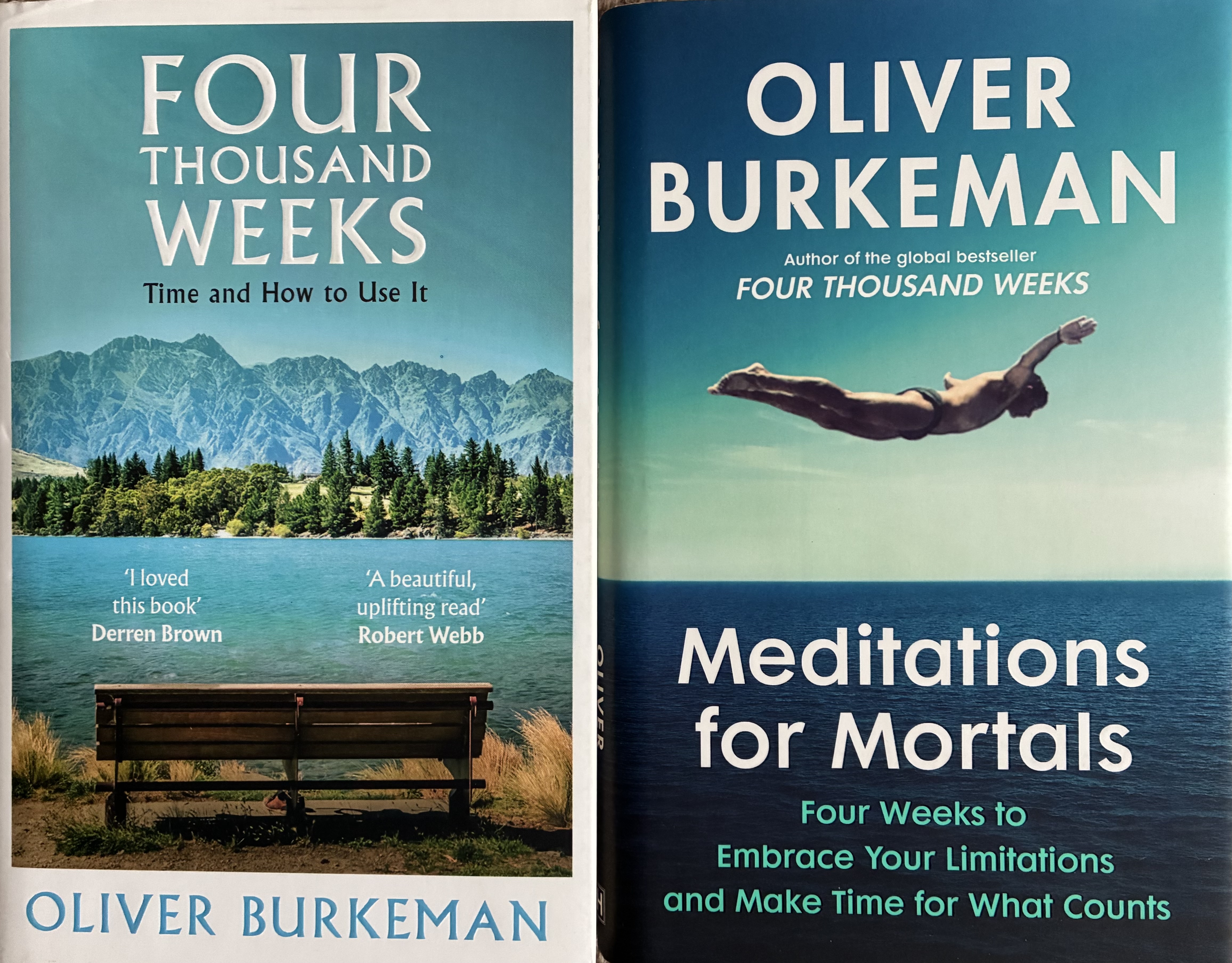
I’d better come straight out with it… I’m a huge fan of Oliver Burkeman’s writings, dating back to the days when he was a regular contributor to The Guardian newspaper with a column delving into productivity-related topics. I read his first book, The Antidote (subtitle: ‘happiness for people who can’t stand positive thinking’), back in 2015, and a few years ago I was lucky enough to attend a couple of fascinating online workshops that he led coinciding with the launch Four Thousand Weeks (FTW), the first of his two more-recent books that are my focus here. FTW was a book that really thrust Burkeman into the limelight, and I don’t think it is going too far to describe him as one of the most respected and influential voices in present-day discourse about the complex relationship with all seem to have with time.
Burkeman often describes himself as a ‘recovering productivity addict’, i.e. someone who in a previous phase of life had a voracious appetite for all of the latest productivity hacks and time management systems. This is a moniker that I could certainly apply to myself (especially as it is ‘recovering’ not ‘recovered’!), and so it’s no surprise that whenever I read anything written by Burkeman, or hear him speaking in an interview, I have an overwhelming feeling that he is peering directly inside my skull and is able to see and comprehend the inner workings of my brain!
Four Thousand Weeks was published in 2021, and I first read it pretty much as soon as I could get my hands on a copy, within a few weeks of the publication date. I found it so interesting and thought-provoking, that my initial reading was followed up just a few months later with another run-through the material, as I listened to Burkeman himself narrate the audiobook version. The basic premise of the book is that a typical human lifespan amounts to ~4000 weeks, and that recognising, and indeed embracing, this finite nature of life (it’s finitude), and thus appreciating that you simply cannot do all of the things you might feel that you should, or want to, do, is the secret to leading a sustainable, meaningful life (or at least a slightly less-frustrating and stressful one).
Burkeman’s most recent book, Meditations for Mortals (MFM), arrived on the scene in September 2024. Again, I read it almost immediately, having pre-ordered it as soon as it was possible to do so. MFM has a neat structure of 28 short chapters arranged into four sections, and is designed to be read one chapter per day over a period of four weeks. In this way, it forms a kind of manual that guides the reader through an exploration of many of the ideas introduced in FTW. After my first reading of MFM, I remember thinking that it would almost certainly be a good idea for me to re-read it on a fairly regular basis, perhaps annually, like a top-up dose of medicine for the mind.
I returned to FTW, and read it for a third time, in June 2025 when it was chosen as the monthly read for The TimeCrafting Trust Book Club that I participate in. That re-reading spurred me to listen to the audiobook version of MFM the following month. My feeling is that whilst FTW works pretty well as an audiobook, MFM is better consumed in physical form. In fact, I’m coming to the conclusion that most works of non-fiction don’t really work that well as audiobooks if you have any real hope of holding onto any nuggets of information or wisdom from them.
In the last year or so I’ve been making a particular effort to write notes and clip passages from the non-fiction books that I read. Sadly, I’m not really very good at doing this. Whilst I am well aware that book notes are of most value when they are a synthesis or personal summary of the material that is covered, I find that kind of note-making very difficult, and so my notes tend to be verbatim copies of phrases and passages that resonate with me in some way. I’d love to be able to write something more considered as I read, but I feel that to do so would take far too much time (that I think I don’t have), and require a lot of patience (that I am pretty sure I don’t have). [Here I find myself putting on my academic tutor voice to remind myself that ‘too much’ is a value judgement statement, and that the value that I get out of the time I choose to put into note-making is clearly directly influenced by my choice of how much time to put into the activity: small time in = probable low value, large time in = potential high value.]
Anyway, it probably won’t be a surprise for me to report that the notes that emerged from my most recent readings of FTW and MFM are extensive… This leaves me with a difficult decision to make in relation to how I go about writing the rest of this blog post. In fact, the need to make that decision is one reason why my blog post writing activity stalled in recent months, and it’s also why I am only now making significant progress writing this post having started it several days ago. What I probably ought to do is to review all of my notes, and synthesise them into a coherent whole that I can summarise in three or four nice, neat paragraphs. But, dear reader (if you exist!), I fear that to approach things that way will just result in yet more delay. [Again, I hear the academic tutor voice in my head telling me sternly that the job of a writer is to make things easy for the reader…]. Consequently, I’m not going to do that… Instead, there are, below, (mostly) a series of short passages taken directly from the text of one or other of the books, with a brief comment or response from me, a little bit like a conversation of sorts…
Four Thousand Weeks
OB: ‘it’s painful to confront how limited your time is, because it means that tough choices are inevitable and that you won’t have time for all you once dreamed you might do‘ (p30) TOH: Well yes, that’s exactly the problem – there are so many things I want to achieve and so little time to achieve them..
OB: ‘Or we procrastinate, which is another means of maintaining the feeling of omnipotent control over life – because you needn’t risk the upsetting experience of failing at an intimidating project, obviously, if you never start it.‘ (p30) TOH: I certainly don’t need much persuading that my chronic procrastination is a result of the fear that what I produce might not be enough to prove that I am as special as my upbringing steered me to believe that I am supposed to be.
OB: ‘You have to choose a few things, sacrifice everything else, and deal with the inevitable sense of loss that results.‘ (p55) TOH: I know, I know, but it’s just so hard for me to let go of things. (although I guess I let go of them anyway, because I procrastinate so much that they never get done…)
OB: ‘Perhaps the most appealing way to resist the truth about your finite time is to initiate a large number of projects at once; that way, you get to feel as though you’re keeping plenty of irons in the fire and making progress on all fronts. Instead, what usually ends up happening is that you make progress on no fronts – because each time a project starts to feel difficult, or frightening, or boring, you can bounce off to a different one instead.‘ (p75) TOH: Exactly. That is absolutely what I do and have always done. I get so far with something, it gets a bit tricky, and so I move on to something else, with the result that I am constantly frustrated with myself for not finishing things. I think that because I was pretty good at most things at school, it was easy for me to make these switches, and so I never fully developed the skill of pushing through when things got difficult.
OB: ‘whenever we succumb to distraction, we’re attempting to flee a painful encounter with our finitude‘ (p105) TOH: I’ve seen this referred to as ‘comfortable-familiar-easy-life-syndrome’. And then you die of course.
OB: ‘The most effective way to sap distraction of its power is just to stop expecting things to be otherwise – to accept that this unpleasantness is simply what it feels like for finite humans to commit ourselves to the kinds of demanding and valuable tasks that force us to confront our limited control over how our lives unfold.‘ TOH: Didn’t someone (Susan Jeffers) write a book once about this? ‘Feel the Fear and Do It Anyway’…
OB: ‘Other people hold off entirely from starting on important projects or embarking on intimate relationships in the first place because they can’t bear the anxiety of having committed themselves to something that might or might not work out happily in practice.‘ (p215) TOH: Indeed, and especially when, like me, your sense of self-worth is almost entirely focused on demonstrating ‘specialness’.
OB: ‘Because now is all you ever get‘ (p219) TOH: Okay, okay, you don’t have to rub it in.
OB: ‘taking on too many projects at once [is a way] of trying to maintain the illusion that you’re in charge of things‘ (p220) TOH: Some years ago, a colleague suggested to me that my difficulties stemmed from a need to be in control. At the time, I couldn’t square this idea in my head at all – I’ve never thought of myself as a control-freak – but over the last few years I have come to realise that yes, I’m very much constantly striving to feel some semblance of control over things/my life.
OB: ‘Let your impossible standards crash to the ground‘ (p222) TOH: Far better to finish something and get it ‘out there’ than never finish is at all (or never even start it for that matter).
OB: ‘If you can face the truth about time in this way – if you can step more fully into the condition of being a limited human – you will reach the greatest heights of productivity, accomplishment, service and fulfilment that were ever in the cards for you to begin with. And the life you will see incrementally taking shape, in the rear-view mirror, will be one that meets the only definitive measure of what it means to have used your weeks well: not how many people you helped, or how much you got done; but what working within the limits of your moment in history and you finite time and talents, you actually got round to doing – and made life more luminous for the rest of us by doing – whatever magnificent task or weird little thing it was that you came here for.‘ (p228) TOH: ‘what… you actually got round to doing’ [sigh]
OB: ‘The average human lifespan is absurdly, terrifyingly, insultingly short. But that isn’t a reason for unremitting despair, or for living in an anxiety-fuelled panic about making the most of your limited time. It’s a cause for relief. You get to give up on something that was always impossible – the quest to become the optimised, infinitely capable, emotionally invincible, fully independent person you’re officially supposed to be. Then you get to roll up your sleeves and start work on what’s gloriously possible instead.‘ (p234) TOH: Okay, you’ve convinced me. I’ll make a really good plan of action and have a careful think about when the best time to get started on it will be… 😉
Meditations for Mortals
OB: ‘‘insecure overachievers’… our accomplishments, impressive as they may sometimes be, are driven ultimately by feelings of inadequacy‘ (p21) TOH: it’s strive, strive, strive to be special
OB: ‘perhaps you’ve tethered your self-esteem to the most crazy-making standard of all “realising your potential” – which means you’ll never get to rest, because how can you ever be sure there’s not a little more potential left to realise?‘ (p21) TOH: Well someone will tell me won’t they? Won’t they?
OB: ‘What is worry, at its core, but the activity of a mind attempting to picture every single bridge that might possibly have to be crossed in future, then trying to figure out how to cross it.‘ (p39) TOH: Have you read my poem? What If? So What?
OB: ‘What the novelist E.L. Doctorow said about novel-writing applies to everything else, too: it’s “like driving a car at night. You never see further than your headlights, but you can make the whole trip that way”.‘ (p48) TOH: But that means being brave enough to embrace uncertainty… Perhaps I need to read my poem What If? So What? again!
OB: refers to an analogy from the book TimeSurfing by Paul Loomans, a Dutch Zen monk, in which tasks or areas of life that you are avoid are referred to as ‘gnawing rats’ and the suggestion is that rather than fearing them or feeling like you should fight them it is better to befriend then. He uses the example of sorting out your shed – the advice is simply to go and stand in the shed and just observe and take stock. Solutions will start to present themselves and some small actions may be taken. (p58) TOH: I refer to these kinds of things as ‘bad smell tasks’ – the ones that seem to hang around on your to-do list for ever.
OB: describes the value of aiming to complete an activity ‘Dailyish’ rather than setting an unattainable ideal of completing it every single day TOH: This is very much something that I have tried to embrace, since being introduced to the idea.
OB: ‘Beyond the mountains, there are always more mountains, at least until you reach the final mountain before your time on earth comes to an end. In the meantime, few things are more exhilarating than mountaineering.‘ (p78 TOH: It’s all about the journey and not the destination as they say, or the difference between atelic and telic activities (or adopting an atelic versus a telic mindset to how you complete activities), as Keiran Setiya sets out wonderfully well in his book Midlife.
OB: ‘… if you see all of this [everyday life] as leading up to some future point when real life will begin, or when you can finally start enjoying yourself, of feeling good about yourself – then you’ll end up treating your actual life as something to ‘get through’ until one day it’ll be over, without the meaningful part ever having arrived.‘ (p122) TOH: I can distinctly remember that when I was younger, I often wished that I was, say, ten years further on in life, which in my head was a time when I had ‘arrived’ and everything was as it should be. Life doesn’t work like that of course.
OB: ‘To treat life as a pilgrimage to a future and better existence is to disown its present value’ (W. Somerset Maugham)‘ (p127) TOH: Beautifully put, but also devastatingly damning! Perhaps it’s time to make a start on something… 😉
Quartet No.1 in C Major I. Exceptional (maestoso ridicolo) II. Growing (allegro vivamente) III. Discovering (allegro con abbandono) IV. Fearful (moderato sostenuto)
Quartet No. 2 in E Major I. Interested (scherzo giocoso) II. Hopeful (andante sognando) III. Exploring (allegro impetuoso) IV. Indecisive (adagietto dissonante)
Quartet No. 3 in A flat minor I. Struggling (largamente melancolico) II. Puzzled (andante misterioso) III. Frustrated (allegro incalzando) IV. Trying (allegro spiritoso)
Quartet No. 4 in D sharp minor I. Disappointed (andante con dolore) II. Angry (allegro furioso) III. Overwhelmed (andate lacrimoso) IV. Capitulated (largo perdendosi)
(c) Tim O’Hare, January 2024
About this poem: Over the last couple of days I have felt a growing sense of inner doom and then today I woke to find myself the recipient of another visit from The Hollow Man. The result was that despite having a mountain of work things to do I found myself stealing time to construct this poem. It started out as a list of words chosen to express something of the way I was seeing different stages of my life and then as these settled naturally into four groups of four I could not resist the reference to T.S. Eliot and the idea of representing the list as a set of musical works complete with accompanying musical terms for tempo and associated emotion. Perhaps it is all a little dark and almost certainly it is a lot contrived but writing this poem seems to have done its job and I can now start to move on again.
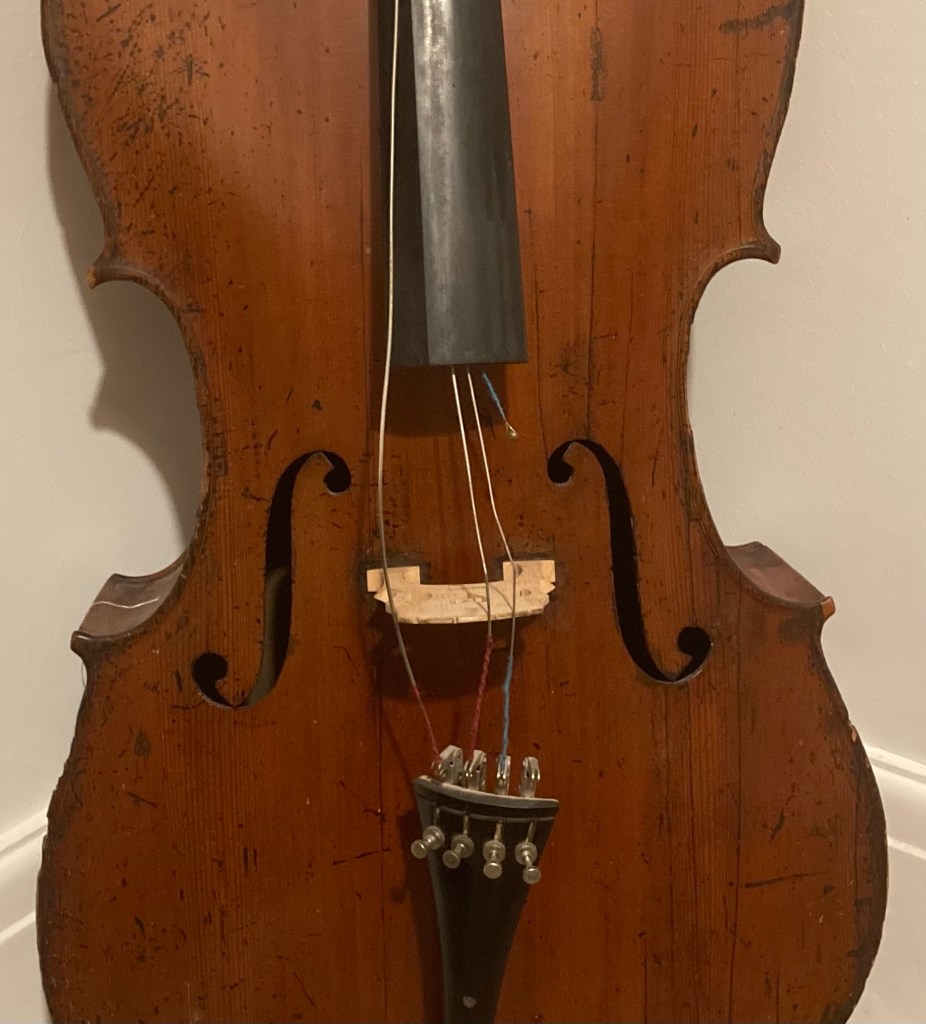
[The photo shows my ‘cello which suffered a broken tail gut leading to its bridge and sound post (internal) collapsing, shortly before the poem was written. It felt like an appropriate accompaniment to the poem…]
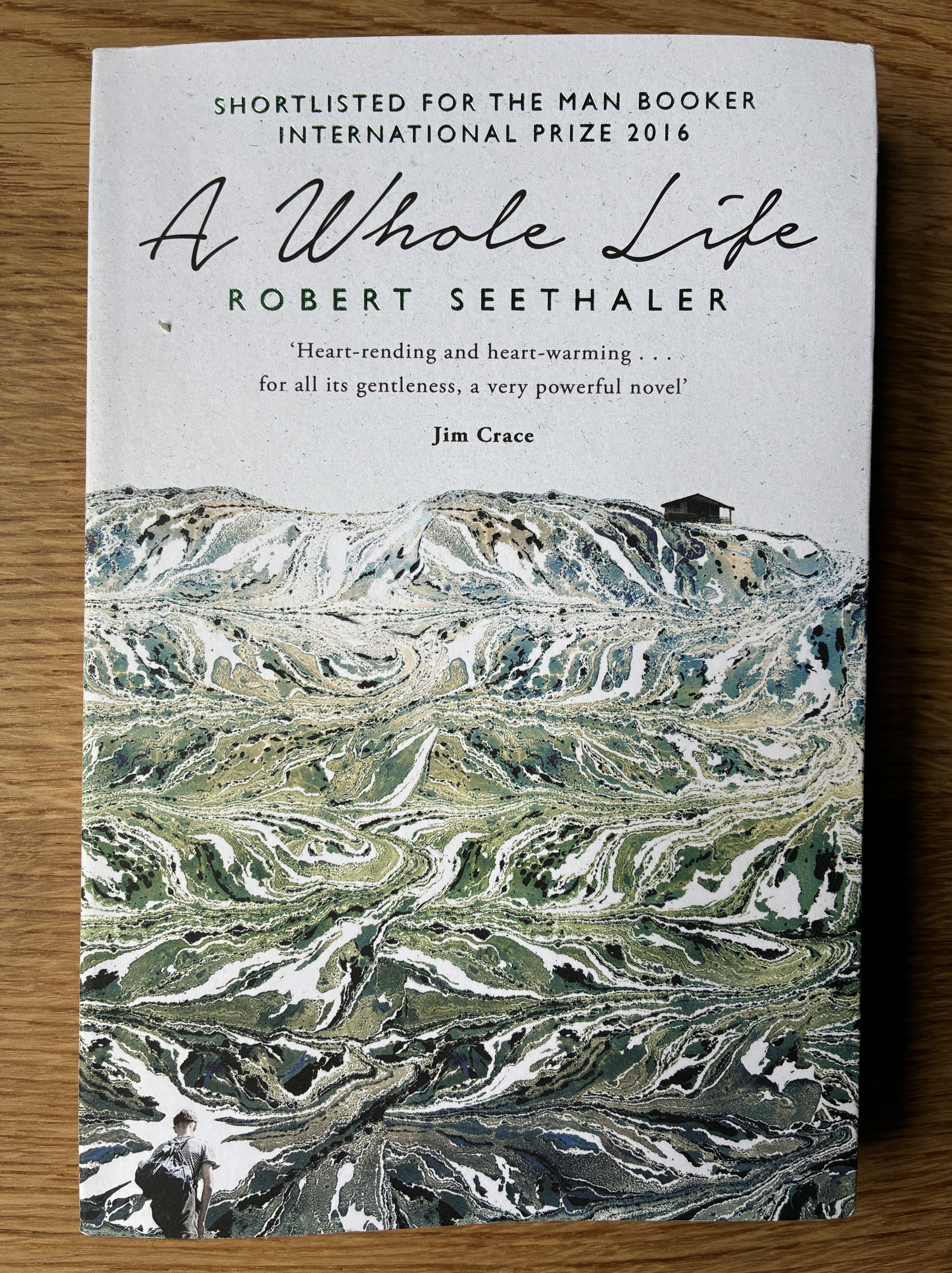
I read Robert Seethaler’s novel A Whole Life last summer, after it was recommended to me by a student that I teach (a recommendation that shows a remarkable level of insight from someone who doesn’t really know me or much about my life at all). Published in 2015, and shortlisted for the Man Booker Prize in 2016, A Whole Life is, on the face of it, a simple story, recounting the life of Andreas Egger – a life that plays out almost entirely in a single valley in the Austrian Alps. It’s one of those stories within which nothing much happens and yet, in a strange way, everything happens; and everything that does happen has a significance and depth that gets right the heart of what it is to live.
Andreas Egger is born between the two world wars and arriving in the valley as a young boy is taken in by a farming family. Somewhat surprisingly, given his rather gruff and lone manner, he falls in love and marries, but the promise of a happy life shattered by when an avalanche strikes his home. He leaves to fight in the Second World War, is taken prisoner and eventually returns home only to find that a rush of development has spread its tentacles into the remote terrain of his world. He does what he needs to do, and works as an engineer building and maintaining the cable cars that have come to the area as skiing begins to grow into the modern tourism industry it is today.
Egger’s life has moments of brightness, or perhaps it is better to say that it promises moments of brightness, but the overall tone of the book is somewhat bleak and foreboding from the outset. Egger makes it through to the ripe old age of almost eighty, but throughout his life it is clear that he is always an outsider, never really integrated into the close community, never fully adjusting to the ever-changing world around him, and never being able to fully experience the loving relationships that at one point seemed to lie ahead for him.
I really enjoyed reading A Whole Life. Seethaler’s writing is precise and unfussy and through his words, it felt like an honour that Egger was sharing his existence, his whole life, with me. There were a couple of passages that stood out for me, to the extent that I grabbed hold of them as I read. The first (page 112 in my edition) captures something of Egger’s quiet, contemplative quality:
Egger didn’t usually speak on his walk. ‘When someone opens their mouth they close their ears,’ Thomas Mattl had always said, and Egger was of the same opinion.
and the second nicely illustrates the kind of philosophy that Egger absorbed by keeping his mouth shut and his ears open, in this case from a fellow inmate in a Russian prison camp:
If you’re on the way to Hell, he’d say, you have to laugh with the devils: it costs nothing, and makes the whole thing more bearable.
I don’t think it would be a bad thing to embrace some of Egger’s calm, just-get-on-with-it, approach to life. And whether I’m on the way to Hell, Heaven, or (more likely) somewhere in between, it surely does make sense to laugh with whoever you are travelling alongside.
Last year, despite not really knowing why (i.e. who I was writing for other than for myself) I decided to make a concerted effort to get into the habit of writing posts for this website on a reasonably frequent basis. By reasonably frequent I was hoping to add three or four entries each week or, to borrow a phrase from the writer Oliver Burkeman, dailyish.
After a fairly slow start (four new entries in January 2025), I picked up momentum and went on to add eight in February, twelve in March, thirteen in April, seven in May, eleven in June, eight in July, and another eight August. Okay, I wasn’t hitting an average of three or four entries per week, but with five separate weeks during which I wrote no entries at all (in January, February, March, April and July) and a five week hiatus with zero entries between mid-May and mid-June, I had managed to write 71 entries in the 23 weeks in which I did produce some new words, giving me an average of just over three entries per week in those ‘productive’ weeks.
During this time period, my blog posts were split between six categories – 24 relating to my Art, 24 about books that I had read, 18 that featured my poems (transferring these across from my poetry website andapoet.blog), five about my writing, three that I described as ‘Wisdom’ and a couple that were ‘Miscellaneous’.
I was generally pleased with how I was doing, and the progress I was making. I had generated a list of topics for future posts – about the art I created, the books I had read, poems I had to add to the site, snippets about my writing, walks that I could describe etc. – which gave me no shortage of future material. Having this list ought to have been positive, indeed it was positive during the first eight months of the year. My progress continued into September, as I added another five entries in the first twelve days of the month. But then I stopped writing completely, my last entry being on 12th September 2025, some 279 days ago… a long time… over three-quarters of a year…
What changed? Did I just get bored? Did I get distracted? Did I decide that since pretty much no-one reads what I write here there simply wasn’t any point in my continuing? It’s possible that the latter was a contributing factor. It’s certainly one that has led me to question my blog writing activity before (for example see Habits, Daily Blogging… Is This The End? ), but no, those answers are not the answer…
My blog writing activity died off because I innocently did the one thing that is pretty much guaranteed to stop me doing any activity I am engaged in, or want to be engaged in. I turned a thing into a THING. This is something that I have written about on this website before, back in 2018 in fact – see: Turning Things Into THINGS. It is one of the primary ways that I sabotage my own desire to tackle an activity. Turning a thing into a THING involves taking what could be a simple, interesting, enjoyable activity, and ambitiously growing it in my mind by adding extra elements (‘bells-and-whistles’) so that it becomes a huge, enormously complicated, and/or daunting challenge that my brain then looks at and says “no thank you very much – that looks like a project that is far too difficult, and potentially painful, for me to take on”.
In the case of this blog, turning a thing into a THING took the following form. In early September 2025 I sat down, looked at my carefully curated and categorised list of potential blog post topics and decided that it would be really great to accelerate my writing so that I was fully ‘caught up’ by the end of November 2025. This was a 10 week period and I had 61 possible blog post topics on my list (many about books that I had read during the previous few months). 61 posts in 10 weeks? ~6 posts per week? That’s only one per day, with a day spare each week… sounds perfectly doable doesn’t it?
Well no, it doesn’t, or at least it shouldn’t have, but what did my brain have to say about the idea? I can tell you. In a journal entry that I wrote on Saturday 13th September I wrote the words ‘… it’s a good plan and I can try to get into a good discipline of writing daily posts on weekdays and adding one or two at the weekends if I can or if I have missed weekday posts‘. It all sounds so simple… [I’ll also note here that my had a multi-week sequence that rotated through the different categories of the possible posts in such a way that they were all nicely spread out through the entire period. If that sounds a bit over-the-top then temember, my plan wasn’t a ‘thing’, it was a ‘THING’.]
If I had set my stall out to simply to carry on writing the odd blog post when I had the chance – perhaps two or three in a good week – then it would have been an activity, a thing, that would have stood a decent chance of getting done. Instead, I turned the thing into a THING and, in the process, killed the activity entirely. To make matters worse, not only have I added nothing to this site for the best part of nine months, but during those months I have frequently berated myself for, and felt disappointed with, my lack of action. I killed off an activity I enjoyed, and I gave myself a new stick to beat myself with. Bravo!
On countless occasions over the last few months I have thought about how I might get back to writing for this blog. Mostly, my thoughts have revolved around trying to come up with new ways that I can somehow, magically, catch up with my post backlog. You see, the perfectionist/completist/collector in me hates the idea that I might not write an entry for every book that I have read, every piece of artwork I produce etc. It quickly rules out the simplest approach, which is to just start adding entries again relating to what I am up to at the moment. An incomplete sequence? A gap? No, no, NO… you cannot possibly have a gap.
But I have fought with myself for long enough, and I recognise that the choice is a simple one. I can think that I can somehow catch up and be destined to remain stuck forever (or at least far behind where I’d like to be), or I can just write something and be done with it. And somehow, unusually for me, the second of these options seems, finally, to have come out on top.
So, here I am again, back on the blog. I’d like to think that I will be able to write new posts on a reasonably frequent basis – two or three a week would be great, one or two would be okay – and I’m going to try to allow myself to write a mix of posts, some relating to ‘now things’ and others picking selected topics from the list that I created previously without requiring myself to cover them all, or to ‘catch up’ within any specific time frame or better still, ever.
Will I be successful? Well I’m not even going to try to second guess the answer to that question. To do so will surely only lead to me into making another marvellous plan in an attempt to ensure success, a marvellous plan that will actually, almost certainly, guarantee failure!
You have used me as you wish to have your fun, scrabbling roughly on the pockmarked surface of my skin, climbing high to turn your face towards the sun. You scrape your boots across me to remove accumulated soil, and carving your initials in my surface, give little thought to what you spoil. You have taken from me what you need using iron picks to gouge out fragments, thinking that you caused no pain because you saw no sign I bleed. You turn your eyes towards me and see only solid rock, looking down upon my dumbness, laughing as you mock.
By day, as you approach from the grassy slope below, you start to notice many shapes of things you know. You see an outline that reminds you of a faithful hound, you watch it shift as you move forwards, then it’s gone without a sound. You turn to view a castle, but no soldiers move for they have fled. You move your head to shape a profile – only then you see the witch’s head. You trace out furrowed brow, hooked nose and jutting chin; you feel grey eyes look through you, and you shiver as an evil spell takes hold within.
At night, in your imagination, led by an unheard call, you see me rise up from my station as I yawn and stretch so tall. You hear the distant thunder of my steps as I march the slowest beat. You sense vibrations deep below, the trembling ground beneath my feet. You are frightened of my power, as I tear the earth apart. You are petrified, turned solid, as the terror grips your heart. You are fearful that I come at last to take what I am due. You sense that it is time. And you are terrified that I am hunting, hunting now for you.
But none of this is true, for all that you see, and everything that you imagine, has been shaped by the stories you were told, and what they let you do. Those imagined forms, the wild thoughts, and all the feelings they produce may seem fantastic when compared with what is in your normal view. So, what is the truth? If only you knew…
I was formed from countless tiny pieces that began as dust, mixed together in her bowl, baked by her heat to form a crust. I was once pressed tight together as I found my solid form, extruded by her shuddering contractions, melded in her womb so warm. I have rested for so long as if I have no task, snuggled by her mossy blanket, wrapped protectively within her grasp. I have waited patiently for several million years, cooled by her gentle whispers, washed clean by her falling tears.
For your time is not all time. Your whole existence is the smallest fraction of my life. This place was mine so long before you came, and will remain my home for even longer once you die.
And your space is not all space. Your whole world is like a single speck of the quartz that shines within the substance of my form, just one of countless millions of specks, all of which are mine.
And your thoughts are not all thoughts. Your thoughts are small and they are fleeting, and so they rarely bend. You are constrained by what they choose to tell you. There is so much you cannot comprehend.
And your life is not all life. Your life is short, and it is fast, and so it limits what you try to claim. You cannot grasp the unfamiliar. You are bound by the rules that shape your game.
Believe me, I do not lie. I do not speak to garner fame. For beyond all that you can see, and everything that you imagine, are stories to be told and things to see that far expand your frame. You may think you are the only one who holds within a spark, but that is falsehood as we share that conscious flame. I too am alive, and Rock Giant is my name.
(c) Tim O’Hare, August 2023
ROCK GIANT: The last few walks that we have done have been on the familiar territory of Dartmoor, taking in one or more of the rocky tors that sit atop many of the hill summits. These enormous piles of granite slabs are the remnants of old volcanoes, material pushed upwards from the upper mantle almost 300 million years ago. I find it impossible to visit a tor without seeing the profiles of faces in the shapes made by the great piles of rocks, or imagining that the rocks are the tip of a toe, an elbow or some other part of a huge stone giant asleep beneath the ground. And then, in a natural progression of my thoughts, those rock giants begin to stir. I am not at all sure why, in the poem, I imagined the rock giant as a threat. My instinct is that they are, in fact, very gentle and friendly creatures. But, of course, I will never really know, because they still have much sleeping to do before they awaken.
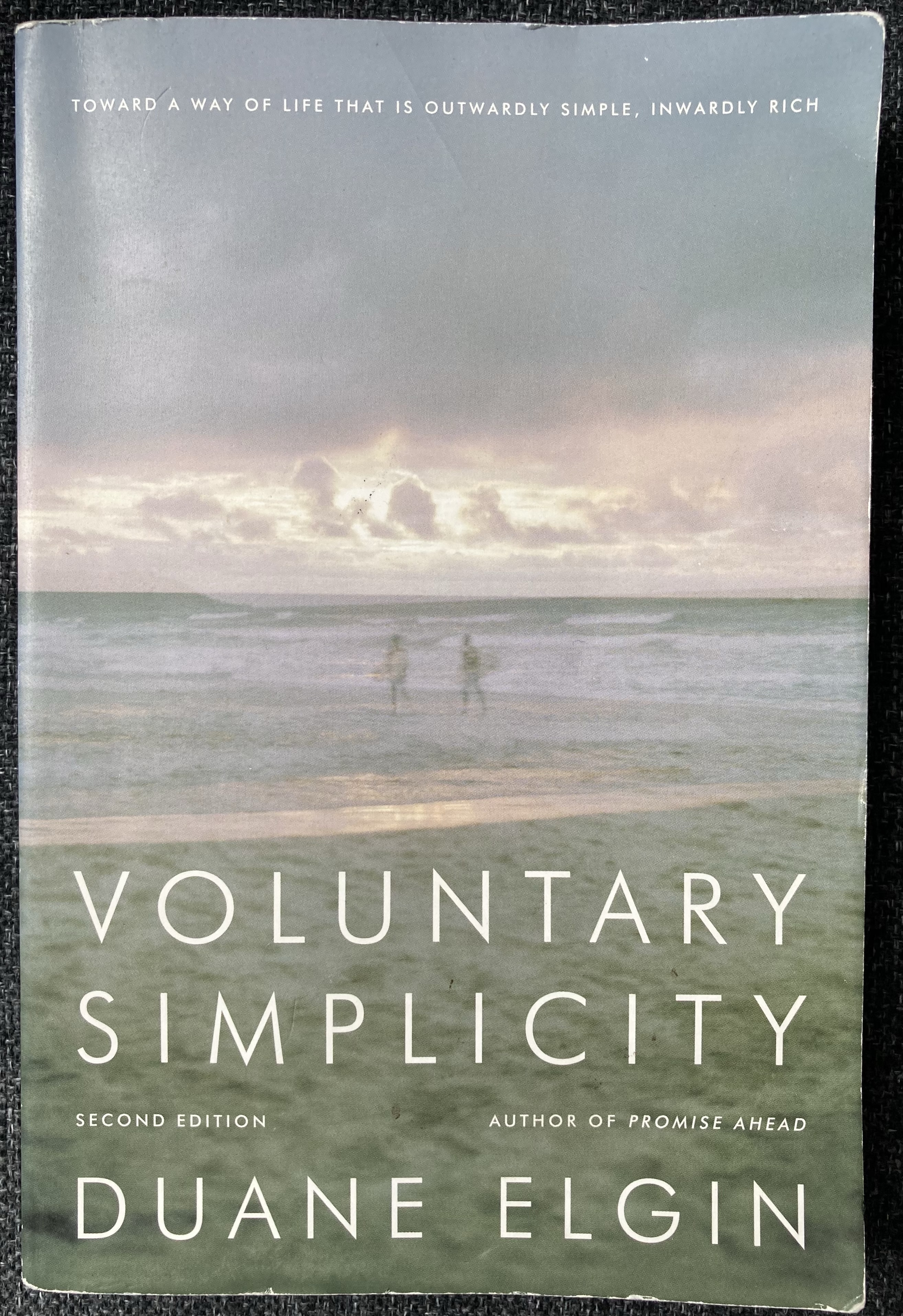
Voluntary Simplicity by Duane Elgin was the March 2025 choice for the TimeCrafting Trust Book Club that I am a member of. I think it’s fair to say that it is unlikely that I would have read it otherwise, although the ideas that it covers – Simplicity and to a lesser extent Minimalism – are certainly ones that I am interested in.
Elgin bases large chunks of the text on a survey he was involved with several decades ago (the first edition of Voluntary Simplicity was published in 1981) which probed the motivations and thinking of many individuals, from many different countries and walks of life, who had opted to simplify their lives. He is at pains to point out the most common perceptions of those who choose to live a ‘simpler life’ – that they tend to be anti-technology, anti-innovation and backward looking – are not generally correct, and that living simply does not have to mean living in poverty, in a rural and/or plain environment, nor does it necessarily result in economic stagnation. In fact, Elgin makes the case that the ever increasing number of people who are choosing to live with simplicity are doing so because it provides a path to greater satisfaction with life, with a deeper connection to the entire world around us.
As the book proceeds, it becomes more and more focused on the necessity that we live more simply in order to survive on the planet as population growth continues, climate changes ever more significantly and obviously, and natural resources are depleted. And, of course, the need for solutions and responses to the challenges that Elgin describes has become significantly more pressing in the years since the book was first released. But Elgin does not get all of his future-visioning right. He places great emphasis on the potential for television to be the vehicle through which positive messages about simplicity can be delivered and is rather dismissive of the potential for new technologies to invade this space. Nevertheless, Elgin’s arguments do mostly stand up to scrutiny.
I felt that Voluntary Simplicity was an ‘okay’ read, although I am sure that there are better, and more up-to-date, books on this topic. I don’t think that it is surprising that prior to reading the announcement that Voluntary Simplicity had been picked as a Book Club book I had ever heard of it or, indeed, of Duane Elgin himself. However, I did my reading did lead me to four quotes that I really liked. The first, comes from one of my favourite sources, the “quote-factory” commonly referred to as Henry David Thoreau. It has perhaps a rather depressing tone – ‘life is frittered away’ – but I think this is what lends it the power to motivate change:
“Our life is frittered away by detail… Simplify, simplify.“
I also really liked Elgin’s own take on the power of simplicity, namely that:
“Simplicity is the razor’s edge that cuts through the trivial and finds the essential.“
and I enjoyed his statement that:
“Our bodies are biodegradable vehicles for acquiring soul-growing experiences.“
‘Biodegradable vehicles for acquiring soul-growing experiences’ – I mean that really is life in a nutshell isn’t it?
Best of all, I think as a result of its own simplicity and the rhythm of the language used, is an adage that Elgin attributes to the New England Puritans:
“Use it up, wear it out, make do, or do without.“
That’s not a bad maxim to try to live by, at least to some extent.
Does it matter what they’re thinking? Does it matter what they think of what I say? Does it matter if I do what they’re expecting? Does it matter if I do it anyway?
Does it matter if I play the game they choose? Does it matter if they think that I’m a fool? Does it matter if I win or if I lose? Does it matter if I play by different rules?
Does it matter if I do it when I should do? Does it matter if I go at my own pace? Does it matter if I keep myself beside you? Does it matter if I run a different race?
Does it matter if I wear a different colour? Does it matter if I my hair’s a little long? Does it matter if I like things to be quieter? Does it matter if I break out into song?
Does it matter if I go across the bridge? Does it matter if I’m in a different land? Does it matter if I speak a different language? Does it matter if I’m hard to understand?
Does it matter if I go to different places? Does it matter if I seem a little weird? Does it matter if I once wore rainbow laces? Does it matter if I’m nothing to be feared?
Does it matter what they’re thinking? Does it matter what they think of what I say? Does it matter if I do what they’re expecting? I think I’ll do it anyway.
(c) Tim O’Hare, June 2023
About this poem: I had read an article about Rejection Sensitive Dysphoria and how this can lead to ‘people pleasing’ behaviour, something that I tend to adopt strongly. ‘Does It Matter?’ tries to capture aspects of the internal struggle that works its way through my head on a near continuous basis and also provides a form of written antidote that reminds me that I do not have to do what I think is expected of me or behave in the ways that I think I am expected to behave or only do things once I have received some form of external confirmation that they are worthwhile or valid things to do.
This was the second poem I wrote, back in early summer 2023. It’s been clear since then that writing and publishing my poems has helped me to become much less dependent on receiving external validation for my work and much happier to just put stuff out there and see what happens (even if that turns out to be nothing very much!). I think this poem expressed something that I always knew inside but was perhaps a little fearful to recognize.
Is it time to slough it off, that rough, tough, protective skin, that hide for unseen treasures deep within.
He had not felt it grow, but grow it had for many years, thickening the defensive wall, blurring eyes and muffling ears.
So early it had started, so slowly it had grown, he’d noticed not the tightening as it closed around his bones, holding him together safe and sound or so it seemed, whilst locking him away to form a shield for self-esteem.
But he had heard the screams and he had seen the flashes of the inner rage and he had felt the punches as they slammed against the cage, only recognising who they came from when witnessed in his broken dreams.
Years passed and then worn thin by constant wear the first crack had appeared, at last revealing what it was and how the dangers it held fast against were nothing to be feared.
So, slough it off, that rough, tough defensive skin, and let new life begin. Slough it off, that mask of false protection and let us see at last what treasures lie within.
(c) Tim O’Hare, June 2023
About this poem: After a coaching session at work talking through some of the challenges I face as a result of my ADHD-traits and the difficulty I find in allowing myself to be the way that I want to be rather than the way that I think I ought to be I was struck by the thought that I needed to let go of the protective behaviours and attitudes I had unknowingly constructed for myself over the years and, in the process, allow my authentic self to emerge. The image that came to mind was of a reptile shedding its skin and for some reason the phrase ‘slough it off’ popped into my head in association with this image. I quickly became rather fond of the word ‘slough’ and then, for the first time ever in my life really and without any warning or deliberate effort, I started to write a poem. ‘Metamorphosis’ is the first evidence that having sloughed off my metaphorical protective skin there was something different and unexpected lurking within!
Note: I have previously posted all of my poetry in a separate website: http://andapoet.blog but I have decided that I will gradually migrate all of that content to this site.
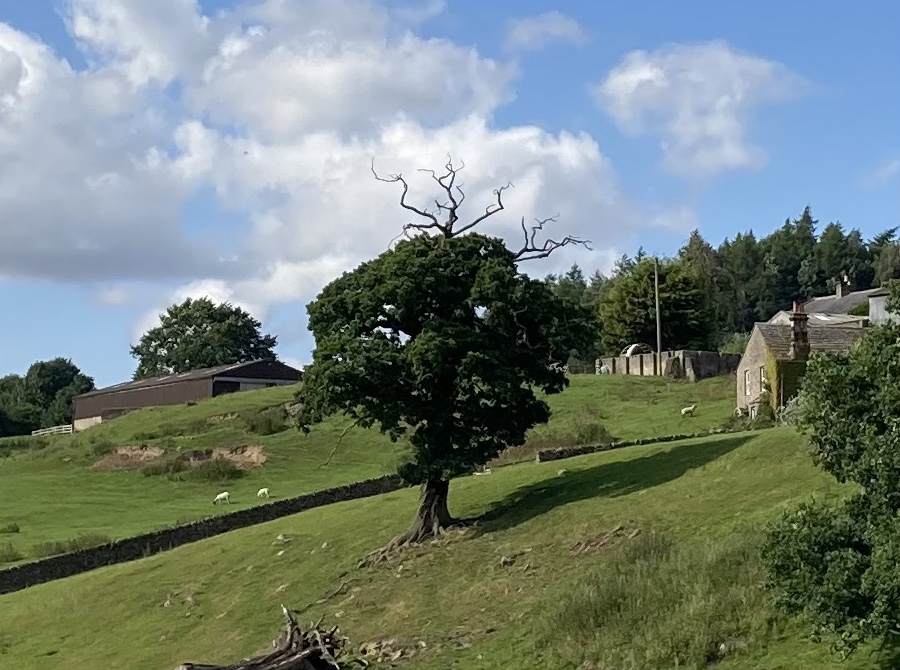
I think it is hard to beat an interesting tree – sometimes it is the shape that speaks to me, sometimes the colours and sometimes it’s the the signs of a hard life lived. So, you can perhaps imagine my excitement when I spotted this particular tree with its strong, thick trunk and its beautifully rounded and perfectly balanced shape all thickly enveloped by deep green leaves, so full of life… and yet, running upwards through its core, emerging to thrust like inverted lightning flashes from its top (and less visible in the photograph, a withered tendril reaching downwards on the left side), the sharp, angular, stripped-bare branches, absolutely dead to the world. This is a tree that is both dead at the core and alive at heart and I have never seen its like before.