
Suffolk Holiday August 2025 #art

Back in April 2025 we spent a week in rural Suffolk, our third visit to the county in three years. Our first trip there, in summer 2023, was something of an accident. We had booked accommodation for a week in Horning in the Norfolk Broads, but almost instantly recognised that it wasn’t a place we wanted to spend a week (too many ‘Private’ signs, too little access to the edges of the waterways, too many noisy ‘party’ boats cruising around, and so many people boozing their time away). As a result, after two less-than-great days, we decided to look online for somewhere different that we could stay that was not too expensive and not too far away for the rest of the week. After a bit of deliberation about the sunk cost of an aborted trip, we headed south to the small village of Redgrave, just on the Suffolk side of the Suffolk-Norfolk border. At the time, Suffolk was a county I had never visited before, and of which I had no great expectations, but within minutes of arriving there I felt settled and relaxed, able to enjoy walks and runs from the doorstep in the marvellous farmland countryside of the surrounding area. We enjoyed our stay so much that we returned to the same accommodation for an Easter holiday break the following year, but for our third visit, in 2025, we were forced to move to a different location. [I should note here that trips all the way over to East Anglia from our home in Plymouth were partly linked to visits to elderly family members in Norwich].

Consequently, in August 2025 we found ourselves staying in another small village, a little to the east of Redgrave and a little deeper into Suffolk. Once again, we enjoyed our stay, although the location wasn’t quite as good, with less options for walks in the immediate vicinity, and no cafe or pub within walking distance. We occupied ourselves with visits to Norwich, and the nearby village of Eye, and walks from Hoxne and Walsham-le-Willows, and we were able to meet up with an old university-friend and his wife for a quick circuit of Framingham Castle. We relaxed, we read, and, of course, I painted…

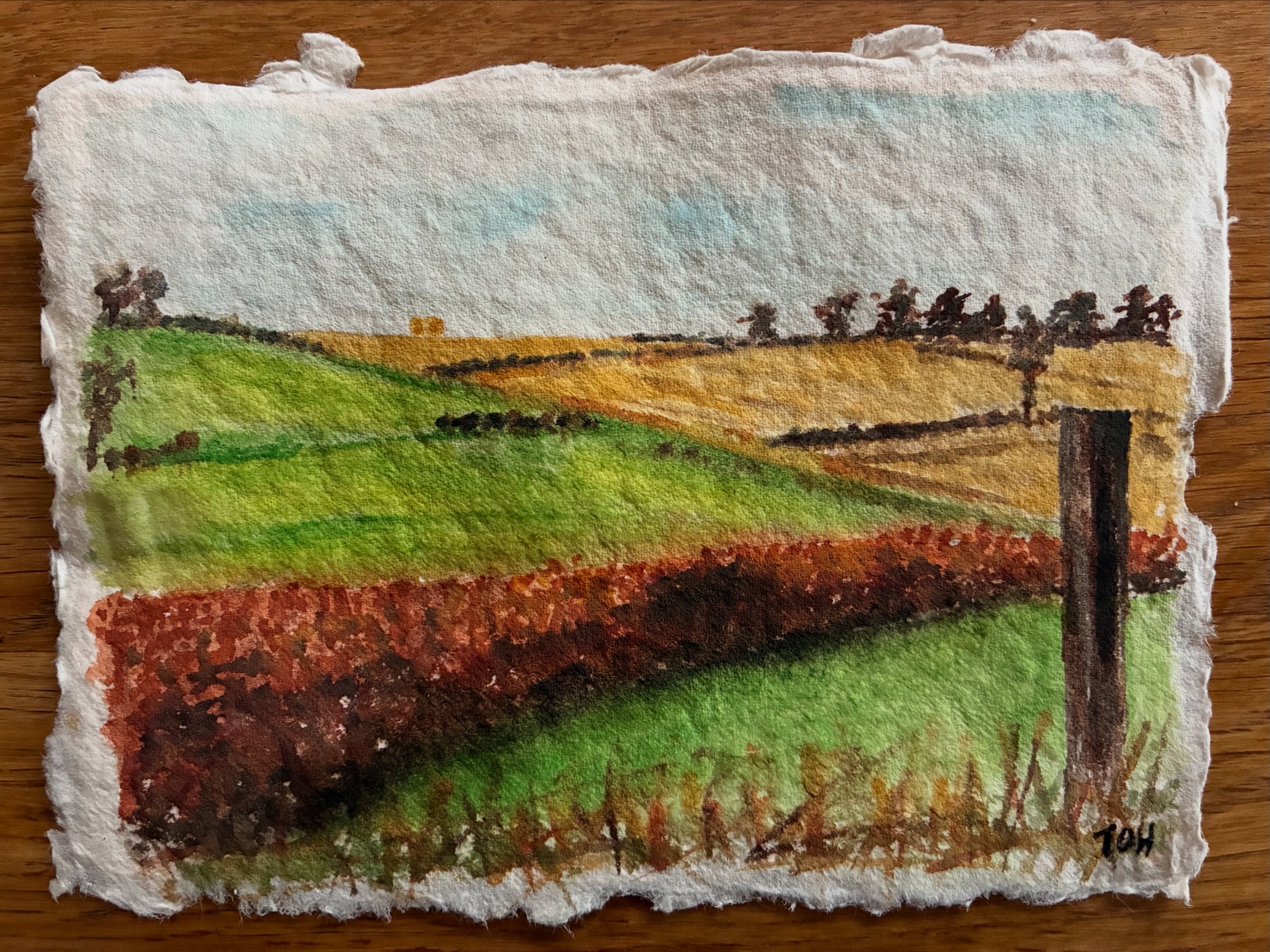
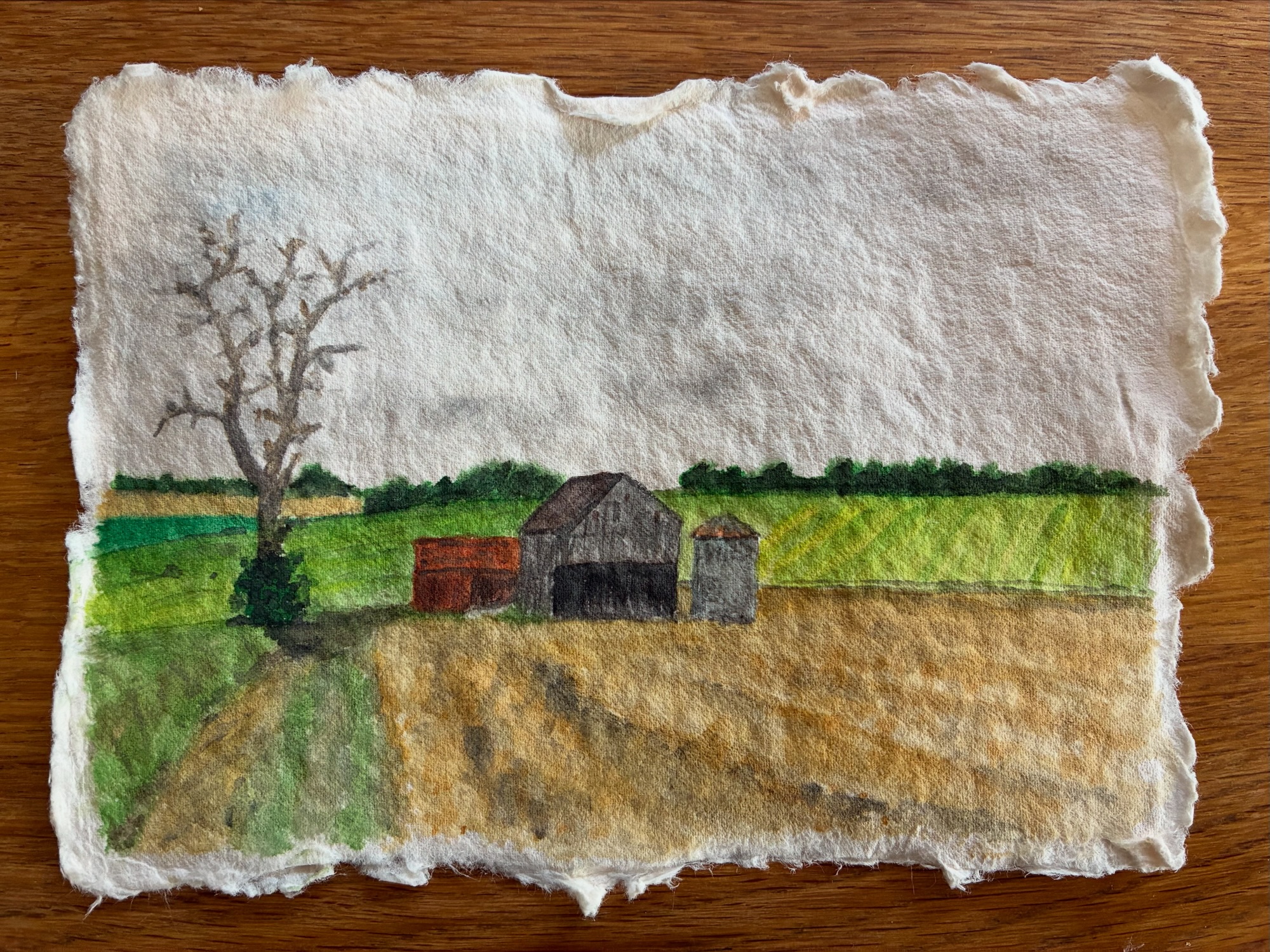
The picture at the top of this post shows a quick, and with hindsight slightly abstract, picture that I painted from a photo I took while walking from Hoxne, showing a typical view of Suffolk fields. The same walk provided the subject for my second painting (below), depicting more fields, a group of farm buildings, and some sharply lined fields. I find that the photos I take quite often feature fields with patterns of lines from ploughing or grass cutting, so it seems that I have a bit of a thing for parallel lines and angles!
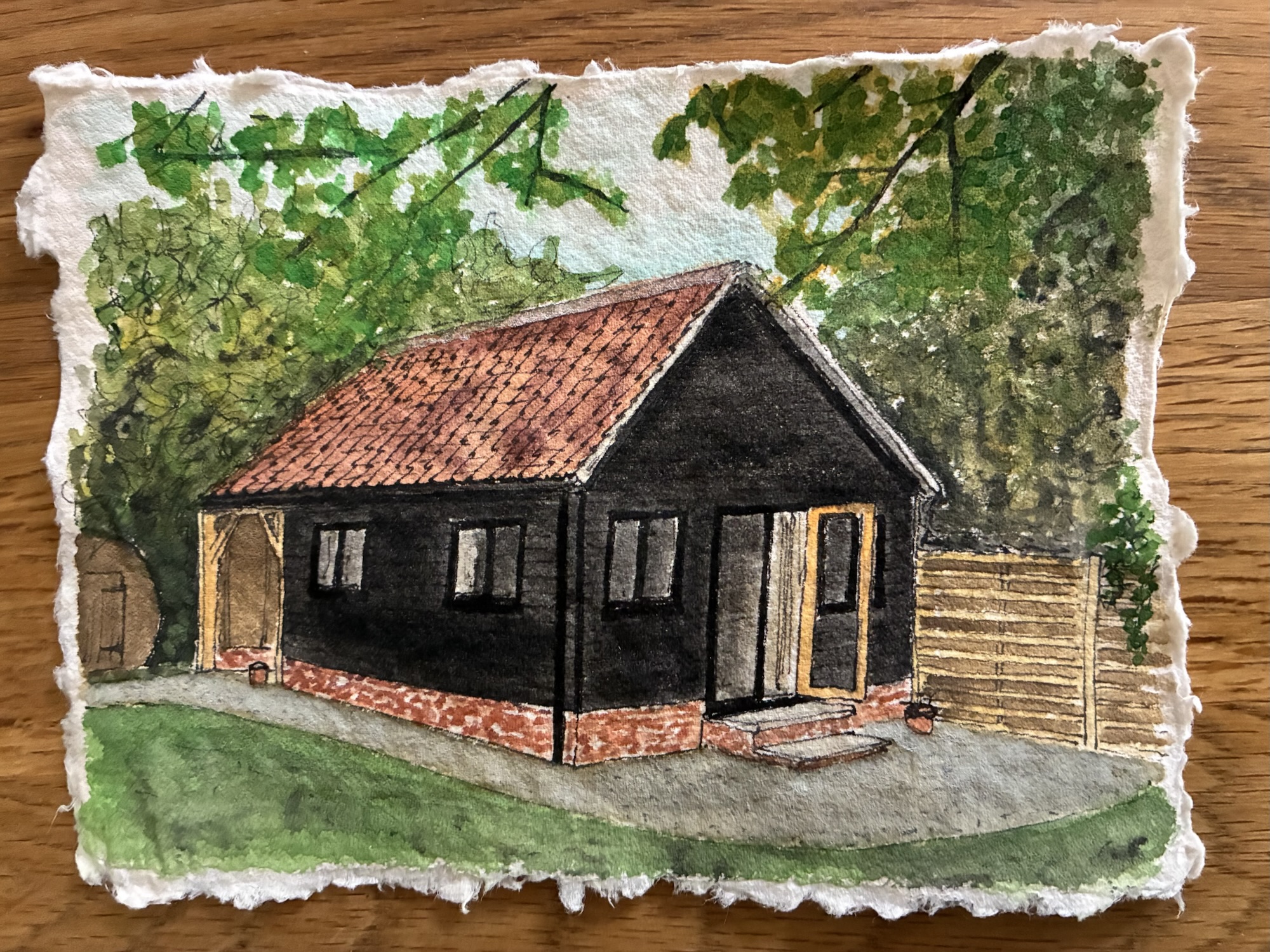
The final picture (below) is of the holiday accommodation that we were staying in. I painted this one to leave behind as a thank you to the owners – a practice that has now become something of a tradition whenever we go away.
We didn’t make it back to Suffolk this year, but we did end up making two trips to Norfolk in April and May. Hopefully, at some point in the not-too-distant future, I’ll share some thoughts about those trips and some of the pictures that I painted on them, as I work my way forwards in time to bring my blog-posting-writing up to the present day.

The Killing Field #poem

This is the killing field –
but the danger does not come to you or me
from the piercing horn of a bull’s rush,
the digoxin punch of a fox’s glove,
or a saliva-damp kiss from a cow’s lip.

This is the killing field –
but the danger does not come to you or me
from the aconitine grip of the wolf’s bane,
the spicular burn from a nettle’s leaf,
or a sudden unexpected stroke of a pony’s tail.

This is the killing field –
and just for once, the danger does not even come
from those who strip the land to build and burn,
who work the soil to plant and grow,
who take whatever they wish to take,
who go wherever they wish to go.

This is the killing field –
but the danger does not come to you or me.
It comes to the little creatures
that scuttle and slither over ground,
or paddle at the water’s edge,
or take flight into the humid air,
or hide away within the sedge.
For they refused to yield
to kiss the ground before the wise birds’ shrieks,
and so were baited by the raptors’ curse.

This is the killing field –
but the danger does not come to you or me.
It comes to the mouse, the rabbit and the vole,
not fast enough to find a hole,
the beetle, grub and dragonfly,
left with no escape to try,
the snake, the newt, the toad, the frog,
too slow to get beneath a log,
the pigeon, finch and moorhen chick,
this time, alas, insufficiently quick.

This is the killing field –
and for all the little creatures that you love,
death comes unheralded from far above.

First comes
Buteo buteo (Buzzard):
Mightiest of all,
soaring high in thermal plumes,
before swooping down
to grasp in taloned feet
the unfortunate prey it must consume.

Then comes
Circus aeruginosus (Marsh Harrier):
Not far behind in stature and power,
ranging low with undulating flight,
before entering the reed bed
to pluck out
the tiny creatures hiding there in fright.

But not all threats require wings of such size, for now come
Falco tinnunculus (Kestrel):
Fast wings, steady hover,
sharp eyes,
before falling like a stone
to pounce
with great surprise
and
Falco subbuteo (Hobby):
Wings swept, swift flier,
thrilling chase,
before making the snatch,
to prove
that it has won the race.

An optimist might think
that the setting of the sun
and the falling of the dark
could bring respite.
But this is the killing field –
and the danger comes both day and night.

For now, in fading light, comes
Tyto alba (Barn Owl):
Heavy flaps, ghostly glide,
a pause upon a post,
before the sudden drop
to make the surprise visit
to its host.

Then, as darkness gathers like a cloak, comes
Athene noctua (Little Owl):
Sitting, watching from a lofty perch,
shattering the silence with its screech,
before flying down,
to snaffle up
whatever it can reach.

And finally, with all light gone, comes
Strix aluco (Tawny Owl):
Master of the dark,
Night vision goggled, waiting patiently with hunting ears,
Before pouncing,
silently,
on each and every morsel of a meal it hears.

This is the killing field –
but the danger does not come to you or me.
The danger comes from far above
from birds named with gladiatorial sounding words:
Buteo buteo and Circus aeruginosus –
majestic Buzzard and Marsh Harrier.
Falcos tinnunculus and Subbuteo –
agile Kestrel and Hobby.
Tyto alba, Athene noctua and Strix aluco:
Barn, Little, Tawny – three wise owls. 

This is the killing field –
and the danger comes with such beauty and grace,
that seeing Death
has never before
put such a smile upon my face.

(c) Tim O’Hare, July 2023


THE KILLING FIELD: While staying in Suffolk during the second week of our summer holiday we walked around Redgrave and Lopham Fen one afternoon. Having seen various birds, but not being entirely sure that I had been able to identify them all correctly, I made sure that we went back for a second look, and I was really thrilled to confirm my first ever sightings of a Marsh Harrier and a Hobby along with the oft-seen Buzzard and Kestrel. These are all beautiful birds, and it was fascinating to watch their different flight patterns and to look up information about their diets and hunting styles. But it struck me quite forcibly that with that beauty and guile came death, and the idea that the area around the fen was a ‘Killing Field’ took root in my head. During our stay we also heard or were told of the whereabouts of several different species of owls – the evening and night hunters – and so I threw those into the deadly mix too.