Plymouth Miniatures #art

Plymouth Miniatures Watercolour Series

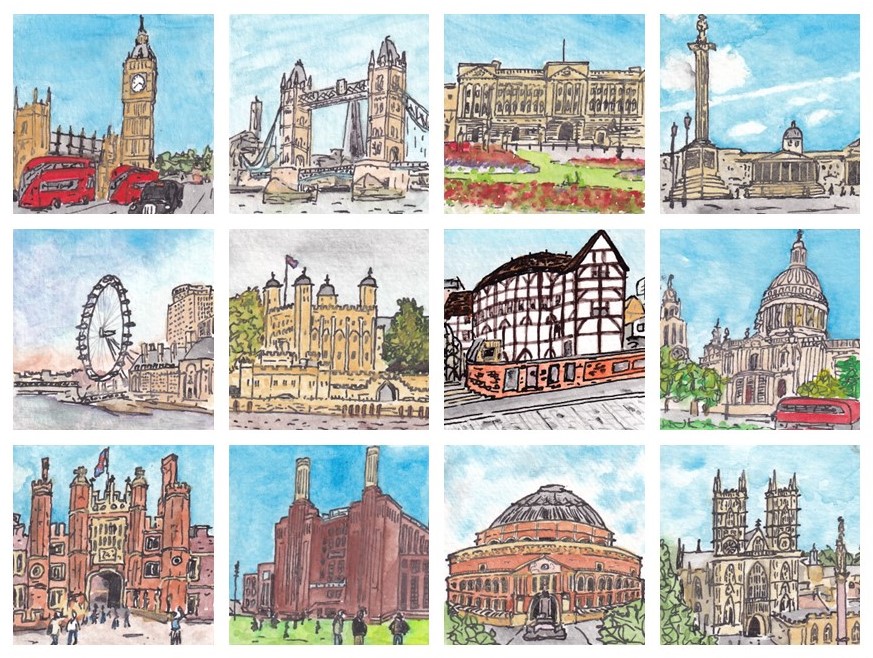
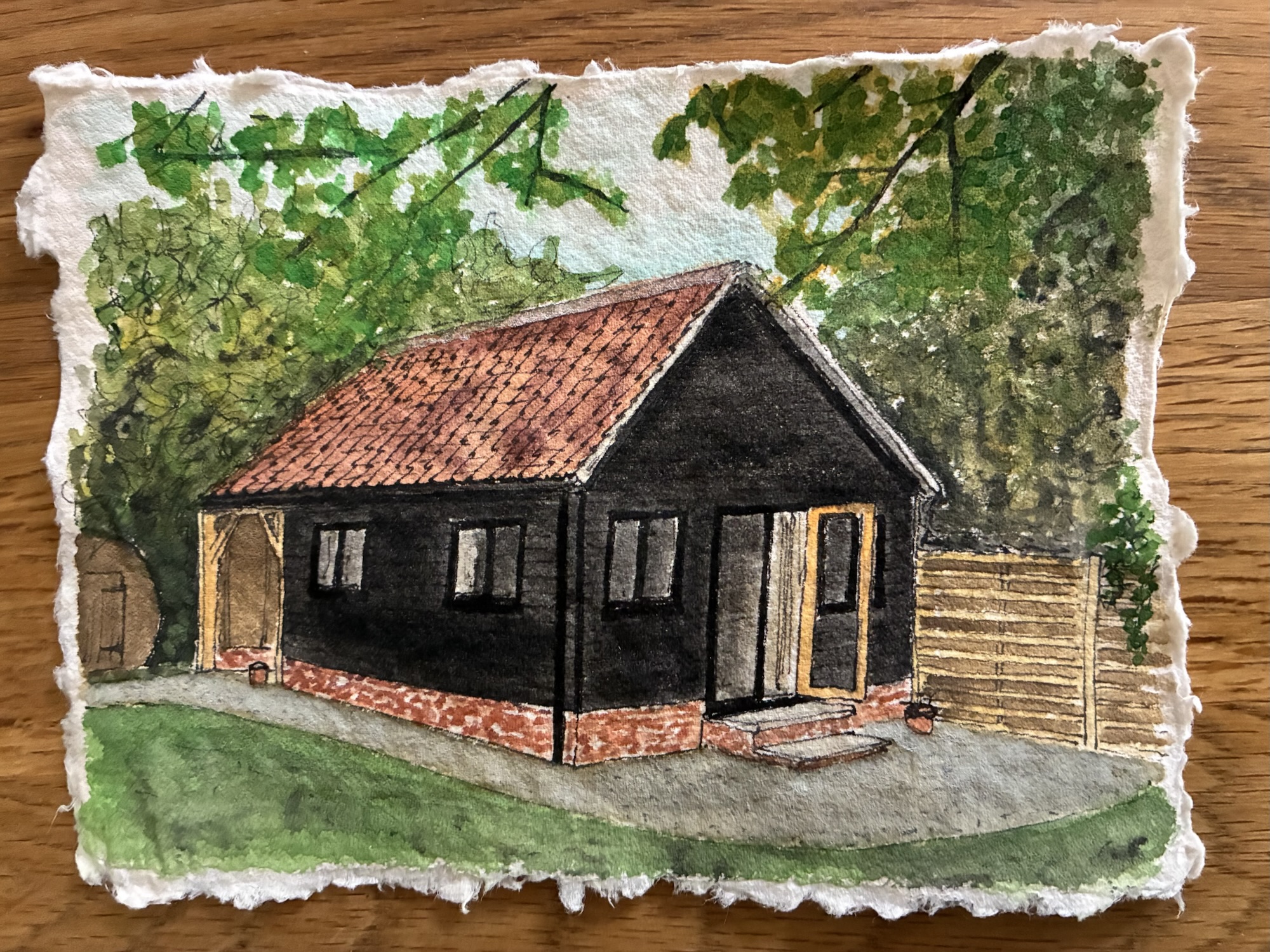
As might be apparent from some of my previous pieces on this website, through the latter part of 2025 and early months of 2026, I got into a nice routine of spending ~30 minutes on many mornings, creating miniature square, ink and watercolour paintings. Once I got established with this routine, I decided that I would always aim to produce these pictures in sets of twelve in what I now refer to as one of my ‘Miniature Watercolour’ series. On completion of one series, I would pick a new theme and then launch straight into painting the next set of pictures. Initially, most of my themes were geographically based, and most of those were relatively local (Dartmoor Scenes, Capital City Landmarks, Cornwall Landmarks, Exmoor Views), but a few other themes did find their way into the mix (House Plants, Trees). Consequently, given that I live and work in Plymouth, the only surprising thing about me completing a Plymouth Miniatures series is that it was the seventh theme I had tackled.

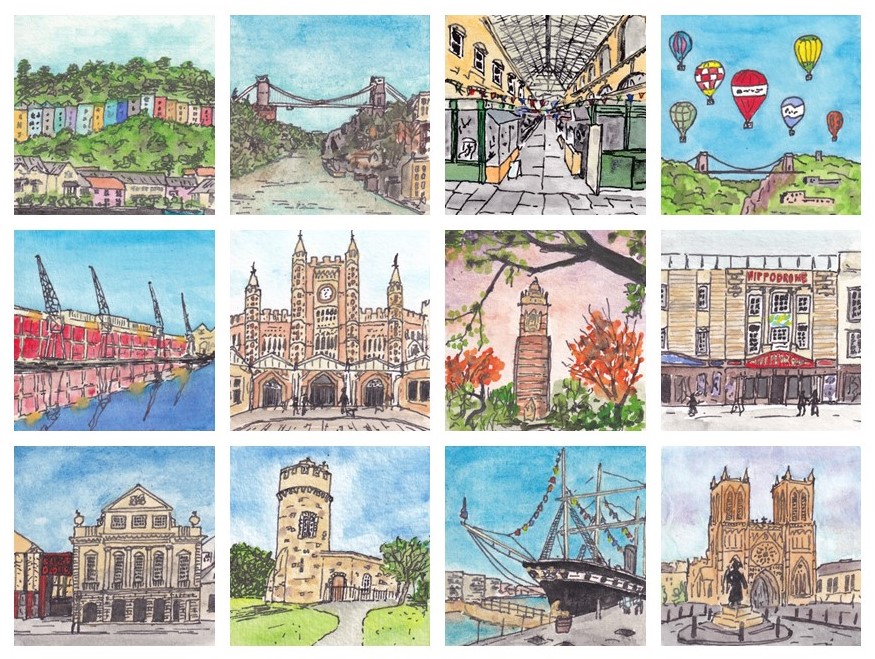
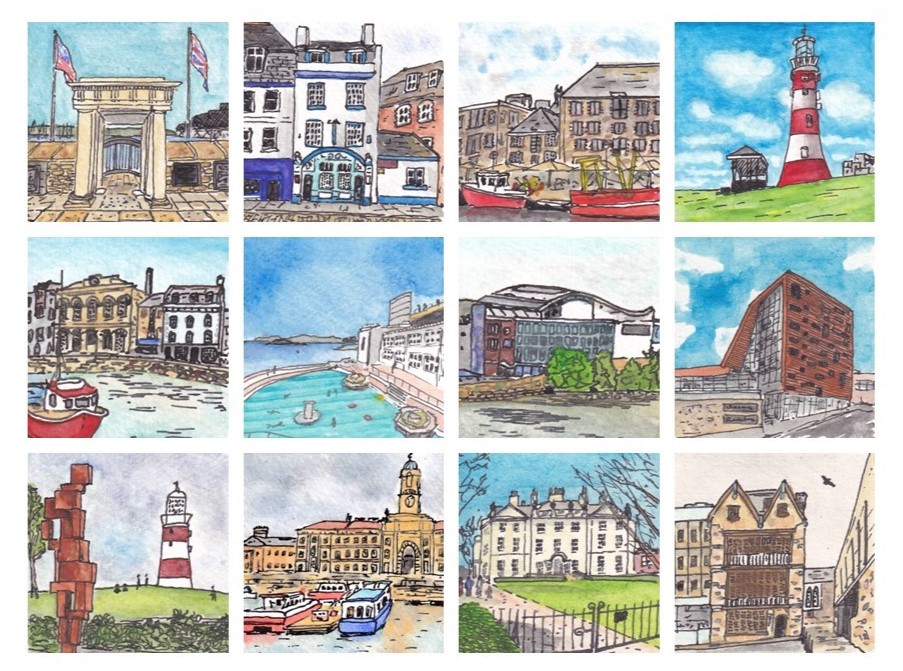
Some of the subjects depicted in this Plymouth Miniature watercolour series overlap with ones I included in the (larger) Plymouth Postcards series I painted earlier in the year, but there are quite a few that I hadn’t tackled before. Working from top-left, across and down the grid of pictures above (with the different ones marked with a *), the paintings show:

  • the Mayflower Steps* – which are not actually the steps from which the Pilgrim Fathers departed English shores in 1620, but a more modern creation.
  • the Dolphin Pub* in the Barbican – possibly the most iconic and well-known drinking establishment in the city.
  • boats moored on the quayside of Sutton Harbour*.
  • Smeaton’s Tower – formerly the lighthouse on the Eddystone Rock, it was rebuilt on Plymouth Hoe in the 1880s as a tourist attraction, and is arguably now the best-known symbol of the city.
  • the Custom’s House and Three Crowns pubs next to Sutton Harbour.
  • Tinsido Lido – a restored open-air art-deco swimming pool on the city waterfront.
  • the National Marine Aquarium.
  • the Roland Levinsky Building on the University of Plymouth campus next to the city centre – named after the former Vice-Chancellor of the university (2002-2007).
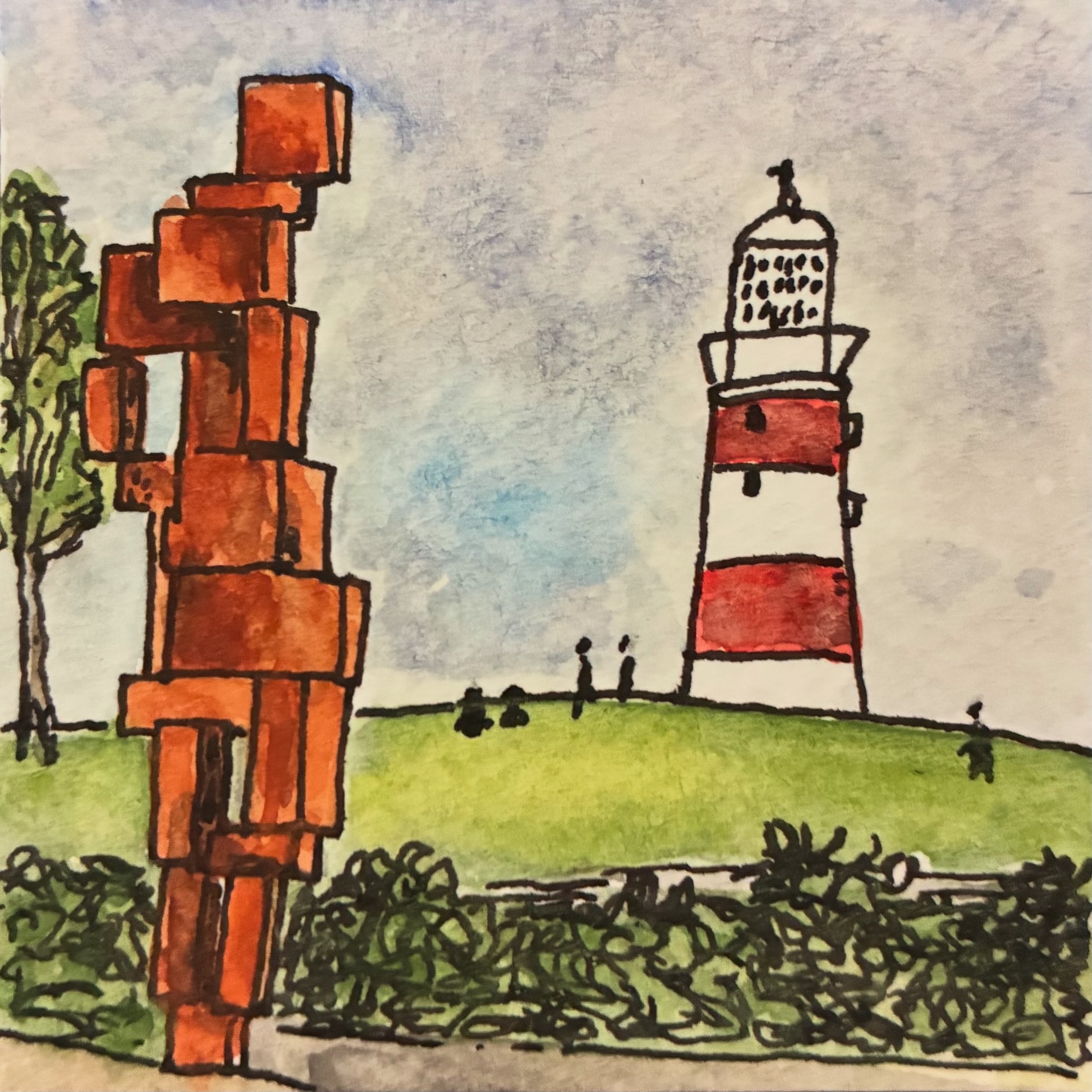
  • Anthony Gormley’s Look II* sculpture, gazing out pensively over Plymouth Sound with the Hoe beyond.
  • the Melville Building in the Royal William Yard – formerly the Royal Navy Victualling Yard, built between 1826 and 1835, and now a location for swanky flats, a cinema, some restaurants and small retail outlets, and fairly frequent food and craft fairs and art exhibitions.
  • Saltram House* – the Georgian home of the Parker family on the southern bank of the River Plym, now owned by the National Trust and a key location used in the film adaptation of Jane Austen’s novel Sense and Sensibility.
  • the 16th century The Merchant’s House*, one of the few really old properties in the city that survived the German bombing raids in World War II.

If I had to pick a favourite from this set I think I would select the Look II sculpture, partly because it’s an unusual and somewhat quirky subject, but also because I’m pleased with the way that I captured the variation of colour of the copper blocks…

In the autumn (2025), I decided that, given their local interest, I would list framed, home-produced prints of these miniature pictures on Facebook Marketplace, and I was really surprised and a little shocked, to find that quite a few people decided to buy them as Christmas presents. I’ve also sold a few prints and greetings cards featuring the individual pictures via my Etsy shop. In addition, I used the pictures to make a small desk calendar and sold a few of those too – in fact I have one on my desk in front of me at the moment! So what started off as a fairly brief, meditative morning diversion, has ended up being a (very minor…) commercial success!

Exmoor Views #art

Exmoor Views Miniature Watercolour Series

Our holiday in Exmoor in July 2025 obviously left me in an Exmoory mood, because within a couple of weeks of our return home I found that I had painted nine miniature watercolours of Exmoor Views. These were in the same small square format that I had used for my previous miniature watercolour series (Dartmoor Scenes , House Plants, Capital City Landmarks, Cornwall Landmarks, and Trees), with each one being painted quickly as part of the ‘morning routine’ that I generally try to get through each day before I try to settle into some more substantive activity.

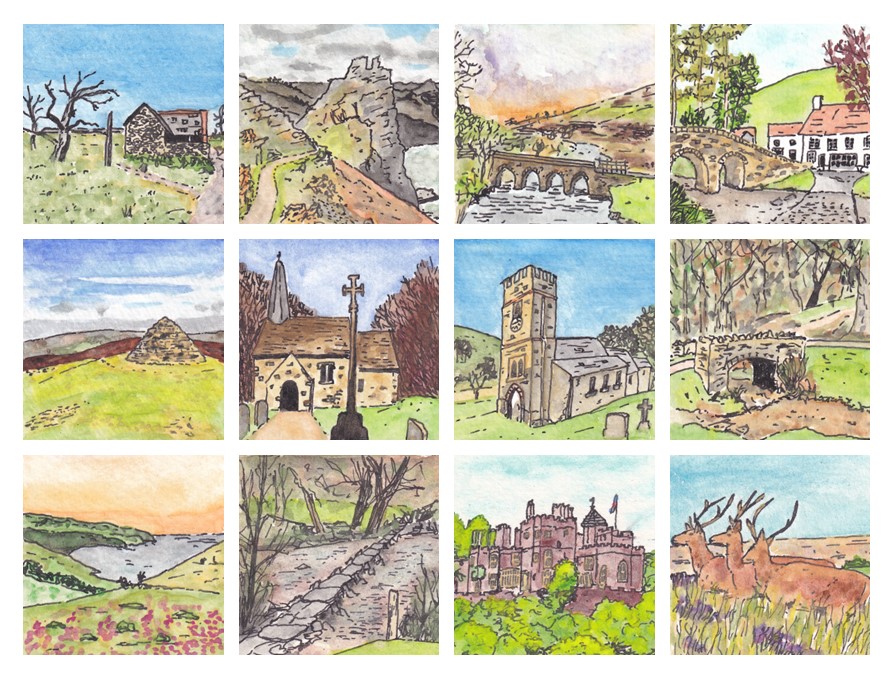
Most of the subjects for these pictures were locations that we had visited during our holiday, with a couple being other Exmoor locations that I was familiar with from previous visits (including the many family holidays we had in Exmoor when I was a child). Working from top-left, across and down the grid of pictures above, the paintings show:

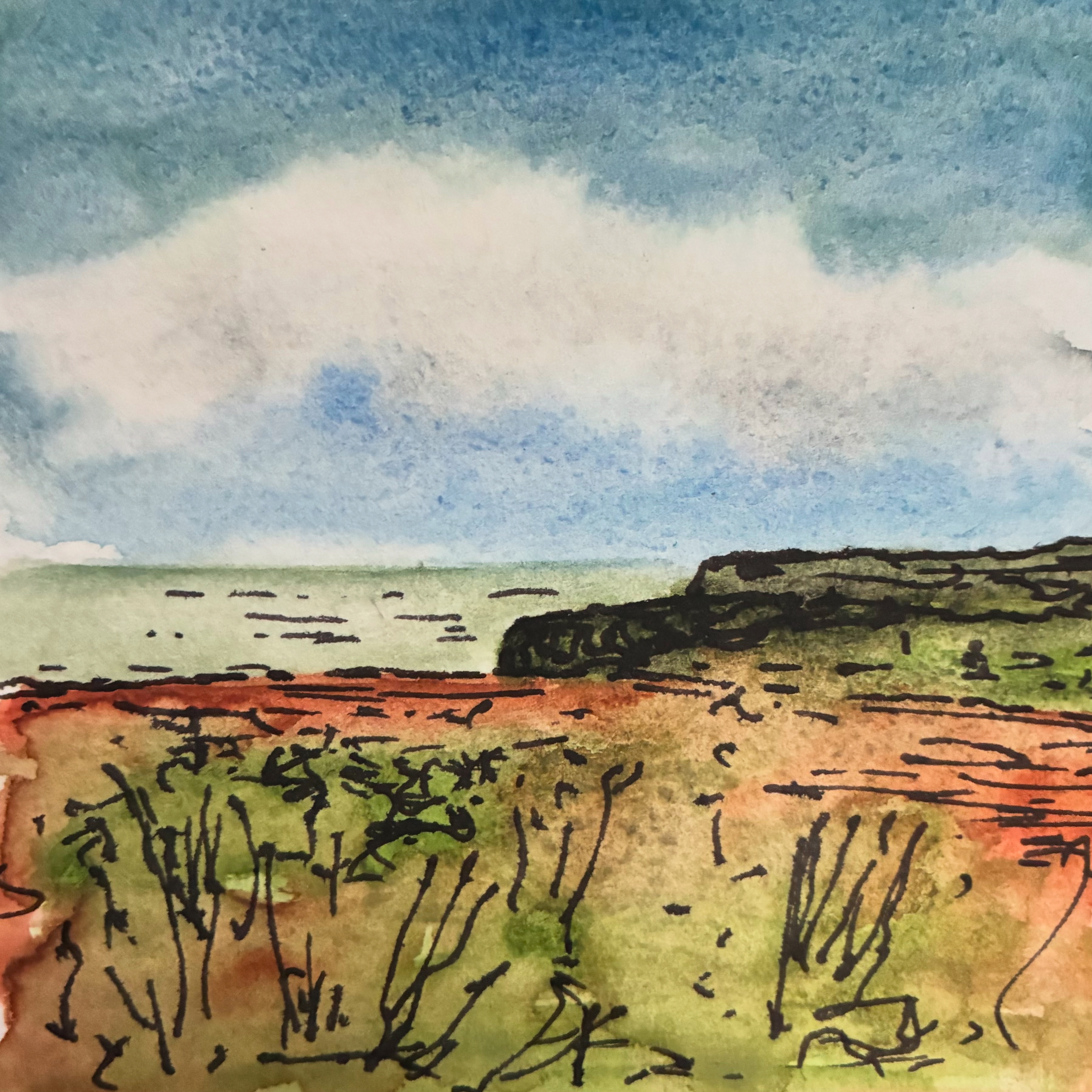
  • a ruined barn in Porlock Bay
  • the Valley of the Rocks near Lynton
  • Landacre Bridge over the River Barle (possibly my mother’s favourite spot)
  • the bridge and ford at Malmsmead at the head of the Doone Valley
  • Dunkery Beacon – Somerset’s highest point
  • St Bueno’s Church at Culbone (said to be the smallest parish in England)
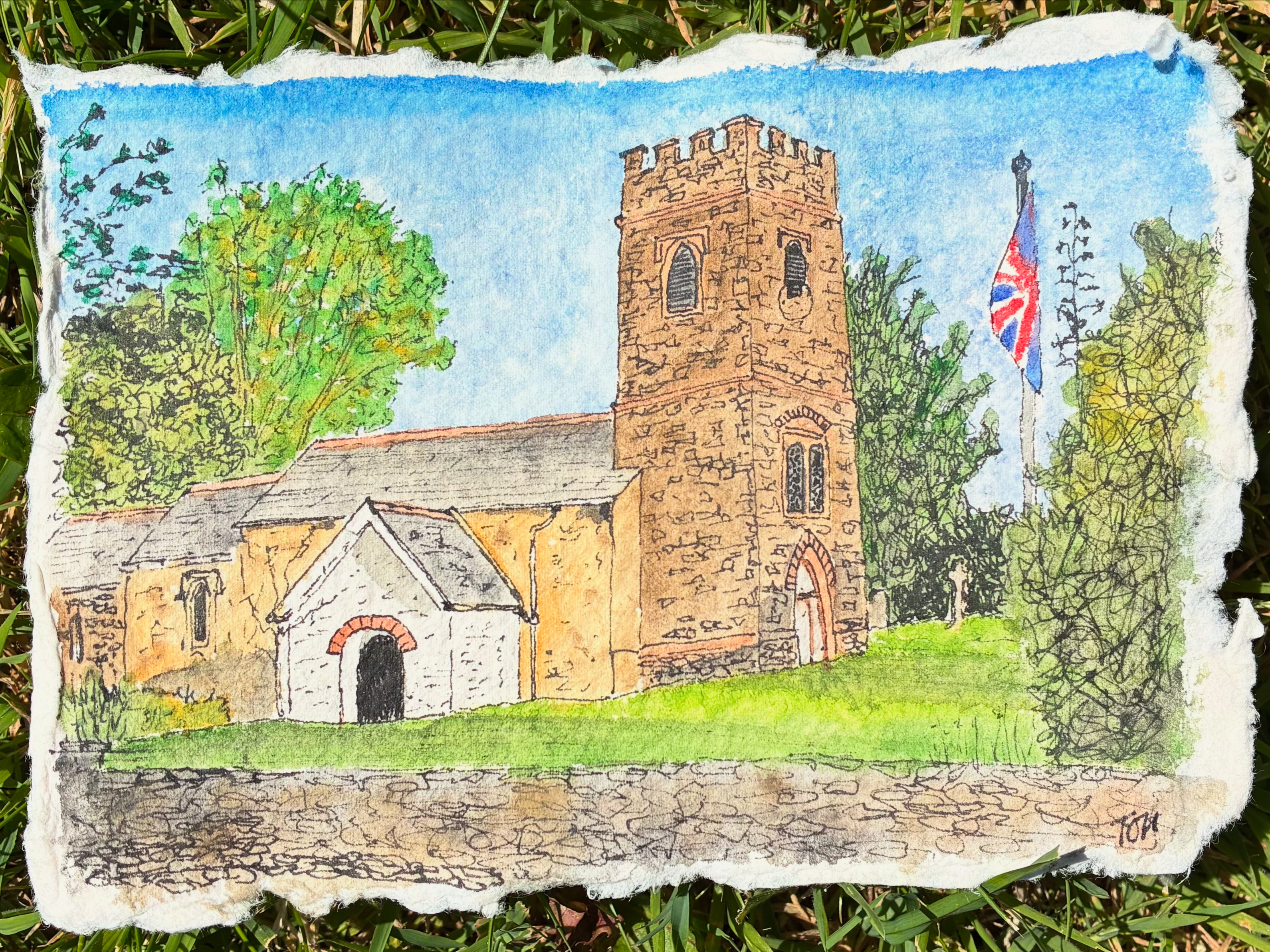
  • Oare Church (where Lorna Doone was shot on her wedding day)
  • Robber’s Bridge
  • a view across Porlock Bay from Bossington Hill

At the time I painted these pictures I had not fully settled into a pattern with my miniature watercolour pictures, but at some point in late summer 2025 I decided that I wanted all of these series to consist of twelve pictures, and so in October I painted three additional paintings to complete the set. These depict:

  • the ancient clapper bridge – Tarr Steps (also over the River Barle)
  • Dunster Castle
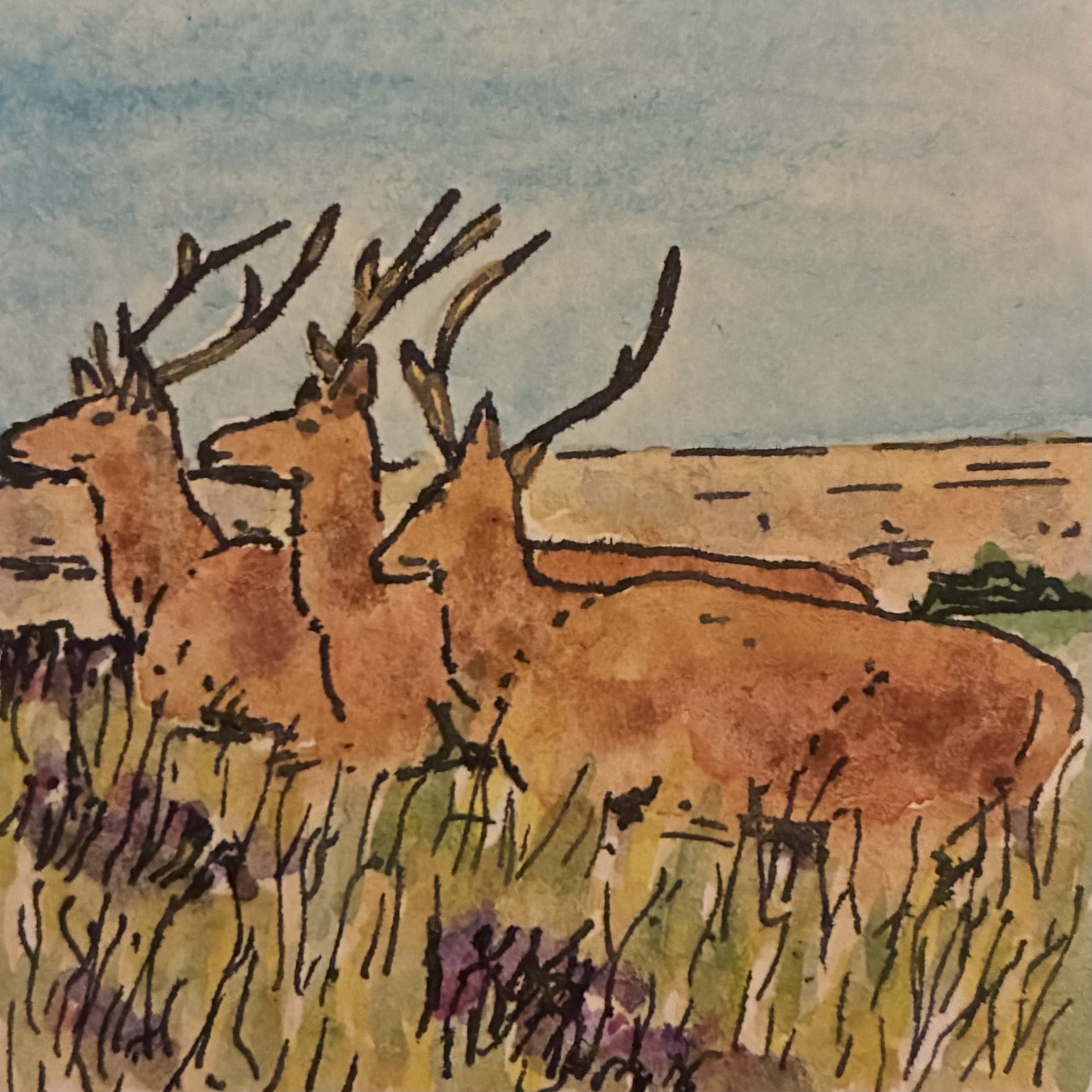
  • a group of red deer

Of these pictures, the most surprising one, both in terms of the subject matter and how the picture turned out, is the last. As I noted in Trees, my paintings generally avoid having people or animals in them (at least not in any detail), so the decision to have a go at drawing and painting Exmoor’s most dramatic wildlife was, for me, an unexpected and somewhat brave one! I was pleasantly surprised when they turned out quite well, in fact I think that this final picture is my favourite of the twelve:

Red Deer on Exmoor

As with my other miniature watercolour series (the ones listed above and several more that I have produced more recently), I sell greetings cards featuring the individual pictures, and home-produced prints with either nine or twelve of the pictures, in my Etsy shop and on Facebook Marketplace.

Exmoor Paintings #art

View of the Exmoor Coast

As described in the posts Quantock Paintings – Part 1 and Quantock Paintings – Part 2, our summer holiday in 2025 was a multi-part affair. A short stay at Crowcombe on the Quantock Hills in June was followed a month later, by a few days a little further west in an AirBnB in Malmsmead, Exmoor. Malmsmead is a location that is well known for being at the head of the so-called ‘Doone Valley’, which is an interesting example of a landscape feature that (now) takes its name from a work of fiction, R.D. Blackmore’s 1869 tale of romance and villainy: ‘Lorna Doone’. However, despite having made many trips to Exmoor over the years, it wasn’t somewhere that I had explored much before.

In Exmoor we were fortunate to be blessed with generally fine and warm weather, and were able to complete several great walks, including, naturally enough, one that took us all the way up the Doone Valley and west over open moorland, before returning north, with great views (see below) towards the Bristol Channel, via the village of Brendon and a nice drop of Exmoor Ale in The Staghunters Inn.

View towards Countisbury Hill, Exmoor

Our accommodation was only a 15 minute walk from the village of Oare, and so we also visited Oare Church, where (in the story) Lorna Doone was shot through a window by the evil, jilted Carver Doone as she stood to marry John Ridd. [Spoiler alert: Lorna survives, and John chases Carver Doone across the moor and watches him sink slowly to his death in a boggy mire, and they all (well all but Carver of course) live happily every after.]

Oare Church, Exmoor

We also completed a walk from Malmsmead towards the coast on what was perhaps the hottest afternoon of the year. This made the walk rather tough going, and this was not helped by the fact that the warm weather seemed to encourage what seemed to be every fly in the entire region to nip and nibble at me along the way.

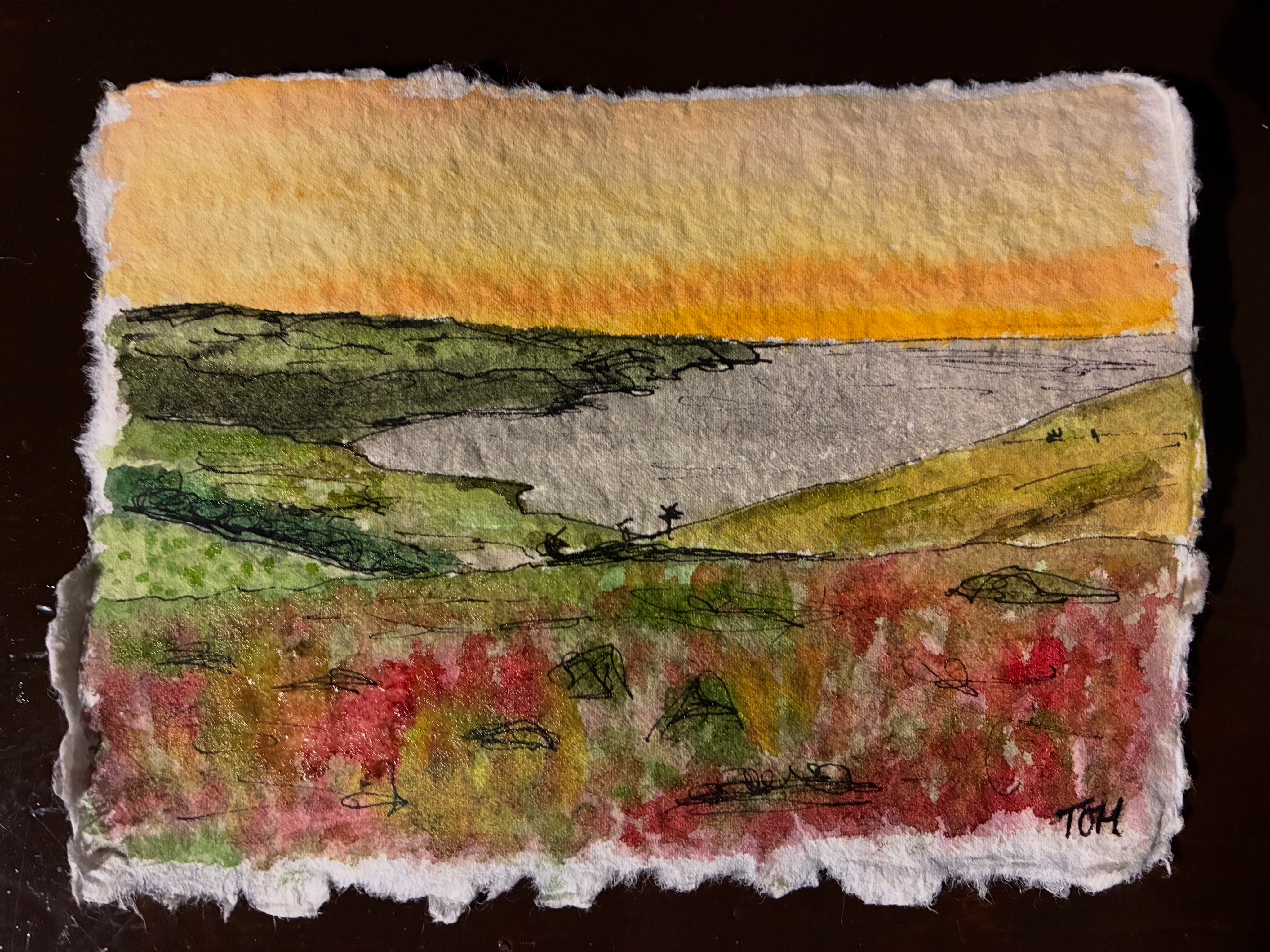
In between the walks, I found time for some painting of course, producing the various pictures that illustrate this post. The final painting I produced whilst away was of the view across Porlock Bay, where we had walked on the first day of our holiday, from Bossington Hill. As it’s a sunset view, it seems like a good picture to use to draw this post to a close…

Porlock Bay Sunset from Bossington Hill

Trees #art

When I started painting in April 2024 I concentrated mostly on painting buildings or landscapes in which any significant living elements such as trees, animals or people were sufficiently distant that I didn’t have to worry too much about their details. After a while, as I discovered my natural style and approach to painting and gained a bit more confidence in my ability, I began to try putting more detail into my work. In the case of trees, I found that if I slowed myself down, and really paid attention to what I was doing, the results of my efforts were not at all bad. (Sadly, whilst I have had some success more recently painting birds and animals, the same still cannot be said about my horrific attempts at incorporating people into my artworks…)

The set of twelve pictures above, a set that I refer to as my Trees series, were painted between June and November 2025, and ended up being the fifth series of miniature watercolour paintings that I produced. Most of the these series were been produced over a much shorter period of time, typically no more than 2-3 weeks, but with these tree pictures I didn’t set out to generate a full set of twelve pictures, they just emerged gradually, in between all of my other painting efforts. Each picture is a 9cm square, a little larger than most of my miniature series paintings (which are typically ~5cm square), and for this reason, I’ve been able to print larger 16cm versions from the originals, that look really smart in a frame, without suffering from resolution issues.

In most cases, I painted these trees from photographs that I had taken at some point, and so I know (roughly) where most of the trees are. However, there are a few that were based on photos from internet searches, and unfortunately I’ve lost track of the details of those ones – keeping track of these kinds of details is something that I still need to get better at. Working from top-left, across and down the grid of twelve pictures, the pictures show:

  • a large tree on the main ridge of the Quantock Hills, above Crowcombe in Somerset, with huge roots that formed a window to frame the view beyond
  • twisted branches and autumn leaves (location unknown)
  • a lone conifer on the southwestern edge of Dartmoor, somewhere on Harrower Common near Yelverton, Devon
  • a view looking back along the cycle path between Clearbrook and Yelverton
  • a lone tree of a type that I like to refer to as a ‘symmetree’ in a slight hollow, again on the main ridge of the Quantock Hills above Crowcombe
  • my favourite row of beech trees below Peek Hill next to the main road from Yelverton to Princetown, Dartmoor
  • beech tree trunks near Grassington in Wharfedale, Yorkshire
  • a typically-windswept tree on Dartmoor
  • a muddy track through some conifer woodland (location unknown)
  • a lone holly tree on Roborough Down
  • a view through a group of pine trees, across the Yealm Estuary from the coast path between Wembury and Warren Point in South Devon
  • a spectacular autumnal, orange-leafed tree in the gardens of Cotehele House (or it might be in the Lost Gardens of Heligan)

Although they are quite simple, some of these tree pictures – the Peek Hill beech trees, the Yorkshire beech tree trunks, and the pine trees near Warren Point – are amongst my personal favourites of all of the pictures I have painted so far. I’ve listed prints of these pictures (composite prints of all twelve and a smaller square version with nine pictures) and greetings cards featuring individual pictures for sale on Facebook Marketplace and in my Etsy shop, but perhaps unsurprisingly, given the chances that anyone putting ‘tree painting’ into their internet search engine will be directed to my tree paintings rather than any of the hundreds if not thousands of alternatives available, I’ve not had any sales so far. But a family friend was so taken with these pictures that she bought a set of four framed prints of her favourite individual trees as a present for a friend and then came back and bought another set for her nephew! It’s nice to know that there is at least one other person out there who also likes these pictures!

Quantock Paintings – Part 2 #art

Following on from my previous art post (Quantock Paintings – Part 1), here are a few more of the paintings that I did during, or shortly after returning home from, our short break in Crowcombe, at the foot of the Quantock Hills in Somerset, last June.

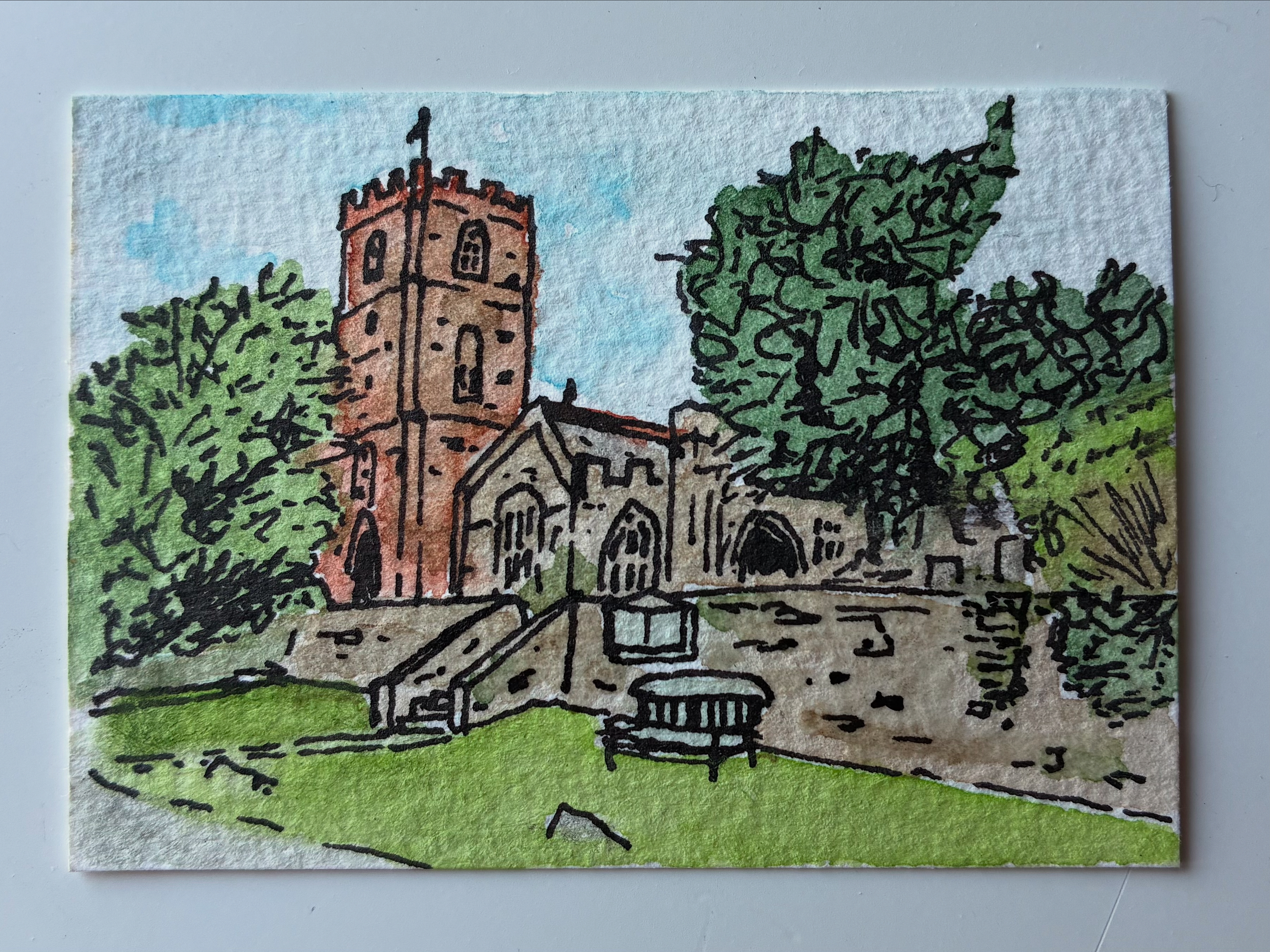
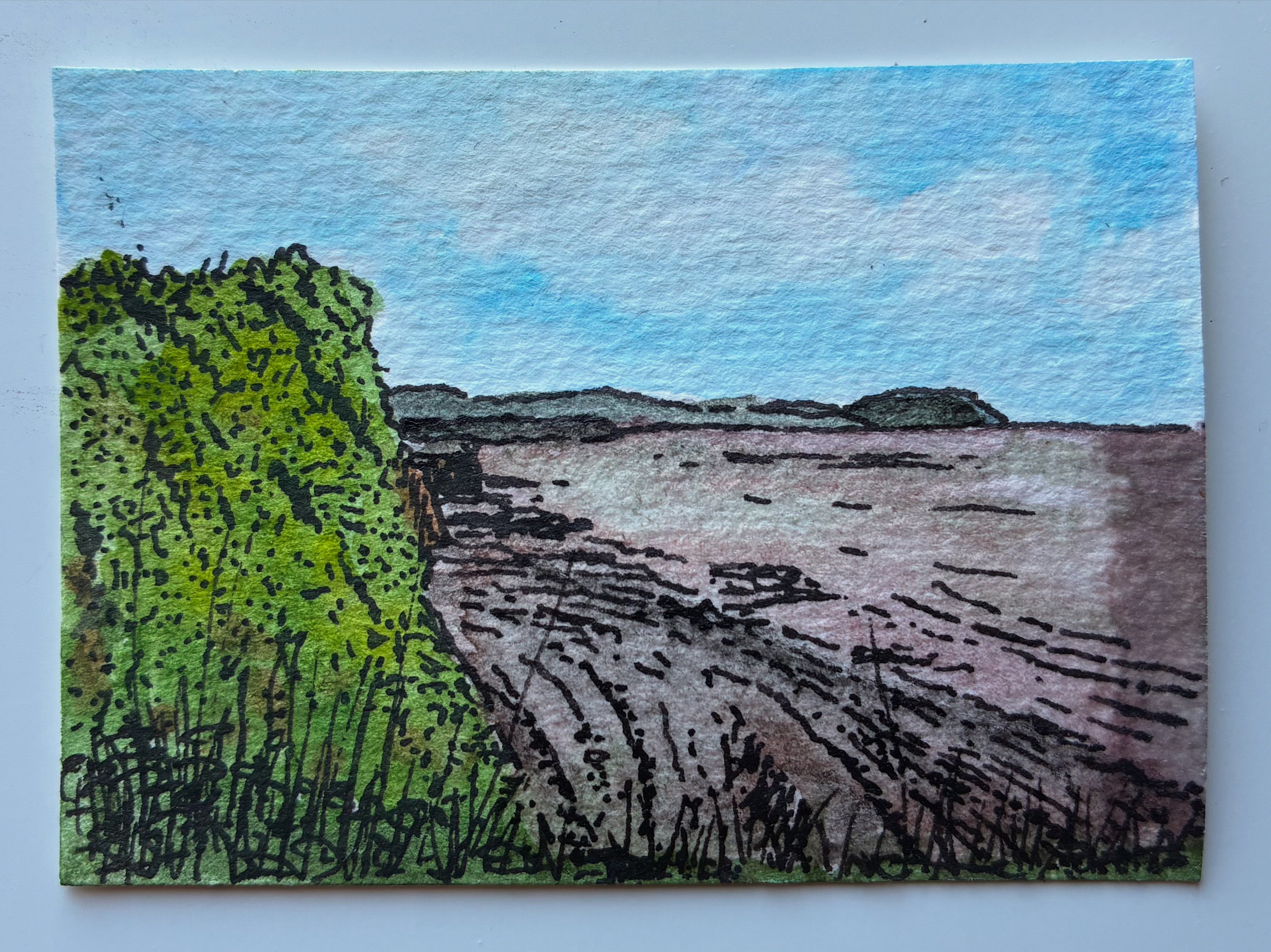
First, here are a couple of pictures depicting views from walks that we did. Both are in my ‘normal’ style, a simple ink pen sketch with the watercolours added on top. I think that I have a tendency to try to put a lot of detail into my drawings (at least until I get bored and start scribbling in trees and foliage), but I am conscious that with painting it is often a case of ‘less is more’. In these two pictures I think that I managed to hold myself in check and kept the drawings fairly simple and ‘loose’. The pictures show Crowcombe Church and a view of the coastline at East Quantoxhead…

Crowcombe Church
View of East Quantoxhead (with a bit of an issue on the right-hand edge!)

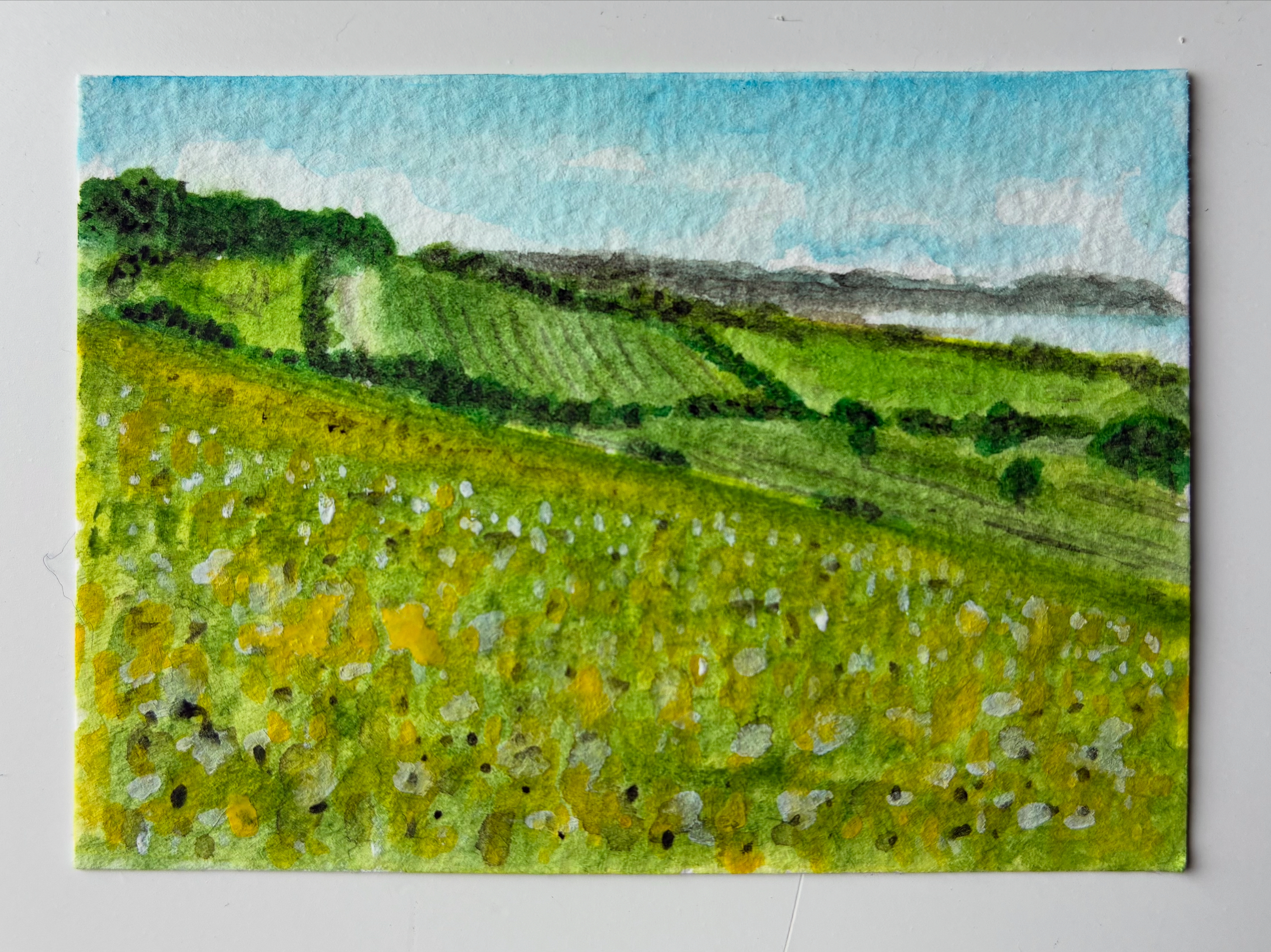
Next, I’ve included the results of an attempt to play with a slightly different approach, eschewing entirely the use of an ink pen to create a base sketch, and instead, going straight for the watercolour paints. I think that in many people’s minds, traditional (true?) watercolour paintings use only paints, generally placing these on a much wetter surface than I use, but I’ve not had any artistic training whatsoever so that’s not how my work has evolved. This picture shows a view from another of the walks that we did, looking west towards Minehead across hedge-lined fields with a riot of wildflowers in the foreground…

Somerset Fields with Wildflowers (no ink)

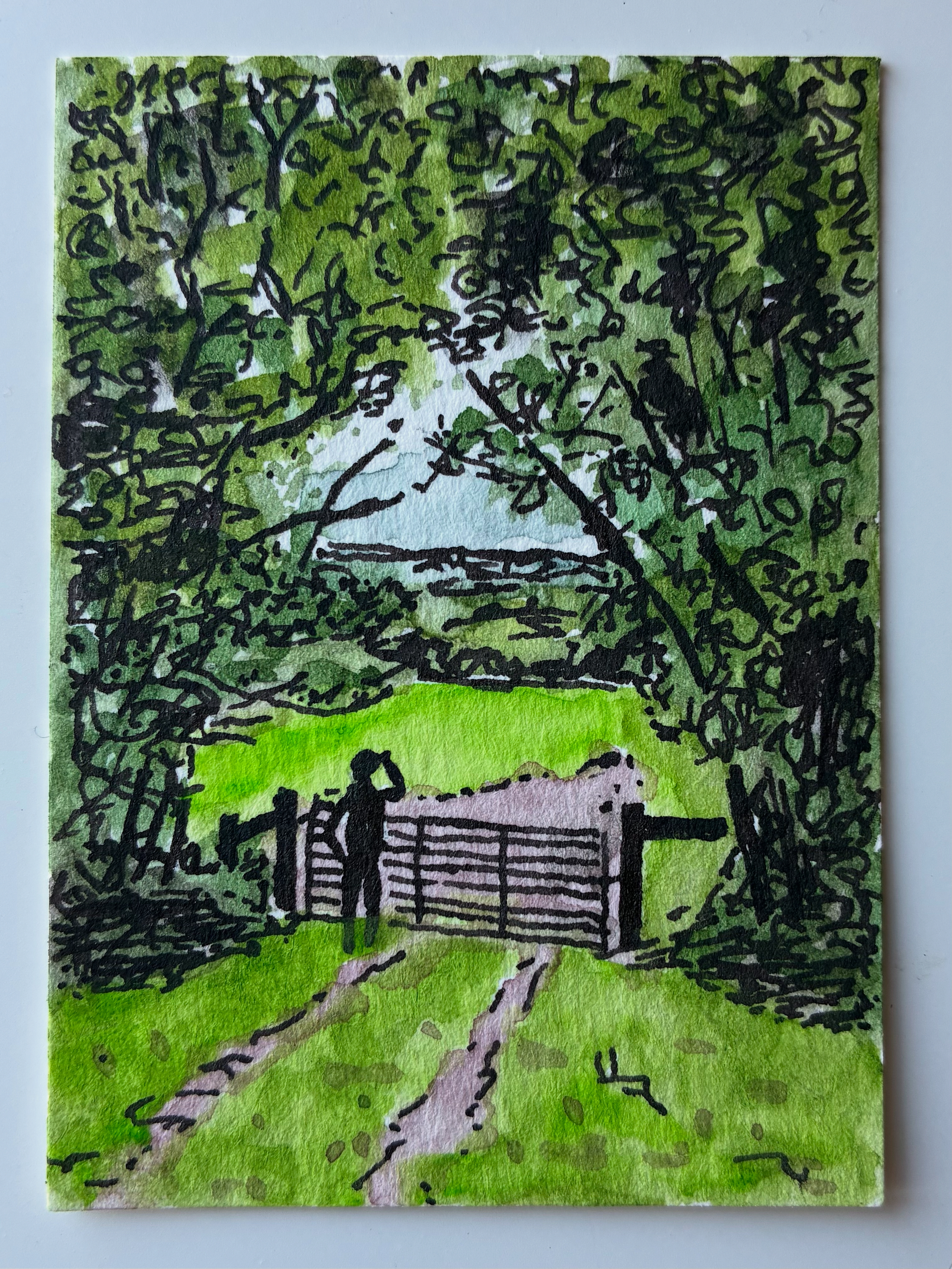
The vast majority of my paintings are of landscapes in one form or another. This is partly because I like landscapes, but also partly because whilst I might be able to make a decent fist of painting trees, fields, hills and buildings etc., I’m pretty much hopeless at drawing and painting people and animals. So, the picture below is a little unusual because it features me, standing at a gate looking east from the main ridge of the Quantock Hills. I like this picture because it is a bit quirky, with some nice ‘busy’ trees, but I don’t think it does anything to improve my reputation as a painter of people!

Through the Trees

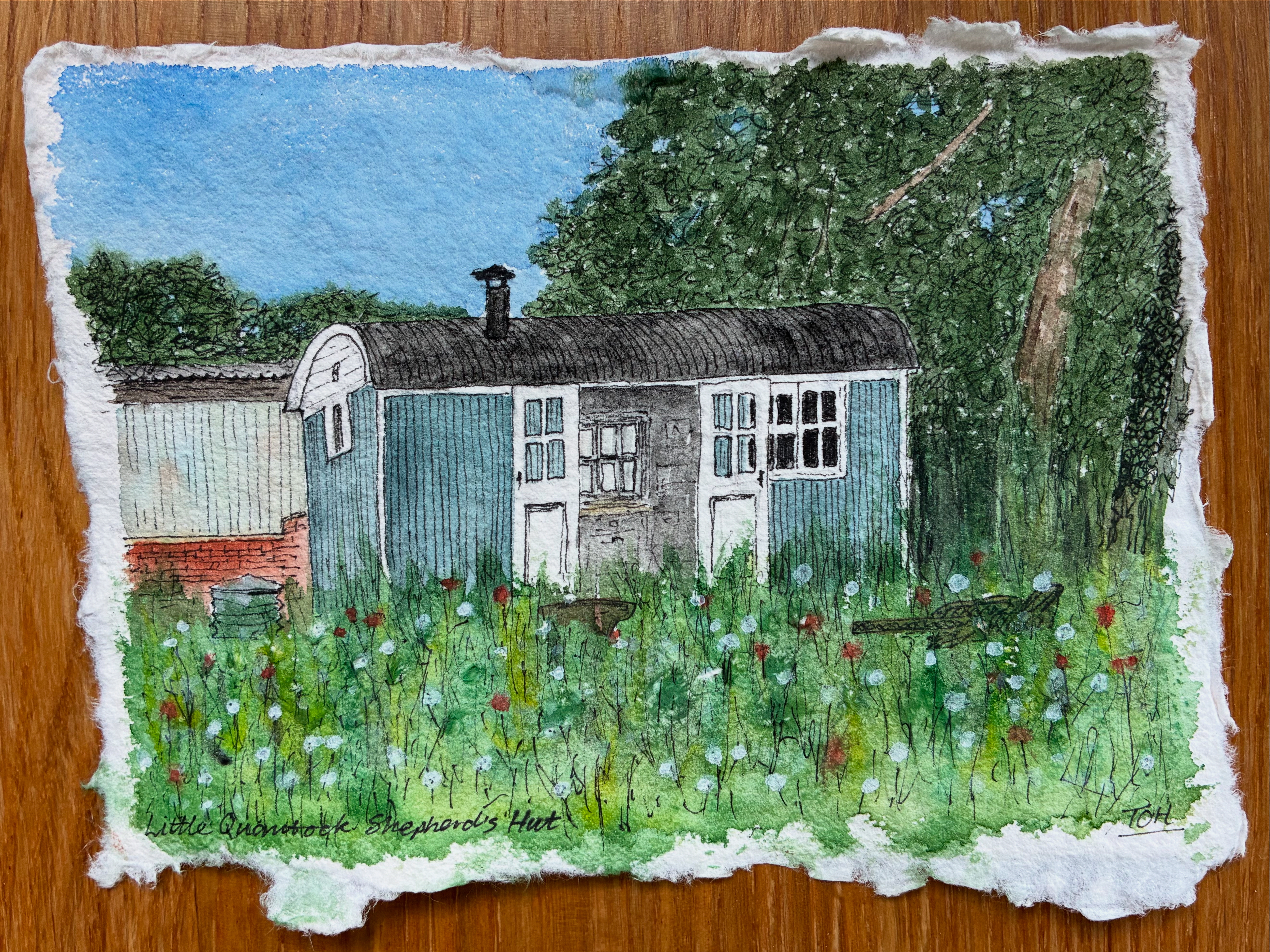
Finally, it’s become a tradition now that I paint a picture showing whatever accommodation we have stayed in when we are away, which we then leave behind as a thank you to the owner of the accommodation. In this case, we were staying in a delightful little Shepherd’s Hut, with a sunset view towards Exmoor. Now, for me to describe a Shepherd’s Hut as ‘delightful’ is something of a miracle, but although the picture doesn’t capture the view, I think it does capture something of the charm of the place.

Crowcombe Short-Break Shepherd’s Hut

I’ve written this post almost exactly one year on from our stay in Crowcombe, and it’s been nice to look back on these pictures and be reminded of a really pleasant few days in a quiet and beautiful part of the world.

Quantock Paintings – Part 1 #art

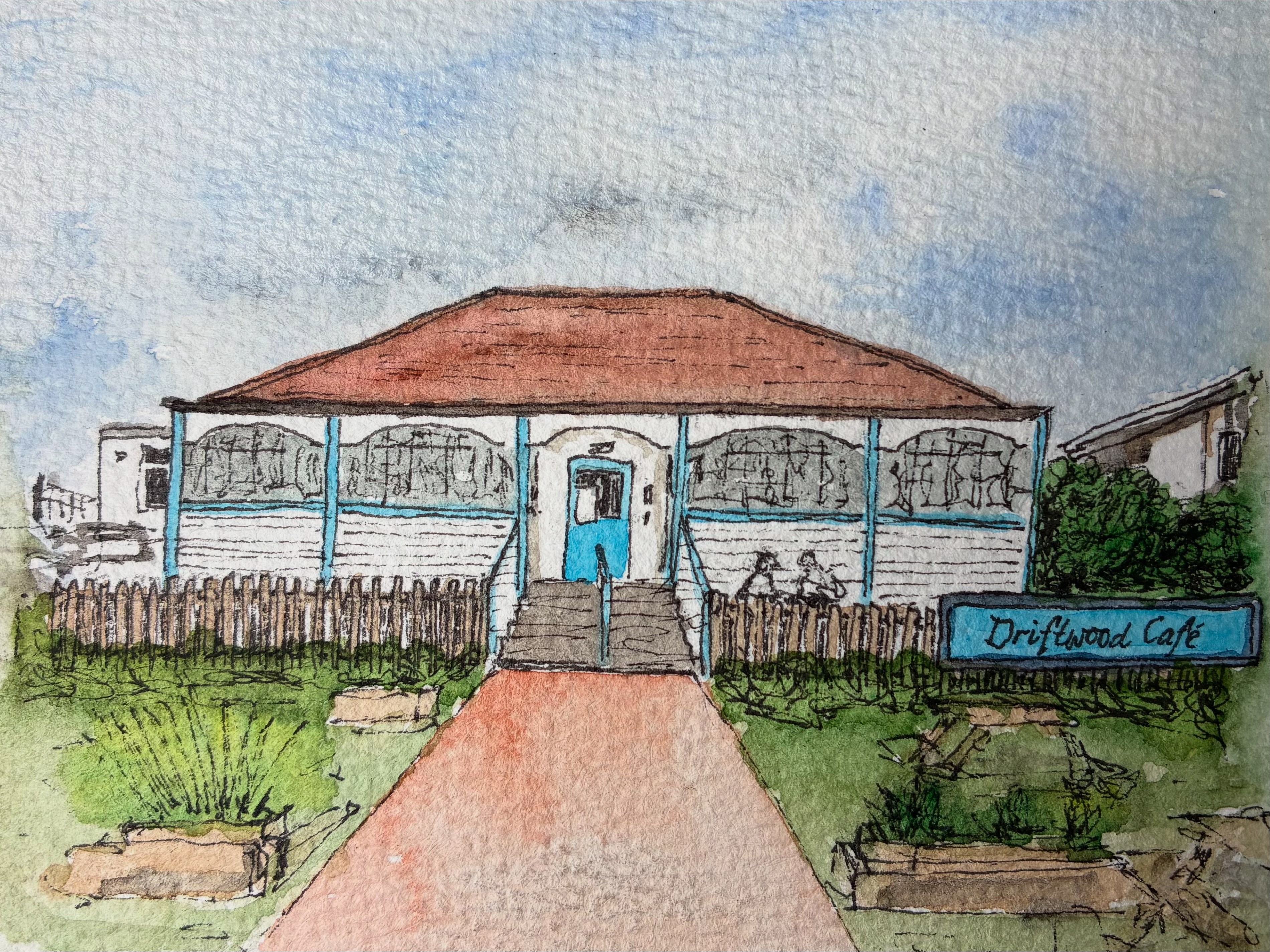
Driftwood Cafe, Blue Anchor, Somerset

In recent summers we have take a series of summer holidays walking in the Yorkshire Dales – first in Swaledale (staying at Low Row near Reeth), then in Wharfedale (based in Ilkley) and last year in ‘Bronte Country’ near Haworth. In each case we combined our week in Yorkshire with a day or two staying somewhere en route to and from our home in Plymouth, or in one case a second week away in Norfolk and Suffolk. For a change, this year, we decided that we’d like to spread our holiday time out over the summer months, and so we picked a couple of fairly local destinations for ‘long weekend’ walking holidays and also booked five days over in Suffolk, combining this with a visit to elderly relatives and an old university friend on mine.

The first of our summer 2025 mini-break locations, in June, took us back to the very familiar territory (for me at least) of the Quantock Hills and the Somerset coast. I grew up a short distance from there in Bridgwater, and we would frequently go on family outings to the area. I also spent quite a lot of time at an activity centre in Kilve on short courses of various kinds (mostly musical).

Although I do like discovering new places, I also very much enjoy returning to familiar haunts, especially for a short trip when you want to be able to slot straight into holiday mode without having to spend time orienting yourself and getting the lie of the land. Our Somerset trip – staying in an AirBnB Shepherd’s Hut near the village of Crowcombe, tucked at the bottom of the western side of the Quantock Hills ridge, very much fell into this ‘familiar territory’ category.

While we were away we enjoyed completing a couple of lengthy walks direct from our accommodation (I particular enjoy a stay away that doesn’t involve having to get in the car), and I was able to spend quite a bit of time painting. In this post I’ll feature four of the pictures that I produced during the break, and I’ll pick up the thread with another post soon that will feature a further group of five pictures.

We started our holiday with lunch at a favourite cafe, the Driftwood Cafe at Blue Anchor – the subject of my first picture (shown at the top of this post). It’s not a fancy cafe at all – I’d describe it as a ham, egg and chips or baked potato cafe – it’s just a nice, simple, easy-going place for a quick bite to eat.

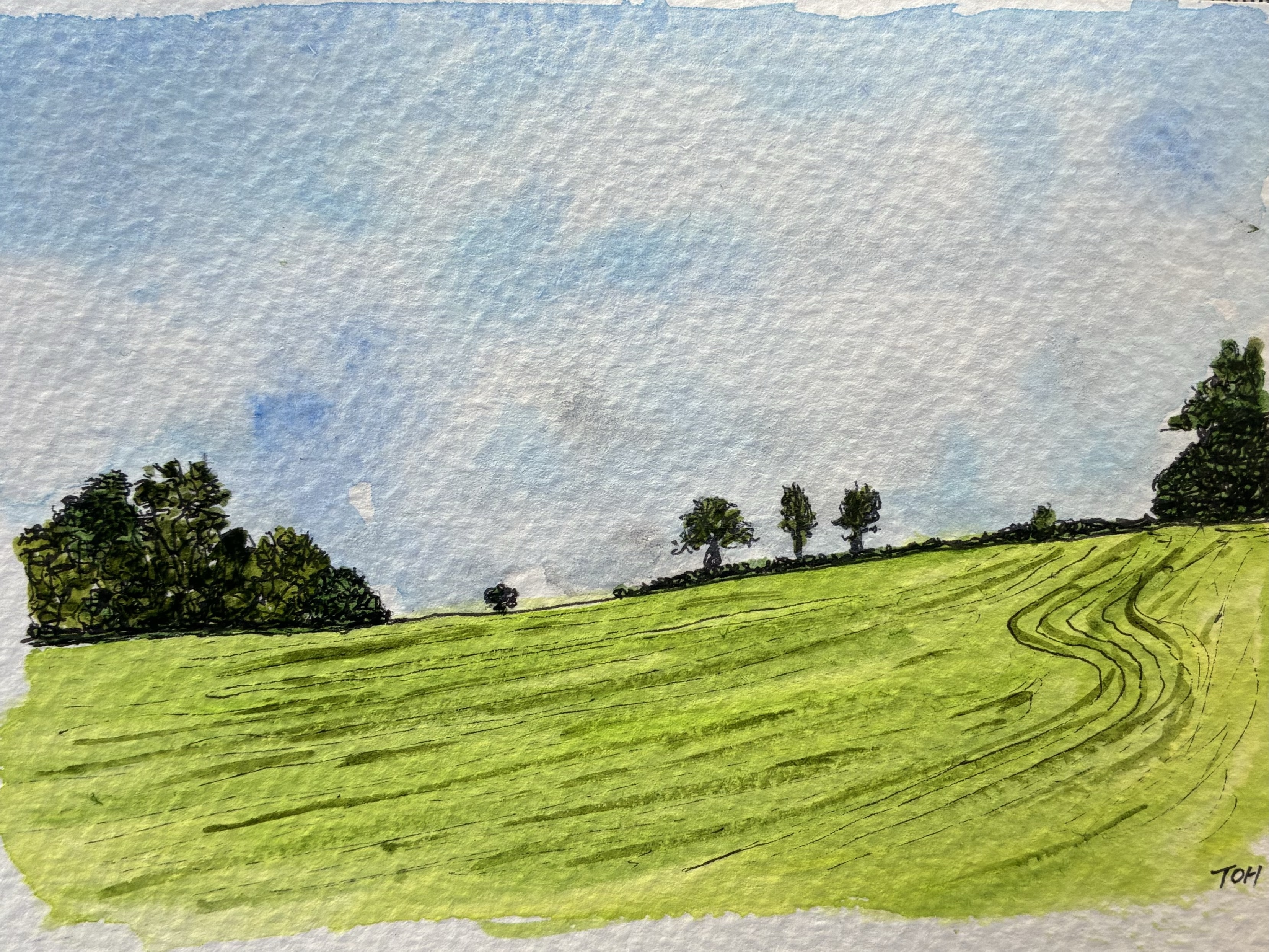
Suitably refueled we then drove the short distance to Kilve and did a short walk (~3 miles) along the coast to East Quantoxhead, before turning inland and returning to the car, with a stop at the Chantry Tea Garden at Kilve where we were the only customers and had an interesting conversation with the owner, who used to be a frequent visitor to Plymouth. The two pictures below show a view of a field that we passed on the return leg (I’ve got a thing for trees silhouetted on the horizon) and the view that we had from our table in the cafe garden of The Chantry itself and the white cottage from which the cafe was run.

Grass Cut Field Near Kilve, Somerset
The Chantry Tea Garden, Kilve, Somerset

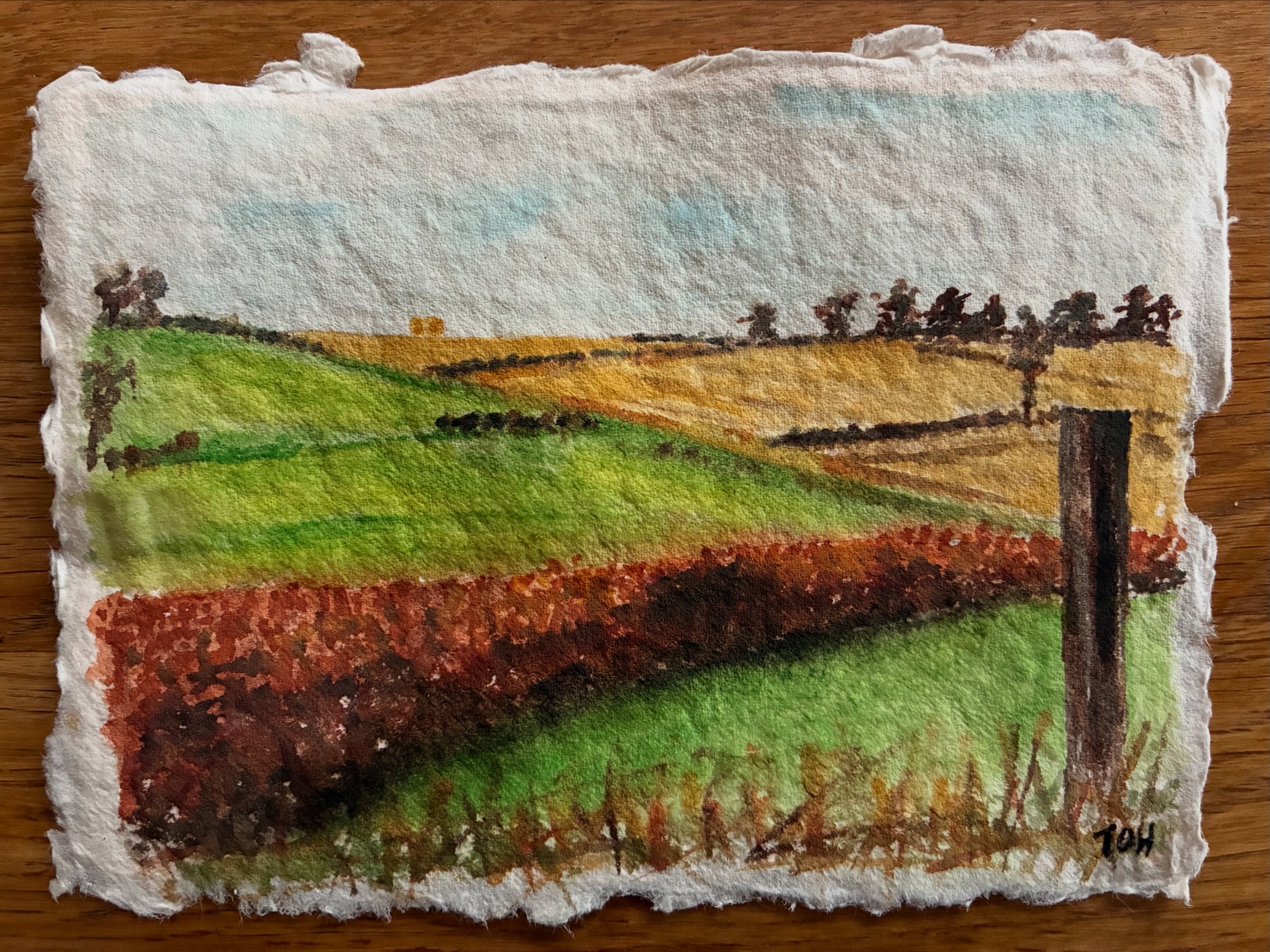
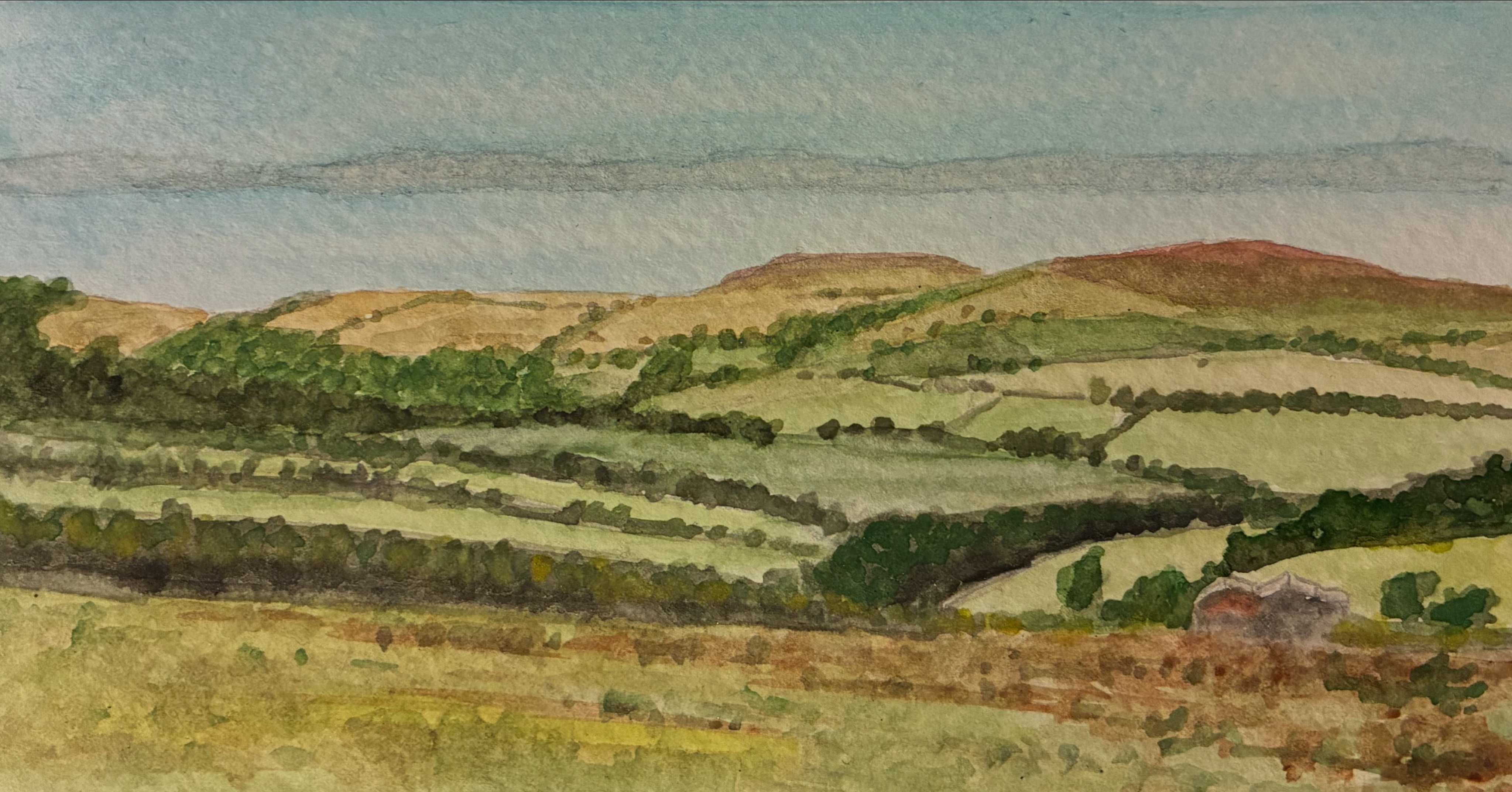
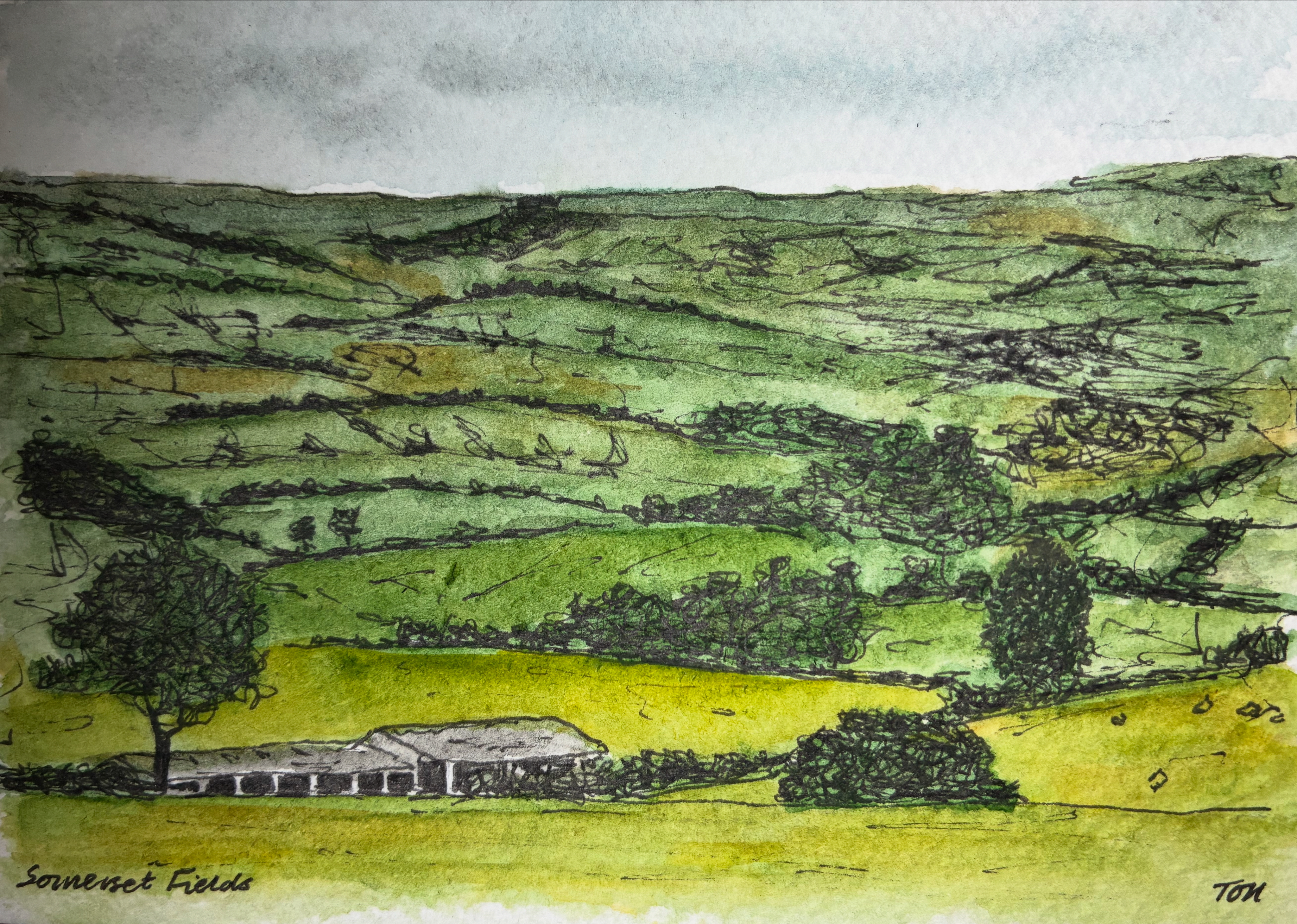
Finally, for now, here’s a scene I painted of the view looking west in the direction of Exmoor from the base of the Quantock Hills. I’ve tried to capture the way that there are successive ‘layers’ of rolling hills as the eye moves towards the horizon, each becoming progressively just a little higher than the previous one. Although wild landscapes can be exhilarating, I do like a farmed landscape – a patchwork of fields, hedges, copses and the odd farm building.

Somerset Fields Looking West From Near Crowcombe

All of these pictures were really just quick ‘practice’ pieces, but I like them all in different ways – Driftwood Cafe for its small details, the grass-cut field for its slightly abstract form, Chantry Tea Garden for its looseness, and Somerset Fields for the way it captures something of the wide expansiveness of the view.

If you have a favourite of these four pictures write a quick comment to let me know!

Mevagissey #art

I painted this little watercolour picture of Mevagissey harbour back in June. I was looking to paint a picture to use for a birthday card for the son of one of my wife’s best friends, and brother to one of my elder daughter’s closest friends (by which I mean that the son was also the brother!). As it happened, a couple of months previously, his mum had seen some of my pictures when visiting our home, we got talking about art, and along the way she told us how he had surprised her by saying that when he finally got his own place to live (he’s in his mid/late 20s) he wanted to have pictures of two places that were special to him – Pew Tor on Dartmoor, close to their home in Tavistock, and Mevagissey in Cornwall.

As the date of the birthday approached I started to think of painting one of my ‘special place’ pictures for his card. The trouble was, I was faced with a choice, and anyone who knows me well will know that one thing I am not good at dealing with is choice. It’s tempting to think that choice is a good thing, and I am sure that I would say that I’d prefer to always have a choice than not, but in many ways I’d find life a lot easier if there was a little creature sitting on my shoulder, or tucked into my sleeve, whispering to tell me what to do all of the time.

Should I paint Pew Tor or should I paint Mevagissey?

I’d painted a larger picture of Pew Tor back in early March and knew that I could produce something smaller but similar that would work as a birthday card. I’d also painted various places in Cornwall as part of my Cornwall Landmarks Miniature Watercolours Series. But I’d never tackled Mevagissey… So, one morning I took a small piece of watercolour paper, performed a quick Google search for a suitable photograph, and set to work.

I like the results of my effort – the painting that introduces this post. The picture I chose was a fairly busy scene, with the quayside at Mevagissey backed by all kinds of interestingly shaped and coloured buildings, a host of colourful boats moored at the water’s edge, a pair of rather striking light-blue benches towards the right of the scene, and the bright yellow fishing boat pulling out confidently towards open waters. It was a picture that provided lots of splashes of colour that give the painting a nice sense of aliveness I think.

But, in the end, it was Pew Tor that won the mental tug-of-war that was taking place inside my head. I put my little Mevagissey picture, really just a test piece, to one side, and opted instead for the Dartmoor ‘special place’ rather than the Cornish one. If you are reading this soon after it was originally posted (on 9th September 2025) and want to see the Pew Tor picture that I ended up using, then you’ll just have to visit this site again in a few days time… because if all goes to plan I will post it here soon. For now, you’ll just have to enjoy a quick trip to Mevagissey – a perfect example of the many picturesque little harbour towns that line the southern Cornish coastline.

Tim O’Hare Art is open for business! #art

Over the last couple of months I have been gradually gearing up to start trying to sell some of my artwork. Obviously, I am not thinking that there will be crowds flocking to part with their hard-earned money to the extent that I might become rich through my artist endeavours. Rather, people who see my pictures often pass comment that they think I could sell them, and the inquisitive part of me thinks that it will be interesting to find out whether that is true, and if it is, which pieces of my output people like enough to pay for. [Okay, okay – I admit it – I’d also love to have the implicit praise and external validation that would come my way if my artwork attracted interest in this way… but I know that it’s far better for me not to get hung up on this aspect of things and, instead, to focus on simply enjoying the process of creating art and then allowing it to leak out into the world.]

So far, my art selling has only gone as far as listing prints of my Dartmoor Stone Circle painting on eBay (two copies sold, albeit to the same buyer, in almost four months…) and, more recently, to set up an online shop on Etsy. In this shop I have listed my Dartmoor Stone Circle print (one copy sold) and lots of different Greetings Cards based on some of my miniature watercolour series: Dartmoor Scenes, House Plants, Capital City Landmarks, Cornwall Landmarks and Exmoor Views (of which I have sold the grand total of two: one of ‘The Forbidden City, Beijing’ from my Capital City Landmarks series and one of ‘The Roundhouse Gallery, Sennen Cove’ from my Cornwall Landmarks series). Clearly, it is slow going, partly because I need to master the art of marketing and try to drive some traffic to the shop, but also, because I doubt that there are many people shopping online for greetings cards of random places or plants! Nevertheless, it was a bit of a thrill when my phone pinged to tell me that these sales had been made..

One of the things that I wanted to make sure of before I launched my online shop was that I had all of my art-related points of contact joined up nicely. To that end, I managed to get hold of an email address and accounts on all of the major social media sites (Instagram, X, Bluesky, Facebook, Meta) that matched the name of my etsy shop (@timohareart). To help with future networking and promotion activities, I designed some business cards to convey all of this information to anyone interested. For these, I decided that I would paint a picture of Plymouth’s most iconic landmark, Smeaton’s Tower, with Plymouth Sound and Cornwall in the background to use on the front of the card. It took me several attempts to set up the picture so that I could add the name of my art ‘business’ without the text crossing the darker parts of the picture and that could be cropped nicely into a circle for use on the back of the card and on my social media accounts. The picture at the top of this post is final version.

The final form of the business card is shown below (front and back)…

… and just in case you’re reading this and are tempted to explore a little more, here are some direct links:

shop: timohareart.etsy.com
web: timohare.blog/art
instagram: @timohareart

(Instagram is probably the best social media site to see all of my artwork as I produce it, but you can find my art via the same social media handle on the other sites, although these are not all updated to the same extent.)

What’s In The Box – A Wedding Anniversary Gift #art

Back in early June it was the first anniversary of the wedding of my elder daughter (K) and wanting to find a unique and personal gift to mark this occasion I set about thinking of some kind of art-related present for the pair of them. I thought about painting a scene from one of their wedding photographs, but my attempts at including recognizable people in my pictures so far have not proved to be very successful, and so I quickly ruled that possibility out. I thought about painting a ‘standard’ picture of some kind, but it wasn’t that obvious how to select a scene that carried some relevant meaning – a view of the Park Bar on the Reading University campus (where they first met) didn’t really appeal and, in any case, that would have taken me back into ‘people problem’ territory again.

Instead, I decided to try out an idea I had a few months ago when I came across some small wooden boxes for sale at bargain price in the shop The Works. These little square boxes, about 6cm across, were almost exactly the same size as the miniature watercolour pictures that I often paint, and it had occurred to me that it would be neat to pop two such pictures into a box so that when it is opened the two pictures are revealed. Putting this idea together with the upcoming wedding anniversary it seemed like a natural fit – to celebrate the matrimonial joining together of two young people with a little box bringing together two pictures – one related to each person.

After a little more deliberatrion, I decided that the two pictures would show the places of origin of the two halves of the happy couple. In my daughter’s case this was the city of Plymouth, a familiar theme for my paintings, and for her now husband (H) I chose a view of Horsley Towers, a rather grand, gothic building that is the dominant landmark in the village of East Horsley in Surrey where he grew up.

Having painted the two miniature pictures and fixed them carefully to the base and lid inside the box, all that remained was to personalize the front of the box with their initials, package it up and drop it in the post to them.

I’m glad to report that they loved their little box of pictures. It’s obviously nothing grand or expensive, but I think the best gifts are those that have a personal touch and are the product of some dedicated labour.

Walkham Woods (charcoal/watercolour) #art

Since I started drawing and painting back in April 2024 I have primarily worked with ink and watercolour paints, with my ‘go-to’ format being small, usually ~5cm square, pictures on some particular theme that I have chosen to explore for a few days. Producing pictures of that type has become my staple art activity, to the extent that I describe this as my ‘art practice’. However, I am constantly thinking about how I would like to explore different formats and work with different media. This especially happens when I visit an art exhibition, see works by other artists,and wonder what I could produce if I branched out a bit. The funny thing is that prior to my big shift into art in April 2024 I had actually begun to dabble with creating pictures with pastels (e.g. see my post Rediscovering The Artist Within) but I have not returned to pastels once since then.

Sometime back in May I must have been somewhere that brought me into contact with some charcoal drawings. I had a set of charcoal pencils sitting unopened in my art supplies box, and so I thought I would branch out a little and see what happened when I completed the drawing phase of a picture with charcoal, rather than adopting my usual approach of starting off with some faint pencil lines and then going all in with my black ink pen. I think I hoped that the different drawing texture might lead to me producing a more abstract picture. Then, after scribbling away with the charcoal pencil for a bit, I returned to the familiar territory of my watercolour paints to give my drawing some colour.

The result of my efforts is shown in the picture above – a charcoal -cribbles-with-watercolour painting of a row of what I refer to a ‘wall trees’, somewhere in the valley of the River Walkham, from a photo that I had taken on a walk there.

I’m not sure exactly what I think of this picture. It seems quite basic and simple – the trees sitting very much on top of the leafy backdrop and lacking much detail in their trunks and branches – and that simplicity pushes me towards thinking that the picture doesn’t quite work. But I also quite like the more impressionistic look – the rough lines suggesting the texture and structure of the stone wall, and the bright greens and particularly the yellows of the leaf canopy shouting out for attention. The picture has a naivety which I think gives it a certain charm. As I look at the picture, my eyes seem to be drawn in to explore what little detail there is, perhaps more so than happens when viewing one of my more detailed ink and watercolour pictures. Overall, I think that perhaps the switch in drawing medium was successful in helping me to present the view in a more abstract, suggestive manner than my normal ink-and-watercolour approach.

I’ve not had another go with charcoal pencils since I created this picture just over two months ago, but revisiting it now and writing this post has fired me up to spend some more time over the coming period to play around with different approaches and media a bit more. I wonder what will emerge!