Exmoor Views #art

Exmoor Views Miniature Watercolour Series

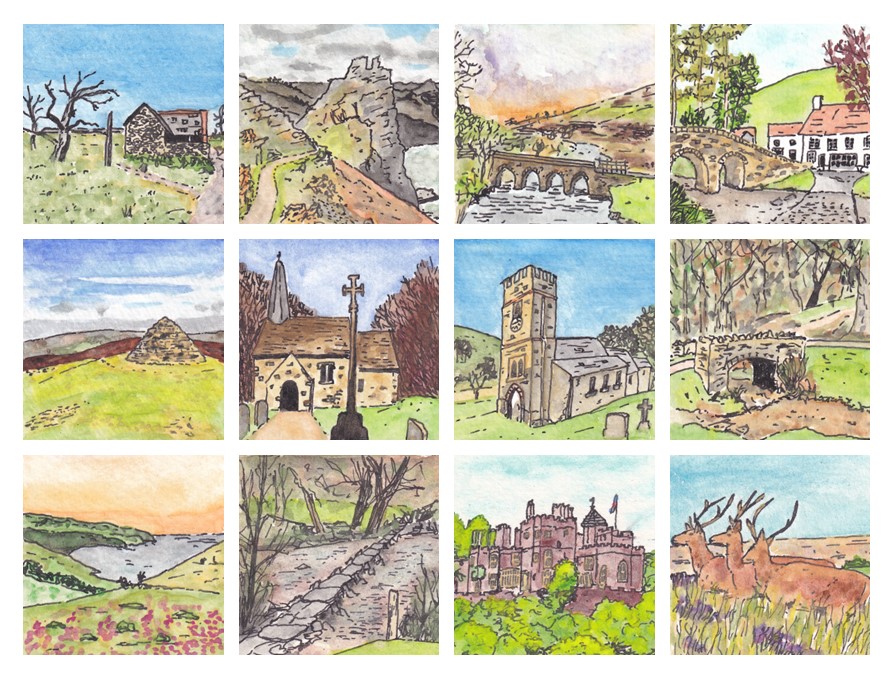
Our holiday in Exmoor in July 2025 obviously left me in an Exmoory mood, because within a couple of weeks of our return home I found that I had painted nine miniature watercolours of Exmoor Views. These were in the same small square format that I had used for my previous miniature watercolour series (Dartmoor Scenes , House Plants, Capital City Landmarks, Cornwall Landmarks, and Trees), with each one being painted quickly as part of the ‘morning routine’ that I generally try to get through each day before I try to settle into some more substantive activity.

Most of the subjects for these pictures were locations that we had visited during our holiday, with a couple being other Exmoor locations that I was familiar with from previous visits (including the many family holidays we had in Exmoor when I was a child). Working from top-left, across and down the grid of pictures above, the paintings show:

  • a ruined barn in Porlock Bay
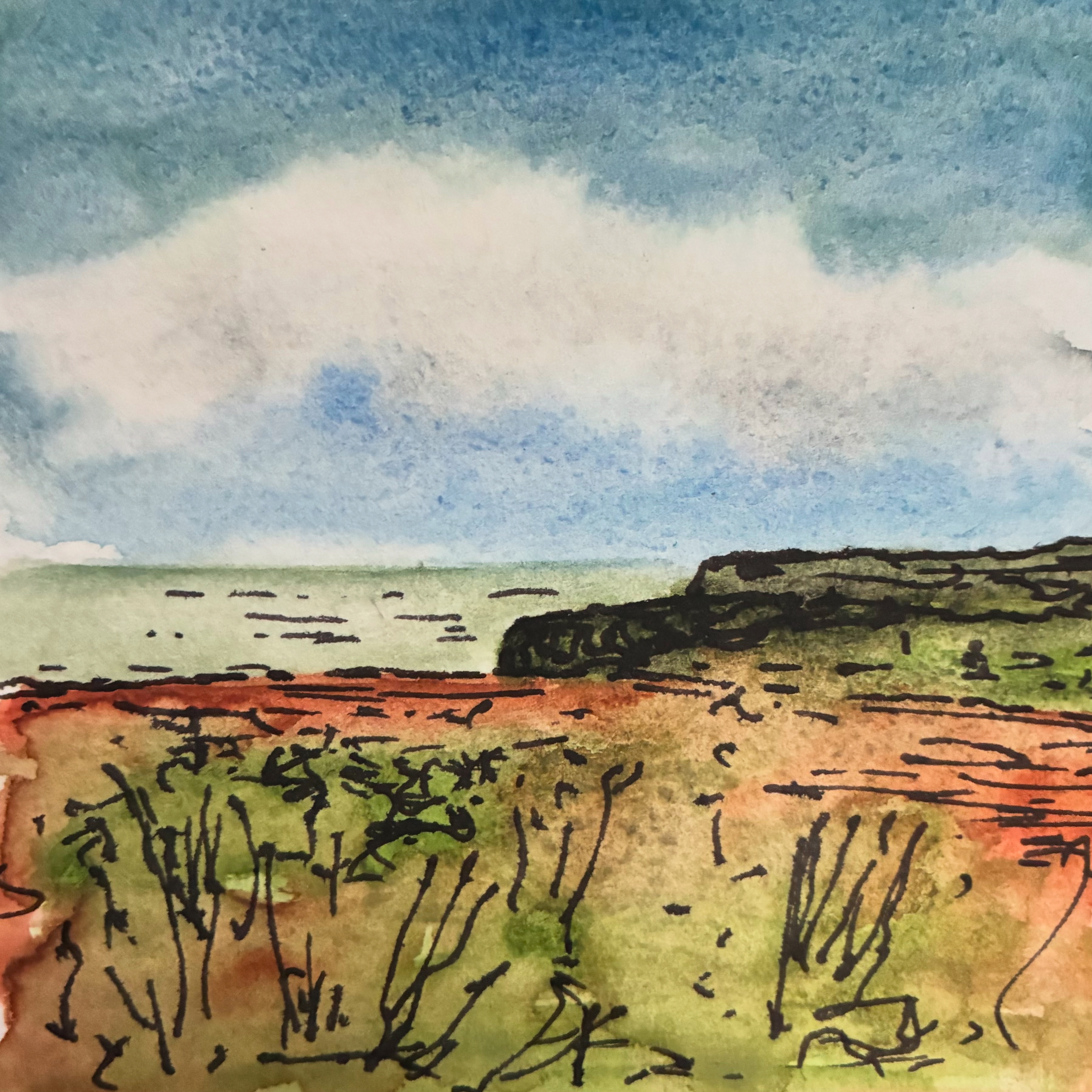
  • the Valley of the Rocks near Lynton
  • Landacre Bridge over the River Barle (possibly my mother’s favourite spot)
  • the bridge and ford at Malmsmead at the head of the Doone Valley
  • Dunkery Beacon – Somerset’s highest point
  • St Bueno’s Church at Culbone (said to be the smallest parish in England)
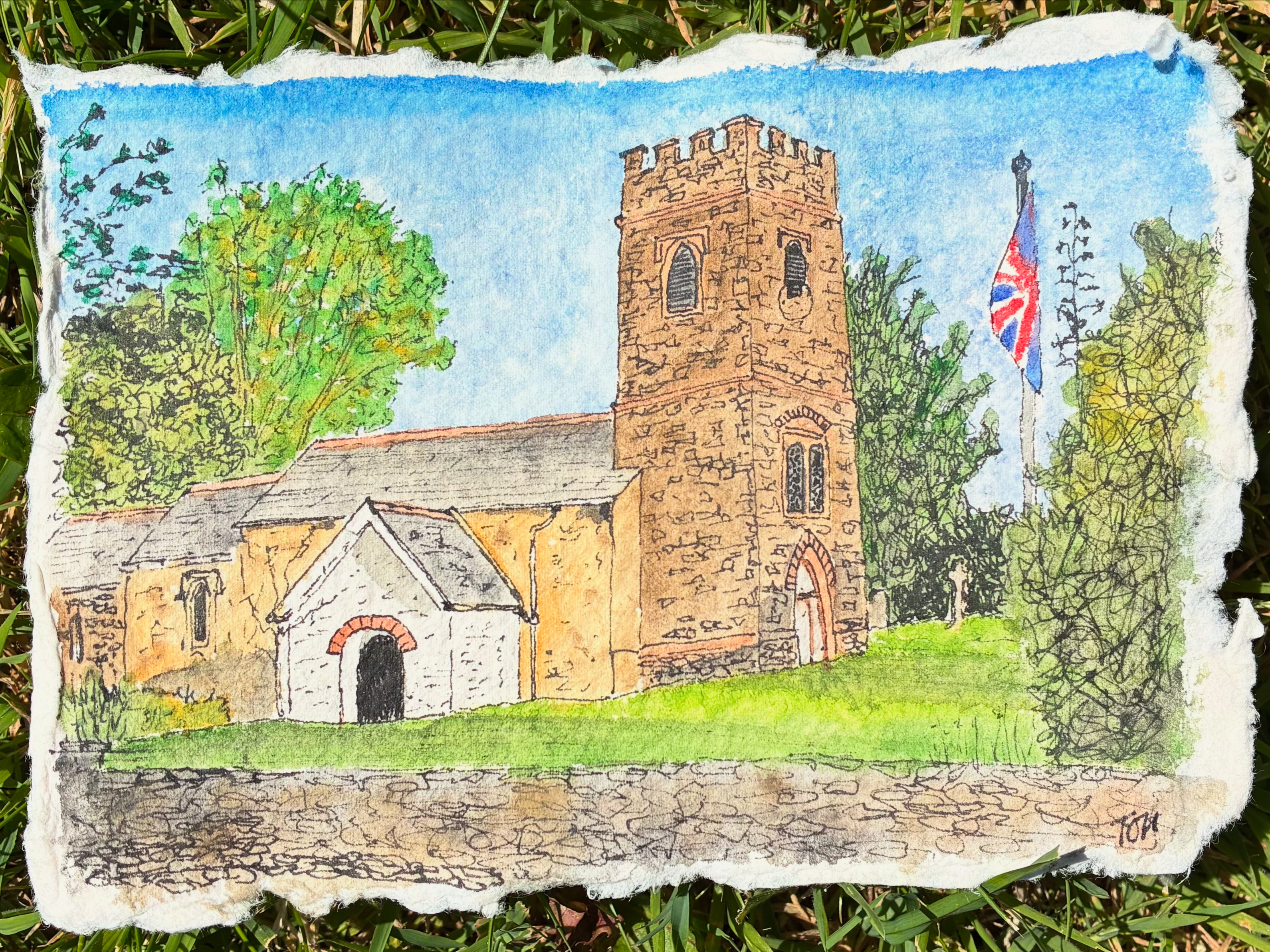
  • Oare Church (where Lorna Doone was shot on her wedding day)
  • Robber’s Bridge
  • a view across Porlock Bay from Bossington Hill

At the time I painted these pictures I had not fully settled into a pattern with my miniature watercolour pictures, but at some point in late summer 2025 I decided that I wanted all of these series to consist of twelve pictures, and so in October I painted three additional paintings to complete the set. These depict:

  • the ancient clapper bridge – Tarr Steps (also over the River Barle)
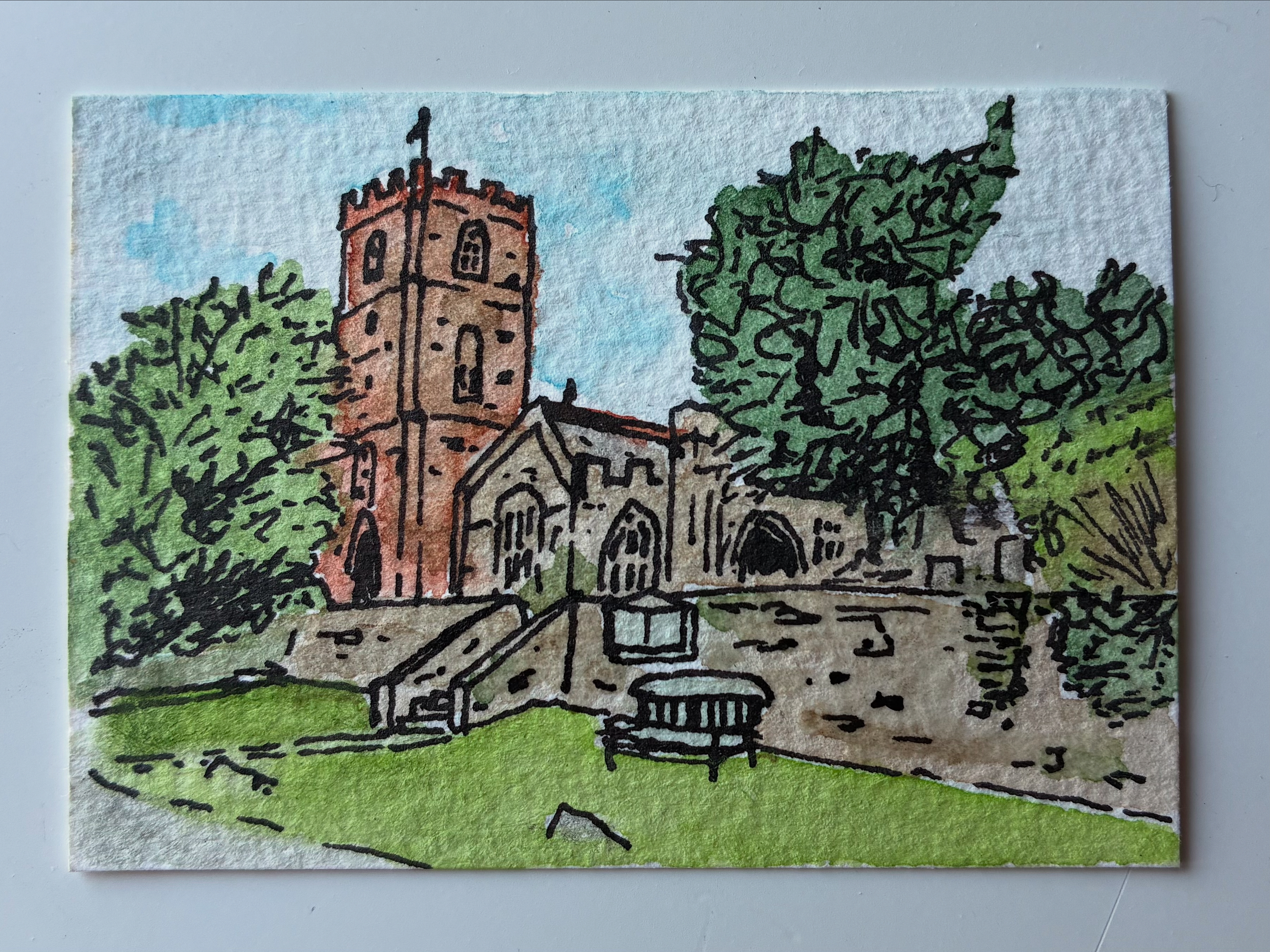
  • Dunster Castle
  • a group of red deer

Of these pictures, the most surprising one, both in terms of the subject matter and how the picture turned out, is the last. As I noted in Trees, my paintings generally avoid having people or animals in them (at least not in any detail), so the decision to have a go at drawing and painting Exmoor’s most dramatic wildlife was, for me, an unexpected and somewhat brave one! I was pleasantly surprised when they turned out quite well, in fact I think that this final picture is my favourite of the twelve:
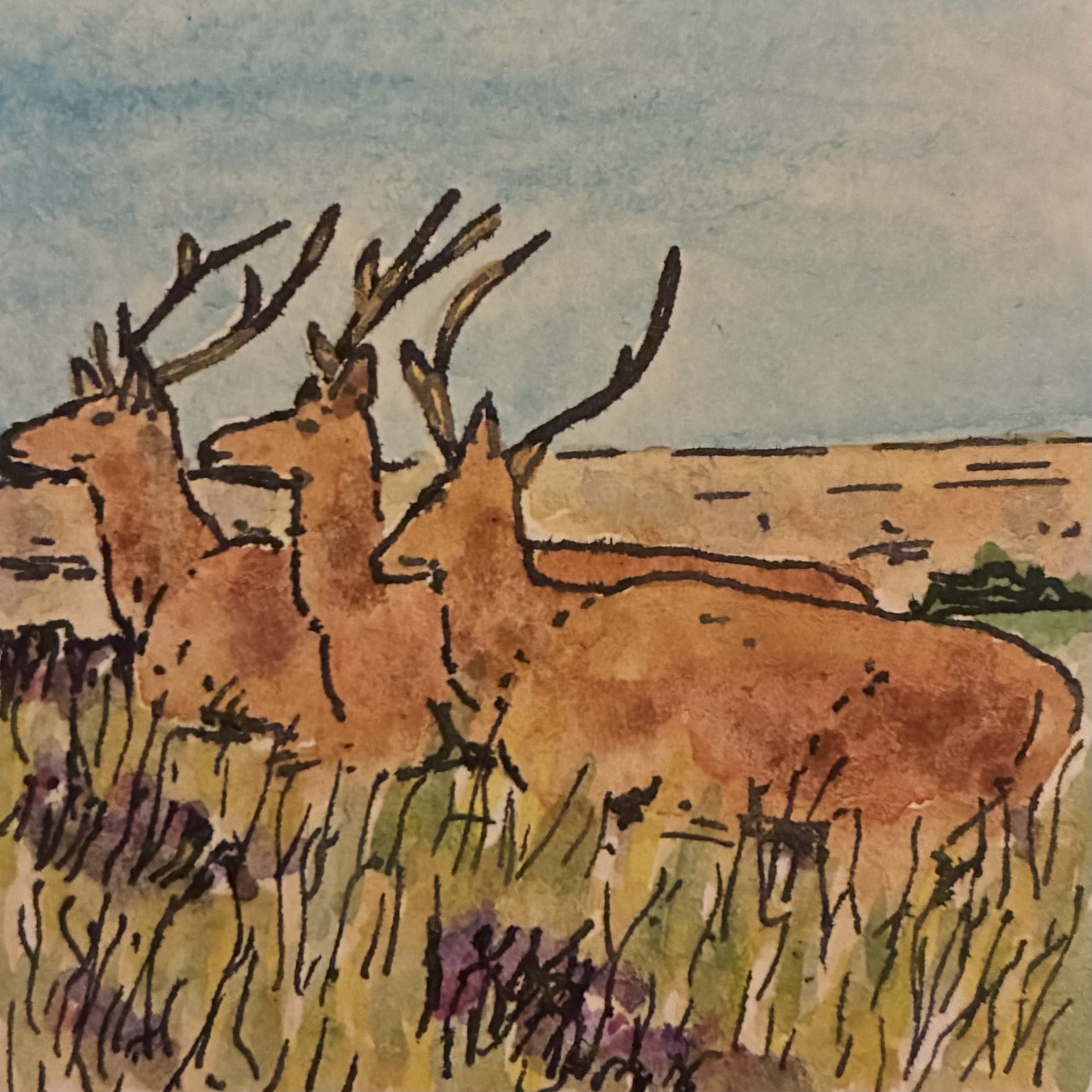
Red Deer on Exmoor

As with my other miniature watercolour series (the ones listed above and several more that I have produced more recently), I sell greetings cards featuring the individual pictures, and home-produced prints with either nine or twelve of the pictures, in my Etsy shop and on Facebook Marketplace.
Exmoor Paintings #art

View of the Exmoor Coast

As described in the posts Quantock Paintings – Part 1 and Quantock Paintings – Part 2, our summer holiday in 2025 was a multi-part affair. A short stay at Crowcombe on the Quantock Hills in June was followed a month later, by a few days a little further west in an AirBnB in Malmsmead, Exmoor. Malmsmead is a location that is well known for being at the head of the so-called ‘Doone Valley’, which is an interesting example of a landscape feature that (now) takes its name from a work of fiction, R.D. Blackmore’s 1869 tale of romance and villainy: ‘Lorna Doone’. However, despite having made many trips to Exmoor over the years, it wasn’t somewhere that I had explored much before.

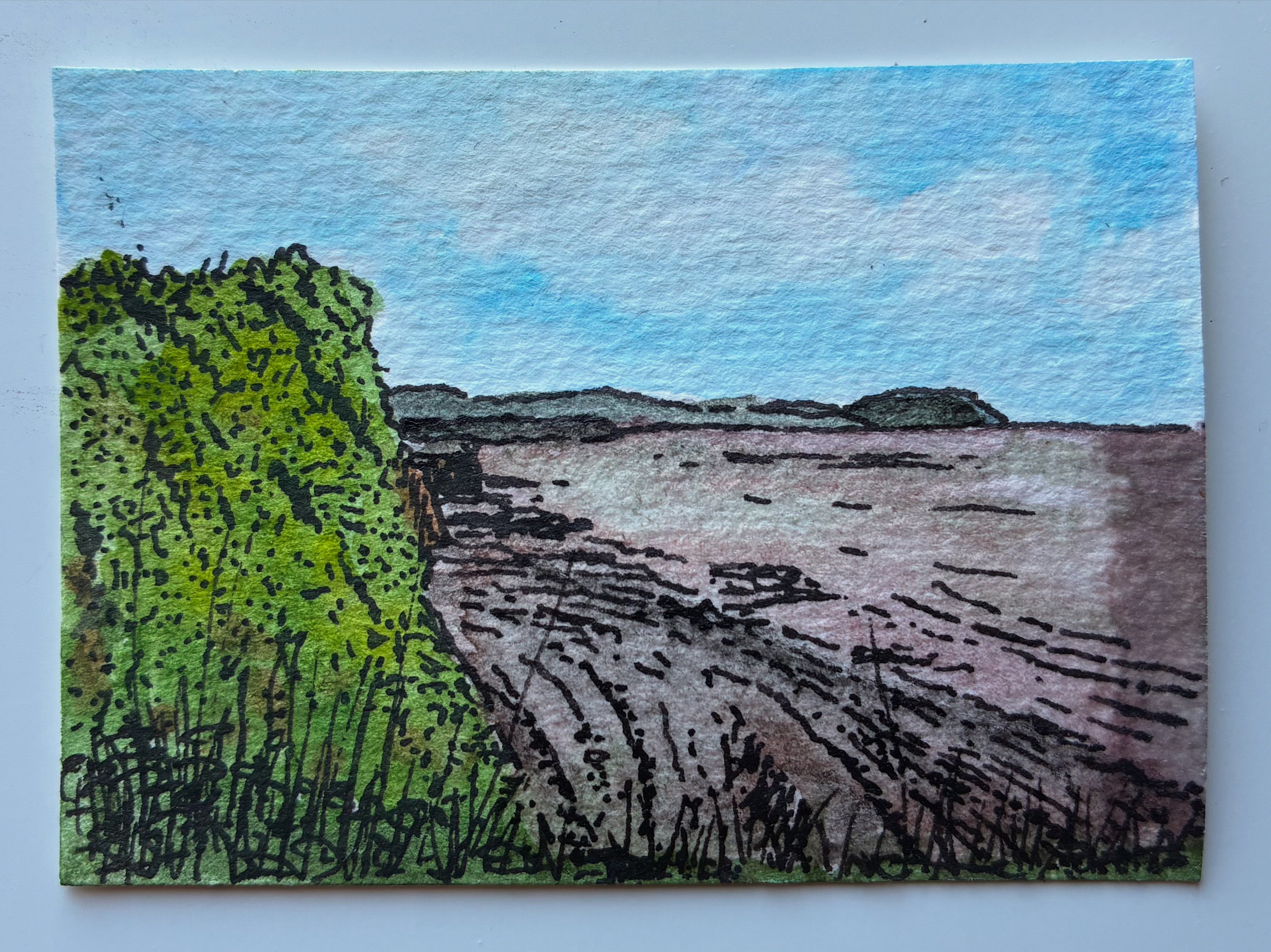
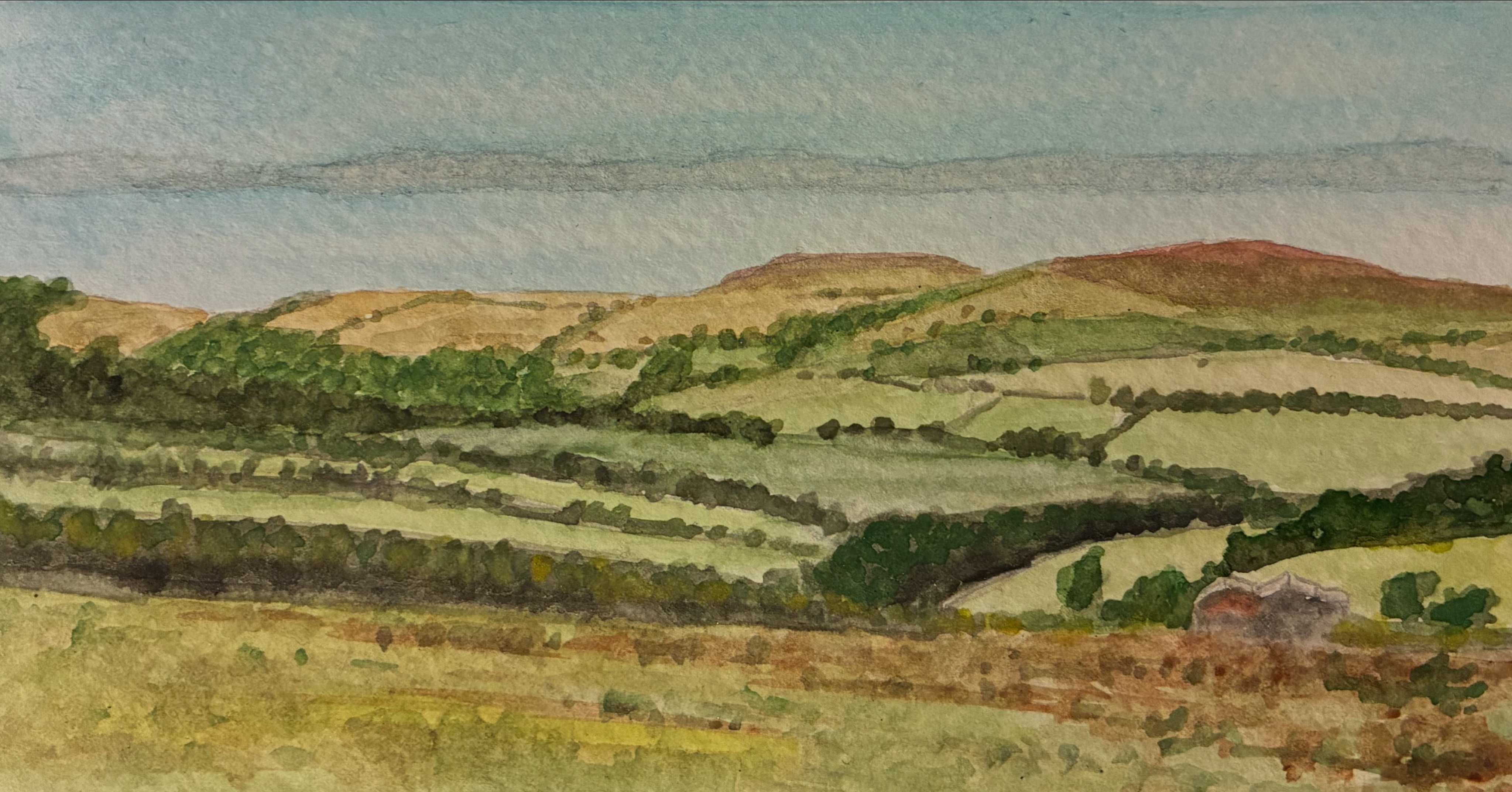
In Exmoor we were fortunate to be blessed with generally fine and warm weather, and were able to complete several great walks, including, naturally enough, one that took us all the way up the Doone Valley and west over open moorland, before returning north, with great views (see below) towards the Bristol Channel, via the village of Brendon and a nice drop of Exmoor Ale in The Staghunters Inn.

View towards Countisbury Hill, Exmoor

Our accommodation was only a 15 minute walk from the village of Oare, and so we also visited Oare Church, where (in the story) Lorna Doone was shot through a window by the evil, jilted Carver Doone as she stood to marry John Ridd. [Spoiler alert: Lorna survives, and John chases Carver Doone across the moor and watches him sink slowly to his death in a boggy mire, and they all (well all but Carver of course) live happily every after.]

Oare Church, Exmoor

We also completed a walk from Malmsmead towards the coast on what was perhaps the hottest afternoon of the year. This made the walk rather tough going, and this was not helped by the fact that the warm weather seemed to encourage what seemed to be every fly in the entire region to nip and nibble at me along the way.

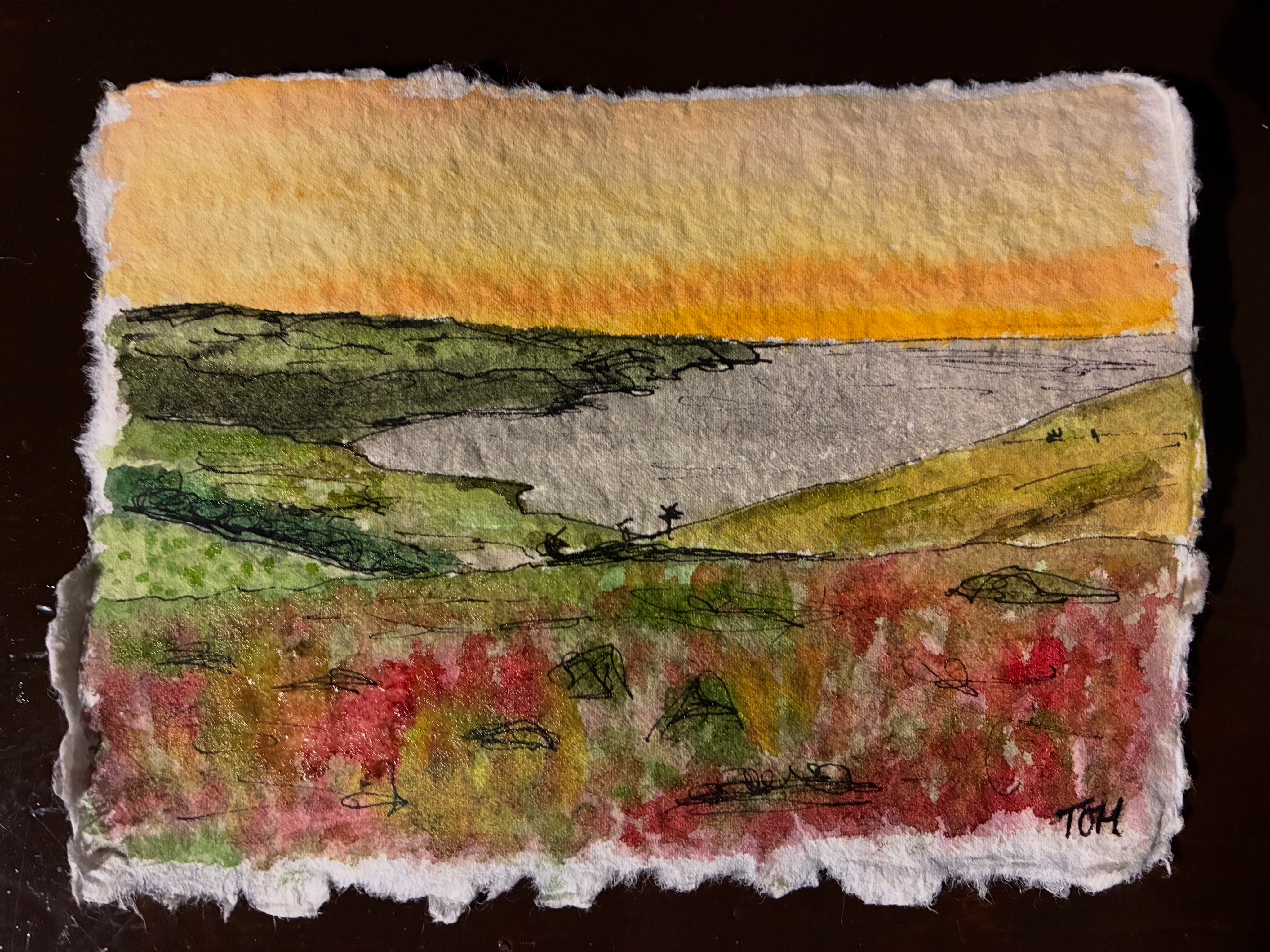
In between the walks, I found time for some painting of course, producing the various pictures that illustrate this post. The final painting I produced whilst away was of the view across Porlock Bay, where we had walked on the first day of our holiday, from Bossington Hill. As it’s a sunset view, it seems like a good picture to use to draw this post to a close…

Porlock Bay Sunset from Bossington Hill

Trees #art

When I started painting in April 2024 I concentrated mostly on painting buildings or landscapes in which any significant living elements such as trees, animals or people were sufficiently distant that I didn’t have to worry too much about their details. After a while, as I discovered my natural style and approach to painting and gained a bit more confidence in my ability, I began to try putting more detail into my work. In the case of trees, I found that if I slowed myself down, and really paid attention to what I was doing, the results of my efforts were not at all bad. (Sadly, whilst I have had some success more recently painting birds and animals, the same still cannot be said about my horrific attempts at incorporating people into my artworks…)

The set of twelve pictures above, a set that I refer to as my Trees series, were painted between June and November 2025, and ended up being the fifth series of miniature watercolour paintings that I produced. Most of the these series were been produced over a much shorter period of time, typically no more than 2-3 weeks, but with these tree pictures I didn’t set out to generate a full set of twelve pictures, they just emerged gradually, in between all of my other painting efforts. Each picture is a 9cm square, a little larger than most of my miniature series paintings (which are typically ~5cm square), and for this reason, I’ve been able to print larger 16cm versions from the originals, that look really smart in a frame, without suffering from resolution issues.

In most cases, I painted these trees from photographs that I had taken at some point, and so I know (roughly) where most of the trees are. However, there are a few that were based on photos from internet searches, and unfortunately I’ve lost track of the details of those ones – keeping track of these kinds of details is something that I still need to get better at. Working from top-left, across and down the grid of twelve pictures, the pictures show:

  • a large tree on the main ridge of the Quantock Hills, above Crowcombe in Somerset, with huge roots that formed a window to frame the view beyond
  • twisted branches and autumn leaves (location unknown)
  • a lone conifer on the southwestern edge of Dartmoor, somewhere on Harrower Common near Yelverton, Devon
  • a view looking back along the cycle path between Clearbrook and Yelverton
  • a lone tree of a type that I like to refer to as a ‘symmetree’ in a slight hollow, again on the main ridge of the Quantock Hills above Crowcombe
  • my favourite row of beech trees below Peek Hill next to the main road from Yelverton to Princetown, Dartmoor
  • beech tree trunks near Grassington in Wharfedale, Yorkshire
  • a typically-windswept tree on Dartmoor
  • a muddy track through some conifer woodland (location unknown)
  • a lone holly tree on Roborough Down
  • a view through a group of pine trees, across the Yealm Estuary from the coast path between Wembury and Warren Point in South Devon
  • a spectacular autumnal, orange-leafed tree in the gardens of Cotehele House (or it might be in the Lost Gardens of Heligan)

Although they are quite simple, some of these tree pictures – the Peek Hill beech trees, the Yorkshire beech tree trunks, and the pine trees near Warren Point – are amongst my personal favourites of all of the pictures I have painted so far. I’ve listed prints of these pictures (composite prints of all twelve and a smaller square version with nine pictures) and greetings cards featuring individual pictures for sale on Facebook Marketplace and in my Etsy shop, but perhaps unsurprisingly, given the chances that anyone putting ‘tree painting’ into their internet search engine will be directed to my tree paintings rather than any of the hundreds if not thousands of alternatives available, I’ve not had any sales so far. But a family friend was so taken with these pictures that she bought a set of four framed prints of her favourite individual trees as a present for a friend and then came back and bought another set for her nephew! It’s nice to know that there is at least one other person out there who also likes these pictures!

Quantock Paintings – Part 2 #art

Following on from my previous art post (Quantock Paintings – Part 1), here are a few more of the paintings that I did during, or shortly after returning home from, our short break in Crowcombe, at the foot of the Quantock Hills in Somerset, last June.

First, here are a couple of pictures depicting views from walks that we did. Both are in my ‘normal’ style, a simple ink pen sketch with the watercolours added on top. I think that I have a tendency to try to put a lot of detail into my drawings (at least until I get bored and start scribbling in trees and foliage), but I am conscious that with painting it is often a case of ‘less is more’. In these two pictures I think that I managed to hold myself in check and kept the drawings fairly simple and ‘loose’. The pictures show Crowcombe Church and a view of the coastline at East Quantoxhead…

Crowcombe Church
View of East Quantoxhead (with a bit of an issue on the right-hand edge!)

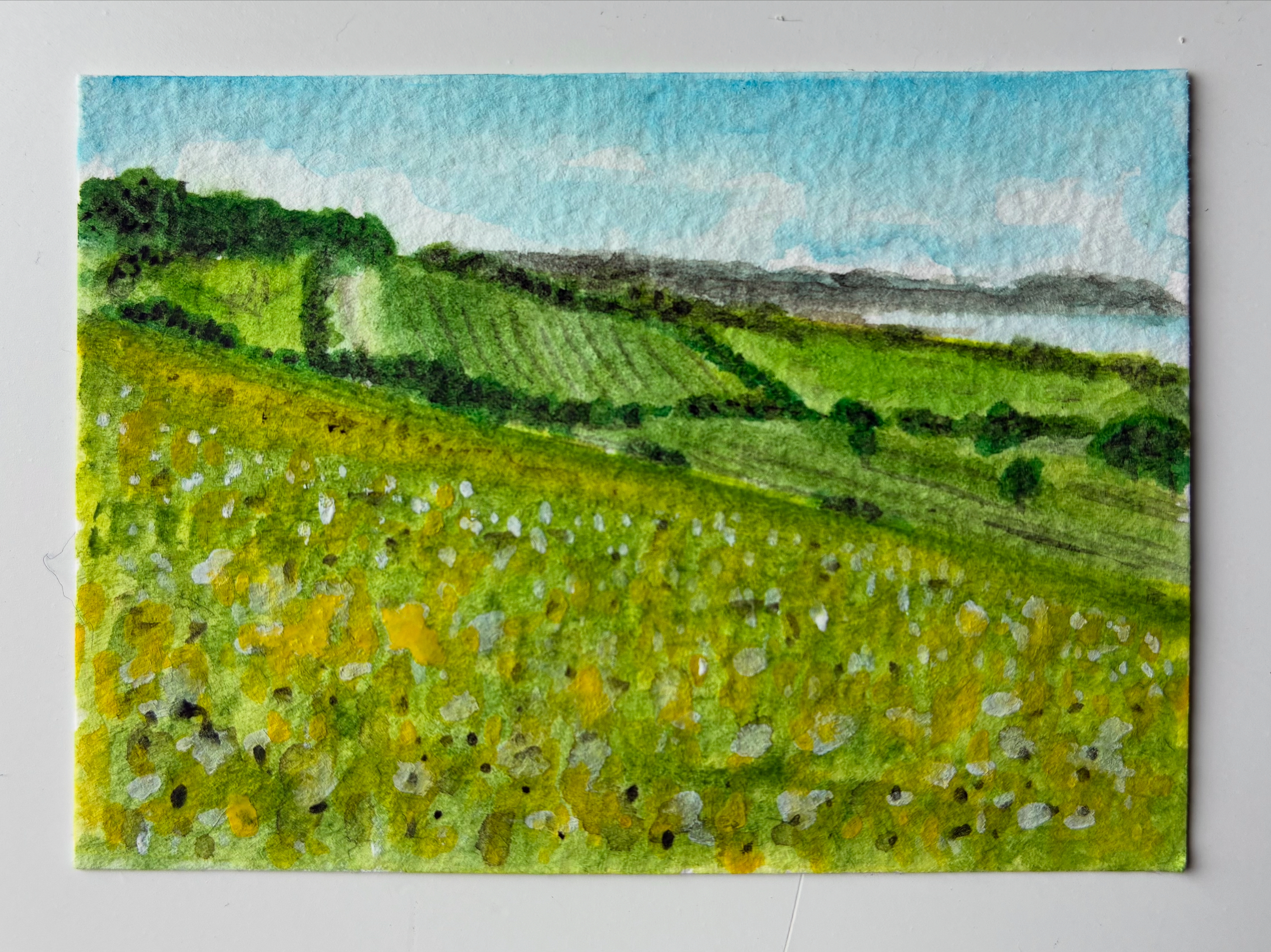
Next, I’ve included the results of an attempt to play with a slightly different approach, eschewing entirely the use of an ink pen to create a base sketch, and instead, going straight for the watercolour paints. I think that in many people’s minds, traditional (true?) watercolour paintings use only paints, generally placing these on a much wetter surface than I use, but I’ve not had any artistic training whatsoever so that’s not how my work has evolved. This picture shows a view from another of the walks that we did, looking west towards Minehead across hedge-lined fields with a riot of wildflowers in the foreground…

Somerset Fields with Wildflowers (no ink)

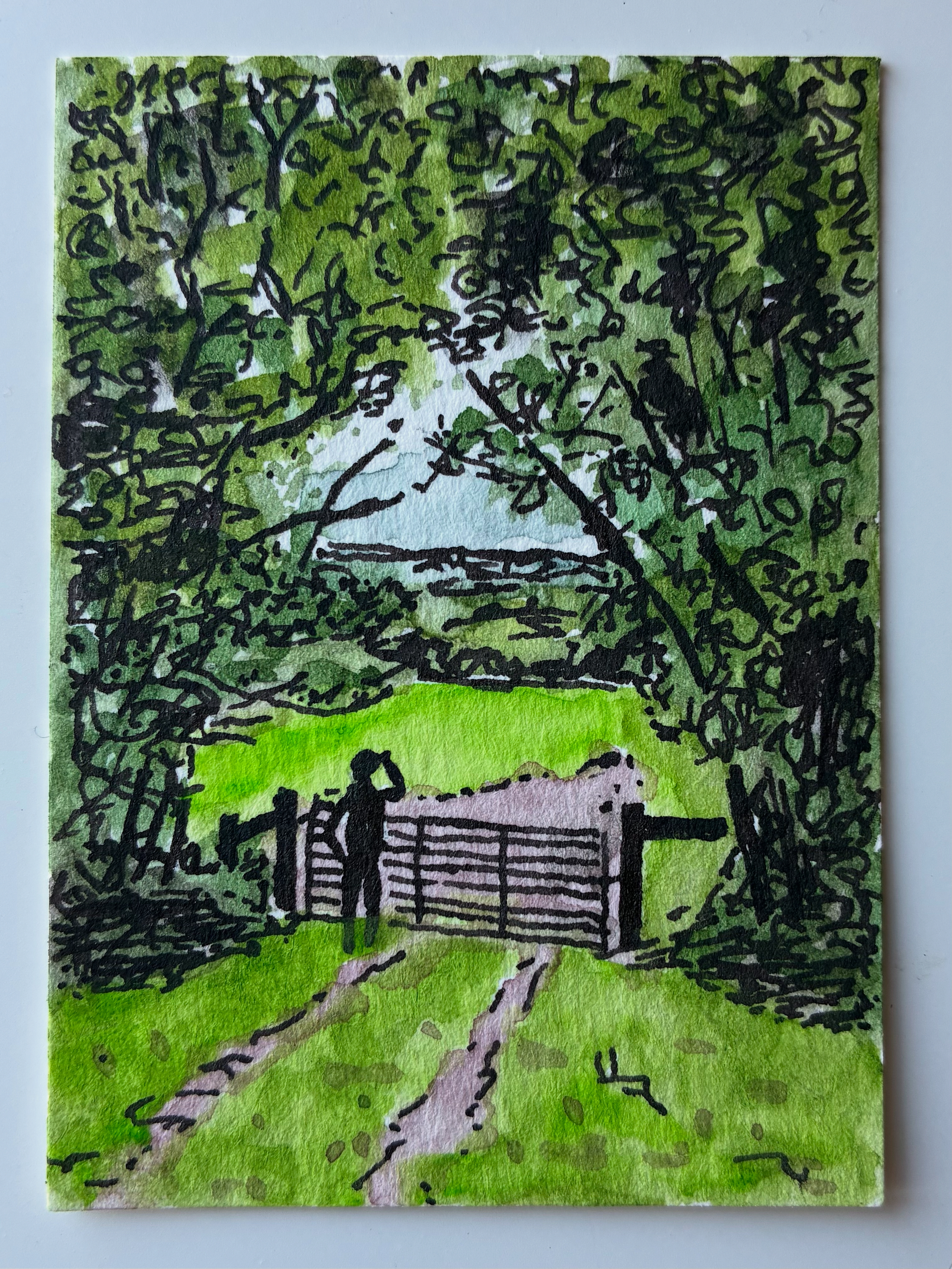
The vast majority of my paintings are of landscapes in one form or another. This is partly because I like landscapes, but also partly because whilst I might be able to make a decent fist of painting trees, fields, hills and buildings etc., I’m pretty much hopeless at drawing and painting people and animals. So, the picture below is a little unusual because it features me, standing at a gate looking east from the main ridge of the Quantock Hills. I like this picture because it is a bit quirky, with some nice ‘busy’ trees, but I don’t think it does anything to improve my reputation as a painter of people!

Through the Trees

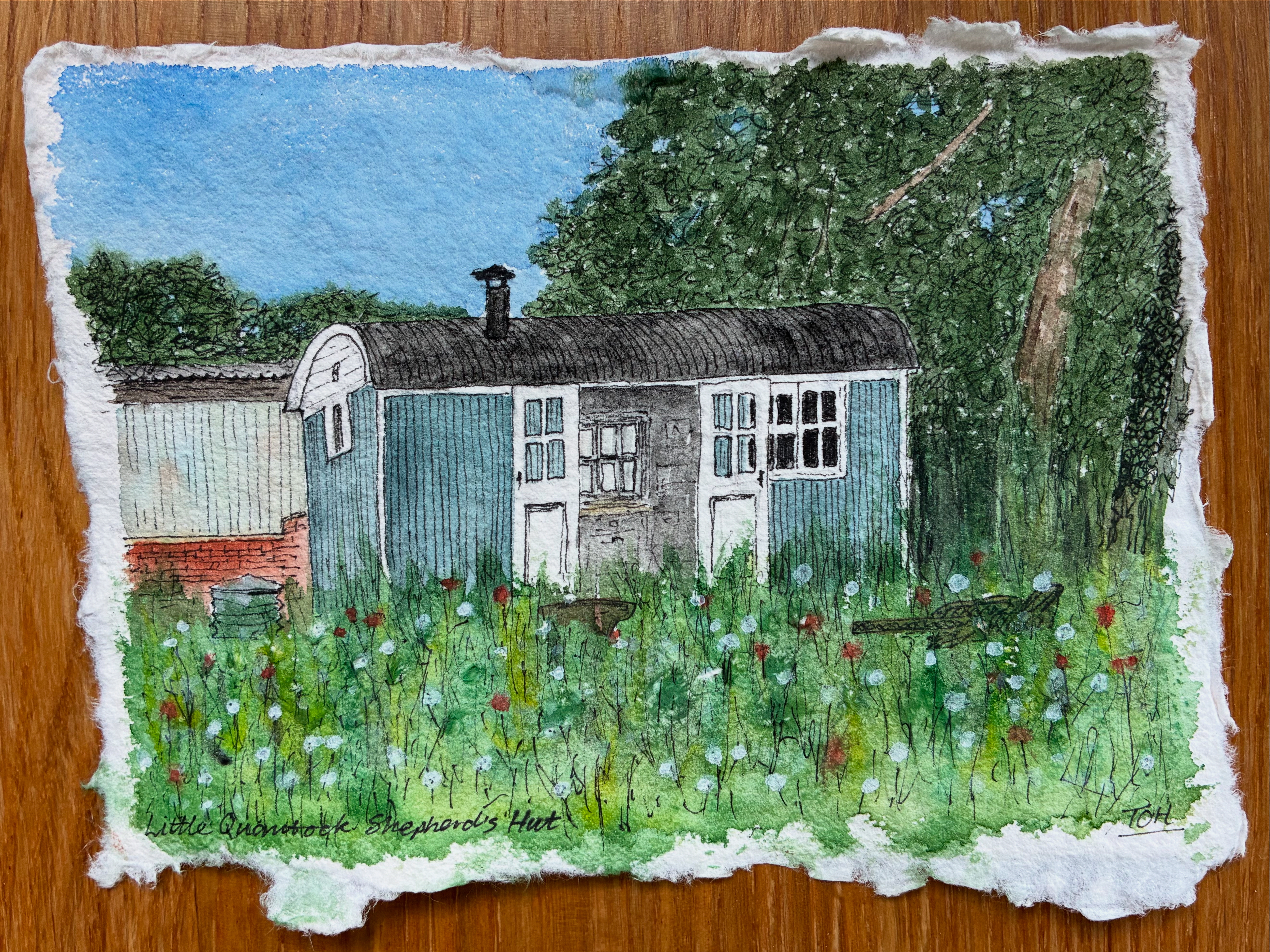
Finally, it’s become a tradition now that I paint a picture showing whatever accommodation we have stayed in when we are away, which we then leave behind as a thank you to the owner of the accommodation. In this case, we were staying in a delightful little Shepherd’s Hut, with a sunset view towards Exmoor. Now, for me to describe a Shepherd’s Hut as ‘delightful’ is something of a miracle, but although the picture doesn’t capture the view, I think it does capture something of the charm of the place.

Crowcombe Short-Break Shepherd’s Hut

I’ve written this post almost exactly one year on from our stay in Crowcombe, and it’s been nice to look back on these pictures and be reminded of a really pleasant few days in a quiet and beautiful part of the world.

Quantock Paintings – Part 1 #art

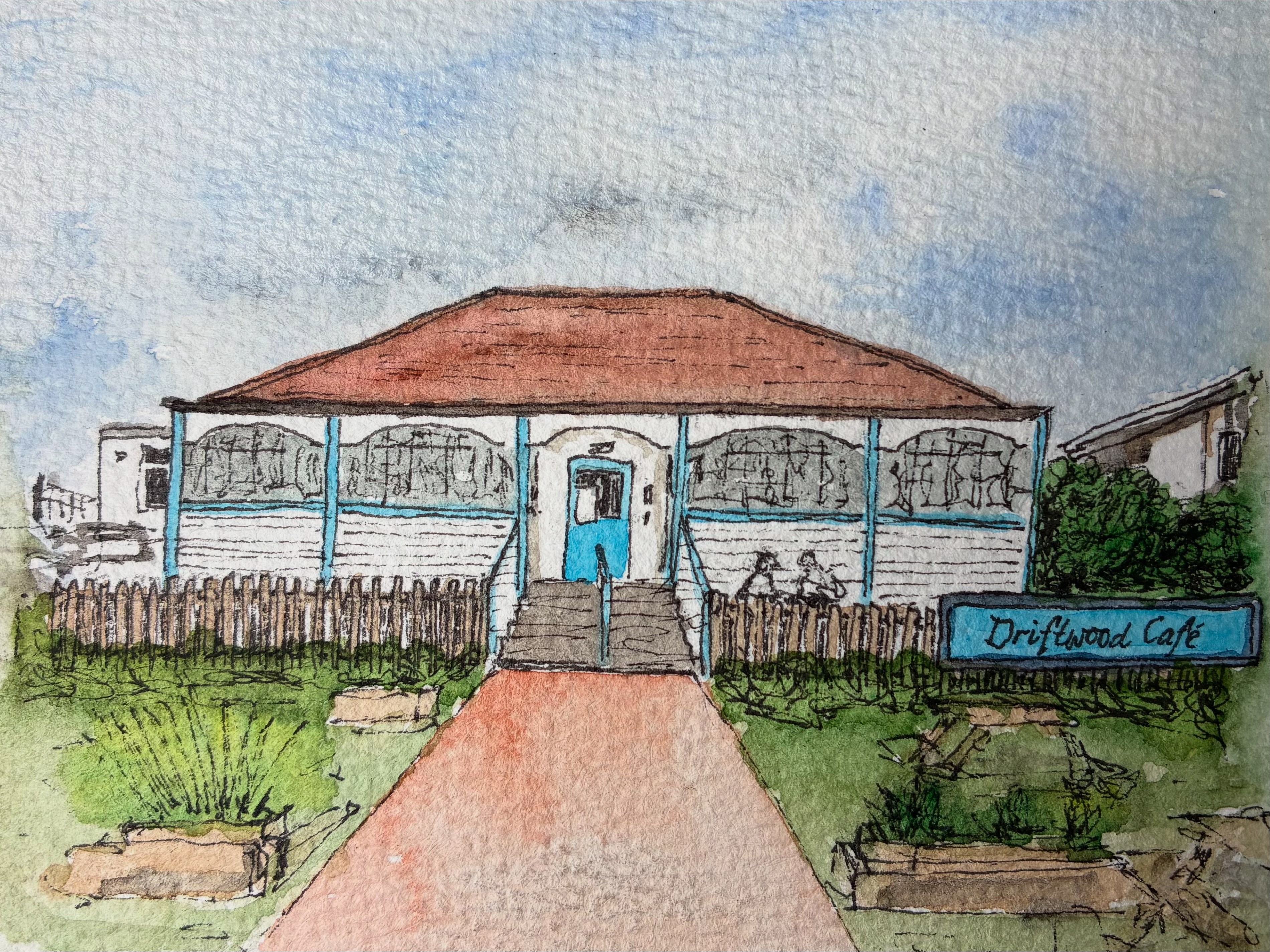
Driftwood Cafe, Blue Anchor, Somerset

In recent summers we have take a series of summer holidays walking in the Yorkshire Dales – first in Swaledale (staying at Low Row near Reeth), then in Wharfedale (based in Ilkley) and last year in ‘Bronte Country’ near Haworth. In each case we combined our week in Yorkshire with a day or two staying somewhere en route to and from our home in Plymouth, or in one case a second week away in Norfolk and Suffolk. For a change, this year, we decided that we’d like to spread our holiday time out over the summer months, and so we picked a couple of fairly local destinations for ‘long weekend’ walking holidays and also booked five days over in Suffolk, combining this with a visit to elderly relatives and an old university friend on mine.

The first of our summer 2025 mini-break locations, in June, took us back to the very familiar territory (for me at least) of the Quantock Hills and the Somerset coast. I grew up a short distance from there in Bridgwater, and we would frequently go on family outings to the area. I also spent quite a lot of time at an activity centre in Kilve on short courses of various kinds (mostly musical).

Although I do like discovering new places, I also very much enjoy returning to familiar haunts, especially for a short trip when you want to be able to slot straight into holiday mode without having to spend time orienting yourself and getting the lie of the land. Our Somerset trip – staying in an AirBnB Shepherd’s Hut near the village of Crowcombe, tucked at the bottom of the western side of the Quantock Hills ridge, very much fell into this ‘familiar territory’ category.

While we were away we enjoyed completing a couple of lengthy walks direct from our accommodation (I particular enjoy a stay away that doesn’t involve having to get in the car), and I was able to spend quite a bit of time painting. In this post I’ll feature four of the pictures that I produced during the break, and I’ll pick up the thread with another post soon that will feature a further group of five pictures.

We started our holiday with lunch at a favourite cafe, the Driftwood Cafe at Blue Anchor – the subject of my first picture (shown at the top of this post). It’s not a fancy cafe at all – I’d describe it as a ham, egg and chips or baked potato cafe – it’s just a nice, simple, easy-going place for a quick bite to eat.

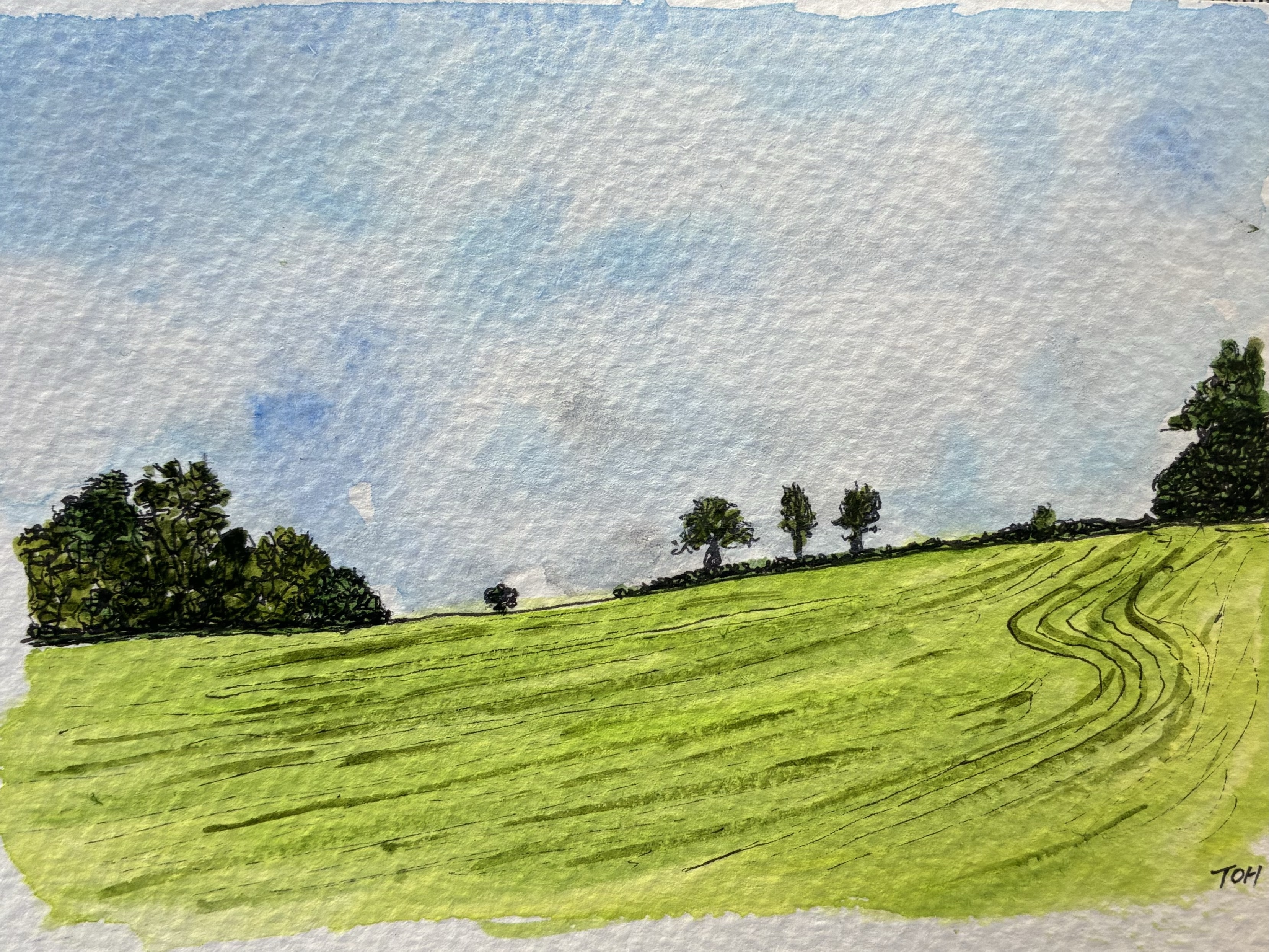
Suitably refueled we then drove the short distance to Kilve and did a short walk (~3 miles) along the coast to East Quantoxhead, before turning inland and returning to the car, with a stop at the Chantry Tea Garden at Kilve where we were the only customers and had an interesting conversation with the owner, who used to be a frequent visitor to Plymouth. The two pictures below show a view of a field that we passed on the return leg (I’ve got a thing for trees silhouetted on the horizon) and the view that we had from our table in the cafe garden of The Chantry itself and the white cottage from which the cafe was run.

Grass Cut Field Near Kilve, Somerset
The Chantry Tea Garden, Kilve, Somerset

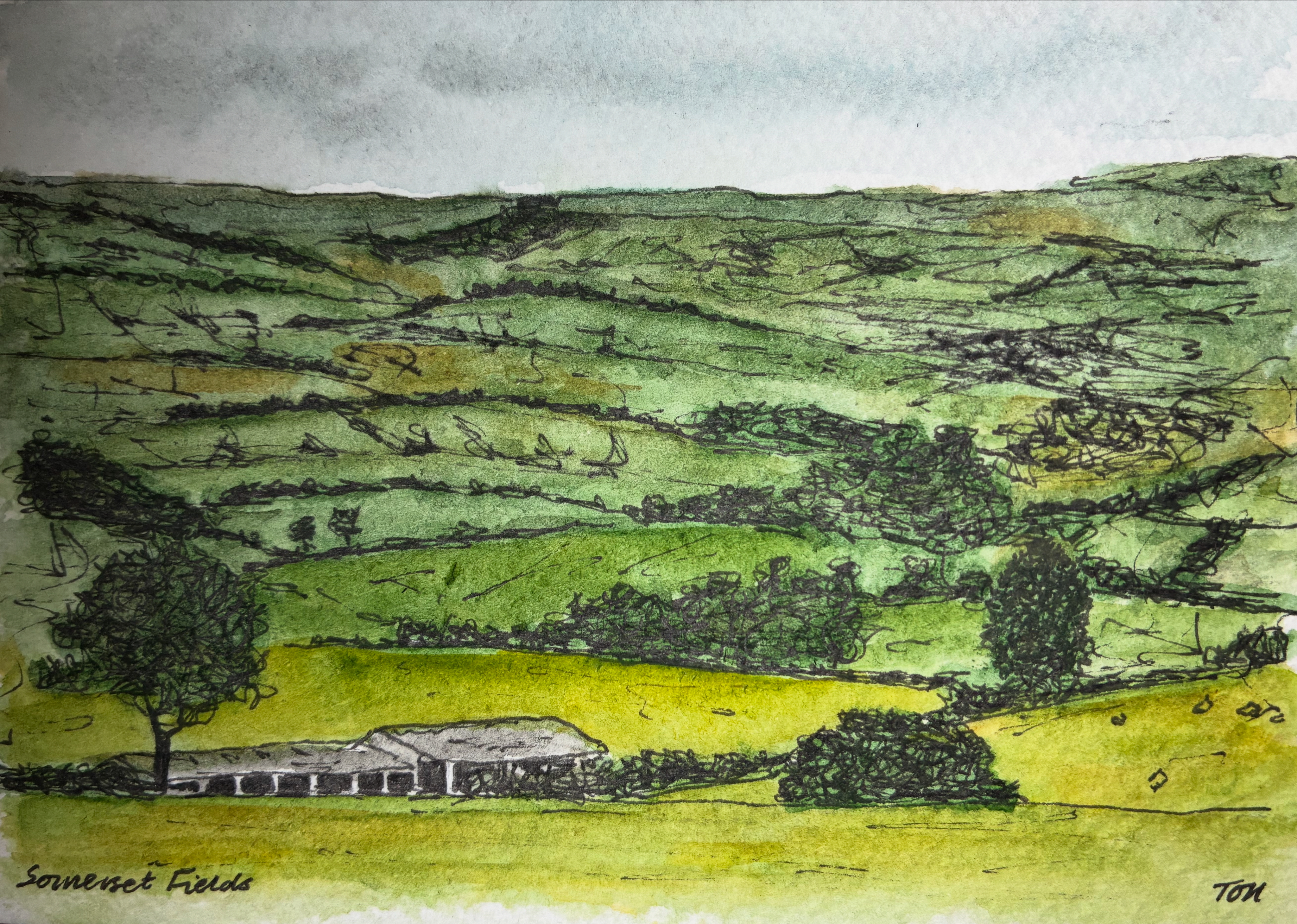
Finally, for now, here’s a scene I painted of the view looking west in the direction of Exmoor from the base of the Quantock Hills. I’ve tried to capture the way that there are successive ‘layers’ of rolling hills as the eye moves towards the horizon, each becoming progressively just a little higher than the previous one. Although wild landscapes can be exhilarating, I do like a farmed landscape – a patchwork of fields, hedges, copses and the odd farm building.

Somerset Fields Looking West From Near Crowcombe

All of these pictures were really just quick ‘practice’ pieces, but I like them all in different ways – Driftwood Cafe for its small details, the grass-cut field for its slightly abstract form, Chantry Tea Garden for its looseness, and Somerset Fields for the way it captures something of the wide expansiveness of the view.

If you have a favourite of these four pictures write a quick comment to let me know!