Our holiday in Exmoor in July 2025 obviously left me in an Exmoory mood, because within a couple of weeks of our return home I found that I had painted nine miniature watercolours of Exmoor Views. These were in the same small square format that I had used for my previous miniature watercolour series (Dartmoor Scenes , House Plants, Capital City Landmarks, Cornwall Landmarks, and Trees), with each one being painted quickly as part of the ‘morning routine’ that I generally try to get through each day before I try to settle into some more substantive activity.
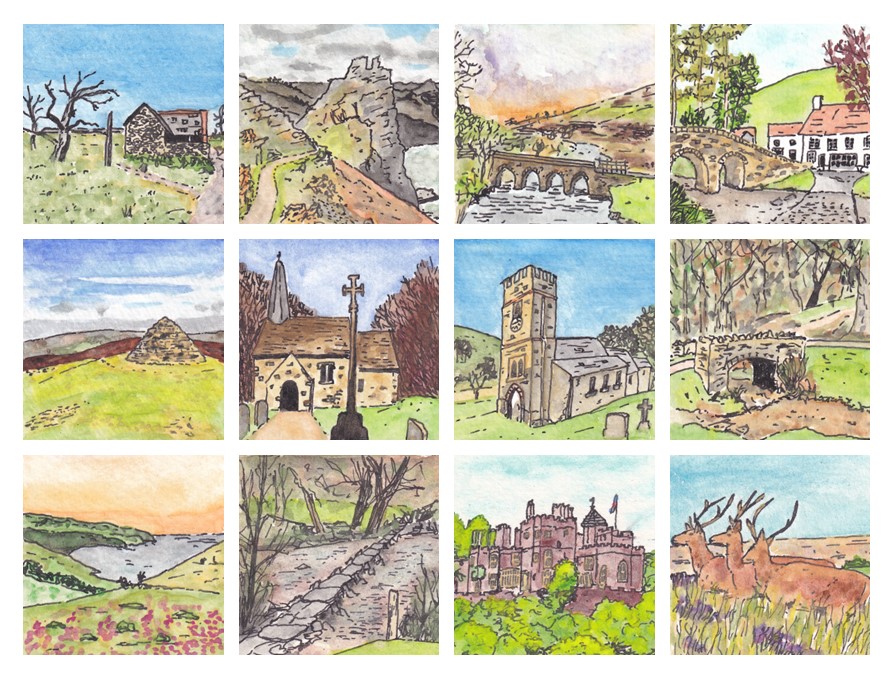
Most of the subjects for these pictures were locations that we had visited during our holiday, with a couple being other Exmoor locations that I was familiar with from previous visits (including the many family holidays we had in Exmoor when I was a child). Working from top-left, across and down the grid of pictures above, the paintings show:
a ruined barn in Porlock Bay
the Valley of the Rocks near Lynton
Landacre Bridge over the River Barle (possibly my mother’s favourite spot)
the bridge and ford at Malmsmead at the head of the Doone Valley
Dunkery Beacon – Somerset’s highest point
St Bueno’s Church at Culbone (said to be the smallest parish in England)
Oare Church (where Lorna Doone was shot on her wedding day)
Robber’s Bridge
a view across Porlock Bay from Bossington Hill
At the time I painted these pictures I had not fully settled into a pattern with my miniature watercolour pictures, but at some point in late summer 2025 I decided that I wanted all of these series to consist of twelve pictures, and so in October I painted three additional paintings to complete the set. These depict:
the ancient clapper bridge – Tarr Steps (also over the River Barle)
Dunster Castle
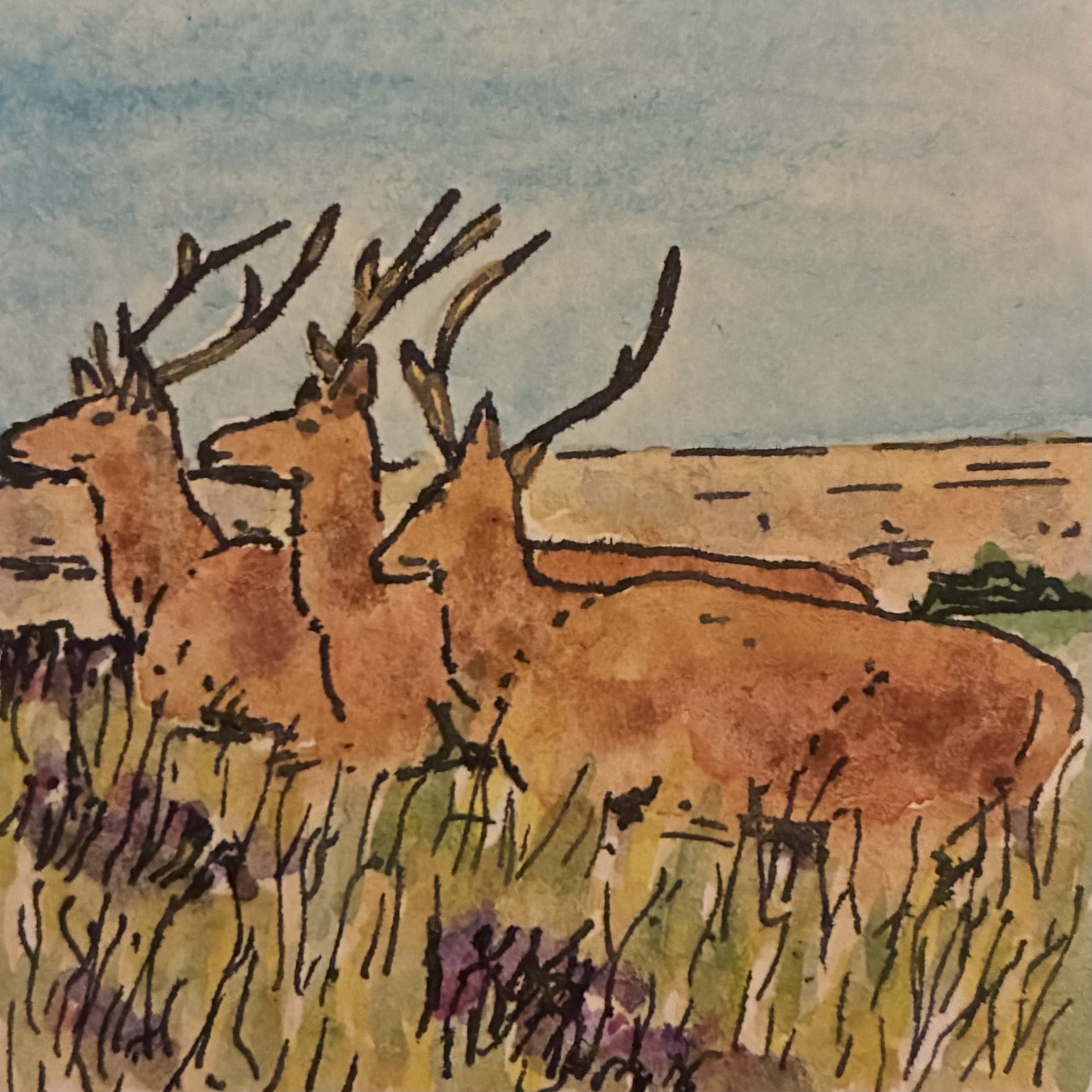
a group of red deer
Of these pictures, the most surprising one, both in terms of the subject matter and how the picture turned out, is the last. As I noted in Trees, my paintings generally avoid having people or animals in them (at least not in any detail), so the decision to have a go at drawing and painting Exmoor’s most dramatic wildlife was, for me, an unexpected and somewhat brave one! I was pleasantly surprised when they turned out quite well, in fact I think that this final picture is my favourite of the twelve:
Red Deer on Exmoor
As with my other miniature watercolour series (the ones listed above and several more that I have produced more recently), I sell greetings cards featuring the individual pictures, and home-produced prints with either nine or twelve of the pictures, in my Etsy shop and on Facebook Marketplace.
Quartet No.1 in C Major I. Exceptional (maestoso ridicolo) II. Growing (allegro vivamente) III. Discovering (allegro con abbandono) IV. Fearful (moderato sostenuto)
Quartet No. 2 in E Major I. Interested (scherzo giocoso) II. Hopeful (andante sognando) III. Exploring (allegro impetuoso) IV. Indecisive (adagietto dissonante)
Quartet No. 3 in A flat minor I. Struggling (largamente melancolico) II. Puzzled (andante misterioso) III. Frustrated (allegro incalzando) IV. Trying (allegro spiritoso)
Quartet No. 4 in D sharp minor I. Disappointed (andante con dolore) II. Angry (allegro furioso) III. Overwhelmed (andate lacrimoso) IV. Capitulated (largo perdendosi)
(c) Tim O’Hare, January 2024
About this poem: Over the last couple of days I have felt a growing sense of inner doom and then today I woke to find myself the recipient of another visit from The Hollow Man. The result was that despite having a mountain of work things to do I found myself stealing time to construct this poem. It started out as a list of words chosen to express something of the way I was seeing different stages of my life and then as these settled naturally into four groups of four I could not resist the reference to T.S. Eliot and the idea of representing the list as a set of musical works complete with accompanying musical terms for tempo and associated emotion. Perhaps it is all a little dark and almost certainly it is a lot contrived but writing this poem seems to have done its job and I can now start to move on again.
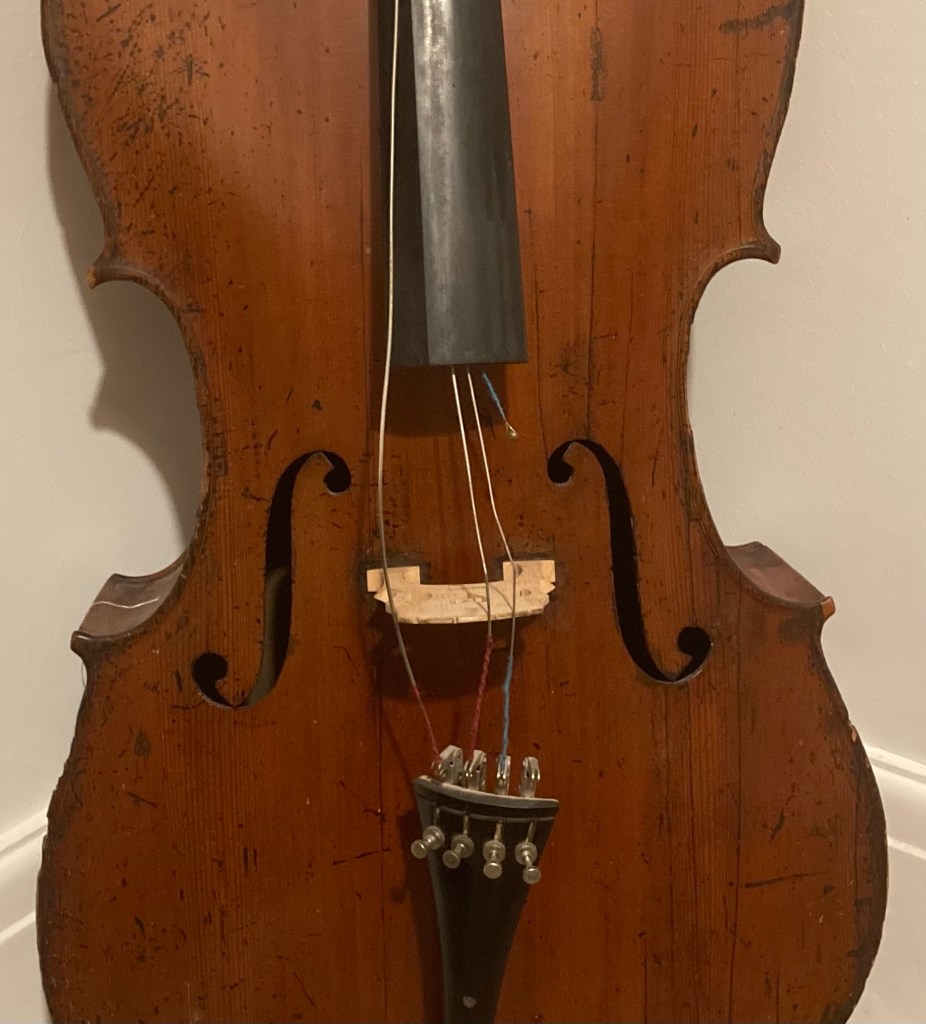
[The photo shows my ‘cello which suffered a broken tail gut leading to its bridge and sound post (internal) collapsing, shortly before the poem was written. It felt like an appropriate accompaniment to the poem…]
As described in the posts Quantock Paintings – Part 1 and Quantock Paintings – Part 2, our summer holiday in 2025 was a multi-part affair. A short stay at Crowcombe on the Quantock Hills in June was followed a month later, by a few days a little further west in an AirBnB in Malmsmead, Exmoor. Malmsmead is a location that is well known for being at the head of the so-called ‘Doone Valley’, which is an interesting example of a landscape feature that (now) takes its name from a work of fiction, R.D. Blackmore’s 1869 tale of romance and villainy: ‘Lorna Doone’. However, despite having made many trips to Exmoor over the years, it wasn’t somewhere that I had explored much before.
In Exmoor we were fortunate to be blessed with generally fine and warm weather, and were able to complete several great walks, including, naturally enough, one that took us all the way up the Doone Valley and west over open moorland, before returning north, with great views (see below) towards the Bristol Channel, via the village of Brendon and a nice drop of Exmoor Ale in The Staghunters Inn.
View towards Countisbury Hill, Exmoor
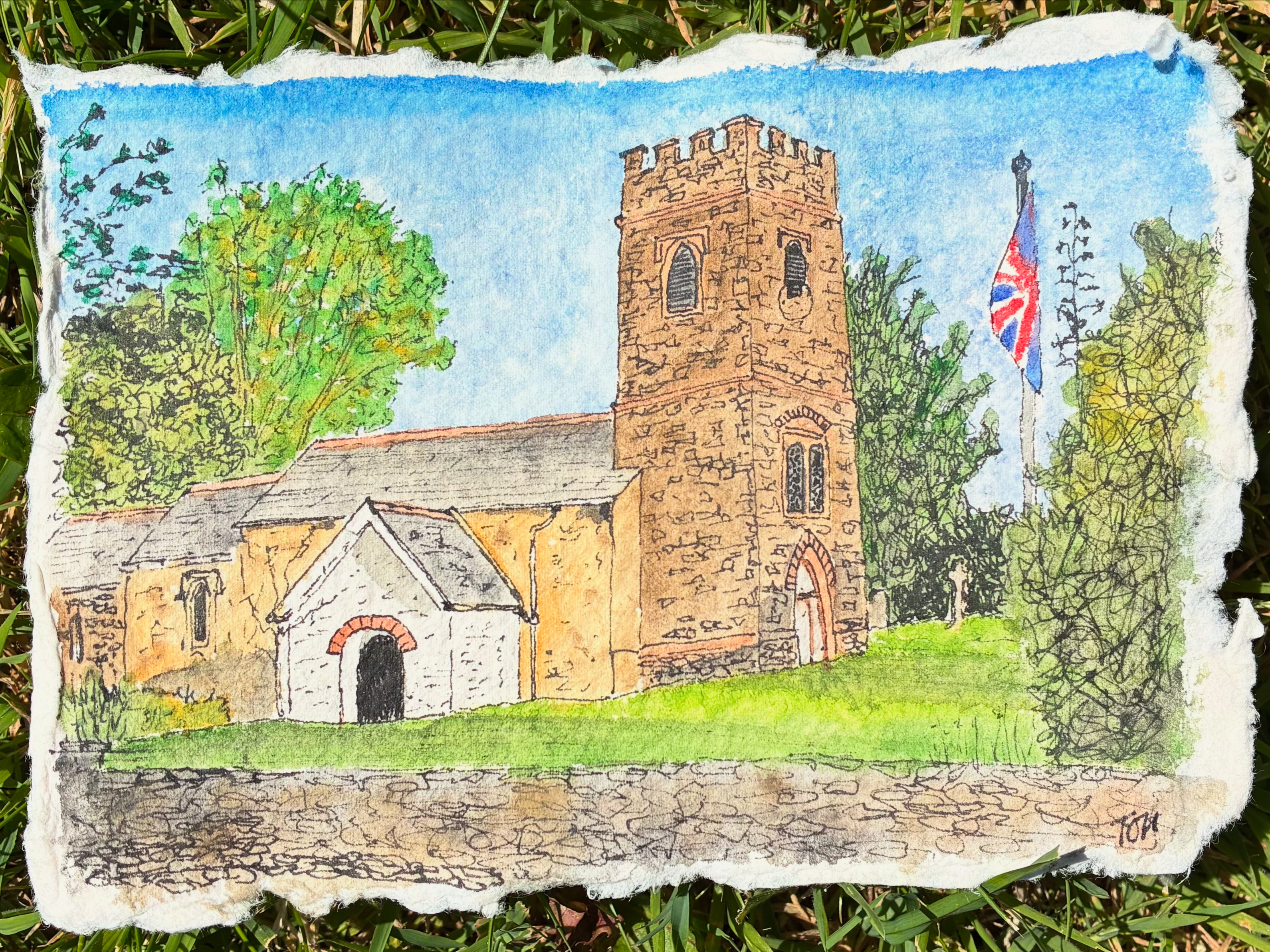
Our accommodation was only a 15 minute walk from the village of Oare, and so we also visited Oare Church, where (in the story) Lorna Doone was shot through a window by the evil, jilted Carver Doone as she stood to marry John Ridd. [Spoiler alert: Lorna survives, and John chases Carver Doone across the moor and watches him sink slowly to his death in a boggy mire, and they all (well all but Carver of course) live happily every after.]
Oare Church, Exmoor
We also completed a walk from Malmsmead towards the coast on what was perhaps the hottest afternoon of the year. This made the walk rather tough going, and this was not helped by the fact that the warm weather seemed to encourage what seemed to be every fly in the entire region to nip and nibble at me along the way.
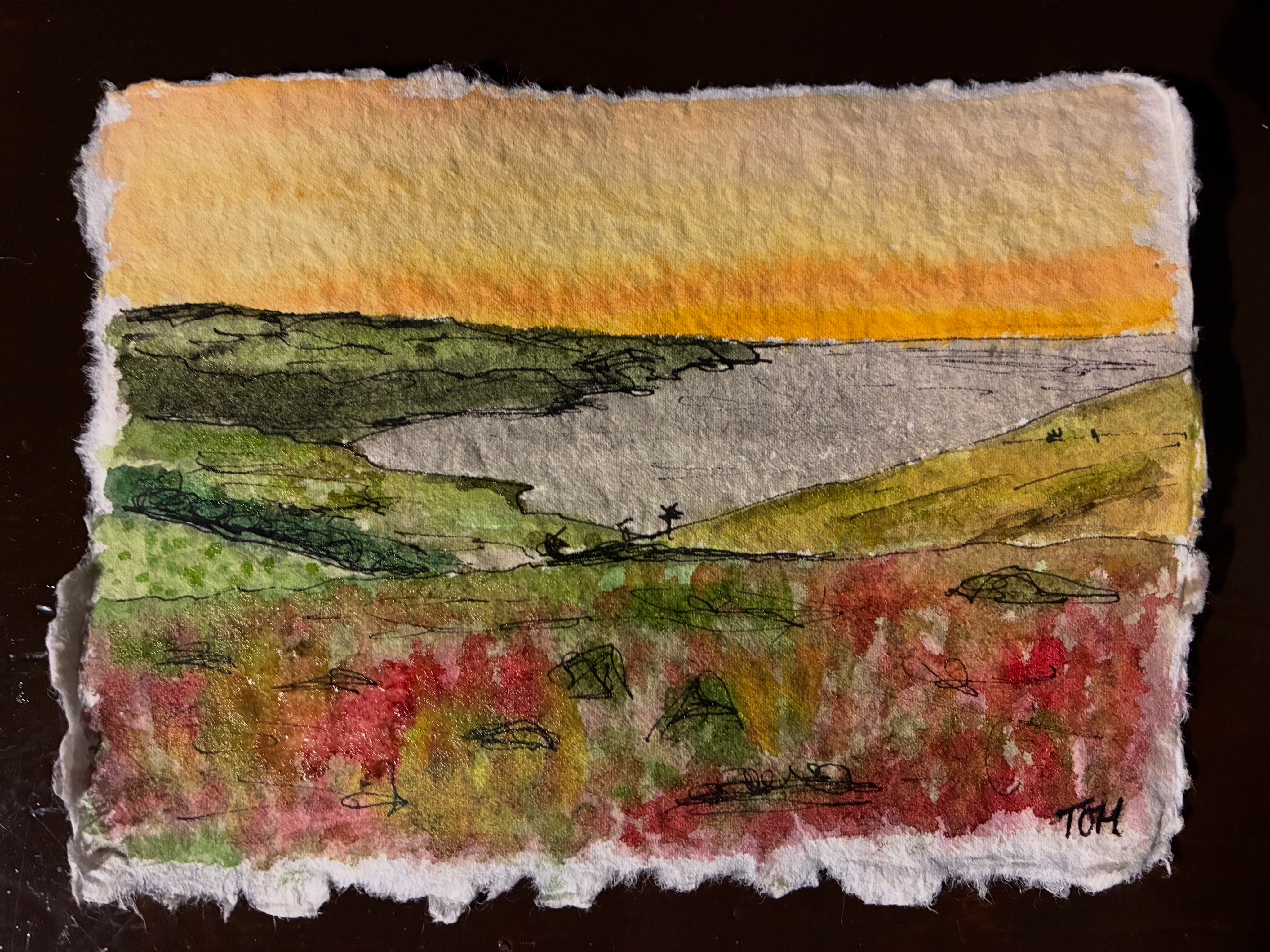
In between the walks, I found time for some painting of course, producing the various pictures that illustrate this post. The final painting I produced whilst away was of the view across Porlock Bay, where we had walked on the first day of our holiday, from Bossington Hill. As it’s a sunset view, it seems like a good picture to use to draw this post to a close…
When I started painting in April 2024 I concentrated mostly on painting buildings or landscapes in which any significant living elements such as trees, animals or people were sufficiently distant that I didn’t have to worry too much about their details. After a while, as I discovered my natural style and approach to painting and gained a bit more confidence in my ability, I began to try putting more detail into my work. In the case of trees, I found that if I slowed myself down, and really paid attention to what I was doing, the results of my efforts were not at all bad. (Sadly, whilst I have had some success more recently painting birds and animals, the same still cannot be said about my horrific attempts at incorporating people into my artworks…)
The set of twelve pictures above, a set that I refer to as my Trees series, were painted between June and November 2025, and ended up being the fifth series of miniature watercolour paintings that I produced. Most of the these series were been produced over a much shorter period of time, typically no more than 2-3 weeks, but with these tree pictures I didn’t set out to generate a full set of twelve pictures, they just emerged gradually, in between all of my other painting efforts. Each picture is a 9cm square, a little larger than most of my miniature series paintings (which are typically ~5cm square), and for this reason, I’ve been able to print larger 16cm versions from the originals, that look really smart in a frame, without suffering from resolution issues.
In most cases, I painted these trees from photographs that I had taken at some point, and so I know (roughly) where most of the trees are. However, there are a few that were based on photos from internet searches, and unfortunately I’ve lost track of the details of those ones – keeping track of these kinds of details is something that I still need to get better at. Working from top-left, across and down the grid of twelve pictures, the pictures show:
a large tree on the main ridge of the Quantock Hills, above Crowcombe in Somerset, with huge roots that formed a window to frame the view beyond
twisted branches and autumn leaves (location unknown)
a lone conifer on the southwestern edge of Dartmoor, somewhere on Harrower Common near Yelverton, Devon
a view looking back along the cycle path between Clearbrook and Yelverton
a lone tree of a type that I like to refer to as a ‘symmetree’ in a slight hollow, again on the main ridge of the Quantock Hills above Crowcombe
my favourite row of beech trees below Peek Hill next to the main road from Yelverton to Princetown, Dartmoor
beech tree trunks near Grassington in Wharfedale, Yorkshire
a typically-windswept tree on Dartmoor
a muddy track through some conifer woodland (location unknown)
a lone holly tree on Roborough Down
a view through a group of pine trees, across the Yealm Estuary from the coast path between Wembury and Warren Point in South Devon
a spectacular autumnal, orange-leafed tree in the gardens of Cotehele House (or it might be in the Lost Gardens of Heligan)
Although they are quite simple, some of these tree pictures – the Peek Hill beech trees, the Yorkshire beech tree trunks, and the pine trees near Warren Point – are amongst my personal favourites of all of the pictures I have painted so far. I’ve listed prints of these pictures (composite prints of all twelve and a smaller square version with nine pictures) and greetings cards featuring individual pictures for sale on Facebook Marketplace and in my Etsy shop, but perhaps unsurprisingly, given the chances that anyone putting ‘tree painting’ into their internet search engine will be directed to my tree paintings rather than any of the hundreds if not thousands of alternatives available, I’ve not had any sales so far. But a family friend was so taken with these pictures that she bought a set of four framed prints of her favourite individual trees as a present for a friend and then came back and bought another set for her nephew! It’s nice to know that there is at least one other person out there who also likes these pictures!
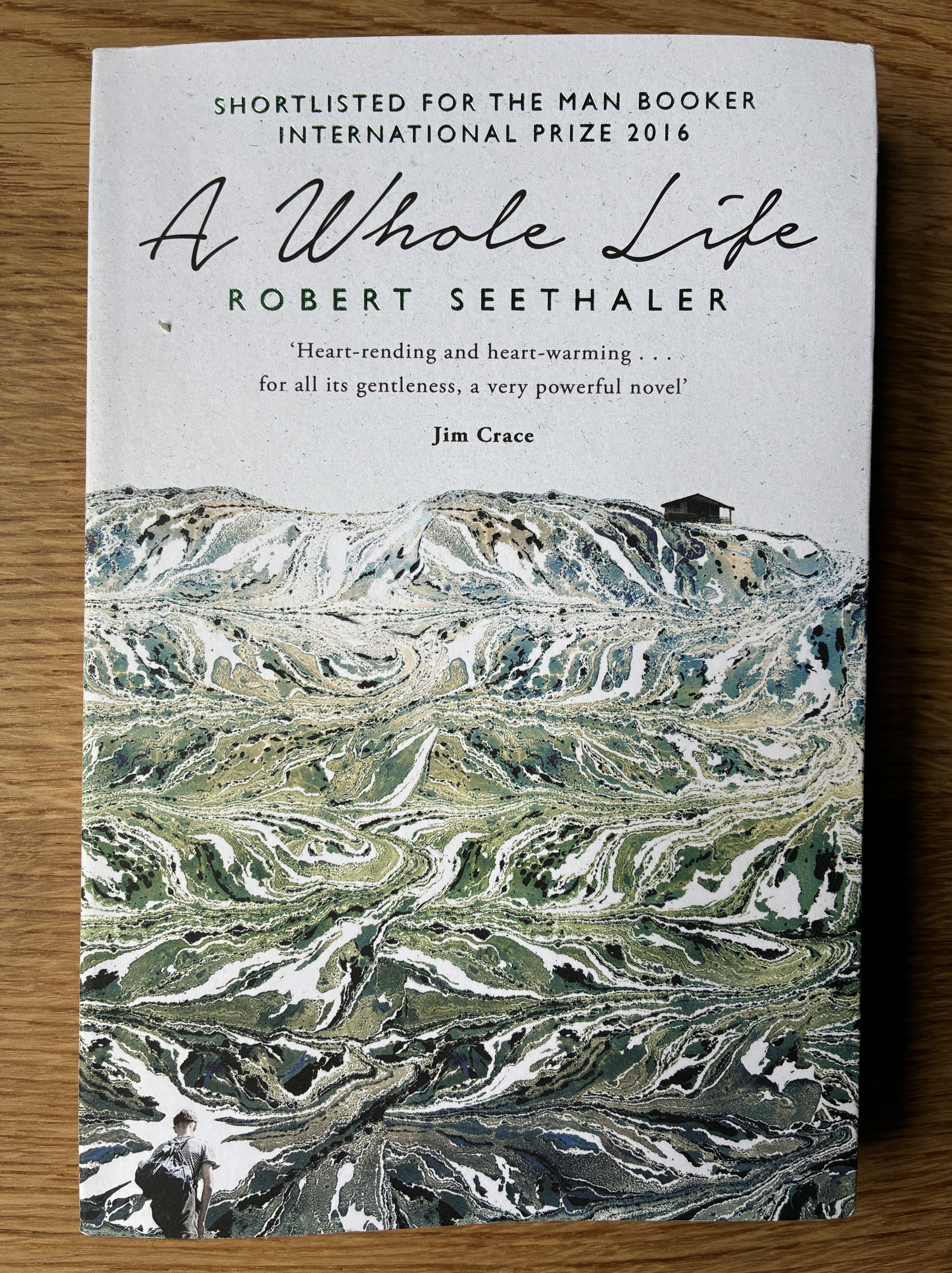
I read Robert Seethaler’s novel A Whole Life last summer, after it was recommended to me by a student that I teach (a recommendation that shows a remarkable level of insight from someone who doesn’t really know me or much about my life at all). Published in 2015, and shortlisted for the Man Booker Prize in 2016, A Whole Life is, on the face of it, a simple story, recounting the life of Andreas Egger – a life that plays out almost entirely in a single valley in the Austrian Alps. It’s one of those stories within which nothing much happens and yet, in a strange way, everything happens; and everything that does happen has a significance and depth that gets right the heart of what it is to live.
Andreas Egger is born between the two world wars and arriving in the valley as a young boy is taken in by a farming family. Somewhat surprisingly, given his rather gruff and lone manner, he falls in love and marries, but the promise of a happy life shattered by when an avalanche strikes his home. He leaves to fight in the Second World War, is taken prisoner and eventually returns home only to find that a rush of development has spread its tentacles into the remote terrain of his world. He does what he needs to do, and works as an engineer building and maintaining the cable cars that have come to the area as skiing begins to grow into the modern tourism industry it is today.
Egger’s life has moments of brightness, or perhaps it is better to say that it promises moments of brightness, but the overall tone of the book is somewhat bleak and foreboding from the outset. Egger makes it through to the ripe old age of almost eighty, but throughout his life it is clear that he is always an outsider, never really integrated into the close community, never fully adjusting to the ever-changing world around him, and never being able to fully experience the loving relationships that at one point seemed to lie ahead for him.
I really enjoyed reading A Whole Life. Seethaler’s writing is precise and unfussy and through his words, it felt like an honour that Egger was sharing his existence, his whole life, with me. There were a couple of passages that stood out for me, to the extent that I grabbed hold of them as I read. The first (page 112 in my edition) captures something of Egger’s quiet, contemplative quality:
Egger didn’t usually speak on his walk. ‘When someone opens their mouth they close their ears,’ Thomas Mattl had always said, and Egger was of the same opinion.
and the second nicely illustrates the kind of philosophy that Egger absorbed by keeping his mouth shut and his ears open, in this case from a fellow inmate in a Russian prison camp:
If you’re on the way to Hell, he’d say, you have to laugh with the devils: it costs nothing, and makes the whole thing more bearable.
I don’t think it would be a bad thing to embrace some of Egger’s calm, just-get-on-with-it, approach to life. And whether I’m on the way to Hell, Heaven, or (more likely) somewhere in between, it surely does make sense to laugh with whoever you are travelling alongside.
In recent summers we have take a series of summer holidays walking in the Yorkshire Dales – first in Swaledale (staying at Low Row near Reeth), then in Wharfedale (based in Ilkley) and last year in ‘Bronte Country’ near Haworth. In each case we combined our week in Yorkshire with a day or two staying somewhere en route to and from our home in Plymouth, or in one case a second week away in Norfolk and Suffolk. For a change, this year, we decided that we’d like to spread our holiday time out over the summer months, and so we picked a couple of fairly local destinations for ‘long weekend’ walking holidays and also booked five days over in Suffolk, combining this with a visit to elderly relatives and an old university friend on mine.
The first of our summer 2025 mini-break locations, in June, took us back to the very familiar territory (for me at least) of the Quantock Hills and the Somerset coast. I grew up a short distance from there in Bridgwater, and we would frequently go on family outings to the area. I also spent quite a lot of time at an activity centre in Kilve on short courses of various kinds (mostly musical).
Although I do like discovering new places, I also very much enjoy returning to familiar haunts, especially for a short trip when you want to be able to slot straight into holiday mode without having to spend time orienting yourself and getting the lie of the land. Our Somerset trip – staying in an AirBnB Shepherd’s Hut near the village of Crowcombe, tucked at the bottom of the western side of the Quantock Hills ridge, very much fell into this ‘familiar territory’ category.
While we were away we enjoyed completing a couple of lengthy walks direct from our accommodation (I particular enjoy a stay away that doesn’t involve having to get in the car), and I was able to spend quite a bit of time painting. In this post I’ll feature four of the pictures that I produced during the break, and I’ll pick up the thread with another post soon that will feature a further group of five pictures.
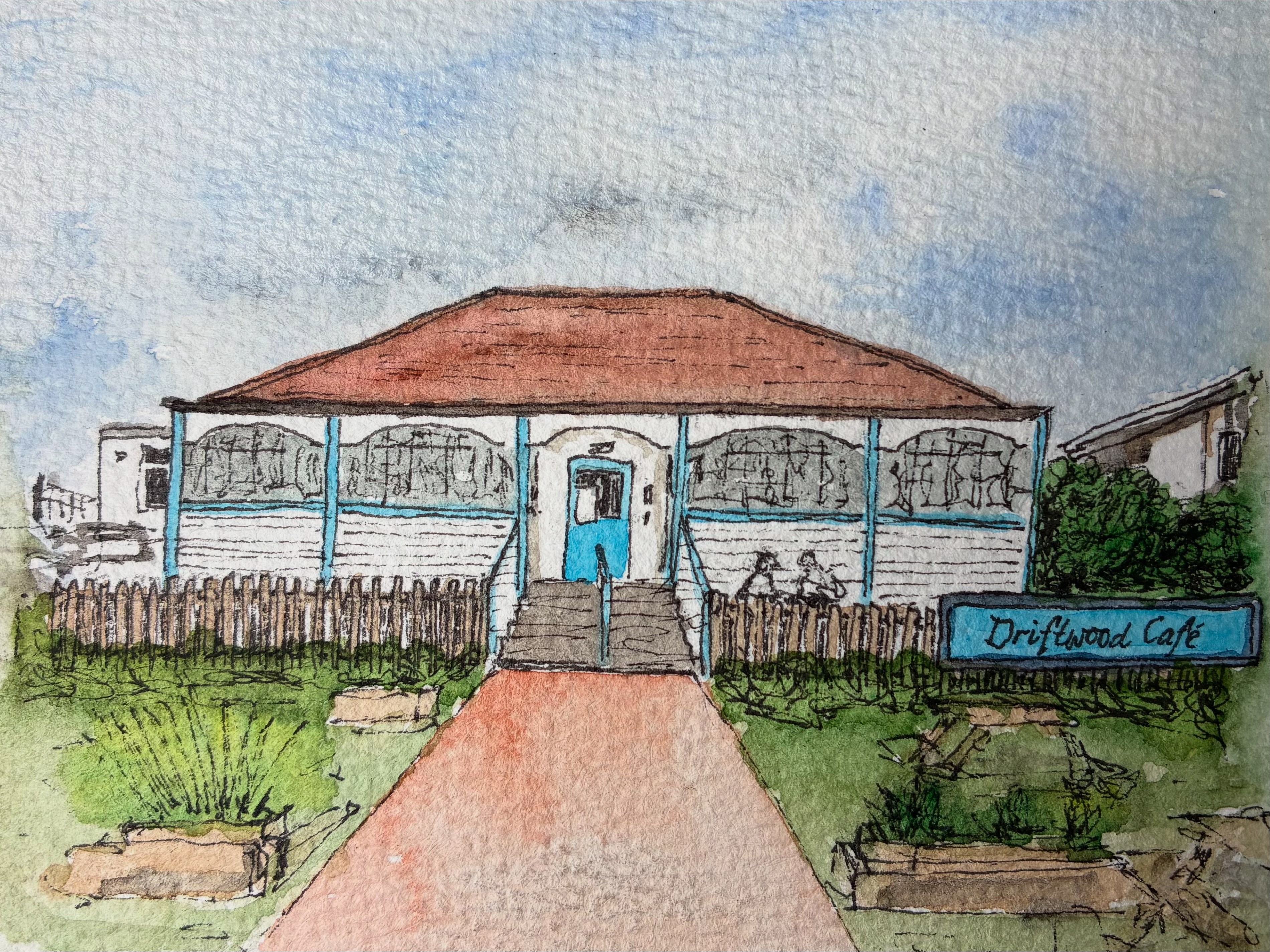
We started our holiday with lunch at a favourite cafe, the Driftwood Cafe at Blue Anchor – the subject of my first picture (shown at the top of this post). It’s not a fancy cafe at all – I’d describe it as a ham, egg and chips or baked potato cafe – it’s just a nice, simple, easy-going place for a quick bite to eat.
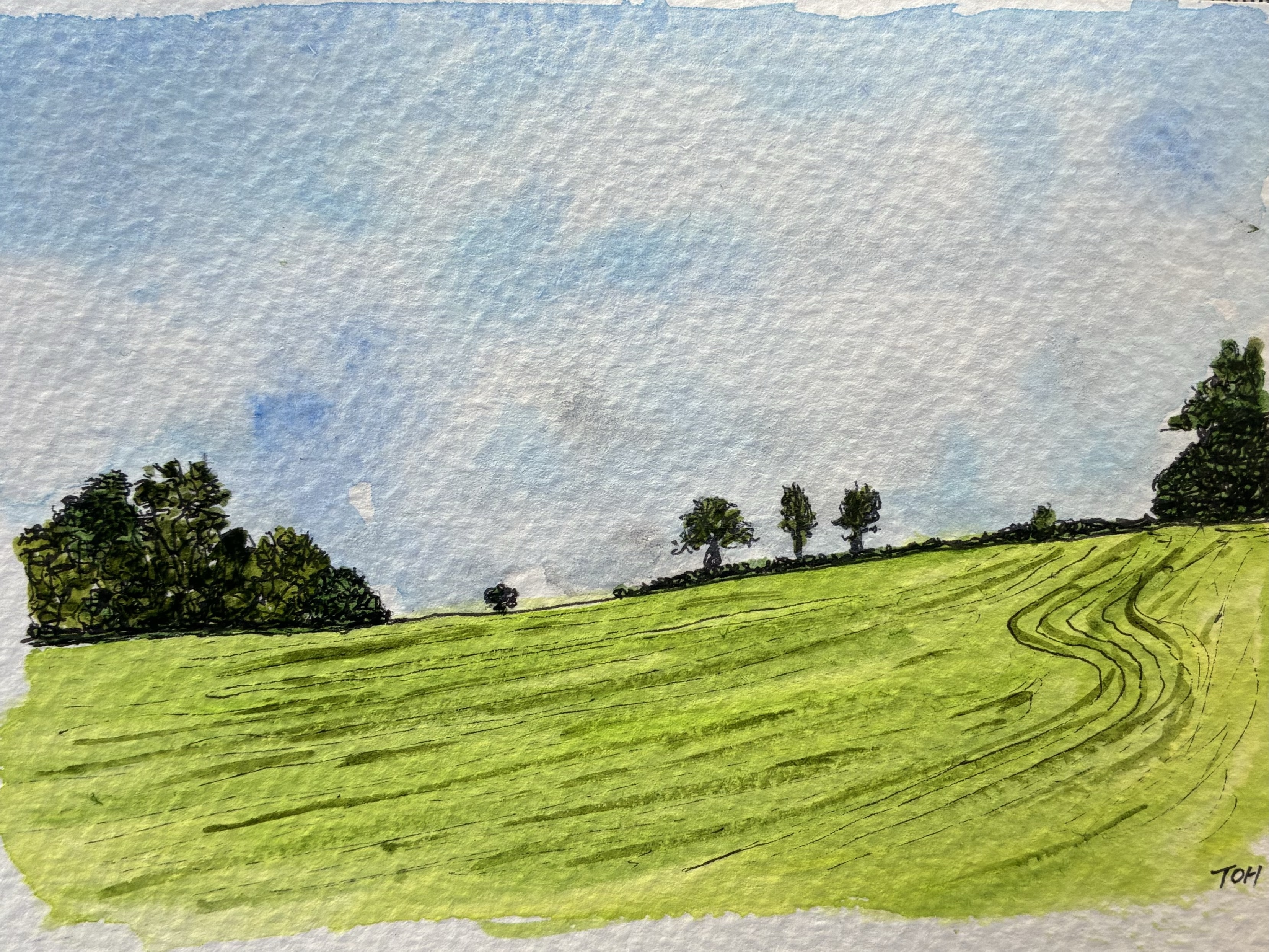
Suitably refueled we then drove the short distance to Kilve and did a short walk (~3 miles) along the coast to East Quantoxhead, before turning inland and returning to the car, with a stop at the Chantry Tea Garden at Kilve where we were the only customers and had an interesting conversation with the owner, who used to be a frequent visitor to Plymouth. The two pictures below show a view of a field that we passed on the return leg (I’ve got a thing for trees silhouetted on the horizon) and the view that we had from our table in the cafe garden of The Chantry itself and the white cottage from which the cafe was run.
Grass Cut Field Near Kilve, SomersetThe Chantry Tea Garden, Kilve, Somerset
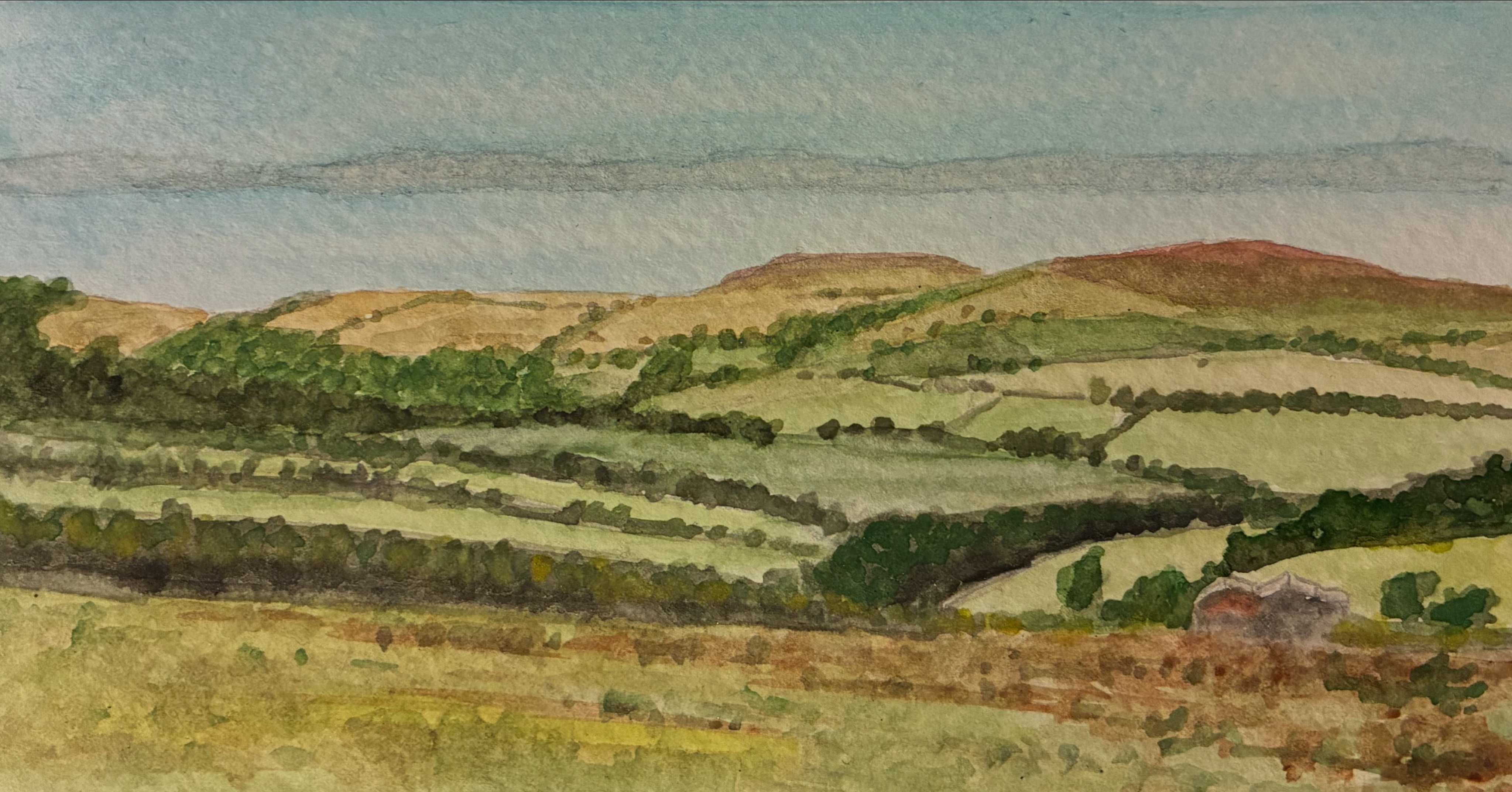
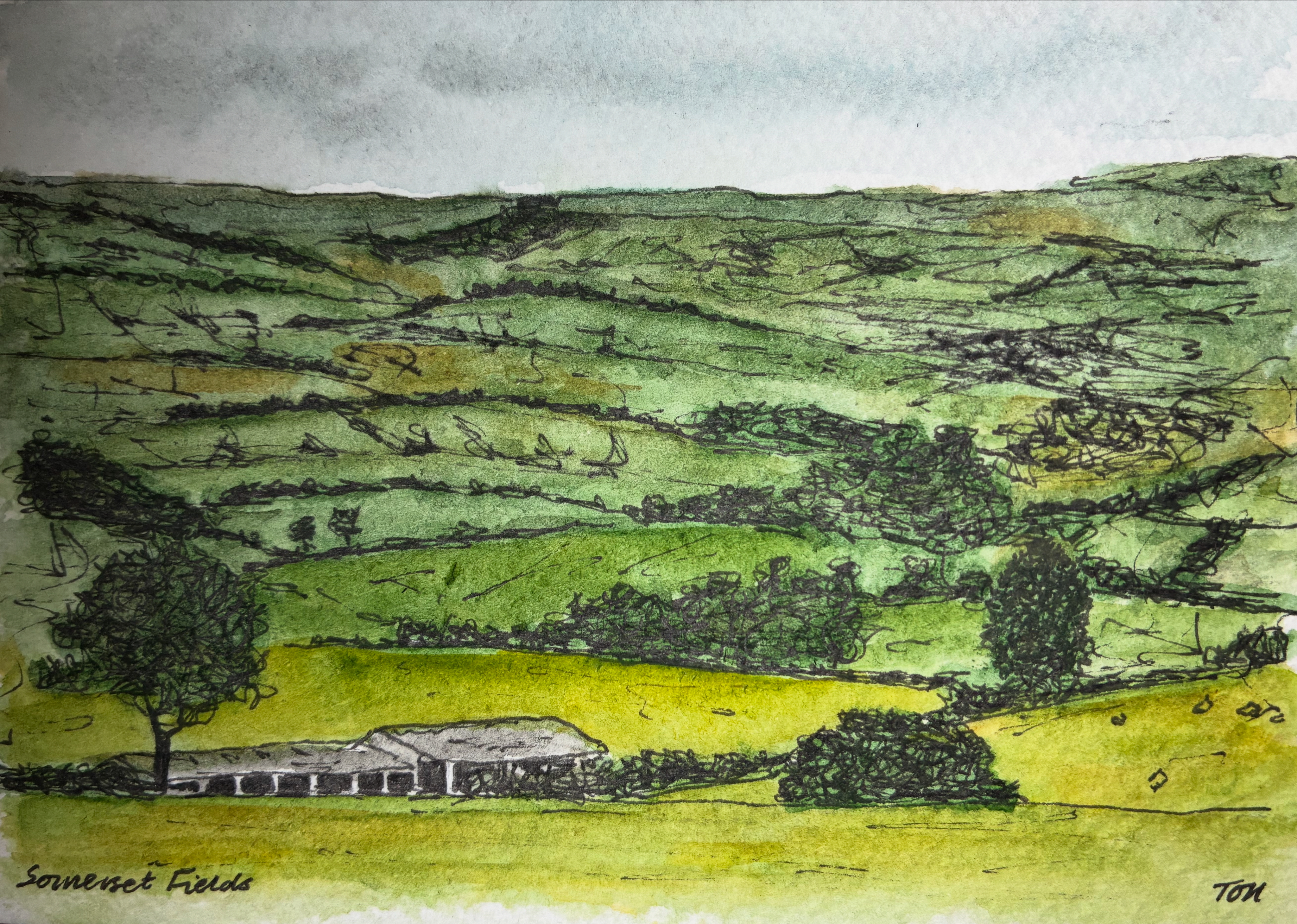
Finally, for now, here’s a scene I painted of the view looking west in the direction of Exmoor from the base of the Quantock Hills. I’ve tried to capture the way that there are successive ‘layers’ of rolling hills as the eye moves towards the horizon, each becoming progressively just a little higher than the previous one. Although wild landscapes can be exhilarating, I do like a farmed landscape – a patchwork of fields, hedges, copses and the odd farm building.
Somerset Fields Looking West From Near Crowcombe
All of these pictures were really just quick ‘practice’ pieces, but I like them all in different ways – Driftwood Cafe for its small details, the grass-cut field for its slightly abstract form, Chantry Tea Garden for its looseness, and Somerset Fields for the way it captures something of the wide expansiveness of the view.
If you have a favourite of these four pictures write a quick comment to let me know!
What is blue and is whatever it is the same for me as it is for you? A scientist might state that blue describes:
‘colours perceived by humans observing light with a dominant wavelength between approximately four-hundred-and-fifty and four-hundred-and-ninety-five nanometres‘,
which may well tell us how blue can arise – in the human mind, when a certain type of electromagnetic radiation enters the eyes. But this does not, I think, tell us what blue really is. For how can we be sure that the imagined colour that my mind selects, in its constant rush to paint upon its ever-changing canvas, comes from the same small pan into which you dipped your brush?
You can say that blue is the colour of the sky (by day at least), or of the vast expanse of open sea (mostly), or the shirt worn by the best team (certainly not). But what if you see all of those as I see green? (Well then we would agree – those shirts belong to by far the greatest team the world has ever seen).
So what is blue to me, or to you?
To complicate matters further… ‘blue’ could refer not to colour but, rather, to the tone of my thoughts. But if I tell you that just now the thoughts inside my head are blue, how do you know whether I am simply feeling a little down on my luck, or whether my mind, unleashed, is filled with images of a naked couple…? Again, we come unstuck.
We must agree then, I think, to put aside all ambiguities, and to take the definition, with all of its nanometres, at face value. Then we can label the sky as blue and the sea as blue, we can assume my mood is melancholy even if it is really full of sauce, and we can move on (although, we will never agree about those shirts of course).
(c) Tim O’Hare, September 2023
BLUE: I’m not entirely sure where the idea for this poem came from but I guess I just liked playing with the words and the rhymes and bringing together some threads from different aspects of my life – science, perception, atmosphere, ocean, sports.
A revised version of this poem was published in Issue 16 (March 2024, ‘Colour’) of Consilience – an online Science Communication/Poetry journal. I’ve repeated it below for completeness…
What is blue and is whatever it is the same for me as it is for you?
A scientist might state that blue describes: ‘colours perceived by a human when observing light having a primary wavelength in the range four-hundred-and-fifty to four-hundred-and-ninety-five nanometres’, which may well tell us how blue can arise – in the human mind, when a certain type of electromagnetic radiation enters the eyes – but does not, I think, tell us what blue really is. For how can we be sure that the imagined colour that my mind selects in its constant rush to paint upon its ever-changing canvas comes from the same small pan into which you dipped your own brush?
You can say that blue is the colour of the sky (by day at least) or of the vast expanse of open sea (mostly) or the shirt worn by the best team (certainly not). But what if you see all of those as I see green? (And then we agree those shirts belong to by far the greatest team the world has ever seen).
So what is blue to me or to you?
To complicate matters further… Blue could refer not to the colour of a sight but, rather, to the tone of my thoughts. But if I tell you that, just now, the thoughts inside my head are blue, how do you know whether I am simply feeling a little down on my luck or whether my mind, unleashed, is filled with a tumble of racy thoughts? Again, we come unstuck.
We must agree then, I think, to put aside the ambiguities and to take the scientist’s definition, with all of its nanometres, at face value. Then we can label the sky as blue and the sea as blue; we can assume my mood is melancholy even it is really full of sauce; and we can move on (although, we will never agree about those shirts of course).
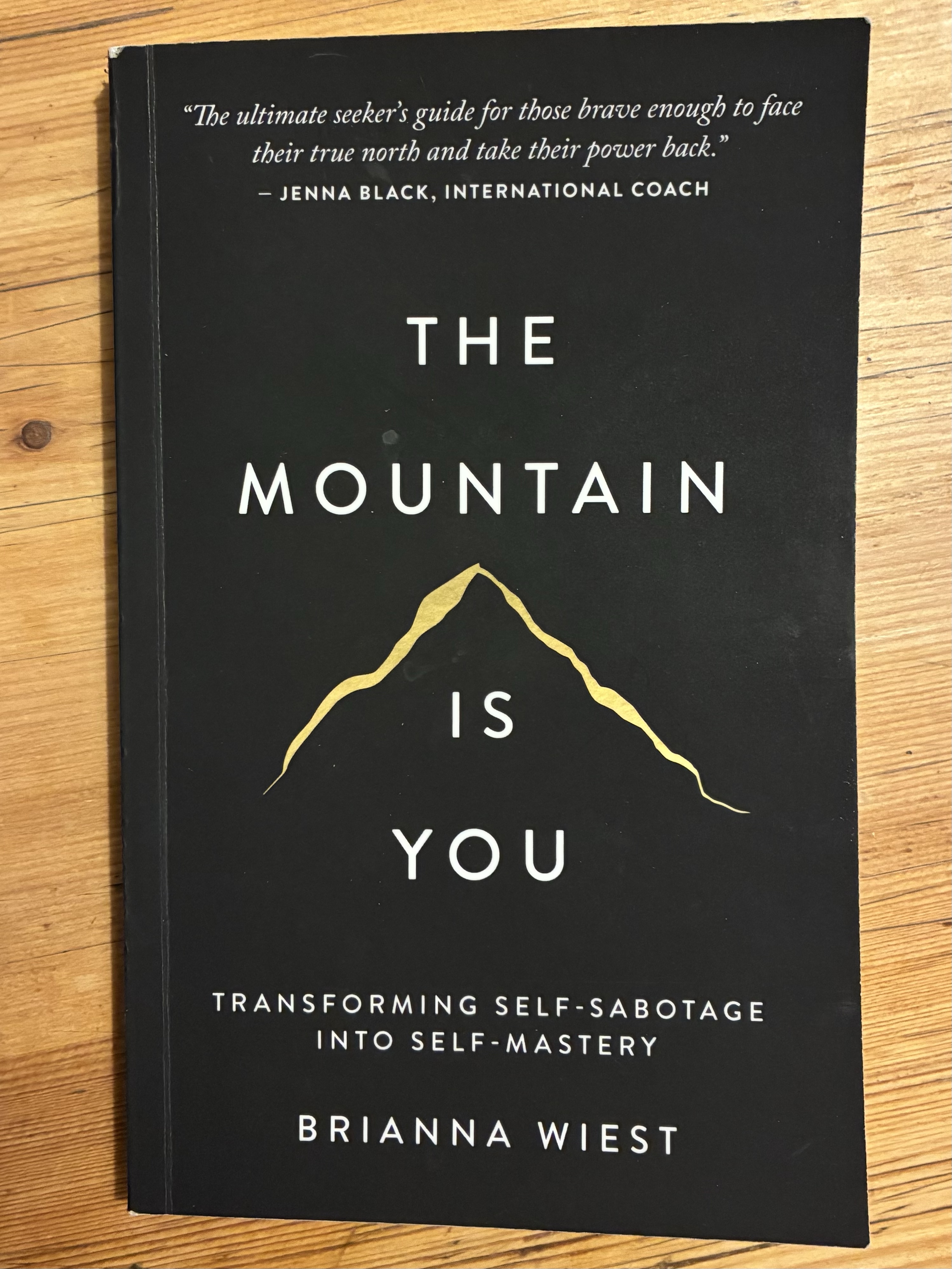
The Mountain Is You: Transforming Self-Sabotage Into Self-Mastery by Brianna West is probably not a book that I would have picked up to read of my own accord, despite that fact that I am pretty much certain that a lot of the struggles I have in pushing myself into action and gaining the sense of achievement and fulfillment that I crave are driven at a fundamental level by self-sabotage in one form or another. There is just something about the whole mountain metaphor, along with the kinds of words used in the book blurb that I read online (‘deep internal work of excavating trauma’, ‘building resilience’, and ‘adjusting how we show up for the climb’) that instinctively put me off. Why then did I work my way through this book for a few weeks in April and May this year? Because it was voted as the reading matter for the May meeting of The Timecrafting Trust Book Club that I participate in, and so, dutifully, I ordered myself a copy and set to work.
Almost from the start, I realized that there might well be a bit more value for me from The Mountain Is You than I had envisaged. I was immediately stuck with some obvious similarity between some of the content being covered and the ideas of psychotherapist Carl Jung that I found enthralling and thoroughly convincing when I read James Hollis’s excellent The Middle Passage a year or so ago.
Wiest begins her book by describing the various forms that self-sabotage can take along with the underlying reasons why each type of self-sabotaging behaviour occurs. There were quite a few lines in this section of the book that resonated with me…
‘sometimes, we sabotage our professional success because what we really want it to create art‘
‘sometimes, our most sabotaging behaviours are really the result of long-held and unexamined fears we have about the world and ourselves‘
‘human beings experience a natural resistance to the unknown, because it is essentially the ultimate loss of control‘
… because yes, I do increasingly seem to be seeing myself as an artist, yes, I definitely have a lot of fears squashed down into my head that hold me back, and yes, I do tend to get overwhelmed and feel very uncomfortable when I perceive that things are spinning out of my control. But why then, knowing all of this, does nothing much really seem to change? Wiest delivers the killer answer:
‘most people do not actually change their lives until not changing becomes the less comfortable option‘
Wiest goes on to argue that, in fact, we might be better off re-framing self-sabotage because, ultimately, the habits and behaviours associated with it are actually a result of your very clever subconcious ensuring that some unfilled need, displaced emotion or neglected desire is being met – that those actions are, in fact, deliberately designed to provide a positive outcome that some hidden part of your subconscious seeks.
Aand funnily enough, just this morning, quite coincidentally, I wrote in my journal that perhaps I allowed myself to procrastinate and hold myself back from taking certain actions even though I know this will result in an intense wave of frustration and anger with myself, because at least those negative feelings and emotions are something that I am familiar with and are, in some weird and twisted way, somewhat comforting.
The next section of The Mountain Is You describes a long list of different manifestations of self-sabotage, and whilst many of these did not feel relevant to me, some of them certainly did – hello Perfectionism, Worrying About Least Likely Circumstances, Being Busy, Fear Of Failure, to name a few.
The start of the process of overcoming self-sabotage begins, Wiest suggests, with tuning into, and listening to, the negative emotions associated with it – things like anger, jealousy, regret, chronic fear. She highlights a basic need to be able to ‘allow yourself to feel what you feel without judgement or suppression and notes that understanding your needs, meeting the ones you are responsible for, and then allowing yourself to show up so others can meet the ones you can’t do on your own will help you break the self-sabotage cycle’. For example, feel angry, notice that you are angry, understand why you are angry, remember that it is okay to feel angry… and then get on with life.
There are then a couple of chapters with fairly standard fare on building emotional intelligence and on letting go of baggage from the past, but as these progressed I could feel the book moving steadily into the kind of territory that my initial instincts had led me to expect. Then, aargh, I hit a section titled ‘Releasing your past into the Quantum Field‘ and my brain was instantly screaming at me that I was now thoroughly into pseudo-scientific mumbo-jumbo land… the kind of land where, apparently, ‘You store … emotions, energies and patterns at a cellular level‘. Now, I guess that in some sense everything associated with an individual human is stored at a cellular level, but I am pretty sure that Wiest is suggesting there’s something rather more mysterious and perhaps spiritual going on. I’d be inclined to simply say that statements of that kind are just nonsense!
I guess that from that point onwards, my brain was in a state of high alert, warning me, perhaps unfairly, that much of what I was reading had no real, solid basis. There were lots of nice, almost mantra-like phrases: ‘be willing to be disliked‘, ‘do your inner work‘ and a series of suggestions to ‘create aligned goals, ‘find you inner peace’, ‘detach from worry’, ‘take triggers as signals’, ‘honour your discomfort’, ‘stop trying to be happy’, ‘arrive into the present’ etc., but in the end it was all a bit too much – too many suggestions, too many affirmations, too many challenges to think about overcoming, with the result that I came away confused and somewhat disappointed. After a promising, really very readable first half, everything seemed to have unraveled as the book reached its conclusion. There was just nothing much that was concrete or tangible for me to cling onto.
Late on in the book there was one phrase that I rather liked in a section titled ‘Be aware of what you give your energy’, namely that ‘the wolf that wins is the one that you feed‘ and strangely, on the day that I read those lines some spoke almost the exact same words to me (perhaps that pesky quantum field was doing its thing…). In fact, the whole book is stuffed full of short phrases and sentences that you could lift off the page and incorporate into an inspirational poster or social media post if that is your thing. I may not have warmed to Wiest’s mountain metaphor or felt that the argument in The Mountain Is You hung together in a fully coherent and convincing manner, but she certainly knows how to write what might be called ‘soundbite sentences’. Forget all the gumph about releasing you past into the quantum field and storing emotions at a cellular level, and take this phrase, right at the end of the book… …
‘One day, the mountain that was in front of you will be so far behind you, it will barely be visible in the distance. But who you become in learning to climb it? That will stay with you forever.‘
I am the square peg in the round hole: jammed in, stuck fast, placed by youthful naivety, forced down by the weight of expectation, held in place by the pressure of life’s demands, and hammered home by the repeated blows of round pegs that, although appearing far too large to fill such a seemingly trivial space, are really too small to even touch the sides.
Yet, even in the tightest grip it is possible to wriggle and writhe – tiny movements that, though causing damage, breaks, and pain, gradually, imperceptibly, ease the bind. The needle must break the cloth to form the stitches of repair.
I am still the square peg, plugging the round hole, missing parts of my surface, diminished, and wearing hidden scars, but now I have worked my way loose. And though I cannot know the planes and slopes of the land that lies outside, I have seen it in glimpses, and I am ready to slide out, with freshly rounded corners, ready to roll.
(c) Tim O’Hare, September 2023
SQUARE PEG: This is another poem that came up on me out of nowhere and very fast. In some ways it is a direct continuation from my poem It Is Time, but whereas that poem is about recognizing that a point of arrival has been reached, Square Peg is more about being ready to start out on the next part of the journey.
Since I started drawing and painting back in April 2024 I have primarily worked with ink and watercolour paints, with my ‘go-to’ format being small, usually ~5cm square, pictures on some particular theme that I have chosen to explore for a few days. Producing pictures of that type has become my staple art activity, to the extent that I describe this as my ‘art practice’. However, I am constantly thinking about how I would like to explore different formats and work with different media. This especially happens when I visit an art exhibition, see works by other artists,and wonder what I could produce if I branched out a bit. The funny thing is that prior to my big shift into art in April 2024 I had actually begun to dabble with creating pictures with pastels (e.g. see my post Rediscovering The Artist Within) but I have not returned to pastels once since then.
Sometime back in May I must have been somewhere that brought me into contact with some charcoal drawings. I had a set of charcoal pencils sitting unopened in my art supplies box, and so I thought I would branch out a little and see what happened when I completed the drawing phase of a picture with charcoal, rather than adopting my usual approach of starting off with some faint pencil lines and then going all in with my black ink pen. I think I hoped that the different drawing texture might lead to me producing a more abstract picture. Then, after scribbling away with the charcoal pencil for a bit, I returned to the familiar territory of my watercolour paints to give my drawing some colour.
The result of my efforts is shown in the picture above – a charcoal -cribbles-with-watercolour painting of a row of what I refer to a ‘wall trees’, somewhere in the valley of the River Walkham, from a photo that I had taken on a walk there.
I’m not sure exactly what I think of this picture. It seems quite basic and simple – the trees sitting very much on top of the leafy backdrop and lacking much detail in their trunks and branches – and that simplicity pushes me towards thinking that the picture doesn’t quite work. But I also quite like the more impressionistic look – the rough lines suggesting the texture and structure of the stone wall, and the bright greens and particularly the yellows of the leaf canopy shouting out for attention. The picture has a naivety which I think gives it a certain charm. As I look at the picture, my eyes seem to be drawn in to explore what little detail there is, perhaps more so than happens when viewing one of my more detailed ink and watercolour pictures. Overall, I think that perhaps the switch in drawing medium was successful in helping me to present the view in a more abstract, suggestive manner than my normal ink-and-watercolour approach.
I’ve not had another go with charcoal pencils since I created this picture just over two months ago, but revisiting it now and writing this post has fired me up to spend some more time over the coming period to play around with different approaches and media a bit more. I wonder what will emerge!



 Tim O'Hare