
Reckoning | Beckoning #poem

Note: This poem has a three column structure so if you are reading it on a small screen device you should switch from ‘mobile’ to ‘tablet’ view to see it properly…

Reckoning?

It is time to rid myself
of
reckoning

The harsh
interrogation of
“How did it go?”

Checking off the actions
against
all those on my list

Only really noticing
the many
I have missed

Assessing my
progress, comparing
with my plan

Keeping track of
distances,
measuring their span

Monitoring my
output so I always
know the score

Emerging with the
figures, highlighting
my flaws

Counting up the wins
and losses,
totaling
to find their sum

I feel kind of
useless when the
reckoning is done

or

and


or


or


or


or


or


or


or


or


so

Beckoning?

Instead, I will try to see
what’s
beckoning

A gentler
introspection
of my flow

Seeking the resonant
vibrations that prove that
I exist

Keeping mind wide open
so that
nothing is dismissed

Reminding myself
that all the time
I’m doing the best I can

Recognising that
what matters is
simply that I ran

Realising the damage
done by
always wanting more

Noticing the many things
born deep
within my core

Dispensing with
judgement,
to prove the worth
of all I’ve done

I embrace my
beckoning question
“What has come?”

(c) Tim O’Hare, February 2024


About this poem: This poem has its origin in a conversation that took place during my last coaching session a couple of weeks ago. I was recounting how terrible I am at following the plans I make and how this generates an intense feeling of frustration and results in me being in a constant spiral of planning, frustration, planning, frustration and a pervading sense of uselessness. I was challenged to come up with an alternative non-judgmental question that I could ask myself and responded almost instantly that I could replace “How did it go?” with “What has come?“. We played with this idea for a while – focusing on how my “What has come?” question would naturally lead me to draw out achievements, output and activities that had emerged from within me without triggering my natural tendency to measure progress, evaluate success and generally judge myself against the completely unnecessary and arbitrary ‘success criteria’ that I carry in my head. My coach loved my question and referred to it as my ‘beckoning question’…

The poem is written as two verses, one relating to the ‘reckoning question’ (on the left) and the other relating to the ‘beckoning question’ (on the right), but it is also possible to read the poem taking one line from each verse in turn and adding the additional bridging word (‘and‘, ‘or‘, ‘so‘) shown in italics between the two verses. I suspect that this layout won’t work very well if the poem is viewed on a small screen (mobile) device but hopefully it works well enough!
(Another) Four Quartets #poem

Quartet No.1 in C Major
I. Exceptional (maestoso ridicolo)
II. Growing (allegro vivamente)
III. Discovering (allegro con abbandono)
IV. Fearful (moderato sostenuto)

Quartet No. 2 in E Major
I. Interested (scherzo giocoso)
II. Hopeful (andante sognando)
III. Exploring (allegro impetuoso)
IV. Indecisive (adagietto dissonante)

Quartet No. 3 in A flat minor
I. Struggling (largamente melancolico)
II. Puzzled (andante misterioso)
III. Frustrated (allegro incalzando)
IV. Trying (allegro spiritoso)

Quartet No. 4 in D sharp minor
I. Disappointed (andante con dolore)
II. Angry (allegro furioso)
III. Overwhelmed (andate lacrimoso)
IV. Capitulated (largo perdendosi)

(c) Tim O’Hare, January 2024


About this poem: Over the last couple of days I have felt a growing sense of inner doom and then today I woke to find myself the recipient of another visit from The Hollow Man. The result was that despite having a mountain of work things to do I found myself stealing time to construct this poem. It started out as a list of words chosen to express something of the way I was seeing different stages of my life and then as these settled naturally into four groups of four I could not resist the reference to T.S. Eliot and the idea of representing the list as a set of musical works complete with accompanying musical terms for tempo and associated emotion. Perhaps it is all a little dark and almost certainly it is a lot contrived but writing this poem seems to have done its job and I can now start to move on again.

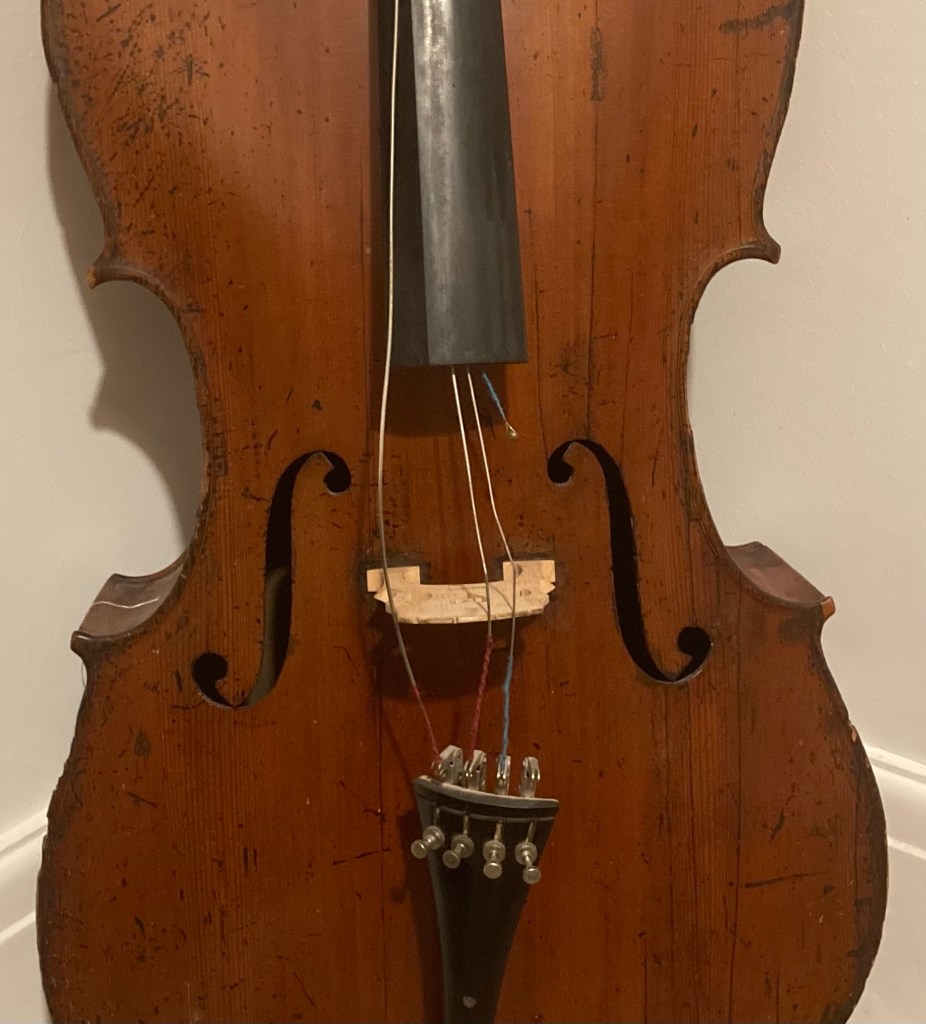
[The photo shows my ‘cello which suffered a broken tail gut leading to its bridge and sound post (internal) collapsing, shortly before the poem was written. It felt like an appropriate accompaniment to the poem…]

Does It Matter? #poem

Does it matter what they’re thinking?
Does it matter what they think of what I say?
Does it matter if I do what they’re expecting?
Does it matter if I do it anyway?

Does it matter if I play the game they choose?
Does it matter if they think that I’m a fool?
Does it matter if I win or if I lose?
Does it matter if I play by different rules?

Does it matter if I do it when I should do?
Does it matter if I go at my own pace?
Does it matter if I keep myself beside you?
Does it matter if I run a different race?

Does it matter if I wear a different colour?
Does it matter if I my hair’s a little long?
Does it matter if I like things to be quieter?
Does it matter if I break out into song?

Does it matter if I go across the bridge?
Does it matter if I’m in a different land?
Does it matter if I speak a different language?
Does it matter if I’m hard to understand?

Does it matter if I go to different places?
Does it matter if I seem a little weird?
Does it matter if I once wore rainbow laces?
Does it matter if I’m nothing to be feared?

Does it matter what they’re thinking?
Does it matter what they think of what I say?
Does it matter if I do what they’re expecting?
I think I’ll do it anyway.

(c) Tim O’Hare, June 2023


About this poem: I had read an article about Rejection Sensitive Dysphoria and how this can lead to ‘people pleasing’ behaviour, something that I tend to adopt strongly. ‘Does It Matter?’ tries to capture aspects of the internal struggle that works its way through my head on a near continuous basis and also provides a form of written antidote that reminds me that I do not have to do what I think is expected of me or behave in the ways that I think I am expected to behave or only do things once I have received some form of external confirmation that they are worthwhile or valid things to do.

This was the second poem I wrote, back in early summer 2023. It’s been clear since then that writing and publishing my poems has helped me to become much less dependent on receiving external validation for my work and much happier to just put stuff out there and see what happens (even if that turns out to be nothing very much!). I think this poem expressed something that I always knew inside but was perhaps a little fearful to recognize.