Note: This poem has a three column structure so if you are reading it on a small screen device you should switch from ‘mobile’ to ‘tablet’ view to see it properly…
Reckoning?
It is time to rid myself of reckoning
The harsh interrogation of “How did it go?”
Checking off the actions against all those on my list
Only really noticing the many I have missed
Assessing my progress, comparing with my plan
Keeping track of distances, measuring their span
Monitoring my output so I always know the score
Emerging with the figures, highlighting my flaws
Counting up the wins and losses, totaling to find their sum
I feel kind of useless when the reckoning is done
or
and
or
or
or
or
or
or
or
or
so
Beckoning?
Instead, I will try to see what’s beckoning
A gentler introspection of my flow
Seeking the resonant vibrations that prove that I exist
Keeping mind wide open so that nothing is dismissed
Reminding myself that all the time I’m doing the best I can
Recognising that what matters is simply that I ran
Realising the damage done by always wanting more
Noticing the many things born deep within my core
Dispensing with judgement, to prove the worth of all I’ve done
I embrace my beckoning question “What has come?”
(c) Tim O’Hare, February 2024
About this poem: This poem has its origin in a conversation that took place during my last coaching session a couple of weeks ago. I was recounting how terrible I am at following the plans I make and how this generates an intense feeling of frustration and results in me being in a constant spiral of planning, frustration, planning, frustration and a pervading sense of uselessness. I was challenged to come up with an alternative non-judgmental question that I could ask myself and responded almost instantly that I could replace “How did it go?” with “What has come?“. We played with this idea for a while – focusing on how my “What has come?” question would naturally lead me to draw out achievements, output and activities that had emerged from within me without triggering my natural tendency to measure progress, evaluate success and generally judge myself against the completely unnecessary and arbitrary ‘success criteria’ that I carry in my head. My coach loved my question and referred to it as my ‘beckoning question’…
The poem is written as two verses, one relating to the ‘reckoning question’ (on the left) and the other relating to the ‘beckoning question’ (on the right), but it is also possible to read the poem taking one line from each verse in turn and adding the additional bridging word (‘and‘, ‘or‘, ‘so‘) shown in italics between the two verses. I suspect that this layout won’t work very well if the poem is viewed on a small screen (mobile) device but hopefully it works well enough!
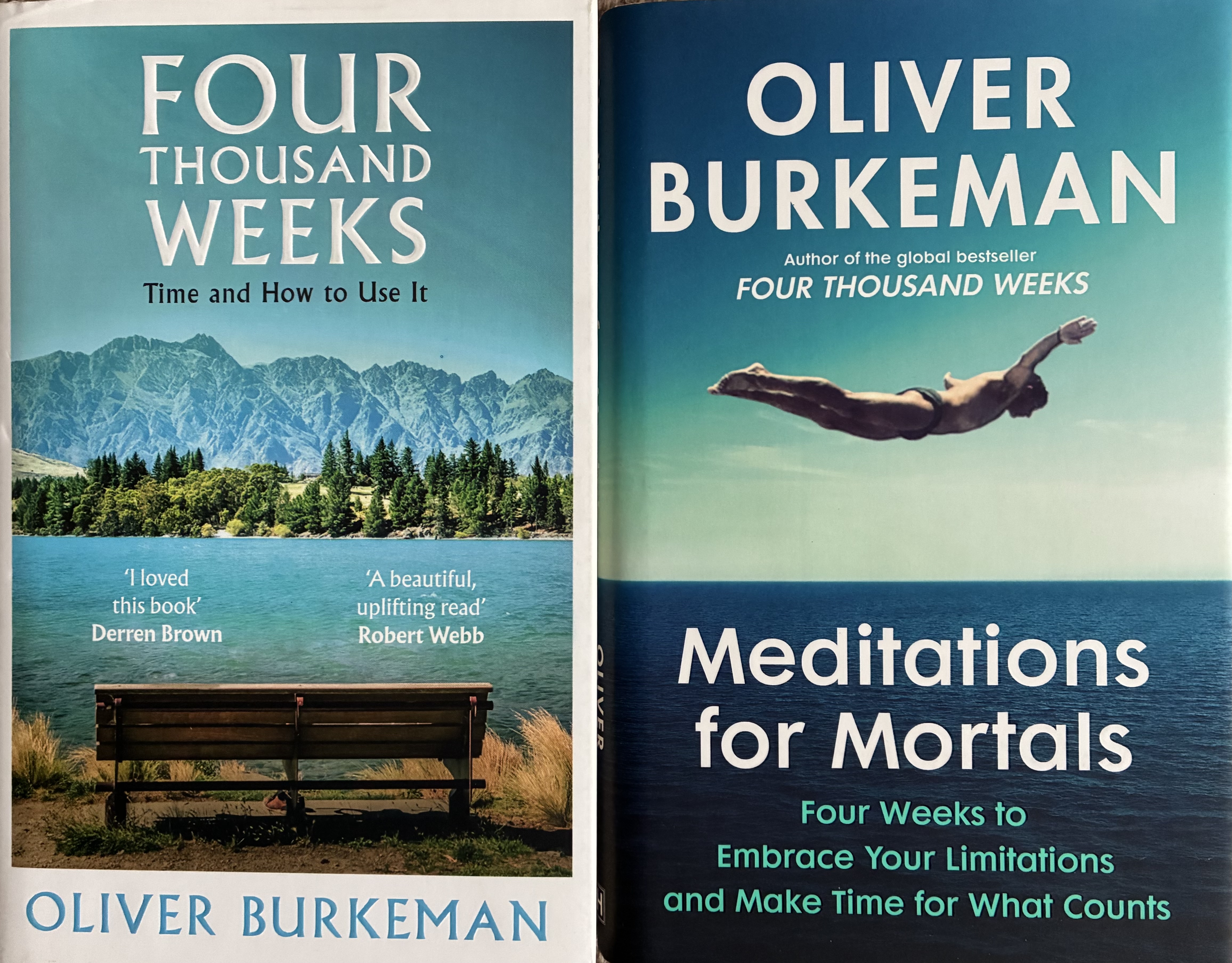
I’d better come straight out with it… I’m a huge fan of Oliver Burkeman’s writings, dating back to the days when he was a regular contributor to The Guardian newspaper with a column delving into productivity-related topics. I read his first book, The Antidote (subtitle: ‘happiness for people who can’t stand positive thinking’), back in 2015, and a few years ago I was lucky enough to attend a couple of fascinating online workshops that he led coinciding with the launch Four Thousand Weeks (FTW), the first of his two more-recent books that are my focus here. FTW was a book that really thrust Burkeman into the limelight, and I don’t think it is going too far to describe him as one of the most respected and influential voices in present-day discourse about the complex relationship with all seem to have with time.
Burkeman often describes himself as a ‘recovering productivity addict’, i.e. someone who in a previous phase of life had a voracious appetite for all of the latest productivity hacks and time management systems. This is a moniker that I could certainly apply to myself (especially as it is ‘recovering’ not ‘recovered’!), and so it’s no surprise that whenever I read anything written by Burkeman, or hear him speaking in an interview, I have an overwhelming feeling that he is peering directly inside my skull and is able to see and comprehend the inner workings of my brain!
Four Thousand Weeks was published in 2021, and I first read it pretty much as soon as I could get my hands on a copy, within a few weeks of the publication date. I found it so interesting and thought-provoking, that my initial reading was followed up just a few months later with another run-through the material, as I listened to Burkeman himself narrate the audiobook version. The basic premise of the book is that a typical human lifespan amounts to ~4000 weeks, and that recognising, and indeed embracing, this finite nature of life (it’s finitude), and thus appreciating that you simply cannot do all of the things you might feel that you should, or want to, do, is the secret to leading a sustainable, meaningful life (or at least a slightly less-frustrating and stressful one).
Burkeman’s most recent book, Meditations for Mortals (MFM), arrived on the scene in September 2024. Again, I read it almost immediately, having pre-ordered it as soon as it was possible to do so. MFM has a neat structure of 28 short chapters arranged into four sections, and is designed to be read one chapter per day over a period of four weeks. In this way, it forms a kind of manual that guides the reader through an exploration of many of the ideas introduced in FTW. After my first reading of MFM, I remember thinking that it would almost certainly be a good idea for me to re-read it on a fairly regular basis, perhaps annually, like a top-up dose of medicine for the mind.
I returned to FTW, and read it for a third time, in June 2025 when it was chosen as the monthly read for The TimeCrafting Trust Book Club that I participate in. That re-reading spurred me to listen to the audiobook version of MFM the following month. My feeling is that whilst FTW works pretty well as an audiobook, MFM is better consumed in physical form. In fact, I’m coming to the conclusion that most works of non-fiction don’t really work that well as audiobooks if you have any real hope of holding onto any nuggets of information or wisdom from them.
In the last year or so I’ve been making a particular effort to write notes and clip passages from the non-fiction books that I read. Sadly, I’m not really very good at doing this. Whilst I am well aware that book notes are of most value when they are a synthesis or personal summary of the material that is covered, I find that kind of note-making very difficult, and so my notes tend to be verbatim copies of phrases and passages that resonate with me in some way. I’d love to be able to write something more considered as I read, but I feel that to do so would take far too much time (that I think I don’t have), and require a lot of patience (that I am pretty sure I don’t have). [Here I find myself putting on my academic tutor voice to remind myself that ‘too much’ is a value judgement statement, and that the value that I get out of the time I choose to put into note-making is clearly directly influenced by my choice of how much time to put into the activity: small time in = probable low value, large time in = potential high value.]
Anyway, it probably won’t be a surprise for me to report that the notes that emerged from my most recent readings of FTW and MFM are extensive… This leaves me with a difficult decision to make in relation to how I go about writing the rest of this blog post. In fact, the need to make that decision is one reason why my blog post writing activity stalled in recent months, and it’s also why I am only now making significant progress writing this post having started it several days ago. What I probably ought to do is to review all of my notes, and synthesise them into a coherent whole that I can summarise in three or four nice, neat paragraphs. But, dear reader (if you exist!), I fear that to approach things that way will just result in yet more delay. [Again, I hear the academic tutor voice in my head telling me sternly that the job of a writer is to make things easy for the reader…]. Consequently, I’m not going to do that… Instead, there are, below, (mostly) a series of short passages taken directly from the text of one or other of the books, with a brief comment or response from me, a little bit like a conversation of sorts…
Four Thousand Weeks
OB: ‘it’s painful to confront how limited your time is, because it means that tough choices are inevitable and that you won’t have time for all you once dreamed you might do‘ (p30) TOH: Well yes, that’s exactly the problem – there are so many things I want to achieve and so little time to achieve them..
OB: ‘Or we procrastinate, which is another means of maintaining the feeling of omnipotent control over life – because you needn’t risk the upsetting experience of failing at an intimidating project, obviously, if you never start it.‘ (p30) TOH: I certainly don’t need much persuading that my chronic procrastination is a result of the fear that what I produce might not be enough to prove that I am as special as my upbringing steered me to believe that I am supposed to be.
OB: ‘You have to choose a few things, sacrifice everything else, and deal with the inevitable sense of loss that results.‘ (p55) TOH: I know, I know, but it’s just so hard for me to let go of things. (although I guess I let go of them anyway, because I procrastinate so much that they never get done…)
OB: ‘Perhaps the most appealing way to resist the truth about your finite time is to initiate a large number of projects at once; that way, you get to feel as though you’re keeping plenty of irons in the fire and making progress on all fronts. Instead, what usually ends up happening is that you make progress on no fronts – because each time a project starts to feel difficult, or frightening, or boring, you can bounce off to a different one instead.‘ (p75) TOH: Exactly. That is absolutely what I do and have always done. I get so far with something, it gets a bit tricky, and so I move on to something else, with the result that I am constantly frustrated with myself for not finishing things. I think that because I was pretty good at most things at school, it was easy for me to make these switches, and so I never fully developed the skill of pushing through when things got difficult.
OB: ‘whenever we succumb to distraction, we’re attempting to flee a painful encounter with our finitude‘ (p105) TOH: I’ve seen this referred to as ‘comfortable-familiar-easy-life-syndrome’. And then you die of course.
OB: ‘The most effective way to sap distraction of its power is just to stop expecting things to be otherwise – to accept that this unpleasantness is simply what it feels like for finite humans to commit ourselves to the kinds of demanding and valuable tasks that force us to confront our limited control over how our lives unfold.‘ TOH: Didn’t someone (Susan Jeffers) write a book once about this? ‘Feel the Fear and Do It Anyway’…
OB: ‘Other people hold off entirely from starting on important projects or embarking on intimate relationships in the first place because they can’t bear the anxiety of having committed themselves to something that might or might not work out happily in practice.‘ (p215) TOH: Indeed, and especially when, like me, your sense of self-worth is almost entirely focused on demonstrating ‘specialness’.
OB: ‘Because now is all you ever get‘ (p219) TOH: Okay, okay, you don’t have to rub it in.
OB: ‘taking on too many projects at once [is a way] of trying to maintain the illusion that you’re in charge of things‘ (p220) TOH: Some years ago, a colleague suggested to me that my difficulties stemmed from a need to be in control. At the time, I couldn’t square this idea in my head at all – I’ve never thought of myself as a control-freak – but over the last few years I have come to realise that yes, I’m very much constantly striving to feel some semblance of control over things/my life.
OB: ‘Let your impossible standards crash to the ground‘ (p222) TOH: Far better to finish something and get it ‘out there’ than never finish is at all (or never even start it for that matter).
OB: ‘If you can face the truth about time in this way – if you can step more fully into the condition of being a limited human – you will reach the greatest heights of productivity, accomplishment, service and fulfilment that were ever in the cards for you to begin with. And the life you will see incrementally taking shape, in the rear-view mirror, will be one that meets the only definitive measure of what it means to have used your weeks well: not how many people you helped, or how much you got done; but what working within the limits of your moment in history and you finite time and talents, you actually got round to doing – and made life more luminous for the rest of us by doing – whatever magnificent task or weird little thing it was that you came here for.‘ (p228) TOH: ‘what… you actually got round to doing’ [sigh]
OB: ‘The average human lifespan is absurdly, terrifyingly, insultingly short. But that isn’t a reason for unremitting despair, or for living in an anxiety-fuelled panic about making the most of your limited time. It’s a cause for relief. You get to give up on something that was always impossible – the quest to become the optimised, infinitely capable, emotionally invincible, fully independent person you’re officially supposed to be. Then you get to roll up your sleeves and start work on what’s gloriously possible instead.‘ (p234) TOH: Okay, you’ve convinced me. I’ll make a really good plan of action and have a careful think about when the best time to get started on it will be… 😉
Meditations for Mortals
OB: ‘‘insecure overachievers’… our accomplishments, impressive as they may sometimes be, are driven ultimately by feelings of inadequacy‘ (p21) TOH: it’s strive, strive, strive to be special
OB: ‘perhaps you’ve tethered your self-esteem to the most crazy-making standard of all “realising your potential” – which means you’ll never get to rest, because how can you ever be sure there’s not a little more potential left to realise?‘ (p21) TOH: Well someone will tell me won’t they? Won’t they?
OB: ‘What is worry, at its core, but the activity of a mind attempting to picture every single bridge that might possibly have to be crossed in future, then trying to figure out how to cross it.‘ (p39) TOH: Have you read my poem? What If? So What?
OB: ‘What the novelist E.L. Doctorow said about novel-writing applies to everything else, too: it’s “like driving a car at night. You never see further than your headlights, but you can make the whole trip that way”.‘ (p48) TOH: But that means being brave enough to embrace uncertainty… Perhaps I need to read my poem What If? So What? again!
OB: refers to an analogy from the book TimeSurfing by Paul Loomans, a Dutch Zen monk, in which tasks or areas of life that you are avoid are referred to as ‘gnawing rats’ and the suggestion is that rather than fearing them or feeling like you should fight them it is better to befriend then. He uses the example of sorting out your shed – the advice is simply to go and stand in the shed and just observe and take stock. Solutions will start to present themselves and some small actions may be taken. (p58) TOH: I refer to these kinds of things as ‘bad smell tasks’ – the ones that seem to hang around on your to-do list for ever.
OB: describes the value of aiming to complete an activity ‘Dailyish’ rather than setting an unattainable ideal of completing it every single day TOH: This is very much something that I have tried to embrace, since being introduced to the idea.
OB: ‘Beyond the mountains, there are always more mountains, at least until you reach the final mountain before your time on earth comes to an end. In the meantime, few things are more exhilarating than mountaineering.‘ (p78 TOH: It’s all about the journey and not the destination as they say, or the difference between atelic and telic activities (or adopting an atelic versus a telic mindset to how you complete activities), as Keiran Setiya sets out wonderfully well in his book Midlife.
OB: ‘… if you see all of this [everyday life] as leading up to some future point when real life will begin, or when you can finally start enjoying yourself, of feeling good about yourself – then you’ll end up treating your actual life as something to ‘get through’ until one day it’ll be over, without the meaningful part ever having arrived.‘ (p122) TOH: I can distinctly remember that when I was younger, I often wished that I was, say, ten years further on in life, which in my head was a time when I had ‘arrived’ and everything was as it should be. Life doesn’t work like that of course.
OB: ‘To treat life as a pilgrimage to a future and better existence is to disown its present value’ (W. Somerset Maugham)‘ (p127) TOH: Beautifully put, but also devastatingly damning! Perhaps it’s time to make a start on something… 😉
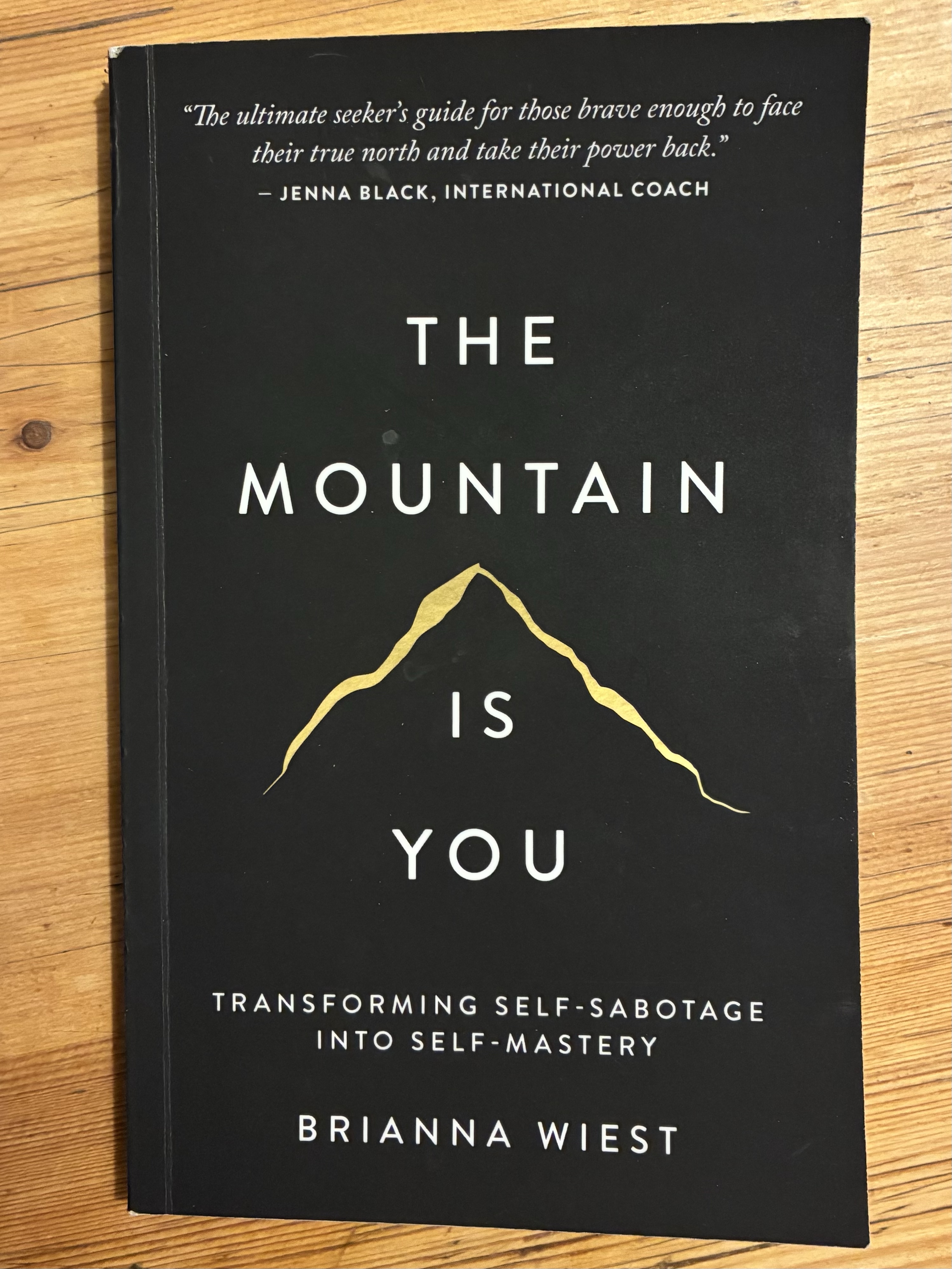
The Mountain Is You: Transforming Self-Sabotage Into Self-Mastery by Brianna West is probably not a book that I would have picked up to read of my own accord, despite that fact that I am pretty much certain that a lot of the struggles I have in pushing myself into action and gaining the sense of achievement and fulfillment that I crave are driven at a fundamental level by self-sabotage in one form or another. There is just something about the whole mountain metaphor, along with the kinds of words used in the book blurb that I read online (‘deep internal work of excavating trauma’, ‘building resilience’, and ‘adjusting how we show up for the climb’) that instinctively put me off. Why then did I work my way through this book for a few weeks in April and May this year? Because it was voted as the reading matter for the May meeting of The Timecrafting Trust Book Club that I participate in, and so, dutifully, I ordered myself a copy and set to work.
Almost from the start, I realized that there might well be a bit more value for me from The Mountain Is You than I had envisaged. I was immediately stuck with some obvious similarity between some of the content being covered and the ideas of psychotherapist Carl Jung that I found enthralling and thoroughly convincing when I read James Hollis’s excellent The Middle Passage a year or so ago.
Wiest begins her book by describing the various forms that self-sabotage can take along with the underlying reasons why each type of self-sabotaging behaviour occurs. There were quite a few lines in this section of the book that resonated with me…
‘sometimes, we sabotage our professional success because what we really want it to create art‘
‘sometimes, our most sabotaging behaviours are really the result of long-held and unexamined fears we have about the world and ourselves‘
‘human beings experience a natural resistance to the unknown, because it is essentially the ultimate loss of control‘
… because yes, I do increasingly seem to be seeing myself as an artist, yes, I definitely have a lot of fears squashed down into my head that hold me back, and yes, I do tend to get overwhelmed and feel very uncomfortable when I perceive that things are spinning out of my control. But why then, knowing all of this, does nothing much really seem to change? Wiest delivers the killer answer:
‘most people do not actually change their lives until not changing becomes the less comfortable option‘
Wiest goes on to argue that, in fact, we might be better off re-framing self-sabotage because, ultimately, the habits and behaviours associated with it are actually a result of your very clever subconcious ensuring that some unfilled need, displaced emotion or neglected desire is being met – that those actions are, in fact, deliberately designed to provide a positive outcome that some hidden part of your subconscious seeks.
Aand funnily enough, just this morning, quite coincidentally, I wrote in my journal that perhaps I allowed myself to procrastinate and hold myself back from taking certain actions even though I know this will result in an intense wave of frustration and anger with myself, because at least those negative feelings and emotions are something that I am familiar with and are, in some weird and twisted way, somewhat comforting.
The next section of The Mountain Is You describes a long list of different manifestations of self-sabotage, and whilst many of these did not feel relevant to me, some of them certainly did – hello Perfectionism, Worrying About Least Likely Circumstances, Being Busy, Fear Of Failure, to name a few.
The start of the process of overcoming self-sabotage begins, Wiest suggests, with tuning into, and listening to, the negative emotions associated with it – things like anger, jealousy, regret, chronic fear. She highlights a basic need to be able to ‘allow yourself to feel what you feel without judgement or suppression and notes that understanding your needs, meeting the ones you are responsible for, and then allowing yourself to show up so others can meet the ones you can’t do on your own will help you break the self-sabotage cycle’. For example, feel angry, notice that you are angry, understand why you are angry, remember that it is okay to feel angry… and then get on with life.
There are then a couple of chapters with fairly standard fare on building emotional intelligence and on letting go of baggage from the past, but as these progressed I could feel the book moving steadily into the kind of territory that my initial instincts had led me to expect. Then, aargh, I hit a section titled ‘Releasing your past into the Quantum Field‘ and my brain was instantly screaming at me that I was now thoroughly into pseudo-scientific mumbo-jumbo land… the kind of land where, apparently, ‘You store … emotions, energies and patterns at a cellular level‘. Now, I guess that in some sense everything associated with an individual human is stored at a cellular level, but I am pretty sure that Wiest is suggesting there’s something rather more mysterious and perhaps spiritual going on. I’d be inclined to simply say that statements of that kind are just nonsense!
I guess that from that point onwards, my brain was in a state of high alert, warning me, perhaps unfairly, that much of what I was reading had no real, solid basis. There were lots of nice, almost mantra-like phrases: ‘be willing to be disliked‘, ‘do your inner work‘ and a series of suggestions to ‘create aligned goals, ‘find you inner peace’, ‘detach from worry’, ‘take triggers as signals’, ‘honour your discomfort’, ‘stop trying to be happy’, ‘arrive into the present’ etc., but in the end it was all a bit too much – too many suggestions, too many affirmations, too many challenges to think about overcoming, with the result that I came away confused and somewhat disappointed. After a promising, really very readable first half, everything seemed to have unraveled as the book reached its conclusion. There was just nothing much that was concrete or tangible for me to cling onto.
Late on in the book there was one phrase that I rather liked in a section titled ‘Be aware of what you give your energy’, namely that ‘the wolf that wins is the one that you feed‘ and strangely, on the day that I read those lines some spoke almost the exact same words to me (perhaps that pesky quantum field was doing its thing…). In fact, the whole book is stuffed full of short phrases and sentences that you could lift off the page and incorporate into an inspirational poster or social media post if that is your thing. I may not have warmed to Wiest’s mountain metaphor or felt that the argument in The Mountain Is You hung together in a fully coherent and convincing manner, but she certainly knows how to write what might be called ‘soundbite sentences’. Forget all the gumph about releasing you past into the quantum field and storing emotions at a cellular level, and take this phrase, right at the end of the book… …
‘One day, the mountain that was in front of you will be so far behind you, it will barely be visible in the distance. But who you become in learning to climb it? That will stay with you forever.‘
I’m a bit of a perfectionist, something which has definitely held me back over the years as I have held off pursuing certain activities ‘in case I couldn’t live up to expectations’ (a trait that I am sure many serial perfectionist procrastinators will be very familiar with). One such activity was always drawing and painting, so it was a bit of a surprise to me when, about a year ago (April 2024), I quite suddenly started painting and following a short video course on what is usually called ‘loose’ watercolour painting, I found that I was (mostly) quite able to side-step my need for ‘perfect’ and simply paint – deliberately being quick was a key element in this. Even better, not only did perfectionism not get in the way of me being able to paint, but I found that painting in a non-perfect way helped my loosen the grip that perfectionism had on me more generally.
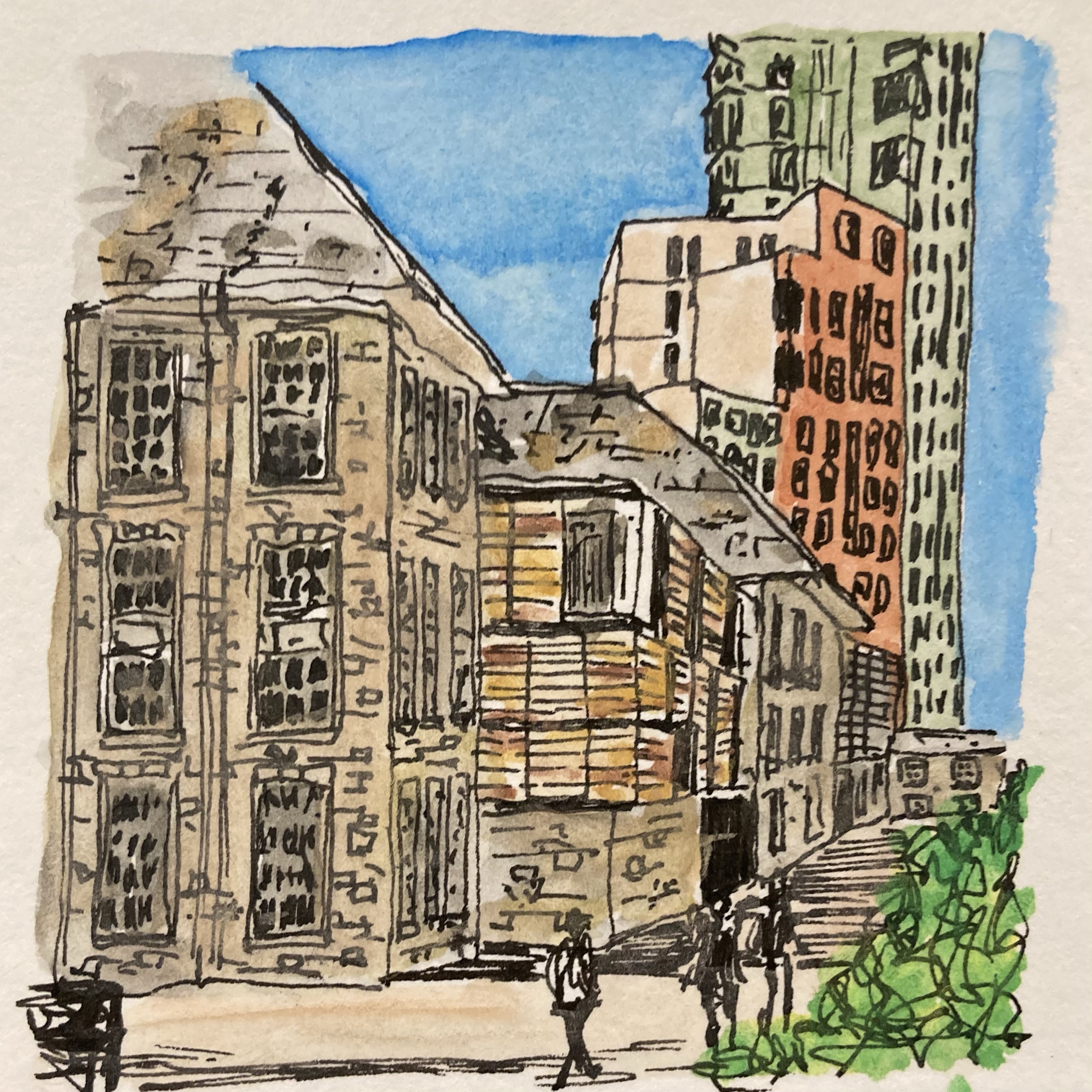
This little picture, painted a few agos, is a nice example of imperfectionism at work. It is a view of the Scott Building (University of Plymouth) on the left with the towering mass of Beckley Point accommodation block behind. If you were to stand where the photo that this picture is based on was taken, you would instantly notice all kinds of discrepancies – the colour of the closest building isn’t quite right, the ground appears to rise upwards because of the way I have used horizontal lines for the shadow cast by the building and the small building in the background (the Reynolds Building in which I used to have my office) is far too small. But none of this really matters. For a start, it’s only a little painting that almost no-one will ever see (and those that do probably won’t know what the scene looks like in reality), but more importantly, I have come to learn that it is the quirky little ‘undetails’ in a picture – a wiggly line here, am improbable colour there, the scratchy outline of a person – that add fun into the mix, and that it is far more important to vaguely capture the sense of a place rather than replicate it in every detail (although pictures like that can also be wonderful and interesting of course).
So, here’s to this quick, little, watercolour picture with all its imperfections – nice and bright, rather jolly and, I think, a sense of movement. It’s not supposed to be a masterpiece, it’s just fine as it is!
OVERDUE: [ ] all the tasks that I said yes to when I ought to have said no [ ] all the calls I need to follow-up so their businesses can grow [ ] all the projects I took upon myself so that I could people please [ ] all the projects I need to do to put myself at ease [ ] all the urgent emails that I know I should have sent [ ] all the bookings that I should have made ahead of the event [ ] all those things that no one cares about but I think are a must [ ] all those gadgets that need mending before they fully bust [ ] all the delegated tasks from others resulting from their lack of time [ ] all the things I think I should do so they think I’m fine [ ] all the action points from meetings that I think were flagged for me [ ] all the edits to the documents that I know you need to see
OTHER: [ ] more tasks that I said yes to when I wanted to say no [ ] more calls I’d like to follow-up to help my business grow [ ] more projects I have taken on so I can people please [ ] more projects that I want to do to put myself at ease [ ] more emails that I know that it would help for me to send [ ] more plans that I could make for upcoming events [ ] more things that no one cares about but I think are a must [ ] more gadgets that need maintenance to stop them going bust [ ] more delegated tasks from others resulting from their lack of time [ ] more things I’d like to finish (only then will I feel fine) [ ] more action points from meetings that I let them flag to me [ ] more edits to the documents that I’d like you to see
SOMEDAY/MAYBE: [ ] try to make some art [ ] try to pause a while [ ] try to take time for myself [ ] try to have fun [ ] try to meet up with a friend [ ] try to smile [ ] try to laugh [ ] try to simply do the things I want [ ] try to quench my thirst [ ] try to look after my brain [ ] try to use a different font [ ] try to listen to my heart [ ] try to sit in the sun [ ] try to soak up the rain [ ] try to read the books that are piled upon the shelf [ ] try to have a nice relaxing bath [ ] try to ‘pay myself first’ [ ] try to ignore the latest trend
WAITING FOR: [ ] the perfect time [ ] the stars to align [ ] the mists to clear [ ] the loss of fear [ ] all of the pieces to fall into place [ ] and, of course, the ideal space [ ] the feeling that it’s right [ ] and for my chest to feel less tight [ ] a decent night’s sleep [ ] the bravery to take a leap [ ] something to drink, and some food [ ] the right mood
TODO TODAY: [ ] put a cross in the unchecked boxes and strike-through all the words in the following lists: …….[ ] WAITING FOR …….[ ] OTHER …….[ ] OVERDUE [ ] wherever they appear in the SOMEDAY/MAYBE list strike-through the words: ‘try to’ [ ] start a new list with the title ‘TODO (RECURRING – EVERY DAY)’ [ ] add the unchecked tasks from SOMEDAY/MAYBE in a pleasing way [ ] tear up all of the old lists and throw them right away
PRESENT
OVERDUE: [x] all the tasks that I said yes to when I ought to have said no [x] all the calls I need to follow-up so their businesses can grow [x] all the projects I took upon myself so that I could people please [x] all the projects I need to do to put myself at ease [x] all the urgent emails that I know I should have sent [x] all the bookings that I should have made ahead of the event [x] all those things that no one cares about but I think are a must [x] all those gadgets that need mending before they fully bust [x] all the delegated tasks from others resulting from their lack of time [x] all the things I think I should do so they think I’m fine [x] all the action points from meetings that I think were flagged for me [x] all the edits to the documents that I know you need to see
OTHER: [x] more tasks that I said yes to when I wanted to say no [x] more calls I’d like to follow-up to help my business grow [x] more projects I have taken on so I can people please [x] more projects that I want to do to put myself at ease [x] more emails that I know that it would help for me to send [x] more plans that I could make for upcoming events [x] more things that no one cares about but I think are a must [x] more gadgets that need maintenance to stop them going bust [x] more delegated tasks from others resulting from their lack of time [x] more things I’d like to finish (only then will I feel fine) [x] more action points from meetings that I let them flag to me [x] more edits to the documents that I’d like you to see
SOMEDAY/MAYBE: [ ] try to make some art [ ] try to pause a while [ ] try to take time for myself [ ] try to have fun [ ] try to meet up with a friend [ ] try to smile [ ] try tolaugh [ ] try to simply do the things I want [ ] try to quench my thirst [ ] try to look after my brain [ ] try to use a different font [ ] try to listen to my heart [ ] try to sit in the sun [ ] try to soak up the rain [ ] try to read the books that are piled upon the shelf [ ] try to have a nice relaxing bath [ ] try to ‘pay myself first’ [ ] try to ignore the latest trend
WAITING FOR: [x] the perfect time [x] the stars to align [x] the mists to clear [x] the loss of fear [x] all of the pieces to fall into place [x] and, of course, the ideal space [x] the feeling that it’s right [x] and for my chest to feel less tight [x] a decent night’s sleep [x] the bravery to take a leap [x] something to drink, and some food [x] the right mood
TODO TODAY: [x] put a tick in the unchecked boxes and strike-through all the words in the following lists: …….[x] WAITING FOR …….[x] OTHER …….[x] OVERDUE [x] wherever they appear in the SOMEDAY/MAYBE list strike-through the words: ‘try to’ [x] start a new list with the title ‘TODO (RECURRING – EVERY DAY)’ [x] add the unchecked tasks from SOMEDAY/MAYBE in a pleasing way [x] tear up all of the old lists and throw them right away
FUTURE
TODO (RECURRING – EVERY DAY): [ ] quench my thirst [ ] ‘pay myself first’ [ ] read the books that are piled upon the shelf [ ] take time for myself [ ] soak up the rain [ ] look after my brain [ ] make some art [ ] listen to my heart [ ] sit in the sun [ ] have fun [ ] have a nice relaxing bath [ ] laugh [ ] pause a while [ ] smile [ ] ignore the latest trend [ ] meet up with a friend [ ] use a different font [ ] simply do the things I want
(c) Tim O’Hare, June 2023
About this poem: I’ve been something of a ‘productivity geek’ for quite a few years using various systems of lists to track what I need to do (or think I need to do). Much of this tracking behaviour is built on a very well-known system known as ‘Getting Things Done’ (GTD) from a book with the same name by the author David Allen. This uses lists for things To Do, things that you are Waiting For, things you might do Someday and/or Maybe etc. Recently, I’ve been trying to relax my use of such systems, especially as I have realised that tracking everything in this way also feeds some of my obsessive collecting and perfectionist behaviours and supports my ‘people pleasing’ tendency. Todo List tries to capture a way out of this pattern of thinking, turning the controlling power of a Todo List into a weapon to destroy the worst aspects of the behaviour such lists can engender.
Does it matter what they’re thinking? Does it matter what they think of what I say? Does it matter if I do what they’re expecting? Does it matter if I do it anyway?
Does it matter if I play the game they choose? Does it matter if they think that I’m a fool? Does it matter if I win or if I lose? Does it matter if I play by different rules?
Does it matter if I do it when I should do? Does it matter if I go at my own pace? Does it matter if I keep myself beside you? Does it matter if I run a different race?
Does it matter if I wear a different colour? Does it matter if I my hair’s a little long? Does it matter if I like things to be quieter? Does it matter if I break out into song?
Does it matter if I go across the bridge? Does it matter if I’m in a different land? Does it matter if I speak a different language? Does it matter if I’m hard to understand?
Does it matter if I go to different places? Does it matter if I seem a little weird? Does it matter if I once wore rainbow laces? Does it matter if I’m nothing to be feared?
Does it matter what they’re thinking? Does it matter what they think of what I say? Does it matter if I do what they’re expecting? I think I’ll do it anyway.
(c) Tim O’Hare, June 2023
About this poem: I had read an article about Rejection Sensitive Dysphoria and how this can lead to ‘people pleasing’ behaviour, something that I tend to adopt strongly. ‘Does It Matter?’ tries to capture aspects of the internal struggle that works its way through my head on a near continuous basis and also provides a form of written antidote that reminds me that I do not have to do what I think is expected of me or behave in the ways that I think I am expected to behave or only do things once I have received some form of external confirmation that they are worthwhile or valid things to do.
This was the second poem I wrote, back in early summer 2023. It’s been clear since then that writing and publishing my poems has helped me to become much less dependent on receiving external validation for my work and much happier to just put stuff out there and see what happens (even if that turns out to be nothing very much!). I think this poem expressed something that I always knew inside but was perhaps a little fearful to recognize.