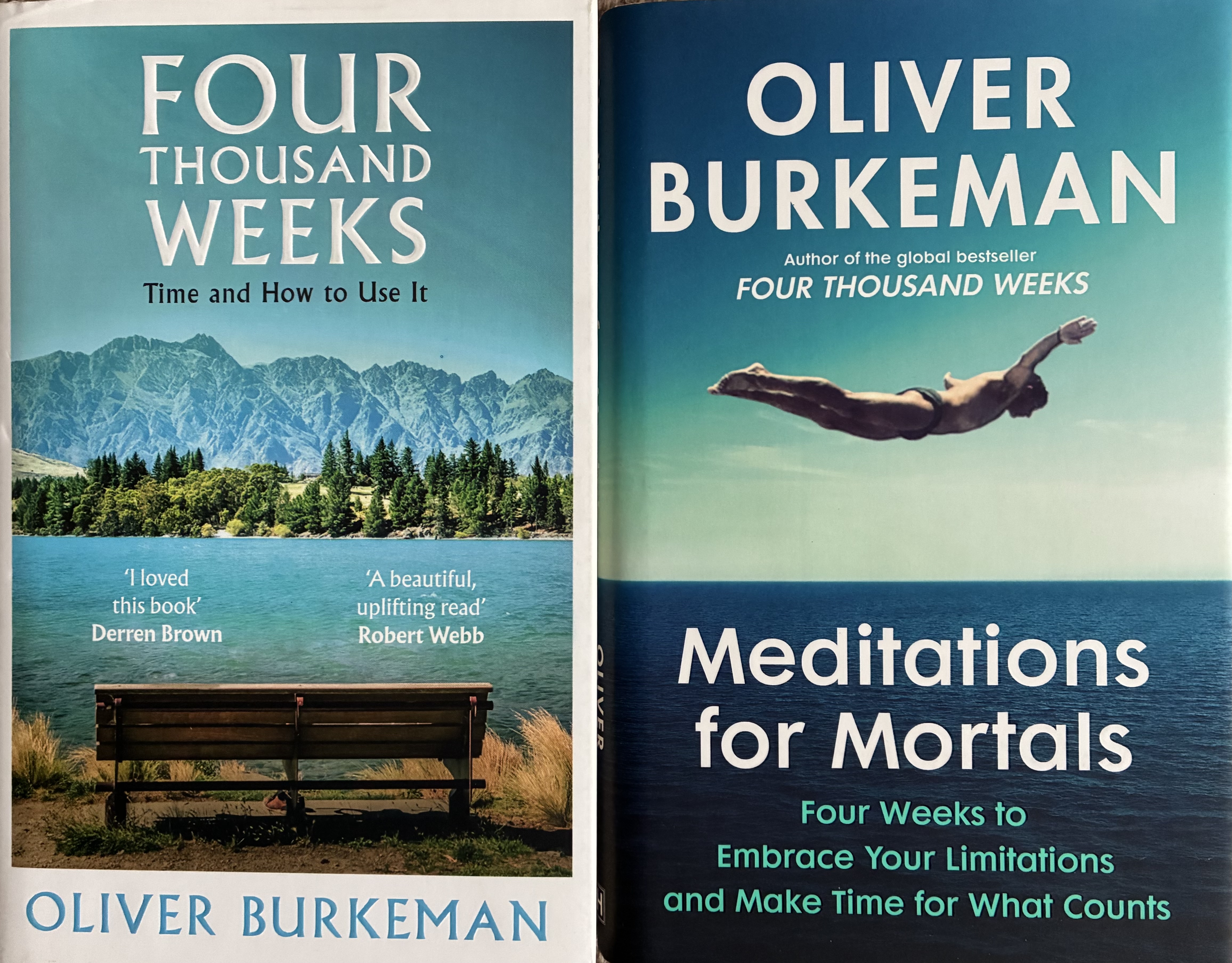
I’d better come straight out with it… I’m a huge fan of Oliver Burkeman’s writings, dating back to the days when he was a regular contributor to The Guardian newspaper with a column delving into productivity-related topics. I read his first book, The Antidote (subtitle: ‘happiness for people who can’t stand positive thinking’), back in 2015, and a few years ago I was lucky enough to attend a couple of fascinating online workshops that he led coinciding with the launch Four Thousand Weeks (FTW), the first of his two more-recent books that are my focus here. FTW was a book that really thrust Burkeman into the limelight, and I don’t think it is going too far to describe him as one of the most respected and influential voices in present-day discourse about the complex relationship with all seem to have with time.
Burkeman often describes himself as a ‘recovering productivity addict’, i.e. someone who in a previous phase of life had a voracious appetite for all of the latest productivity hacks and time management systems. This is a moniker that I could certainly apply to myself (especially as it is ‘recovering’ not ‘recovered’!), and so it’s no surprise that whenever I read anything written by Burkeman, or hear him speaking in an interview, I have an overwhelming feeling that he is peering directly inside my skull and is able to see and comprehend the inner workings of my brain!
Four Thousand Weeks was published in 2021, and I first read it pretty much as soon as I could get my hands on a copy, within a few weeks of the publication date. I found it so interesting and thought-provoking, that my initial reading was followed up just a few months later with another run-through the material, as I listened to Burkeman himself narrate the audiobook version. The basic premise of the book is that a typical human lifespan amounts to ~4000 weeks, and that recognising, and indeed embracing, this finite nature of life (it’s finitude), and thus appreciating that you simply cannot do all of the things you might feel that you should, or want to, do, is the secret to leading a sustainable, meaningful life (or at least a slightly less-frustrating and stressful one).
Burkeman’s most recent book, Meditations for Mortals (MFM), arrived on the scene in September 2024. Again, I read it almost immediately, having pre-ordered it as soon as it was possible to do so. MFM has a neat structure of 28 short chapters arranged into four sections, and is designed to be read one chapter per day over a period of four weeks. In this way, it forms a kind of manual that guides the reader through an exploration of many of the ideas introduced in FTW. After my first reading of MFM, I remember thinking that it would almost certainly be a good idea for me to re-read it on a fairly regular basis, perhaps annually, like a top-up dose of medicine for the mind.
I returned to FTW, and read it for a third time, in June 2025 when it was chosen as the monthly read for The TimeCrafting Trust Book Club that I participate in. That re-reading spurred me to listen to the audiobook version of MFM the following month. My feeling is that whilst FTW works pretty well as an audiobook, MFM is better consumed in physical form. In fact, I’m coming to the conclusion that most works of non-fiction don’t really work that well as audiobooks if you have any real hope of holding onto any nuggets of information or wisdom from them.
In the last year or so I’ve been making a particular effort to write notes and clip passages from the non-fiction books that I read. Sadly, I’m not really very good at doing this. Whilst I am well aware that book notes are of most value when they are a synthesis or personal summary of the material that is covered, I find that kind of note-making very difficult, and so my notes tend to be verbatim copies of phrases and passages that resonate with me in some way. I’d love to be able to write something more considered as I read, but I feel that to do so would take far too much time (that I think I don’t have), and require a lot of patience (that I am pretty sure I don’t have). [Here I find myself putting on my academic tutor voice to remind myself that ‘too much’ is a value judgement statement, and that the value that I get out of the time I choose to put into note-making is clearly directly influenced by my choice of how much time to put into the activity: small time in = probable low value, large time in = potential high value.]
Anyway, it probably won’t be a surprise for me to report that the notes that emerged from my most recent readings of FTW and MFM are extensive… This leaves me with a difficult decision to make in relation to how I go about writing the rest of this blog post. In fact, the need to make that decision is one reason why my blog post writing activity stalled in recent months, and it’s also why I am only now making significant progress writing this post having started it several days ago. What I probably ought to do is to review all of my notes, and synthesise them into a coherent whole that I can summarise in three or four nice, neat paragraphs. But, dear reader (if you exist!), I fear that to approach things that way will just result in yet more delay. [Again, I hear the academic tutor voice in my head telling me sternly that the job of a writer is to make things easy for the reader…]. Consequently, I’m not going to do that… Instead, there are, below, (mostly) a series of short passages taken directly from the text of one or other of the books, with a brief comment or response from me, a little bit like a conversation of sorts…
Four Thousand Weeks
OB: ‘it’s painful to confront how limited your time is, because it means that tough choices are inevitable and that you won’t have time for all you once dreamed you might do‘ (p30)
TOH: Well yes, that’s exactly the problem – there are so many things I want to achieve and so little time to achieve them..
OB: ‘Or we procrastinate, which is another means of maintaining the feeling of omnipotent control over life – because you needn’t risk the upsetting experience of failing at an intimidating project, obviously, if you never start it.‘ (p30)
TOH: I certainly don’t need much persuading that my chronic procrastination is a result of the fear that what I produce might not be enough to prove that I am as special as my upbringing steered me to believe that I am supposed to be.
OB: ‘You have to choose a few things, sacrifice everything else, and deal with the inevitable sense of loss that results.‘ (p55)
TOH: I know, I know, but it’s just so hard for me to let go of things. (although I guess I let go of them anyway, because I procrastinate so much that they never get done…)
OB: ‘Perhaps the most appealing way to resist the truth about your finite time is to initiate a large number of projects at once; that way, you get to feel as though you’re keeping plenty of irons in the fire and making progress on all fronts. Instead, what usually ends up happening is that you make progress on no fronts – because each time a project starts to feel difficult, or frightening, or boring, you can bounce off to a different one instead.‘ (p75)
TOH: Exactly. That is absolutely what I do and have always done. I get so far with something, it gets a bit tricky, and so I move on to something else, with the result that I am constantly frustrated with myself for not finishing things. I think that because I was pretty good at most things at school, it was easy for me to make these switches, and so I never fully developed the skill of pushing through when things got difficult.
OB: ‘whenever we succumb to distraction, we’re attempting to flee a painful encounter with our finitude‘ (p105)
TOH: I’ve seen this referred to as ‘comfortable-familiar-easy-life-syndrome’. And then you die of course.
OB: ‘The most effective way to sap distraction of its power is just to stop expecting things to be otherwise – to accept that this unpleasantness is simply what it feels like for finite humans to commit ourselves to the kinds of demanding and valuable tasks that force us to confront our limited control over how our lives unfold.‘
TOH: Didn’t someone (Susan Jeffers) write a book once about this? ‘Feel the Fear and Do It Anyway’…
OB: ‘Other people hold off entirely from starting on important projects or embarking on intimate relationships in the first place because they can’t bear the anxiety of having committed themselves to something that might or might not work out happily in practice.‘ (p215)
TOH: Indeed, and especially when, like me, your sense of self-worth is almost entirely focused on demonstrating ‘specialness’.
OB: ‘Because now is all you ever get‘ (p219)
TOH: Okay, okay, you don’t have to rub it in.
OB: ‘taking on too many projects at once [is a way] of trying to maintain the illusion that you’re in charge of things‘ (p220)
TOH: Some years ago, a colleague suggested to me that my difficulties stemmed from a need to be in control. At the time, I couldn’t square this idea in my head at all – I’ve never thought of myself as a control-freak – but over the last few years I have come to realise that yes, I’m very much constantly striving to feel some semblance of control over things/my life.
OB: ‘Let your impossible standards crash to the ground‘ (p222)
TOH: Far better to finish something and get it ‘out there’ than never finish is at all (or never even start it for that matter).
OB: ‘If you can face the truth about time in this way – if you can step more fully into the condition of being a limited human – you will reach the greatest heights of productivity, accomplishment, service and fulfilment that were ever in the cards for you to begin with. And the life you will see incrementally taking shape, in the rear-view mirror, will be one that meets the only definitive measure of what it means to have used your weeks well: not how many people you helped, or how much you got done; but what working within the limits of your moment in history and you finite time and talents, you actually got round to doing – and made life more luminous for the rest of us by doing – whatever magnificent task or weird little thing it was that you came here for.‘ (p228)
TOH: ‘what… you actually got round to doing’ [sigh]
OB: ‘The average human lifespan is absurdly, terrifyingly, insultingly short. But that isn’t a reason for unremitting despair, or for living in an anxiety-fuelled panic about making the most of your limited time. It’s a cause for relief. You get to give up on something that was always impossible – the quest to become the optimised, infinitely capable, emotionally invincible, fully independent person you’re officially supposed to be. Then you get to roll up your sleeves and start work on what’s gloriously possible instead.‘ (p234)
TOH: Okay, you’ve convinced me. I’ll make a really good plan of action and have a careful think about when the best time to get started on it will be… 😉
Meditations for Mortals
OB: ‘‘insecure overachievers’… our accomplishments, impressive as they may sometimes be, are driven ultimately by feelings of inadequacy‘ (p21)
TOH: it’s strive, strive, strive to be special
OB: ‘perhaps you’ve tethered your self-esteem to the most crazy-making standard of all “realising your potential” – which means you’ll never get to rest, because how can you ever be sure there’s not a little more potential left to realise?‘ (p21)
TOH: Well someone will tell me won’t they? Won’t they?
OB: ‘What is worry, at its core, but the activity of a mind attempting to picture every single bridge that might possibly have to be crossed in future, then trying to figure out how to cross it.‘ (p39)
TOH: Have you read my poem? What If? So What?
OB: ‘What the novelist E.L. Doctorow said about novel-writing applies to everything else, too: it’s “like driving a car at night. You never see further than your headlights, but you can make the whole trip that way”.‘ (p48)
TOH: But that means being brave enough to embrace uncertainty… Perhaps I need to read my poem What If? So What? again!
OB: refers to an analogy from the book Time Surfing by Paul Loomans, a Dutch Zen monk, in which tasks or areas of life that you are avoid are referred to as ‘gnawing rats’ and the suggestion is that rather than fearing them or feeling like you should fight them it is better to befriend then. He uses the example of sorting out your shed – the advice is simply to go and stand in the shed and just observe and take stock. Solutions will start to present themselves and some small actions may be taken. (p58)
TOH: I refer to these kinds of things as ‘bad smell tasks’ – the ones that seem to hang around on your to-do list for ever.
OB: describes the value of aiming to complete an activity ‘Dailyish’ rather than setting an unattainable ideal of completing it every single day
TOH: This is very much something that I have tried to embrace, since being introduced to the idea.
OB: ‘Beyond the mountains, there are always more mountains, at least until you reach the final mountain before your time on earth comes to an end. In the meantime, few things are more exhilarating than mountaineering.‘ (p78
TOH: It’s all about the journey and not the destination as they say, or the difference between atelic and telic activities (or adopting an atelic versus a telic mindset to how you complete activities), as Keiran Setiya sets out wonderfully well in his book Midlife.
OB: ‘… if you see all of this [everyday life] as leading up to some future point when real life will begin, or when you can finally start enjoying yourself, of feeling good about yourself – then you’ll end up treating your actual life as something to ‘get through’ until one day it’ll be over, without the meaningful part ever having arrived.‘ (p122)
TOH: I can distinctly remember that when I was younger, I often wished that I was, say, ten years further on in life, which in my head was a time when I had ‘arrived’ and everything was as it should be. Life doesn’t work like that of course.
OB: ‘To treat life as a pilgrimage to a future and better existence is to disown its present value’ (W. Somerset Maugham)‘ (p127)
TOH: Beautifully put, but also devastatingly damning! Perhaps it’s time to make a start on something… 😉

