
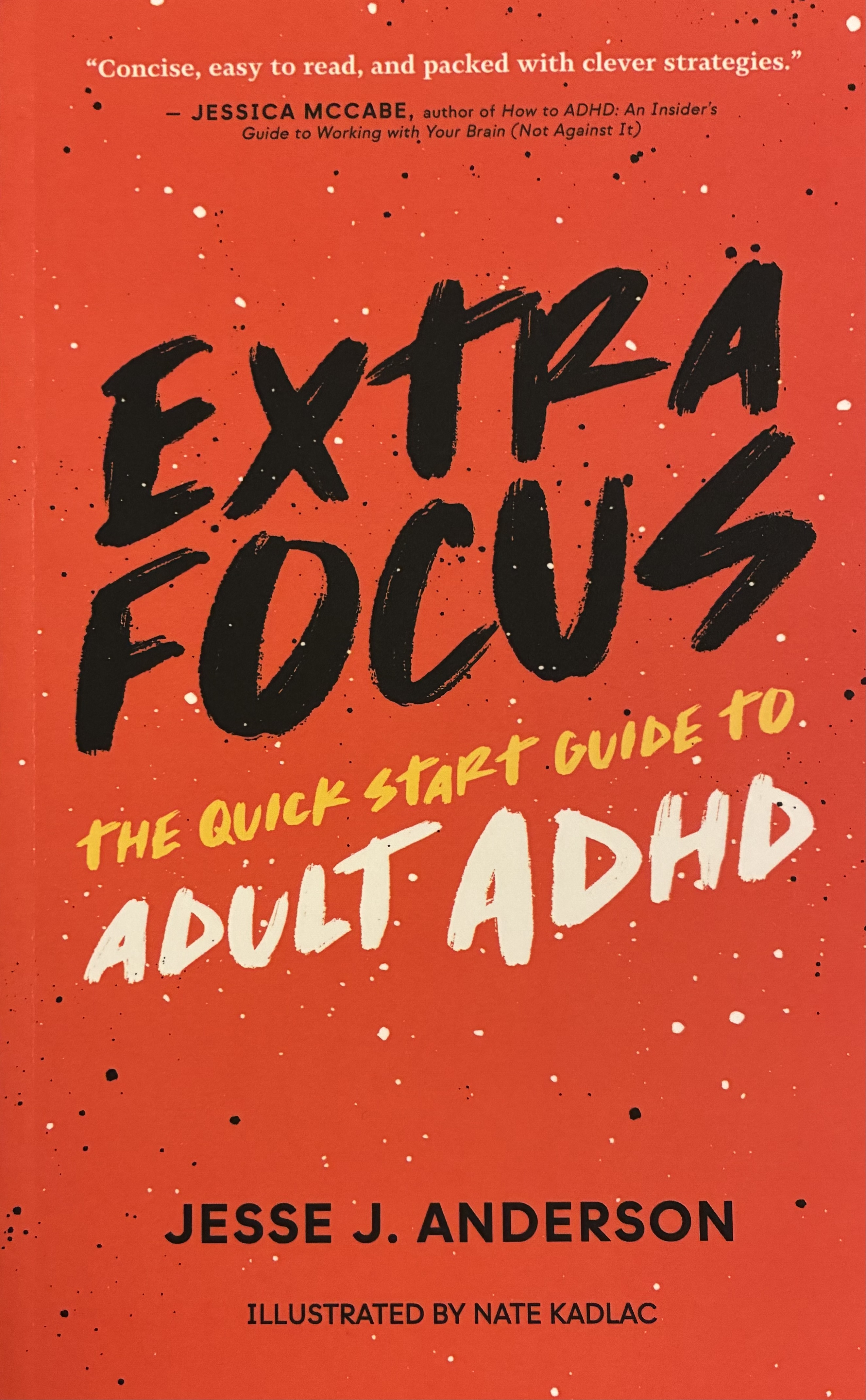
I first came across Jesse J. Anderson’s work in June 2025 via a live-streamed episode of the ‘A Productive Conversation‘ podcast that I was able to view through my membership of Mike Vardy‘s online community The TimeCrafting Trust (this is a link to the specific episode: A Productive Conversation – Episode 625: Jesse J. Anderson Talks About ADHD, Extra Focus, and Finding Flow). It was an interesting and engaging conversation discussing Anderson’s book (Extra Focus: The Quick-Start Guide to Adult ADHD) that, amongst other things, highlighted the idea that whereas most neurotypical people are motivated by importance, people with ADHD tend to have a more interest-based motivational drive. One impact of this is that it is generally assumed that if a task is important, it will get done, and so much of the advice on how to get (more) things done focuses on how to make tasks more important – or at least to seem more important. I guess that for many, perhaps even most, such advice can be useful, but for those battling against the unseen challenges posed by possessing an ‘ADHD-brain’, things are often rather more difficult. Not only do commonly used motivation-boosting tricks not work much of the time, but the fact that they don’t work, and for no apparently good reason, adds a big dollop of frustration and even shame into the mix too.
In the podcast interview, Anderson talked through what he calls the 4 Cs: a simple framework designed to enhance motivation by appealing to the ADHD-brain’s focus on interest. The 4 Cs in the name each stand for a different word that captures an approach that could be used to try to stimulate motivation, namely:
- CAPTIVATE – making tasks interesting
- CREATE – using creativity and seeking novelty
- COMPETE – stimulating interest via competition and challenge
- COMPLETE – making use of deadlines and ramping up urgency
After viewing the livestream event, I was impressed with the openness and authenticity in the way that Anderson spoke, and so a few weeks later I listened to the audiobook version of the book. It was an interesting listen, but whilst I enjoy listening to audiobooks, I do find it difficult to hold on to the detail of much of what I have listened to, especially as most of my listening takes place while I am walking to and from work. Consequently, my notes from this first pass through the material are rather limited, basically consisting of a restatement of the 4 Cs framework, along with a set of related questions that can be used to try to build motivation towards the completion of tasks when necessary:
- How can I make the task more interesting for me?
- How can I approach the task in a different/creative way?
- How can I add a competitive edge to the task?
- How can I ensure that I obtain positive (external) feedback on completion of the task?
Apart from this, my notes only reveal one other thing that I was particularly struck by, namely an assertion that the commonly-given productivity advice to ‘Eat the Frog‘, as popularised by the business coach/author Brian Tracey, is not at all effective for many people with ADHD. [The idea behind ‘eat the frog’ is that you should tackle your most difficult, significant, tricky, and as a result high value, task as your first action each day]. Instead, Anderson suggests starting the day with some fun/easy tasks in order to build up what he calls ‘motivation momentum‘. This chimes with my own day-to-day experience, and was perhaps the first time I had come across this way of thinking about my preference for a ‘slow morning’ start, rather than seeing it as being related to having a ‘night owl‘ chronotype (something that I am not convinced I possess to any great extent).
The rather limited nature of my initial notes might suggest that the content of the book did not prove especially interesting. However, I obviously did feel that there was more in Extra Focus that might be useful, not only for me, but to pass on to the considerable number of neurodiverse/ADHD-brained students that I work with in my job as a university lecturer, because in December 2025 I decided to make a second pass through the book, but in print format. Looking at my fairly extensive notes, it’s clear that in this second reading I did a much more thorough job of working through the material…
Anderson starts out with some general thoughts about the challenges of ADHD, noting that calling it an attention deficit is inaccurate, and suggesting instead that it is better viewed as being a dysregulation of attention. He then sets out the 4 Cs approach and suggests that instead of eating the frog first, ADHDers might be better served by eating the ice cream first… something which sounds like a much better idea to me!
The book then moves into a fairly long list of different motivation-enhancing strategies, things like adding action verbs to tasks, altering your environment to make it more stimulating, finding a ‘body double’ to provide some external accountability, gamifying tasks, and racing against the clock. There was not much in this section that stood out to me, but I think this would be a useful section for someone who is at the start of their ADHD-adaptation journey.
The later part of the book has three areas of focus – TIME, MEMORY, and EMOTION – and I think that all three of these sections contain useful content and advice. In particular, the chapter on Emotion, which covers topics such as ‘success amnesia‘ (the tendency to forget/ignore past successes), ‘imposter syndrome‘, ‘rejection sensitivity‘, ‘shame distortion‘, and ‘impulsivity and inhibition‘ might be quite eye-opening for readers who have not previously linked these characteristics or challenges to ownership of an ADHD-brain.
The book ends with encouragement that when you understand how your brain works you can use that knowledge to your advantage, guidance that may well seem obvious to many readers. However, my own experience of ADHD is that it can be very difficult, if not downright impossible at times, to understand how an ADHD-brain is working in any given moment. With this in mind, having a well-written and straightforward guide such as Extra Focus to lead you through consideration of many of the key related topics and ideas, can only be a good thing.
I’d say that of all the books I have read about coping with the challenges of owning an ADHD-brain, Extra Focus is up there in my top two or three. It’s written with the ADHD-brained reader in mind, in simple, plain language and has a clear emphasis on practical implementation throughout. Overall, I think it would be an excellent starting place for anyone new to exploring the challenges posed by an ADHD brain, whether driven by personal need, a desire to better understand or support a friend or family member, or just for general interest.
Now, where’s that tub of ice cream?

