
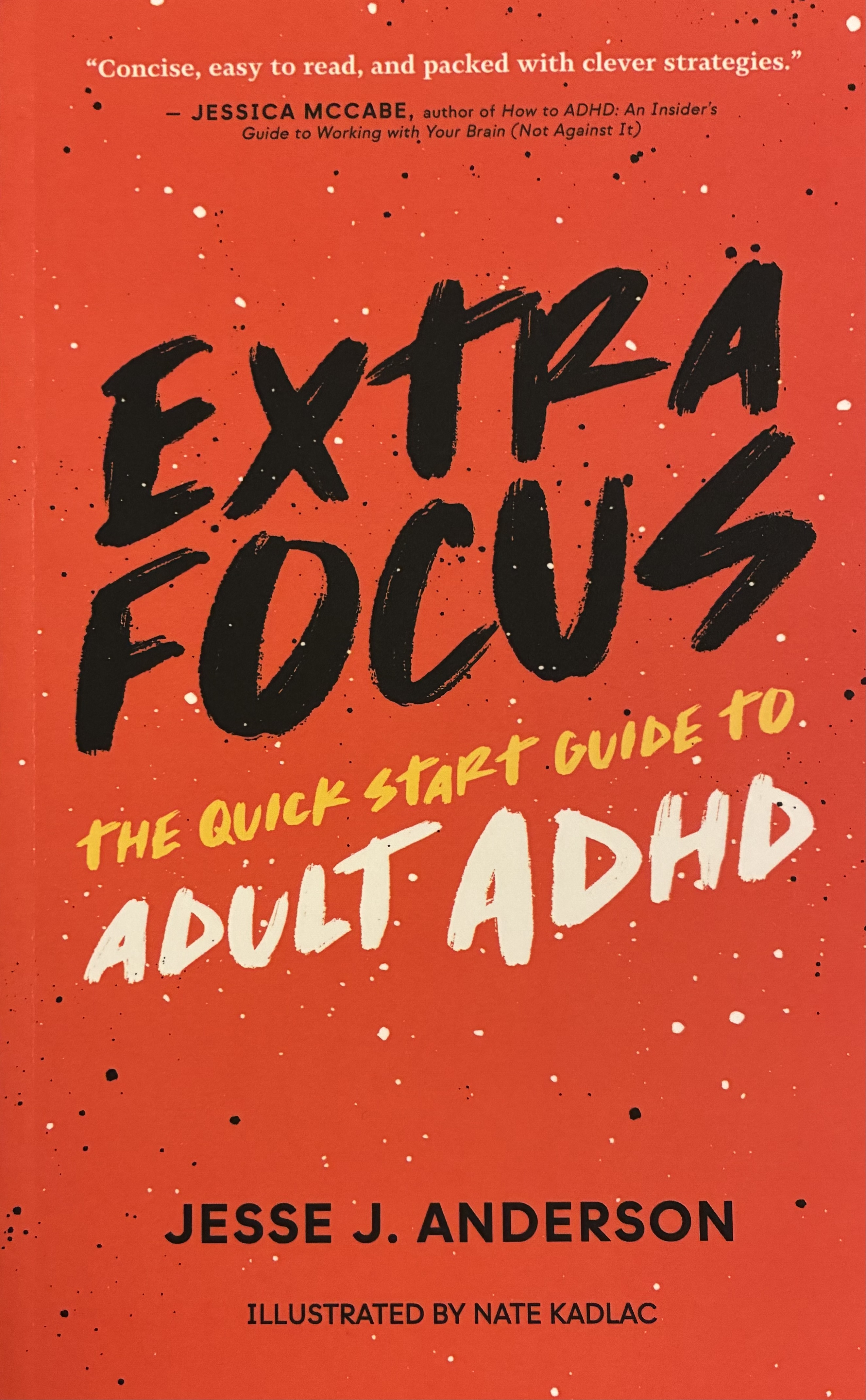
Extra Focus – Jesse J. Anderson #reading

I first came across Jesse J. Anderson’s work in June 2025 via a live-streamed episode of the ‘A Productive Conversation‘ podcast that I was able to view through my membership of Mike Vardy‘s online community The TimeCrafting Trust (this is a link to the specific episode: A Productive Conversation – Episode 625: Jesse J. Anderson Talks About ADHD, Extra Focus, and Finding Flow). It was an interesting and engaging conversation discussing Anderson’s book (Extra Focus: The Quick-Start Guide to Adult ADHD) that, amongst other things, highlighted the idea that whereas most neurotypical people are motivated by importance, people with ADHD tend to have a more interest-based motivational drive. One impact of this is that it is generally assumed that if a task is important, it will get done, and so much of the advice on how to get (more) things done focuses on how to make tasks more important – or at least to seem more important. I guess that for many, perhaps even most, such advice can be useful, but for those battling against the unseen challenges posed by possessing an ‘ADHD-brain’, things are often rather more difficult. Not only do commonly used motivation-boosting tricks not work much of the time, but the fact that they don’t work, and for no apparently good reason, adds a big dollop of frustration and even shame into the mix too.

In the podcast interview, Anderson talked through what he calls the 4 Cs: a simple framework designed to enhance motivation by appealing to the ADHD-brain’s focus on interest. The 4 Cs in the name each stand for a different word that captures an approach that could be used to try to stimulate motivation, namely:

  • CAPTIVATE – making tasks interesting
  • CREATE – using creativity and seeking novelty
  • COMPETE – stimulating interest via competition and challenge
  • COMPLETE – making use of deadlines and ramping up urgency

After viewing the livestream event, I was impressed with the openness and authenticity in the way that Anderson spoke, and so a few weeks later I listened to the audiobook version of the book. It was an interesting listen, but whilst I enjoy listening to audiobooks, I do find it difficult to hold on to the detail of much of what I have listened to, especially as most of my listening takes place while I am walking to and from work. Consequently, my notes from this first pass through the material are rather limited, basically consisting of a restatement of the 4 Cs framework, along with a set of related questions that can be used to try to build motivation towards the completion of tasks when necessary:

  • How can I make the task more interesting for me?
  • How can I approach the task in a different/creative way?
  • How can I add a competitive edge to the task?
  • How can I ensure that I obtain positive (external) feedback on completion of the task?

Apart from this, my notes only reveal one other thing that I was particularly struck by, namely an assertion that the commonly-given productivity advice to ‘Eat the Frog‘, as popularised by the business coach/author Brian Tracey, is not at all effective for many people with ADHD. [The idea behind ‘eat the frog’ is that you should tackle your most difficult, significant, tricky, and as a result high value, task as your first action each day]. Instead, Anderson suggests starting the day with some fun/easy tasks in order to build up what he calls ‘motivation momentum‘. This chimes with my own day-to-day experience, and was perhaps the first time I had come across this way of thinking about my preference for a ‘slow morning’ start, rather than seeing it as being related to having a ‘night owl‘ chronotype (something that I am not convinced I possess to any great extent).

The rather limited nature of my initial notes might suggest that the content of the book did not prove especially interesting. However, I obviously did feel that there was more in Extra Focus that might be useful, not only for me, but to pass on to the considerable number of neurodiverse/ADHD-brained students that I work with in my job as a university lecturer, because in December 2025 I decided to make a second pass through the book, but in print format. Looking at my fairly extensive notes, it’s clear that in this second reading I did a much more thorough job of working through the material…

Anderson starts out with some general thoughts about the challenges of ADHD, noting that calling it an attention deficit is inaccurate, and suggesting instead that it is better viewed as being a dysregulation of attention. He then sets out the 4 Cs approach and suggests that instead of eating the frog first, ADHDers might be better served by eating the ice cream first… something which sounds like a much better idea to me!

The book then moves into a fairly long list of different motivation-enhancing strategies, things like adding action verbs to tasks, altering your environment to make it more stimulating, finding a ‘body double’ to provide some external accountability, gamifying tasks, and racing against the clock. There was not much in this section that stood out to me, but I think this would be a useful section for someone who is at the start of their ADHD-adaptation journey.

The later part of the book has three areas of focus – TIME, MEMORY, and EMOTION – and I think that all three of these sections contain useful content and advice. In particular, the chapter on Emotion, which covers topics such as ‘success amnesia‘ (the tendency to forget/ignore past successes), ‘imposter syndrome‘, ‘rejection sensitivity‘, ‘shame distortion‘, and ‘impulsivity and inhibition‘ might be quite eye-opening for readers who have not previously linked these characteristics or challenges to ownership of an ADHD-brain.

The book ends with encouragement that when you understand how your brain works you can use that knowledge to your advantage, guidance that may well seem obvious to many readers. However, my own experience of ADHD is that it can be very difficult, if not downright impossible at times, to understand how an ADHD-brain is working in any given moment. With this in mind, having a well-written and straightforward guide such as Extra Focus to lead you through consideration of many of the key related topics and ideas, can only be a good thing.

I’d say that of all the books I have read about coping with the challenges of owning an ADHD-brain, Extra Focus is up there in my top two or three. It’s written with the ADHD-brained reader in mind, in simple, plain language and has a clear emphasis on practical implementation throughout. Overall, I think it would be an excellent starting place for anyone new to exploring the challenges posed by an ADHD brain, whether driven by personal need, a desire to better understand or support a friend or family member, or just for general interest.

Now, where’s that tub of ice cream?

Things That Help #poem

Things that help include…

A slow start to the day,
with plenty of time for my morning routine…
at least half an hour for reading, lots of different books –
some daily inspiration, a chapter of a long novel,
a short story, some poetry,
and a few pages from a science magazine,
with a cup of black coffee (currently decaf) by my side,
and frequent stops to record an idea
or to note some words of wisdom I have spied.

Then, a dive into my Journal notebook (Moleskine, large, squared),
with my zero-point-nine millimetre Pentel
twist-grip propelling pencil in hand,
scribbling away,
as my thoughts coalesce through the words I write
in a way I simply cannot understand.

At least two or three runs each week…
Preferably, although not as often as I would like, out of the city,
even though I rarely feel that I want to go
and often set out wearing a frown,
ideally working towards some future long-distance event that,
despite crowding in on me horribly as it approaches,
seems to be a necessary challenge,
albeit one reluctantly thrown down.

Having enough money to keep buying books…
titles I come across that interest and intrigue,
for it seems that books are my favourite food
and provide me with much of the sustenance that I need.

Not being hungry…
so, yes, please do bring me that snack
(real food of course, not a book!)

Remembering to drink water…
because going without it is something for which
I really seem to have a knack,
until it is too late, my body dry,
and my brain shrivelled to uselessness by its lack.

Knowing what is coming up…
and having a plan for the hours and days ahead,
even though I know I will not follow my intentions,
will waste much of the day
and become frustrated with myself.
(It’ll be a complete disaster if I set off with no kind of schedule, instead.)

Getting outside into nature, trees, sky, clouds,
and all the rest of it…
especially when there are big views –
it’s so much better for connecting with the world
than a constant processed diet provided by The News.

Talking out my thoughts…
(even if you do not really want to listen,
as long as you nod every so often,
and give a few prompts to keep me going,
it will really help to boost my knowing
and keep my ideas growing.)

Being the master of my own time and space…
so that I can sort and sift my thoughts,
move slowly through the day,
and know where I am and where I am heading.

Working at my own pace…
but also not having to make too many choices.
Although I will always have an opinion –
I admit that’s true –
it is usually far better if you simply tell me what we’re going to do.

Encouragement and praise…
just the right amount and I have to believe that it is sincere.
Just like the ambrosia eaten by Gods it can be sweet and sticky,
so getting this one right is really tricky.

What doesn’t help is…

Losing sight of the things that help,
or forgetting that even though I am certain of their value,
I will often have to force myself to do them,
and that, with insufficient respect for myself,
I will likely lack the courage to make sure that they happen
Enough.

(c) Tim O’Hare, September 2023


THINGS THAT HELP: As I allude to in my note for The Hollow Man (and probably elsewhere) there are certain things I like to do each day or on a regular/routine basis that help me to maintain my level of functioning. I find that I can go for a few days without following my ‘morning routine’ but if I let things slip for any longer or fail to force myself out for a run or a walk in the countryside I start to unravel. Things That Help captures some of these activities and ingredients that keep me in balance and, most importantly, notes the need to keep them in sight and to keep pushing myself to do them. I’ve come to think that everyone should write out their own list of Things That Help and keep it in a prominent place as a reminder

The Hollow Man #poem

He does not signal his arrival with a knock upon the door.
I am not warned of his entry by footsteps sounding on the floor.
He is not accompanied by wraith-like wisps of mist.
Nor does he lean in close to give my cheeks a loving kiss.
There is no movement as he slides into the room.
I only realise he is present when overcome by gloom.

For he is a master of disguise,
sidling up to me, out of sight of prying eyes
until he has taken up his place,
occupying every single atom of my space,
matching every feature, to cast a shadow on my face.
He reshapes my breath to turn each exhalation into a sigh,
and cries tears upon my heart to dowse the flames
and cause the fire to die.

If I am sitting reading in a chair,
he squeezes in to look upon the words,
and twists their meanings
so that they transform, grotesquely and absurd.
If I am gazing from the window to catch sight of nature’s green,
he draws a veil across my eyes to wipe away life’s vibrant sheen.
If I am setting out upon a chosen path,
he conjures fog so thick and heavy that I cannot find the start.
If I have hopes to pursue a long-awaited plan,
he shows me every obstacle and challenge that he can.
He breaks the bridges of my imagination
so that they have insufficient span.
He was with me yesterday.
He is The Hollow Man.

He does not ask if it is convenient for him to share my time.
I have no say in this, the choice is his, not mine.
He does not consider for one moment
whether I would like him near,
for if he needs my space he takes it with no fear.
He gives no thought to any impact that he makes.
It’s up to him to choose the one he takes.

For he is a master of deceit,
and if he needs to feed then he will eat
until he has taken all he grips,
draining arteries with a thousand sips,
sucking out the marrow through his lips.
He gnaws away until my bones are stripped of meat,
and leaves the empty carcass in a heap.

When he is with me all I feel is rank despair.
I try to look ahead but only find a vacant stare.
When he is with me I can see no hope,
I cannot move as I would like, my walk becomes a slope.
When he is with me there is only cloud,
and I would even welcome then a deathly shroud.
When he is with me there is nothing you can say,
for I am empty till he moves away.
There is no weapon you can use to end his stay.
He is The Hollow Man,
and he will have his day.

Yet, he will tire, and then as softly as he came,
I find that he has slipped away to leave me with my fragile frame,
and if I search with care for what lies buried in the depths,
I find that he has not quite stripped me as I slept.
For there are embers that still burn though feebly bright,
that, tended gently, provide new warmth that brings a light.

For he is a master who will make his mark,
and from those tiny flames out jumps a spark,
until it catches on the dried-out skin,
taking hold to make new flames begin,
exploding with the hidden energy within,
then bursting outwards as a firework on its arc,
until the world no longer seems so dark.

There is no fanfare as he leaves his host,
he simply slips into the ether to become another haunting ghost.
There is no note to say farewell,
no threat that he’ll return to cast his spell.
But I expect that he’ll be back,
that he will claw his way inside once more
to turn my soul to black.
And strangely, though his visits cause much strain,
the gift he brings is worth the pain,
and even though I shudder at his name,
I know with certainty that he will come again.

He is the slaughterer –
the one who feeds upon the lamb.
He is the emptier –
the one who draws out all the poison
that has spread across the land.
He is The Hollow Man,
and I must welcome his arrival,
for he is part of who I am.

(c) Tim O’Hare, August 2023


THE HOLLOW MAN: I would say that I am usually in a fairly positive frame of mind, but every so often, and always without any real warning, I find that I have slipped into a deep state in which I have absolutely zero motivation and can see no point whatsoever in doing anything at all. I become uncommunicative, I mutter, I trudge. I know that I am in this state, but I am powerless to change things; in fact, in the moment, I don’t want to. The best way that I can describe how I feel is empty, or hollow. Over time, I have learned that this down phase passes, and usually I wake the next morning feeling back to normal, better even, than I did before the dip. My energy levels shoot back up, and I feel more inspired. ‘The Hollow Man’ was written on such a morning. After a terrible dip the previous day I had spent an hour or so reading, gone for a short run, and emerged from the shower with the first two lines of the poem in my head. As soon as I could I stood at my whiteboard, wrote out those two lines and then followed the seam to chip out the whole of the first verse. At that point I was thinking that I should stop, but I soon found myself at the computer typing in the first verse and then, over the next couple of hours, all of the rest of the poem tumbled out. At the outset, I had no idea that the poem would ultimately become uplifting (well I think it is uplifting!) and perhaps even a little profound.