Extra Focus – Jesse J. Anderson #reading

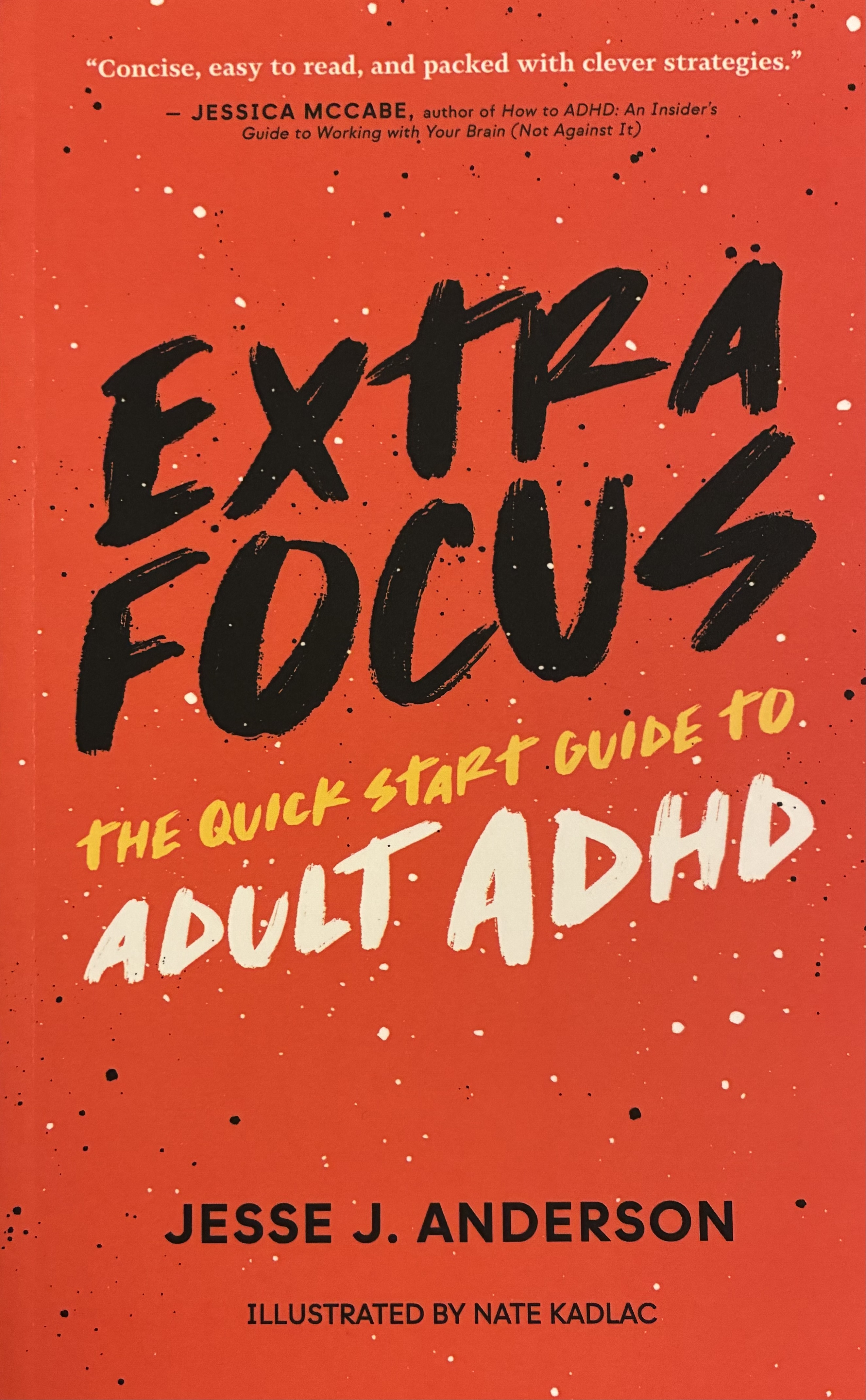
I first came across Jesse J. Anderson’s work in June 2025 via a live-streamed episode of the ‘A Productive Conversation‘ podcast that I was able to view through my membership of Mike Vardy‘s online community The TimeCrafting Trust (this is a link to the specific episode: A Productive Conversation – Episode 625: Jesse J. Anderson Talks About ADHD, Extra Focus, and Finding Flow). It was an interesting and engaging conversation discussing Anderson’s book (Extra Focus: The Quick-Start Guide to Adult ADHD) that, amongst other things, highlighted the idea that whereas most neurotypical people are motivated by importance, people with ADHD tend to have a more interest-based motivational drive. One impact of this is that it is generally assumed that if a task is important, it will get done, and so much of the advice on how to get (more) things done focuses on how to make tasks more important – or at least to seem more important. I guess that for many, perhaps even most, such advice can be useful, but for those battling against the unseen challenges posed by possessing an ‘ADHD-brain’, things are often rather more difficult. Not only do commonly used motivation-boosting tricks not work much of the time, but the fact that they don’t work, and for no apparently good reason, adds a big dollop of frustration and even shame into the mix too.

In the podcast interview, Anderson talked through what he calls the 4 Cs: a simple framework designed to enhance motivation by appealing to the ADHD-brain’s focus on interest. The 4 Cs in the name each stand for a different word that captures an approach that could be used to try to stimulate motivation, namely:

  • CAPTIVATE – making tasks interesting
  • CREATE – using creativity and seeking novelty
  • COMPETE – stimulating interest via competition and challenge
  • COMPLETE – making use of deadlines and ramping up urgency

After viewing the livestream event, I was impressed with the openness and authenticity in the way that Anderson spoke, and so a few weeks later I listened to the audiobook version of the book. It was an interesting listen, but whilst I enjoy listening to audiobooks, I do find it difficult to hold on to the detail of much of what I have listened to, especially as most of my listening takes place while I am walking to and from work. Consequently, my notes from this first pass through the material are rather limited, basically consisting of a restatement of the 4 Cs framework, along with a set of related questions that can be used to try to build motivation towards the completion of tasks when necessary:

  • How can I make the task more interesting for me?
  • How can I approach the task in a different/creative way?
  • How can I add a competitive edge to the task?
  • How can I ensure that I obtain positive (external) feedback on completion of the task?

Apart from this, my notes only reveal one other thing that I was particularly struck by, namely an assertion that the commonly-given productivity advice to ‘Eat the Frog‘, as popularised by the business coach/author Brian Tracey, is not at all effective for many people with ADHD. [The idea behind ‘eat the frog’ is that you should tackle your most difficult, significant, tricky, and as a result high value, task as your first action each day]. Instead, Anderson suggests starting the day with some fun/easy tasks in order to build up what he calls ‘motivation momentum‘. This chimes with my own day-to-day experience, and was perhaps the first time I had come across this way of thinking about my preference for a ‘slow morning’ start, rather than seeing it as being related to having a ‘night owl‘ chronotype (something that I am not convinced I possess to any great extent).

The rather limited nature of my initial notes might suggest that the content of the book did not prove especially interesting. However, I obviously did feel that there was more in Extra Focus that might be useful, not only for me, but to pass on to the considerable number of neurodiverse/ADHD-brained students that I work with in my job as a university lecturer, because in December 2025 I decided to make a second pass through the book, but in print format. Looking at my fairly extensive notes, it’s clear that in this second reading I did a much more thorough job of working through the material…

Anderson starts out with some general thoughts about the challenges of ADHD, noting that calling it an attention deficit is inaccurate, and suggesting instead that it is better viewed as being a dysregulation of attention. He then sets out the 4 Cs approach and suggests that instead of eating the frog first, ADHDers might be better served by eating the ice cream first… something which sounds like a much better idea to me!

The book then moves into a fairly long list of different motivation-enhancing strategies, things like adding action verbs to tasks, altering your environment to make it more stimulating, finding a ‘body double’ to provide some external accountability, gamifying tasks, and racing against the clock. There was not much in this section that stood out to me, but I think this would be a useful section for someone who is at the start of their ADHD-adaptation journey.

The later part of the book has three areas of focus – TIME, MEMORY, and EMOTION – and I think that all three of these sections contain useful content and advice. In particular, the chapter on Emotion, which covers topics such as ‘success amnesia‘ (the tendency to forget/ignore past successes), ‘imposter syndrome‘, ‘rejection sensitivity‘, ‘shame distortion‘, and ‘impulsivity and inhibition‘ might be quite eye-opening for readers who have not previously linked these characteristics or challenges to ownership of an ADHD-brain.

The book ends with encouragement that when you understand how your brain works you can use that knowledge to your advantage, guidance that may well seem obvious to many readers. However, my own experience of ADHD is that it can be very difficult, if not downright impossible at times, to understand how an ADHD-brain is working in any given moment. With this in mind, having a well-written and straightforward guide such as Extra Focus to lead you through consideration of many of the key related topics and ideas, can only be a good thing.

I’d say that of all the books I have read about coping with the challenges of owning an ADHD-brain, Extra Focus is up there in my top two or three. It’s written with the ADHD-brained reader in mind, in simple, plain language and has a clear emphasis on practical implementation throughout. Overall, I think it would be an excellent starting place for anyone new to exploring the challenges posed by an ADHD brain, whether driven by personal need, a desire to better understand or support a friend or family member, or just for general interest.

Now, where’s that tub of ice cream?

Problem Shared #poem

A problem shared is a problem halved,
or so the saying goes.
But whether that is really true
is debatable I suppose.

My problem had been hidden deep inside
until you called it by its name.
And that was like the whistle,
blown to start the game.

The problem that was diagnosed
affected how I lived.
It stopped me getting on with things;
it made my brain a sieve.

This problem that you helped me with
is tricky to unpack,
It means my brain keeps worrying.
I never can relax.

The problem I am grappling with
is not a sickness I contracted.
Rather, it’s part of me,
so always I’m distracted.

The problem you explored with me
in many ways defies convention.
It’s not that I don’t want to,
I just can’t control my attention.

The problem that I shared with you
for years has had me troubled.
And to be honest, since you got involved
its size has more than doubled.

It isn’t that you didn’t help
because certainly you did.
It’s just that now I’m in the game
you’ve helped me lift the lid.

The problem that was inside me
has now come bursting out.
And now I want to dance and sing
and jump and scream and even shout!

My problem shared, it hasn’t halved,
or reduced in size at all.
But now we’ve torn down all the bricks
it’s no longer a wall.

So, although my problem may have multiplied
by three or four or five.
Truly, I give thanks
because you’ve helped me come alive.

(c) Tim O’Hare, July 2023


About this poem: I was given a diagnosis of ADHD at the age of 56 in summer 2022 through a private provider called ‘Problem Shared’, and for about 9 months in late 2022 and the first half of 2023 I had roughly monthly online sessions with a prescribing nurse. These conversations were always very enjoyable (for both of us I think) and helped me to unpack some of the challenges I was experiencing and to express my thoughts and ideas on tackling those challenges, and on ADHD more generally. This poem was not intended to relate only to my interactions with the ‘Problem Shared’ organization, but I used the name as a starting point. It captures the idea that whilst my diagnosis, and subsequent treatment, has certainly generally the flow of my life a lot better, it has also opened up all kinds of additional issues and challenges.

Now It All Makes Sense – Alex Partridge #reading

A few weeks ago, I completed my seventh book of the year: ‘Now It All Makes Sense’ by Alex Partridge. This was one that I consumed in audiobook format, narrated by the author.

I decided to listen to this book after my wife drew my attention to it. I’m not sure where she came across it being mentioned, but it’s clear that Partridge currently has a pretty massive media presence with social media channels (with millions of followers), a podcast called ADHD Chatter (with 500,000 listeners) and now this book (an ‘instant Sunday Times bestseller’ apparently). From a bit of searching online, it seems that, in the world of new media he is viewed as one of the experts on adult ADHD (Attention Deficit Hyperactivity Disorder). His background is in social media content creation – he founded UNILAD and LADBible at the age of just 21, two social news and entertainment companies that, according to his biography, were followed by 300 million people. I guess it is not surprising then that after being diagnosed with ADHD at the age of 34, he has come to be a dominant figure in the online adult ADHD media space but I’d never heard of him.

You might think that as a fellow late-diagnosed ADHDer (albeit more than 20 years later in life than Partridge), I would have found plenty in ‘Now It All Makes Sense’ that resonated with me, but that wasn’t the case at all.

I’ll come straight to it… I didn’t much like this book. Partridge clearly writes from his own experience, which is, obviously, a sensible thing for him to do… except that throughout the book he refers to ADHD only in terms of his own particular expression of it. He writes/says things like “Those of us with ADHD will be familiar with…” and “As anyone with ADHD will know…”, and then he describes how he is forgetful, how he loses things, how he is completely disorganized, how he is entrepreneurial etc. Well, I have ADHD and I am not (generally) forgetful, I don’t (generally) lose things, I am probably one of the most organized people around and would hardly describe myself as entrepreneurialanything…, so no, actually, I am not “familiar with” and don’t really “know” the ADHD that is described by Partridge, not in myself at least. And if I am not familiar with it then I am sure that there are plenty of others in the same boat. ‘It’ might now all make sense to Alex Partridge, and I am sure that ‘it’ will now also make more sense to some readers of his book, but if I had read or listened to the book a few years ago it would simply have reinforced the inaccurate understanding of ADHD that I then held… and who knows, that might have prevented or delayed me from being able to make sense of my own ‘it’ in the way that I have been able to since my diagnosis.

There’s nothing wrong with Partridge’s account of his ADHD, the impacts it has had, and is having, on his life, and the advice and tips that he provides in the book… provided, that is, that you have an ADHD presentation that is similar to his (or are seeking to understand ADHD in relation to someone you know who is like him). But many people don’t have that ADHD presentation like his and so are not that much like him… that’s one of the peculiarly frustrating but also, dare I say it, interesting, things about ADHD – the challenges it creates can be very different for different individuals. What is wrong… no, perhaps ‘wrong’ is too strong a word here, let’s say ‘potentially unhelpful’ is that Partridge doesn’t really seem to recognize this variation in the diverse challenges that ADHD presents for different people enough. In this way, I think that Partridge misses the opportunity to really broaden out his readers’ understandings of the challenges of living with ADHD, and given his huge online audience and social media status, I think that’s rather disappointing, Maybe instead of ‘Now It All Makes Sense’ the title of the book ought to have been ‘Now I All Make Sense’ (forgive the mangled grammar) to reflect the rather personal nature of Partridge’s narrative.

Metamorphosis #poem

Is it time to slough it off,
that rough, tough, protective skin,
that hide for unseen treasures deep within.

He had not felt it grow, but grow it had for many years,
thickening the defensive wall,
blurring eyes and muffling ears.

So early it had started, so slowly it had grown,
he’d noticed not the tightening as it closed around his bones,
holding him together safe and sound or so it seemed,
whilst locking him away to form a shield for self-esteem.

But he had heard the screams
and he had seen the flashes of the inner rage
and he had felt the punches as they slammed against the cage,
only recognising who they came from when witnessed in his broken dreams.

Years passed and then
worn thin by constant wear the first crack had appeared,
at last revealing what it was
and how the dangers it held fast against were nothing to be feared.

So, slough it off, that rough, tough defensive skin,
and let new life begin.
Slough it off, that mask of false protection
and let us see at last what treasures lie within.

(c) Tim O’Hare, June 2023


About this poem: After a coaching session at work talking through some of the challenges I face as a result of my ADHD-traits and the difficulty I find in allowing myself to be the way that I want to be rather than the way that I think I ought to be I was struck by the thought that I needed to let go of the protective behaviours and attitudes I had unknowingly constructed for myself over the years and, in the process, allow my authentic self to emerge. The image that came to mind was of a reptile shedding its skin and for some reason the phrase ‘slough it off’ popped into my head in association with this image. I quickly became rather fond of the word ‘slough’ and then, for the first time ever in my life really and without any warning or deliberate effort, I started to write a poem. ‘Metamorphosis’ is the first evidence that having sloughed off my metaphorical protective skin there was something different and unexpected lurking within!

Note: I have previously posted all of my poetry in a separate website: http://andapoet.blog but I have decided that I will gradually migrate all of that content to this site.

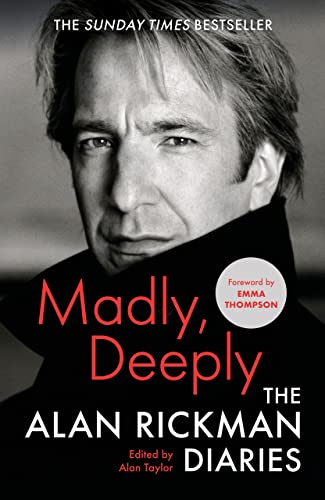
Madly, Deeply – The Alan Rickman Diaries

This morning I finally finished the weighty tome that is Madly Deeply – The Alan Rickman Diaries. I started it back in June 2023 and have been reading a section, usually 3-6 months of entries, most weekday mornings since then. So, it has been a long read and, to some extent, a bit of a slog.

I was attracted to reading Madly Deeply after reading a review article in a newspaper soon after it was released. The article made quite a big play of how wonderful Rickman’s actual diaries were to look at, often illustrated with really nice sketches and drawings relating to the themes he was writing about, so it was something of a let-down to find that the published book contained only five pages (of over 450 in total) that showed any of these illustrations (and two of those five pages were the inside front cover). But never mind, there would always be interesting insights to read about the Harry Potter films since he surely must have loved his involvement in those in his role as Severus Snape…

Alas, it turns out that Rickman clearly didn’t much like being such a major part of the HP film series to the extent that he almost bailed out part way through (imagine if that had happened…).

The first thing that hit me smack bang in the face when I started reading the diaries (they begin in 1993 and run through to his death at the age of 69 in 2015) was that his life was absolutely, completely, inexpicably busy. Hardly a day seemed to pass when he wasn’t flying somewhere, seeing a film or play, dining out with friends, rehearsing, discussing things with directors and producers and agents, fending off critics etc. In fact, it felt like he did most of these things on most days – one day in New York, then on to Paris, Prague, South Africa, Italy, California, London in an utter whirlwind of activity. Just reading about his life left me exhausted and I still cannot comprehend how anyone can cope with such a life and, apparently, have so much energy. [I wasn’t surprised when, quite far on in the diaries, he casually dropped in a reference to his ADHD… although his flavour ADHD was certainly not much like my flavour of ADHD!]

I can’t say that I particularly warmed to Alan Rickman as a person through his diary entries which surprised me a little, although on reflection there is really no reason why I might have expected to. His entries often paint a picture of a slightly bitter man, somewhat intolerant about the ‘failings’ of others (of which there seemed to be many), who seemed to feel a little under-valued and, perhaps, frustrated that he was not always understood as he felt he should be. But then there are also clear indications of loyalty, a desire for fairness and a love of his art and a quirky sense of humour.

Overall, it was interesting to get a little glimpse of a world that I was almost completely oblivious to prior to reading the book – an insane world of rushing about and pouring oneself into project after project – a world that truly must have been madly and deeply exhausting but, I guess, full of experience and excitement. I don’t want to rush about quite to the extent that Alan Rickman seemed able to but it’s perhaps useful to have received this glimpse of just how much a life fully lived can contain.