Exmoor Views #art

Exmoor Views Miniature Watercolour Series

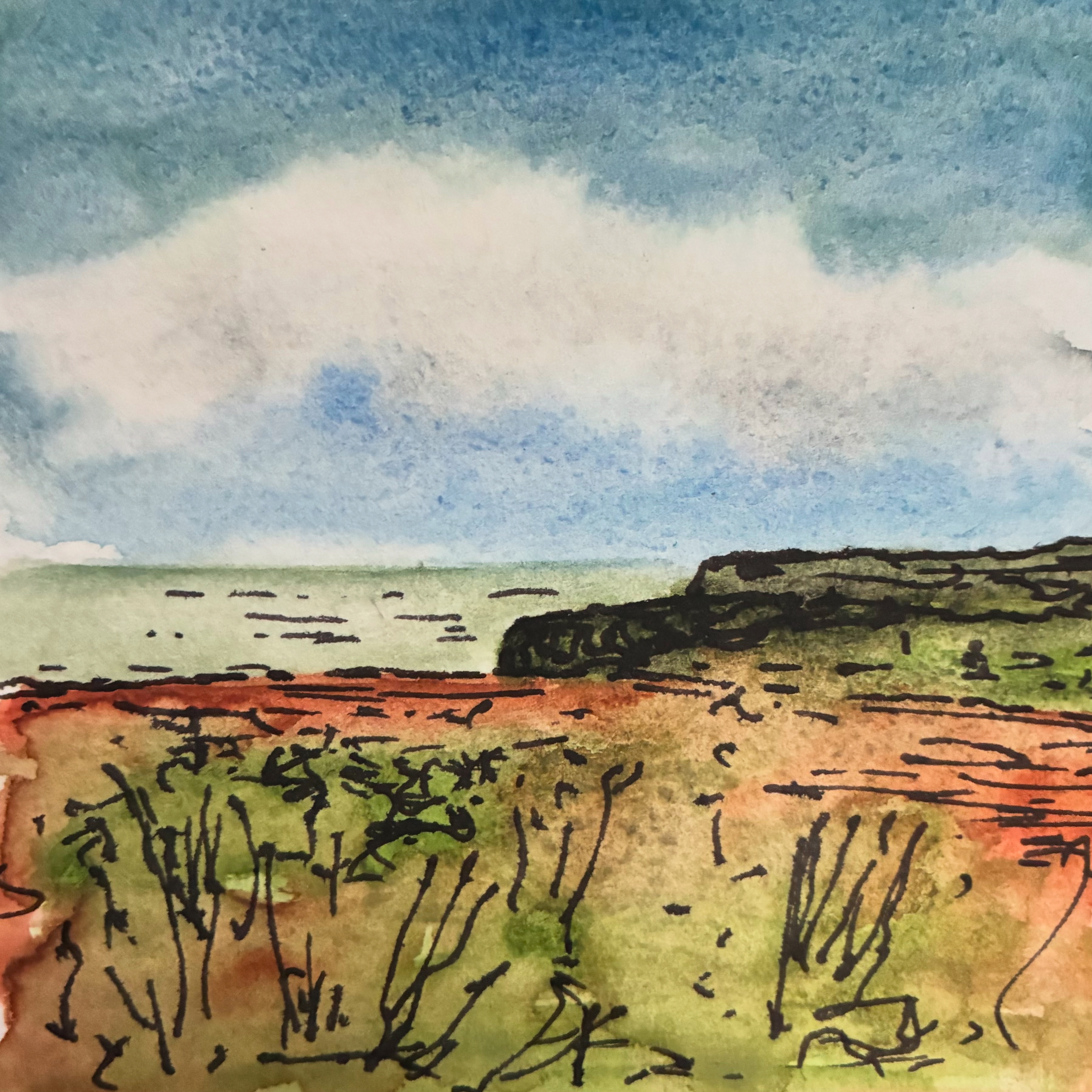
Our holiday in Exmoor in July 2025 obviously left me in an Exmoory mood, because within a couple of weeks of our return home I found that I had painted nine miniature watercolours of Exmoor Views. These were in the same small square format that I had used for my previous miniature watercolour series (Dartmoor Scenes , House Plants, Capital City Landmarks, Cornwall Landmarks, and Trees), with each one being painted quickly as part of the ‘morning routine’ that I generally try to get through each day before I try to settle into some more substantive activity.

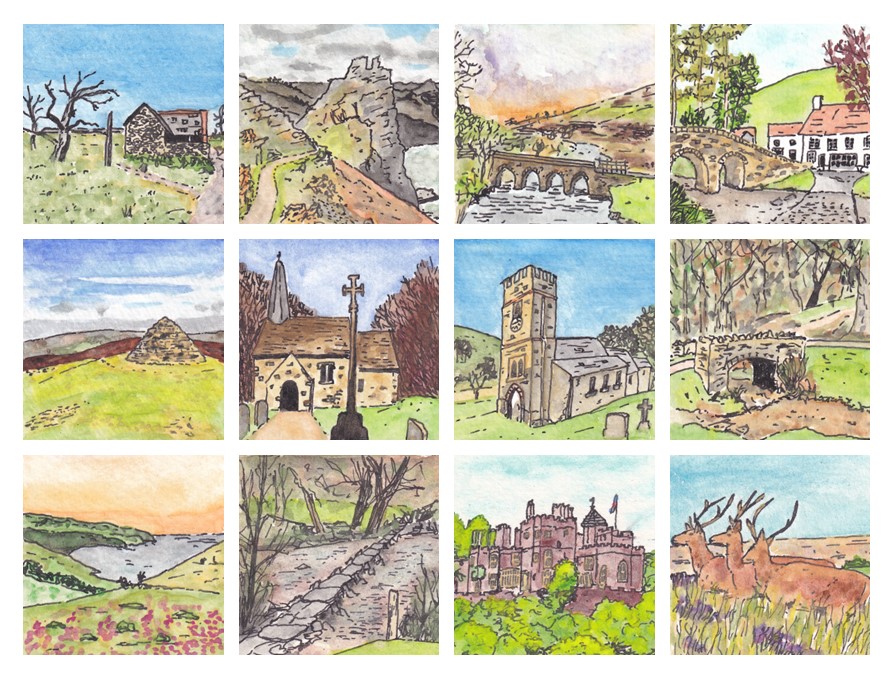
Most of the subjects for these pictures were locations that we had visited during our holiday, with a couple being other Exmoor locations that I was familiar with from previous visits (including the many family holidays we had in Exmoor when I was a child). Working from top-left, across and down the grid of pictures above, the paintings show:

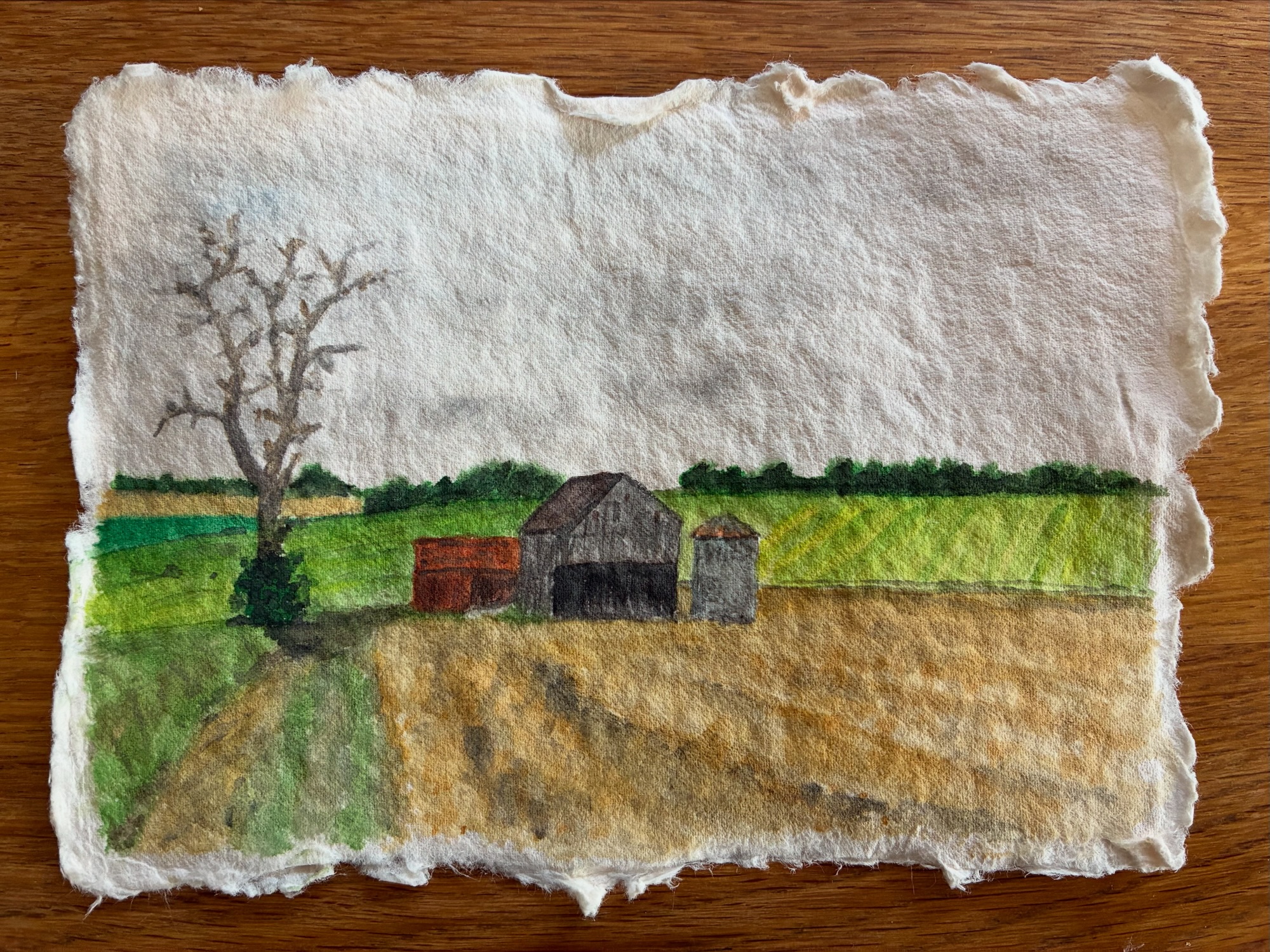
  • a ruined barn in Porlock Bay
  • the Valley of the Rocks near Lynton
  • Landacre Bridge over the River Barle (possibly my mother’s favourite spot)
  • the bridge and ford at Malmsmead at the head of the Doone Valley
  • Dunkery Beacon – Somerset’s highest point
  • St Bueno’s Church at Culbone (said to be the smallest parish in England)
  • Oare Church (where Lorna Doone was shot on her wedding day)
  • Robber’s Bridge
  • a view across Porlock Bay from Bossington Hill

At the time I painted these pictures I had not fully settled into a pattern with my miniature watercolour pictures, but at some point in late summer 2025 I decided that I wanted all of these series to consist of twelve pictures, and so in October I painted three additional paintings to complete the set. These depict:

  • the ancient clapper bridge – Tarr Steps (also over the River Barle)
  • Dunster Castle
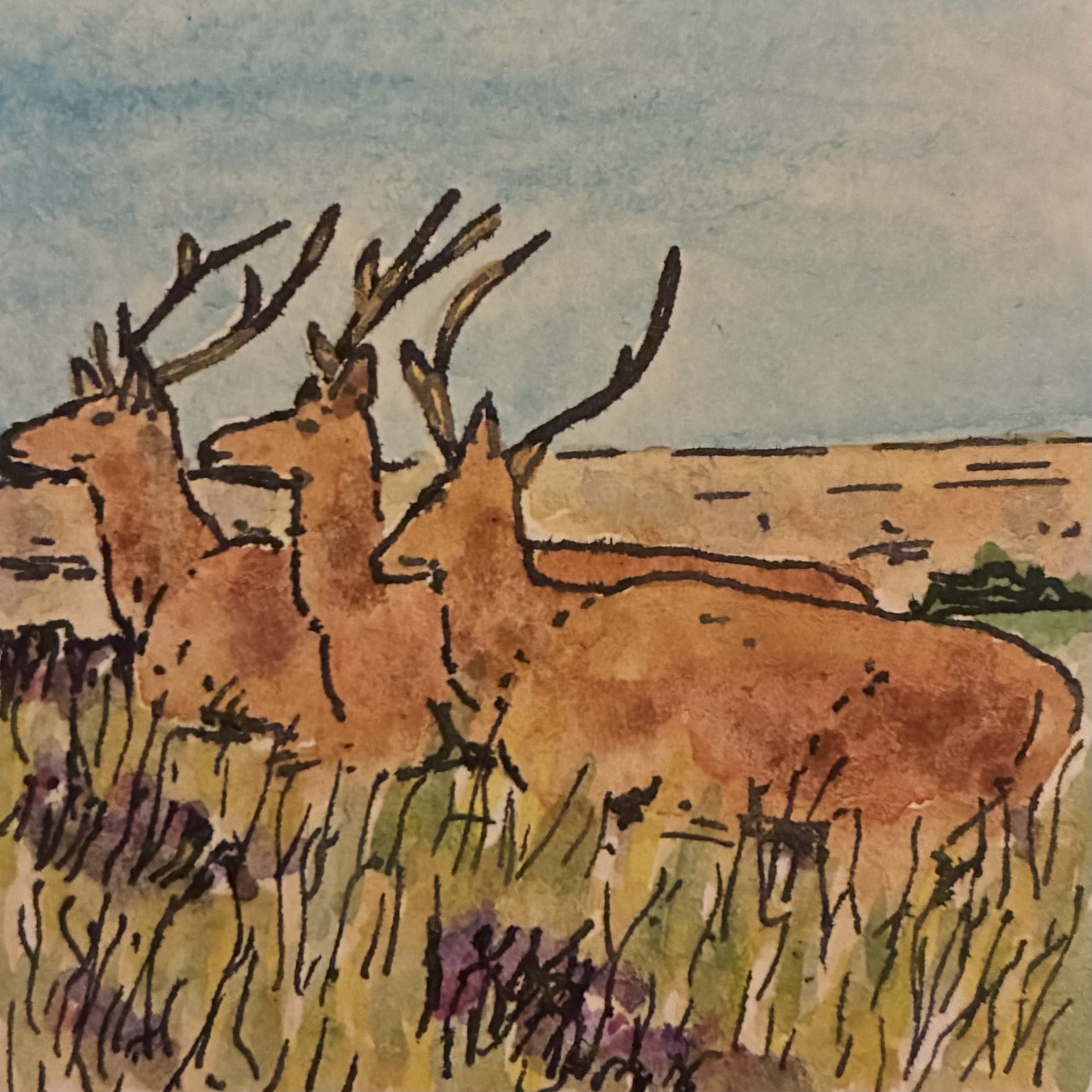
  • a group of red deer

Of these pictures, the most surprising one, both in terms of the subject matter and how the picture turned out, is the last. As I noted in Trees, my paintings generally avoid having people or animals in them (at least not in any detail), so the decision to have a go at drawing and painting Exmoor’s most dramatic wildlife was, for me, an unexpected and somewhat brave one! I was pleasantly surprised when they turned out quite well, in fact I think that this final picture is my favourite of the twelve:

Red Deer on Exmoor

As with my other miniature watercolour series (the ones listed above and several more that I have produced more recently), I sell greetings cards featuring the individual pictures, and home-produced prints with either nine or twelve of the pictures, in my Etsy shop and on Facebook Marketplace.

Exmoor Paintings #art

View of the Exmoor Coast

As described in the posts Quantock Paintings – Part 1 and Quantock Paintings – Part 2, our summer holiday in 2025 was a multi-part affair. A short stay at Crowcombe on the Quantock Hills in June was followed a month later, by a few days a little further west in an AirBnB in Malmsmead, Exmoor. Malmsmead is a location that is well known for being at the head of the so-called ‘Doone Valley’, which is an interesting example of a landscape feature that (now) takes its name from a work of fiction, R.D. Blackmore’s 1869 tale of romance and villainy: ‘Lorna Doone’. However, despite having made many trips to Exmoor over the years, it wasn’t somewhere that I had explored much before.

In Exmoor we were fortunate to be blessed with generally fine and warm weather, and were able to complete several great walks, including, naturally enough, one that took us all the way up the Doone Valley and west over open moorland, before returning north, with great views (see below) towards the Bristol Channel, via the village of Brendon and a nice drop of Exmoor Ale in The Staghunters Inn.

View towards Countisbury Hill, Exmoor

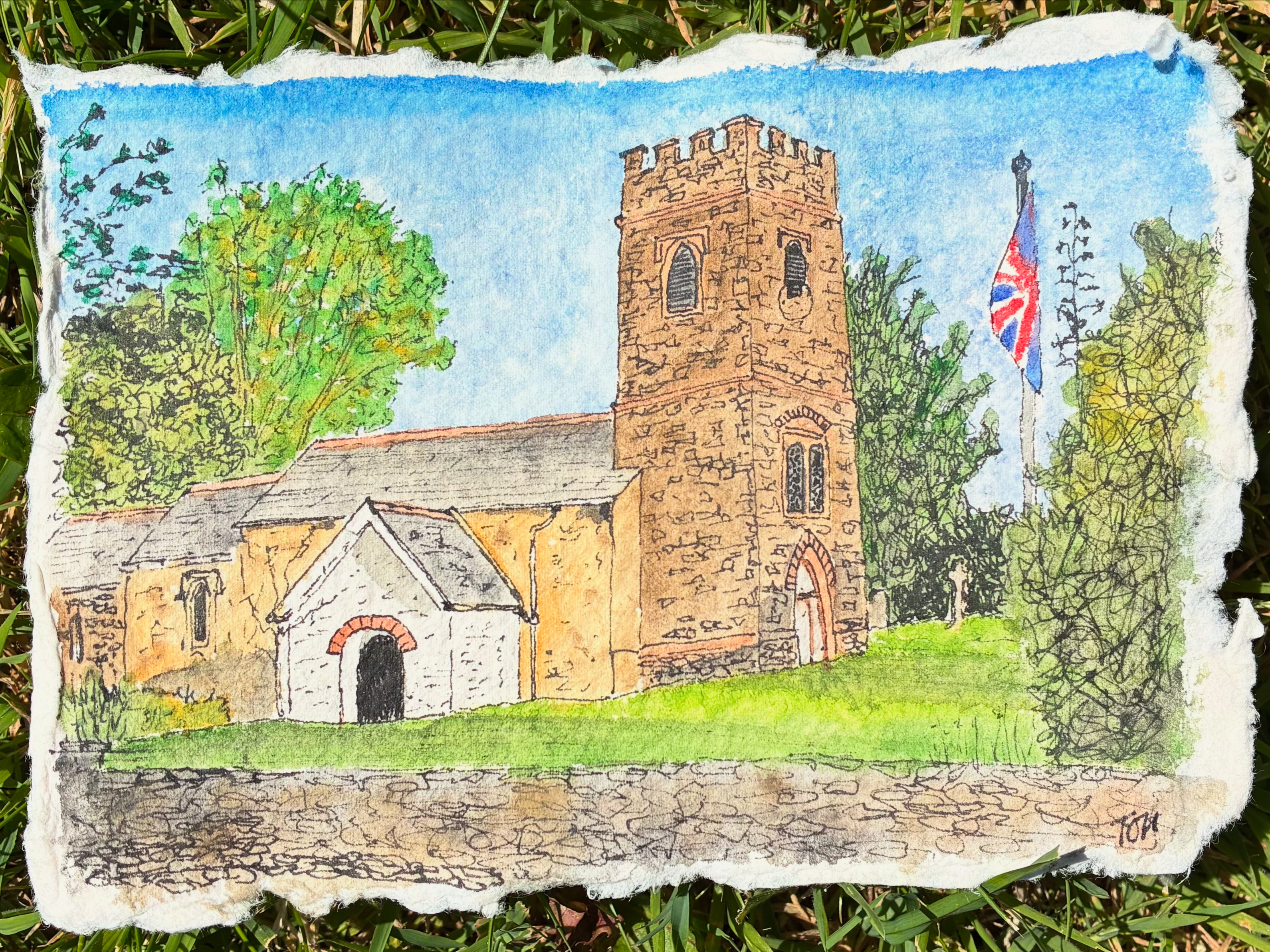
Our accommodation was only a 15 minute walk from the village of Oare, and so we also visited Oare Church, where (in the story) Lorna Doone was shot through a window by the evil, jilted Carver Doone as she stood to marry John Ridd. [Spoiler alert: Lorna survives, and John chases Carver Doone across the moor and watches him sink slowly to his death in a boggy mire, and they all (well all but Carver of course) live happily every after.]

Oare Church, Exmoor

We also completed a walk from Malmsmead towards the coast on what was perhaps the hottest afternoon of the year. This made the walk rather tough going, and this was not helped by the fact that the warm weather seemed to encourage what seemed to be every fly in the entire region to nip and nibble at me along the way.

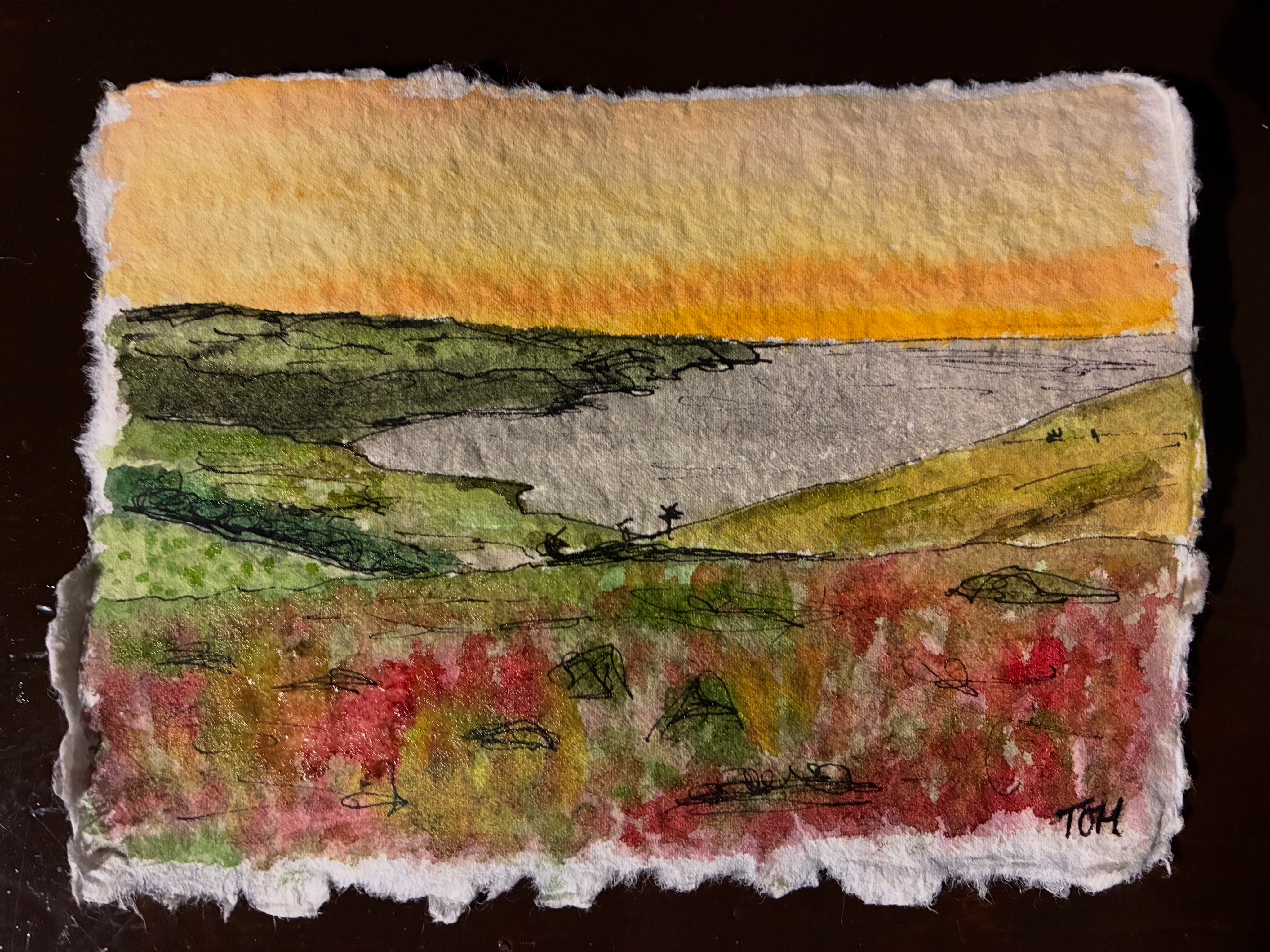
In between the walks, I found time for some painting of course, producing the various pictures that illustrate this post. The final painting I produced whilst away was of the view across Porlock Bay, where we had walked on the first day of our holiday, from Bossington Hill. As it’s a sunset view, it seems like a good picture to use to draw this post to a close…

Porlock Bay Sunset from Bossington Hill

Quantock Paintings – Part 2 #art

Following on from my previous art post (Quantock Paintings – Part 1), here are a few more of the paintings that I did during, or shortly after returning home from, our short break in Crowcombe, at the foot of the Quantock Hills in Somerset, last June.

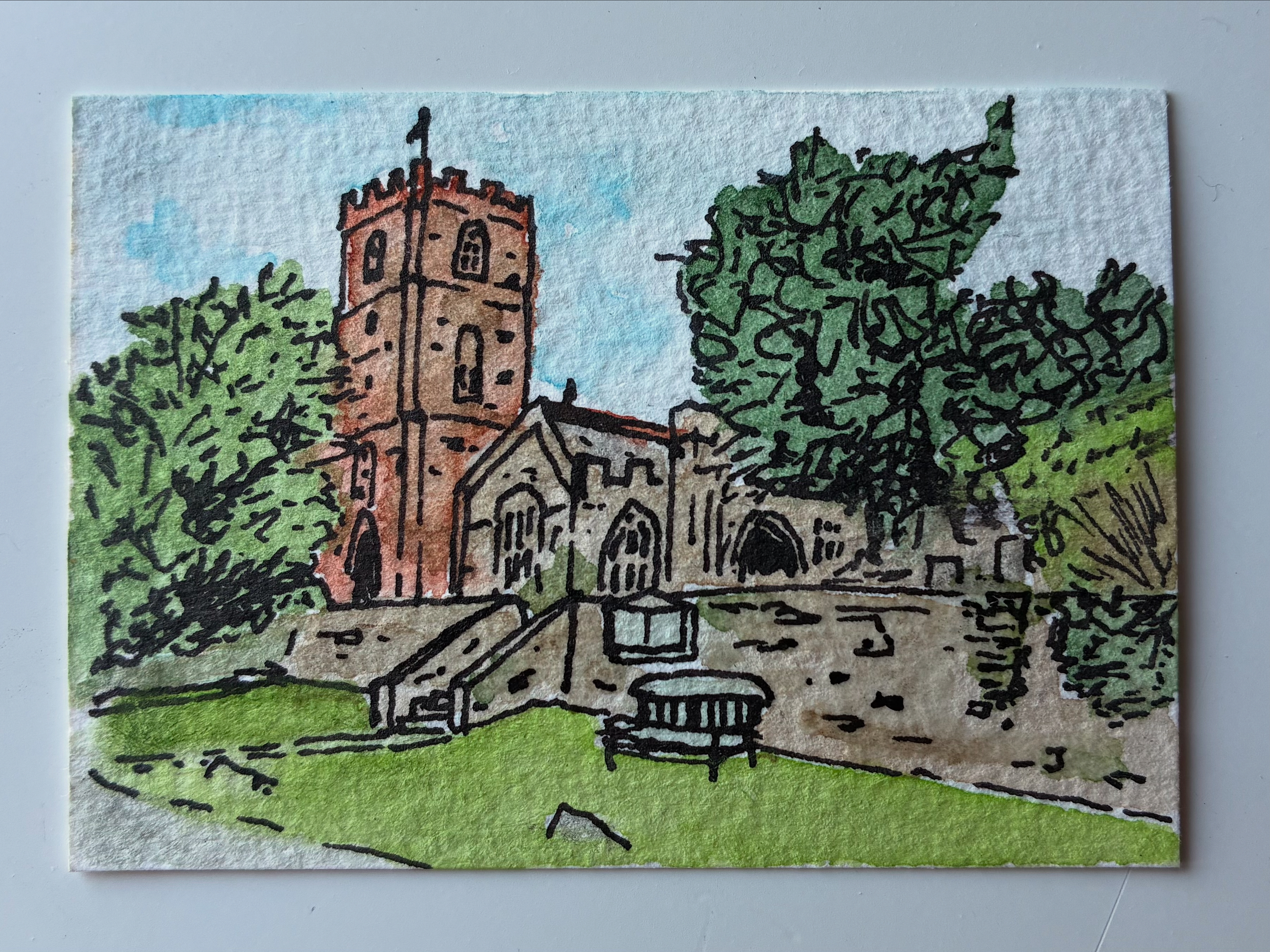
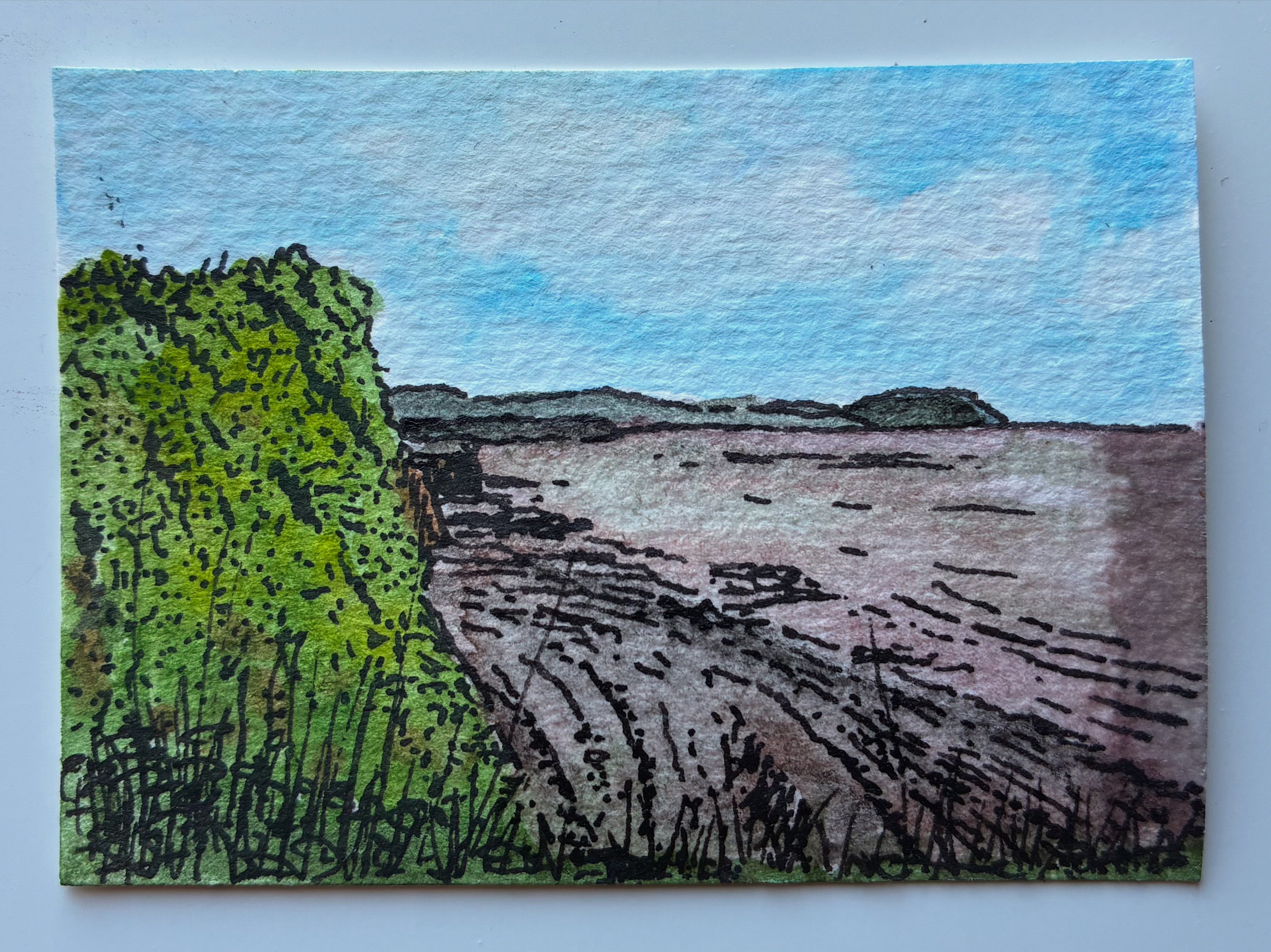
First, here are a couple of pictures depicting views from walks that we did. Both are in my ‘normal’ style, a simple ink pen sketch with the watercolours added on top. I think that I have a tendency to try to put a lot of detail into my drawings (at least until I get bored and start scribbling in trees and foliage), but I am conscious that with painting it is often a case of ‘less is more’. In these two pictures I think that I managed to hold myself in check and kept the drawings fairly simple and ‘loose’. The pictures show Crowcombe Church and a view of the coastline at East Quantoxhead…

Crowcombe Church
View of East Quantoxhead (with a bit of an issue on the right-hand edge!)

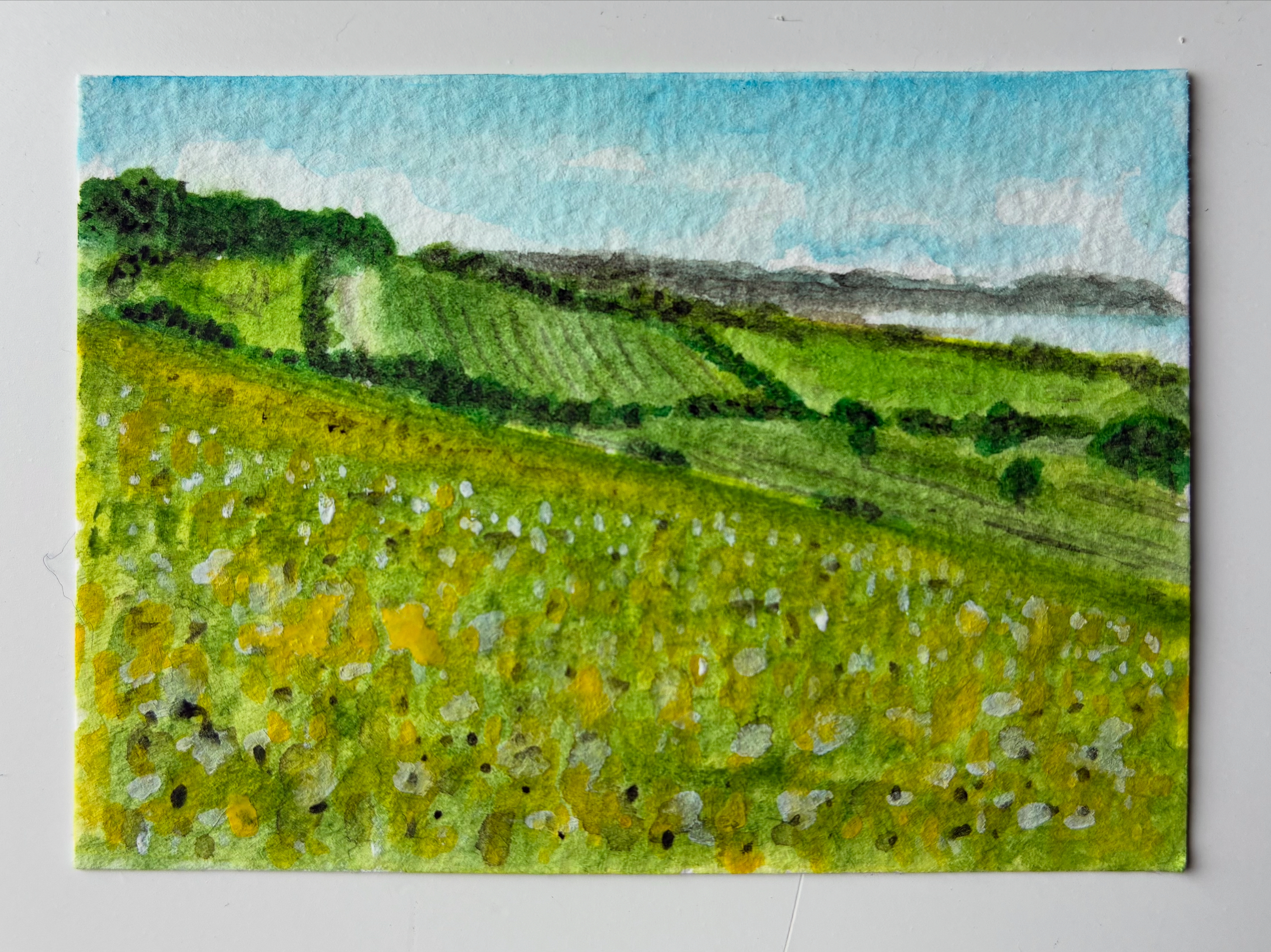
Next, I’ve included the results of an attempt to play with a slightly different approach, eschewing entirely the use of an ink pen to create a base sketch, and instead, going straight for the watercolour paints. I think that in many people’s minds, traditional (true?) watercolour paintings use only paints, generally placing these on a much wetter surface than I use, but I’ve not had any artistic training whatsoever so that’s not how my work has evolved. This picture shows a view from another of the walks that we did, looking west towards Minehead across hedge-lined fields with a riot of wildflowers in the foreground…

Somerset Fields with Wildflowers (no ink)

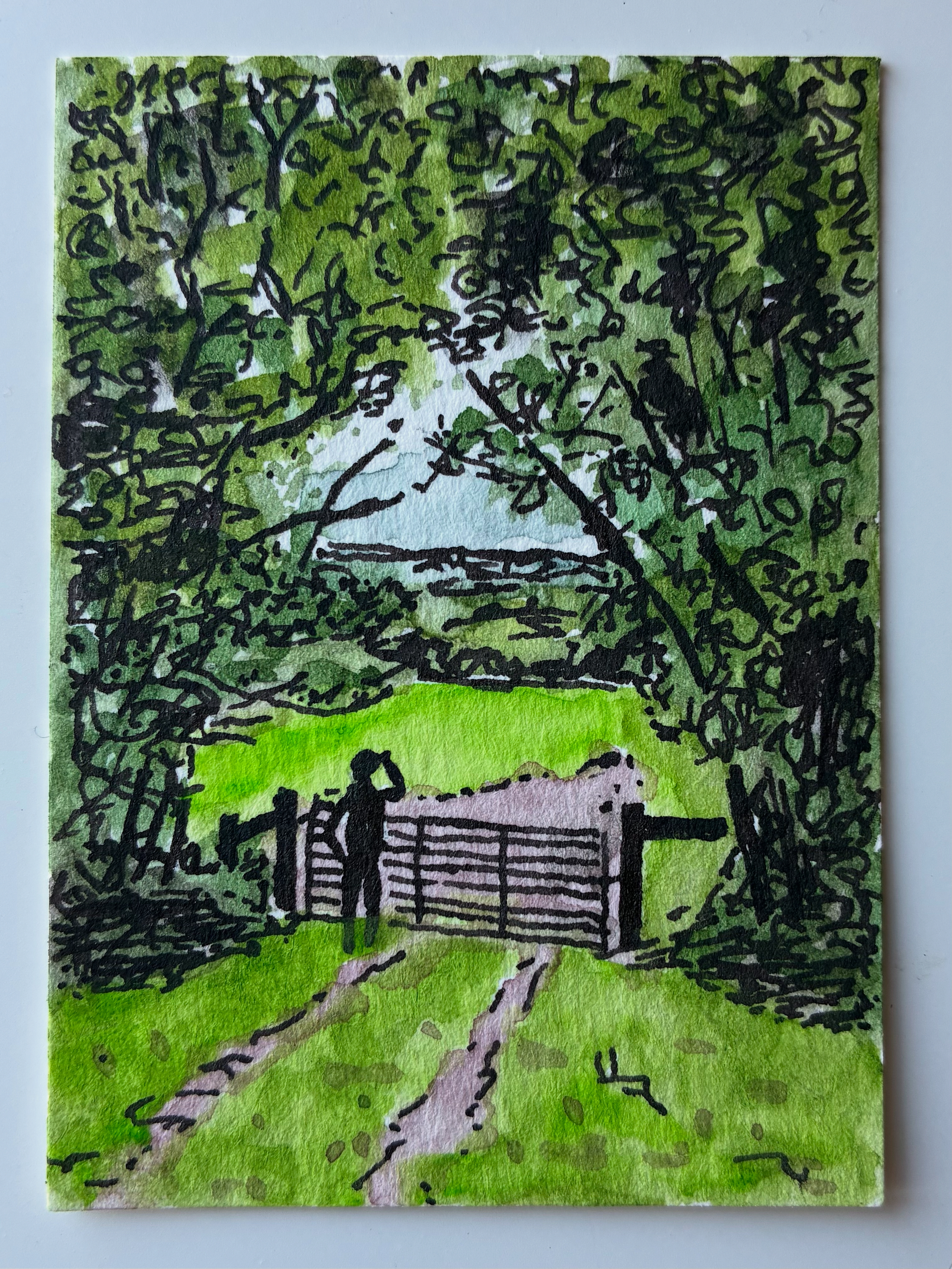
The vast majority of my paintings are of landscapes in one form or another. This is partly because I like landscapes, but also partly because whilst I might be able to make a decent fist of painting trees, fields, hills and buildings etc., I’m pretty much hopeless at drawing and painting people and animals. So, the picture below is a little unusual because it features me, standing at a gate looking east from the main ridge of the Quantock Hills. I like this picture because it is a bit quirky, with some nice ‘busy’ trees, but I don’t think it does anything to improve my reputation as a painter of people!

Through the Trees

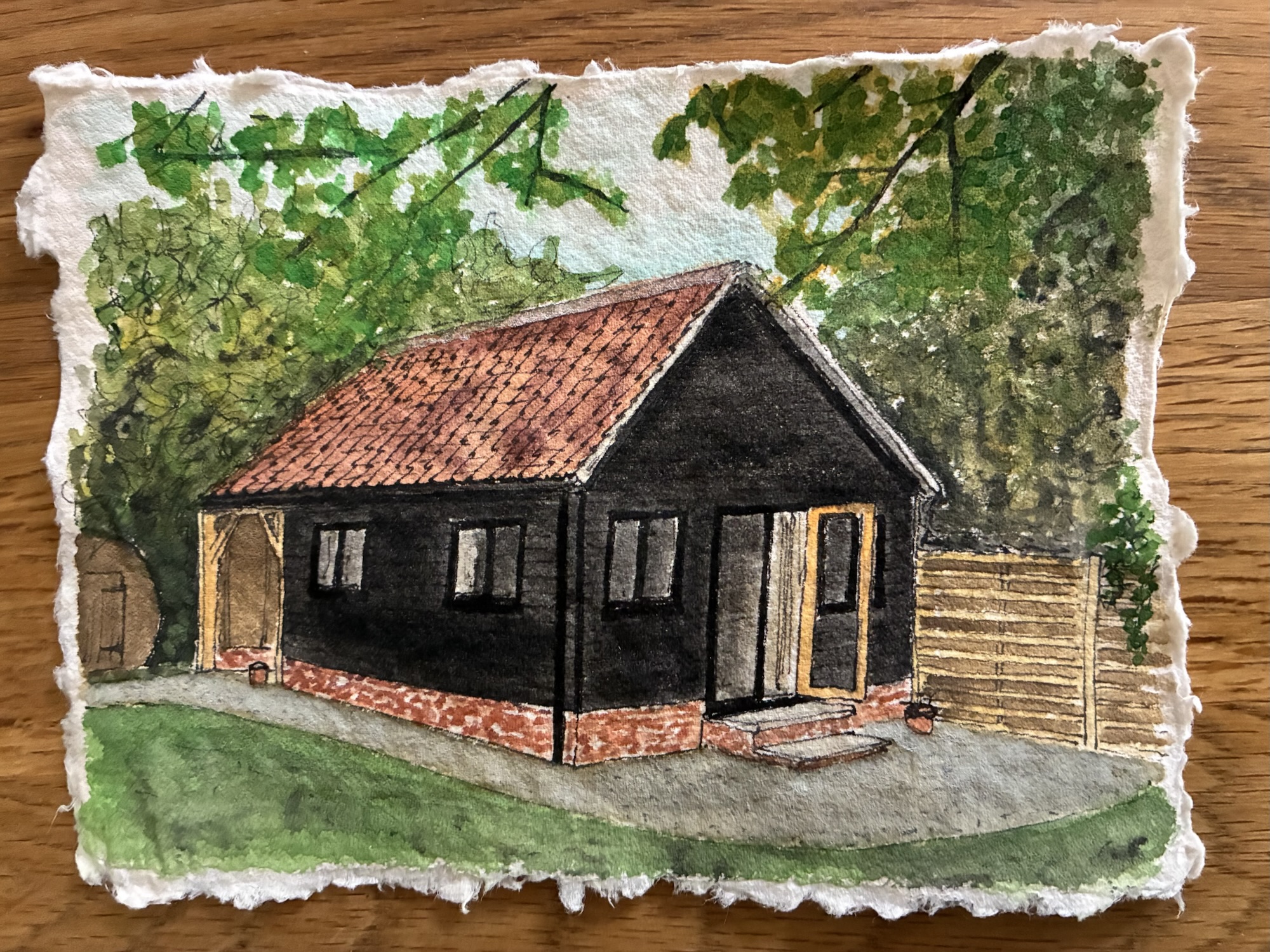
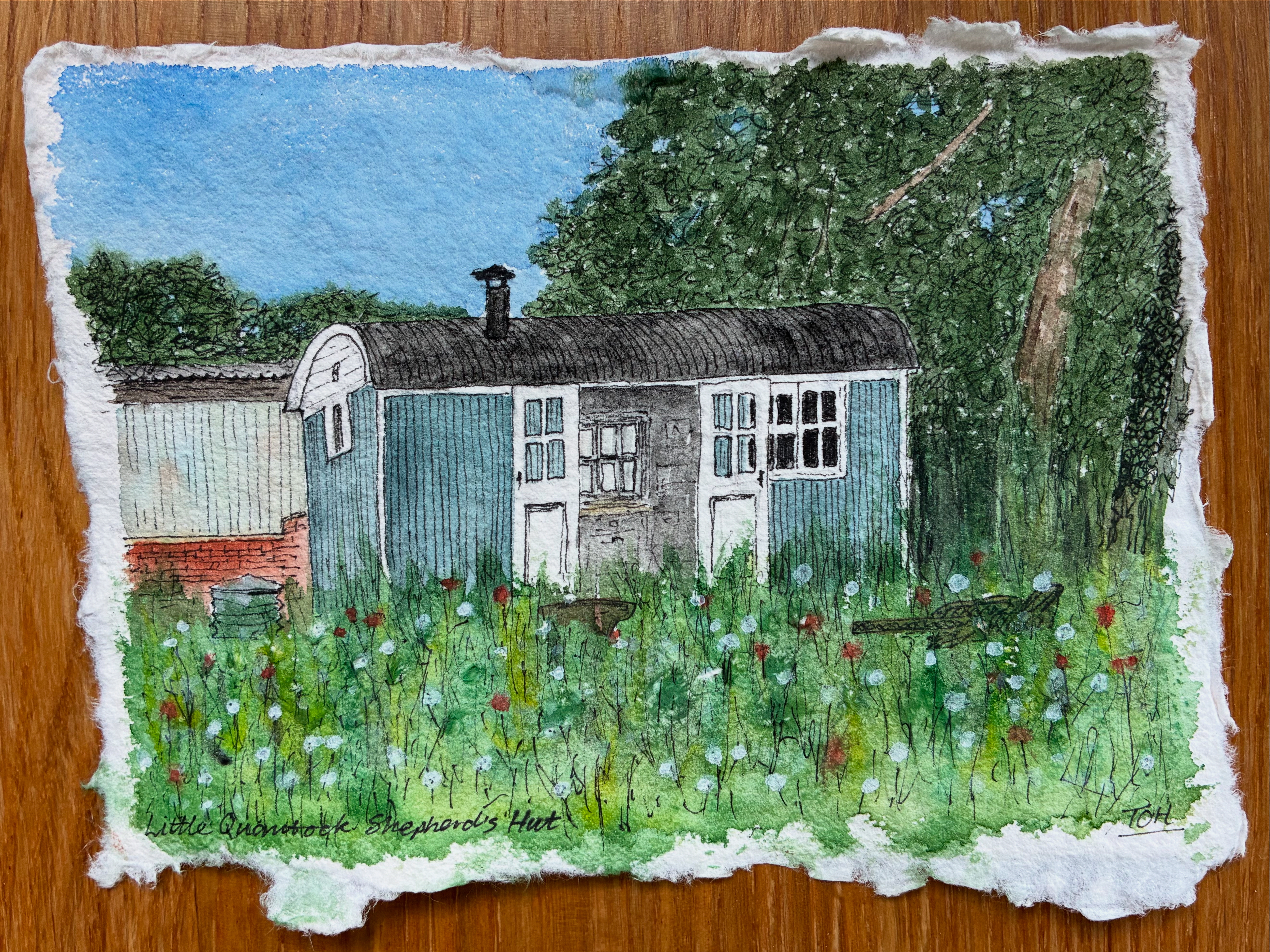
Finally, it’s become a tradition now that I paint a picture showing whatever accommodation we have stayed in when we are away, which we then leave behind as a thank you to the owner of the accommodation. In this case, we were staying in a delightful little Shepherd’s Hut, with a sunset view towards Exmoor. Now, for me to describe a Shepherd’s Hut as ‘delightful’ is something of a miracle, but although the picture doesn’t capture the view, I think it does capture something of the charm of the place.

Crowcombe Short-Break Shepherd’s Hut

I’ve written this post almost exactly one year on from our stay in Crowcombe, and it’s been nice to look back on these pictures and be reminded of a really pleasant few days in a quiet and beautiful part of the world.

Quantock Paintings – Part 1 #art

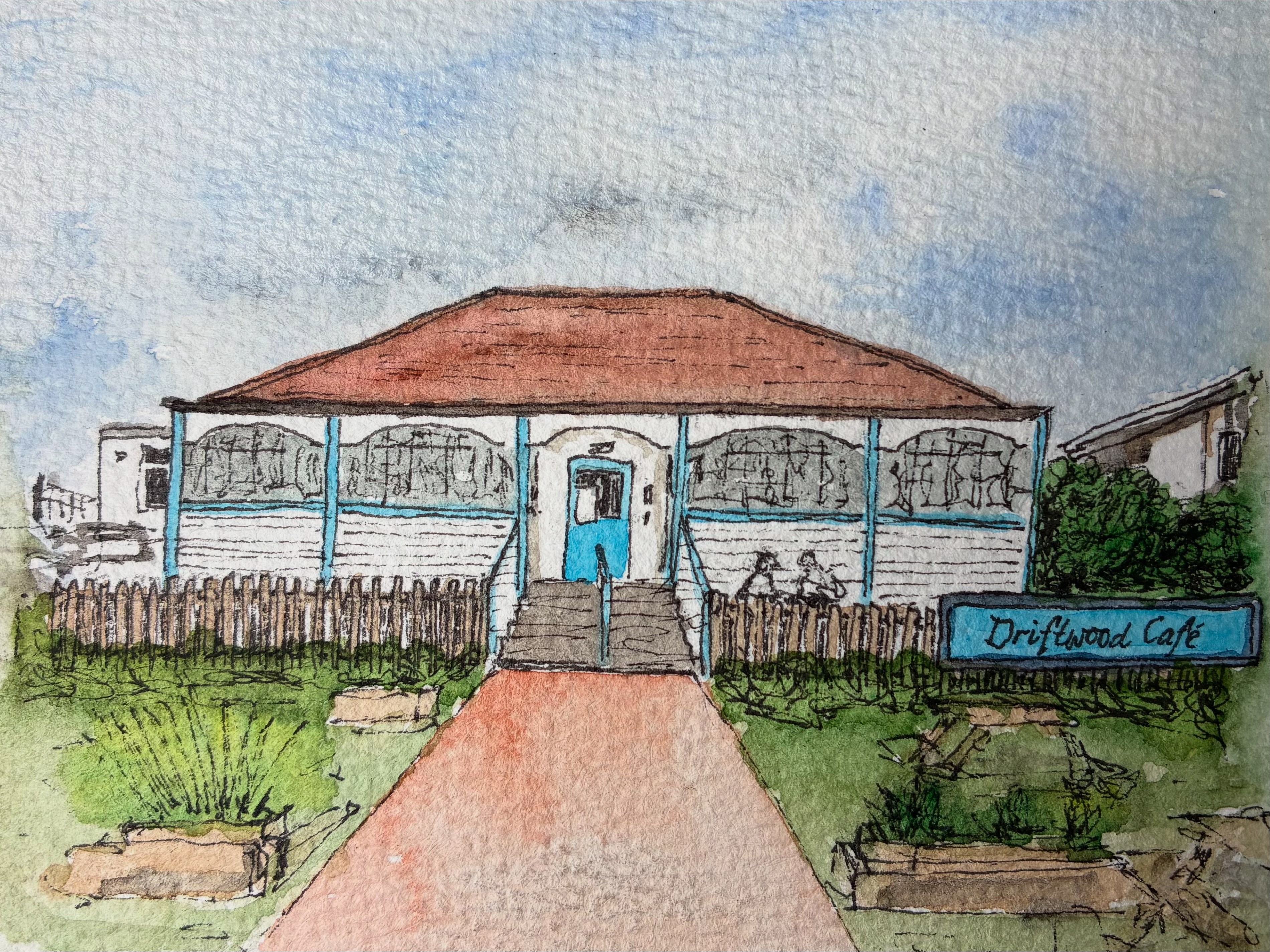
Driftwood Cafe, Blue Anchor, Somerset

In recent summers we have take a series of summer holidays walking in the Yorkshire Dales – first in Swaledale (staying at Low Row near Reeth), then in Wharfedale (based in Ilkley) and last year in ‘Bronte Country’ near Haworth. In each case we combined our week in Yorkshire with a day or two staying somewhere en route to and from our home in Plymouth, or in one case a second week away in Norfolk and Suffolk. For a change, this year, we decided that we’d like to spread our holiday time out over the summer months, and so we picked a couple of fairly local destinations for ‘long weekend’ walking holidays and also booked five days over in Suffolk, combining this with a visit to elderly relatives and an old university friend on mine.

The first of our summer 2025 mini-break locations, in June, took us back to the very familiar territory (for me at least) of the Quantock Hills and the Somerset coast. I grew up a short distance from there in Bridgwater, and we would frequently go on family outings to the area. I also spent quite a lot of time at an activity centre in Kilve on short courses of various kinds (mostly musical).

Although I do like discovering new places, I also very much enjoy returning to familiar haunts, especially for a short trip when you want to be able to slot straight into holiday mode without having to spend time orienting yourself and getting the lie of the land. Our Somerset trip – staying in an AirBnB Shepherd’s Hut near the village of Crowcombe, tucked at the bottom of the western side of the Quantock Hills ridge, very much fell into this ‘familiar territory’ category.

While we were away we enjoyed completing a couple of lengthy walks direct from our accommodation (I particular enjoy a stay away that doesn’t involve having to get in the car), and I was able to spend quite a bit of time painting. In this post I’ll feature four of the pictures that I produced during the break, and I’ll pick up the thread with another post soon that will feature a further group of five pictures.

We started our holiday with lunch at a favourite cafe, the Driftwood Cafe at Blue Anchor – the subject of my first picture (shown at the top of this post). It’s not a fancy cafe at all – I’d describe it as a ham, egg and chips or baked potato cafe – it’s just a nice, simple, easy-going place for a quick bite to eat.

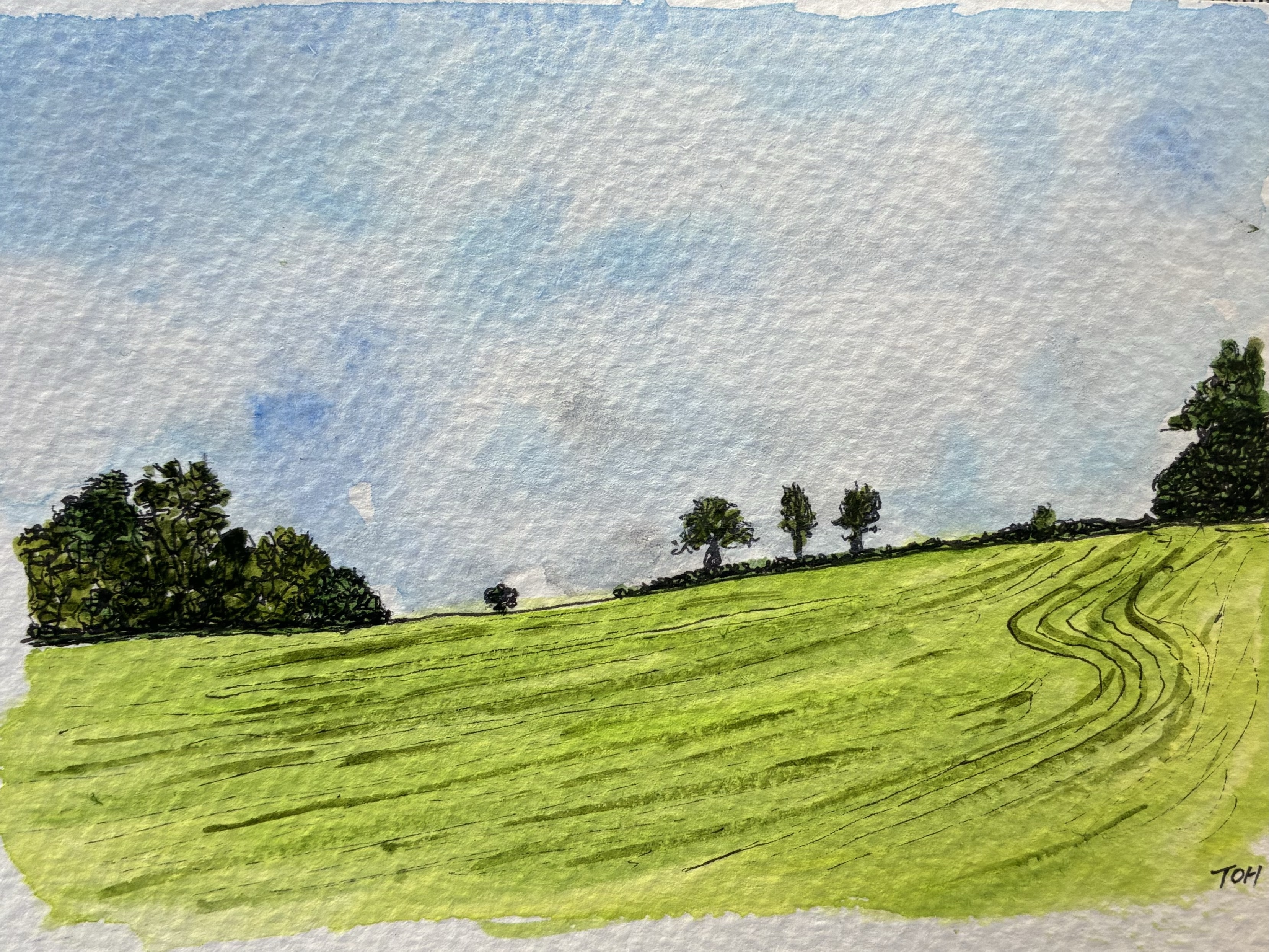
Suitably refueled we then drove the short distance to Kilve and did a short walk (~3 miles) along the coast to East Quantoxhead, before turning inland and returning to the car, with a stop at the Chantry Tea Garden at Kilve where we were the only customers and had an interesting conversation with the owner, who used to be a frequent visitor to Plymouth. The two pictures below show a view of a field that we passed on the return leg (I’ve got a thing for trees silhouetted on the horizon) and the view that we had from our table in the cafe garden of The Chantry itself and the white cottage from which the cafe was run.

Grass Cut Field Near Kilve, Somerset
The Chantry Tea Garden, Kilve, Somerset

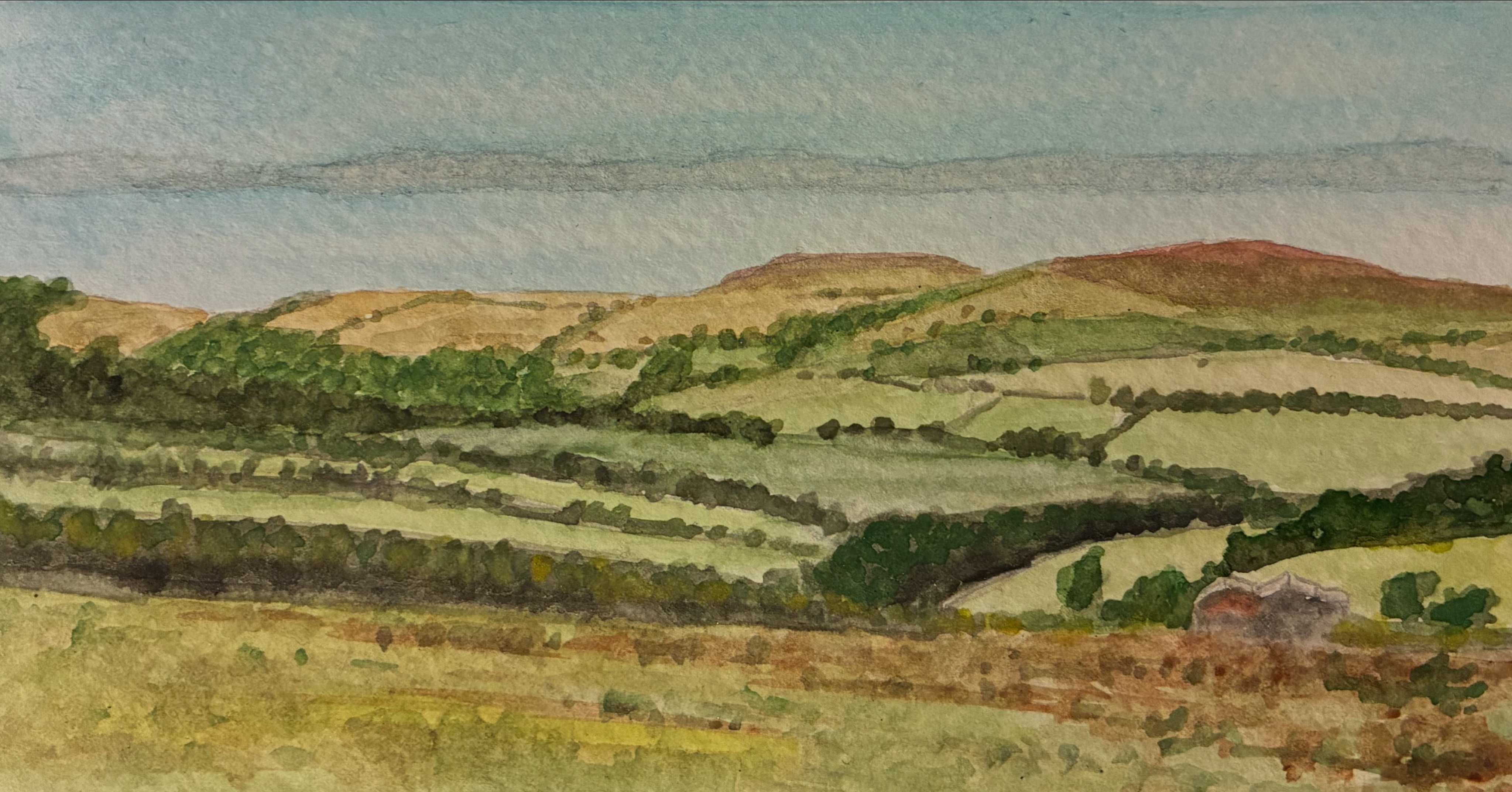
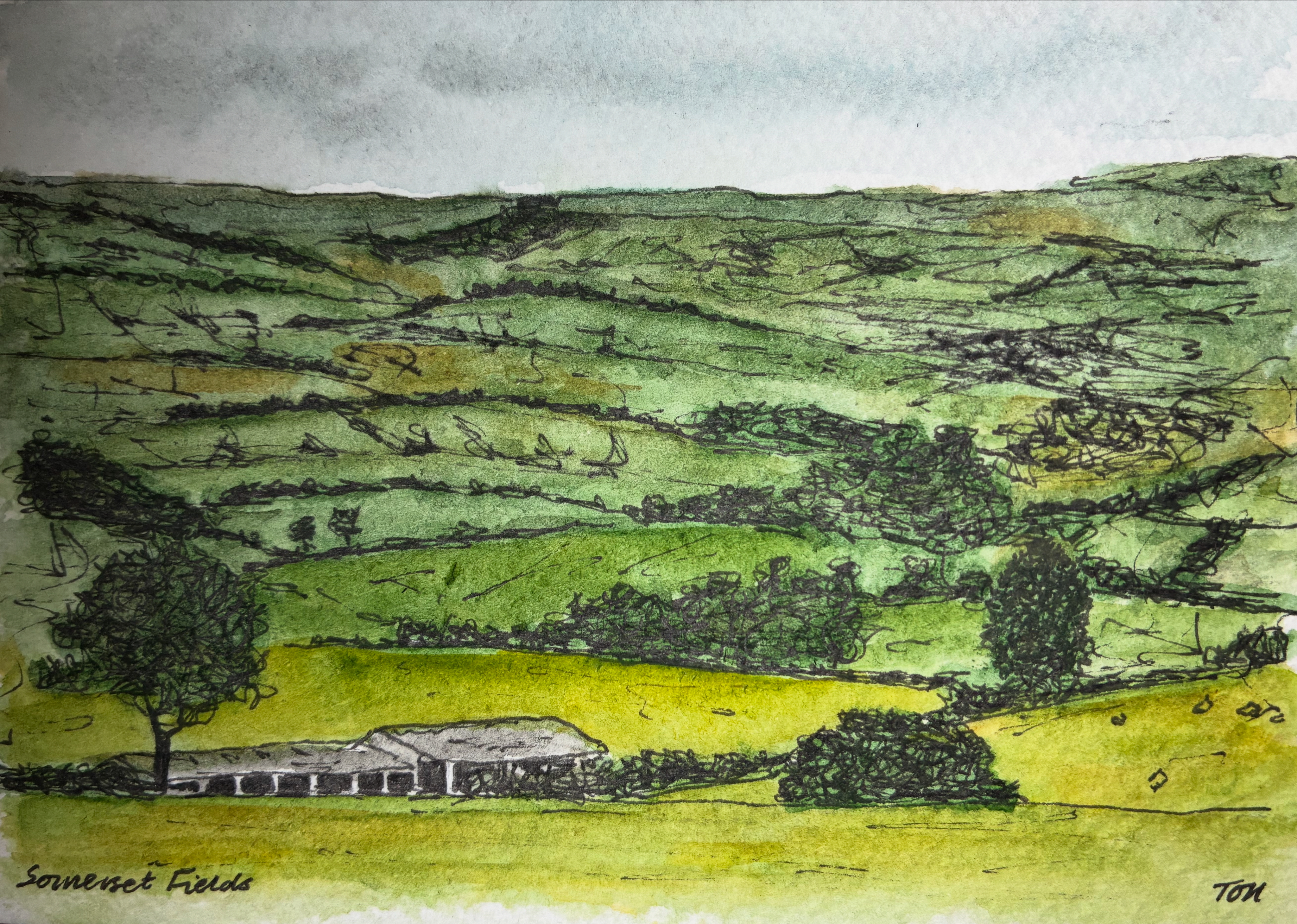
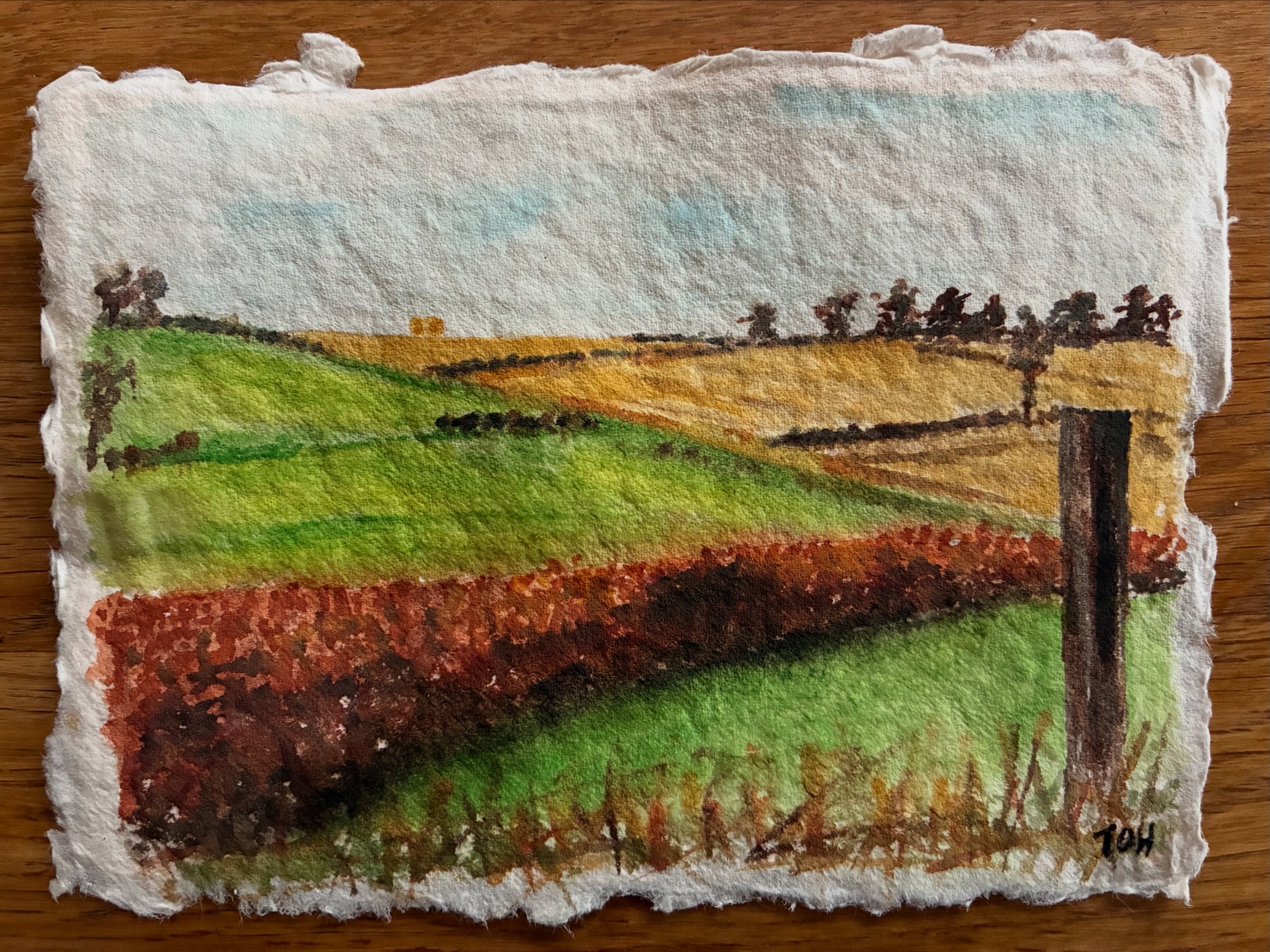
Finally, for now, here’s a scene I painted of the view looking west in the direction of Exmoor from the base of the Quantock Hills. I’ve tried to capture the way that there are successive ‘layers’ of rolling hills as the eye moves towards the horizon, each becoming progressively just a little higher than the previous one. Although wild landscapes can be exhilarating, I do like a farmed landscape – a patchwork of fields, hedges, copses and the odd farm building.

Somerset Fields Looking West From Near Crowcombe

All of these pictures were really just quick ‘practice’ pieces, but I like them all in different ways – Driftwood Cafe for its small details, the grass-cut field for its slightly abstract form, Chantry Tea Garden for its looseness, and Somerset Fields for the way it captures something of the wide expansiveness of the view.

If you have a favourite of these four pictures write a quick comment to let me know!

Mevagissey #art

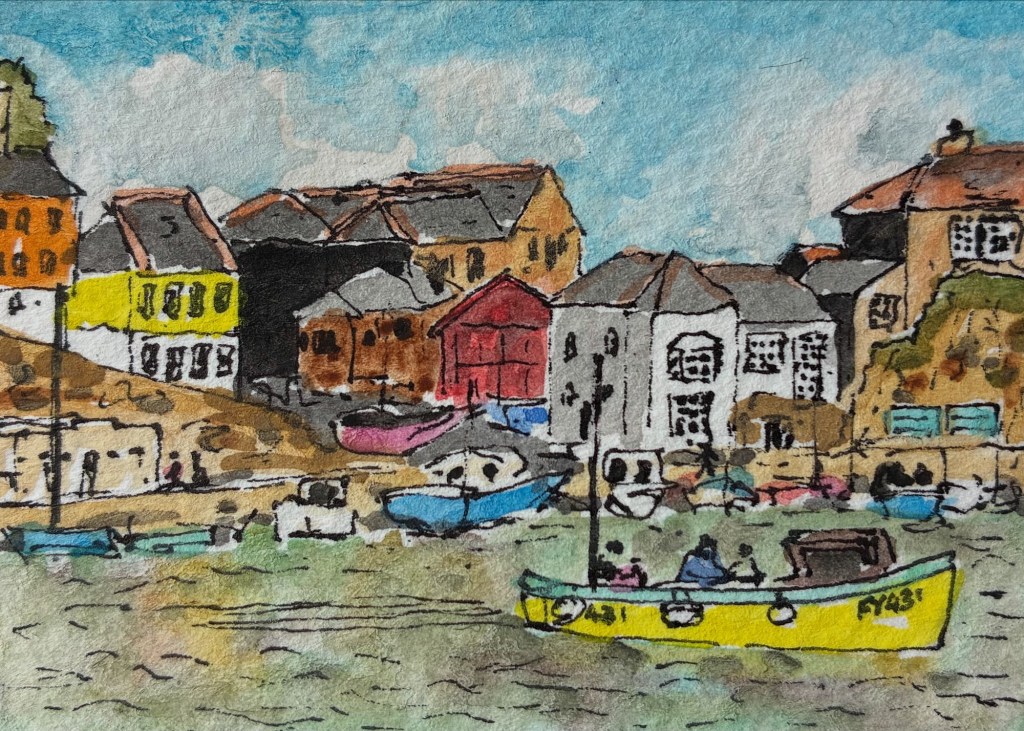
I painted this little watercolour picture of Mevagissey harbour back in June. I was looking to paint a picture to use for a birthday card for the son of one of my wife’s best friends, and brother to one of my elder daughter’s closest friends (by which I mean that the son was also the brother!). As it happened, a couple of months previously, his mum had seen some of my pictures when visiting our home, we got talking about art, and along the way she told us how he had surprised her by saying that when he finally got his own place to live (he’s in his mid/late 20s) he wanted to have pictures of two places that were special to him – Pew Tor on Dartmoor, close to their home in Tavistock, and Mevagissey in Cornwall.

As the date of the birthday approached I started to think of painting one of my ‘special place’ pictures for his card. The trouble was, I was faced with a choice, and anyone who knows me well will know that one thing I am not good at dealing with is choice. It’s tempting to think that choice is a good thing, and I am sure that I would say that I’d prefer to always have a choice than not, but in many ways I’d find life a lot easier if there was a little creature sitting on my shoulder, or tucked into my sleeve, whispering to tell me what to do all of the time.

Should I paint Pew Tor or should I paint Mevagissey?

I’d painted a larger picture of Pew Tor back in early March and knew that I could produce something smaller but similar that would work as a birthday card. I’d also painted various places in Cornwall as part of my Cornwall Landmarks Miniature Watercolours Series. But I’d never tackled Mevagissey… So, one morning I took a small piece of watercolour paper, performed a quick Google search for a suitable photograph, and set to work.

I like the results of my effort – the painting that introduces this post. The picture I chose was a fairly busy scene, with the quayside at Mevagissey backed by all kinds of interestingly shaped and coloured buildings, a host of colourful boats moored at the water’s edge, a pair of rather striking light-blue benches towards the right of the scene, and the bright yellow fishing boat pulling out confidently towards open waters. It was a picture that provided lots of splashes of colour that give the painting a nice sense of aliveness I think.

But, in the end, it was Pew Tor that won the mental tug-of-war that was taking place inside my head. I put my little Mevagissey picture, really just a test piece, to one side, and opted instead for the Dartmoor ‘special place’ rather than the Cornish one. If you are reading this soon after it was originally posted (on 9th September 2025) and want to see the Pew Tor picture that I ended up using, then you’ll just have to visit this site again in a few days time… because if all goes to plan I will post it here soon. For now, you’ll just have to enjoy a quick trip to Mevagissey – a perfect example of the many picturesque little harbour towns that line the southern Cornish coastline.

Walkham Woods (charcoal/watercolour) #art

Since I started drawing and painting back in April 2024 I have primarily worked with ink and watercolour paints, with my ‘go-to’ format being small, usually ~5cm square, pictures on some particular theme that I have chosen to explore for a few days. Producing pictures of that type has become my staple art activity, to the extent that I describe this as my ‘art practice’. However, I am constantly thinking about how I would like to explore different formats and work with different media. This especially happens when I visit an art exhibition, see works by other artists,and wonder what I could produce if I branched out a bit. The funny thing is that prior to my big shift into art in April 2024 I had actually begun to dabble with creating pictures with pastels (e.g. see my post Rediscovering The Artist Within) but I have not returned to pastels once since then.

Sometime back in May I must have been somewhere that brought me into contact with some charcoal drawings. I had a set of charcoal pencils sitting unopened in my art supplies box, and so I thought I would branch out a little and see what happened when I completed the drawing phase of a picture with charcoal, rather than adopting my usual approach of starting off with some faint pencil lines and then going all in with my black ink pen. I think I hoped that the different drawing texture might lead to me producing a more abstract picture. Then, after scribbling away with the charcoal pencil for a bit, I returned to the familiar territory of my watercolour paints to give my drawing some colour.

The result of my efforts is shown in the picture above – a charcoal -cribbles-with-watercolour painting of a row of what I refer to a ‘wall trees’, somewhere in the valley of the River Walkham, from a photo that I had taken on a walk there.

I’m not sure exactly what I think of this picture. It seems quite basic and simple – the trees sitting very much on top of the leafy backdrop and lacking much detail in their trunks and branches – and that simplicity pushes me towards thinking that the picture doesn’t quite work. But I also quite like the more impressionistic look – the rough lines suggesting the texture and structure of the stone wall, and the bright greens and particularly the yellows of the leaf canopy shouting out for attention. The picture has a naivety which I think gives it a certain charm. As I look at the picture, my eyes seem to be drawn in to explore what little detail there is, perhaps more so than happens when viewing one of my more detailed ink and watercolour pictures. Overall, I think that perhaps the switch in drawing medium was successful in helping me to present the view in a more abstract, suggestive manner than my normal ink-and-watercolour approach.

I’ve not had another go with charcoal pencils since I created this picture just over two months ago, but revisiting it now and writing this post has fired me up to spend some more time over the coming period to play around with different approaches and media a bit more. I wonder what will emerge!

Cornwall Landmarks #art

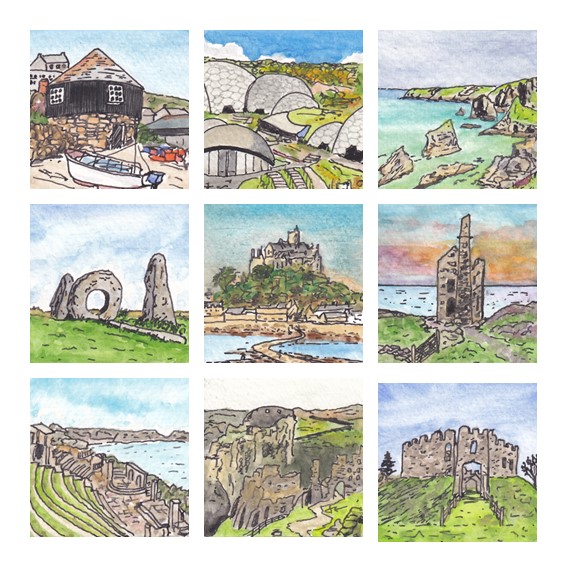
I like to try to spend a little time painting on as many days as I can, and for obvious reasons, the key to this is to keep my pictures small. One of my favourite formats seems to be 5cm square pictures painted in a fairly loose style, with not too much detail and a fairly limited colour palette. Each picture starts with a few pencil marks that serve as guide lines for the pen work, mostly outlining key features and providing various forms of shading. Once the ink has dried, which only takes a few seconds, I start to apply the watercolour paint, usually colouring the sky and any large blocks of vegetation first, before moving on to fill in any details. The whole process generally takes less than 30 minutes and my preference is to spend time of this as pretty much the first thing I do in the morning. When I completed my first small picture, I didn’t have any particular plans for further pictures on the same theme, but one picture led to another, and it seems that I end up producing these miniature watercolours as part of a series, first Dartmoor Scenes and then House Plants, Capital City Landmarks, and a series of slightly larger Mysterious Britain pictures. Most recently, returning closer to home, I completed this set of pictures showing various landmarks in our neighbouring county, Cornwall.

The pictures weren’t painted in this order, but the subjects of my Cornwall Landmarks series are (from top-left working across the rows and down the columns in the composite picture above) The Roundhouse Gallery, Sennen Cove, The Eden Project near St Austell, Bedruthan Steps, Men-An-Tol stone ring, St Michael’s Mount near Penzance, a classic coastal tin mine pumping station, the Minac Theatre, Tintagel Castle and Restormel Castle near Lostwithiel. If I had to choose favourites then I think I would go for the pictures of The Roundhouse Gallery, Bedruthan Steps and Restormel Castle, although I might well make different selections the next time I look at them!

As with each of my other miniature watercolour series, I plan to get some copies of the 3 x 3 composite picture printed as greetings cards to sell at some point, and I will probably try out some of them as individual framed versions too.

I guess the obvious question for me now is where I will go next with this kind of miniature watercolour picture. This morning I painted a view from a photograph I took last week while staying in Exmoor, and so I guess that it is likely that I will end up doing some more from that beautiful part of the world. But whether I will end up with enough for a full series, so that I can make another 3 x 3 composite, only time will tell!

Dartmoor Panoramas #art

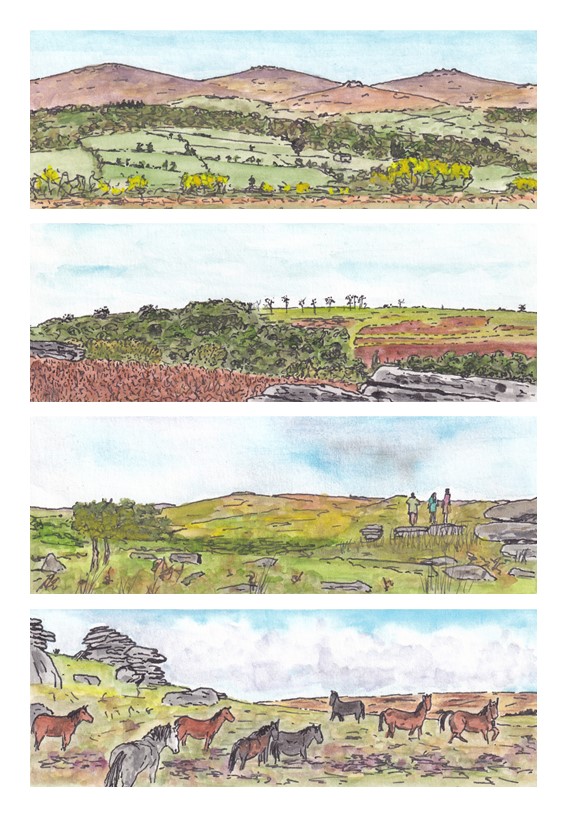
The proximity of Dartmoor to our home in Plymouth generally means that it is our go-to place for weekend walks, so it is hardly surprising that my phone is full of photographs of Dartmoor landscapes. I’m a particular sucker for ‘big views’, but my attempts to capture these in photographs are always something of a let down. Looking with the naked eye, big views fill my visual space with rich detail, but on camera everything seems to shrink, recede and flatten, resulting in a rather distant picture that is dominated by sky, and especially foreground, that the brain somehow filters out of the live view. I expect that this phenomenon is well understood by photographers, and it probably even has a special name, but to me it is just known as ‘disappointment’. This is compounded by the difficulty that I face when I subsequently try to capture this same kind of open, expansive view in one of my paintings. The part of a photograph that I want to paint seems to be only a small component of the whole, and no amount of zooming in seems to really help.

On one recent trip to Dartmoor I was pondering this issue when it occurred to me that what I was seeing with my eyes was a little like the view I got when I used my thumbs and index fingers to create a rectangular, letterbox-like, frame and then looked through that frame as if looking through a window. Despite there being so much more that could be seen, my brain seemed simply to ignore that part of the view that would have outside this frame, whereas my phone camera played no such trick. I began to wonder whether the key to painting this kind of view was to change the size and shape of the picture, adopting a similar letterbox, or panoramic, format. So, for a few days I played with this approach. The results are a series of four small painting that I refer to as my Dartmoor Panorama series.

I’m pleased with these pictures, at least to the extent that they better capture something approximating to the kinds of spacious views that I like best. Using a panoramic format does seem to work. In the third picture I was brave enough to include some people standing on one of the tors and gazing out at the view> I think this little piece of detail adds a lot to the picture, including a splash of contrasting colour. I was even more brave in the fourth picture, including a group of Dartmoor ponies. I tend to think that I’m not able to paint animals, but perhaps I am improving, because at least some of the ponies in this picture seem to have come out pretty well. I am particularly pleased with the grey pony in the foreground and the somewhat lively pony furthest to the right.

I feel sure that I will use this approach to painting expansive views again, and I suspect that at some point my curiosity will lead me to explore some photography guides to see whether I can find a proper explanation of my observation. It might have something to do with ‘foreshortening’ and/or ‘depth-of-field’ (words that I am vaguely familiar with that at least sound like they could be contributing factors). Who knows, perhaps someone reading this post will be able to point me in the right direction!

Rock Giant #poem

You have used me as you wish to have your fun,
scrabbling roughly on the pockmarked surface of my skin,
climbing high to turn your face towards the sun.
You scrape your boots across me to remove accumulated soil,
and carving your initials in my surface,
give little thought to what you spoil.
You have taken from me what you need
using iron picks to gouge out fragments,
thinking that you caused no pain because you saw no sign I bleed.
You turn your eyes towards me and see only solid rock,
looking down upon my dumbness,
laughing as you mock.

By day, as you approach from the grassy slope below,
you start to notice many shapes of things you know.
You see an outline that reminds you of a faithful hound,
you watch it shift as you move forwards,
then it’s gone without a sound.
You turn to view a castle, but no soldiers move for they have fled.
You move your head to shape a profile –
only then you see the witch’s head.
You trace out furrowed brow, hooked nose and jutting chin;
you feel grey eyes look through you,
and you shiver as an evil spell takes hold within.

At night, in your imagination, led by an unheard call,
you see me rise up from my station as I yawn and stretch so tall.
You hear the distant thunder of my steps
as I march the slowest beat.
You sense vibrations deep below,
the trembling ground beneath my feet.
You are frightened of my power, as I tear the earth apart.
You are petrified, turned solid, as the terror grips your heart.
You are fearful that I come at last to take what I am due.
You sense that it is time.
And you are terrified that I am hunting, hunting now for you.

But none of this is true,
for all that you see, and everything that you imagine,
has been shaped by the stories you were told,
and what they let you do.
Those imagined forms, the wild thoughts,
and all the feelings they produce may seem fantastic
when compared with what is in your normal view.
So, what is the truth?
If only you knew…

I was formed from countless tiny pieces that began as dust,
mixed together in her bowl,
baked by her heat to form a crust.
I was once pressed tight together as I found my solid form,
extruded by her shuddering contractions,
melded in her womb so warm.
I have rested for so long as if I have no task,
snuggled by her mossy blanket,
wrapped protectively within her grasp.
I have waited patiently for several million years,
cooled by her gentle whispers,
washed clean by her falling tears.

For your time is not all time.
Your whole existence is the smallest fraction of my life.
This place was mine so long before you came,
and will remain my home for even longer once you die.

And your space is not all space.
Your whole world is like a single speck of the quartz that shines
within the substance of my form,
just one of countless millions of specks, all of which are mine.

And your thoughts are not all thoughts.
Your thoughts are small and they are fleeting, and so they rarely bend.
You are constrained by what they choose to tell you.
There is so much you cannot comprehend.

And your life is not all life.
Your life is short, and it is fast, and so it limits what you try to claim.
You cannot grasp the unfamiliar.
You are bound by the rules that shape your game.

Believe me, I do not lie.
I do not speak to garner fame.
For beyond all that you can see, and everything that you imagine,
are stories to be told and things to see that far expand your frame.
You may think you are the only one who holds within a spark,
but that is falsehood as we share that conscious flame.
I too am alive,
and Rock Giant is my name.

(c) Tim O’Hare, August 2023


ROCK GIANT: The last few walks that we have done have been on the familiar territory of Dartmoor, taking in one or more of the rocky tors that sit atop many of the hill summits. These enormous piles of granite slabs are the remnants of old volcanoes, material pushed upwards from the upper mantle almost 300 million years ago. I find it impossible to visit a tor without seeing the profiles of faces in the shapes made by the great piles of rocks, or imagining that the rocks are the tip of a toe, an elbow or some other part of a huge stone giant asleep beneath the ground. And then, in a natural progression of my thoughts, those rock giants begin to stir. I am not at all sure why, in the poem, I imagined the rock giant as a threat. My instinct is that they are, in fact, very gentle and friendly creatures. But, of course, I will never really know, because they still have much sleeping to do before they awaken.

Alvor – oh no it’s not – oh yes it is #art

I have probably mentioned in a previous post that over the last year it has become fairly standard practice that each time we are approaching the birthday of a friend or family member I rustle up a painting showing a scene or location that has a special association for the recipient. I paint these pictures on a piece of very rough-edged, handmade paper that I have a stack of, and then fix the painting onto a 5 x 7 inch recycled card blank. The result is a specially created, uniquely-designed, hand-made card*. These are always well received, and it is funny how often the recipient doesn’t twig that I did the painting, despite me usually putting my initials in the bottom-right corner. I guess I have only been painting for 14 months and so a lot of people aren’t even aware that the picture on their card is a piece of my handiwork.

Back in April, I set out to create one such card, this time for Ann, the wife of my wife’s father. For some years, Ann and Keith greatly enjoyed holidays at the resort of Alvor on the Algarve coast of Portugal, but health issues and reduced mobility have meant that these trips have not been possible for quite a while now. Consequently, we decided that it would be fitting for me to paint a scene of Alvor to use for Ann’s card. I took a look online, googling images of Alvor, but couldn’t find anything that grabbed me until I came across what I thought was a suitable picture on a tourist site that was promoting the merits of Alvor. It showed an attractive open square, with people going about their business, a few trees and plants, and some interesting patterns in the paving, surrounded by some fairly grand, old buildings, including one that was a striking bright green – perfect to add an interesting splash of colour to the scene. I duly set to work and perhaps 45-60 minutes later, and as I usually do, I posted the finished picture to my social media accounts on Bluesky and Instagram.

After I had finished making the card itself, and it was safely on its way in the post, a work colleague commented on my instagram post along the lines that ‘there is a green-painted building exactly like the one in my picture just a little way along the coast from Alvor in Lagos‘. The first time I read the comment I simply thought ‘well that’s a coincidence‘… but then it dawned on me that they were perhaps just being polite, or maybe subtle, with their wording. Some more image searching soon revealed that no, the square I had painted was not actually in Alvor, and yes, the square I had painted was actually in Lagos… In fact, as I searched further I found that practically every picture I found online of Lagos seemed to feature that same square with its beautiful, old, bright green building. Doh… I had been duped – the website I had originally found the picture on had obviously (how shall I put this?) been developed by a ‘Creative Geographer’.

Ann’s birthday came and went. I had already confessed to my error, and the card was much appreciated nevertheless, but, quite obviously, I was left feeling that I had not quite struck the target. So, a few weeks later, when some spare minutes arrived, I did a new, and more careful, search for pictures of Alvor, plumped for a nice beach/waterfront scene, and set to work again. The result of my efforts is shown below.

I learned (or was reminded of) a good lesson here, namely that you cannot believe everything (much?) that you read on the internet, and Ann was thrilled to receive two birthday cards including the second bonus birthday card with a picture that really did bring back happy memories. So, in the end, we both came out as winners!

* If there is a special place that you would like me to paint, for a birthday card or otherwise, feel free to get in touch. I’m on the point of opening my art activity for business and would be happy to take commissions. I think it would be fun, and interesting, to paint some new and different special places.