Bristol Miniatures #art

Bristol Miniatures Watercolour Series

Towards the end of last year I had got myself into a pretty strong routine of spending 30-40 minutes at the start of most days painting. In almost all of these ‘art practice’ session I would produce a miniature watercolour painting, about 5cm square, working my way through different themes. Pretty much as soon as I finished one series of 12 pictures, I would move onto a new theme and begin the next series. So, having completed my London Landmarks series I was in search of a new theme to work through and a chance comment by one of my personal tutees plus a comment from someone who had purchased a small composite print of my Plymouth Miniatures series pictures, led me to select the city of Bristol for my ninth series.

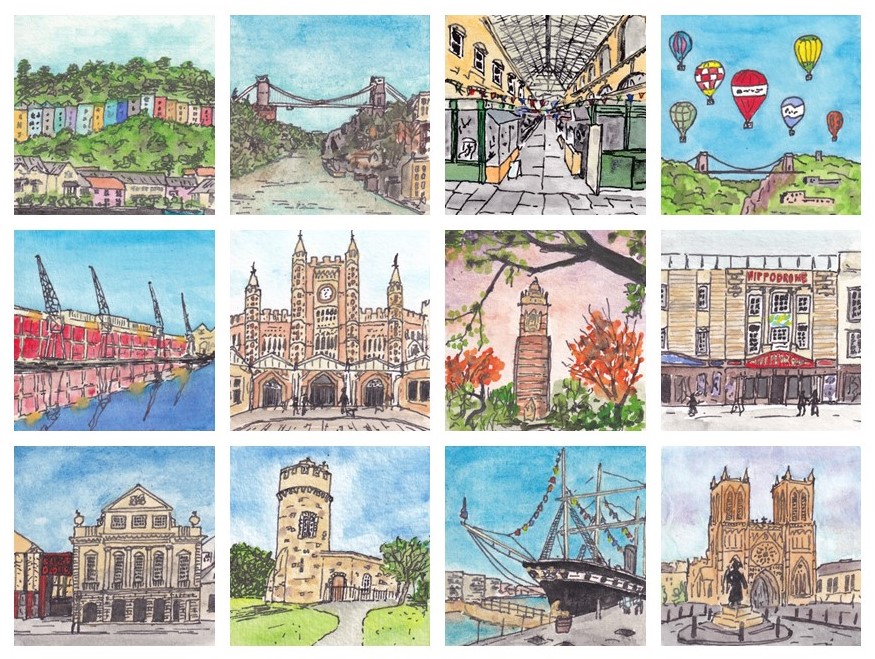
Some of the subjects for the series were immediately obvious – for example, the Clifton Suspension Bridge and the SS Great Britain – and it wasn’t difficult to identify other buildings and views that were suitable for miniaturisation. The full list of the pictures (working left to right and top to bottom in the grid of pictures shown above) is:

  • the brightly coloured houses of Cliftonwood
  • Brunel’s Clifton Suspension Bridge over the Avon Gorge
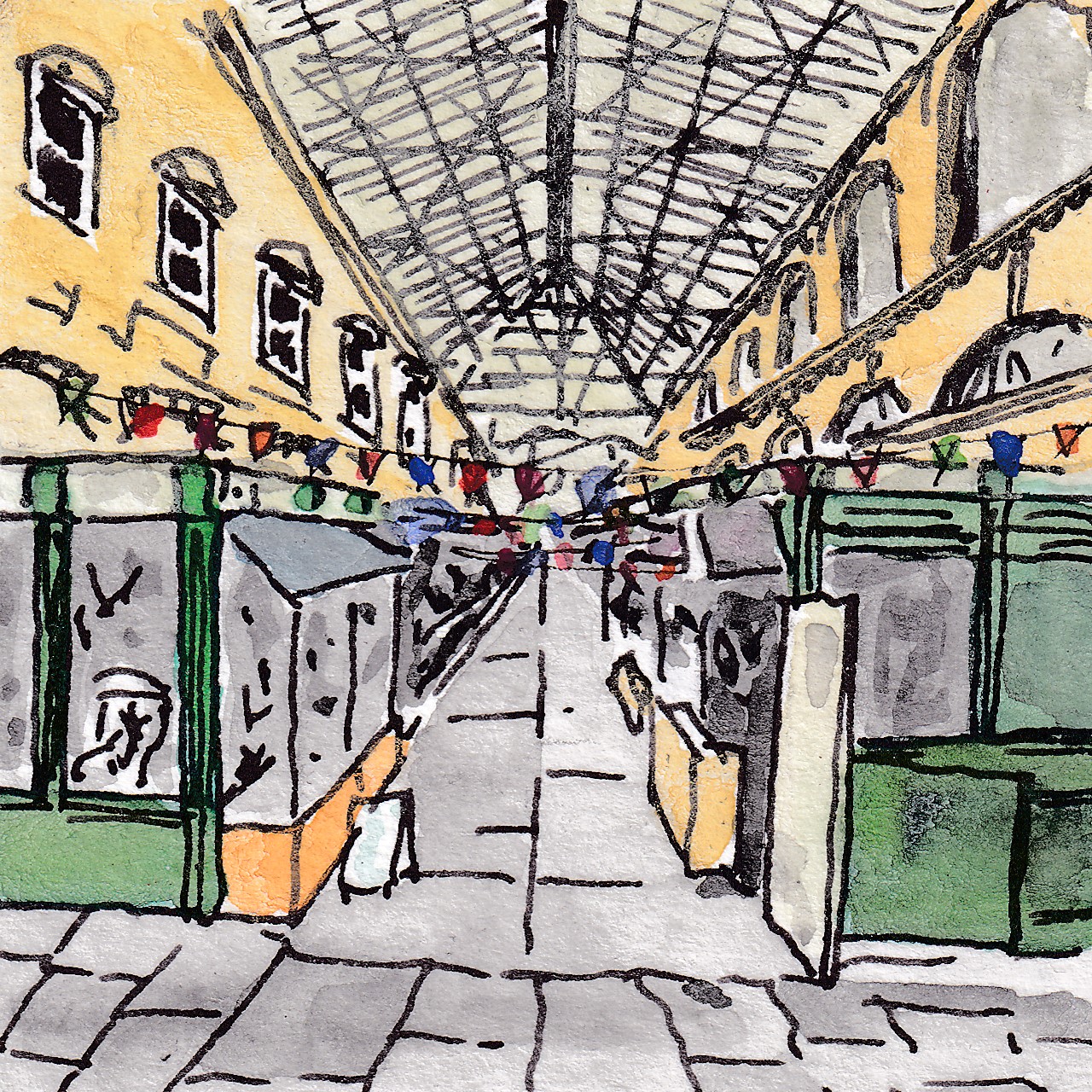
  • the interior of St Nicholas Market
  • the Bristol Balloon Fiesta
  • the M-Shed museum on the dock side
  • Bristol Templemeads Railway Station
  • the Cabot Tower
  • the Bristol Hippodrome
  • the Old Vic Theatre
  • the Clifton Observatory
  • Brunel’s SS Great Britain
  • Bristol Cathedral

As with all of my other miniature watercolour series (Dartmoor Scenes, Capital City Landmarks, Cornwall Landmarks, Exmoor Views, Plymouth Miniatures, House Plants, Trees, London Landmarks), I have listed composite prints and greetings cards of these pictures on Etsy. The best sellers so far seem to be the ones of the Old Vic Theatre and the Bristol Hippodrome, but I also had one order for almost the entire set of cards!

I’ve got two favourites from this set, the colourful houses of Cliftonwood, and the interior of St Nicholas Market. In the first case, I just like the simple blocks of colour that make up the houses, and in the second, I’ve always liked views that have a straight feature such as a road, railway line or canal that disappears towards a central vanishing point…
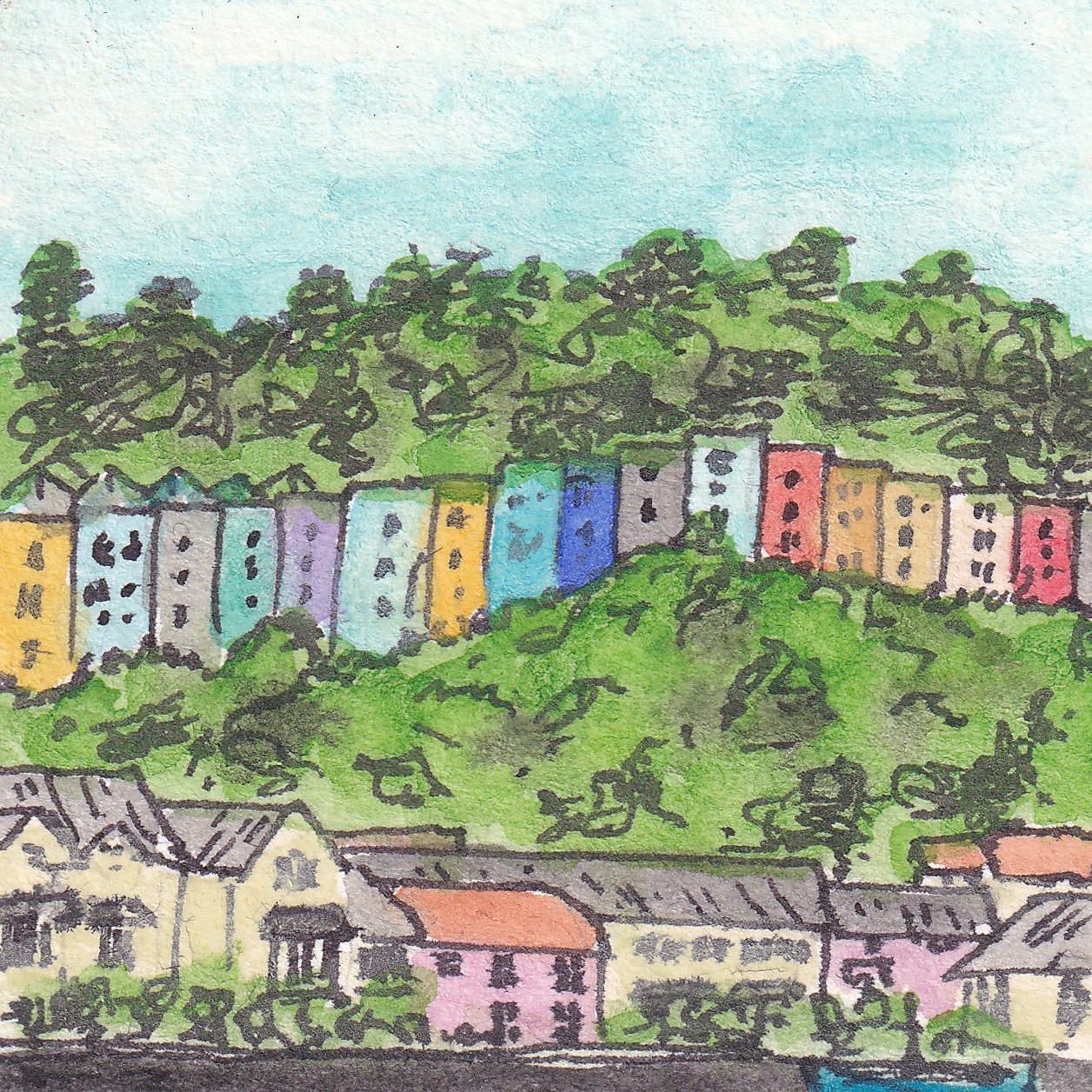
Cliftonwood Houses
St Nicholas Market

London Landmarks #art

London Landmarks Watercolour Series

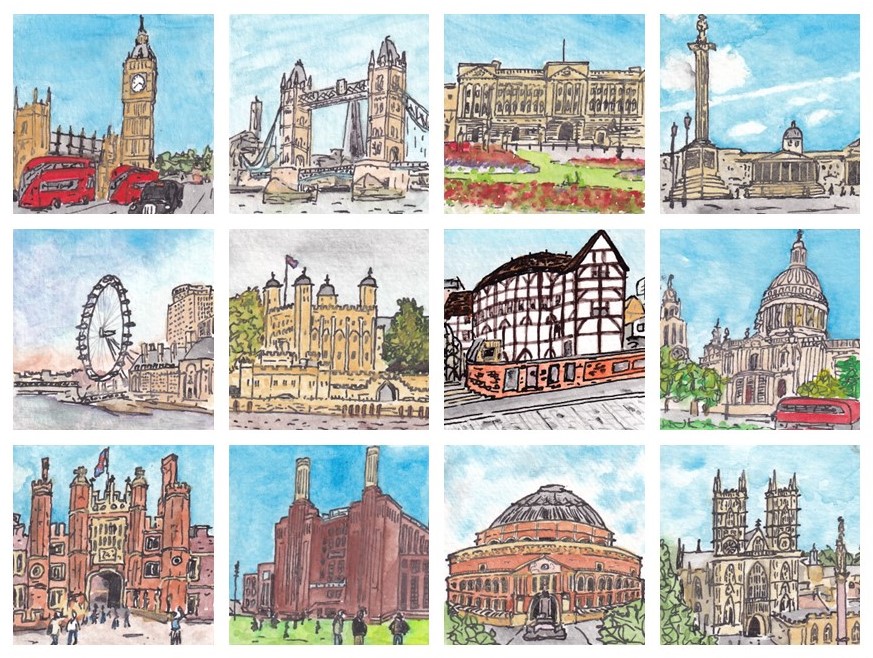
For my eighth series of miniature watercolour paintings, completed last September, I decided that it was time to tackle some of the well-known landmarks in the U.K.’s capital city London. I have to admit that my own visits to London are relatively few in number, with most of the recent ones revolving around trips to watch Plymouth Argyle playing at Wembley (twice, both times depressingly unsuccessful), and against Arsenal, Chelsea and Brentford in the FA Cup. However, like pretty much everyone else, I’m very familiar with many of the obvious historical and touristic landmarks… but when I paint a series of miniature watercolours, I like to throw in a few less obvious subjects, and in the case of this set, that led to me choosing Hampton Court Palace, Battersea Power Station, the Royal Albert Hall, and the Globe Theatre.

The full list of the pictures (working left to right and top to bottom in the grid of pictures shown above) is:

  • the Big Ben clock tower
  • London Bridge
  • Buckingham Palace
  • Nelson’s Column in Trafalgar Square
  • the London Eye
  • the Tower of London
  • the Globe Theatre
  • St Paul’s Cathedral
  • Hampton Court Palace
  • Battersea Power Station
  • the Royal Albert Hall
  • Westminster Abbey

As with all of my other miniature watercolour series (Dartmoor Scenes, Capital City Landmarks, Cornwall Landmarks, Exmoor Views, Plymouth Miniatures, House Plants, Trees), I have listed composite prints and greetings cards of these pictures on Etsy and have sold quite a few of the greetings cards since doing so. Interestingly, as with some of my other series, I am finding that it is the cards featuring more unusual subjects that tend to be the ones that sell. I found this a bit puzzling at first, but on reflection it makes sense because with the more obvious subjects, buyers have lots of choice and the platform algorithm is much less likely to show them my picture in response to their search.

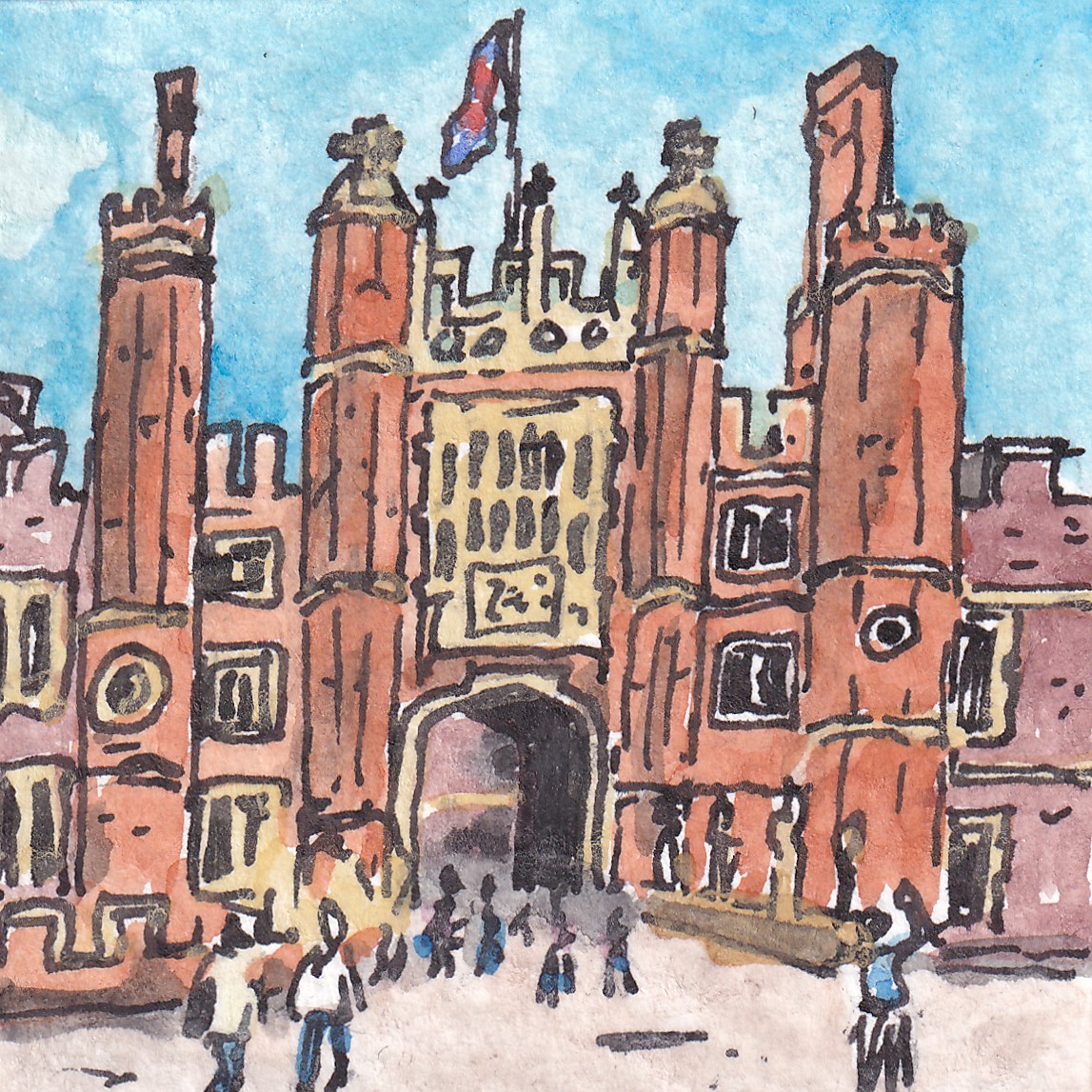
If I was going to pick out a favourite from this series I think I might go for Hampton Court Palace. I think I have picked out enough of the detail in the building and also managed to give it a bit of depth with the shadow under the archway. I think the people in the foreground also help to add interest.

Hampton Court Palace

Plymouth Miniatures #art

Plymouth Miniatures Watercolour Series

As might be apparent from some of my previous pieces on this website, through the latter part of 2025 and early months of 2026, I got into a nice routine of spending ~30 minutes on many mornings, creating miniature square, ink and watercolour paintings. Once I got established with this routine, I decided that I would always aim to produce these pictures in sets of twelve in what I now refer to as one of my ‘Miniature Watercolour’ series. On completion of one series, I would pick a new theme and then launch straight into painting the next set of pictures. Initially, most of my themes were geographically based, and most of those were relatively local (Dartmoor Scenes, Capital City Landmarks, Cornwall Landmarks, Exmoor Views), but a few other themes did find their way into the mix (House Plants, Trees). Consequently, given that I live and work in Plymouth, the only surprising thing about me completing a Plymouth Miniatures series is that it was the seventh theme I had tackled.

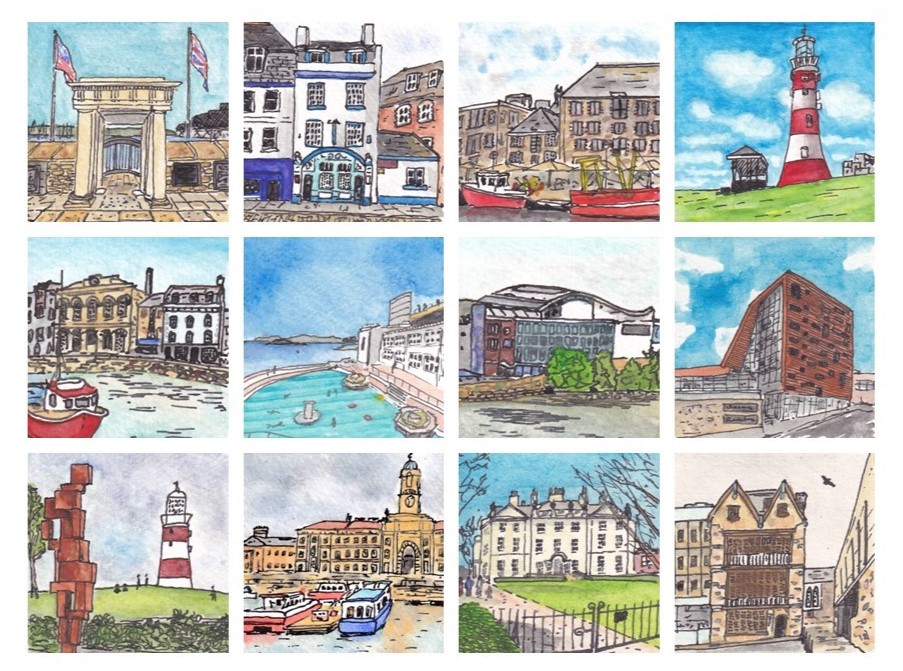
Some of the subjects depicted in this Plymouth Miniature watercolour series overlap with ones I included in the (larger) Plymouth Postcards series I painted earlier in the year, but there are quite a few that I hadn’t tackled before. Working from top-left, across and down the grid of pictures above (with the different ones marked with a *), the paintings show:

  • the Mayflower Steps* – which are not actually the steps from which the Pilgrim Fathers departed English shores in 1620, but a more modern creation.
  • the Dolphin Pub* in the Barbican – possibly the most iconic and well-known drinking establishment in the city.
  • boats moored on the quayside of Sutton Harbour*.
  • Smeaton’s Tower – formerly the lighthouse on the Eddystone Rock, it was rebuilt on Plymouth Hoe in the 1880s as a tourist attraction, and is arguably now the best-known symbol of the city.
  • the Custom’s House and Three Crowns pubs next to Sutton Harbour.
  • Tinsido Lido – a restored open-air art-deco swimming pool on the city waterfront.
  • the National Marine Aquarium.
  • the Roland Levinsky Building on the University of Plymouth campus next to the city centre – named after the former Vice-Chancellor of the university (2002-2007).
  • Anthony Gormley’s Look II* sculpture, gazing out pensively over Plymouth Sound with the Hoe beyond.
  • the Melville Building in the Royal William Yard – formerly the Royal Navy Victualling Yard, built between 1826 and 1835, and now a location for swanky flats, a cinema, some restaurants and small retail outlets, and fairly frequent food and craft fairs and art exhibitions.
  • Saltram House* – the Georgian home of the Parker family on the southern bank of the River Plym, now owned by the National Trust and a key location used in the film adaptation of Jane Austen’s novel Sense and Sensibility.
  • the 16th century The Merchant’s House*, one of the few really old properties in the city that survived the German bombing raids in World War II.

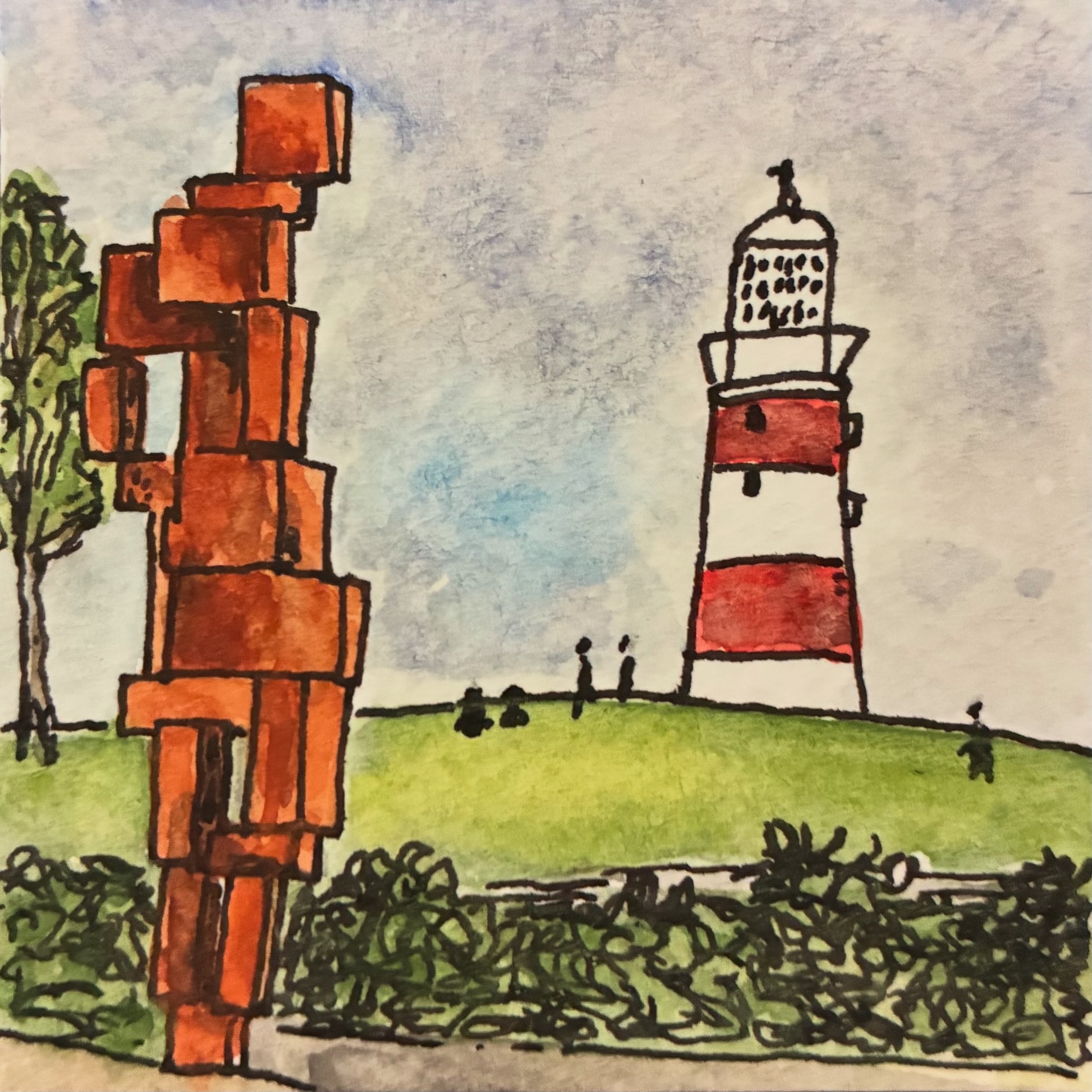
If I had to pick a favourite from this set I think I would select the Look II sculpture, partly because it’s an unusual and somewhat quirky subject, but also because I’m pleased with the way that I captured the variation of colour of the copper blocks…

In the autumn (2025), I decided that, given their local interest, I would list framed, home-produced prints of these miniature pictures on Facebook Marketplace, and I was really surprised and a little shocked, to find that quite a few people decided to buy them as Christmas presents. I’ve also sold a few prints and greetings cards featuring the individual pictures via my Etsy shop. In addition, I used the pictures to make a small desk calendar and sold a few of those too – in fact I have one on my desk in front of me at the moment! So what started off as a fairly brief, meditative morning diversion, has ended up being a (very minor…) commercial success!