A slow start to the day, with plenty of time for my morning routine… at least half an hour for reading, lots of different books – some daily inspiration, a chapter of a long novel, a short story, some poetry, and a few pages from a science magazine, with a cup of black coffee (currently decaf) by my side, and frequent stops to record an idea or to note some words of wisdom I have spied.
Then, a dive into my Journal notebook (Moleskine, large, squared), with my zero-point-nine millimetre Pentel twist-grip propelling pencil in hand, scribbling away, as my thoughts coalesce through the words I write in a way I simply cannot understand.
At least two or three runs each week… Preferably, although not as often as I would like, out of the city, even though I rarely feel that I want to go and often set out wearing a frown, ideally working towards some future long-distance event that, despite crowding in on me horribly as it approaches, seems to be a necessary challenge, albeit one reluctantly thrown down.
Having enough money to keep buying books… titles I come across that interest and intrigue, for it seems that books are my favourite food and provide me with much of the sustenance that I need.
Not being hungry… so, yes, please do bring me that snack (real food of course, not a book!)
Remembering to drink water… because going without it is something for which I really seem to have a knack, until it is too late, my body dry, and my brain shrivelled to uselessness by its lack.
Knowing what is coming up… and having a plan for the hours and days ahead, even though I know I will not follow my intentions, will waste much of the day and become frustrated with myself. (It’ll be a complete disaster if I set off with no kind of schedule, instead.)
Getting outside into nature, trees, sky, clouds, and all the rest of it… especially when there are big views – it’s so much better for connecting with the world than a constant processed diet provided by The News.
Talking out my thoughts… (even if you do not really want to listen, as long as you nod every so often, and give a few prompts to keep me going, it will really help to boost my knowing and keep my ideas growing.)
Being the master of my own time and space… so that I can sort and sift my thoughts, move slowly through the day, and know where I am and where I am heading.
Working at my own pace… but also not having to make too many choices. Although I will always have an opinion – I admit that’s true – it is usually far better if you simply tell me what we’re going to do.
Encouragement and praise… just the right amount and I have to believe that it is sincere. Just like the ambrosia eaten by Gods it can be sweet and sticky, so getting this one right is really tricky.
What doesn’t help is…
Losing sight of the things that help, or forgetting that even though I am certain of their value, I will often have to force myself to do them, and that, with insufficient respect for myself, I will likely lack the courage to make sure that they happen Enough.
(c) Tim O’Hare, September 2023
THINGS THAT HELP: As I allude to in my note for The Hollow Man (and probably elsewhere) there are certain things I like to do each day or on a regular/routine basis that help me to maintain my level of functioning. I find that I can go for a few days without following my ‘morning routine’ but if I let things slip for any longer or fail to force myself out for a run or a walk in the countryside I start to unravel. Things That Help captures some of these activities and ingredients that keep me in balance and, most importantly, notes the need to keep them in sight and to keep pushing myself to do them. I’ve come to think that everyone should write out their own list of Things That Help and keep it in a prominent place as a reminder
It is time to banish thoughts of giving up, to be replaced by the comfort of giving in – acceptance rather than flight, to fold back the shutters, emerging from the dark of night – allowing in some light.
It is time to cease the role of the bully, forcing the fearful child within to be the man he thought he should. Instead, enfolding in a loving hug to draw out all he could have been. If only he had understood.
It is time to give the boy a chance, to give him space to play his part, to let him fall and graze his elbow – blood and gravel – even though tears may flow. He may be strong enough. How else will we know?
It is time to take those steps that cross the threshold of the door, to find that it was open all along – never locked – and behind it? The voice of the song oft heard, though always sounding slightly wrong.
It is time to push on through the fog, that cloak of damp that so confuses senses, seeking clearer skies, different colours, other forms to try on for size. Who knows how those choices may surprise?
It is time to give in, not to temptation, hopelessness or terror, but to follow the path to those imagined lands, shaping their form with my own hands. Finally, he understands.
(c) Tim O’Hare, August 2023
IT IS TIME: This poem came completely out of the blue, coalescing onto the page in less than an hour. It reflects a big decision made on the previous day – to signal that I must let go of a big role at work, to stop fighting with the thought that to do so was some kind of failure, and to just accept that I no longer have it within me to push and cajole or fight with myself anymore.
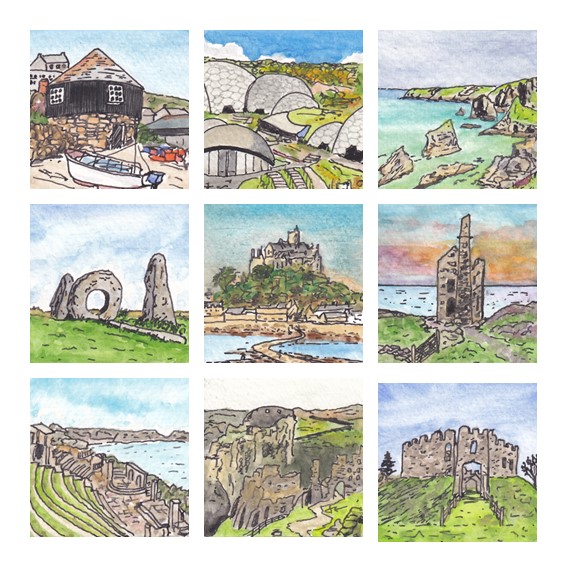
I like to try to spend a little time painting on as many days as I can, and for obvious reasons, the key to this is to keep my pictures small. One of my favourite formats seems to be 5cm square pictures painted in a fairly loose style, with not too much detail and a fairly limited colour palette. Each picture starts with a few pencil marks that serve as guide lines for the pen work, mostly outlining key features and providing various forms of shading. Once the ink has dried, which only takes a few seconds, I start to apply the watercolour paint, usually colouring the sky and any large blocks of vegetation first, before moving on to fill in any details. The whole process generally takes less than 30 minutes and my preference is to spend time of this as pretty much the first thing I do in the morning. When I completed my first small picture, I didn’t have any particular plans for further pictures on the same theme, but one picture led to another, and it seems that I end up producing these miniature watercolours as part of a series, first Dartmoor Scenes and then House Plants, Capital City Landmarks, and a series of slightly larger Mysterious Britain pictures. Most recently, returning closer to home, I completed this set of pictures showing various landmarks in our neighbouring county, Cornwall.
The pictures weren’t painted in this order, but the subjects of my Cornwall Landmarks series are (from top-left working across the rows and down the columns in the composite picture above) The Roundhouse Gallery, Sennen Cove, The Eden Project near St Austell, Bedruthan Steps, Men-An-Tol stone ring, St Michael’s Mount near Penzance, a classic coastal tin mine pumping station, the Minac Theatre, Tintagel Castle and Restormel Castle near Lostwithiel. If I had to choose favourites then I think I would go for the pictures of The Roundhouse Gallery, Bedruthan Steps and Restormel Castle, although I might well make different selections the next time I look at them!
As with each of my other miniature watercolour series, I plan to get some copies of the 3 x 3 composite picture printed as greetings cards to sell at some point, and I will probably try out some of them as individual framed versions too.
I guess the obvious question for me now is where I will go next with this kind of miniature watercolour picture. This morning I painted a view from a photograph I took last week while staying in Exmoor, and so I guess that it is likely that I will end up doing some more from that beautiful part of the world. But whether I will end up with enough for a full series, so that I can make another 3 x 3 composite, only time will tell!
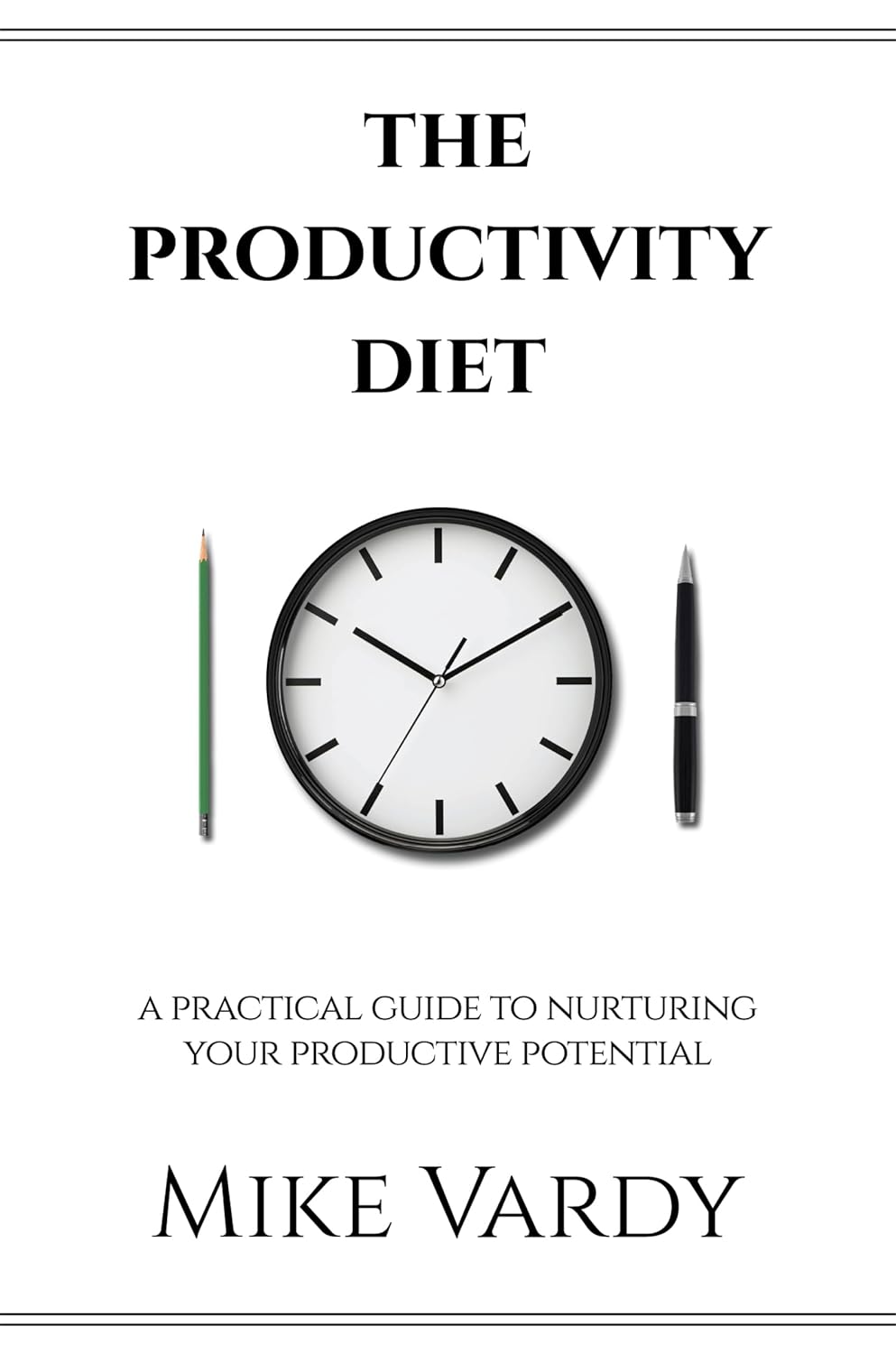
The Productivity Diet is the latest book written by Mike Vardy. Mike, who is based in Victoria, British Columbia, on the western side of Canada, describes himself as a ‘seasoned productivity expert, writer, coach and podcaster’ (quoting from his own website biography), and it was through the latter, his podcast A Productive Conversation, that I first became aware of his work. I don’t know how I initially stumbled on this podcast but for some years I have been a sucker for consuming content related to productivity (or ‘how we operate’ as I prefer to think of it). At some point, listening to episodes of the podcast led me to signing up for Mike’s email newsletter and then, after he sent out a request for people who felt they had a tendency to get started later in the day to contact him, I ended up chatting with him via Zoom about the productivity challenges that I faced and the approaches to overcoming those challenges that I used. At the end of the call, I politely declined the opportunity to join a coaching course with him (£££!!!) but did sign up as a member of his online community The TimeCrafting Trust. That was in March 2024, and over the last 15 months I have got to know quite a few other members of the community, most of whom are based in North America, and participated in a wide range of online events including monthly Book Club meetings, podcast livestreams, workshops and seasonal planning sessions. I think it’s fair to say that whilst Mike and I have never met in person, I could properly describe him as a friend, albeit of the online variety.
But what of The Productivity Diet itself? Mike’s basic view is that we cannot ‘manage time’ and so, instead, we should focus on managing our attention, in particular taking into account how much energy we have at any moment. To paraphrase the book: Productivity isn’t about managing time. It’s about how we use it, how we relate to it, and how we move within it. Mike argues that we should eschew rigid productivity systems in favour of thinking about productivity as a continuous interaction between Intention, Attention, Reflection and Action. Mike’s approach, which he calls TimeCrafting, involves laying out some broad intentions for our areas of focus, but then navigating the reality of our daily experience with a sense of gentleness and responsiveness to our evolving needs.
The Productivity Diet was the subject of a Kickstarter Campaign that Mike started before I got to know him. I think there were a few hiccups along the way, but the book was launched successfully earlier this year. The launch included Mike making appearances on a number of other productivity-related podcasts, and when he announced that he was going to focus an episode of his own podcast on the book I thought it would be fun to offer my services as a stand-in ‘host’ so that rather than it being Mike Vardy having a productive conversation with himself, the episode had a more normal host-author format. A little to my surprise, and despite the fact that I have pretty much no experience of working in broadcast communications, Mike thought this was a good idea and we went ahead and had a lot of fun recording the episode. You can pick it up here if you’re at all interested: A Productive Conversation Episode 603.
There are three major pillars to TimeCrafting as set out in The Productivity Diet: Time Theming, Attention Paths and Reflection.
Mike is big on the first of these pillars, Time Theming, suggesting that it can be beneficial to designate different kinds of themes to act as guide-rails as you decide, in the moment, exactly what to do next. These themes are time-based, for example, daily, weekly, monthly, seasonal or what are termed ‘horizontal’ themes where you select to focus your attention on a particular type of activity at the same time each day. At an even longer timescale, it is suggested that you adopt an ‘Annual Axiom’ – essentially a very short (e.g. three word) description to guide your overall approach to the year ahead. In the world of TimeCrafting, one might decide to group administrative tasks together to tackle on, say, Thursday, or to designate Friday as a day to consider finance-based activities, Tuesday for ‘creating’ etc. One might decide that the focus for the week ahead is, say, ‘rejuvenation’ or ‘correspondence’, or that the next month is for ‘growing contacts’ etc. A key aspect of Time Theming is that the themes are not meant to be a way to rigidly enforce a particular regime of action, but serve more as beacons to guide you back to an intended path if you move away from it. In addition, it is perfectly fine to do tasks and activities that do not match the current intended theme if there is time and space to do so.
The term ‘Attention Path‘ relates to a factor that will influence what you choose to, or can, focus your attention on at any given moment. The Productivity Diet introduces the acronym TREAT as a way to separate out five different types of attention path. TREAT stands for Time-based, Resource-based, Energy-based, Activity-based and Theme-based. The idea is that when selecting tasks to work on next, one considers the options in relation to each of these attention path types, asking questions like: Can this task be accomplished in the time I now have available? Do I have the resources I need to hand? Do I have the energy for this? Does it make sense to do this alongside some other similar task? Does this fit within my intended theme? I know from my interactions with him, that Mike is a firm believer in designating tasks as being low, medium or high energy so that, for example, when you hit a point in a day where you feel fatigued and might otherwise grind to a complete halt (as we all do…) you can glance at your list of possible tasks and pick one or two low energy tasks to accomplish. In this way, time which might otherwise be lost to the void of the internet (for example) can still result in some useful outcome.
The third pillar of TimeCrafting is Reflection. This is the key to continuous evolution and improvement. By reflecting on your actions, for example by writing in a journal, you can identify adjustments that can be made, obstacles to overcome, approaches that can be reinforced or extended. Without meaningful reflection there is no evidence base to use to help inform the decisions you make about what to do when and how etc., and so everything just unfolds somehow in a rather haphazard manner.
I will admit that in my own day-to-day operations, I have not had a great deal of success in using daily, weekly or monthly themes. I think my work days are too variable and I do not have sufficient control over exactly what needs to be done when, for them to work in a very consistent manner. But I think that having the general approach in mind is still helpful, especially at the longer timescales (‘this week/month I will focus on finishing X’). I have had more success with horizontal theming, but the variability of my days (sometimes I have classes to teach, other days I have a meeting etc) means that my attempts to impose order on my day through horizontal themes is generally most successful during the earlier and later (non-work hours) parts of each day. Similarly, I do consider attention paths to some extent, but I find that once my day is underway I tend to forget my plans and just go with the flow. It doesn’t help that I am not very good at checking in with myself to consider whether I would benefit from re-directing my attention (even setting reminders to do this doesn’t work very well – I just ignore them much of the time!). It’s not that I think the ideas underlying TimeCrafting are not valid, quite the reverse really, but I just seem to revolt against any attempt to constrain or direct my attention even though I would very much like to be able to do so!
I like the general approach of TimeCrafting that is set out in The Productivity Diet. I’ve tried to implement what might be called ‘heavier’ systems – things like time-blocking/time-boxing – and whilst they seem to offer an attractive level of control, I always (and quickly) end up revolting against them as my feelings in the moment take over. TimeCrafting offers a more gentle, sensitive, approach to keeping yourself on track, or at least somewhere close to being on track. To use a travel analogy, TimeCrafting is like having a traditional map, understanding what all of the symbols mean and knowing generally where you want to end up, but allowing yourself flexibility to move around the terrain, informed by the map, in the way that feels most appropriate at the time. This seems to me to be a much better way to travel than to switch on the SatNav and following it blindly to the selected destination, even when the road you have just been instructed to turn down is clearly little more than a rough and ever-narrowing track heading to an almost inevitable dead end and a ton of frustration as you try to turn around or back-up, surrounded by a herd of angry cows. Give me the map and my intuition any day!
It was the morning of the fourth day of July, twenty twenty-three, and I was running, alone, on Ilkley Moor. I could not take the path that I had planned, for it was stolen from me by the grasp of ferns, and so, instead, I found another way to travel west – my route, like life, a path of unexpected turns.
As I drew level with a group of trees, planted in my mental map, I turned to head, almost a scramble, up the rock-strewn slope, until with the ground flattening all around, I came to a stone wall and followed a well-worn path that lay in its shadow, east, towards the radio mast. From there I knew my way, down the track they call the Keighley Road, with a view across the valley over Ilkley town that, like the passing of a life, would slip away too fast.
As I began my descent, his profile came into view, to my right, just off the track, though still some distance well ahead – a small, dark man, sitting, gazing directly across my path, chin resting on hands, elbows propped on knees, his head straining forwards as if to peer through time to seek some other space. He remained there as I closed, his features sharpening in my sight, and I was struck how, like so much else in life, his presence was incongruous. For this did not seem to be his place.
I expected him to move as I approached, if only to shift his pose, but he sat looking west across the track, across the moor – still. And as my eyes searched for detail in his form I saw that he was too small, about two-thirds the size of a man, and so dark, yet without colour.
My brain was screaming at me: ‘Something is not right here’, and I felt a heavy weight in the air around me. I continued on, towards the point beside the grey stone on which he sat. My heart was beating fast, preparing to meet another life, but on my arrival there was no-one there.
(c) Tim O’Hare, August 2023
AN ENCOUNTER ON ILKLEY MOOR: This poem tells the true story of an encounter that I had on a morning run while staying on Ilkley Moor for a week. There was a rock on the verge by the track that I ran along as I made my descent to our holiday let. As I came down the track towards it, I saw the figure of a small, dark man sitting there, just as I describe in the poem, and I instinctively felt that I was not able to recognise all that lay before me. Even now, many months later, I cannot let go of the fact that he was there and that, just for a few moments, either he or I was not in the right place.
The proximity of Dartmoor to our home in Plymouth generally means that it is our go-to place for weekend walks, so it is hardly surprising that my phone is full of photographs of Dartmoor landscapes. I’m a particular sucker for ‘big views’, but my attempts to capture these in photographs are always something of a let down. Looking with the naked eye, big views fill my visual space with rich detail, but on camera everything seems to shrink, recede and flatten, resulting in a rather distant picture that is dominated by sky, and especially foreground, that the brain somehow filters out of the live view. I expect that this phenomenon is well understood by photographers, and it probably even has a special name, but to me it is just known as ‘disappointment’. This is compounded by the difficulty that I face when I subsequently try to capture this same kind of open, expansive view in one of my paintings. The part of a photograph that I want to paint seems to be only a small component of the whole, and no amount of zooming in seems to really help.
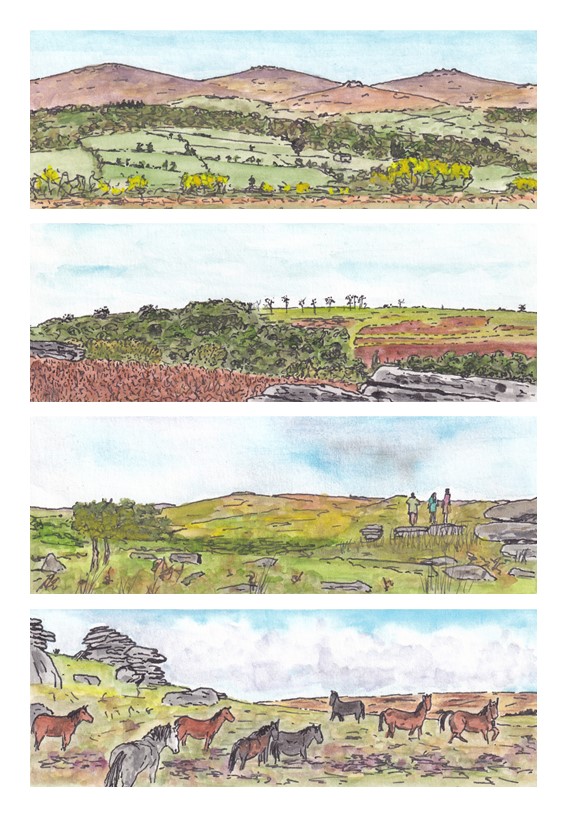
On one recent trip to Dartmoor I was pondering this issue when it occurred to me that what I was seeing with my eyes was a little like the view I got when I used my thumbs and index fingers to create a rectangular, letterbox-like, frame and then looked through that frame as if looking through a window. Despite there being so much more that could be seen, my brain seemed simply to ignore that part of the view that would have outside this frame, whereas my phone camera played no such trick. I began to wonder whether the key to painting this kind of view was to change the size and shape of the picture, adopting a similar letterbox, or panoramic, format. So, for a few days I played with this approach. The results are a series of four small painting that I refer to as my Dartmoor Panorama series.
I’m pleased with these pictures, at least to the extent that they better capture something approximating to the kinds of spacious views that I like best. Using a panoramic format does seem to work. In the third picture I was brave enough to include some people standing on one of the tors and gazing out at the view> I think this little piece of detail adds a lot to the picture, including a splash of contrasting colour. I was even more brave in the fourth picture, including a group of Dartmoor ponies. I tend to think that I’m not able to paint animals, but perhaps I am improving, because at least some of the ponies in this picture seem to have come out pretty well. I am particularly pleased with the grey pony in the foreground and the somewhat lively pony furthest to the right.
I feel sure that I will use this approach to painting expansive views again, and I suspect that at some point my curiosity will lead me to explore some photography guides to see whether I can find a proper explanation of my observation. It might have something to do with ‘foreshortening’ and/or ‘depth-of-field’ (words that I am vaguely familiar with that at least sound like they could be contributing factors). Who knows, perhaps someone reading this post will be able to point me in the right direction!
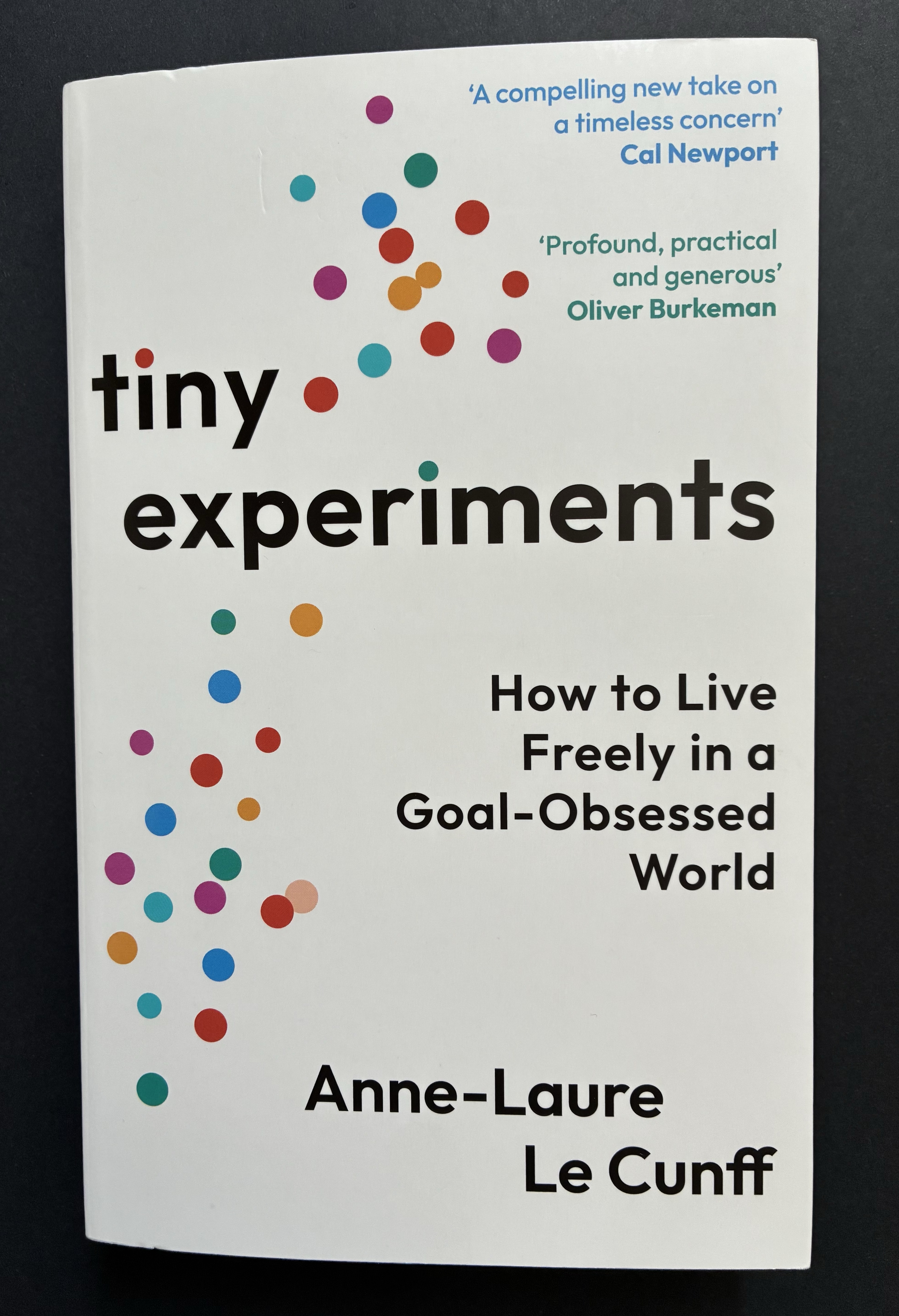
I read Anne-Laure Le Cunff’s debut book, Tiny Experiments, just a month after it was released in March 2025. However, this was not my first sight of the key ideas that the book contains, because I was lucky enough to be chosen as one of 300 people participating in a series of four, weekly online workshops, led by Le Cunff, that took place in February, in the lead up to the book’s publication. These workshops and the online community that accompanied them was called The Curiosity Collective, the name giving prominence to what is perhaps the key theme running Le Cunff’s work – the exhortation to live life in ‘curious mode‘, always willing to explore and experiment with your approach to life, and how you operate in the world. My experience attending those online workshops, showed me that Le Cunff is a highly skilled communicator and excellent teacher, and so I approached reading Tiny Experiments with high expectations. As an added bonus, the book had been chosen as the April pick for The TimeCrafting Trust Book Club.
As noted above, curiosity lies at the heart of Le Cunff’s ideas, and this is most obviously seen in her simple, four-part model for exploring and implementing change in your life. This model is rather neatly captured by the word sequence: PACT > ACT > REACT > IMPACT. At the start of the book, Le Cunff encourages the reader to adopt the mindset of a ‘self-anthropologist’, observing how they act in the world and the outcomes of these results, and then asking questions in relation to these observations. Le Cunff then structures the bulk of the text around her four-step model, stressing the importance of moving away from a Linear Mindset (X leads to Y leads to Z – end of story) towards the adoption of an Experimental Mindset based on the implementation of continuous experimental loops. My own feeling is that the key message here is not really about the distinction between linear v looping but, rather, one of ongoing adaptation and experimentation. The experiments one conducts don’t need to be thought of as loops (in fact they probably won’t bring you back to near your starting point) but they should take you somewhere, and in the process provide valuable evidence to help you work out what you might experiment with and where you might go next.
In the PACT phase of her model, Le Cunff presents a really neat (because it is simple) template for setting up what she refers to as a Tiny Experiment (an exploration of what happens when you make some small, realistic and manageable shift in the way that you operate). This template – a PACT – takes the following form:
“I will [action] for [duration]”
The key here is make sure that the action is purposeful, actionable (something that you can reliably perform), continuous (i.e. repeatable and not changing from day-to-day) and trackable. It is also important to be specific about the duration of the experiment (or else the number of repetitions). This ensures that the experiment is set up so that it provides a large enough dataset for meaningful conclusions to be drawn, but does not continue for so long that the action becomes tedious, or redundant or of little continued value. Essentially, the whole point of the PACT is to provide information that can then be used to adapt future behaviour and experiments, and not as a means to try to establish new habits.
In the ACT phase, you set about completing the activity specified in the PACT. This section of the book has some interesting material exploring the powerful forces of procrastination and, associated with this, perfectionism, that can so easily derail progress towards a goal.
The third phase of the model, REACT, occurs once the action described in the PACT has been completed for the specified duration. At this point, the goal is to look for, and then consider, evidence of the results of the action. Le Cunff highlights that it is important to look for evidence from within/internally (reflection) and externally (feedback from others, evaluation of results). Here, she presents what I suspect will become the most significant legacy of Tiny Experiments, namely her simple PLUS- MINUS-NEXT framework for reflection: what went well, felt good – what challenges or obstacles you faced, what was difficult, what negative feelings emerged – and then how the insights gained can shape future actions. [But whilst this framework is neat and seems to be catching on in the productivity community it might be noted that it is not so very different from the well-established ‘plus-minus-interesting’ framework.]
Because the whole point of Tiny Experiments is to encourage the adoption of an Experimental Mindset towards life, the REACT reflection should lead to a decision being made in relation to the area being investigated by the PACT. Le Cunff suggests that there are three possibilities: PERSIST – prolong the pact, or PAUSE – quit the pact or put it on hold, or PIVOT – modify the pact or shift the focus of a subsequent pact.
The final section of Le Cunff’s framework, IMPACT, focuses on the idea that it is helpful to be open/public about what you are setting out to achieve with your PACT and/or to work with others when pursuing it. This is largely a matter of gaining a useful chunk of external accountability, and also valuable feedback, but having seen many ‘public’ statements of Tiny ExperimentsPACTs in Le Cunff’s online community Ness Labs and on social media more generally, it is clear that it also serves as a powerful tool to market and promote Le Cunff’s ideas.
I enjoyed reading Tiny Experiments, and I feel pretty sure that it will be the kind of book that continues to have presence in the market for some time. It is well written and nicely structured, and the core ideas are simple (which is a good thing) and neatly presented, such that they have every chance of ‘sticking’. I think the phrase ‘Tiny Experiments‘ will likely become part of the productivity lexicon in similar fashion to James Clear’s ‘Atomic Habits‘. I also think that the “I will [action] for [duration]” statement for a PACT, the ‘PACT-ACT-REACT-IMPACT‘ model (or at least the ‘PACT–ACT–REACT‘ part of it) and, in particular, the ‘PLUS-MINUS-NEXT‘ framework for reflection, will all end up having a healthy existence outside the printed pages of the Tiny Experiments book…
… but in the end, my enthusiasm for Tiny Experiments waned. I had several goes at defining pacts and conducting experiments, but I wasn’t able to make myself see any of them through to a satisfactory conclusion. Life got in the way, and I found myself ignoring my pacts and carrying on with my usual scattergun approach to trying things out. This, of course, probably says more about me than it does about the potential efficacy of Le Cunff’s ideas, but my experience was that despite the simplicity and neatness of the Tiny Experiments model, it did not possess enough power to persuade me to go all in with it. I have also felt that most of the Tiny Experiments that I have seen others setting out to pursue would really be much better described as ‘tiny habits’ (a phrase already coined by the author B.J. Fogg and, of course, rather similar to James Clear’s ‘atomic habits’), rather than tiny experiments, and to put it bluntly, many of them read like tiny morsels of misty-eyed, wishful thinking…
So, in the end I congratulate Anne-Laure Le Cunff for writing a really nice book that captures some neat ideas and makes some good general points, but despite the fact that I am still indulging in some daily ‘plus-minus-next’ reflection, I can’t say that it has turned me into a Tiny Experimentalist.
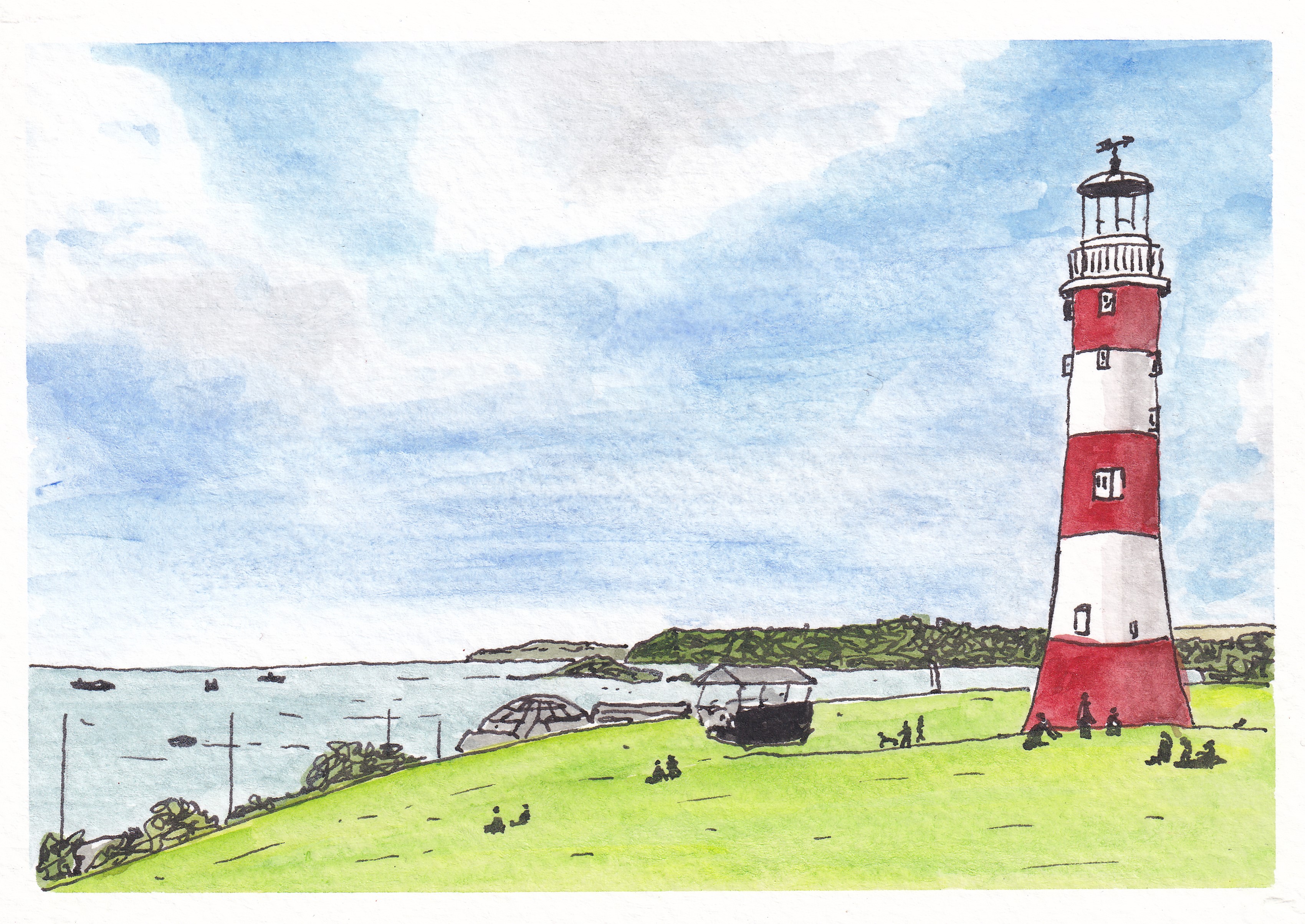
Back in April, after completing four series on miniature watercolour pictures (Dartmoor Scenes, House Plants, Capital City Landmarks and Mysterious Britain), I decided that I would give myself a new challenge by scaling up my paintings a bit and keep my subject matter close to home with a set of pictures that I described with the working title ‘Plymouth Postcards’. I wanted to try to keep the same kind of fairly loose style but I thought it would be good to be able to capture a bit more detail of each scene. My miniature watercolours had been just 5cm square (or 5cm x 7cm in the case of the Mysterious Britain series) but this new series was, naturally, postcard sized (roughly 10cm x 15cm). That’s an increase in area of up to six times, and so it gave me quite lot more sketching, drawing and painting to complete!
My first picture (above) focused on what is probably the most iconic view associated with Plymouth, the red-and-white striped form of Smeaton’s Tower – one-time lighthouse on the Eddystone Rock which was moved to Plymouth Hoe when it was replaced in the 1880s.
Next up, I remained close to the waterfront with a view across the inner basin of Sutton Harbour towards the old customs house and the Three Crowns pub. I am not sure that the colour of the water there is ever quite as blue as my picture suggests, but I like the bright and cheery feel of this painting…
Sutton Harbour, Plymouth
Third came a view of one of Plymouth’s most distinctive new buildings, the Roland Levinsky Building, home of the Arts Faculty at my workplace, the University of Plymouth. Again, the sky is perhaps a little too bright, but I like the three-way competition between the blue sky, the green of the grassy area in the foreground, and the coppery-orange cladding of the building itself…
The Roland Levinsky Building, University of Plymouth
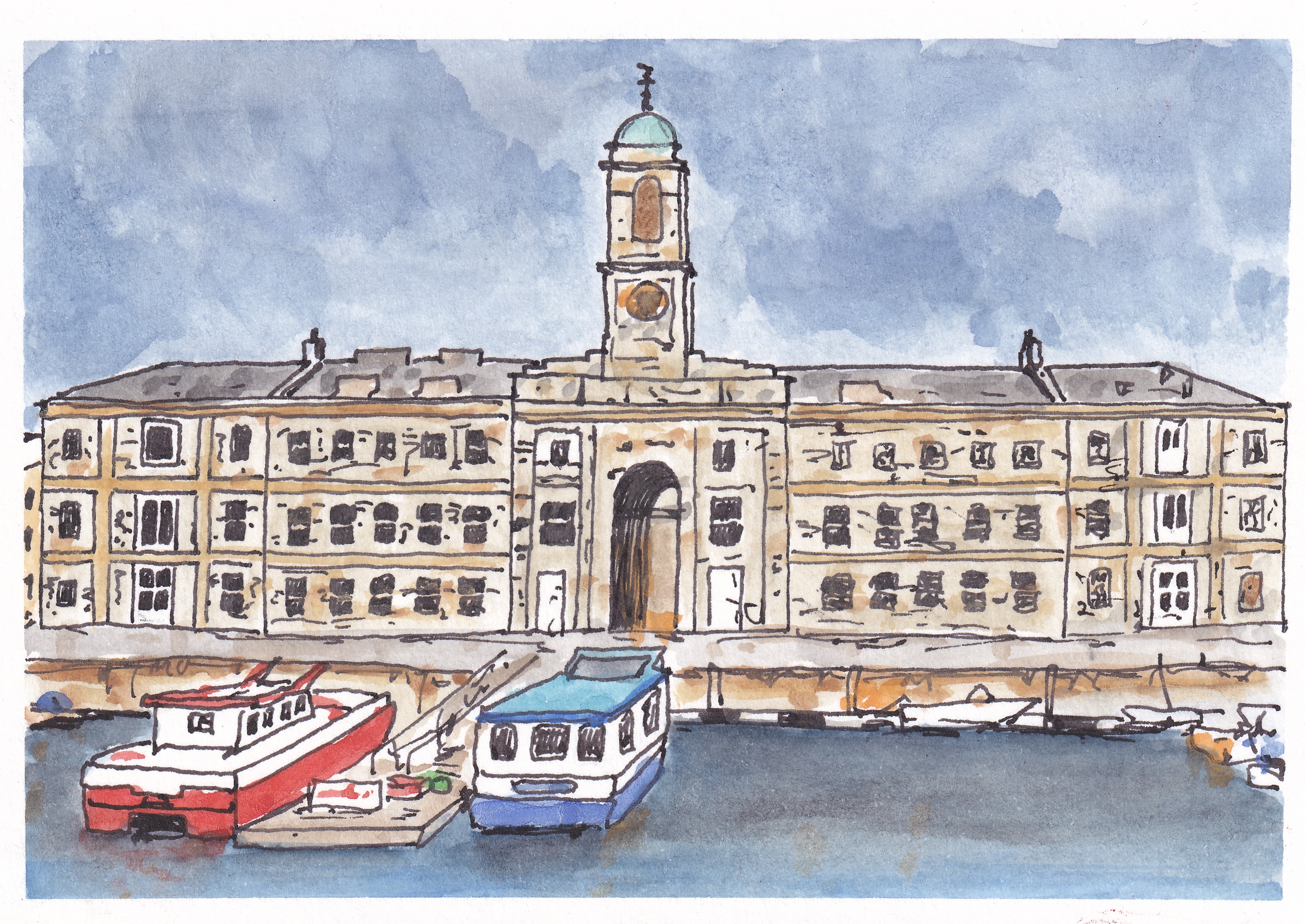
After painting a fairly new building, it was time to visit a much older one with a ffront-on view of one of the main buildings at the Royal William Yard, formerly the victualling yard for the Royal Navy but now a home for swanky apartments, restaurants, various studios and art spaces, and a cinema. I think this is one of my favourites from the series…
Royal William Yard, Plymouth
Then, it was back to the city centre for a picture showing the Charles Church, bombed in the Second World War and left in its broken state as a memorial to lives lost. Behind it, the angular exterior of the eastern end of the Drake Circus Shopping Centre forms an interesting backdrop which was surprisingly challenging to paint…
Charles Church and Drake Circus Shopping Centre, Plymouth
For my sixth Plymouth Postcard, I took a trip down to the Barbican area of the city for a view of the Plymouth Gin Distillery on Southside Street. It was difficult to get the perspective of the curved road right but I think I have just about managed it…
Plymouth Gin Distillery, Southside Street
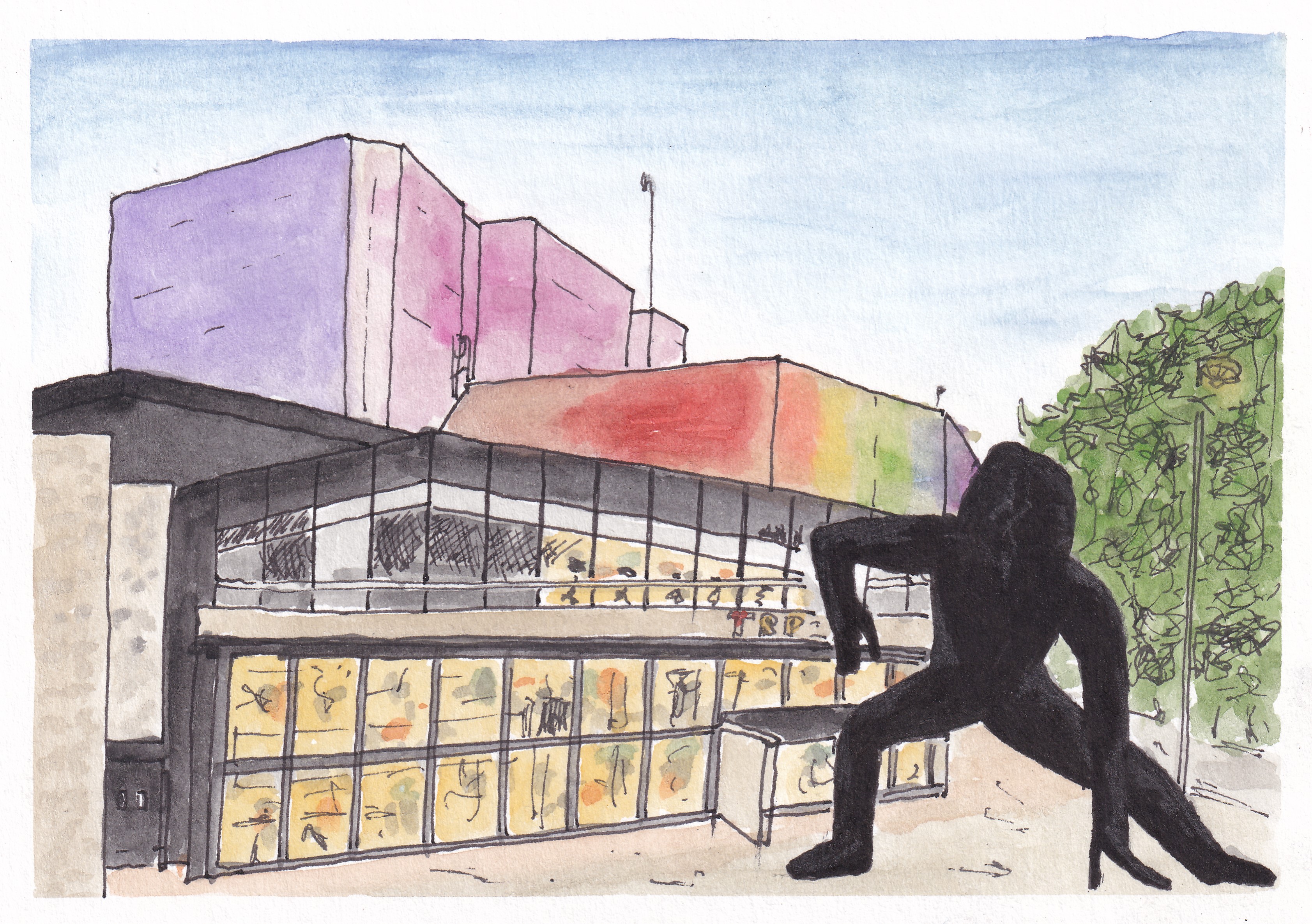
It was time to get a bit ‘arty’, so my next picture was of the interestingly illuminated Theatre Royal, with the imposing form of the statue ‘Messenger’ in front of it. I think that I did pretty well with the theatre itself, and the shape of the statue isn’t too bad, but my initial attempts to shade its dark form resulted in it looking like a hairy gorilla, and so I coloured it black with a permanent marker to try to salvage the picture. Unfortunately, this was only partially successful and I think I would have to describe this one as something of a ‘fail’…
Theatre Royal and ‘Messenger’, Plymouth
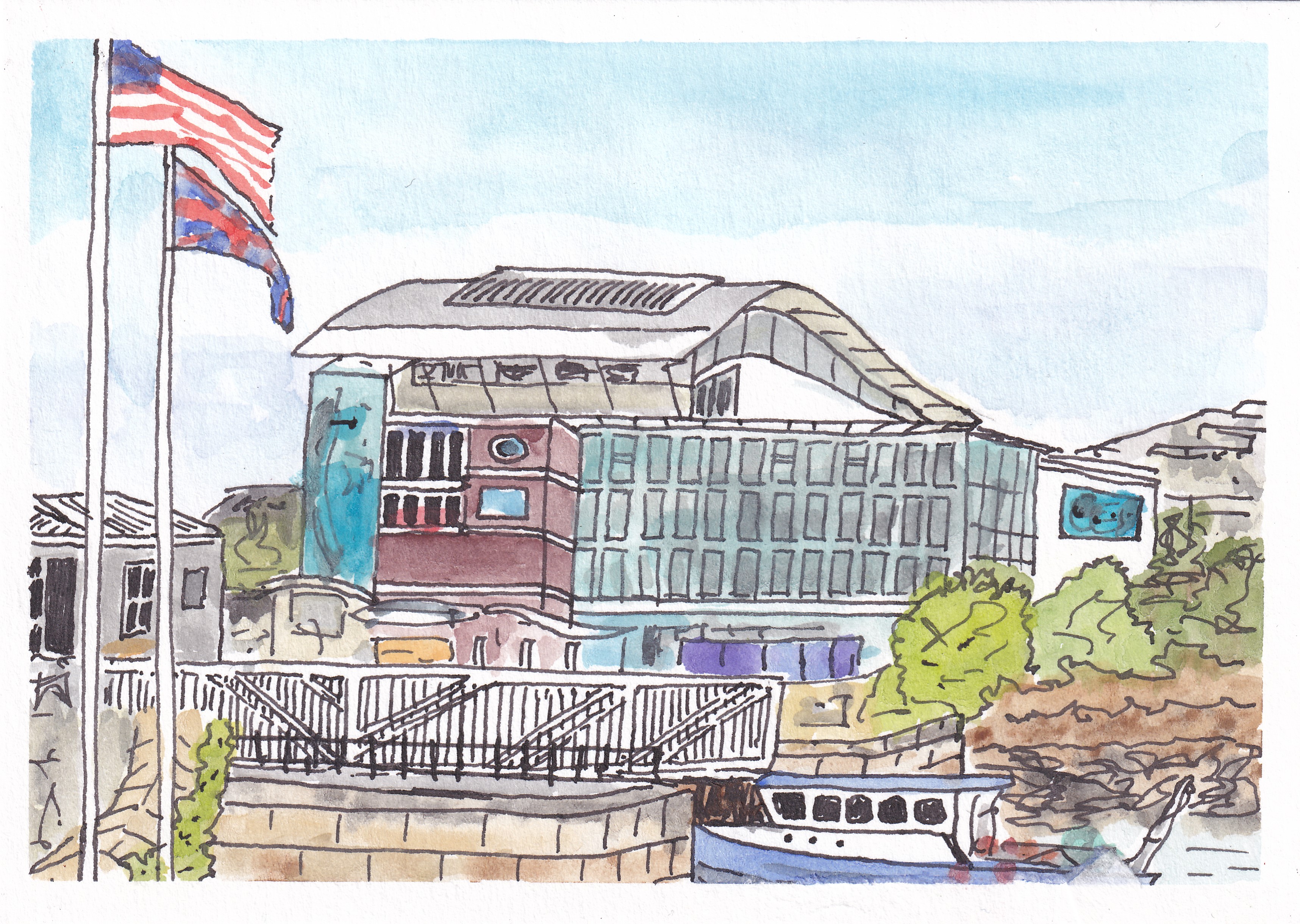
Painting number eight took me back to Sutton Harbour, this time looking across the swing bridge towards the Fish Market on the far left and the National Marine Aquarium, with its wavy roof in the centre. I’m please with the way I captured the blue colour of the windows and the advertising poster on the left of the building, and I like the foreground detail of the boat and bridge. Sadly, my attempt at a Union Jack flag was not quite so successful and the flag of the USA seems to have lost its stars…
The National Marine Aquarium, Plymouth
My ninth picture took me to very familiar territory, with a view of the old turnstiles at Home Park, home of Plymouth Argyle Football Club…
Home Park, Plymouth Argyle Football Club
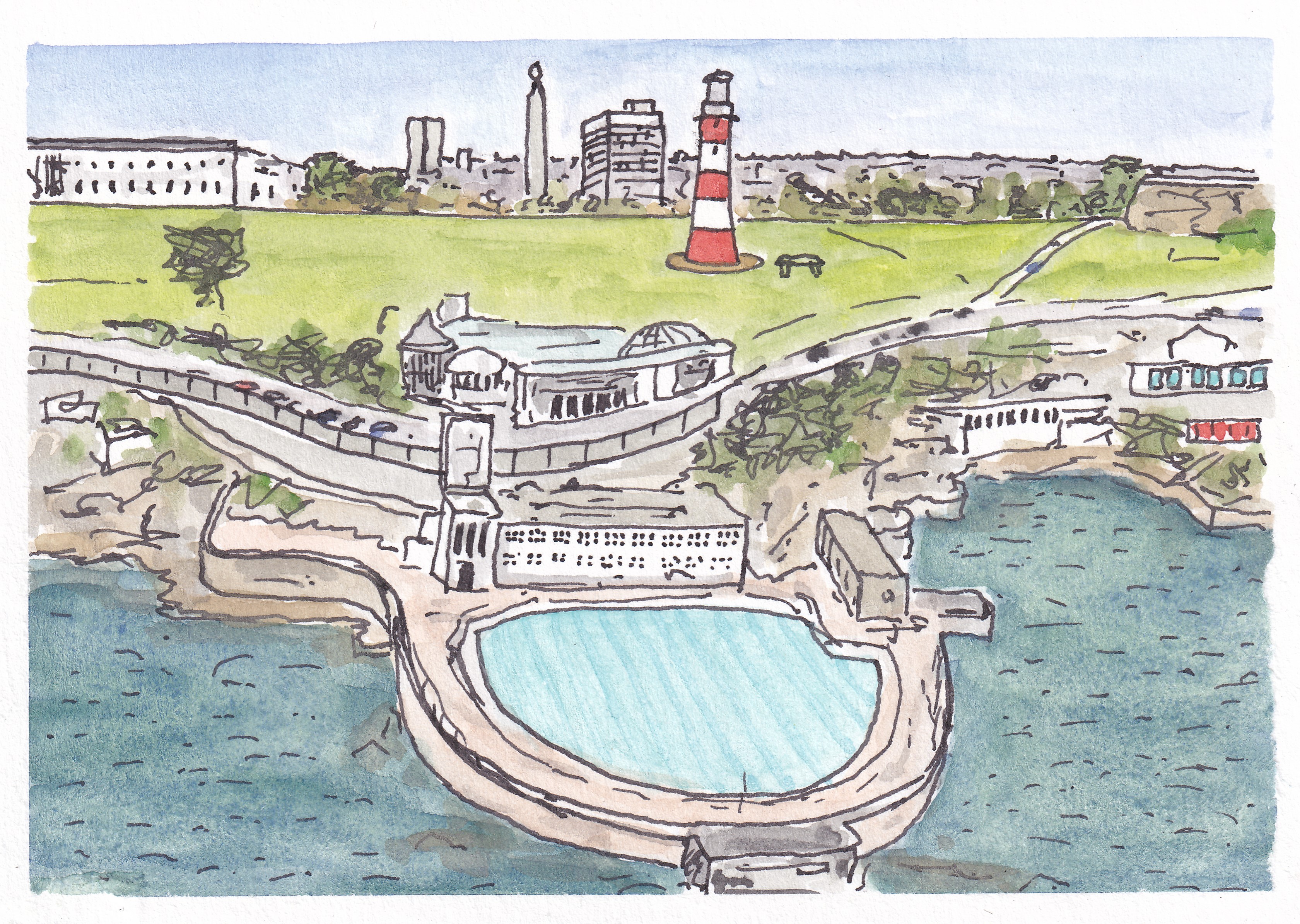
… and then it was back to the waterfront with a view of the art deco Tinside Lido with part of Plymouth Hoe, Smeaton’s Tower and the war memorial in the background…
Tinside Lido and Plymouth Hoe
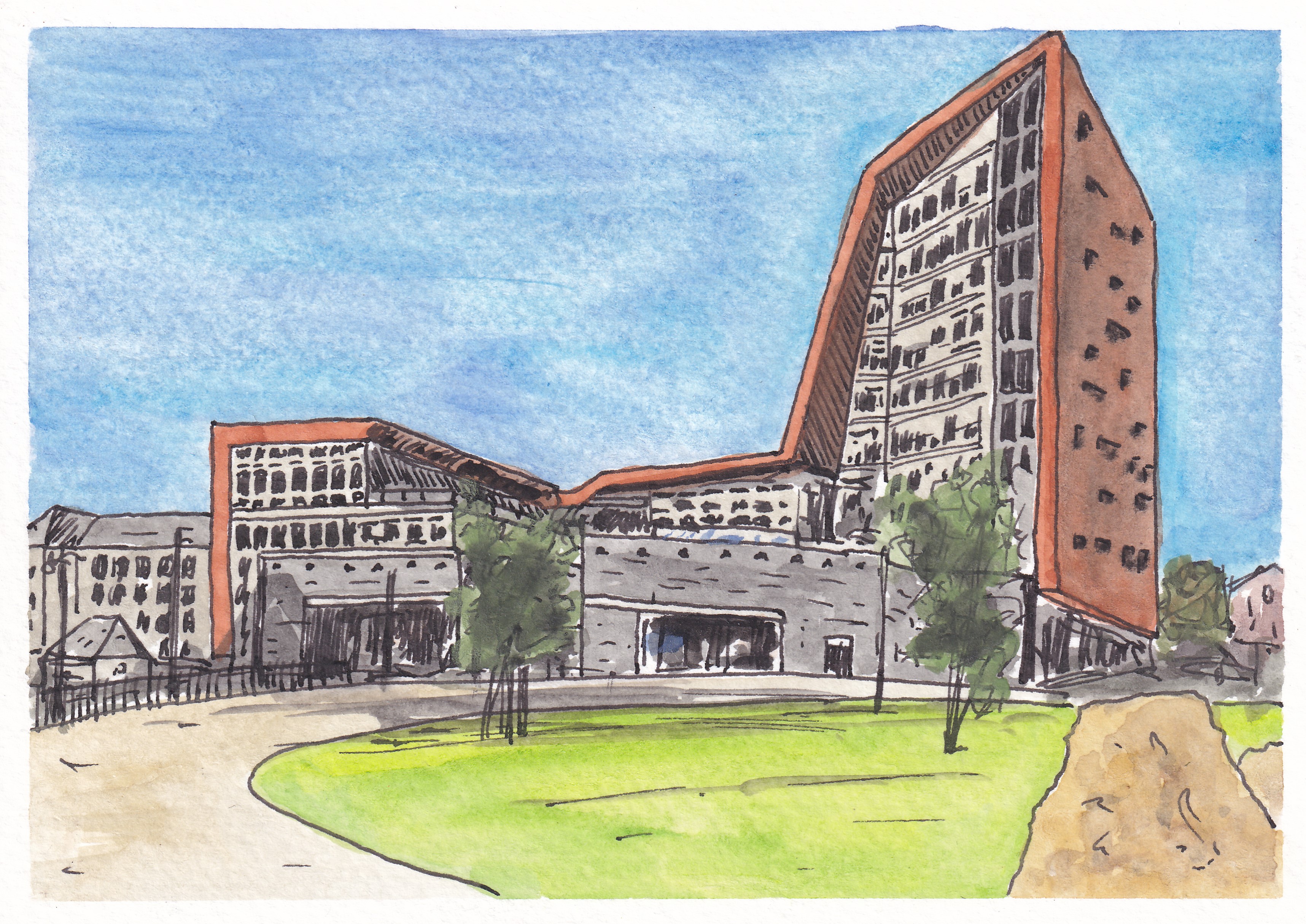
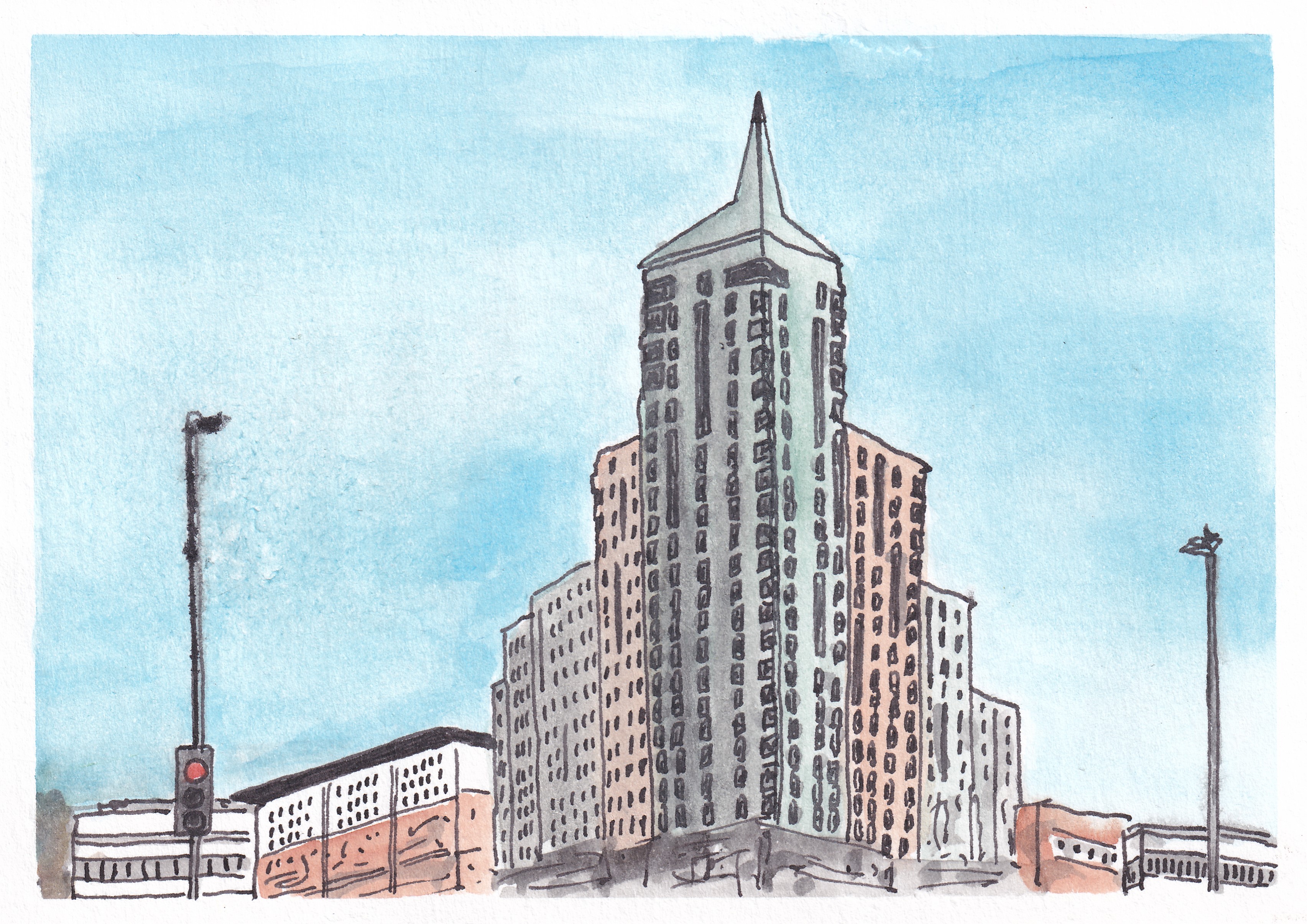
I finished my series with two pictures of contrasting buildings. First up was the Devonport Town Hall and Column, with the oddly coloured and spectacularly fronted (and named) Odd Fellows Hall on the right. Finally, my subject was the sharply-topped, and so highly appropriately named, Beckley Point (a Hall of Residence for students in the city). This is, apparently, the tallest building in the southwest of England (although I don’t know what is being counted as the southwest in this case)…
Devonport Town Hall and Column and the Odd Fellows HallBeckley Point Hall of Residence, Plymouth
This was a fun series to do, taking 17 days to complete, and overall I was pleased with the results of my efforts. It was interesting to try to capture some of the more striking buildings and views that Plymouth has to offer, particularly as it is generally regarded as an architecturally bland and unexciting place (largely as a result of the fact that much of the city centre was flattened by bombing raids in the Second World War).
I am sure that I will do plenty more paintings of Plymouth views in the future, but I think this set forms a good initial collection, showcasing some of the different areas and places of interest in the city nicely.
You have used me as you wish to have your fun, scrabbling roughly on the pockmarked surface of my skin, climbing high to turn your face towards the sun. You scrape your boots across me to remove accumulated soil, and carving your initials in my surface, give little thought to what you spoil. You have taken from me what you need using iron picks to gouge out fragments, thinking that you caused no pain because you saw no sign I bleed. You turn your eyes towards me and see only solid rock, looking down upon my dumbness, laughing as you mock.
By day, as you approach from the grassy slope below, you start to notice many shapes of things you know. You see an outline that reminds you of a faithful hound, you watch it shift as you move forwards, then it’s gone without a sound. You turn to view a castle, but no soldiers move for they have fled. You move your head to shape a profile – only then you see the witch’s head. You trace out furrowed brow, hooked nose and jutting chin; you feel grey eyes look through you, and you shiver as an evil spell takes hold within.
At night, in your imagination, led by an unheard call, you see me rise up from my station as I yawn and stretch so tall. You hear the distant thunder of my steps as I march the slowest beat. You sense vibrations deep below, the trembling ground beneath my feet. You are frightened of my power, as I tear the earth apart. You are petrified, turned solid, as the terror grips your heart. You are fearful that I come at last to take what I am due. You sense that it is time. And you are terrified that I am hunting, hunting now for you.
But none of this is true, for all that you see, and everything that you imagine, has been shaped by the stories you were told, and what they let you do. Those imagined forms, the wild thoughts, and all the feelings they produce may seem fantastic when compared with what is in your normal view. So, what is the truth? If only you knew…
I was formed from countless tiny pieces that began as dust, mixed together in her bowl, baked by her heat to form a crust. I was once pressed tight together as I found my solid form, extruded by her shuddering contractions, melded in her womb so warm. I have rested for so long as if I have no task, snuggled by her mossy blanket, wrapped protectively within her grasp. I have waited patiently for several million years, cooled by her gentle whispers, washed clean by her falling tears.
For your time is not all time. Your whole existence is the smallest fraction of my life. This place was mine so long before you came, and will remain my home for even longer once you die.
And your space is not all space. Your whole world is like a single speck of the quartz that shines within the substance of my form, just one of countless millions of specks, all of which are mine.
And your thoughts are not all thoughts. Your thoughts are small and they are fleeting, and so they rarely bend. You are constrained by what they choose to tell you. There is so much you cannot comprehend.
And your life is not all life. Your life is short, and it is fast, and so it limits what you try to claim. You cannot grasp the unfamiliar. You are bound by the rules that shape your game.
Believe me, I do not lie. I do not speak to garner fame. For beyond all that you can see, and everything that you imagine, are stories to be told and things to see that far expand your frame. You may think you are the only one who holds within a spark, but that is falsehood as we share that conscious flame. I too am alive, and Rock Giant is my name.
(c) Tim O’Hare, August 2023
ROCK GIANT: The last few walks that we have done have been on the familiar territory of Dartmoor, taking in one or more of the rocky tors that sit atop many of the hill summits. These enormous piles of granite slabs are the remnants of old volcanoes, material pushed upwards from the upper mantle almost 300 million years ago. I find it impossible to visit a tor without seeing the profiles of faces in the shapes made by the great piles of rocks, or imagining that the rocks are the tip of a toe, an elbow or some other part of a huge stone giant asleep beneath the ground. And then, in a natural progression of my thoughts, those rock giants begin to stir. I am not at all sure why, in the poem, I imagined the rock giant as a threat. My instinct is that they are, in fact, very gentle and friendly creatures. But, of course, I will never really know, because they still have much sleeping to do before they awaken.
Some time ago (by which I mean years, not weeks or even months), well before I had finished writing the final draft of my children’s adventure story Empedocles’ Children, I had the idea for another children’s book – The Time Crackers. Empedocles’ Children ended up as a fairly weighty tome, coming in at around 110,000 words and (probably) best suiting readers towards the upper end of what is termed ‘middle grade’ (ages 8-12). I hadn’t particularly aimed it at that reading level, it just turned out that way, but for The Time Crackers, I felt that the story would connect best with slightly younger children, and decided that I would make a conscious effort to keep the chapters short and ensure that the story was snappy and moved along at a good pace.
Without giving too much away, the basic premise of The Time Crackers centres around two children who discover a portal through which they shift to the same location but at a specific time at which an important (real) historical event takes place there. They are able to move back and forth between the historic and modern time periods (as long as they keep hold of the ‘key’ of course, which is tricky when they don’t even know that one exists…). Then, while they are in the historical setting, they get caught up in an adventure that requires them to solve a coded puzzle which then leads them to take action to ensure that the history unfolds as it should do.
At the outset I had the basic premise of the story, the location and its associated historical setting and event, and an idea for the initial incident that brings the two children to discover the time-crossing portal (the setting is Plymouth and the historical setting is the late 16th century so you can probably guess the historical event!). I also had the idea for a second location, and an association with a completely different historical period, and so I can quite imagine that by the time I have finished it, The Time Crackers will have become The Time Crackers 1:….., the first story in The Time Crackers series.
I started writing the first chapter of The Time Crackers (‘Flashback’) at least a year ago (probably more) and managed to add two more chapters (‘The New Girl’ and ‘Target Practice’), reaching the point in the story where the two children, Jim and Mols, have been introduced (to the reader and to each other), we have got to know a little bit about Jim, his character and his home set-up, and things were nicely set up ready for the trigger incident that leads Jim and Mols to discover the time portal. But then, as is often the way with me, things ground to a halt as I got busy, diverted my attention towards other creative projects (such as my discovery of painting 14 months ago), or just succumbed to the chronic procrastination that is the bane of my life. Whatever the reason, the ability to sit down and write new words eluded me…
… until yesterday, when, without too much effort, I finally opened and re-read Chapter 3, decided that it was essentially complete and then found that sentences were emerging in my brain and flowing smoothly to my fingers and then onwards onto the screen as I launched myself into Chapter 4 (‘Noises In The Dark’). The result was that after about 30-40 minutes I had harvested the next 800 or so words of the story, and in the process, advanced the story almost to its pivotal moment, the accidental discovery of the time portal. That moment deserves to be the focus of Chapter 5, but before I can find out exactly how events unfold, I need to go back into Chapter 4 and flesh it out with another an additional few hundred words so that it balances the length of the previous chapters a bit better. I had been hoping to do that today, but alas, I managed to divert my attention into other projects instead. I am not sure whether this was a piece of deliberate self-sabotage, my brain opting not to even try to write just in case the well had run dry, or whether it was just the way of things. What I do know is that I really would like to press on with writing this story, because I am excited to see how it unfolds and to discover what thrills and scrapes Jim and Mols get themselves into as they try to solve The Mystery of Drake’s Drum.