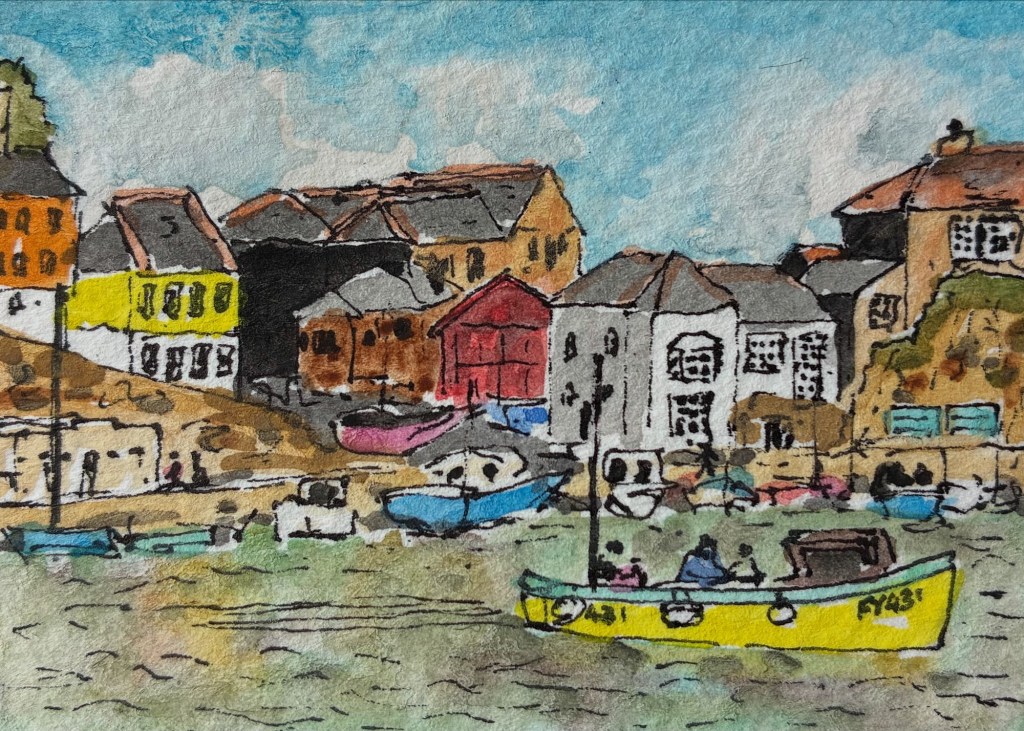
I painted this little watercolour picture of Mevagissey harbour back in June. I was looking to paint a picture to use for a birthday card for the son of one of my wife’s best friends, and brother to one of my elder daughter’s closest friends (by which I mean that the son was also the brother!). As it happened, a couple of months previously, his mum had seen some of my pictures when visiting our home, we got talking about art, and along the way she told us how he had surprised her by saying that when he finally got his own place to live (he’s in his mid/late 20s) he wanted to have pictures of two places that were special to him – Pew Tor on Dartmoor, close to their home in Tavistock, and Mevagissey in Cornwall.
As the date of the birthday approached I started to think of painting one of my ‘special place’ pictures for his card. The trouble was, I was faced with a choice, and anyone who knows me well will know that one thing I am not good at dealing with is choice. It’s tempting to think that choice is a good thing, and I am sure that I would say that I’d prefer to always have a choice than not, but in many ways I’d find life a lot easier if there was a little creature sitting on my shoulder, or tucked into my sleeve, whispering to tell me what to do all of the time.
Should I paint Pew Tor or should I paint Mevagissey?
I’d painted a larger picture of Pew Tor back in early March and knew that I could produce something smaller but similar that would work as a birthday card. I’d also painted various places in Cornwall as part of my Cornwall Landmarks Miniature Watercolours Series. But I’d never tackled Mevagissey… So, one morning I took a small piece of watercolour paper, performed a quick Google search for a suitable photograph, and set to work.
I like the results of my effort – the painting that introduces this post. The picture I chose was a fairly busy scene, with the quayside at Mevagissey backed by all kinds of interestingly shaped and coloured buildings, a host of colourful boats moored at the water’s edge, a pair of rather striking light-blue benches towards the right of the scene, and the bright yellow fishing boat pulling out confidently towards open waters. It was a picture that provided lots of splashes of colour that give the painting a nice sense of aliveness I think.
But, in the end, it was Pew Tor that won the mental tug-of-war that was taking place inside my head. I put my little Mevagissey picture, really just a test piece, to one side, and opted instead for the Dartmoor ‘special place’ rather than the Cornish one. If you are reading this soon after it was originally posted (on 9th September 2025) and want to see the Pew Tor picture that I ended up using, then you’ll just have to visit this site again in a few days time… because if all goes to plan I will post it here soon. For now, you’ll just have to enjoy a quick trip to Mevagissey – a perfect example of the many picturesque little harbour towns that line the southern Cornish coastline.
In the early months of this year I read and heard several references to a soon-to-be published book: Wild Courage by Jenny Wood. My interest was piqued further after I viewed a Livestream of an episode of the podcast ‘A Productive Conversation‘, in which the host, Mike Vardy, chatted with the author about her book (A Productive Conversation: Episode 611 – Jenny Wood talks about wild courage and fearless self-advocacy). I duly ordered the book and began reading it soon after it arrived on my doorstep, optimistic that it was going to be an interesting and enjoyable read.
Wood’s basic idea is that in order to progress we need to have courage – to push through fear of the unknown, fear of discontent, fear of failure and fear of judgement by others. She argues that successful people feel, but put aside, all of this fear, becoming their own strongest advocate, and having the courage to take whatever steps are necessary to advance towards their goal(s).
The distinctive feature, or twist, in Woods espousal of this feel the fear and do it anyway approach to life is that she identifies nine traits that generally hold negative connotations, and then recasts each of them as a type of courage that the reader is encouraged to develop and deploy. The nine traits, and their associate courage, are as follows:
WEIRD – the courage to stand out
SELFISH – the courage to stand up for what you want
SHAMELESS – the courage to stand being your efforts and abilities
OBSESSED – the courage to set your own standard
NOSY – the courage to dig deeper
MANIPULATIVE – the courage to influence others
BRUTAL – the courage to protect your time and energy
RECKLESS – the courage to take calculated risks
BOSSY – the courage to listen and lead
I don’t think there’s anything wrong with this approach, in fact I think it provides an interesting route into thinking about this territory…
(can you tell that there’s a but coming?)
…but what I wasn’t expecting from the book, and what disappointed and annoyed me as I read it, was the way that at every turn Wood focused on deploying all of this courage in one area only – career advancement and promotion – so much so that I was left feeling rather battered by the notion that this is the only thing that really matters in life.
At various points in the book I found my anger rising as Wood gave precisely the kind of advice that I detest. For example, in Brutal she instructs readers to ‘let the tree fall‘, i.e. to skip ‘unimportant’ tasks quietly. She suggests that ‘if they’re actually necessary, they’ll come around again, and you’ll have been busy doing unambiguously important work in the meantime.‘. To this I say ‘no, no, no‘. There is nothing more annoying than colleagues who fail to respond to simple requests for information citing the ‘if it’s important I’ll be asked again’ line of reasoning… It’s selfish, inefficient, and plain and simply rude; it says to the person who has sent the request that their time is not important and that it is yours to waste. No, just respond to the request promptly and don’t force people to keep track of your lack of response and to ask twice, or however many more times it takes to rouse you out of your own little world… [rant over]
I also found Wild Courage to be guilty of over-using the ‘personal story’ approach to illustrating the points that were being made. Perhaps some readers like this kind of thing. The odd personal story is fine, I think, but please sprinkle in a few from different scenarios, different worlds, other people etc., so that not every example is drawn from the world of working for Google.
In the end, I found myself frustrated by my reading of Wild Courage. It’s not that the approach and the ideas contained in the book aren’t valid. In the end, the courage that might stem from embracing each of the ‘negative’ traits can be expressed in a nice, succinct and positive manner that has much wider application that career advancement simply by putting the word courage to one side in each phrase. Then, the lessons that flow from those nine traits become a simple set of instructions:
stand out
stand up for what you want
stand behind you efforts and abilities
set your own standard
dig deeper
influence others
protect your time and energy
take calculated risks
listen and lead
which to my mind is a whole lot easier to absorb and a lot more useful than getting caught up having to justify the adoption of those negatively associated words, spinning the idea of courage out of them and suggesting that there is something a little wild about doing so. And what’s more, it’s a set of instructions that is clearly applicable to almost every aspect of life and not just the narrow, corporate-career-focus that Wood chooses to target.
Over the last couple of months I have been gradually gearing up to start trying to sell some of my artwork. Obviously, I am not thinking that there will be crowds flocking to part with their hard-earned money to the extent that I might become rich through my artist endeavours. Rather, people who see my pictures often pass comment that they think I could sell them, and the inquisitive part of me thinks that it will be interesting to find out whether that is true, and if it is, which pieces of my output people like enough to pay for. [Okay, okay – I admit it – I’d also love to have the implicit praise and external validation that would come my way if my artwork attracted interest in this way… but I know that it’s far better for me not to get hung up on this aspect of things and, instead, to focus on simply enjoying the process of creating art and then allowing it to leak out into the world.]
So far, my art selling has only gone as far as listing prints of my Dartmoor Stone Circle painting on eBay (two copies sold, albeit to the same buyer, in almost four months…) and, more recently, to set up an online shop on Etsy. In this shop I have listed my Dartmoor Stone Circle print (one copy sold) and lots of different Greetings Cards based on some of my miniature watercolour series: Dartmoor Scenes, House Plants, Capital City Landmarks, Cornwall Landmarks and Exmoor Views (of which I have sold the grand total of two: one of ‘The Forbidden City, Beijing’ from my Capital City Landmarks series and one of ‘The Roundhouse Gallery, Sennen Cove’ from my Cornwall Landmarks series). Clearly, it is slow going, partly because I need to master the art of marketing and try to drive some traffic to the shop, but also, because I doubt that there are many people shopping online for greetings cards of random places or plants! Nevertheless, it was a bit of a thrill when my phone pinged to tell me that these sales had been made..
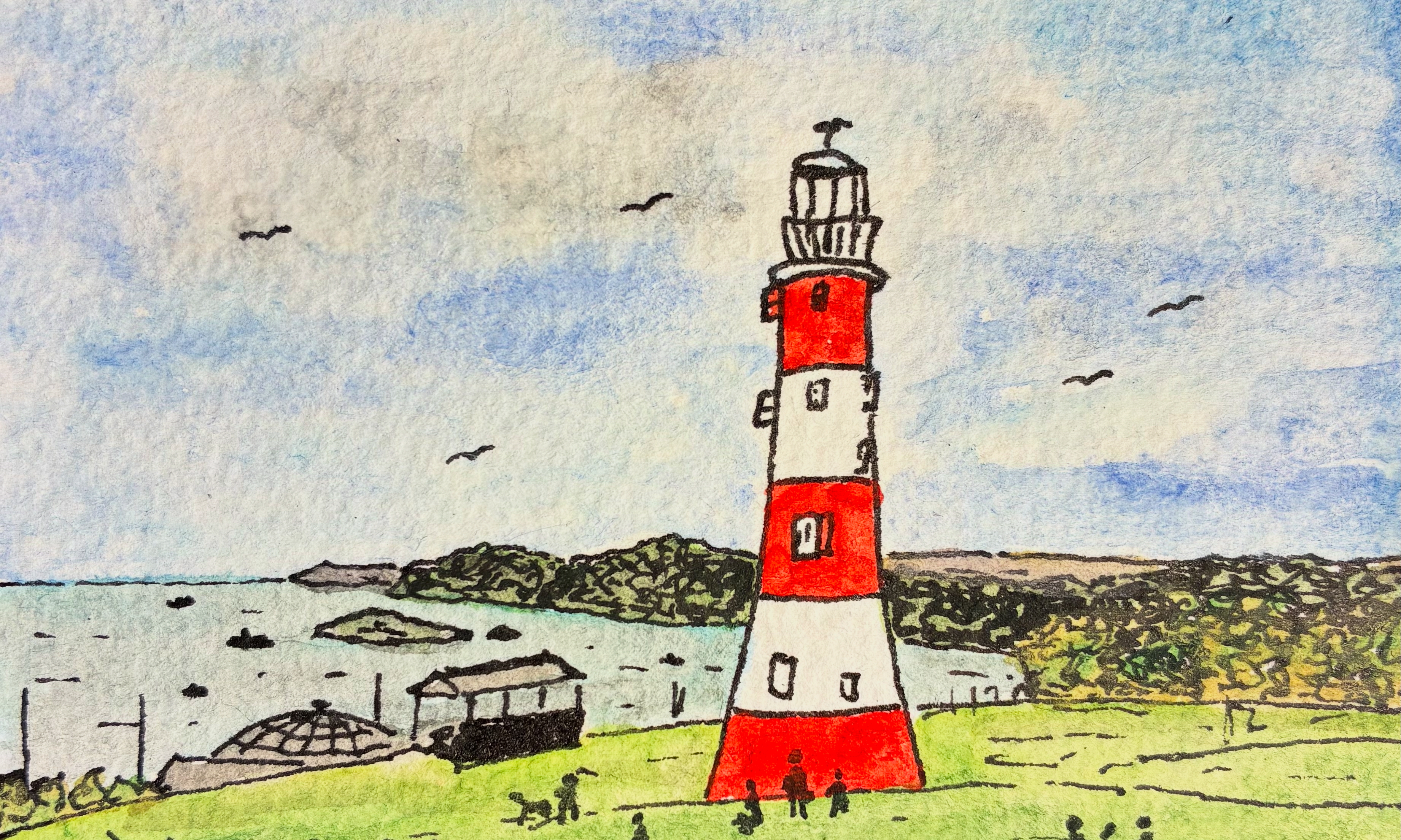
One of the things that I wanted to make sure of before I launched my online shop was that I had all of my art-related points of contact joined up nicely. To that end, I managed to get hold of an email address and accounts on all of the major social media sites (Instagram, X, Bluesky, Facebook, Meta) that matched the name of my etsy shop (@timohareart). To help with future networking and promotion activities, I designed some business cards to convey all of this information to anyone interested. For these, I decided that I would paint a picture of Plymouth’s most iconic landmark, Smeaton’s Tower, with Plymouth Sound and Cornwall in the background to use on the front of the card. It took me several attempts to set up the picture so that I could add the name of my art ‘business’ without the text crossing the darker parts of the picture and that could be cropped nicely into a circle for use on the back of the card and on my social media accounts. The picture at the top of this post is final version.
The final form of the business card is shown below (front and back)…
… and just in case you’re reading this and are tempted to explore a little more, here are some direct links:
(Instagram is probably the best social media site to see all of my artwork as I produce it, but you can find my art via the same social media handle on the other sites, although these are not all updated to the same extent.)
I read Revelation, the fourth title in C.J. Sansom’s Shardlake series during April and May 2025. As with the other books in this series, it is quite a weighty tome and follows the lawyer Matthew Shardlake and his general assistant Jack Barak as they investigate another peculiar set of crimes during the reign of King Henry VIII in early 16th century England. The previous book in the series, Sovereign, had seen Shardlake travelling north to York, but Revelation returns the action to the rapidly expanding, crowded and evidently crime-ridden city of London.
Initially, Shardlake finds himself caught up in the investigation of a single, macabre, murder of a legal colleague friend. However, it soon becomes apparent that the murderer is working through the seven prophesies of the Book of Revelation in the bible as more bodies, brutally killed in ways that match the prophesies, are uncovered. As Shardlake’s investigation unfolds and they second-guess the murderers next moves and race to neutralize them, Shardlake comes to realise that he is also very much at threat, adding an extra dimension of urgency to his searches. This is added to by concerns that the crimes have the potential to impact at the highest level, drawing Henry VIII’s future wife Catherine Parr into peril. Along the way, Shardlake spends a lot of time working to free a young man from Bedlam, rekindles his love for an old flame (the wife of the first victim) and Barak becomes ever more distant from his new wife Tamasin, who he first encountered in York while helping investigate the crimes described in the previous book, Sovereign, after the death of their young child.
I remember really enjoying the first book in this series, Dissolution, and I have enjoyed the rest of the series too, but I feel that, perhaps surprisingly, rather than growing in strength as the characters mature and settle into their fictional world, the stories have become progressively weaker with each title. The introduction of the more personal, relationship-base activities of the main characters seem to be rather forced and somewhat out of character, and after making a significant impact in the first two books, Shardlake’s physician friend Guy, potentially the most interesting character of all, seems to have become rather sidelined.
Despite its weaknesses, I still felt that Revelation provided a fairly gripping historical adventure yarn with plenty of twists and turns, and I will certainly continue with the series in the future.
What is blue and is whatever it is the same for me as it is for you? A scientist might state that blue describes:
‘colours perceived by humans observing light with a dominant wavelength between approximately four-hundred-and-fifty and four-hundred-and-ninety-five nanometres‘,
which may well tell us how blue can arise – in the human mind, when a certain type of electromagnetic radiation enters the eyes. But this does not, I think, tell us what blue really is. For how can we be sure that the imagined colour that my mind selects, in its constant rush to paint upon its ever-changing canvas, comes from the same small pan into which you dipped your brush?
You can say that blue is the colour of the sky (by day at least), or of the vast expanse of open sea (mostly), or the shirt worn by the best team (certainly not). But what if you see all of those as I see green? (Well then we would agree – those shirts belong to by far the greatest team the world has ever seen).
So what is blue to me, or to you?
To complicate matters further… ‘blue’ could refer not to colour but, rather, to the tone of my thoughts. But if I tell you that just now the thoughts inside my head are blue, how do you know whether I am simply feeling a little down on my luck, or whether my mind, unleashed, is filled with images of a naked couple…? Again, we come unstuck.
We must agree then, I think, to put aside all ambiguities, and to take the definition, with all of its nanometres, at face value. Then we can label the sky as blue and the sea as blue, we can assume my mood is melancholy even if it is really full of sauce, and we can move on (although, we will never agree about those shirts of course).
(c) Tim O’Hare, September 2023
BLUE: I’m not entirely sure where the idea for this poem came from but I guess I just liked playing with the words and the rhymes and bringing together some threads from different aspects of my life – science, perception, atmosphere, ocean, sports.
A revised version of this poem was published in Issue 16 (March 2024, ‘Colour’) of Consilience – an online Science Communication/Poetry journal. I’ve repeated it below for completeness…
What is blue and is whatever it is the same for me as it is for you?
A scientist might state that blue describes: ‘colours perceived by a human when observing light having a primary wavelength in the range four-hundred-and-fifty to four-hundred-and-ninety-five nanometres’, which may well tell us how blue can arise – in the human mind, when a certain type of electromagnetic radiation enters the eyes – but does not, I think, tell us what blue really is. For how can we be sure that the imagined colour that my mind selects in its constant rush to paint upon its ever-changing canvas comes from the same small pan into which you dipped your own brush?
You can say that blue is the colour of the sky (by day at least) or of the vast expanse of open sea (mostly) or the shirt worn by the best team (certainly not). But what if you see all of those as I see green? (And then we agree those shirts belong to by far the greatest team the world has ever seen).
So what is blue to me or to you?
To complicate matters further… Blue could refer not to the colour of a sight but, rather, to the tone of my thoughts. But if I tell you that, just now, the thoughts inside my head are blue, how do you know whether I am simply feeling a little down on my luck or whether my mind, unleashed, is filled with a tumble of racy thoughts? Again, we come unstuck.
We must agree then, I think, to put aside the ambiguities and to take the scientist’s definition, with all of its nanometres, at face value. Then we can label the sky as blue and the sea as blue; we can assume my mood is melancholy even it is really full of sauce; and we can move on (although, we will never agree about those shirts of course).
Back in early June it was the first anniversary of the wedding of my elder daughter (K) and wanting to find a unique and personal gift to mark this occasion I set about thinking of some kind of art-related present for the pair of them. I thought about painting a scene from one of their wedding photographs, but my attempts at including recognizable people in my pictures so far have not proved to be very successful, and so I quickly ruled that possibility out. I thought about painting a ‘standard’ picture of some kind, but it wasn’t that obvious how to select a scene that carried some relevant meaning – a view of the Park Bar on the Reading University campus (where they first met) didn’t really appeal and, in any case, that would have taken me back into ‘people problem’ territory again.
Instead, I decided to try out an idea I had a few months ago when I came across some small wooden boxes for sale at bargain price in the shop The Works. These little square boxes, about 6cm across, were almost exactly the same size as the miniature watercolour pictures that I often paint, and it had occurred to me that it would be neat to pop two such pictures into a box so that when it is opened the two pictures are revealed. Putting this idea together with the upcoming wedding anniversary it seemed like a natural fit – to celebrate the matrimonial joining together of two young people with a little box bringing together two pictures – one related to each person.
After a little more deliberatrion, I decided that the two pictures would show the places of origin of the two halves of the happy couple. In my daughter’s case this was the city of Plymouth, a familiar theme for my paintings, and for her now husband (H) I chose a view of Horsley Towers, a rather grand, gothic building that is the dominant landmark in the village of East Horsley in Surrey where he grew up.
Having painted the two miniature pictures and fixed them carefully to the base and lid inside the box, all that remained was to personalize the front of the box with their initials, package it up and drop it in the post to them.
I’m glad to report that they loved their little box of pictures. It’s obviously nothing grand or expensive, but I think the best gifts are those that have a personal touch and are the product of some dedicated labour.
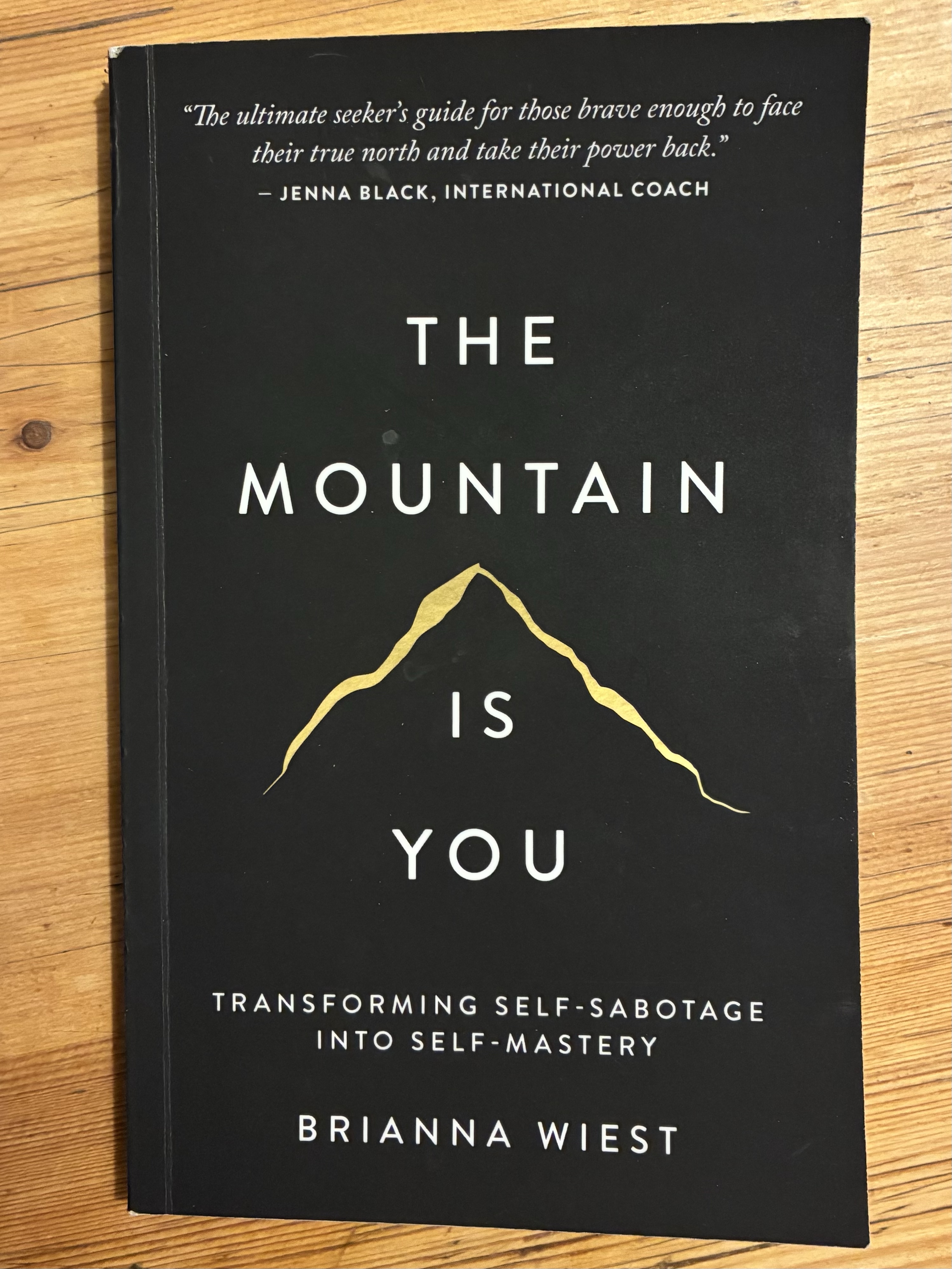
The Mountain Is You: Transforming Self-Sabotage Into Self-Mastery by Brianna West is probably not a book that I would have picked up to read of my own accord, despite that fact that I am pretty much certain that a lot of the struggles I have in pushing myself into action and gaining the sense of achievement and fulfillment that I crave are driven at a fundamental level by self-sabotage in one form or another. There is just something about the whole mountain metaphor, along with the kinds of words used in the book blurb that I read online (‘deep internal work of excavating trauma’, ‘building resilience’, and ‘adjusting how we show up for the climb’) that instinctively put me off. Why then did I work my way through this book for a few weeks in April and May this year? Because it was voted as the reading matter for the May meeting of The Timecrafting Trust Book Club that I participate in, and so, dutifully, I ordered myself a copy and set to work.
Almost from the start, I realized that there might well be a bit more value for me from The Mountain Is You than I had envisaged. I was immediately stuck with some obvious similarity between some of the content being covered and the ideas of psychotherapist Carl Jung that I found enthralling and thoroughly convincing when I read James Hollis’s excellent The Middle Passage a year or so ago.
Wiest begins her book by describing the various forms that self-sabotage can take along with the underlying reasons why each type of self-sabotaging behaviour occurs. There were quite a few lines in this section of the book that resonated with me…
‘sometimes, we sabotage our professional success because what we really want it to create art‘
‘sometimes, our most sabotaging behaviours are really the result of long-held and unexamined fears we have about the world and ourselves‘
‘human beings experience a natural resistance to the unknown, because it is essentially the ultimate loss of control‘
… because yes, I do increasingly seem to be seeing myself as an artist, yes, I definitely have a lot of fears squashed down into my head that hold me back, and yes, I do tend to get overwhelmed and feel very uncomfortable when I perceive that things are spinning out of my control. But why then, knowing all of this, does nothing much really seem to change? Wiest delivers the killer answer:
‘most people do not actually change their lives until not changing becomes the less comfortable option‘
Wiest goes on to argue that, in fact, we might be better off re-framing self-sabotage because, ultimately, the habits and behaviours associated with it are actually a result of your very clever subconcious ensuring that some unfilled need, displaced emotion or neglected desire is being met – that those actions are, in fact, deliberately designed to provide a positive outcome that some hidden part of your subconscious seeks.
Aand funnily enough, just this morning, quite coincidentally, I wrote in my journal that perhaps I allowed myself to procrastinate and hold myself back from taking certain actions even though I know this will result in an intense wave of frustration and anger with myself, because at least those negative feelings and emotions are something that I am familiar with and are, in some weird and twisted way, somewhat comforting.
The next section of The Mountain Is You describes a long list of different manifestations of self-sabotage, and whilst many of these did not feel relevant to me, some of them certainly did – hello Perfectionism, Worrying About Least Likely Circumstances, Being Busy, Fear Of Failure, to name a few.
The start of the process of overcoming self-sabotage begins, Wiest suggests, with tuning into, and listening to, the negative emotions associated with it – things like anger, jealousy, regret, chronic fear. She highlights a basic need to be able to ‘allow yourself to feel what you feel without judgement or suppression and notes that understanding your needs, meeting the ones you are responsible for, and then allowing yourself to show up so others can meet the ones you can’t do on your own will help you break the self-sabotage cycle’. For example, feel angry, notice that you are angry, understand why you are angry, remember that it is okay to feel angry… and then get on with life.
There are then a couple of chapters with fairly standard fare on building emotional intelligence and on letting go of baggage from the past, but as these progressed I could feel the book moving steadily into the kind of territory that my initial instincts had led me to expect. Then, aargh, I hit a section titled ‘Releasing your past into the Quantum Field‘ and my brain was instantly screaming at me that I was now thoroughly into pseudo-scientific mumbo-jumbo land… the kind of land where, apparently, ‘You store … emotions, energies and patterns at a cellular level‘. Now, I guess that in some sense everything associated with an individual human is stored at a cellular level, but I am pretty sure that Wiest is suggesting there’s something rather more mysterious and perhaps spiritual going on. I’d be inclined to simply say that statements of that kind are just nonsense!
I guess that from that point onwards, my brain was in a state of high alert, warning me, perhaps unfairly, that much of what I was reading had no real, solid basis. There were lots of nice, almost mantra-like phrases: ‘be willing to be disliked‘, ‘do your inner work‘ and a series of suggestions to ‘create aligned goals, ‘find you inner peace’, ‘detach from worry’, ‘take triggers as signals’, ‘honour your discomfort’, ‘stop trying to be happy’, ‘arrive into the present’ etc., but in the end it was all a bit too much – too many suggestions, too many affirmations, too many challenges to think about overcoming, with the result that I came away confused and somewhat disappointed. After a promising, really very readable first half, everything seemed to have unraveled as the book reached its conclusion. There was just nothing much that was concrete or tangible for me to cling onto.
Late on in the book there was one phrase that I rather liked in a section titled ‘Be aware of what you give your energy’, namely that ‘the wolf that wins is the one that you feed‘ and strangely, on the day that I read those lines some spoke almost the exact same words to me (perhaps that pesky quantum field was doing its thing…). In fact, the whole book is stuffed full of short phrases and sentences that you could lift off the page and incorporate into an inspirational poster or social media post if that is your thing. I may not have warmed to Wiest’s mountain metaphor or felt that the argument in The Mountain Is You hung together in a fully coherent and convincing manner, but she certainly knows how to write what might be called ‘soundbite sentences’. Forget all the gumph about releasing you past into the quantum field and storing emotions at a cellular level, and take this phrase, right at the end of the book… …
‘One day, the mountain that was in front of you will be so far behind you, it will barely be visible in the distance. But who you become in learning to climb it? That will stay with you forever.‘
I am the square peg in the round hole: jammed in, stuck fast, placed by youthful naivety, forced down by the weight of expectation, held in place by the pressure of life’s demands, and hammered home by the repeated blows of round pegs that, although appearing far too large to fill such a seemingly trivial space, are really too small to even touch the sides.
Yet, even in the tightest grip it is possible to wriggle and writhe – tiny movements that, though causing damage, breaks, and pain, gradually, imperceptibly, ease the bind. The needle must break the cloth to form the stitches of repair.
I am still the square peg, plugging the round hole, missing parts of my surface, diminished, and wearing hidden scars, but now I have worked my way loose. And though I cannot know the planes and slopes of the land that lies outside, I have seen it in glimpses, and I am ready to slide out, with freshly rounded corners, ready to roll.
(c) Tim O’Hare, September 2023
SQUARE PEG: This is another poem that came up on me out of nowhere and very fast. In some ways it is a direct continuation from my poem It Is Time, but whereas that poem is about recognizing that a point of arrival has been reached, Square Peg is more about being ready to start out on the next part of the journey.
Since I started drawing and painting back in April 2024 I have primarily worked with ink and watercolour paints, with my ‘go-to’ format being small, usually ~5cm square, pictures on some particular theme that I have chosen to explore for a few days. Producing pictures of that type has become my staple art activity, to the extent that I describe this as my ‘art practice’. However, I am constantly thinking about how I would like to explore different formats and work with different media. This especially happens when I visit an art exhibition, see works by other artists,and wonder what I could produce if I branched out a bit. The funny thing is that prior to my big shift into art in April 2024 I had actually begun to dabble with creating pictures with pastels (e.g. see my post Rediscovering The Artist Within) but I have not returned to pastels once since then.
Sometime back in May I must have been somewhere that brought me into contact with some charcoal drawings. I had a set of charcoal pencils sitting unopened in my art supplies box, and so I thought I would branch out a little and see what happened when I completed the drawing phase of a picture with charcoal, rather than adopting my usual approach of starting off with some faint pencil lines and then going all in with my black ink pen. I think I hoped that the different drawing texture might lead to me producing a more abstract picture. Then, after scribbling away with the charcoal pencil for a bit, I returned to the familiar territory of my watercolour paints to give my drawing some colour.
The result of my efforts is shown in the picture above – a charcoal -cribbles-with-watercolour painting of a row of what I refer to a ‘wall trees’, somewhere in the valley of the River Walkham, from a photo that I had taken on a walk there.
I’m not sure exactly what I think of this picture. It seems quite basic and simple – the trees sitting very much on top of the leafy backdrop and lacking much detail in their trunks and branches – and that simplicity pushes me towards thinking that the picture doesn’t quite work. But I also quite like the more impressionistic look – the rough lines suggesting the texture and structure of the stone wall, and the bright greens and particularly the yellows of the leaf canopy shouting out for attention. The picture has a naivety which I think gives it a certain charm. As I look at the picture, my eyes seem to be drawn in to explore what little detail there is, perhaps more so than happens when viewing one of my more detailed ink and watercolour pictures. Overall, I think that perhaps the switch in drawing medium was successful in helping me to present the view in a more abstract, suggestive manner than my normal ink-and-watercolour approach.
I’ve not had another go with charcoal pencils since I created this picture just over two months ago, but revisiting it now and writing this post has fired me up to spend some more time over the coming period to play around with different approaches and media a bit more. I wonder what will emerge!
Since I finished writing my children’s adventure story, Empedocles’ Children, earlier this year, I have been exploring the various avenues through which I might eventually get it published. By far the most likely is that I will end up self-publishing Empedocles’ Children as an eBook and print-on-demand paperback, largely because to get a book out into the world via a traditional publishing route you have to first be successful in gaining the interest of a Literary Agent and, by all accounts, the chances of that happening are pretty minimal… As a result, I am adopting the working assumption that the doors to traditional publishers will remain firmly closed to me, but that doesn’t mean that I am not going to give that route to publication a try, in fact I have already started, having worked my way through an online course from Jericho Writers called ‘How To Get A Literary Agent’. About a month ago, following the approach suggested in that course, I sent off ‘query letters’, accompanied by a one-page synopsis and whatever portion of the manuscript the agent requested querying authors to send (usually the first three chapters), to eight Literary Agents. My plan is to send off a further set of query letters to another group of eight agents sometime in September, and then complete a final set of eight submissions in November(ish). The logic of this staged approach to submissions is that it provides the opportunity to modify the submission made to the later groups of agents on the basis of any responses (or lack of responses) received from the earlier one.
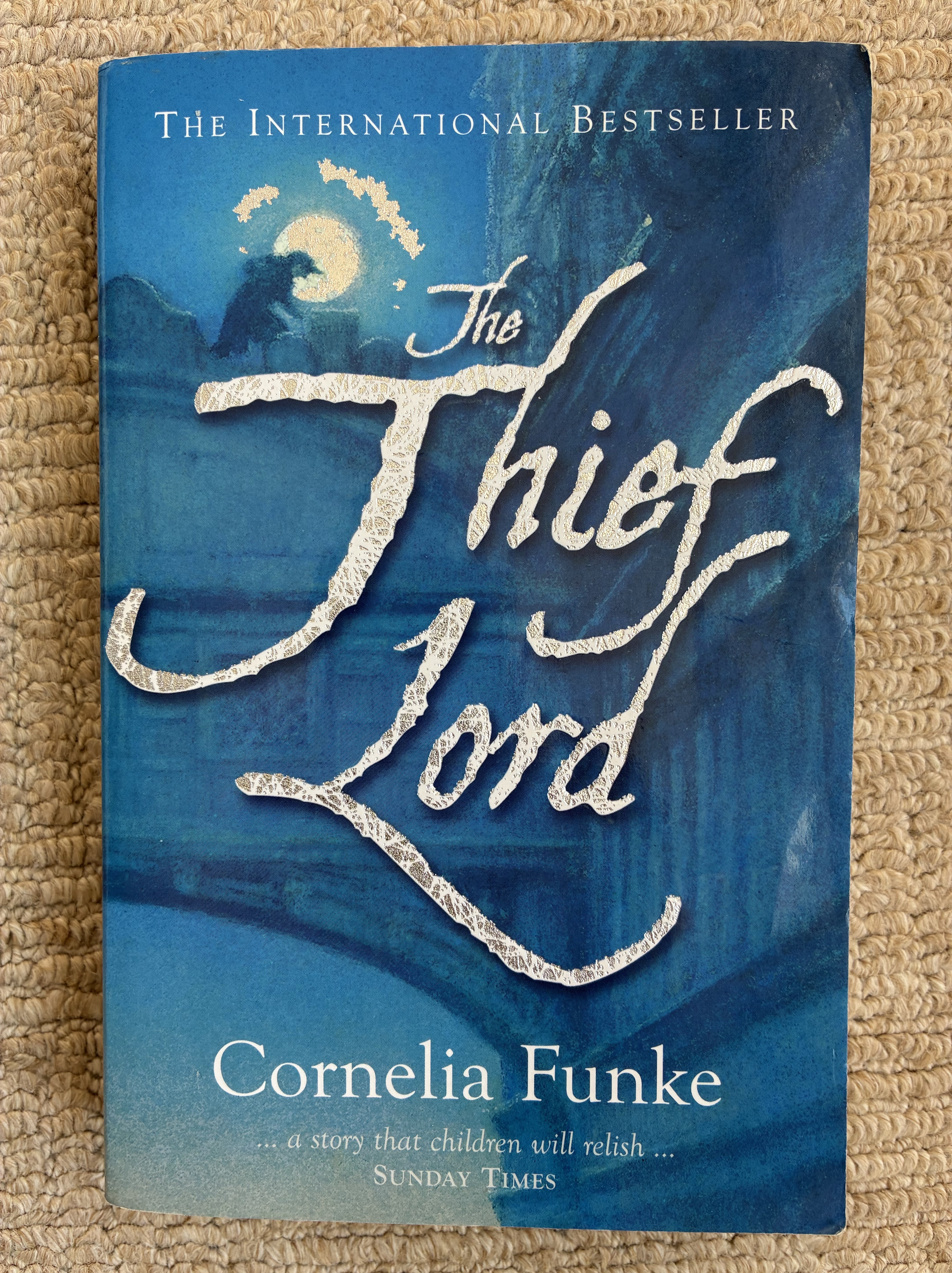
But what has any of this got to do with Cornelia Funke’s children’s novel The Thief Lord? The answer is that one of the things Literary Agents generally ask is that authors liken their work to what are termed ‘comparative titles’ (or ‘comps’). This is supposed to be a good way of the author showing where their book fits into the market (and that they know where their book fits into the market), and so help the agent decide whether or not it might be the kind of book that they want to represent and think they can sell to a publisher. With this in mind, before I could finalize my submission package I had to try to come up with a few such comps. Since I don’t routinely read children’s fiction, I spent a long time perusing the shelves of the local bookstore, but this didn’t really help me much because it seems to me that almost all new children’s books now feature magic, witches and wizards, dragons and suchlike. I also decided that I should try to get into the habit of reading some children’s fiction, and so when I stumbled upon a copy of The Thief Lord in a charity shop, I grabbed the opportunity to read a title by one of the most successful writers for children of recent decades.
The story of The Thief Lord is set, rather randomly, in Venice, and follows two orphaned boys, Prosper and his younger brother Boniface who have travelled from Germany after escaping from the clutches of their rather severe aunt who only wants to adopt the younger Boniface. In Venice, the two boys fall in with a group of street children led by the super confident, and extremely talented ‘Thief Lord’, Scipio. The first half of the book sees Prosper and Boniface become steadily more drawn into the group and their schemes to steal items to sell on, often to a corrupt antique dealer Barbarossa. The story hangs together pretty well and I found it a fairly enjoyable read…
…but then in the second half of the story, everything turns a bit weird. The group of children, rather improbably end up being befriended by a woman, Ida Spavento, whose house they were trying to rob, and then the plot suddenly takes Prosper and Scipio to an island where they find a merry-go-round that magically changes the age of those who ride it. I won’t spoil the story by saying who rides it and the extent to which they become younger or older, suffice to say that two of the main characters undergo contrasting permanent transformations after the merry-go-round breaks, trapping them at their new ages. I found the whole of this section of the book to be rather random – as if Funke knew that she wanted (or needed) to put a surprise twist into the book but hadn’t really worked out how to embed it into the story that she was in the process of writing. However, I’m an almost-60-year-old adult and The Thief Lord clearly wasn’t written for someone like me. Perhaps younger readers like (or liked, The Thief Lord was published in 2002) stories that change tack quite radically partway through. Who knows?
Overall, I quite enjoyed reading The Thief Lord, but I didn’t find it particularly satisfying. Interestingly, according to the Wikipedia entry for the book, a review in Publishers Weekly ‘found fault with the pacing’, a comment which matches up well with my own feelings about the story. In the end, I wasn’t left much the wiser in terms of finding a comp for my own book, although there is some similarity in the way that our stories unfold as they go along rather than following some obvious up-front structure or plot. I think there is also some similarity in the way that the stories bring together a group of children with different backgrounds and attributes. But in most respects the two books are very different, not least because Funke’s book has been published, translated into different languages, turned into a film (albeit apparently not a good one) and sold many thousands of copies, whereas my book hasn’t been published, hasn’t been translated, hasn’t been turned into the film and hasn’t sold a single copy…