I am the square peg in the round hole: jammed in, stuck fast, placed by youthful naivety, forced down by the weight of expectation, held in place by the pressure of life’s demands, and hammered home by the repeated blows of round pegs that, although appearing far too large to fill such a seemingly trivial space, are really too small to even touch the sides.
Yet, even in the tightest grip it is possible to wriggle and writhe – tiny movements that, though causing damage, breaks, and pain, gradually, imperceptibly, ease the bind. The needle must break the cloth to form the stitches of repair.
I am still the square peg, plugging the round hole, missing parts of my surface, diminished, and wearing hidden scars, but now I have worked my way loose. And though I cannot know the planes and slopes of the land that lies outside, I have seen it in glimpses, and I am ready to slide out, with freshly rounded corners, ready to roll.
(c) Tim O’Hare, September 2023
SQUARE PEG: This is another poem that came up on me out of nowhere and very fast. In some ways it is a direct continuation from my poem It Is Time, but whereas that poem is about recognizing that a point of arrival has been reached, Square Peg is more about being ready to start out on the next part of the journey.
It is time to banish thoughts of giving up, to be replaced by the comfort of giving in – acceptance rather than flight, to fold back the shutters, emerging from the dark of night – allowing in some light.
It is time to cease the role of the bully, forcing the fearful child within to be the man he thought he should. Instead, enfolding in a loving hug to draw out all he could have been. If only he had understood.
It is time to give the boy a chance, to give him space to play his part, to let him fall and graze his elbow – blood and gravel – even though tears may flow. He may be strong enough. How else will we know?
It is time to take those steps that cross the threshold of the door, to find that it was open all along – never locked – and behind it? The voice of the song oft heard, though always sounding slightly wrong.
It is time to push on through the fog, that cloak of damp that so confuses senses, seeking clearer skies, different colours, other forms to try on for size. Who knows how those choices may surprise?
It is time to give in, not to temptation, hopelessness or terror, but to follow the path to those imagined lands, shaping their form with my own hands. Finally, he understands.
(c) Tim O’Hare, August 2023
IT IS TIME: This poem came completely out of the blue, coalescing onto the page in less than an hour. It reflects a big decision made on the previous day – to signal that I must let go of a big role at work, to stop fighting with the thought that to do so was some kind of failure, and to just accept that I no longer have it within me to push and cajole or fight with myself anymore.
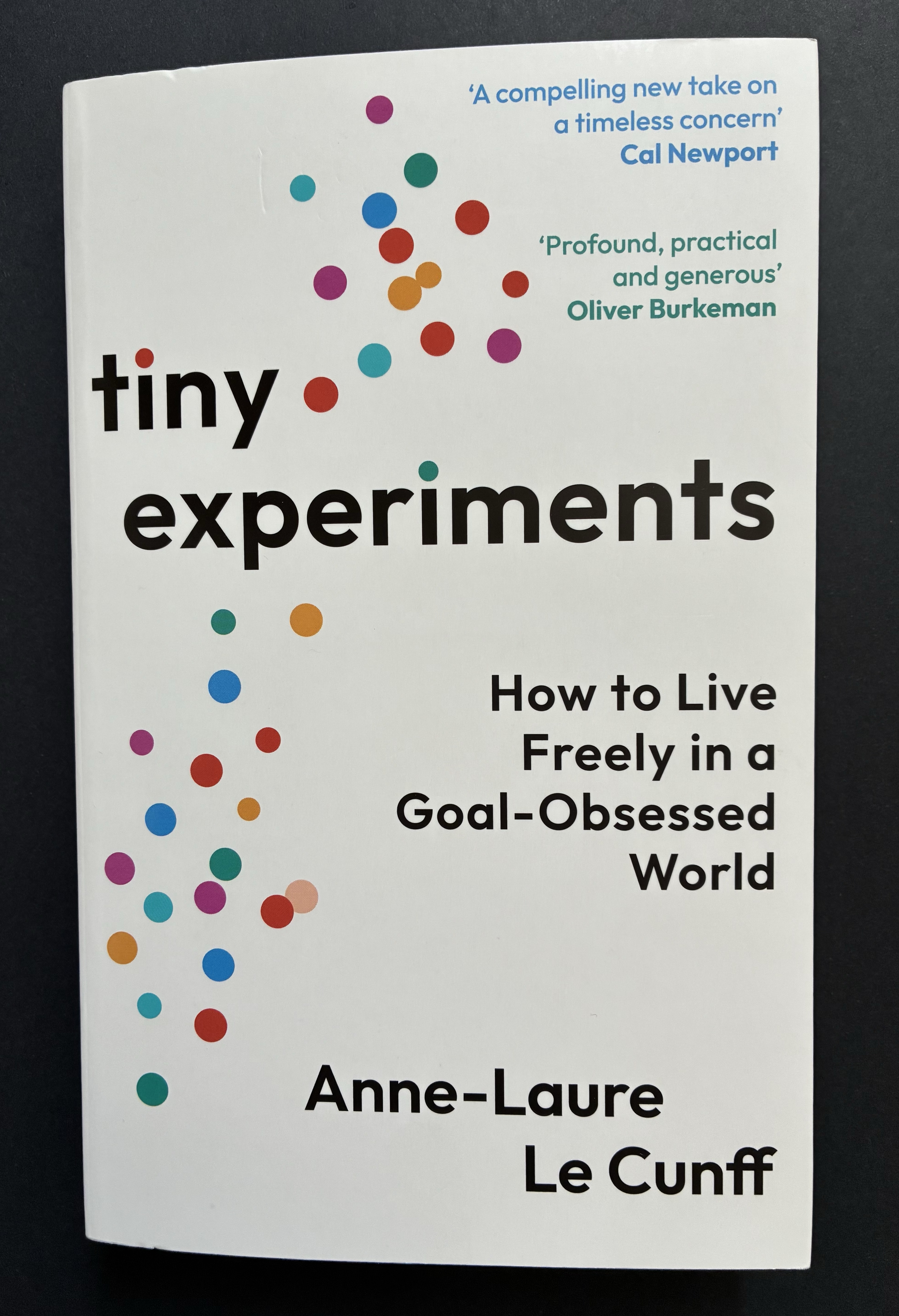
I read Anne-Laure Le Cunff’s debut book, Tiny Experiments, just a month after it was released in March 2025. However, this was not my first sight of the key ideas that the book contains, because I was lucky enough to be chosen as one of 300 people participating in a series of four, weekly online workshops, led by Le Cunff, that took place in February, in the lead up to the book’s publication. These workshops and the online community that accompanied them was called The Curiosity Collective, the name giving prominence to what is perhaps the key theme running Le Cunff’s work – the exhortation to live life in ‘curious mode‘, always willing to explore and experiment with your approach to life, and how you operate in the world. My experience attending those online workshops, showed me that Le Cunff is a highly skilled communicator and excellent teacher, and so I approached reading Tiny Experiments with high expectations. As an added bonus, the book had been chosen as the April pick for The TimeCrafting Trust Book Club.
As noted above, curiosity lies at the heart of Le Cunff’s ideas, and this is most obviously seen in her simple, four-part model for exploring and implementing change in your life. This model is rather neatly captured by the word sequence: PACT > ACT > REACT > IMPACT. At the start of the book, Le Cunff encourages the reader to adopt the mindset of a ‘self-anthropologist’, observing how they act in the world and the outcomes of these results, and then asking questions in relation to these observations. Le Cunff then structures the bulk of the text around her four-step model, stressing the importance of moving away from a Linear Mindset (X leads to Y leads to Z – end of story) towards the adoption of an Experimental Mindset based on the implementation of continuous experimental loops. My own feeling is that the key message here is not really about the distinction between linear v looping but, rather, one of ongoing adaptation and experimentation. The experiments one conducts don’t need to be thought of as loops (in fact they probably won’t bring you back to near your starting point) but they should take you somewhere, and in the process provide valuable evidence to help you work out what you might experiment with and where you might go next.
In the PACT phase of her model, Le Cunff presents a really neat (because it is simple) template for setting up what she refers to as a Tiny Experiment (an exploration of what happens when you make some small, realistic and manageable shift in the way that you operate). This template – a PACT – takes the following form:
“I will [action] for [duration]”
The key here is make sure that the action is purposeful, actionable (something that you can reliably perform), continuous (i.e. repeatable and not changing from day-to-day) and trackable. It is also important to be specific about the duration of the experiment (or else the number of repetitions). This ensures that the experiment is set up so that it provides a large enough dataset for meaningful conclusions to be drawn, but does not continue for so long that the action becomes tedious, or redundant or of little continued value. Essentially, the whole point of the PACT is to provide information that can then be used to adapt future behaviour and experiments, and not as a means to try to establish new habits.
In the ACT phase, you set about completing the activity specified in the PACT. This section of the book has some interesting material exploring the powerful forces of procrastination and, associated with this, perfectionism, that can so easily derail progress towards a goal.
The third phase of the model, REACT, occurs once the action described in the PACT has been completed for the specified duration. At this point, the goal is to look for, and then consider, evidence of the results of the action. Le Cunff highlights that it is important to look for evidence from within/internally (reflection) and externally (feedback from others, evaluation of results). Here, she presents what I suspect will become the most significant legacy of Tiny Experiments, namely her simple PLUS- MINUS-NEXT framework for reflection: what went well, felt good – what challenges or obstacles you faced, what was difficult, what negative feelings emerged – and then how the insights gained can shape future actions. [But whilst this framework is neat and seems to be catching on in the productivity community it might be noted that it is not so very different from the well-established ‘plus-minus-interesting’ framework.]
Because the whole point of Tiny Experiments is to encourage the adoption of an Experimental Mindset towards life, the REACT reflection should lead to a decision being made in relation to the area being investigated by the PACT. Le Cunff suggests that there are three possibilities: PERSIST – prolong the pact, or PAUSE – quit the pact or put it on hold, or PIVOT – modify the pact or shift the focus of a subsequent pact.
The final section of Le Cunff’s framework, IMPACT, focuses on the idea that it is helpful to be open/public about what you are setting out to achieve with your PACT and/or to work with others when pursuing it. This is largely a matter of gaining a useful chunk of external accountability, and also valuable feedback, but having seen many ‘public’ statements of Tiny ExperimentsPACTs in Le Cunff’s online community Ness Labs and on social media more generally, it is clear that it also serves as a powerful tool to market and promote Le Cunff’s ideas.
I enjoyed reading Tiny Experiments, and I feel pretty sure that it will be the kind of book that continues to have presence in the market for some time. It is well written and nicely structured, and the core ideas are simple (which is a good thing) and neatly presented, such that they have every chance of ‘sticking’. I think the phrase ‘Tiny Experiments‘ will likely become part of the productivity lexicon in similar fashion to James Clear’s ‘Atomic Habits‘. I also think that the “I will [action] for [duration]” statement for a PACT, the ‘PACT-ACT-REACT-IMPACT‘ model (or at least the ‘PACT–ACT–REACT‘ part of it) and, in particular, the ‘PLUS-MINUS-NEXT‘ framework for reflection, will all end up having a healthy existence outside the printed pages of the Tiny Experiments book…
… but in the end, my enthusiasm for Tiny Experiments waned. I had several goes at defining pacts and conducting experiments, but I wasn’t able to make myself see any of them through to a satisfactory conclusion. Life got in the way, and I found myself ignoring my pacts and carrying on with my usual scattergun approach to trying things out. This, of course, probably says more about me than it does about the potential efficacy of Le Cunff’s ideas, but my experience was that despite the simplicity and neatness of the Tiny Experiments model, it did not possess enough power to persuade me to go all in with it. I have also felt that most of the Tiny Experiments that I have seen others setting out to pursue would really be much better described as ‘tiny habits’ (a phrase already coined by the author B.J. Fogg and, of course, rather similar to James Clear’s ‘atomic habits’), rather than tiny experiments, and to put it bluntly, many of them read like tiny morsels of misty-eyed, wishful thinking…
So, in the end I congratulate Anne-Laure Le Cunff for writing a really nice book that captures some neat ideas and makes some good general points, but despite the fact that I am still indulging in some daily ‘plus-minus-next’ reflection, I can’t say that it has turned me into a Tiny Experimentalist.
A couple of weeks ago we paid a visit to Make Southwest, an exhibition space for contemporary craft and design and a leading charity for craft education located in the small town of Bovey Tracey on the southern edge of Dartmoor, about 25 miles from our home in Plymouth. It’s a venue that we have visited a few times before – there is always some kind of special exhibition (this time it was a exhibition of contemporary bells called Sound and Silence) and an interesting array of local artwork, books and assorted items to look at in the shop. On this occasion, the reason for our trip was to see a smaller exhibition of wood engraved prints and, in particular, the printmaker Molly Lemon, who had travelled down from her base in Gloucestershire to demonstrate her work. We have encountered Molly at several Craft/Art Events in the last couple of years and always enjoyed viewing, and chatting to her, about her work. We also enjoyed seeing her compete in, and reach the semi-finals of, the Sky Arts TV Series Landscape Artist of the Year a few weeks ago.
Since I started painting about a year ago, whenever I go to any kind of art gallery or art/craft event I particularly enjoy scavenging the work that is on display or sale for ideas that I can try out for myself. Looking at the various pieces of artwork for sale in the shop at Make Southwest, I was particularly enamoured by some tiny pieces of work created by the printmaker Mike Tingle (also here). These were very small (just a few centimetre) square prints on slightly larger squares of rough-edged paper, with a title and the artist’s name written in pencil around the picture (there is an example of a similar kind of picture just below the centre in this piece of work: Dartmoor Box No 1). I really liked the miniature size and somewhat ‘rough’ nature of the pieces and I immediately thought that it would be fun to try to produce something similar using one of my own small Dartmoor Scenes watercolour paintings.
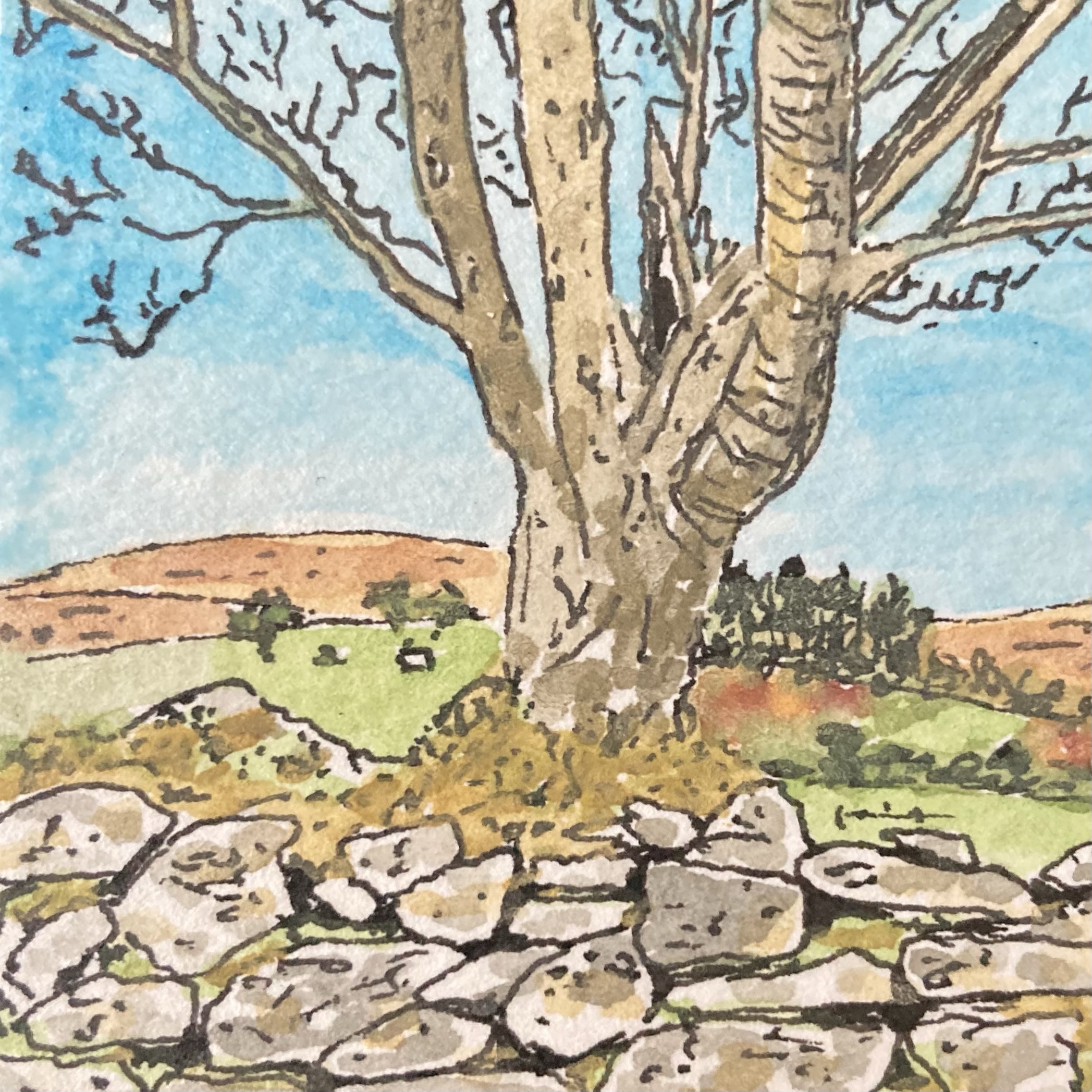
After returning home, I set about seeing what I could produce. First, I selected one of my pictures, opting for this one of a tree growing out of a typical Dartmoor dry-stone wall:
The original picture is a 4.5 cm square ink and watercolour sketch, and my intention was to use our home inkjet printer to make the best quality colour photocopy of it that I could, printing onto a sheet of watercolour paper so that the texture of the original was preserved. I’d already played around with making copies of some of my paintings in this way and so I knew that although the copied versions weren’t quite the same as the originals, with the paler colours tending to wash-out a bit, the process worked pretty well. So far so good.
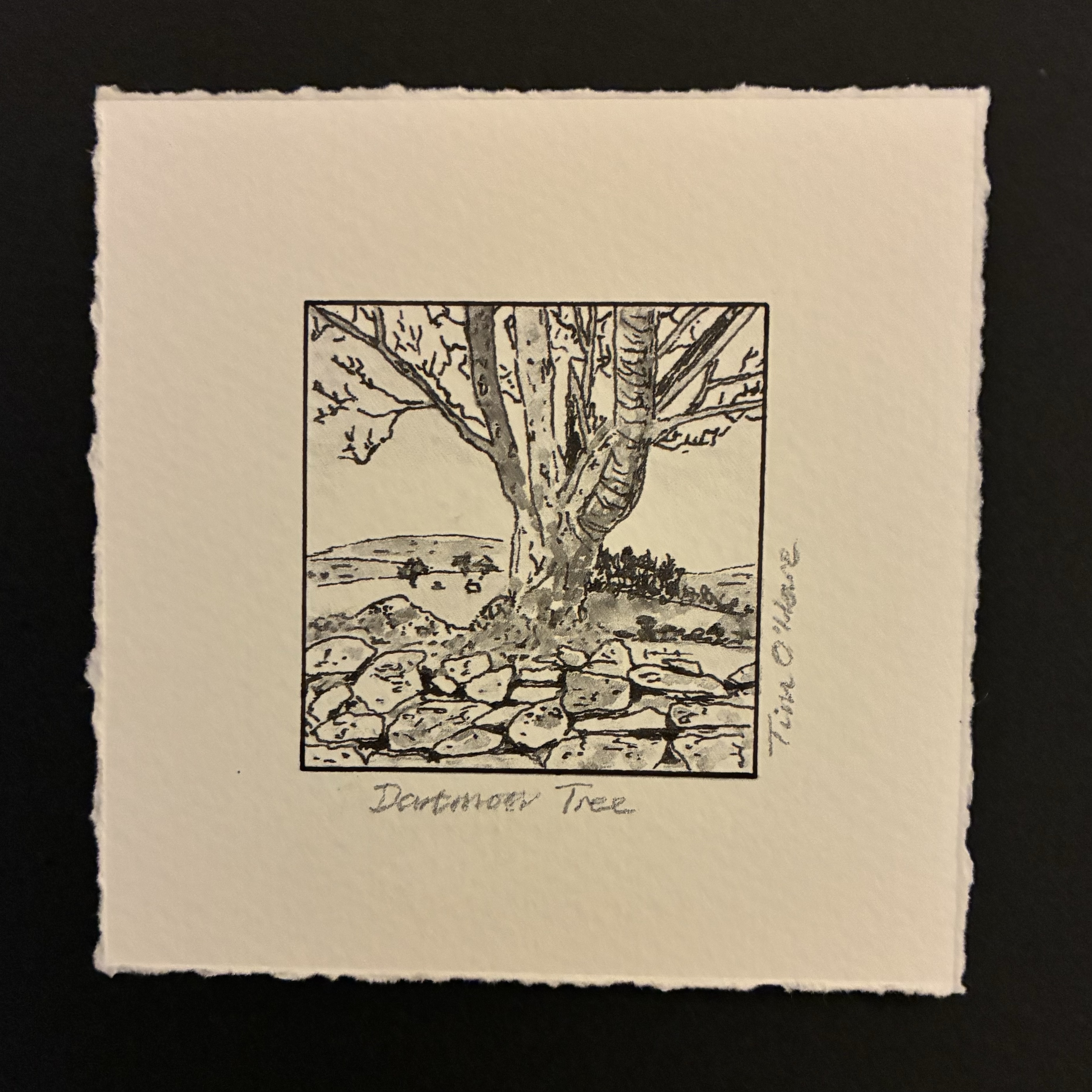
This is the point at which I made my mistake. In the process of making the copy I somehow selected black-and-white printing, and so when I saw what the printer had spat out into the print tray I was instantly annoyed and frustrated. To make matters worse, because the original picture was on a small square of fairly thick paper, as the scanning light moved below the copier glass a dark shadow line was cast on one side of the copied picture. Not only did I only have a black-and-white copy, but I had a black-and-white copy that had a dark line along one of its edges. What a waste of a sheet of paper and ink…
However, once I had overcome my initial disappointment and self-censure, I decided to press on with the rest of my production process and see what the end result looked like. I had intended that there would be no border between the picture and the surrounding area of paper, but now there was that dark line along one side spoiling that design idea. What could I do? Well, go with the mistake of course. I took my drawing pen and with the aid of a straight edge and a lot of care, I inked in a similar line on the other three sides. Hmmm… it didn’t look as I had planned but I liked the result. Then I measured out a wider border, and again aided by a straight edge, I tore the paper down to size. This part of the process is something that I have found takes a lot of care… if the tear is too sharp you don’t get the nice rough edge I was after, but if you are at all rushed and loose you end up with something that looks clumsy and careless. Fortunately, I managed to do a good job. Finally, I grabbed a soft pencil and quickly wrote a title below the bottom edge and my name on the right-hand side…
The result of this endeavour was the small picture shown at the top of this post and, despite my black-and-white and shadow mistakes in the copying process, I’m really pleased with the end result, so much so, in fact, that I intend to take the rest of my Dartmoor Scenes pictures and treat them in the same fashion. Even better, not only did I end up with a new picture that I really liked and the discovery of a new way to transform existing pictures into a different, somewhat distinctive, form, but I also gave myself a great reminder that making mistakes in life is not always a bad thing. In fact, sometimes, as in this case, a mistake can open up a different path from the one that was intended that leads you towards an unexpected but interesting, exciting or enjoyable destination!
OVERDUE: [ ] all the tasks that I said yes to when I ought to have said no [ ] all the calls I need to follow-up so their businesses can grow [ ] all the projects I took upon myself so that I could people please [ ] all the projects I need to do to put myself at ease [ ] all the urgent emails that I know I should have sent [ ] all the bookings that I should have made ahead of the event [ ] all those things that no one cares about but I think are a must [ ] all those gadgets that need mending before they fully bust [ ] all the delegated tasks from others resulting from their lack of time [ ] all the things I think I should do so they think I’m fine [ ] all the action points from meetings that I think were flagged for me [ ] all the edits to the documents that I know you need to see
OTHER: [ ] more tasks that I said yes to when I wanted to say no [ ] more calls I’d like to follow-up to help my business grow [ ] more projects I have taken on so I can people please [ ] more projects that I want to do to put myself at ease [ ] more emails that I know that it would help for me to send [ ] more plans that I could make for upcoming events [ ] more things that no one cares about but I think are a must [ ] more gadgets that need maintenance to stop them going bust [ ] more delegated tasks from others resulting from their lack of time [ ] more things I’d like to finish (only then will I feel fine) [ ] more action points from meetings that I let them flag to me [ ] more edits to the documents that I’d like you to see
SOMEDAY/MAYBE: [ ] try to make some art [ ] try to pause a while [ ] try to take time for myself [ ] try to have fun [ ] try to meet up with a friend [ ] try to smile [ ] try to laugh [ ] try to simply do the things I want [ ] try to quench my thirst [ ] try to look after my brain [ ] try to use a different font [ ] try to listen to my heart [ ] try to sit in the sun [ ] try to soak up the rain [ ] try to read the books that are piled upon the shelf [ ] try to have a nice relaxing bath [ ] try to ‘pay myself first’ [ ] try to ignore the latest trend
WAITING FOR: [ ] the perfect time [ ] the stars to align [ ] the mists to clear [ ] the loss of fear [ ] all of the pieces to fall into place [ ] and, of course, the ideal space [ ] the feeling that it’s right [ ] and for my chest to feel less tight [ ] a decent night’s sleep [ ] the bravery to take a leap [ ] something to drink, and some food [ ] the right mood
TODO TODAY: [ ] put a cross in the unchecked boxes and strike-through all the words in the following lists: …….[ ] WAITING FOR …….[ ] OTHER …….[ ] OVERDUE [ ] wherever they appear in the SOMEDAY/MAYBE list strike-through the words: ‘try to’ [ ] start a new list with the title ‘TODO (RECURRING – EVERY DAY)’ [ ] add the unchecked tasks from SOMEDAY/MAYBE in a pleasing way [ ] tear up all of the old lists and throw them right away
PRESENT
OVERDUE: [x] all the tasks that I said yes to when I ought to have said no [x] all the calls I need to follow-up so their businesses can grow [x] all the projects I took upon myself so that I could people please [x] all the projects I need to do to put myself at ease [x] all the urgent emails that I know I should have sent [x] all the bookings that I should have made ahead of the event [x] all those things that no one cares about but I think are a must [x] all those gadgets that need mending before they fully bust [x] all the delegated tasks from others resulting from their lack of time [x] all the things I think I should do so they think I’m fine [x] all the action points from meetings that I think were flagged for me [x] all the edits to the documents that I know you need to see
OTHER: [x] more tasks that I said yes to when I wanted to say no [x] more calls I’d like to follow-up to help my business grow [x] more projects I have taken on so I can people please [x] more projects that I want to do to put myself at ease [x] more emails that I know that it would help for me to send [x] more plans that I could make for upcoming events [x] more things that no one cares about but I think are a must [x] more gadgets that need maintenance to stop them going bust [x] more delegated tasks from others resulting from their lack of time [x] more things I’d like to finish (only then will I feel fine) [x] more action points from meetings that I let them flag to me [x] more edits to the documents that I’d like you to see
SOMEDAY/MAYBE: [ ] try to make some art [ ] try to pause a while [ ] try to take time for myself [ ] try to have fun [ ] try to meet up with a friend [ ] try to smile [ ] try tolaugh [ ] try to simply do the things I want [ ] try to quench my thirst [ ] try to look after my brain [ ] try to use a different font [ ] try to listen to my heart [ ] try to sit in the sun [ ] try to soak up the rain [ ] try to read the books that are piled upon the shelf [ ] try to have a nice relaxing bath [ ] try to ‘pay myself first’ [ ] try to ignore the latest trend
WAITING FOR: [x] the perfect time [x] the stars to align [x] the mists to clear [x] the loss of fear [x] all of the pieces to fall into place [x] and, of course, the ideal space [x] the feeling that it’s right [x] and for my chest to feel less tight [x] a decent night’s sleep [x] the bravery to take a leap [x] something to drink, and some food [x] the right mood
TODO TODAY: [x] put a tick in the unchecked boxes and strike-through all the words in the following lists: …….[x] WAITING FOR …….[x] OTHER …….[x] OVERDUE [x] wherever they appear in the SOMEDAY/MAYBE list strike-through the words: ‘try to’ [x] start a new list with the title ‘TODO (RECURRING – EVERY DAY)’ [x] add the unchecked tasks from SOMEDAY/MAYBE in a pleasing way [x] tear up all of the old lists and throw them right away
FUTURE
TODO (RECURRING – EVERY DAY): [ ] quench my thirst [ ] ‘pay myself first’ [ ] read the books that are piled upon the shelf [ ] take time for myself [ ] soak up the rain [ ] look after my brain [ ] make some art [ ] listen to my heart [ ] sit in the sun [ ] have fun [ ] have a nice relaxing bath [ ] laugh [ ] pause a while [ ] smile [ ] ignore the latest trend [ ] meet up with a friend [ ] use a different font [ ] simply do the things I want
(c) Tim O’Hare, June 2023
About this poem: I’ve been something of a ‘productivity geek’ for quite a few years using various systems of lists to track what I need to do (or think I need to do). Much of this tracking behaviour is built on a very well-known system known as ‘Getting Things Done’ (GTD) from a book with the same name by the author David Allen. This uses lists for things To Do, things that you are Waiting For, things you might do Someday and/or Maybe etc. Recently, I’ve been trying to relax my use of such systems, especially as I have realised that tracking everything in this way also feeds some of my obsessive collecting and perfectionist behaviours and supports my ‘people pleasing’ tendency. Todo List tries to capture a way out of this pattern of thinking, turning the controlling power of a Todo List into a weapon to destroy the worst aspects of the behaviour such lists can engender.
Does it matter what they’re thinking? Does it matter what they think of what I say? Does it matter if I do what they’re expecting? Does it matter if I do it anyway?
Does it matter if I play the game they choose? Does it matter if they think that I’m a fool? Does it matter if I win or if I lose? Does it matter if I play by different rules?
Does it matter if I do it when I should do? Does it matter if I go at my own pace? Does it matter if I keep myself beside you? Does it matter if I run a different race?
Does it matter if I wear a different colour? Does it matter if I my hair’s a little long? Does it matter if I like things to be quieter? Does it matter if I break out into song?
Does it matter if I go across the bridge? Does it matter if I’m in a different land? Does it matter if I speak a different language? Does it matter if I’m hard to understand?
Does it matter if I go to different places? Does it matter if I seem a little weird? Does it matter if I once wore rainbow laces? Does it matter if I’m nothing to be feared?
Does it matter what they’re thinking? Does it matter what they think of what I say? Does it matter if I do what they’re expecting? I think I’ll do it anyway.
(c) Tim O’Hare, June 2023
About this poem: I had read an article about Rejection Sensitive Dysphoria and how this can lead to ‘people pleasing’ behaviour, something that I tend to adopt strongly. ‘Does It Matter?’ tries to capture aspects of the internal struggle that works its way through my head on a near continuous basis and also provides a form of written antidote that reminds me that I do not have to do what I think is expected of me or behave in the ways that I think I am expected to behave or only do things once I have received some form of external confirmation that they are worthwhile or valid things to do.
This was the second poem I wrote, back in early summer 2023. It’s been clear since then that writing and publishing my poems has helped me to become much less dependent on receiving external validation for my work and much happier to just put stuff out there and see what happens (even if that turns out to be nothing very much!). I think this poem expressed something that I always knew inside but was perhaps a little fearful to recognize.
Is it time to slough it off, that rough, tough, protective skin, that hide for unseen treasures deep within.
He had not felt it grow, but grow it had for many years, thickening the defensive wall, blurring eyes and muffling ears.
So early it had started, so slowly it had grown, he’d noticed not the tightening as it closed around his bones, holding him together safe and sound or so it seemed, whilst locking him away to form a shield for self-esteem.
But he had heard the screams and he had seen the flashes of the inner rage and he had felt the punches as they slammed against the cage, only recognising who they came from when witnessed in his broken dreams.
Years passed and then worn thin by constant wear the first crack had appeared, at last revealing what it was and how the dangers it held fast against were nothing to be feared.
So, slough it off, that rough, tough defensive skin, and let new life begin. Slough it off, that mask of false protection and let us see at last what treasures lie within.
(c) Tim O’Hare, June 2023
About this poem: After a coaching session at work talking through some of the challenges I face as a result of my ADHD-traits and the difficulty I find in allowing myself to be the way that I want to be rather than the way that I think I ought to be I was struck by the thought that I needed to let go of the protective behaviours and attitudes I had unknowingly constructed for myself over the years and, in the process, allow my authentic self to emerge. The image that came to mind was of a reptile shedding its skin and for some reason the phrase ‘slough it off’ popped into my head in association with this image. I quickly became rather fond of the word ‘slough’ and then, for the first time ever in my life really and without any warning or deliberate effort, I started to write a poem. ‘Metamorphosis’ is the first evidence that having sloughed off my metaphorical protective skin there was something different and unexpected lurking within!
Note: I have previously posted all of my poetry in a separate website: http://andapoet.blog but I have decided that I will gradually migrate all of that content to this site.
 Tim O'Hare