The Wisdom of Groundhog Day – Paul Hannam #reading

I first read Paul Hannam’s ‘The Wisdom of Groundhog Day’ (TWoGD) back in October 2022. It was one of a number of occasions when I have listened to an episode of a podcast on my walk home from work and been so taken with the content being discussed that I placed an order for the book as I walked along and before I had even arrived home. In this case, the podcast episode was an interview with the author about his book from the ever excellent ‘Art of Manliness’ podcast (Episode 828: The Groundhog Day Roadmap for Changing Your Life).

In the 2.5 years that have passed since that reading, I have held a really positive memory of TWoGD. I was drawn to the way in which Hannam teases his message out of the story of the ‘Groundhog Day’ film – ostensibly just a routine comedy about a grouchy weatherman who gets stuck in a small town having to live the same day of his life again and again and again. The heart of the message is that to find happiness and fulfilment in life it is necessary to change yourself on the inside and this happiness can only arise when you are fully present and focused at all times on being true to yourself, open to experience, and appreciative of the world and the people around you. Based on this memory, I breifly mentioned TWoGD at the end of a meeting of the Book Club associated with Mike Vardy‘s Timecrafting Trust Community and with others intrigued by the idea of the book, it was chosen to be our February read.

So, I came back to TWoGD for a second reading with high hopes and also a little trepidation… What if everyone else hated the book? As I worked my way through it for a second time I found myself with very mixed feelings. I could still see, and appreciate, the cleverness that lay behind it, but I also couldn’t help feeling that it was all a bit forced – a neat idea stretched out to a length many times greater than necessary. I found that there were certain stylistic aspects about the writing that I really disliked – the way that it was written in what seemed to be a series of ‘sound bite’ paragraphs one after the other with not much flow when read together, and the fact that at every turn the example given for how such and such a principle idea had made an impact on someone was taken from Hannam’s personal experience.

As it turned out, most other members of the book club community had fairly similar issues with TWoGD as I did, but the message of the book was well received and we had a lively and interesting discussion nevertheless.

If I was going to sum up the message in TWoGD in one phrase then I think I would struggle to do better than to use the same quote that Hannam uses in the book’s conclusion, taken from the second volume of Marcel Proust’s epic ‘Remembrance of Things Past’ (1924):

We are not provided with wisdom, we must discover it for ourselves, after a journey through the wilderness which no one else can take for us, an effort which no one can spare us.’

The Mind of a Bee – Lars Chittka #reading

At work, I am part of the supervisory team for a part-time PhD student who is trying to explain the relatively recent (2001) appearance of a tree bumblebee Bombus hypnorum in the U.K. My involvement in the project arose because one possibility for explaining how these bees made the hop across the English Channel from mainland Europe is that they might have been carried over be easterly or southeasterly winds. As the only person who teaches some meteorology in my department I was drawn into discussions at the outset of the project about 5 years ago, and my involvement has continued ever since.

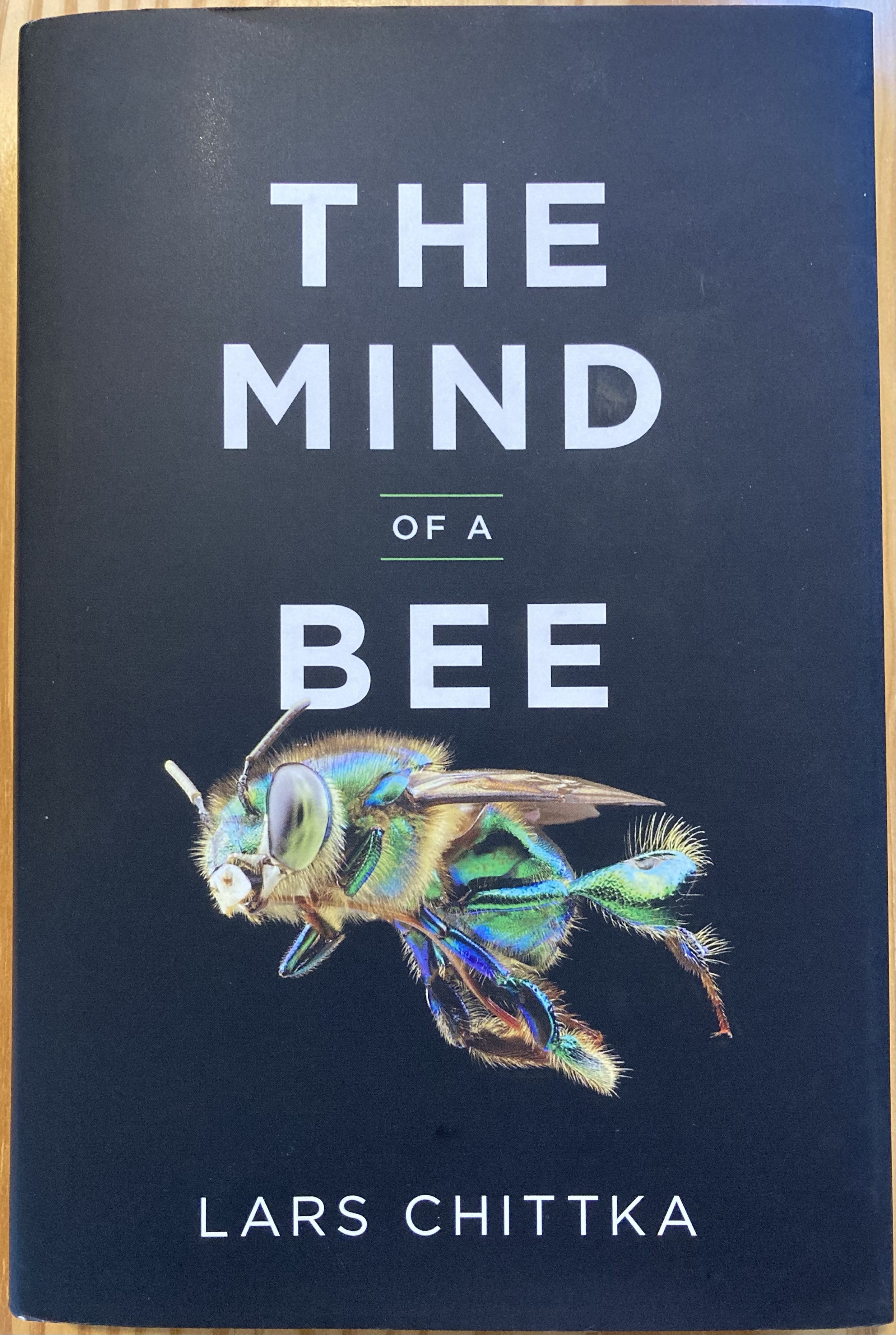
What do I know about bees? Almost nothing… I completed an ‘O’ Level in Biology back in 1981 but I don’t recall bees ever being a topic that we learned about. Since then, although I have a general interest in natural history, I can’t say that I have thought about bees very much. But sometime around 2017 or 2018, the bird box in our garden was taken over by bees, I mentioned this to my the Head of School (who does know about bees), learned that most bumblebees nest in holes in the ground but that some, like my ones, were tree bumblebees, and from there I gradually became enmeshed in the ongoing attempt to explain why one type of these tree bumblebees had suddenly appeared in the U.K. Eventually, I decided I really should get to know a bit about more about bumblebees and that led me first to read Dave Goulson’s book ‘A Sting In The Tale’ (in June 2022) and then at the start of this year, Lars Chittka’s book ‘The Mind of a Bee’.

‘The Mind of A Bee’ was a fascinating book, covering bees’ sensory capabilities, instinctual behaviours, intelligence, communication systems, spatial memory and navigational capabilities, learning, brain structure, personality and consciousness. Packed with easily understandable summaries of a huge of scientific experiments and interesting background information about the scientists that conducted them, ‘The Mind of a Bee’ leaves no room for doubt that despite their small size, bees brains are capable of many astounding feats and that the bees themselves are highly complex animals with many sophisticated behaviours and skills.

The part of the book that interested and intrigued me most was the section early on about sensory capability and, in particular, bee vision. Bee vision is shifted to shorter wavelengths than human vision which means that bees can ‘see’ in the ultra-violet part of the electromagnetic spectrum and are effectively red-blind (which explains why red flowers are relatively rare in European fauna [research has also shown that flower colours have adapted to match insect vision and not the other way around as would perhaps seem more intuitive]). Bee vision is also trichromatic (UV, blue, green) and bee brains mix these three colours in the same way that human brains mix red, green and blue, ending up with a mixed colour that is indistinguishable from pure light at the relevant frequency. Apparently, this is unusual… and it is also very different from the way that we perceive sound, where we can perceive many frequencies at the same time so that we hear chords, harmony and dissonance. This difference arises because we have thousands of auditory receptors responding to different frequencies. I found it fascinating to think about what sound would be like if we could only sense three frequencies and mixed them to make a single note and what vision would be like if we saw objects as chords of different coloured lights. To be honest, my mind was a bit blown by thinking about all of this!

Reading ‘The Mind of a Bee’ certainly gave me a lot of insight into the brains, behaviours and learning capabilities of bees. It’s certainly a book that opens up the mind of the human that reads it and makes that mind think about just how different the game of life can be for different animals.

Free To Focus – Michael Hyatt #reading

The third book I read (or in this case, listened to as an audiobook) was Michael Hyatt’s ‘Free to Focus’. I had listened to a podcast interview with the author one morning (an episode of A Productive Conversation with Mike Vardy) and, although much of Hyatt’s advice on productivity and getting things done was common fare, I liked one or two of the descriptions he gave to some of the ideas that were spoken about and thought I would follow up by listening to his book to see whether there was a bit more meat to put on the bones.

I found the book rather dry, with little content that was at all original, and little further depth on the elements that had piqued my interest in the podcast episode. I did like his way of thinking about areas of activity through an analogy with acting – that we do some of our work on the front-stage (the parts we do for public consumption, the locations of our performances and outputs), some on the back-stage (behind the scenes work preparing, rehearsing, grafting away in private) and some on the off-stage (the other activities in our life not directly linked to our main, professional work). Sadly, that’s nowhere near enough for me to suggest that this is a book that anyone else might benefit from reading/listening to.

Orbital – Samantha Harvey #reading

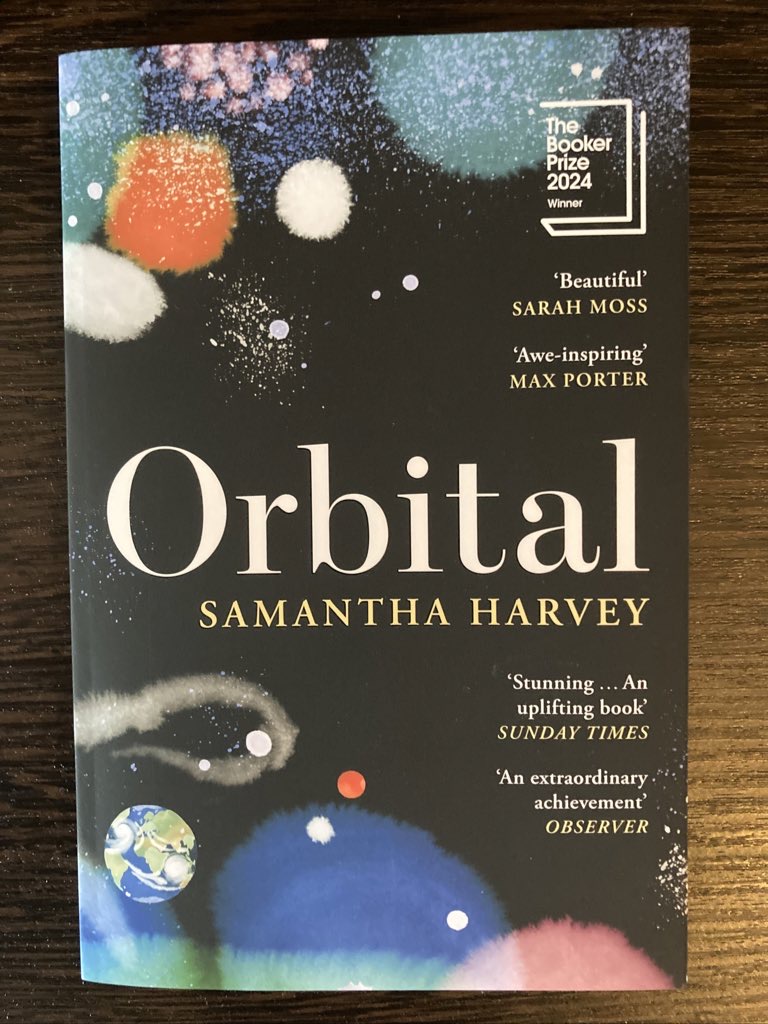
‘Orbital’, the 2024 Booker Prize-winning novel by Samantha Harvey was the first book that I finished reading this year. I will admit that I am not usually a reader of what might be called ‘literary’ fiction but as this book was fairly short and has a science-based theme (the book recounts the thoughts of a group of astronauts on board the International Space Station (ISS) as it orbits the Earth over the period of one day), my wife thought it would probably interest me and gave it to me as a Christmas present.

I find books like this, that don’t really have a story as such, quite intriguing. It is interesting to ask the question: What it is that makes spending time with one set of fictional characters doing nothing in particular, apart from existing and thinking, interesting? (especially as it is easy to imagine many instances when it certainly wouldn’t be).

As it turned out, I did enjoy the day I spent with Harvey’s collections of imagined astronauts as they repeatedly observed their home planet (the ISS completes 16 orbits of Earth per day) and mused on their connections with the people, places and events down below. The writing challenges the reader to consider their own place in the world and the perspective from which they view both ordinary and extraordinary events. For me, the core themes that emerged from my reading of Orbital were the extent to which so much of human endeavour is bound up in the pursuit of progress, both the grand-scale technological progress shared only by a few such as the astronauts on the ISS, and the small-scale, day-to-day progress, shared by everyone of us, and the fragility of the world that all of this progress has created.

While gazing down onto the planet’s surface, one of the astronauts muses on this theme of progress in connection with his relationship with his daughter and the passage in the text that captures the stream of his thoughts as he does so was one that resonated deeply for me:

But what he meant to say to his daughter – and what he will say when he returns – is that progress is not a thing but a feeling, it’s a feeling of adventure and expansion that starts in the belly and works up to the chest (and so often ends in the head where it tends to go wrong). It’s a feeling he has almost perpetually when here, in both the biggest and smallest of moments – this belly-chest knowing of the deep beauty of things, and of some improbable grace that has shot him up here in the thick of the stars. A beauty he feels while he vacuums the control panels and air vents, as they eat their lunch separately and then dinner together as they pile their waste into a cargo module to be launched towards earth where it’ll burn up in the atmosphere and be gone, as the spectrometer surveys the planet, as the day becomes night which quickly becomes day as the stars appear and disappear, as the continents pass beneath in infinite colour as he catches a glob of toothpaste mid-air on his brush, as he combs his hair and climbs tired at the end of each day into his untethered sleeping bag and hangs neither upside down nor the right way up, because there is no right way up, a fact the brain comes to accept without argument, as he prepares to sleep two hundred and fifty miles above any ground for their falsely imposed night while outside the sun rises and sets fitfully.