Quantock Paintings – Part 1 #art

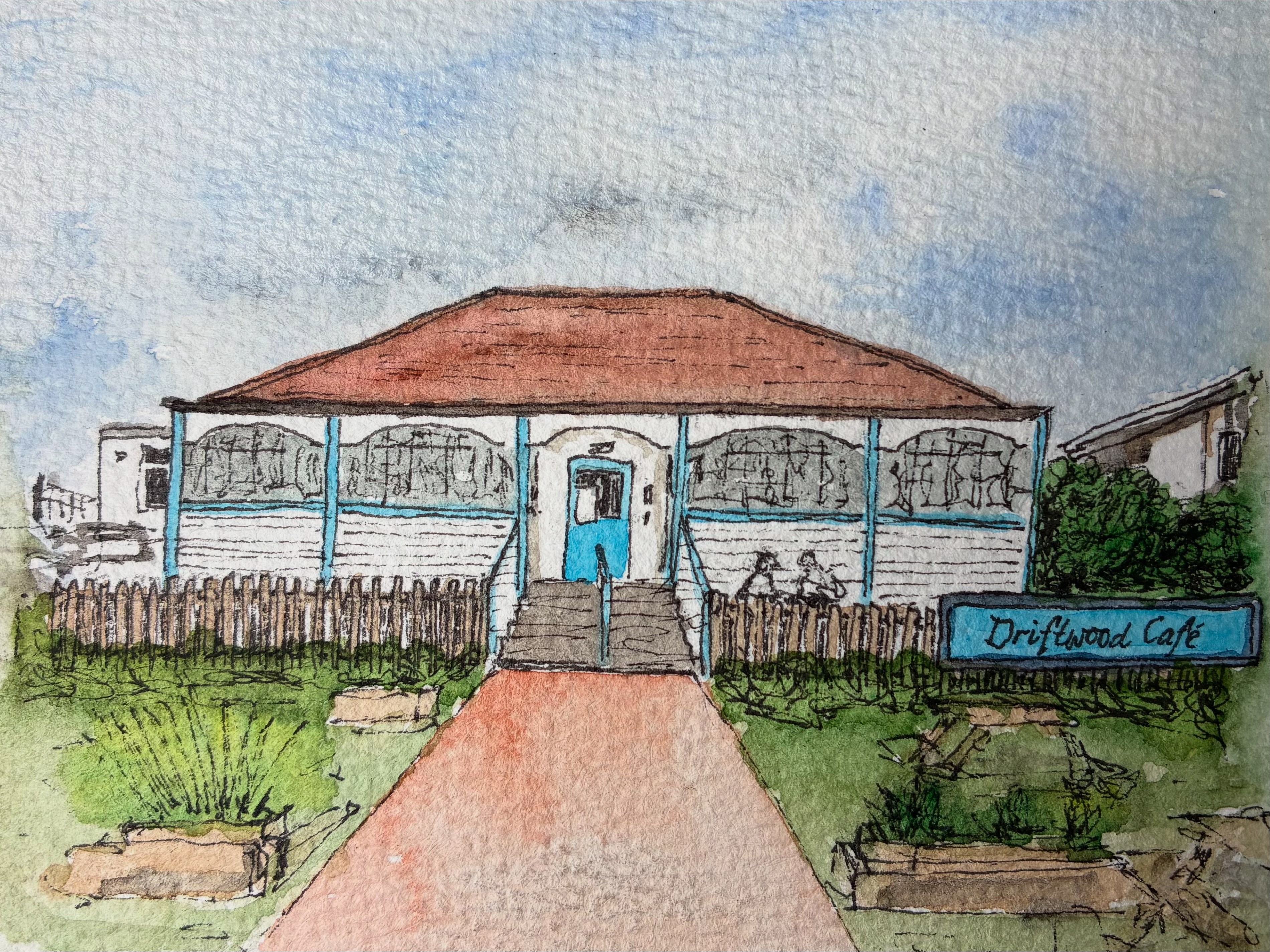
Driftwood Cafe, Blue Anchor, Somerset

In recent summers we have take a series of summer holidays walking in the Yorkshire Dales – first in Swaledale (staying at Low Row near Reeth), then in Wharfedale (based in Ilkley) and last year in ‘Bronte Country’ near Haworth. In each case we combined our week in Yorkshire with a day or two staying somewhere en route to and from our home in Plymouth, or in one case a second week away in Norfolk and Suffolk. For a change, this year, we decided that we’d like to spread our holiday time out over the summer months, and so we picked a couple of fairly local destinations for ‘long weekend’ walking holidays and also booked five days over in Suffolk, combining this with a visit to elderly relatives and an old university friend on mine.

The first of our summer 2025 mini-break locations, in June, took us back to the very familiar territory (for me at least) of the Quantock Hills and the Somerset coast. I grew up a short distance from there in Bridgwater, and we would frequently go on family outings to the area. I also spent quite a lot of time at an activity centre in Kilve on short courses of various kinds (mostly musical).

Although I do like discovering new places, I also very much enjoy returning to familiar haunts, especially for a short trip when you want to be able to slot straight into holiday mode without having to spend time orienting yourself and getting the lie of the land. Our Somerset trip – staying in an AirBnB Shepherd’s Hut near the village of Crowcombe, tucked at the bottom of the western side of the Quantock Hills ridge, very much fell into this ‘familiar territory’ category.

While we were away we enjoyed completing a couple of lengthy walks direct from our accommodation (I particular enjoy a stay away that doesn’t involve having to get in the car), and I was able to spend quite a bit of time painting. In this post I’ll feature four of the pictures that I produced during the break, and I’ll pick up the thread with another post soon that will feature a further group of five pictures.

We started our holiday with lunch at a favourite cafe, the Driftwood Cafe at Blue Anchor – the subject of my first picture (shown at the top of this post). It’s not a fancy cafe at all – I’d describe it as a ham, egg and chips or baked potato cafe – it’s just a nice, simple, easy-going place for a quick bite to eat.

Suitably refueled we then drove the short distance to Kilve and did a short walk (~3 miles) along the coast to East Quantoxhead, before turning inland and returning to the car, with a stop at the Chantry Tea Garden at Kilve where we were the only customers and had an interesting conversation with the owner, who used to be a frequent visitor to Plymouth. The two pictures below show a view of a field that we passed on the return leg (I’ve got a thing for trees silhouetted on the horizon) and the view that we had from our table in the cafe garden of The Chantry itself and the white cottage from which the cafe was run.
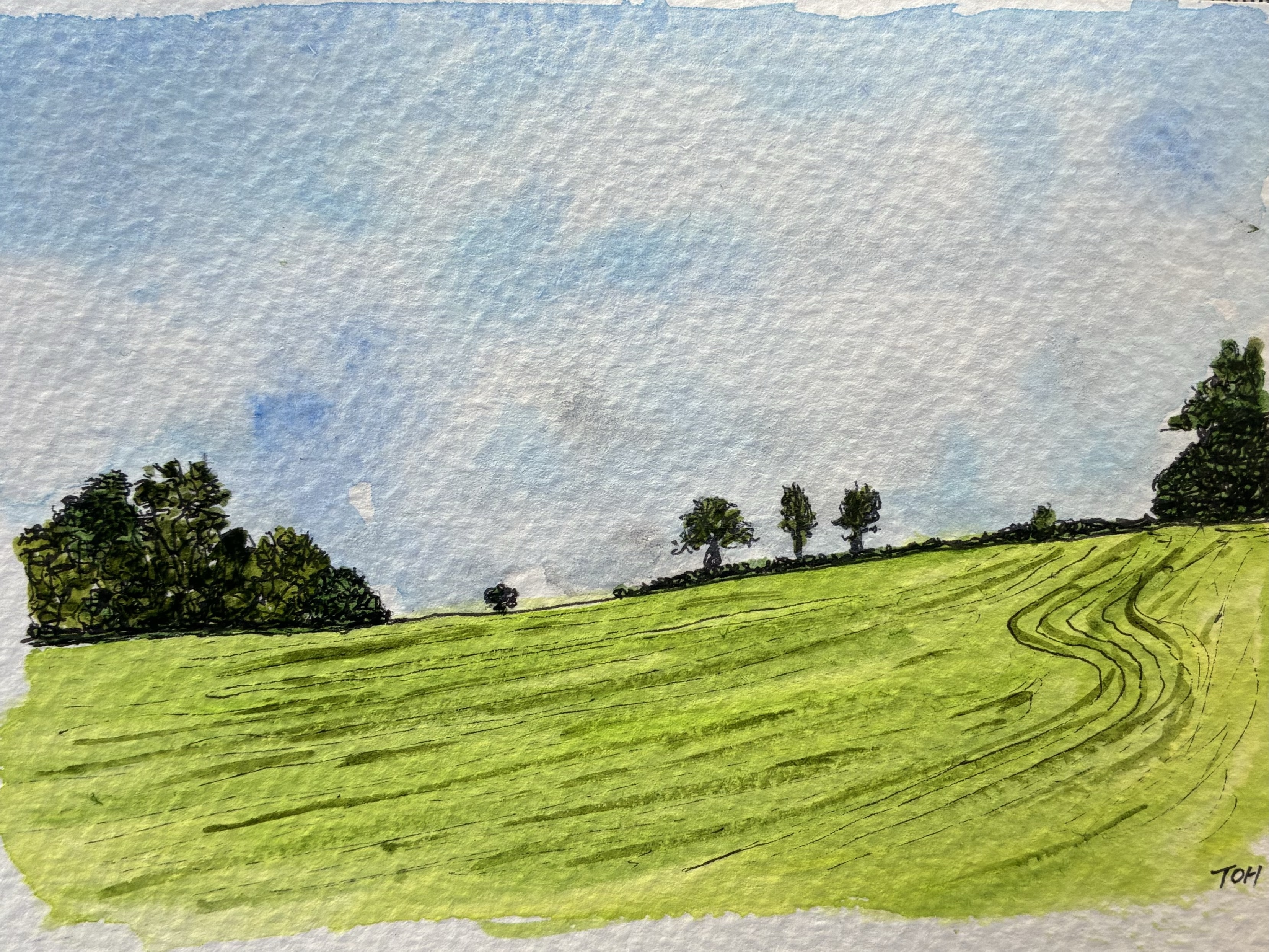
Grass Cut Field Near Kilve, Somerset
The Chantry Tea Garden, Kilve, Somerset

Finally, for now, here’s a scene I painted of the view looking west in the direction of Exmoor from the base of the Quantock Hills. I’ve tried to capture the way that there are successive ‘layers’ of rolling hills as the eye moves towards the horizon, each becoming progressively just a little higher than the previous one. Although wild landscapes can be exhilarating, I do like a farmed landscape – a patchwork of fields, hedges, copses and the odd farm building.
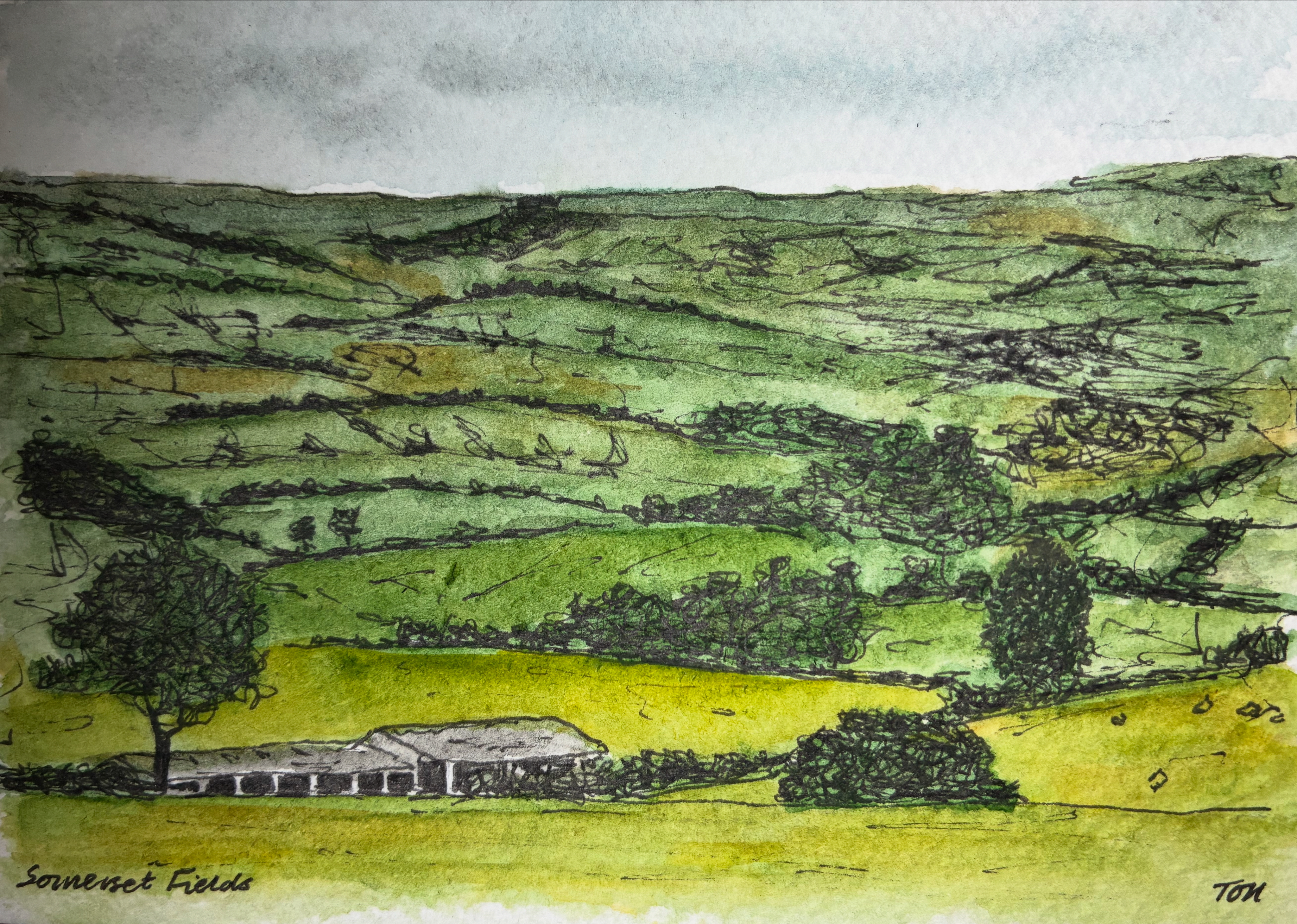
Somerset Fields Looking West From Near Crowcombe

All of these pictures were really just quick ‘practice’ pieces, but I like them all in different ways – Driftwood Cafe for its small details, the grass-cut field for its slightly abstract form, Chantry Tea Garden for its looseness, and Somerset Fields for the way it captures something of the wide expansiveness of the view.

If you have a favourite of these four pictures write a quick comment to let me know!
Blue #poem

What is blue
and is whatever it is the same for me as it is for you?
A scientist might state that blue describes:

colours perceived by humans observing light with a dominant wavelength between approximately four-hundred-and-fifty and four-hundred-and-ninety-five nanometres‘,

which may well tell us how blue can arise –
in the human mind,
when a certain type of electromagnetic radiation enters the eyes.
But this does not, I think, tell us what blue really is.
For how can we be sure
that the imagined colour that my mind selects,
in its constant rush to paint upon its ever-changing canvas,
comes from the same small pan
into which you dipped your brush?

You can say that blue is the colour of the sky
(by day at least),
or of the vast expanse of open sea
(mostly),
or the shirt worn by the best team
(certainly not).
But what if you see all of those as I see green?
(Well then we would agree – those shirts belong to by far the greatest team the world has ever seen).

So what is blue
to me, or to you?

To complicate matters further…
‘blue’ could refer not to colour but, rather,
to the tone of my thoughts.
But if I tell you that just now the thoughts inside my head are blue,
how do you know
whether I am simply feeling a little down on my luck,
or whether my mind, unleashed,
is filled with images of a naked couple…?
Again, we come unstuck.

We must agree then, I think, to put aside all ambiguities,
and to take the definition, with all of its nanometres, at face value.
Then we can label the sky as blue and the sea as blue,
we can assume my mood is melancholy
even if it is really full of sauce,
and we can move on
(although, we will never agree about those shirts of course).

(c) Tim O’Hare, September 2023


BLUE: I’m not entirely sure where the idea for this poem came from but I guess I just liked playing with the words and the rhymes and bringing together some threads from different aspects of my life – science, perception, atmosphere, ocean, sports.


A revised version of this poem was published in Issue 16 (March 2024, ‘Colour’) of Consilience – an online Science Communication/Poetry journal. I’ve repeated it below for completeness…


What is blue
and is whatever it is the same for me as it is for you?

A scientist might state that blue describes:
‘colours perceived by a human when observing light having a primary wavelength in the range four-hundred-and-fifty to four-hundred-and-ninety-five nanometres’,
which may well tell us how blue can arise –
in the human mind,
when a certain type of electromagnetic radiation enters the eyes –
but does not, I think, tell us what blue really is.
For how can we be sure
that the imagined colour that my mind selects in its constant rush
to paint upon its ever-changing canvas
comes from the same small pan into which you dipped your own brush?

You can say that blue is the colour of the sky (by day at least)
or of the vast expanse of open sea (mostly)
or the shirt worn by the best team (certainly not).
But what if you see all of those as I see green?
(And then we agree those shirts belong to by far the greatest team the world has ever seen).

So what is blue
to me or to you?

To complicate matters further…
Blue could refer not to the colour of a sight but, rather,
to the tone of my thoughts.
But if I tell you that, just now, the thoughts inside my head are blue,
how do you know whether I am simply feeling a little down on my luck
or whether my mind, unleashed, is filled with a tumble of racy thoughts?
Again, we come unstuck.

We must agree then, I think, to put aside the ambiguities
and to take the scientist’s definition, with all of its nanometres, at face value.
Then we can label the sky as blue and the sea as blue;
we can assume my mood is melancholy even it is really full of sauce;
and we can move on
(although, we will never agree about those shirts of course).

(c) Tim O’Hare, March 2024

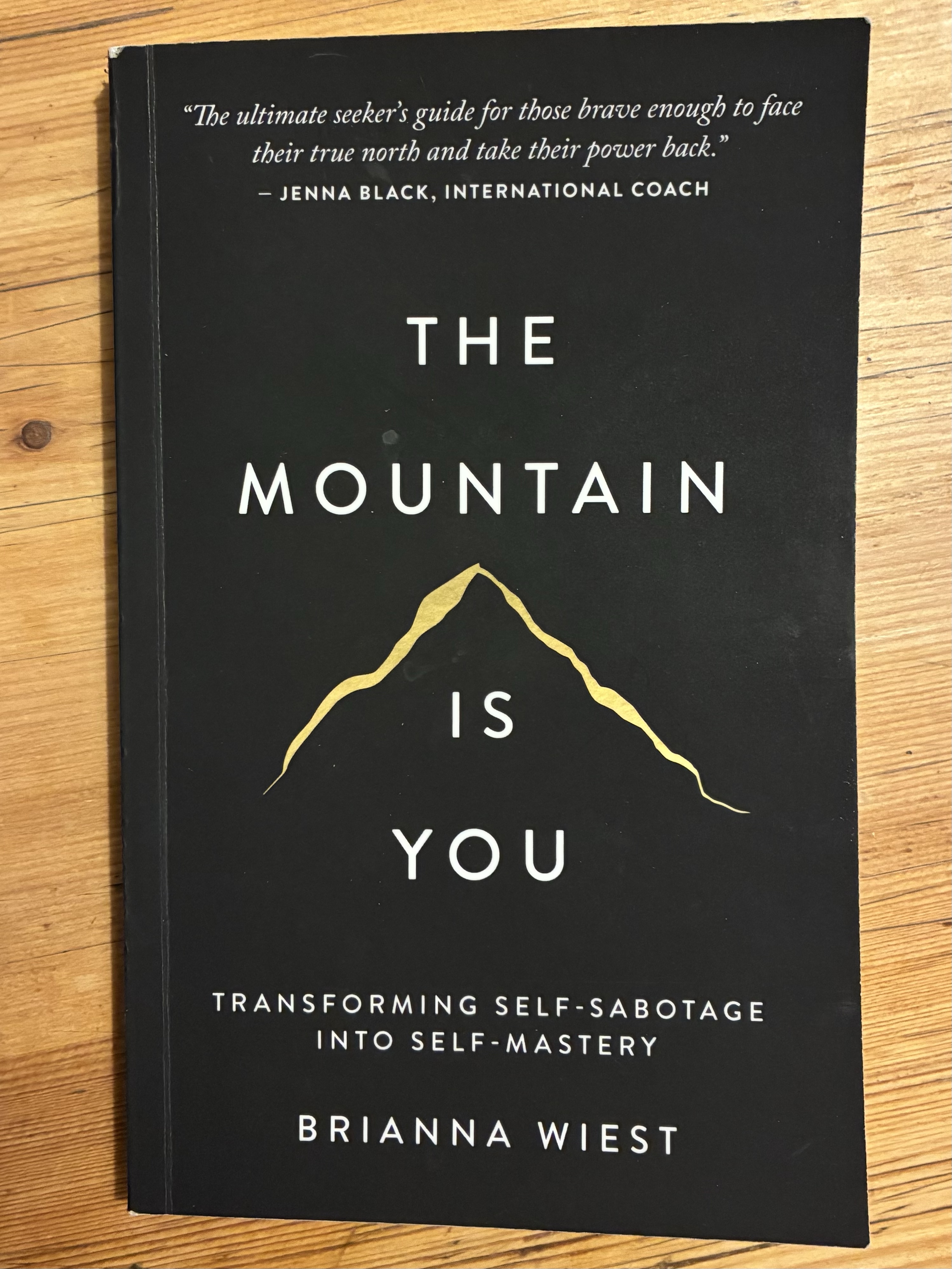
The Mountain Is You – Brianna Wiest #reading

The Mountain Is You: Transforming Self-Sabotage Into Self-Mastery by Brianna West is probably not a book that I would have picked up to read of my own accord, despite that fact that I am pretty much certain that a lot of the struggles I have in pushing myself into action and gaining the sense of achievement and fulfillment that I crave are driven at a fundamental level by self-sabotage in one form or another. There is just something about the whole mountain metaphor, along with the kinds of words used in the book blurb that I read online (‘deep internal work of excavating trauma’, ‘building resilience’, and ‘adjusting how we show up for the climb’) that instinctively put me off. Why then did I work my way through this book for a few weeks in April and May this year? Because it was voted as the reading matter for the May meeting of The Timecrafting Trust Book Club that I participate in, and so, dutifully, I ordered myself a copy and set to work.

Almost from the start, I realized that there might well be a bit more value for me from The Mountain Is You than I had envisaged. I was immediately stuck with some obvious similarity between some of the content being covered and the ideas of psychotherapist Carl Jung that I found enthralling and thoroughly convincing when I read James Hollis’s excellent The Middle Passage a year or so ago.

Wiest begins her book by describing the various forms that self-sabotage can take along with the underlying reasons why each type of self-sabotaging behaviour occurs. There were quite a few lines in this section of the book that resonated with me…

  • sometimes, we sabotage our professional success because what we really want it to create art
  • sometimes, our most sabotaging behaviours are really the result of long-held and unexamined fears we have about the world and ourselves
  • human beings experience a natural resistance to the unknown, because it is essentially the ultimate loss of control

… because yes, I do increasingly seem to be seeing myself as an artist, yes, I definitely have a lot of fears squashed down into my head that hold me back, and yes, I do tend to get overwhelmed and feel very uncomfortable when I perceive that things are spinning out of my control. But why then, knowing all of this, does nothing much really seem to change? Wiest delivers the killer answer:

most people do not actually change their lives until not changing becomes the less comfortable option

Wiest goes on to argue that, in fact, we might be better off re-framing self-sabotage because, ultimately, the habits and behaviours associated with it are actually a result of your very clever subconcious ensuring that some unfilled need, displaced emotion or neglected desire is being met – that those actions are, in fact, deliberately designed to provide a positive outcome that some hidden part of your subconscious seeks.

Aand funnily enough, just this morning, quite coincidentally, I wrote in my journal that perhaps I allowed myself to procrastinate and hold myself back from taking certain actions even though I know this will result in an intense wave of frustration and anger with myself, because at least those negative feelings and emotions are something that I am familiar with and are, in some weird and twisted way, somewhat comforting.

The next section of The Mountain Is You describes a long list of different manifestations of self-sabotage, and whilst many of these did not feel relevant to me, some of them certainly did – hello Perfectionism, Worrying About Least Likely Circumstances, Being Busy, Fear Of Failure, to name a few.

The start of the process of overcoming self-sabotage begins, Wiest suggests, with tuning into, and listening to, the negative emotions associated with it – things like anger, jealousy, regret, chronic fear. She highlights a basic need to be able to ‘allow yourself to feel what you feel without judgement or suppression and notes that understanding your needs, meeting the ones you are responsible for, and then allowing yourself to show up so others can meet the ones you can’t do on your own will help you break the self-sabotage cycle’. For example, feel angry, notice that you are angry, understand why you are angry, remember that it is okay to feel angry… and then get on with life.

There are then a couple of chapters with fairly standard fare on building emotional intelligence and on letting go of baggage from the past, but as these progressed I could feel the book moving steadily into the kind of territory that my initial instincts had led me to expect. Then, aargh, I hit a section titled ‘Releasing your past into the Quantum Field‘ and my brain was instantly screaming at me that I was now thoroughly into pseudo-scientific mumbo-jumbo land… the kind of land where, apparently, ‘You store … emotions, energies and patterns at a cellular level‘. Now, I guess that in some sense everything associated with an individual human is stored at a cellular level, but I am pretty sure that Wiest is suggesting there’s something rather more mysterious and perhaps spiritual going on. I’d be inclined to simply say that statements of that kind are just nonsense!

I guess that from that point onwards, my brain was in a state of high alert, warning me, perhaps unfairly, that much of what I was reading had no real, solid basis. There were lots of nice, almost mantra-like phrases: ‘be willing to be disliked‘, ‘do your inner work‘ and a series of suggestions to ‘create aligned goals, ‘find you inner peace’, ‘detach from worry’, ‘take triggers as signals’, ‘honour your discomfort’, ‘stop trying to be happy’, ‘arrive into the present’ etc., but in the end it was all a bit too much – too many suggestions, too many affirmations, too many challenges to think about overcoming, with the result that I came away confused and somewhat disappointed. After a promising, really very readable first half, everything seemed to have unraveled as the book reached its conclusion. There was just nothing much that was concrete or tangible for me to cling onto.

Late on in the book there was one phrase that I rather liked in a section titled ‘Be aware of what you give your energy’, namely that ‘the wolf that wins is the one that you feed‘ and strangely, on the day that I read those lines some spoke almost the exact same words to me (perhaps that pesky quantum field was doing its thing…). In fact, the whole book is stuffed full of short phrases and sentences that you could lift off the page and incorporate into an inspirational poster or social media post if that is your thing. I may not have warmed to Wiest’s mountain metaphor or felt that the argument in The Mountain Is You hung together in a fully coherent and convincing manner, but she certainly knows how to write what might be called ‘soundbite sentences’. Forget all the gumph about releasing you past into the quantum field and storing emotions at a cellular level, and take this phrase, right at the end of the book… …

One day, the mountain that was in front of you will be so far behind you, it will barely be visible in the distance. But who you become in learning to climb it? That will stay with you forever.

BOOM!

Square Peg #poem

I am the square peg in the round hole:
jammed in,
stuck fast,
placed by youthful naivety,
forced down by the weight of expectation,
held in place by the pressure of life’s demands,
and hammered home
by the repeated blows of round pegs that,
although appearing far too large
to fill such a seemingly trivial space,
are really too small to even touch the sides.

Yet, even in the tightest grip
it is possible to wriggle and writhe –
tiny movements that, though causing damage, breaks, and pain,
gradually,
imperceptibly,
ease the bind.
The needle must break the cloth to form the stitches of repair.

I am still the square peg,
plugging the round hole,
missing parts of my surface,
diminished,
and wearing hidden scars,
but now I have worked my way loose.
And though I cannot know the planes and slopes
of the land that lies outside,
I have seen it in glimpses,
and I am ready to slide out,
with freshly rounded corners,
ready to roll.

(c) Tim O’Hare, September 2023


SQUARE PEG: This is another poem that came up on me out of nowhere and very fast. In some ways it is a direct continuation from my poem It Is Time, but whereas that poem is about recognizing that a point of arrival has been reached, Square Peg is more about being ready to start out on the next part of the journey.

Walkham Woods (charcoal/watercolour) #art

Since I started drawing and painting back in April 2024 I have primarily worked with ink and watercolour paints, with my ‘go-to’ format being small, usually ~5cm square, pictures on some particular theme that I have chosen to explore for a few days. Producing pictures of that type has become my staple art activity, to the extent that I describe this as my ‘art practice’. However, I am constantly thinking about how I would like to explore different formats and work with different media. This especially happens when I visit an art exhibition, see works by other artists,and wonder what I could produce if I branched out a bit. The funny thing is that prior to my big shift into art in April 2024 I had actually begun to dabble with creating pictures with pastels (e.g. see my post Rediscovering The Artist Within) but I have not returned to pastels once since then.

Sometime back in May I must have been somewhere that brought me into contact with some charcoal drawings. I had a set of charcoal pencils sitting unopened in my art supplies box, and so I thought I would branch out a little and see what happened when I completed the drawing phase of a picture with charcoal, rather than adopting my usual approach of starting off with some faint pencil lines and then going all in with my black ink pen. I think I hoped that the different drawing texture might lead to me producing a more abstract picture. Then, after scribbling away with the charcoal pencil for a bit, I returned to the familiar territory of my watercolour paints to give my drawing some colour.

The result of my efforts is shown in the picture above – a charcoal -cribbles-with-watercolour painting of a row of what I refer to a ‘wall trees’, somewhere in the valley of the River Walkham, from a photo that I had taken on a walk there.

I’m not sure exactly what I think of this picture. It seems quite basic and simple – the trees sitting very much on top of the leafy backdrop and lacking much detail in their trunks and branches – and that simplicity pushes me towards thinking that the picture doesn’t quite work. But I also quite like the more impressionistic look – the rough lines suggesting the texture and structure of the stone wall, and the bright greens and particularly the yellows of the leaf canopy shouting out for attention. The picture has a naivety which I think gives it a certain charm. As I look at the picture, my eyes seem to be drawn in to explore what little detail there is, perhaps more so than happens when viewing one of my more detailed ink and watercolour pictures. Overall, I think that perhaps the switch in drawing medium was successful in helping me to present the view in a more abstract, suggestive manner than my normal ink-and-watercolour approach.

I’ve not had another go with charcoal pencils since I created this picture just over two months ago, but revisiting it now and writing this post has fired me up to spend some more time over the coming period to play around with different approaches and media a bit more. I wonder what will emerge!

The Productivity Diet – Mike Vardy #reading

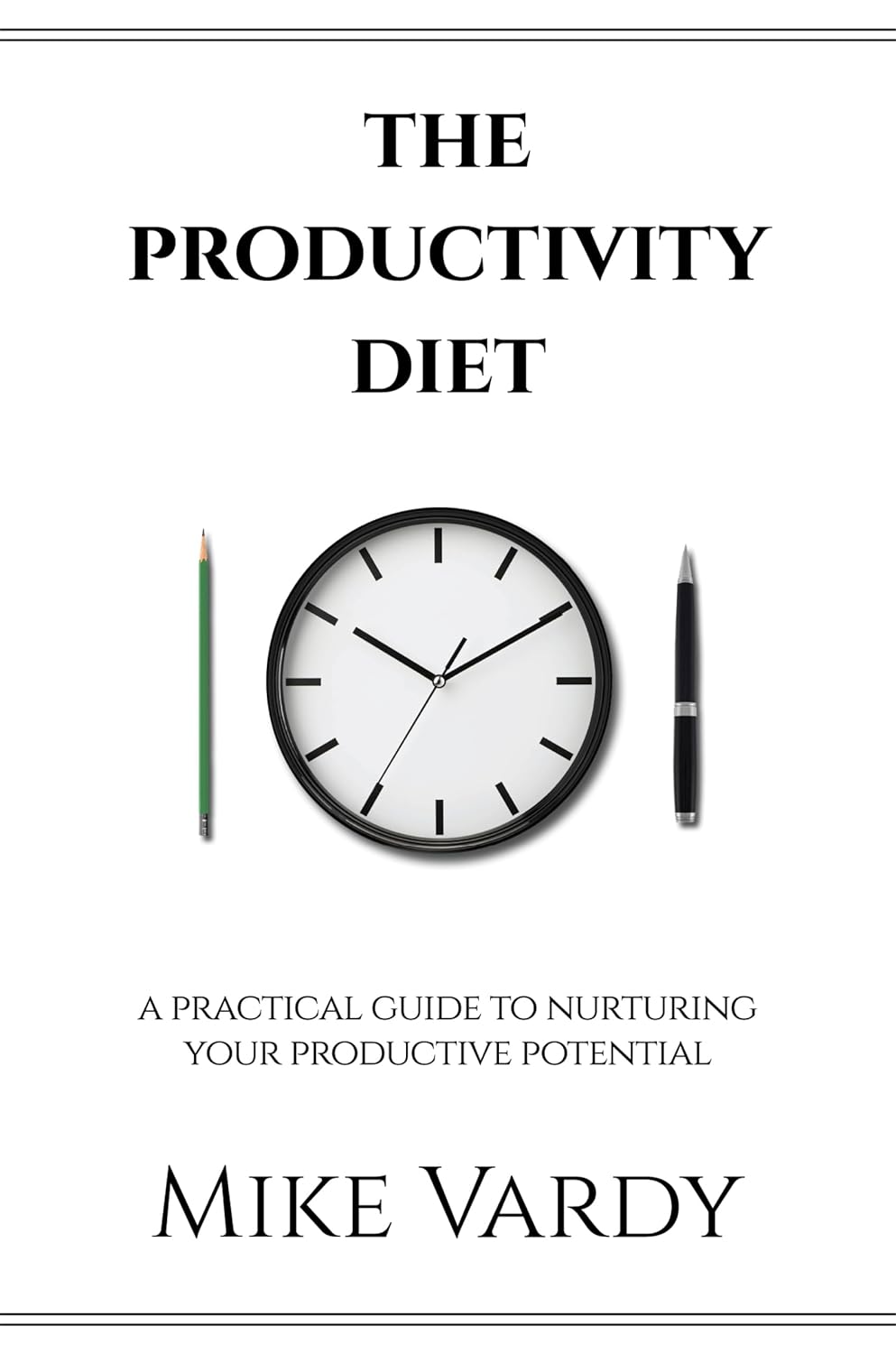
The Productivity Diet is the latest book written by Mike Vardy. Mike, who is based in Victoria, British Columbia, on the western side of Canada, describes himself as a ‘seasoned productivity expert, writer, coach and podcaster’ (quoting from his own website biography), and it was through the latter, his podcast A Productive Conversation, that I first became aware of his work. I don’t know how I initially stumbled on this podcast but for some years I have been a sucker for consuming content related to productivity (or ‘how we operate’ as I prefer to think of it). At some point, listening to episodes of the podcast led me to signing up for Mike’s email newsletter and then, after he sent out a request for people who felt they had a tendency to get started later in the day to contact him, I ended up chatting with him via Zoom about the productivity challenges that I faced and the approaches to overcoming those challenges that I used. At the end of the call, I politely declined the opportunity to join a coaching course with him (£££!!!) but did sign up as a member of his online community The TimeCrafting Trust. That was in March 2024, and over the last 15 months I have got to know quite a few other members of the community, most of whom are based in North America, and participated in a wide range of online events including monthly Book Club meetings, podcast livestreams, workshops and seasonal planning sessions. I think it’s fair to say that whilst Mike and I have never met in person, I could properly describe him as a friend, albeit of the online variety.

But what of The Productivity Diet itself? Mike’s basic view is that we cannot ‘manage time’ and so, instead, we should focus on managing our attention, in particular taking into account how much energy we have at any moment. To paraphrase the book: Productivity isn’t about managing time. It’s about how we use it, how we relate to it, and how we move within it. Mike argues that we should eschew rigid productivity systems in favour of thinking about productivity as a continuous interaction between Intention, Attention, Reflection and Action. Mike’s approach, which he calls TimeCrafting, involves laying out some broad intentions for our areas of focus, but then navigating the reality of our daily experience with a sense of gentleness and responsiveness to our evolving needs.

The Productivity Diet was the subject of a Kickstarter Campaign that Mike started before I got to know him. I think there were a few hiccups along the way, but the book was launched successfully earlier this year. The launch included Mike making appearances on a number of other productivity-related podcasts, and when he announced that he was going to focus an episode of his own podcast on the book I thought it would be fun to offer my services as a stand-in ‘host’ so that rather than it being Mike Vardy having a productive conversation with himself, the episode had a more normal host-author format. A little to my surprise, and despite the fact that I have pretty much no experience of working in broadcast communications, Mike thought this was a good idea and we went ahead and had a lot of fun recording the episode. You can pick it up here if you’re at all interested: A Productive Conversation Episode 603.

There are three major pillars to TimeCrafting as set out in The Productivity Diet: Time Theming, Attention Paths and Reflection.

Mike is big on the first of these pillars, Time Theming, suggesting that it can be beneficial to designate different kinds of themes to act as guide-rails as you decide, in the moment, exactly what to do next. These themes are time-based, for example, daily, weekly, monthly, seasonal or what are termed ‘horizontal’ themes where you select to focus your attention on a particular type of activity at the same time each day. At an even longer timescale, it is suggested that you adopt an ‘Annual Axiom’ – essentially a very short (e.g. three word) description to guide your overall approach to the year ahead. In the world of TimeCrafting, one might decide to group administrative tasks together to tackle on, say, Thursday, or to designate Friday as a day to consider finance-based activities, Tuesday for ‘creating’ etc. One might decide that the focus for the week ahead is, say, ‘rejuvenation’ or ‘correspondence’, or that the next month is for ‘growing contacts’ etc. A key aspect of Time Theming is that the themes are not meant to be a way to rigidly enforce a particular regime of action, but serve more as beacons to guide you back to an intended path if you move away from it. In addition, it is perfectly fine to do tasks and activities that do not match the current intended theme if there is time and space to do so.

The term ‘Attention Path‘ relates to a factor that will influence what you choose to, or can, focus your attention on at any given moment. The Productivity Diet introduces the acronym TREAT as a way to separate out five different types of attention path. TREAT stands for Time-based, Resource-based, Energy-based, Activity-based and Theme-based. The idea is that when selecting tasks to work on next, one considers the options in relation to each of these attention path types, asking questions like: Can this task be accomplished in the time I now have available? Do I have the resources I need to hand? Do I have the energy for this? Does it make sense to do this alongside some other similar task? Does this fit within my intended theme? I know from my interactions with him, that Mike is a firm believer in designating tasks as being low, medium or high energy so that, for example, when you hit a point in a day where you feel fatigued and might otherwise grind to a complete halt (as we all do…) you can glance at your list of possible tasks and pick one or two low energy tasks to accomplish. In this way, time which might otherwise be lost to the void of the internet (for example) can still result in some useful outcome.

The third pillar of TimeCrafting is Reflection. This is the key to continuous evolution and improvement. By reflecting on your actions, for example by writing in a journal, you can identify adjustments that can be made, obstacles to overcome, approaches that can be reinforced or extended. Without meaningful reflection there is no evidence base to use to help inform the decisions you make about what to do when and how etc., and so everything just unfolds somehow in a rather haphazard manner.

I will admit that in my own day-to-day operations, I have not had a great deal of success in using daily, weekly or monthly themes. I think my work days are too variable and I do not have sufficient control over exactly what needs to be done when, for them to work in a very consistent manner. But I think that having the general approach in mind is still helpful, especially at the longer timescales (‘this week/month I will focus on finishing X’). I have had more success with horizontal theming, but the variability of my days (sometimes I have classes to teach, other days I have a meeting etc) means that my attempts to impose order on my day through horizontal themes is generally most successful during the earlier and later (non-work hours) parts of each day. Similarly, I do consider attention paths to some extent, but I find that once my day is underway I tend to forget my plans and just go with the flow. It doesn’t help that I am not very good at checking in with myself to consider whether I would benefit from re-directing my attention (even setting reminders to do this doesn’t work very well – I just ignore them much of the time!). It’s not that I think the ideas underlying TimeCrafting are not valid, quite the reverse really, but I just seem to revolt against any attempt to constrain or direct my attention even though I would very much like to be able to do so!

I like the general approach of TimeCrafting that is set out in The Productivity Diet. I’ve tried to implement what might be called ‘heavier’ systems – things like time-blocking/time-boxing – and whilst they seem to offer an attractive level of control, I always (and quickly) end up revolting against them as my feelings in the moment take over. TimeCrafting offers a more gentle, sensitive, approach to keeping yourself on track, or at least somewhere close to being on track. To use a travel analogy, TimeCrafting is like having a traditional map, understanding what all of the symbols mean and knowing generally where you want to end up, but allowing yourself flexibility to move around the terrain, informed by the map, in the way that feels most appropriate at the time. This seems to me to be a much better way to travel than to switch on the SatNav and following it blindly to the selected destination, even when the road you have just been instructed to turn down is clearly little more than a rough and ever-narrowing track heading to an almost inevitable dead end and a ton of frustration as you try to turn around or back-up, surrounded by a herd of angry cows. Give me the map and my intuition any day!

An Encounter on Ilkley Moor #poem

It was the morning of the fourth day of July, twenty twenty-three,
and I was running, alone, on Ilkley Moor.
I could not take the path that I had planned,
for it was stolen from me by the grasp of ferns,
and so, instead, I found another way to travel west –
my route, like life, a path of unexpected turns.

As I drew level with a group of trees, planted in my mental map,
I turned to head, almost a scramble, up the rock-strewn slope,
until with the ground flattening all around, I came to a stone wall
and followed a well-worn path that lay in its shadow,
east, towards the radio mast.
From there I knew my way,
down the track they call the Keighley Road,
with a view across the valley over Ilkley town
that, like the passing of a life, would slip away too fast.

As I began my descent, his profile came into view,
to my right, just off the track,
though still some distance well ahead –
a small, dark man, sitting, gazing directly across my path,
chin resting on hands,
elbows propped on knees,
his head straining forwards
as if to peer through time to seek some other space.
He remained there as I closed, his features sharpening in my sight,
and I was struck how, like so much else in life,
his presence was incongruous.
For this did not seem to be his place.

I expected him to move as I approached, if only to shift his pose,
but he sat looking west across the track, across the moor – still.
And as my eyes searched for detail in his form
I saw that he was too small, about two-thirds the size of a man,
and so dark, yet without colour.

My brain was screaming at me: ‘Something is not right here’,
and I felt a heavy weight in the air around me.
I continued on,
towards the point beside the grey stone on which he sat.
My heart was beating fast, preparing to meet another life,
but on my arrival there was no-one there.

(c) Tim O’Hare, August 2023


AN ENCOUNTER ON ILKLEY MOOR: This poem tells the true story of an encounter that I had on a morning run while staying on Ilkley Moor for a week. There was a rock on the verge by the track that I ran along as I made my descent to our holiday let. As I came down the track towards it, I saw the figure of a small, dark man sitting there, just as I describe in the poem, and I instinctively felt that I was not able to recognise all that lay before me. Even now, many months later, I cannot let go of the fact that he was there and that, just for a few moments, either he or I was not in the right place.

Dartmoor Panoramas #art

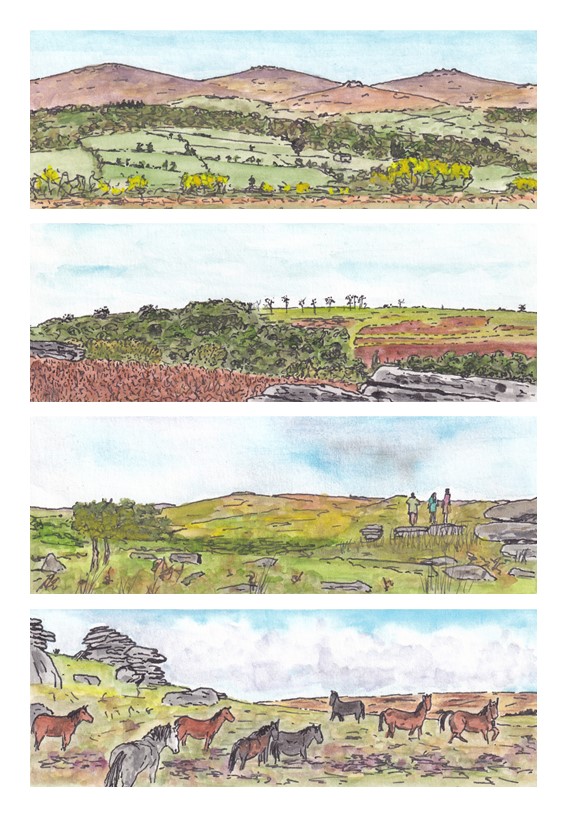
The proximity of Dartmoor to our home in Plymouth generally means that it is our go-to place for weekend walks, so it is hardly surprising that my phone is full of photographs of Dartmoor landscapes. I’m a particular sucker for ‘big views’, but my attempts to capture these in photographs are always something of a let down. Looking with the naked eye, big views fill my visual space with rich detail, but on camera everything seems to shrink, recede and flatten, resulting in a rather distant picture that is dominated by sky, and especially foreground, that the brain somehow filters out of the live view. I expect that this phenomenon is well understood by photographers, and it probably even has a special name, but to me it is just known as ‘disappointment’. This is compounded by the difficulty that I face when I subsequently try to capture this same kind of open, expansive view in one of my paintings. The part of a photograph that I want to paint seems to be only a small component of the whole, and no amount of zooming in seems to really help.

On one recent trip to Dartmoor I was pondering this issue when it occurred to me that what I was seeing with my eyes was a little like the view I got when I used my thumbs and index fingers to create a rectangular, letterbox-like, frame and then looked through that frame as if looking through a window. Despite there being so much more that could be seen, my brain seemed simply to ignore that part of the view that would have outside this frame, whereas my phone camera played no such trick. I began to wonder whether the key to painting this kind of view was to change the size and shape of the picture, adopting a similar letterbox, or panoramic, format. So, for a few days I played with this approach. The results are a series of four small painting that I refer to as my Dartmoor Panorama series.

I’m pleased with these pictures, at least to the extent that they better capture something approximating to the kinds of spacious views that I like best. Using a panoramic format does seem to work. In the third picture I was brave enough to include some people standing on one of the tors and gazing out at the view> I think this little piece of detail adds a lot to the picture, including a splash of contrasting colour. I was even more brave in the fourth picture, including a group of Dartmoor ponies. I tend to think that I’m not able to paint animals, but perhaps I am improving, because at least some of the ponies in this picture seem to have come out pretty well. I am particularly pleased with the grey pony in the foreground and the somewhat lively pony furthest to the right.

I feel sure that I will use this approach to painting expansive views again, and I suspect that at some point my curiosity will lead me to explore some photography guides to see whether I can find a proper explanation of my observation. It might have something to do with ‘foreshortening’ and/or ‘depth-of-field’ (words that I am vaguely familiar with that at least sound like they could be contributing factors). Who knows, perhaps someone reading this post will be able to point me in the right direction!

Tiny Experiments – Anne-Laure Le Cunff #reading

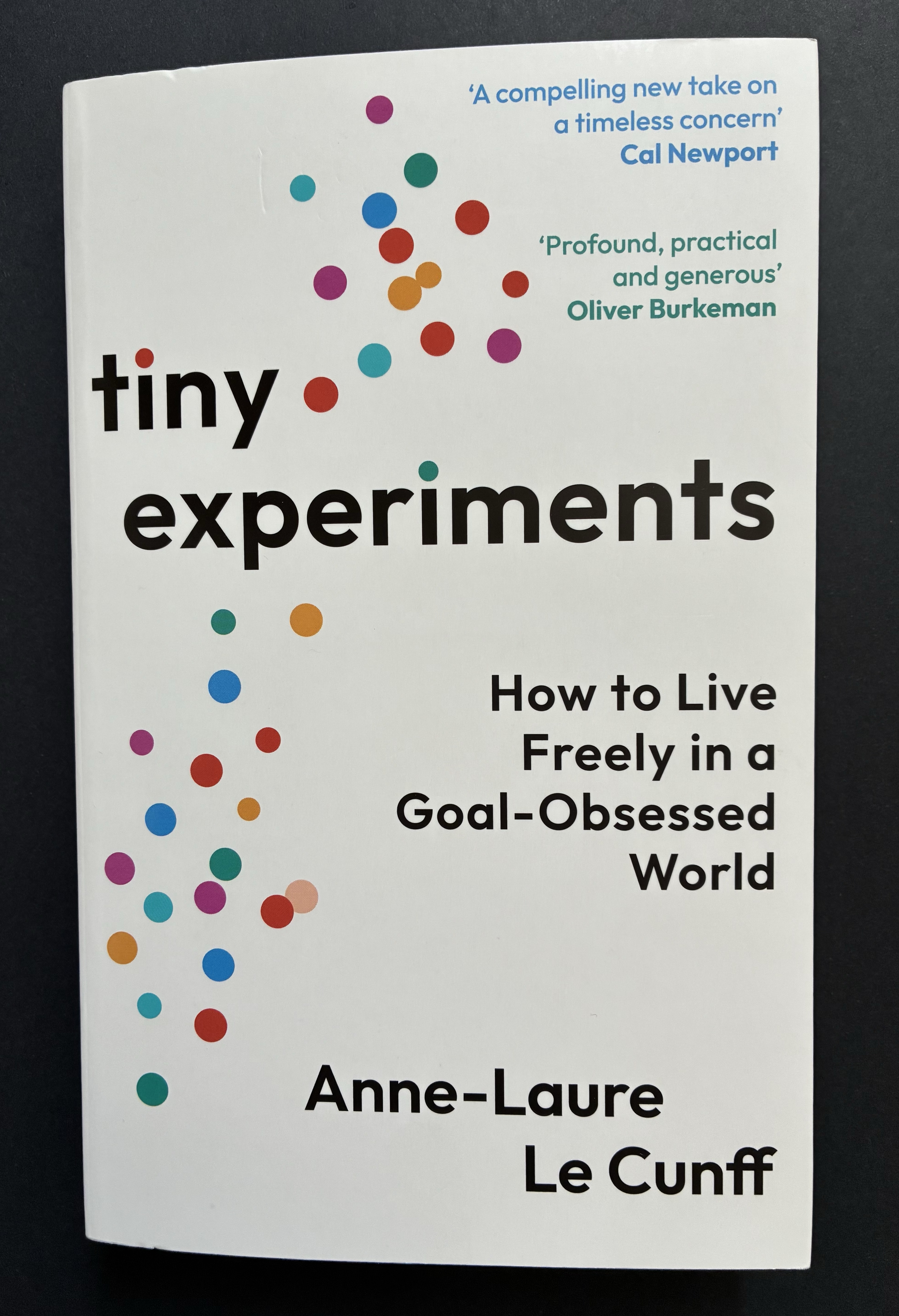
I read Anne-Laure Le Cunff’s debut book, Tiny Experiments, just a month after it was released in March 2025. However, this was not my first sight of the key ideas that the book contains, because I was lucky enough to be chosen as one of 300 people participating in a series of four, weekly online workshops, led by Le Cunff, that took place in February, in the lead up to the book’s publication. These workshops and the online community that accompanied them was called The Curiosity Collective, the name giving prominence to what is perhaps the key theme running Le Cunff’s work – the exhortation to live life in ‘curious mode‘, always willing to explore and experiment with your approach to life, and how you operate in the world. My experience attending those online workshops, showed me that Le Cunff is a highly skilled communicator and excellent teacher, and so I approached reading Tiny Experiments with high expectations. As an added bonus, the book had been chosen as the April pick for The TimeCrafting Trust Book Club.

As noted above, curiosity lies at the heart of Le Cunff’s ideas, and this is most obviously seen in her simple, four-part model for exploring and implementing change in your life. This model is rather neatly captured by the word sequence: PACT > ACT > REACT > IMPACT. At the start of the book, Le Cunff encourages the reader to adopt the mindset of a ‘self-anthropologist’, observing how they act in the world and the outcomes of these results, and then asking questions in relation to these observations. Le Cunff then structures the bulk of the text around her four-step model, stressing the importance of moving away from a Linear Mindset (X leads to Y leads to Z – end of story) towards the adoption of an Experimental Mindset based on the implementation of continuous experimental loops. My own feeling is that the key message here is not really about the distinction between linear v looping but, rather, one of ongoing adaptation and experimentation. The experiments one conducts don’t need to be thought of as loops (in fact they probably won’t bring you back to near your starting point) but they should take you somewhere, and in the process provide valuable evidence to help you work out what you might experiment with and where you might go next.

In the PACT phase of her model, Le Cunff presents a really neat (because it is simple) template for setting up what she refers to as a Tiny Experiment (an exploration of what happens when you make some small, realistic and manageable shift in the way that you operate). This template – a PACT – takes the following form:

“I will [action] for [duration]”

The key here is make sure that the action is purposeful, actionable (something that you can reliably perform), continuous (i.e. repeatable and not changing from day-to-day) and trackable. It is also important to be specific about the duration of the experiment (or else the number of repetitions). This ensures that the experiment is set up so that it provides a large enough dataset for meaningful conclusions to be drawn, but does not continue for so long that the action becomes tedious, or redundant or of little continued value. Essentially, the whole point of the PACT is to provide information that can then be used to adapt future behaviour and experiments, and not as a means to try to establish new habits.

In the ACT phase, you set about completing the activity specified in the PACT. This section of the book has some interesting material exploring the powerful forces of procrastination and, associated with this, perfectionism, that can so easily derail progress towards a goal.

The third phase of the model, REACT, occurs once the action described in the PACT has been completed for the specified duration. At this point, the goal is to look for, and then consider, evidence of the results of the action. Le Cunff highlights that it is important to look for evidence from within/internally (reflection) and externally (feedback from others, evaluation of results). Here, she presents what I suspect will become the most significant legacy of Tiny Experiments, namely her simple PLUS- MINUS-NEXT framework for reflection: what went well, felt good – what challenges or obstacles you faced, what was difficult, what negative feelings emerged – and then how the insights gained can shape future actions. [But whilst this framework is neat and seems to be catching on in the productivity community it might be noted that it is not so very different from the well-established ‘plus-minus-interesting’ framework.]

Because the whole point of Tiny Experiments is to encourage the adoption of an Experimental Mindset towards life, the REACT reflection should lead to a decision being made in relation to the area being investigated by the PACT. Le Cunff suggests that there are three possibilities: PERSIST – prolong the pact, or PAUSE – quit the pact or put it on hold, or PIVOT – modify the pact or shift the focus of a subsequent pact.

The final section of Le Cunff’s framework, IMPACT, focuses on the idea that it is helpful to be open/public about what you are setting out to achieve with your PACT and/or to work with others when pursuing it. This is largely a matter of gaining a useful chunk of external accountability, and also valuable feedback, but having seen many ‘public’ statements of Tiny Experiments PACTs in Le Cunff’s online community Ness Labs and on social media more generally, it is clear that it also serves as a powerful tool to market and promote Le Cunff’s ideas.

I enjoyed reading Tiny Experiments, and I feel pretty sure that it will be the kind of book that continues to have presence in the market for some time. It is well written and nicely structured, and the core ideas are simple (which is a good thing) and neatly presented, such that they have every chance of ‘sticking’. I think the phrase ‘Tiny Experiments‘ will likely become part of the productivity lexicon in similar fashion to James Clear’s ‘Atomic Habits‘. I also think that the “I will [action] for [duration]” statement for a PACT, the ‘PACT-ACT-REACT-IMPACT‘ model (or at least the ‘PACTACTREACT‘ part of it) and, in particular, the ‘PLUS-MINUS-NEXT‘ framework for reflection, will all end up having a healthy existence outside the printed pages of the Tiny Experiments book…

… but in the end, my enthusiasm for Tiny Experiments waned. I had several goes at defining pacts and conducting experiments, but I wasn’t able to make myself see any of them through to a satisfactory conclusion. Life got in the way, and I found myself ignoring my pacts and carrying on with my usual scattergun approach to trying things out. This, of course, probably says more about me than it does about the potential efficacy of Le Cunff’s ideas, but my experience was that despite the simplicity and neatness of the Tiny Experiments model, it did not possess enough power to persuade me to go all in with it. I have also felt that most of the Tiny Experiments that I have seen others setting out to pursue would really be much better described as ‘tiny habits’ (a phrase already coined by the author B.J. Fogg and, of course, rather similar to James Clear’s ‘atomic habits’), rather than tiny experiments, and to put it bluntly, many of them read like tiny morsels of misty-eyed, wishful thinking…

So, in the end I congratulate Anne-Laure Le Cunff for writing a really nice book that captures some neat ideas and makes some good general points, but despite the fact that I am still indulging in some daily ‘plus-minus-next’ reflection, I can’t say that it has turned me into a Tiny Experimentalist.

The Call of the Wild – Jack London #reading

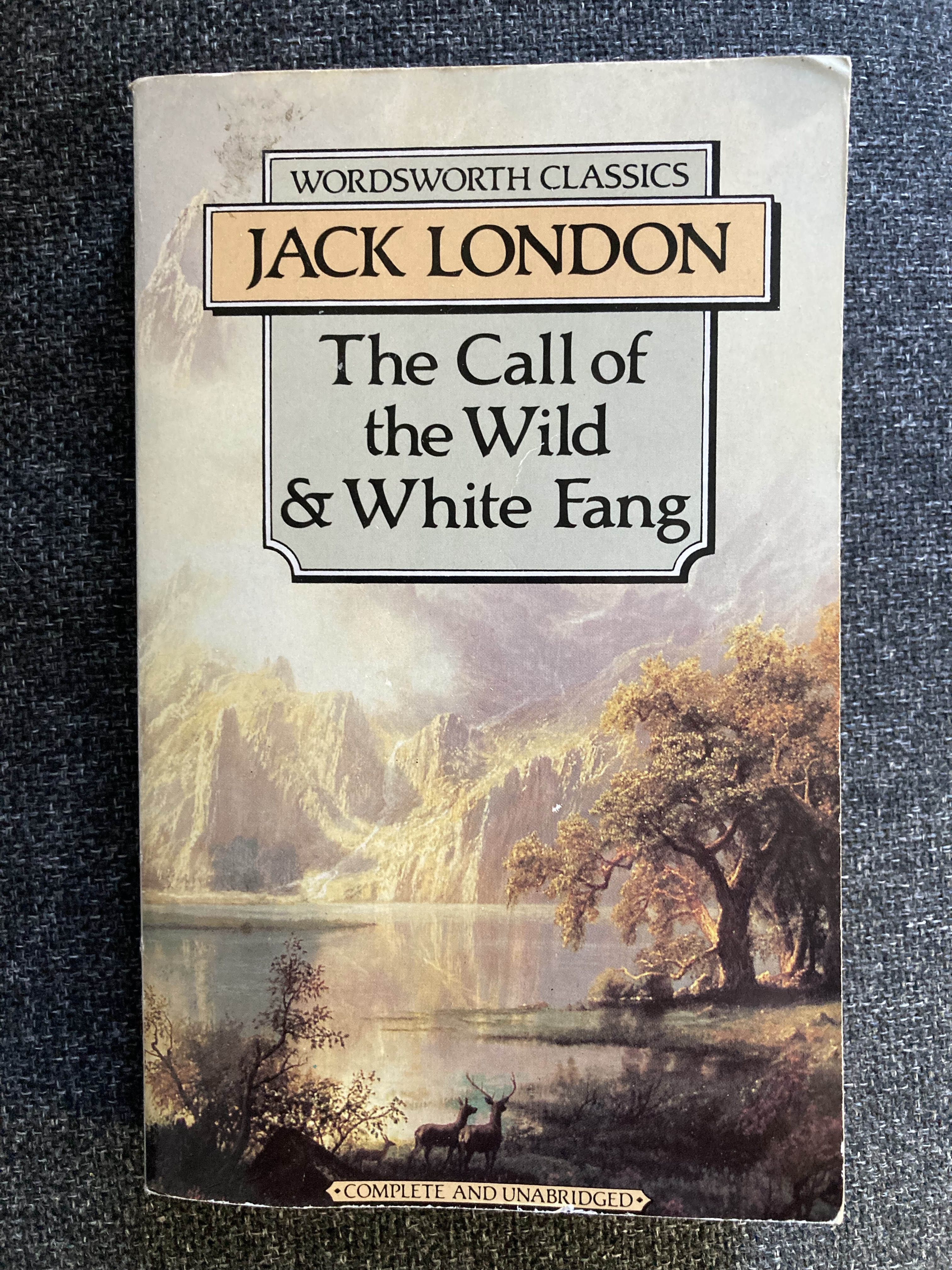
A few years ago I discovered the wonderful book 1000 Books To Read Before You Die by James Mustich. Looking through it made me think about the range of books that I read, and in an attempt to make myself explore titles that I might not otherwise look at, I decided that I would work my way through the letters of the alphabet, picking a title written by an author whose surname started with each letter in turn. On my first trip through the alphabet back in 2020 my L title was The Wizard of Earthsea by Ursula Le Guin and then on a second, much slower, alphabetical loop that began in mid-2022 and has only fairly recently reached R, I chose The Spy Who Came In From The Cold by John Le Carre. However, on both of these occasions I came very, very close to selecting one of Jack London’s adventure stories… and so after picking up a combined volume of The Call of the Wild and White Fang in a charity shop, I decided I would finally give one of them a go, plumping for The Call of the Wild, partly because it was the first stories that London wrote, but primarily (I will admit) because it was the shorter of the two!

I enjoyed the story, which is written entirely from the perspective of Buck, a pampered St Bernard-Scotch Shepherd dog who is stolen from a California ranch and sold into service as a sled dog in Alaska. Buck soon has to get wise to the demands of his new environment, being beaten by his first owner and learning to fight with the other dogs to ensure his place in the pecking order. Over time Buck passes between several owners, and makes the long journey into the Klondike region of Canada and across the Yukon Trail. Buck soon establishes himself as the lead dog, having to brutally respond to challenges from rivals. Eventually, Buck is found in a poor state by an experienced traveller John Thornton who nurses him back to health, and the two form a strong bond. Thornton becomes rich after finding gold, and with little work for his dog team to do, Buck, now thoroughly attuned to life in the wild northlands, hears the howling of wolves and wanders off into the wilderness. Buck locates a wolf pack and then makes regular trips to socialise with a lone wolf from it. One day, Buck returns to camp to find that Thornton, his companions, and their dogs, have all been killed by native Americans, and so he sets off in search of his wild brother. Buck encounters a wolf pack and has to fight with them for survival, before discovering that his lone wolf friend is a member of the pack. The story ends with Buck answering the ‘call of the wild’ as he goes off to join with the pack.

It was interesting to read a story in which the human characters are secondary and all of the events are seen through a dog’s eyes. Buck’s journey from domesticated animal to a fearsome creature capable of matching a pack of wild wolves is fascinating to follow, and along the way there are lots of poignant moments as Buck and his human owners come to know and love each other. There are also some sickening scenes in which some of the humans show a complete lack of respect for their animal companions, and for the environment through which they are travelling.

The overarching theme of the book, at least from my perspective, centres on the harshness of the environment and the need to show it, and those traveling through it (human or canine), the utmost respect. Buck instinctively learns first to survive, and then to thrive in the wild, but most of his human owners, underestimating the power of the natural world, do not fare so well.

Call of the Wild was an enjoyable, fairly light read, and it certainly didn’t put me off indulging in another dose of canine adventure, in the form of White Fang, at some point in the future.