Atomic Habits – James Clear #reading

The second book that I finished reading in 2025 was ‘Atomic Habits’ by James Clear. I had previously listened to the audiobook version almost immediately after it was released in 2018 but I picked it up again because it was selected as the January title for an online book club that I am a member of within The Timecrafting Trust (Mike Vardy). I will admit that, as much as anything, this time round my interest in Atomic Habits was focused on why it has occupied the bestseller lists for pretty much the entire period of its existence, selling an astonishing 15 million copies in the process (the irony of the fact that I have contributed two of those sales over the years was not lost on me!).

As the subtitle suggests, Atomic Habits positions itself as a guide to building good habits and breaking bad ones. It certainly does start off with a strong focus on (daily) habits, but as I worked my way through the text I soon found myself thinking that it wasn’t really about habits, rather it was simply about how to get things done.

Early in the book I found myself railing against Clear’s argument that habits are such powerful things because they act like compound interest – if you adopt a daily habit to become 1% better in some respect then the power of that habit compounds each day. Clear suggests that if you get 1 percent better each day for one year then you will end up 37 times better by the time you are done and implies that such improvements in personal performance or skill can be achieved by repeatedly performing a 1% better habit each day (note: 37 times better, not 37% better – I checked the maths!). But this is surely not true. A habit that makes you 1% better on the first day continues to make you 1% better than you originally were on the second and subsequent days, but to get better and better (i.e. to grow or compound the percentage improvement) I think you would have to change your activity on each successive day. I accept that there might well be some additional gain to be had by repeating the same habit each day, but not to the extent suggested by the comparison with compound interest. For example, if you adopt a habit of running a mile each day then you will certainly get fitter over an extended period of time than if you just go for the run once, but after a while you will find that your fitness has reached a plateau and to gain further improvement you will have to start running two miles each day etc. In my opinion, if you have to constantly change what you are doing then you are not developing a habit, you are just carrying out an ongoing programme of self-improvement! [I suppose it could be argued that the habit is then repeatedly showing up to complete that ever-changing activity.]

Setting aside my reservations about whether the book is really about habits or, as I think, about setting up your life so that you are more likely to get things done in general, where Atomic Habits succeeds is in distilling the ideas covered into a very simple set of four principles or laws. Each of these laws is matched to one of the stages associated with taking action: cue, craving, response and reward. Clear states these laws as follows:

  • make it obvious
  • make it attractive
  • make it easy
  • make it satisfying

I think it is hard to argue with this framework. Clear considers each of these laws in some detail offering various suggestions to help in each case, but I think that much of this material is not that necessary because the four laws do most of the heavy-lifting on their own.

Put simply: if you want to increase the chances that you will perform a task or activity then you need to make it more obvious and/or more attractive and/or easier and/or more satisfying. Similarly, to combat a bad or unwanted habit, you need to make the cue that triggers it less visible and make the habit itself less attractive and/or more difficult to do and/or less satisfying. I think it is this simplicity of the core message in Atomic Habits that is the secret of its success and its astonishing sales figures. It’s a message that is obviously right (or at least feels obviously right), easy to remember and also easy to make use of.
Job done.
Orbital – Samantha Harvey #reading

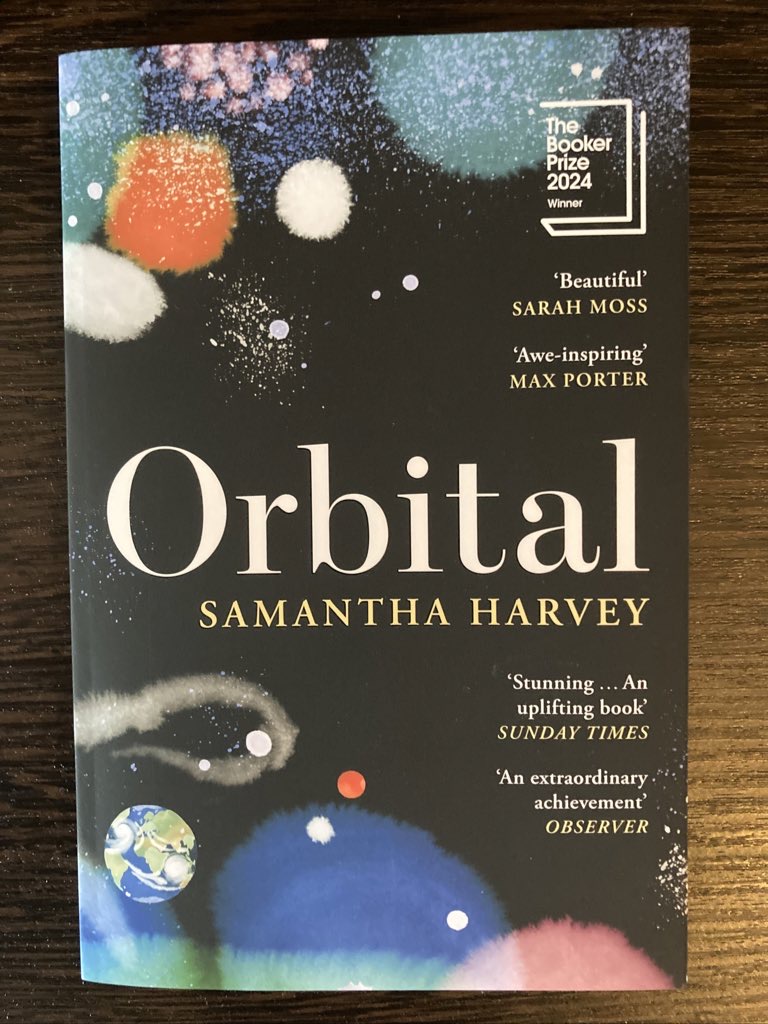
‘Orbital’, the 2024 Booker Prize-winning novel by Samantha Harvey was the first book that I finished reading this year. I will admit that I am not usually a reader of what might be called ‘literary’ fiction but as this book was fairly short and has a science-based theme (the book recounts the thoughts of a group of astronauts on board the International Space Station (ISS) as it orbits the Earth over the period of one day), my wife thought it would probably interest me and gave it to me as a Christmas present.

I find books like this, that don’t really have a story as such, quite intriguing. It is interesting to ask the question: What it is that makes spending time with one set of fictional characters doing nothing in particular, apart from existing and thinking, interesting? (especially as it is easy to imagine many instances when it certainly wouldn’t be).

As it turned out, I did enjoy the day I spent with Harvey’s collections of imagined astronauts as they repeatedly observed their home planet (the ISS completes 16 orbits of Earth per day) and mused on their connections with the people, places and events down below. The writing challenges the reader to consider their own place in the world and the perspective from which they view both ordinary and extraordinary events. For me, the core themes that emerged from my reading of Orbital were the extent to which so much of human endeavour is bound up in the pursuit of progress, both the grand-scale technological progress shared only by a few such as the astronauts on the ISS, and the small-scale, day-to-day progress, shared by everyone of us, and the fragility of the world that all of this progress has created.

While gazing down onto the planet’s surface, one of the astronauts muses on this theme of progress in connection with his relationship with his daughter and the passage in the text that captures the stream of his thoughts as he does so was one that resonated deeply for me:

But what he meant to say to his daughter – and what he will say when he returns – is that progress is not a thing but a feeling, it’s a feeling of adventure and expansion that starts in the belly and works up to the chest (and so often ends in the head where it tends to go wrong). It’s a feeling he has almost perpetually when here, in both the biggest and smallest of moments – this belly-chest knowing of the deep beauty of things, and of some improbable grace that has shot him up here in the thick of the stars. A beauty he feels while he vacuums the control panels and air vents, as they eat their lunch separately and then dinner together as they pile their waste into a cargo module to be launched towards earth where it’ll burn up in the atmosphere and be gone, as the spectrometer surveys the planet, as the day becomes night which quickly becomes day as the stars appear and disappear, as the continents pass beneath in infinite colour as he catches a glob of toothpaste mid-air on his brush, as he combs his hair and climbs tired at the end of each day into his untethered sleeping bag and hangs neither upside down nor the right way up, because there is no right way up, a fact the brain comes to accept without argument, as he prepares to sleep two hundred and fifty miles above any ground for their falsely imposed night while outside the sun rises and sets fitfully.

Madly, Deeply – The Alan Rickman Diaries

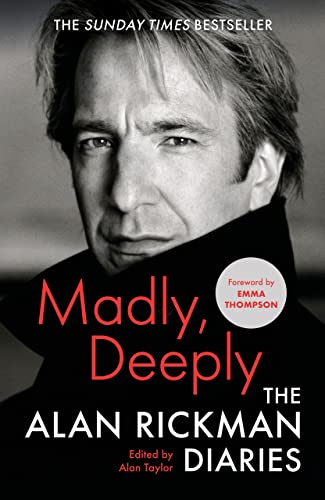
This morning I finally finished the weighty tome that is Madly Deeply – The Alan Rickman Diaries. I started it back in June 2023 and have been reading a section, usually 3-6 months of entries, most weekday mornings since then. So, it has been a long read and, to some extent, a bit of a slog.

I was attracted to reading Madly Deeply after reading a review article in a newspaper soon after it was released. The article made quite a big play of how wonderful Rickman’s actual diaries were to look at, often illustrated with really nice sketches and drawings relating to the themes he was writing about, so it was something of a let-down to find that the published book contained only five pages (of over 450 in total) that showed any of these illustrations (and two of those five pages were the inside front cover). But never mind, there would always be interesting insights to read about the Harry Potter films since he surely must have loved his involvement in those in his role as Severus Snape…

Alas, it turns out that Rickman clearly didn’t much like being such a major part of the HP film series to the extent that he almost bailed out part way through (imagine if that had happened…).

The first thing that hit me smack bang in the face when I started reading the diaries (they begin in 1993 and run through to his death at the age of 69 in 2015) was that his life was absolutely, completely, inexpicably busy. Hardly a day seemed to pass when he wasn’t flying somewhere, seeing a film or play, dining out with friends, rehearsing, discussing things with directors and producers and agents, fending off critics etc. In fact, it felt like he did most of these things on most days – one day in New York, then on to Paris, Prague, South Africa, Italy, California, London in an utter whirlwind of activity. Just reading about his life left me exhausted and I still cannot comprehend how anyone can cope with such a life and, apparently, have so much energy. [I wasn’t surprised when, quite far on in the diaries, he casually dropped in a reference to his ADHD… although his flavour ADHD was certainly not much like my flavour of ADHD!]

I can’t say that I particularly warmed to Alan Rickman as a person through his diary entries which surprised me a little, although on reflection there is really no reason why I might have expected to. His entries often paint a picture of a slightly bitter man, somewhat intolerant about the ‘failings’ of others (of which there seemed to be many), who seemed to feel a little under-valued and, perhaps, frustrated that he was not always understood as he felt he should be. But then there are also clear indications of loyalty, a desire for fairness and a love of his art and a quirky sense of humour.

Overall, it was interesting to get a little glimpse of a world that I was almost completely oblivious to prior to reading the book – an insane world of rushing about and pouring oneself into project after project – a world that truly must have been madly and deeply exhausting but, I guess, full of experience and excitement. I don’t want to rush about quite to the extent that Alan Rickman seemed able to but it’s perhaps useful to have received this glimpse of just how much a life fully lived can contain.

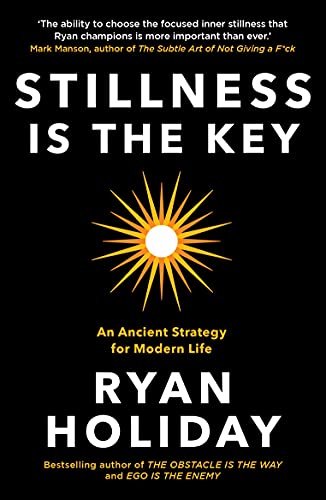
Stillness Is The Key (Ryan Holiday)

Stillness Is The Key was the third of author and modern-day purveyor of Stoic wisdom Ryan Holiday’s original set of books about the application of practicing Stoicism in everyday life. I read (actually listened to) the first two – Ego Is The Enemy and The Obstacle Is The Way – back in late 2017 soon after I started to become interested in Stoicism. Since then I have worked my way through the rest of his more recent output such that I would now probably have to label myself as a committed Ryan Holiday disciple. In 2018 I read The Daily Stoic one day at a time (something I am in the process of repeating this year) and then I listened to the first two volumes of his ongoing Stoic Virtues series – Courage Is Calling and Discipline Is Destiny – in 2021 and 2022 respectively. Last year I completed Lives of the Stoics and I have the third installment of the Stoic Virtues series (Right Thing, Right Now – Justice In An Unjust World) on pre-order for its release later this year. So with all of that in mind it is somewhat odd that it is only now that I have gone back to complete the original trilogy by listening to Stillness Is The Key.

With Ryan Holiday’s work I have always particularly enjoyed listening to the audiobook versions. Not all readers are the right person to narrate their own words but I find that Holiday’s narration brings the words to life and always keeps my attention (usually I am walking to or from work when I listen to audiobooks).

As with all of his other books I enjoyed this dose of Stoic wisdom. Holiday makes the simple wisdom contained in the ancient writings of Epictetus, Seneca and, of course, Marcus Aurelius relevant to life in the present day, treating them like mentors who we can lean upon for advice whenever we feel in need of a slight nudge or some help to become unstuck. The general theme of Stillness Is The Key is, naturally, one of slowing down a little, considering, maintaining a sense of balanced calm and, let’s face it, we could all do with some of that at times (or even often!).

I don’t think Stillness Is The Key is Holiday’s best work. In fact, I think his more recent Stoic Virtues series books are much better crafted than his earlier ones, but then that is surely to be expected as he has lived, practiced and absorbed Stoicism for longer and, I tentatively suggest, become a better writer too as the years have passed. But Stillness Is The Key is still worth reading (or listening to) because above all else it is important to remember that Stoicism is a more than a philosophy – it’s a way of approaching life and something that needs to be practiced, practiced and practiced, day in and day out. Anything that sets out Stoic ideas as clearly as Holiday’s writing and puts them in the front of my mind for a bit is going to help ensure that all of that practice helps to push me a little closer to that impossible to find place where practice makes perfect!

The Bigger Picture (Petrus Ursem)

Last November we popped up to Yelverton to visit a local event for artists and makers from the Tamar Valley. There were quite a few stalls with different types of artwork that I really liked, one such being the work of artist and writer Peter Ursem. As well as his wonderful lithograph prints of various locations in and around Dartmoor and the Tamar Valley he also had a few prints and cards of some poetry and copies of his books – a children’s adventure story trilogy that I really must read sometime and a small volume called ‘The Bigger Picture’ written under his pen-name Petrus Ursem. I got chatting with Peter about is work and immediately felt a strong mental connection – we talked about the process of writing and where ideas come from and he told me about how TBP was a collection of short fables written in similar form to those of the Master of Fables, Aesop, with a group of animals interacting to discuss and explore different pieces of wisdom and thought. I was immediately hooked by his description and purchased a copy of TBP which I have been reading on and off since then – one fable (of forty in total) each morning.

Many of the fables in The Bigger Picture take a word or short phrase and then have the different animals (a rather odd mix including a crocodile, an owl a peacock, a worm, a bull, a bee and others along with a few non-animal characters like Cloud) riffing on it as they meet up and go about their daily business, always uncovering some little nugget of wisdom along the way. To give an idea there are fables called ‘Between a Rock and a Hard Place’, ‘Point of View’ and ‘No Half Measures’. Talking with Peter I was interested to hear that partly this construction stemmed from him originally being from The Netherlands and so being intrigued by certain turns of phrase in English.

I finished the last fable ‘Being You’ last week and as I did so I found myself wishing that during my first readings I had made some notes to capture a few quotes and some of the glimpses of wisdom the fables contained. At first, I was a little disappointed to reflect that most of what I had read had slipped straight out of my head but then I realised that this was actually a bonus… because I have now promised myself that at some point in the not too distant future I will read The Bigger Picture through again, with pencil and notebook in hand, and be inspired and enchanted once more.

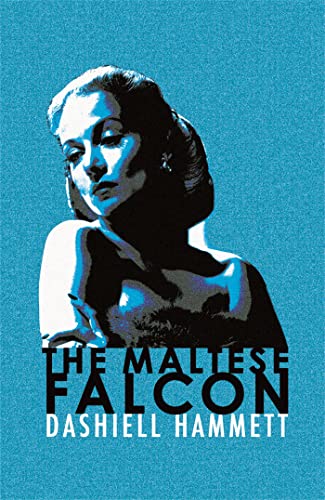
The Maltese Falcon (Dashiell Hammett)

Way back in 2020 I started a ‘project’ of reading my way through an alphabet of author surnames using the wonderful book ‘1000 Books To Read Before You Die’ by James Mustich as my inspiration. The idea was to deliberately pick books and authors that I wouldn’t otherwise or normally read, selecting titles from those for which Mustich’s entries piqued my interest in some way. These weren’t the only books I read at the time but I made a point of moving quite swiftly through the alphabet and it took me just under 15 months to make it through from A as far as W but missing out Q because the only option suggested by Mustich was The Q’uran and whilst I would actually like to read that book I just didn’t want to have to devote so much of my reading time to that kind of challenge. The options for X, Y and Z were also really limited and so I decided not to force myself to complete those last three letters. It was a really interesting experience and one that introduced me to some really excellent books including one of my now all-time favourites, Jeanette Haien’s ‘The All Of It’.

In summer 2022 I decided I would repeat the challenge and started again on A, but this time I only got as far as C in the space of two months before my reading went off in other directions. I picked things up again last summer and made my way through D to G during the rest of 2023. Having gained a little momentum again I decided to keep going with my second author alphabet this year…

My first completed book of the year was ‘The Maltese Falcon’ by Dashiell Hammett – a 1930s thriller involving various rather odd and somewhat incompetent criminals and somewhat too invincible private eye who are all caught up in pursuit of a valuable old, bejeweled statuette of a bird. The action moved on quickly, rather too quickly for any significant plot or character development in my opinion which in the end left me having quite enjoyed the read but certainly not drawn to explore any of Hammett’s other work.

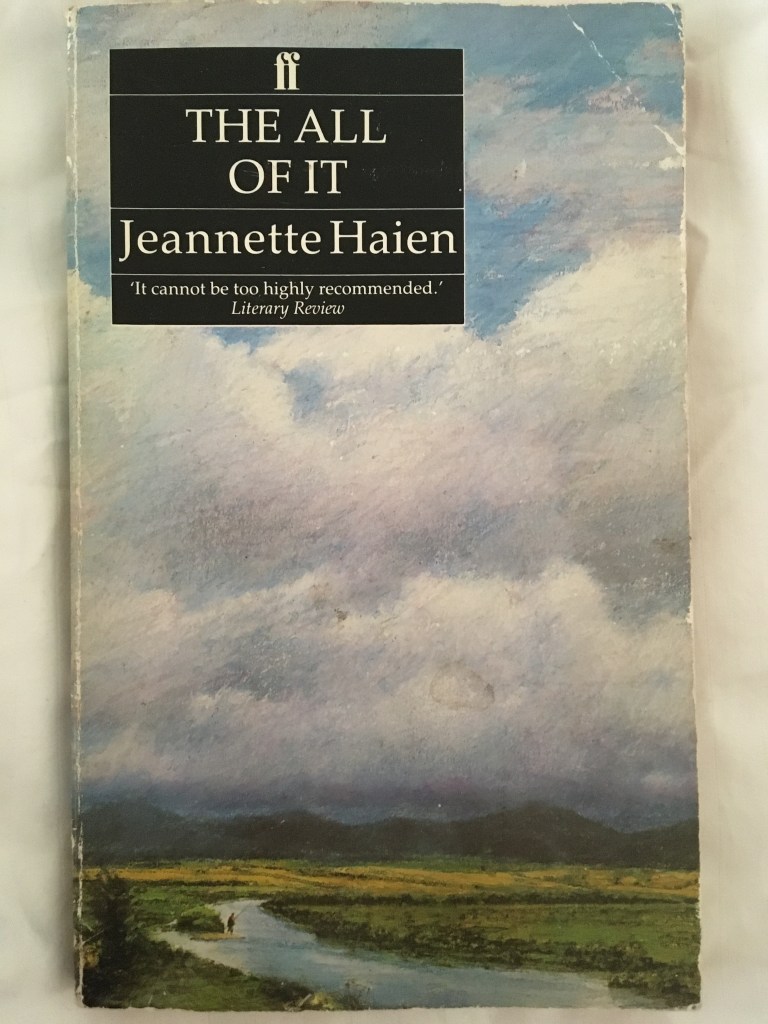
The All Of It (Jeannette Haien)

At the start of the year I decided that interspersed within other books, I would aim to read one book by an author from each letter of the alphabet in sequence chosen from James Mustich’s wonderful volume 1001 Books To Read Before You Die. In particular, I wanted as much as possible to try to use this mini-project as a spur to read (or listen to in audiobook form) works that I wouldn’t otherwise consider. So far this year I have already worked my way through Edward Abbey’s ‘Desert Solitaire’, Natalie Babbitt’s ‘Tuck Everlasting’, J.L. Carr’s ‘A Month in the Country’, Alain De Botton’s ‘How Proust Can Change Your Life’, Loren Eiseley’s ‘The Immense Journey’, F.Scott Fitzgerald’s ‘The Great Gatsby’ and William Golding’s ‘Lord of the Flies’ amongst 22 other books mostly not in Mustich’s big list. Last night, I finished my ‘H’ book, Jeanette Haien’s ‘The All Of It’.

‘The All Of It’ is a short novel (just over 140 pages) and was Haien’s first, written in her 60s after she had had a successful career as a concert pianist. The novel is set in the wild part of northwestern Ireland and revolves around the ‘confession’ by a 60ish year old woman Edna to the local Catholic Priest Father Declan after the passing of 63 year old Kevin. I won’t say any more about Kevin in case you read the book. Interspersed with Edna’s ‘confession’, when she tells Father Declan the ‘all of it’ is description of his attempt to catch a salmon on the final day of the fishing season a day or two after their conversation. I can’t really say any more about the plot because that would give everything away. It’s a simple story, nicely told and really it is a story about being fearless and taking the plunge, of which there are at least four taken in the story – Edna and Kevin’s plunge in their childhood, Edna’s plunge in telling Father Declan the story, Father Declan’s plunge in having one last cast with a fly (a trout fly even!) and then Father Declan’s final plunge, arguably the most significant plunge of all.

I bought my copy of ‘The All Of It’ secondhand from an eBay seller. It absolutely stank of what I can only describe as musty, old lady, perfume – not exactly the best thing at a time when you have heightened awareness of the contents of the air that you put near your face and you have a habit of flicking quickly through the pages of a book to look for chapter breaks and to gauge how far you have to go. Several times I blasted my face with old, I mean REALLY old, perfume and who knows what else. But I am still alive so far and, oddly, the musty old perfume smell made me feel just a little more connected to Edna than I might otherwise have been.

I’m an absolute sucker for a story that holds wisdom within it and, although simple, ‘The All Of It’ certainly does hold wisdom, oodles of it. Sometimes in life you just have to step over the threshold or start to talk or cast your line or listen to your heart.

The Four Tendencies (Gretchen Rubin)

Last week I was struck with the thought that whilst I am pretty good at doing the stuff I have to do for other people or by specific deadlines, I am pretty rubbish at making progress on things that I simply want to get done for the sake of it or that I have a more-or-less open-ended time structure for. Sometimes a work task will start off on a pretty much open-ended timeline and I make some progress but then a deadline appears, usually instigated by someone else, and I rapidly make progress to ensure that I deliver it on time. I wrote down a few words on this in my notebook around the idea that I tend to need ‘external accountability’ to push forwards on tasks, did a quick internet search for that pair of words and immediately stumbled on the framework of The Four Tendencies as outlined by US author Gretchen Rubin. I have come across this framework before not least when I read Rubin’s book ‘Better Than Before’ last year as it is covered briefly in that volume (I didn’t particularly like ‘Better Than Before’ and felt it was all a bit frothy and under-researched). It turned out that Rubin had now published another book called ‘The Four Tendencies’ expanding on the framework and, because it aligned with my thoughts at the moment, I thought it was probably one that I should give a try. At the time, I happened to be sitting in a cafe in a bookshop and a quick Google search revealed that there was one copy of the book on the shelves – from that point, the purchase was pretty much inevitable.

A week on I have finished reading ‘The Four Tendencies’. Overall, I think the general concept of the framework is interesting and somewhat thought-provoking. Basically the framework is a classic 2 x 2 matrix with four quadrants defined by whether an individual tends to meet or not meet external and internal expectations. The result is four ‘tendencies’ – the Upholder who meets external and internal expectations, the Obliger who meets external expectations but struggles with internal ones, the Questioner who readily meets internal expectations but fights against external ones and the Rebel who fights against both external and internal expectations. There is a short online quiz that can be used to determine your personal tendency which is supposed to be unchangeable. Even before taking the quiz I was pretty sure I was an Obliger and this is how it turned out. However, I was pretty much convinced that my wife would be an Upholder but she turned out to be the opposite – a Rebel. Both of my daughters came through as Questioners which was not too surprising. The book WAS interesting in terms of helping me to think about the underlying concept of the framework and, in particular, in considering how thinking about the tendencies of work colleagues would influence the way that they respond to instructions, requests for information etc. However, the more of the book I read, the more frustrated with it I became. Most of what Rubin writes is based on her own ‘research’ which essentially entails talking to people and receiving comments from them on her blog and podcast and the book is written utilising lots of example quotes to support the ideas being discussed. But with this approach there is an almost inevitable feeling that there is a lot of cherry picking going on and that examples are chosen to make a desired point when perfectly sensible counter-examples can readily be imagined. Also, the deeper into things I got the more I felt that some of the writing was contradictory and muddled. For example, Rebels are portrayed as more-or-less actively seeking to, and enjoying, pushing back at expectations but I think there must be many ‘rebels’ who don’t actively want to not meet expectations – they just find that they struggle to. In fairness, Rubin does highlight that other factors such as personality traits, mindsets etc sit across the tendencies framework but, to me, this felt like saying that everything in the book could be wrong or could be hugely influenced by other factors not considered.

As an Obliger (supposedly), the secret to meeting internal expectations better is apparently to seek external accountability. This kind of rings true for me, but I am pretty sure that this is only a small part of the solution.

After I read the book I took the quiz again and came out as a Questioner. To be honest I think you could probably get whatever tendency you wanted to get with very small tweaks in the responses given. After all, the quiz is not a properly constructed research tool that has been validated in any way (one of the questions isn’t even worded in a way that makes full sense).

In summary, I like the basic idea of the four tendencies and it is an interesting aspect of personal operation to think about for a while. It just doesn’t have enough meat to it to stretched out to a full book.

The Happiness (Book) Epidemic

After a day of rain and with the local snowmageddon apparently more or less over we ventured out at the end of this afternoon for a quick trip to Waterstones bookshop. The main purpose of the visit was to look at books about soup (i.e. books with recipes for soups not esoteric books on the history or philosophy of soup – I am not THAT strange) but while in the bookshop it was hard to resist the temptation of a quick general browse. I love looking at books in bookshops but the problem is that I always find at least 10 books that I want to read and then have to fight myself not to buy any, using the knowledge that I already have (probably) 20-30 unread titles sitting around at home waiting for their turn to be opened. So today I was strictly on a look but don’t buy mission.

As I looked around the main thing that struck me is that it seems to be impossible to be a ‘somebody’ these days without writing a book on the topic of happiness, or the related ideas of how to live a good life or how to live a healthy life or even the holy trinity of how to live a healthy, happy AND good life. There are books on happiness by TV presenters, sportspeople, philosophers, food experts, survivalists, etc. – the list goes on. Now a quick glance down through the archive of this blog may well lead you to (correctly) conclude that I am somewhat partial to reading this kind of material and so I am not exactly complaining about this state of affairs. SOME of these books are interesting, approach things from a unique or novel angle, are based on sound research etc. but it cannot possibly be the case that they ALL have something distinctive to say on the topic. There is obviously an epidemic of book writing on happiness with everybody and their neighbours jumping onto the bandwagon to try to grab their own little piece of the the happiness market profit (or perhaps work through their own unhappiness in an attempt to reverse it). Ten years ago, perhaps even just five, the idea of there being a ‘happiness’ industry would probably have been laughed at. Now it is a rich vein for celebrities to mine for £s and $s. I guess they have obviously never come across the research that shows that (lots of) money doesn’t buy happiness, or if they have, they can’t bring themselves to believe it. Perhaps I should be more generous – perhaps they are just trying to help…

I did see one title that I will definitely be getting at some point, a book called (I think) ‘A Good Life: Philosophy From Cradle To Grave’ by Mark Rowlands. I’ve read two books by Rowlands before – ‘Running with the Pack’ (his book about running, mostly with his various dogs) and ‘The Philosopher and the Wolf’ (his book about his life with a wolf and other wolf-dog crosses and the lessons he has learned about life from these animals) and I found both to be absolutely superb, full of proper, deep, philosophical musings. But then Rowlands IS a philosopher and a teacher so it’s hardly surprising that he has interesting things to say.

Seven Brief Lessons On Physics (Carlo Rovelli)

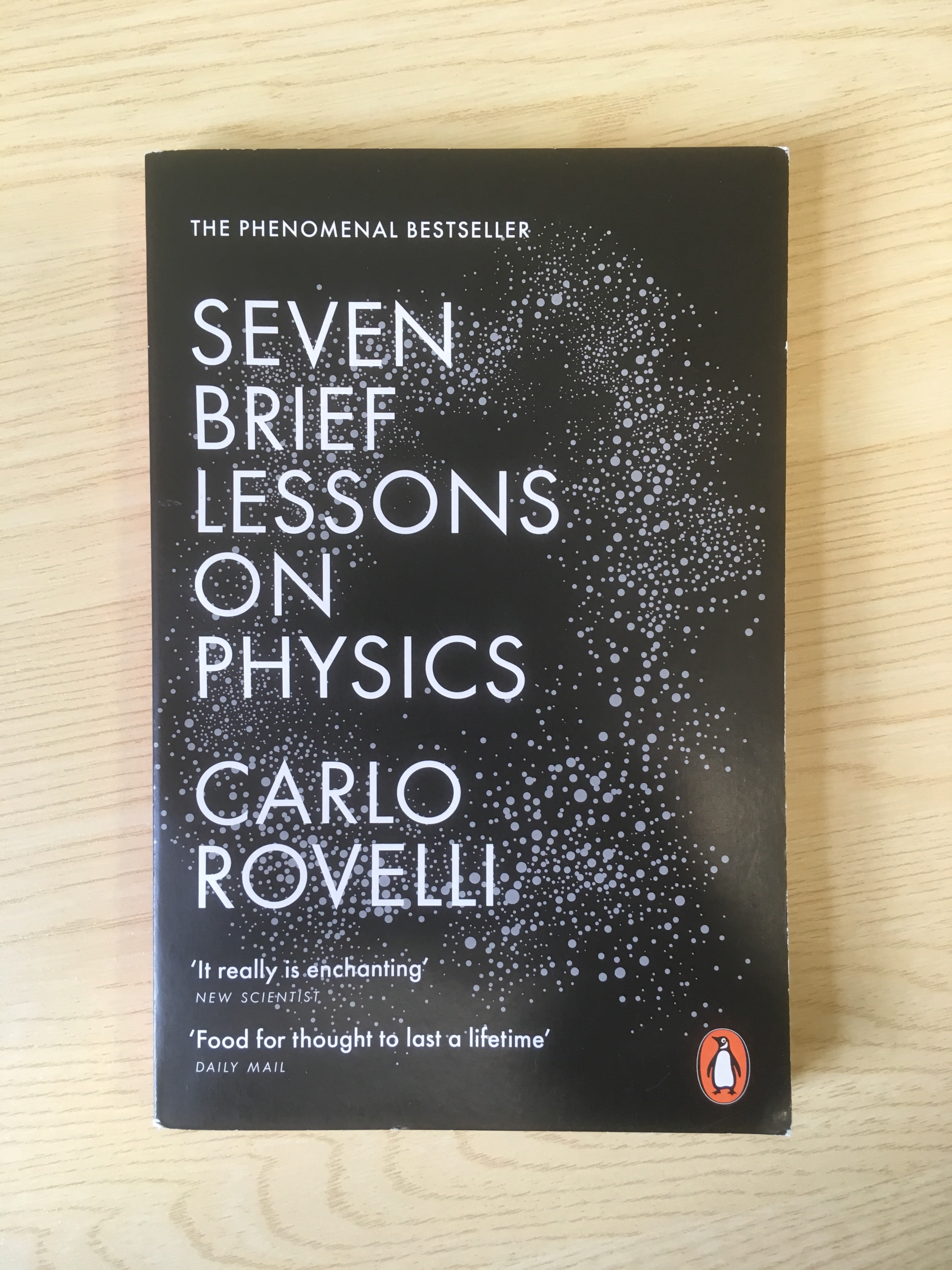
Today I finished reading Carlo Rovelli’s slim volume ‘Seven Brief Lessons On Physics’. As I described in my entry ‘Reading and Walking’ last Tuesday I bought this book as a stop-gap so that I had something scientific to read in order to keep one of my daily streaks going. I had just finished Tim Flannery’s ‘Atmosphere of Hope’ and was still waiting for the March edition of Scientific American to arrive (which it has now) and so I needed something fast and after a quick diversion into Waterstone’s bookshop ‘Seven Brief Lessons…’ seem to fit the bill.

I found Seven Brief Lessons… to be a delightful read. It is VERY light on detailed scientific content but beautifully written to enhance awareness of the some of the key ideas of 20th century – general relativity, quantum mechanics, the structure of the universe, how the concept of time is linked to heat flow. Rovelli is a great writer – the words flow off the page into your head like good quality chocolate melting slowly on your tongue. As my analogy suggests, the language is frequently delicious and every time the text threatens to become overwhelmingly complex (which it must do because some of the concepts being described are overwhelming and complex) Rovelli pulls back from the brink and guides the reader onto firmer ground. Since Rovelli is Italian, credit must also go to the two translators, Simon Carnell and Erica Segre.

You will gather that I was rather beguiled by Rovelli’s writing, so I am absolutely delighted to know that he has another book ‘Reality Is Not What It Seems’ in which he outlines some of the key developments in physics from the ancient Greek philosophers through to the present day. I already have a big pile of books at home waiting to be read so it may take me a while to get to this second bite of Rovelli but it is certainly going to be added to the pile and devoured at some point.