Meditations is essentially a collection of journal entries written by Marcus Aurelius, Roman Emperor (161-180) and well-known adherent to the principles of Stoic philosophy. Most of the entries are short notes, written by Marcus as he unpacked his thoughts on the events of a day just passed or noted down some reminder to himself about the way that he wanted to live his life. These entries were never set down with a view to them being read by anyone other than the author, but they now constitute one of the most commonly cited sources of Stoic wisdom, to the extent that Marcus Aurelius is now generally regarded as one of the big three Stoic philosophers (along with Seneca and Epictetus).
I have read and listened to multiple books on Stoic philosophy and the Stoic approach to live that draw heavily on Meditations, most notably the works of Ryan Holiday – in particular The Daily Stoic and the first three books in his series on the four Stoic virtues: Courage is Calling (Courage), Discipline is Destiny (Temperance) and Right Thing, Right Now (Justice) [the fourth and final book in the series: Wisdom Takes Work (Wisdom) is scheduled for publication later in 2025] – and I have dipped into Meditations on and off over the years. But I had not actually read Meditations in its entirety for myself. With that in mind, at the start of this year, I decided to include Meditations as a component of my ‘morning reading’ sequence.
My initial plan was to read one entry of Meditations each morning, but I soon found that the entries are so variable that this approach was frequently not particularly satisfying, and so I switched to reading 5 or 10 entries at a time (depending on how they fell on the page). This meant that it ended up taking me 2.5 months to complete the whole volume.
I had quite high hopes for my reading of Meditations – I was familiar with it as a source of many great quotes – but, in fact, I found it something of a slog to get through. Every now and again a sentence would leap out at me and I would rush to note it down, but around those golden nuggets there was quite a lot of dull rock. I think that most readers would get a lot more out of reading material that draws from Meditations, such as the aforementioned works by Ryan Holiday, than working their way through the original source material. It can obviously be argued that the former approach is lazy and relinquishes control over what wisdom one might gain from the material, but my feeling is that in this case, the ‘tour’ is much enhanced by the commentary provided by a skillful guide.
I guess the real issue with Meditations is that, as already noted, it is not a book that was written by the author to be read. It’s much more suitable for the ‘open at a random page and read an entry whenever the mood takes you’ approach than a cover-to-cover examination (unless your intention is to actually study it). But either way, the little nuggets of wisdom should emerge, and can serve as useful reminders. Here are a few that stood out for me…
Be like the rocky headland on which the waves constantly break. It stands firm, and round it the seething waters are laid to rest.
Just as drifting sands constantly overlay the previous sand, so in our lives what we once did is very quickly covered over by subsequent layers.
Perfection of character is this – to live each day as if it were your last, without frenzy, without apathy, without pretence.
When you have done good and another has benefited, why do you still look, as fools do, for a third thing besides – credit for good works, or a return.
Universal nature delights in change, and all that flows from nature happens for the good.
A few weeks ago I started a new practice of spending a few minutes each morning producing a quick piece of artwork.
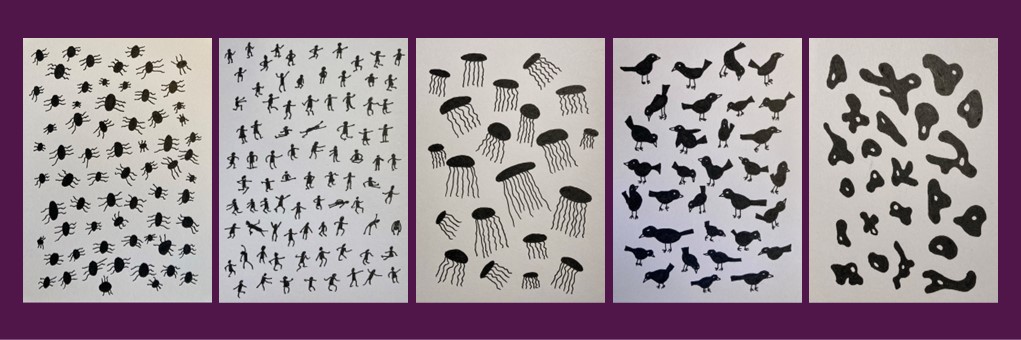
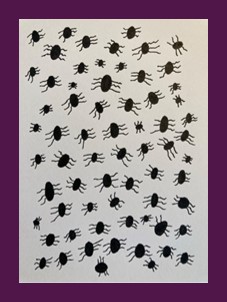
Without really thinking about what I was doing I grabbed a small sketchpad and in ink pen and starting doodling little bugs, eventually covering the page with an assortment of bugs all slightly different sizes, with different leg lengths and scurrying in different directions.
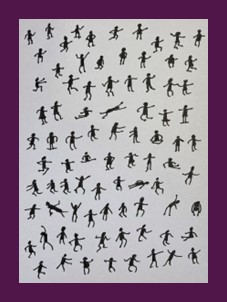
The next day, faced with another blank sheet of paper, I found that it was little people, in various poses that flowed from my pen. After posting these on my Bluesky social media account and asking which of the little people was a viewer’s favourite it was fun to see the various comments coming in.
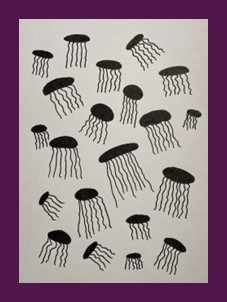
It was hard to follow the little people, and on the third day I went marine with a host of (sort of) jellyfish.
For the fourth day, having done a few trial sketches, I set about drawing small blackbirds. It was amusing to have it pointed out later that one of these was legless…
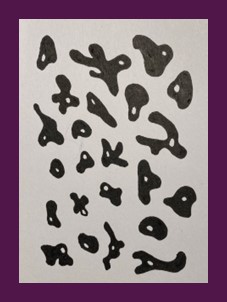
Finally, with my imagination failing me I completed my Miniature Creatures series with a page of amoeba (or is it amoebas?). Well, I call them amoeba, but really they are just weirdly-shaped black blobs with a white spot somewhere inside their ‘body’. Whatever they are, they look kind of alive…
It was interesting to produce some artwork that is quite unlike most of my drawings and paintings, much more abstract and in the case of the bugs, people and birds at least, a little cartoony. They are quite trivial pieces, but fun to do and judging by some of the feedback I got, fun to look at too!
I wrote this piece back in 2021 – one of three that I wrote under the working title: ‘Glances and Glimpses’. Each of the pieces captures some thoughts on an activity or incident that connects different periods of my life and/or opens a window on some aspect of my character, thereby providing a glance or a glimpse inside my head and into my life. I used to think, rather grandly I suppose, that I might write enough of these to produce a full-blown autobiography/memoir of sorts, and who knows, that may still be the case. For now I will be content to post this one here, with the others to follow. Perhaps doing this will spur me on to have go at writing some more ‘Glances and Glimpses’ to join them in the not too distant future.
+++++
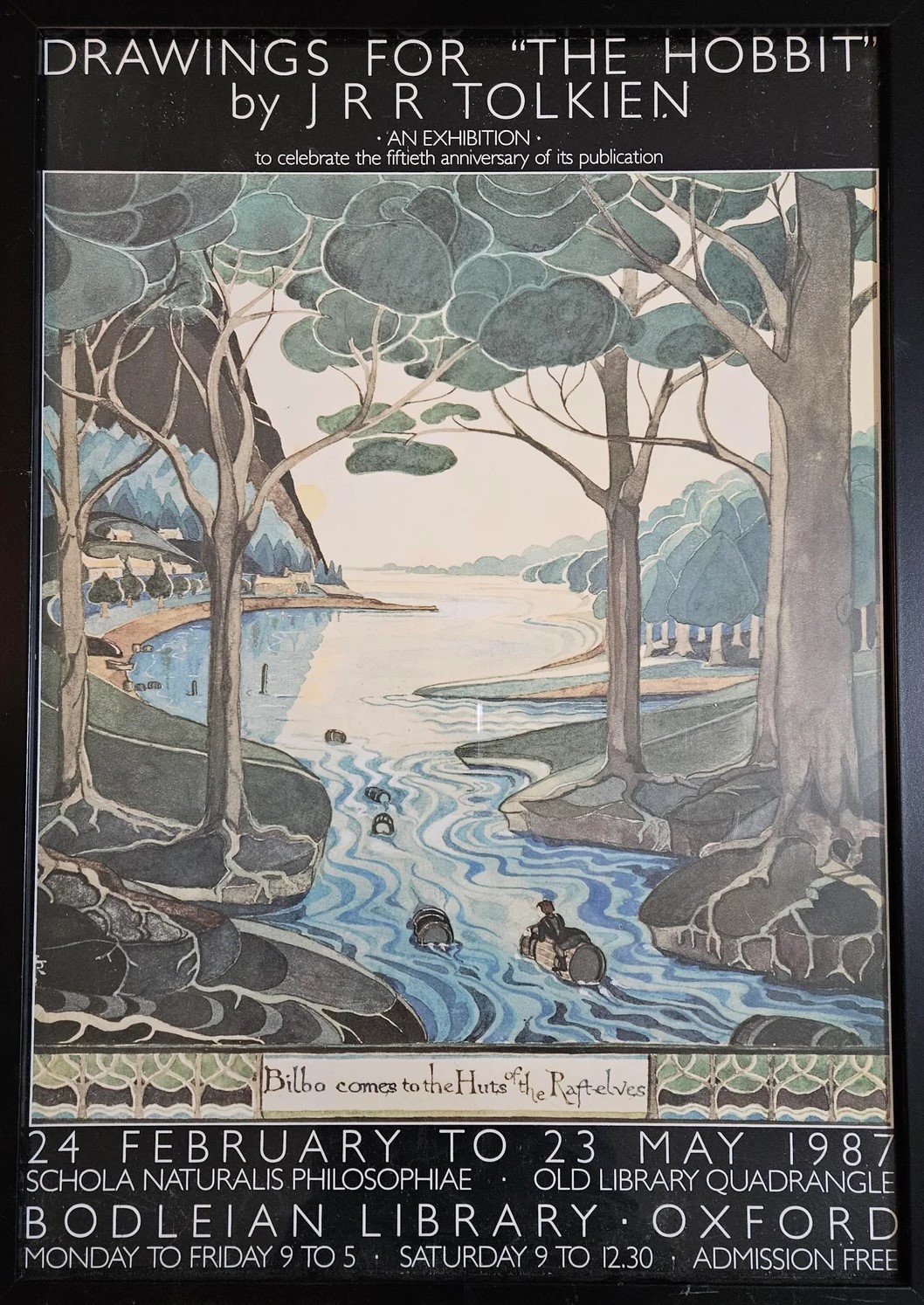
In the downstairs toilet of our house, which is just a small room off the hallway tucked underneath the stairs, hangs a poster. It’s mounted in a simple clip-frame. Every time I go into that space I look at that poster. Every time I see that poster I smile inwardly, and rapidly tell myself the story of when I first saw it, how I first obtained it, how I lost it, and how I got it back again. Ultimately, it’s a story of a thoughtful act of kindness, a simple act of love, a gift-giving from someone who deeply cares about me. It’s also a story that serves as a bridge to my past, and to many moments of happiness some years before the gift-giver even came into my life. There’s more. The theme of the poster is one of adventure and bravery, fear and danger, and leaping (plunging might be better) into the unknown. Those words – adventure, bravery – are not really me. Plunging into the unknown is NOT what I do. Fear stalks me constantly. So the poster is a reminder that it is okay to be brave, to be adventurous, to take risks and to plunge into the unknown, regardless of your fears, and without clear sight of the dangers. In fact, it’s more than okay, it’s a positively good idea!
The poster at the heart of this story advertised an exhibition of drawings that the author J.R.R. Tolkien made to accompany his book ‘The Hobbit’. The exhibition took place at the Bodleian Library, Oxford, between 24th February and 23rd May 1987 and was a celebration of the fiftieth anniversary of the publication of the book in 1937. It is a beautiful poster, mostly because apart from a title and the vital information about the exhibition in white letters on a black background at the top and bottom, it is almost entirely made up of one of Tolkien’s best works of art. The picture is titled ‘Bilbo comes to the Huts of the Raft-Elves’ and captures the moment in the story when, having strayed into the territory of the Wood-Elves and been imprisoned in their dungeons, the hobbit Bilbo manages to obtain a set of keys, free his band of dwarf companions and escape by floating them all off down the river in empty wine barrels. The picture shows the river after it has leveled out through rapids and waterfalls, meandering onward towards a small settlement through woods that come right down to the water’s edge, all gnarly roots and hummocky promontories. In the distance there are buildings – the huts of the Raft-Elves – alongside a small beach-like area on a broad right-sweeping bend in the river. In the mid-ground, in the centre of the channel, are a number of barrels floating smoothly down towards the beach, and bringing up the rear is one barrel with the small figure of Bilbo clinging tightly to the top of it as it floats along, since, having himself sealed the last dwarf-laden barrel, there was no-one left to seal in Bilbo… The lighting of the picture is beautiful, rays of sunlight stretching down through the canopy of trees, illuminating the middle distance, drawing the eye ever onward. The colours are soft greens, soft blues, greys and browns. It is a delicious palette that perfectly captures the deep woods, the swirling waters and the hope that lies ahead. The poster was designed by Trilokesh Mukherjee and whilst it is the picture that is the real thing of beauty, credit must be given for a design that blends the outer information and the inner artwork to such wonderful effect. Trilokesh Mukherjee will probably never know just how much pleasure his piece of design work has given me over the last 34 years.
As you will gather, I love this poster. I loved it from the moment I first saw it pinned to a noticeboard in the long corridor of Lady Margaret Hall, Oxford, that I wandered down several times each day to get from my room in college to the dining hall and food. I loved it so much that one day, on my way back from dinner, I stopped at the poster, pulled out the drawing pins that held it fast to the wall, and grabbed it. From that moment, that poster was mine. I could place it on my own wall and gaze at it whenever I wanted to, as much as I wanted to. My precious!
Looking back, it is hugely ironic that whilst I gained possession of the poster, I did not set foot in the exhibition. It was open for 8 hours every weekday and 3.5 hours every Saturday during the entire period of the exhibition. It was perhaps a 15 minute walk from my room and in a building that I frequently passed. There was no admission fee. Yet still I did not go to see the actual work of art itself. At that time in my life, going to an art exhibition just wasn’t really the kind of thing I did. Tragic really.
I had, of course, read The Hobbit – just once at that time, perhaps 10 years previously. I remember the circumstances fairly well. I was off school with a cold – the sort of 3 day ‘snuffler’ that was bad enough to lay a child low but not bad enough to prevent all kinds of activity… So, I could read. Over those few days I took the small hardback copy of The Hobbit down from our family bookshelves – I remember there was no dust jacket, just the soft, almost olive green board covers – and I followed Bilbo and his companions as they made their way from The Shire to The Lonely Mountain, defeated the dragon Smaug and gathered up the golden treasure hoard. Along the way of course, Bilbo gains The Ring, that bringer of so much trouble and strife, that metaphor for the weight that we all carry with us through life. But that is another tale. The one abiding memory that I have from my first reading of The Hobbit was from towards the end of the story when one of Bilbo’s dwarf companions, I think I was the effervescent Killi, dies of wounds received in a fight. I think perhaps he was protecting Bilbo at the time. I remember how I cried; oh how I cried.
1987 was the year that I finished my time studying in Oxford, and so that summer the poster was rolled up and carried away from its spiritual home. Bilbo had come to the huts of the Raft-Elves, now he was coming with me… and he stayed with me for some years, probably stuck to a wall on display at times, perhaps not at others. I know that he was still with me some years later – certainly four or five years later – because after I had met my wife Karen we must have had the poster on display at home. During that time I must have spoken fondly of the poster, so strongly in fact, that my words burned an impression in her memory. Dragon fire words!
The problem with posters of course is that they are not made to last. My poster had a job to do for perhaps a few months at most. So, as the years passed and the poster was moved here and moved there, pinned and unpinned, rolled and unrolled, blutacked and unblutacked, its edges died a slow death, its corners fractured, its heart creased. At some point, probably at one of our early house moves, the decision must have been made that my precious poster should end its journey; and so it was lost and essentially forgotten about, by me at least.
We come forward many years – around 30 years from when I first saw the poster on the noticeboard in Oxford and perhaps 20 from when it slipped away from me. My elder daughter was at university in Reading and with my younger daughter in tow I took myself off to Oxford to watch Plymouth Argyle play Oxford United down towards the south-eastern fringe of the city. My wife came along too to share a little time with our elder daughter who had popped up on the train for the afternoon. I can’t be sure of the score of the match, but it might have been 0-0 for there has certainly been one such goalless draw between those two teams at that location that I have seen, the most mind-numbingly dull 0-0 draw that you could possibly imagine, bereft of goals, bereft of excitement, bereft of anything remotely resembling entertainment.
We drove home to Plymouth immediately after the game. I was probably tired and almost certainly not in a good mood. Travelling halfway across the country for that sort of game is not the best way to spend a Saturday. I am sure that doom and gloom would have been the order of things, for me at least. And then:
“Guess what I’ve got you?”
There it was. My poster. Well, not exactly my poster but a flat, undamaged, shiny copy of the exact same poster – not a reproduction, not a different poster of the same picture… the same poster – ‘designed by Trilokesh Mukerjee’. Perfection.
It turned out that wife and daughter had been browsing in Blackwell’s – the famous Oxford bookshop – and there, nestled hidden in a rack was the ‘Drawings for “The Hobbit” by J.R.R. Tolkien’ exhibition poster – just one copy, presumably sitting there for 30 or so years, costing just a few pounds, waiting for its moment.
That poster, my second copy, did not get pinned, rolled or blutacked, it got loved. As soon as possible it went straight into a frame and onto the wall, the wall where it has remained ever since, and where I now see it several times most days. It reminds me of happy times in Oxford – friends, places, events. It makes me laugh that I didn’t even make it to the exhibition. It causes me to retell its story in my mind. And it reminds me how things that are lost can be found. Most importantly, every day it reminds me that someone listens, someone watches, someone remembers and someone loves.
A couple of years later, I noticed that there was an exhibition of artwork and artefacts of Tolkien in the Bodleian Library, Oxford. It was the only such public exhibition of these items for many years and it included the small number of paintings that Tolkien painted for The Hobbit. Of course we went. The pictures, the maps, the draft chapters were all wonderful. The picture was wonderful. But my poster is better.
Bilbo and the dwarves escape from the dungeons of the Wood-Elves and down the river in the only way that is possible. It is an uncomfortable mode of transport, it is an uncertain path to take – being caught whilst loading the barrels, drowning, suffocating, being dashed against rocks are all possible outcomes – but they take it nonetheless. Quite literally, they throw themselves into life and life carries them forward. That is a lesson that I need to be reminded of every single day. The road goes ever on, but it requires bravery to keep moving forwards.
(c) Tim O’Hare, March 2025 (originally written in 2021)
Build a Second Brain they said, it will help you stay on top of your life. It will help you manage your personal knowledge, and keep you from informational overload strife.
Build a Second Brain they said, it will definitely be something you’ll want to pass on. It even comes with a fancy name. It will be what they call a Zettelkasten.
Build a Second Brain they said, it will be much more useful than note-taking. It will help you organise all kinds of content, while developing your skills in note-making.
Build a Second Brain they said, it will help you make connections. It will join up all of your different ideas, rather than keeping them separate in sections.
Build a Second Brain they said, it’ll stop your mind being like a sieve. It’ll help you solve problems and find new solutions, by helping you be more creative.
Build a Second Brain they said, it will allow you to keep track of all your tasks. It will help when you’re not quite sure what to do, and not say ‘yes’ when ‘no’ is the best response if anyone asks.
Build a Second Brain they said, it will lead to all kinds of digital high-jinks. It will make you think about graphs and blocks, and connect up your notes with links.
Build a Second Brain they said, it does not matter which software you use. It won’t eat up hours and hours of your time, as you try out each one and can’t choose.
Build a Second Brain they said, it really will be loads of fun. It will give you so much more mental bandwidth, than you have with just brain number one.
Build a Second Brain they said, but I am really not sure. I’ve enough problems working the brain that I’ve got, that I doubt I could cope with one more!
(c) Tim O’Hare, July 2023
About the poem: I had been reading a lot about an area that is known as ‘Personal Knowledge Management’ (PKM) which is based on an older system of keeping discrete notes on index cards in slip boxes (in German this is called a ‘Zettelkasten’). One recent book on the topic (Building A Second Brain by Tiago Forte) has popularized the idea of a PKM-system as being like a ‘Second Brain’ and all kinds of claims are made by many authors about the usefulness of building a Second Brain for information storage and retrieval, creativity, task management etc. Me being me, I threw myself into building my own digital second brain and then (also me being me) I became a bit obsessed with making it perfect, consistent, all-encompassing etc. It rather took over my life for a bit.
A few weeks ago, I completed my seventh book of the year: ‘Now It All Makes Sense’ by Alex Partridge. This was one that I consumed in audiobook format, narrated by the author.
I decided to listen to this book after my wife drew my attention to it. I’m not sure where she came across it being mentioned, but it’s clear that Partridge currently has a pretty massive media presence with social media channels (with millions of followers), a podcast called ADHD Chatter (with 500,000 listeners) and now this book (an ‘instant Sunday Times bestseller’ apparently). From a bit of searching online, it seems that, in the world of new media he is viewed as one of the experts on adult ADHD (Attention Deficit Hyperactivity Disorder). His background is in social media content creation – he founded UNILAD and LADBible at the age of just 21, two social news and entertainment companies that, according to his biography, were followed by 300 million people. I guess it is not surprising then that after being diagnosed with ADHD at the age of 34, he has come to be a dominant figure in the online adult ADHD media space but I’d never heard of him.
You might think that as a fellow late-diagnosed ADHDer (albeit more than 20 years later in life than Partridge), I would have found plenty in ‘Now It All Makes Sense’ that resonated with me, but that wasn’t the case at all.
I’ll come straight to it… I didn’t much like this book. Partridge clearly writes from his own experience, which is, obviously, a sensible thing for him to do… except that throughout the book he refers to ADHD only in terms of his own particular expression of it. He writes/says things like “Those of us with ADHD will be familiar with…” and “As anyone with ADHD will know…”, and then he describes how he is forgetful, how he loses things, how he is completely disorganized, how he is entrepreneurial etc. Well, I have ADHD and I am not (generally) forgetful, I don’t (generally) lose things, I am probably one of the most organized people around and would hardly describe myself as entrepreneurialanything…, so no, actually, I am not “familiar with” and don’t really “know” the ADHD that is described by Partridge, not in myself at least. And if I am not familiar with it then I am sure that there are plenty of others in the same boat. ‘It’ might now all make sense to Alex Partridge, and I am sure that ‘it’ will now also make more sense to some readers of his book, but if I had read or listened to the book a few years ago it would simply have reinforced the inaccurate understanding of ADHD that I then held… and who knows, that might have prevented or delayed me from being able to make sense of my own ‘it’ in the way that I have been able to since my diagnosis.
There’s nothing wrong with Partridge’s account of his ADHD, the impacts it has had, and is having, on his life, and the advice and tips that he provides in the book… provided, that is, that you have an ADHD presentation that is similar to his (or are seeking to understand ADHD in relation to someone you know who is like him). But many people don’t have that ADHD presentation like his and so are not that much like him… that’s one of the peculiarly frustrating but also, dare I say it, interesting, things about ADHD – the challenges it creates can be very different for different individuals. What is wrong… no, perhaps ‘wrong’ is too strong a word here, let’s say ‘potentially unhelpful’ is that Partridge doesn’t really seem to recognize this variation in the diverse challenges that ADHD presents for different people enough. In this way, I think that Partridge misses the opportunity to really broaden out his readers’ understandings of the challenges of living with ADHD, and given his huge online audience and social media status, I think that’s rather disappointing, Maybe instead of ‘Now It All Makes Sense’ the title of the book ought to have been ‘Now I All Make Sense’ (forgive the mangled grammar) to reflect the rather personal nature of Partridge’s narrative.
I’ve been a regular attender at the home games of Plymouth Argyle Football Club since soon after we moved to Plymouth in summer 1992. The first game I attended was towards the end of the 1992-93 season, and then from 1993-94 onwards I have only missed the odd game each season. In my time as a fan I have seen the team relegated 5 times and promoted 6 times, but sadly, it seems likely that those numbers will have evened out by the time the current season is completed…
In 2003 I started to take my two daughters alternately to games – at that time they were 7 and 5 years old – and then not long after that we would all go together. In the last few years, since my elder daughter moved away to set up her own home in Surrey, I have continued to attend with my younger daughter, and as she has now settled locally, it seems likely that this will continue. Going to Argyle is something that has brought us a lot of great memories, including a few when we travelled to away games for cup matches or key league games. Our trip to Port Vale in May 2023 to see Argyle clinch the League 1 title, achieving over 100 points in the season, was a particular highlight.
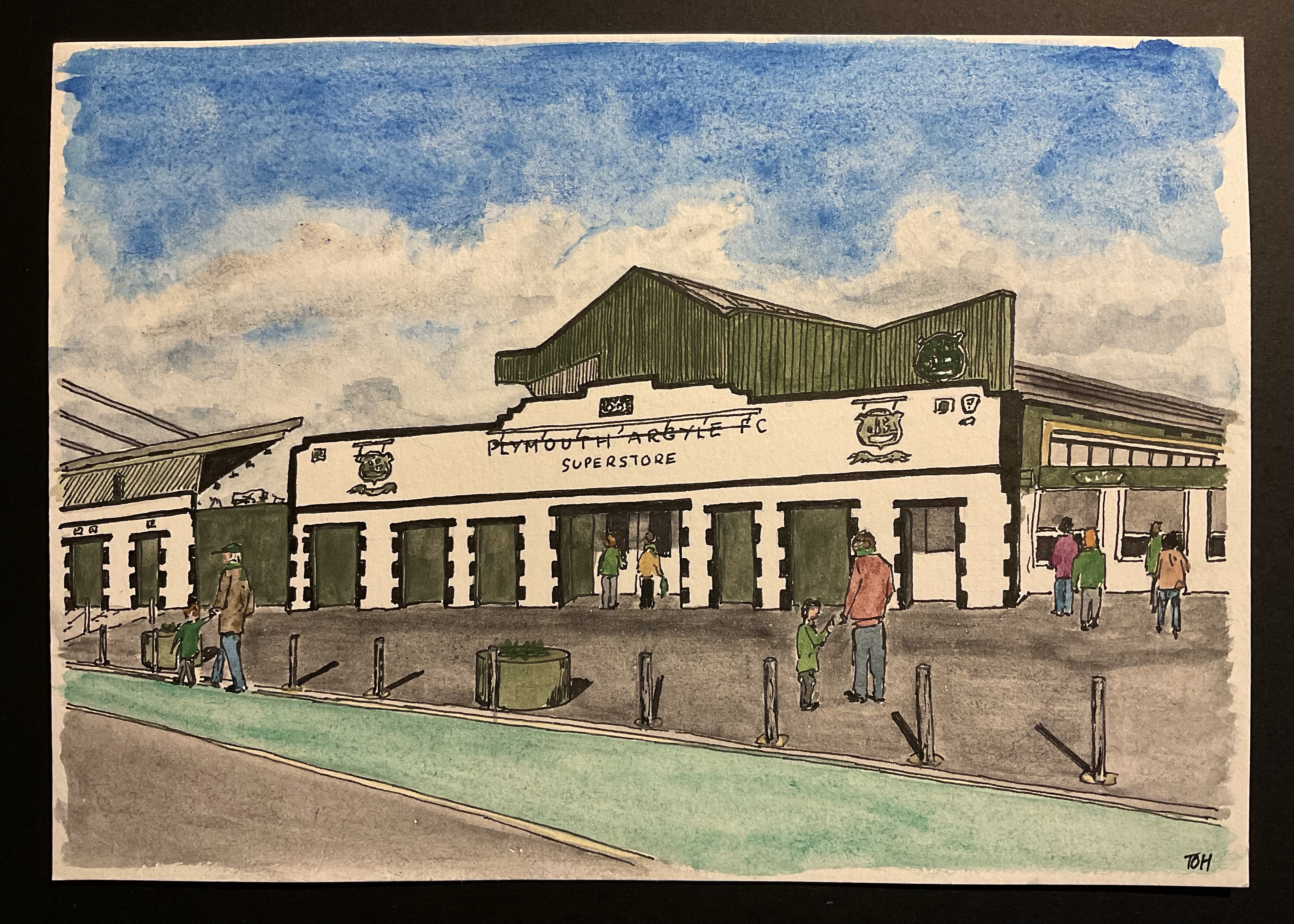
Since I started painting just under a year ago, it seems to have become a bit of a tradition that for birthdays and other special occasions I will paint some kind of artwork to give as a present. Sometimes this is just a small picture for a card or a bookmark, but on a few occasions I have gone for a larger, more ‘significant’ work. So, it was pretty obvious that for my younger daughter’s birthday at the beginning of this month I would produce an Argyle-related picture… The result was the above picture, showing the old entrance to ground, now converted into the club ‘superstore’. I was pleased with how it turned out and also pleased with myself for being brave enough to put a few people into the scene (but notice there are no faces or hands!)
I’m pleased to report that the painting, which I put in a black frame, was very well received… and now it has been given, it’s safe for me to release a picture of it into the world without any risk that I might spoil the surprise. Green Army!
For some years I have been reading my way through the Journal of Henry David Thoreau. Initially, I would just read a few entries at a time, but at some point in 2020 I hit upon the idea of reading entries on the day and month that they were written. At that time I was quite a good way through the book, and so my ‘on-this-date’ reading began with the entries that Thoreau wrote in 1856. Now, 5 years later, in my 2025 it is Thoreau’s 1861, and so the entries I am reading come from the penultimate year of his life (Thoreau died aged 44 in May 1862). When I started this project I was reading a journal entry on most days, but in the last few months, as Thoreau’s health has declined, the frequency of entries has reduced drastically such that I am only sporadically opening my copy of the Journal to discover that there is something there for me to read.
Thoreau’s Journal is packed with detailed observations of the land, wildlife and people around Concord, Massachussetts, and while many of the entries are quite dry and descriptive, with Thoreau you never know when a wonderful nugget of wisdom or a special turn of phrase will crop up. One such occasion happened last May, a couple of weeks before my elder daughter’s wedding, when a perfectly phrased gem popped up that I was able to integrate beautifully well into my ‘father-of-the-bride’ wedding speech!
Earlier this week (on 18th March to be exact) I read a passage of the Journal that I greatly enjoyed and which made me think, and so I thought I would use this post to highlight it to the world (as if… a better wording might be ‘to share it with the one or two people who might randomly stumble upon these words’). In the passage, Thoreau reflects on how the interest one might show in any given piece of history depends on more than just the subject of that history and that… No, I must let Thoreau take up the story…
‘You can’t read any genuine history – as that of Herodotus or the Venerable Bede – without perceiving that our interest depends not on the subject but on the man*, – on the manner in which he treats the subject and the importance he gives it. A feeble writer and without genius must have what he thinks a great theme, which we are already interested in through the accounts of others, but a genius – a Shakespeare, for instance – would make the history of his parish more interesting than another’s history of the world.’
It’s that last line that is the sparkle within the diamond: ‘a genius would make the history of his parish more interesting than another’s history of the world.’.
In my opinion, Thoreau has it spot on – everything is interesting and anything can be interesting if its story is well told. So, when we think about what to read, what to listen to, what to absorb from the world around us, the secret is to recognize and pay attention to those who are masters of the story-telling craft.**
* or woman obviously, but Thoreau was writing in 1861 ** like Thoreau (obviously)
I first read Paul Hannam’s ‘The Wisdom of Groundhog Day’ (TWoGD) back in October 2022. It was one of a number of occasions when I have listened to an episode of a podcast on my walk home from work and been so taken with the content being discussed that I placed an order for the book as I walked along and before I had even arrived home. In this case, the podcast episode was an interview with the author about his book from the ever excellent ‘Art of Manliness’ podcast (Episode 828: The Groundhog Day Roadmap for Changing Your Life).
In the 2.5 years that have passed since that reading, I have held a really positive memory of TWoGD. I was drawn to the way in which Hannam teases his message out of the story of the ‘Groundhog Day’ film – ostensibly just a routine comedy about a grouchy weatherman who gets stuck in a small town having to live the same day of his life again and again and again. The heart of the message is that to find happiness and fulfilment in life it is necessary to change yourself on the inside and this happiness can only arise when you are fully present and focused at all times on being true to yourself, open to experience, and appreciative of the world and the people around you. Based on this memory, I breifly mentioned TWoGD at the end of a meeting of the Book Club associated with Mike Vardy‘s Timecrafting Trust Community and with others intrigued by the idea of the book, it was chosen to be our February read.
So, I came back to TWoGD for a second reading with high hopes and also a little trepidation… What if everyone else hated the book? As I worked my way through it for a second time I found myself with very mixed feelings. I could still see, and appreciate, the cleverness that lay behind it, but I also couldn’t help feeling that it was all a bit forced – a neat idea stretched out to a length many times greater than necessary. I found that there were certain stylistic aspects about the writing that I really disliked – the way that it was written in what seemed to be a series of ‘sound bite’ paragraphs one after the other with not much flow when read together, and the fact that at every turn the example given for how such and such a principle idea had made an impact on someone was taken from Hannam’s personal experience.
As it turned out, most other members of the book club community had fairly similar issues with TWoGD as I did, but the message of the book was well received and we had a lively and interesting discussion nevertheless.
If I was going to sum up the message in TWoGD in one phrase then I think I would struggle to do better than to use the same quote that Hannam uses in the book’s conclusion, taken from the second volume of Marcel Proust’s epic ‘Remembrance of Things Past’ (1924):
‘We are not provided with wisdom, we must discover it for ourselves, after a journey through the wilderness which no one else can take for us, an effort which no one can spare us.’
I’m a bit of a perfectionist, something which has definitely held me back over the years as I have held off pursuing certain activities ‘in case I couldn’t live up to expectations’ (a trait that I am sure many serial perfectionist procrastinators will be very familiar with). One such activity was always drawing and painting, so it was a bit of a surprise to me when, about a year ago (April 2024), I quite suddenly started painting and following a short video course on what is usually called ‘loose’ watercolour painting, I found that I was (mostly) quite able to side-step my need for ‘perfect’ and simply paint – deliberately being quick was a key element in this. Even better, not only did perfectionism not get in the way of me being able to paint, but I found that painting in a non-perfect way helped my loosen the grip that perfectionism had on me more generally.
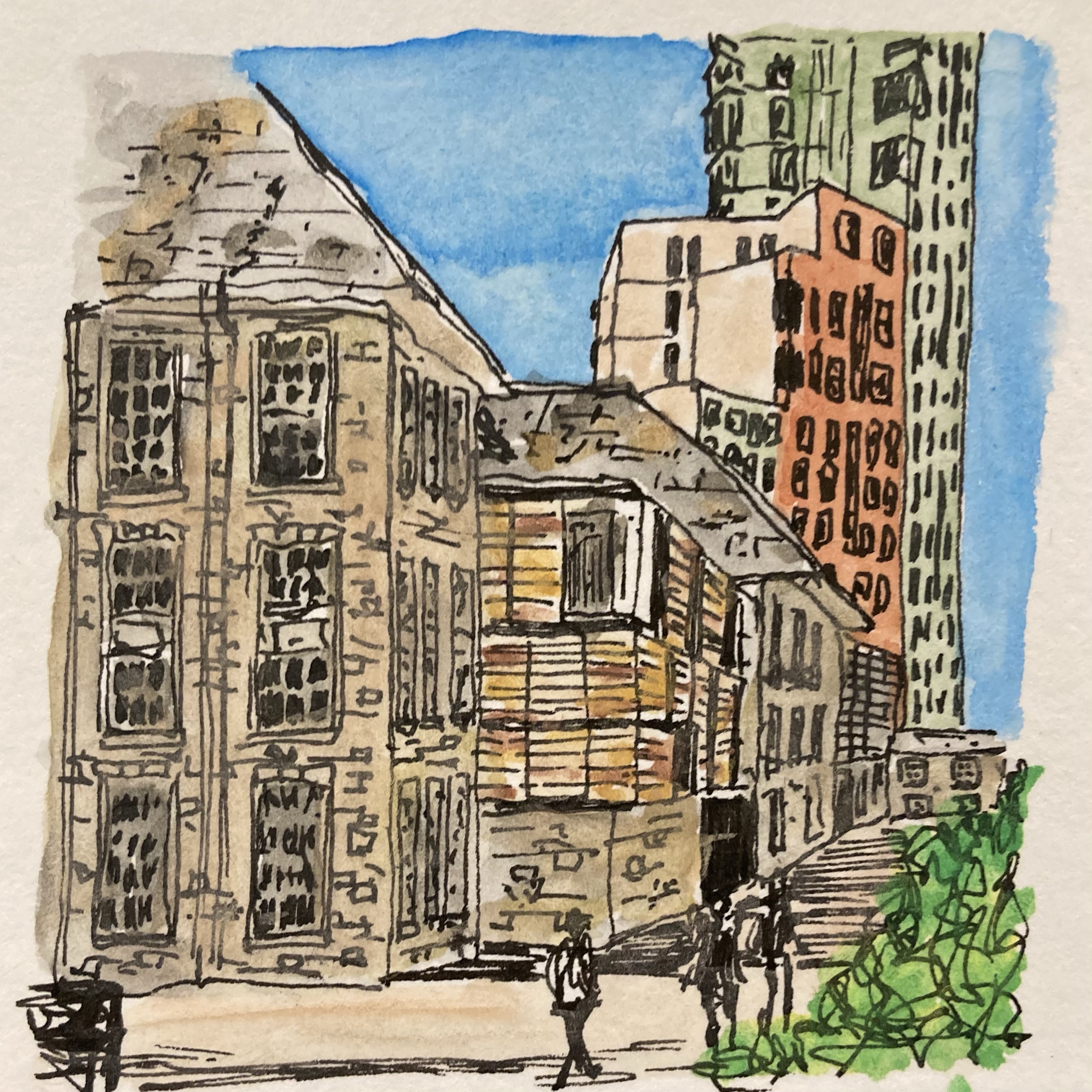
This little picture, painted a few agos, is a nice example of imperfectionism at work. It is a view of the Scott Building (University of Plymouth) on the left with the towering mass of Beckley Point accommodation block behind. If you were to stand where the photo that this picture is based on was taken, you would instantly notice all kinds of discrepancies – the colour of the closest building isn’t quite right, the ground appears to rise upwards because of the way I have used horizontal lines for the shadow cast by the building and the small building in the background (the Reynolds Building in which I used to have my office) is far too small. But none of this really matters. For a start, it’s only a little painting that almost no-one will ever see (and those that do probably won’t know what the scene looks like in reality), but more importantly, I have come to learn that it is the quirky little ‘undetails’ in a picture – a wiggly line here, am improbable colour there, the scratchy outline of a person – that add fun into the mix, and that it is far more important to vaguely capture the sense of a place rather than replicate it in every detail (although pictures like that can also be wonderful and interesting of course).
So, here’s to this quick, little, watercolour picture with all its imperfections – nice and bright, rather jolly and, I think, a sense of movement. It’s not supposed to be a masterpiece, it’s just fine as it is!
I don’t know if it is the air: clean and fresh like an ice-cold beer, bubbles rising, condensation on the glass, enough to quench the fiercest thirst. Because sometimes… it’s more like warm flat ale, the dregs of a barrel, forced down, because it cannot possibly go to waste.
Maybe it’s the trees: aged beings, firm trunks, twisting branches, rustling leaves – all kinds of greens – magic matter drawn from thin air. Although sometimes I am not so keen… when a dipping twig catches me in the eye, or a gnarly root sends me sprawling to the ground.
Perhaps it is the quiet: only the soft, gentle, companion sounds to the peacefulness of nature’s play – the babbling of a stream, the stir of swaying grass, the lowing of distant beasts. Although sometimes… the incessant cawing racket of jackdaws batters my ears and interrupts my calm far more acutely than the hum of traffic or the playground shrieks of children.
It can also be the smells: sweet fragrances of flowers, fresh cut hay, that first exhalation of dry soil after a much-needed drink of rain. Although sometimes… there are certain emanations, animal and vegetable, that have me rushing to hold my nose.
I wonder whether it is the sky: deep blue, adorned with a constantly changing dance of clouds, then fading to burning orange before the deepest black, be-jewelled with silver stars. But sometimes… such vastness can be far too much, for this brain to consume in one sitting.
It’s definitely the route: words in the book, lines upon the map, places to stop for a view, a little piece of history, a drink and a big piece of cake. Although sometimes… the wrong words have been used, those lines have simply not been drawn in the right places, and the much-anticipated tea shop is closed, just because it is Wednesday.
It’s tempting to think it is the solitude: just me and the hills and the trees and the birds and… and… and… Although, if I am really honest, I will admit that sometimes… that can also be a state of loneliness.
In any case, it’s certainly also the companionship: sauntering along, side-by-side, ahead, behind, talking about the world around us, solving problems, making plans. Although sometimes… you just will not walk at the right speed, and yes, I do know that I drive you crazy every time I stop to listen out for birds or to take one more arty snap with the app or the camera on my phone.
I think it could simply be the scale of it: always as far as the eye can see (and then beyond into the land of imagination), stretching back through an infinitude of whens and forward into yet more thens. Although sometimes, as truly awe-inspiring as that can be to consider, I’m reminded that really there is only here and now.
So, it seems to be the all of it: air, trees, quiet, smells, sky, route, solitude, companionship, scale., and more – a little piece of all of the everything that has ever been, regardless of whether I, and all the others just like me, am here to do my worst, whilst all the time I try to do my best. Because… we can build things, we can shape things, we can sell things, and we can waste things, but when I take a walk outside, away from all the stuff, and when I allow myself to forget what I think I am, just for a moment, well then I am home.
(c) Tim O’Hare, June 2023
HOME: Our summer holidays tend to be based around walking in nature and I always find that this activity helps my brain to slow down and provides a great source of nourishment for my thinking. During the process of writing ‘Home’ I reflected on what it is that makes walking in nature such an important and grounding activity for me, and as I ran through various possibilities and found counterarguments for each one I came to realise that there is no single magic ingredient – it was simply that walking in nature was where I felt most at home.





 Tim O'Hare