
VAT’s a mystery

If I buy a cappuccino from the canteen at work it costs me £1.09. If a student buys a cappuccino from the same canteen is costs them 95p. I believe that the difference (14p) arises because students do not have to pay Value-Added-Tax (VAT) on their food and drink purchases whereas staff do. I can understand this but what I would like to know is does it make a difference i) who drinks the cappuccino? or ii) who’s money is used to buy the cappuccino? or iii) who hands over the money that is used to buy the cappuccino? What would happen in each of the following situations:

  1. I buy a cappuccino for a student to drink
  2. A student buys a cappuccino for me to drink
  3. I use a student’s money to buy a student a cappuccino to drink
  4. I give my money to a student to buy a cappuccino for me to drink
  5. I give my money to a student to buy a cappuccino for them to drink
  6. A student gives me the money for me to buy myself a cappuccino to drink

It seems to me that in cases 1, 3 and 4 the cost of the cappuccino is £1.09 and in cases 2, 5 a 6 the cost is 95p but in cases 2, 4 and 6 I get to do the drinking and in cases 1, 3 and 5 the student does the drinking. Case 4 is the best one for me, so if any of my students are reading this and want to come to some kind of arrangement, feel free to get in touch (there’s the seed of a money-making idea in here somewhere).
The Hot Topic

There seems to be a pattern emerging for my recent entries to this site, namely that they are all related in some way to climate change and what we need to be doing to cope with it. I don’t want this pattern to take hold too strongly, but I guess that given that my work is focussed on oceanography and meteorology and given that our planet is warming and climates are changing, there is some inevitability about this. Anyway, this entry is just to record that I recently finished reading a really excellent book on climate change due to human-induced global warming and to strongly recommend it to anyone interested in this topic (and to be honest, if you’re not interested in this topic then you should be and you soon will be…). The book is called “The Hot Topic” and is written by Gabrielle Walker (coincidentally mentioned in another entry on this site a few days ago) and Sir David King (who until 2007 was Chief Scientific Advisor to the UK Government). The book sets out in simple terms the basic science behind climate change, how we will need to adapt to the changes that will occur, what kinds of technological solutions we might be able to develop to help to reduce our emissions of the so-called Greenhouse Gases and explores the relevant political dimensions and personal and local solutions (what we can all do to help). It’s quite short, is highly readable and is packed with lots of references to key scientific works that have informed our understanding of climate change. You can find more information about the book from the Bloomsbury Publishing website entry.

Since reading the book I have been much more careful about switching off lights and appliances around the house when they are not needed and have taken a decision not to use the lift at work (my office is on the 5th floor) or to press the button to open the automatic doors. Both the lift and the door use energy every time they are used and that energy most likely comes from the burning of fossil fuels. As long as I don’t end up eating more to provide myself with the extra energy I need to climb the stairs or open the door, I’ll be making a very small contribution to helping to keep the planet cooler in the future. It may not be much, but every little helps.

When the water level rises…

New research is suggesting that as sea levels around the world rise the actual rise that occurs in different locations may be very different. Apparently if the West Antarctic ice sheet melts, the meltwater will not spread evenly around the world’s oceans but, instead, will be focussed towards the east coast of North America (with sea levels there being 1-2 metres higher than elsewhere). According to climate models, this effect would occur for a number of reasons. First, as the ice sheet gets smaller it will exert a weaker gravitational pull on the surrounding oceans allowing it to move northwards more easily. Secondly, a lighter ice sheet will allow underlying land to rise displacing water elsewhere. Finally, and perhaps most importantly, the redistribution of this large mass of water would alter the Earth’s spin shifting the locations of existing bulges of water that occur between the equator and the poles. The research is described briefly in New Scientist, Issue 2695 (14 February 2009).

And that’s not all… a completely separate study has calculated that sea levels on the east coast of the USA could rise by around 0.5 metres by 2100 due to a combination of the slow-down of the Atlantic Meridional Overturning Circulation (AMOC) caused by global warming and thermal expansion of ocean waters due to rising temperatures. This research is described briefly in New Scientist, Issue 2700 (21 March 2009) .

All in all, the future doesn’t look bright for low lying parts of the east of the USA.

The North Atlantic trigger

It has been known for some time that various parts of the world’s climate system can become synchronised, for example the pattern of El Nino events in the Pacific can be linked with the North Atlantic Oscillation (NAO). New research now purports to demonstrate that rather than simply being two climate signals that become coupled, it is the activity in the North Atlantic that is the driving force in the partnership. This finding could have important consequences because the North Atlantic is currently the location of the most rapid climatic changes on the planet so the changes that are occuring there could rapidly lead to other changes around the world. There is a short news item on this research in New Scientist, Issue 2695 (14 February 2009) .

BBC Radio 4 Oceans: what lies beneath

BBC Radio 4 is currently running a four part series “Oceans: what lies beneath” in which the author and broadcaster Gabrielle Walker “looks at how little we understand the waters on which human life depends, and talks to the scientists who are making some extraordinary discoveries deep beneath the ocean waves”. The four parts are titled “Ocean Life”, “The Deep”, “Ocean Resources” and “Oceans and Climate”. Each episode is 30 minutes long and can be listened to online at the BBC Radio 4 Oceans webpage.

Ted the “human dolphin”

If you are of an adventurous disposition then you will probably be interested to learn about Ted Ciamillo’s quest to build a human-powered submarine and use it to cross the Atlantic Ocean. Ciamillo is an American inventor who has previously worked on an underwater propulsion vehicle called the Hydrospeeder (like an underwater motobike). Recently, he has been developing a human-powered submarine that uses a propulsion system based on a dolphin’s tail. Apparently this system is much more efficient than a traditional rigid propellor. So, Ciamillo is building  small submarine that is driven by such a tail and powered by pushing leg and arm levers back and forth. He intends to sit in this submarine, clothed in a wetsuit and breathing using some kind of scuba or snorkel system. He will pedal a couple of metres below the surface, coming up at night to sleep in a tent rigged up on the top of the submarine. The plan is to complete the route, from Cape Verde off the west coast of Africa to Barbados in the Caribbean, in 50 days – that’s 3700 kilometres, so his average speed would be around about 75 kilometres per day. Apart from the technological and endurance challenges involved, the idea is that he will be able to make unique measurements of marine life from what will be a very quiet and highly manouvreable craft, so , for example, he may be able to make valuable observations of bioluminescent organisms. A New Scientist article about Ciamillo’s submarine and his planned voyage appeared in Issue 2693 (31 January 2009).

Ice circles

In the first year tutorial sessions that I run on our Ocean Exploration and Ocean Science courses we give all of our students an opportunity to give a short informal presentation to their group on a topical piece of marine science news (though sometimes the topics, being selected by the students, have relatively little to do with marine science). The idea is that these presentations are a prelude to an assessed presentation that the students give later in the term and a chance to get a bit of practice and confidence-building. Most of these presentations cover topics that I am familiar with but occasionally they throw up something completely new to me… A couple of weeks ago we ran this year’s sessions and one of the students spoke about “ice circles”. These are, what appear to be, perfect circles of ice that form in rivers and rotate slowly as the river flows around and underneath them. One such ice circle, 10 feet wide and potentially the first to be observed in a British river, had recently formed in the River Otter in Devon and the news story had been picked up by this student’s  home local newspaper (and reported subsequently in various places including here in The Times newspaper). Apparently ice circles are much more common in Scandinavia and there is some debate about how they form with one suggestion being that they are the result of alien activities… whatever the truth (and personally I don’t go for the alien stories) it’s well worth having a bit of a google for “ice circles” to look at some of the spectacular images that are out there on the web.

Chance favours the prepared mind

Listening to last week’s Scientific American podcast I was particularly struck by a quote that was mentioned in one of the reports. In the podcast the quote was given as “chance favours the prepared mind” and attibuted to Louis Pasteur but looking it up online it seems that the original quote was more along the lines of  “In the field of observation, chance favours the prepared mind”. This longer quote reflects Pasteur’s work as an scientist and rings true in my mind, but the shorter quote has more wider applicability as a statement of the familiar idea that “we make our own luck”. Anyway, I liked the quote and I certainly believe it to be true so I thought I’d lay it down as an entry on this site.

Eight is not the magic number

I spend quite a lot of my time in meetings of various committees, sometimes acting as Chair. So, it is perhaps not surprising that I was interested to read a recent New Scientist article (“The curse of the committee”, Issue 2690, 10 January 2009) describing some recent work by a couple of Austrian physicists which set out to create a mathematical model of the interactions that occur in committees and organisations of various sizes. This work revisits ground covered in the 1950s by C Northcote Parkinson (who is one of those “famous” people belonging to my “I know the name but I don’t know why” category). Parkinson is best known for the so-called “Parkinson’s Law” which basically states that work expands to fill the time available for its completion (a principle that certainly seems to have a lot of truth in it). Anyway, the new research explored how the size of a committee or administrative structure influences its effectiveness.

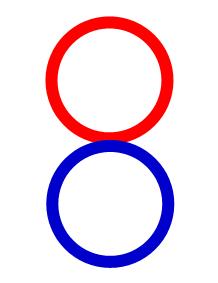
Based on knowledge of organisations throughout history, Parkinson argued that there was an upper limit on membership size beyond which an organisation becomes ineffective and will split into smaller units. The new research supports Parkinson’s hunch but more intriguingly, it was found that when the number of decision-makers involved in a group decision-making activity is eight there is a very high probability of deadlock occuring with the group splitting into two equal but opposing factions. So, the number eight is simply a bad number for committee membership etc. Thinking about this a little, it seems to me that this is an obvious result – look at the symbol for number eight: 8. It’s made up of two small loops (two groups) that touch each other but don’t overlap; two opposing factions that are unable to reach a consensus, like this:

eight

Sparrow rescue

Earlier today I was in our garden clearing up some fallen twigs and leaves when I spotted a distressed sparrow hanging upside down in one of our trees. On closer inspection it became apparent that one of its “toes” (I’m not sure that birds have toes but I think you’ll know what I mean) had become tightly fixed onto a very small but strong branch by some fine white tape which the sparrow must have been collecting as nesting material. I guess that after the sparrow was initially trapped it managed to twist the tape tighter and tighter around its “toe” as it struggled to get free. I called my wife over and while she supported the bird with a dust-pan I tried to free the bird by removing the tape but our initial efforts were unsuccessful, partly because the tape was so tightly wound but also because one of our next door neighbour’s cats had also spotted the sparrow and was determined to make it a bite of lunch… In the end we had to call out our eldest daughter to remove the cat and once this was done we were able to concentrate fully on the rescue. With one neat snip of my pen-knife scissors the tape was cut and the sparrow immediately flew away, taking refuge in a nearby tree. At first we thought it might have suffered permanent damage because it sat there fluttering about whilst all its friends twittered wildly, but after a few more moments it flew off again and from the last we saw of it, it seemed fine. It is amazing how much saving a life like this, albeit the life of just a little bird, leaves you feeling like you have done something really worthwhile.