Swallows and Amazons – Arthur Ransome #reading

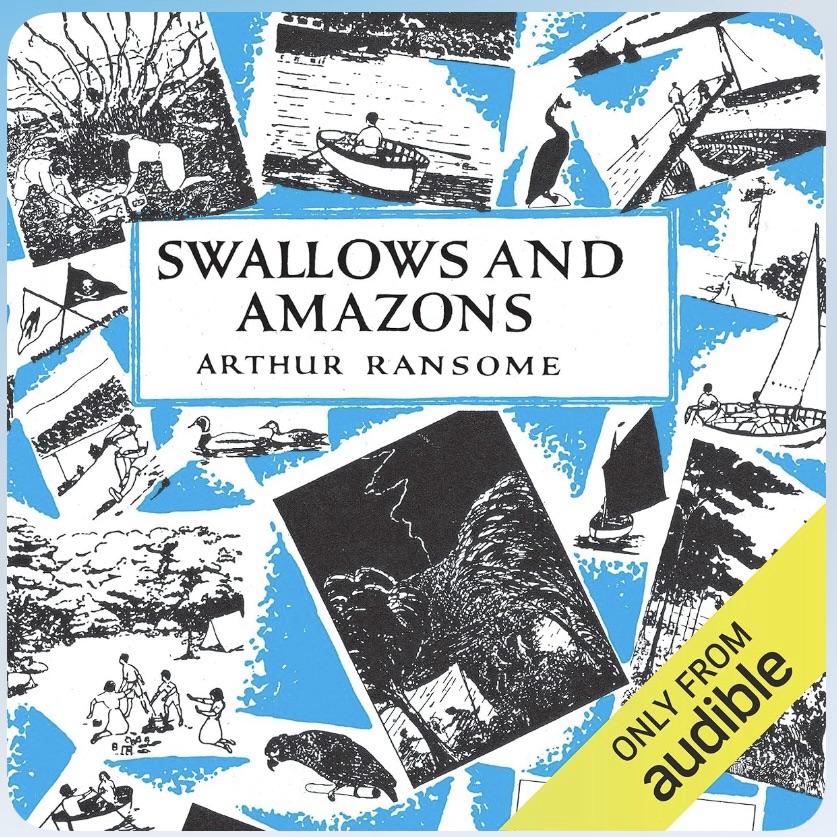
I listened to the audiobook of Swallows and Amazons, Arthur Ransome’s classic novel for children during the period from late March through to early June this year. It was a fairly long process, almost 9 hours of listening, accomplished mostly on my walks to and from work. There were two reasons for my choice of listening, the first linking to my desire to read explore more novels for children as I tried to find stories that were in any way comparable to my own attempt at a children’s adventure story (something that I have written about in my post on Cornelia Funke’s book The Thief Lord), and the second being that Swallows and Amazons was a suitable ‘R’ pick as I worked my way, for the second time, through an alphabet of author surnames in James Mustich’s wonderful book ‘1000 Books To Read Before You Die’.

Swallows and Amazons is, of course, a very well known title, and for many people it is a much-loved one. But despite its name being very familiar to me, I had never previously read a single word of it. I had a vague idea of what it was about – a bunch of kids having adventures on a boat – but for some reason I thought it was set in the Norfolk Broads rather than the Lake District.

The story revolves around the adventures of four siblings, conveniently, to give a nice balance, two boys and two girls – John, Susan, Titty and Roger – as they spend a summer holiday camping on an island in the middle of a lake and sailing their boat, Swallow, around and about each day. Published in 1930, the children unsurprisingly fall into neatly gender-stereotyped and age-constrained roles, John is very much the responsible old-head, and, naturally, captain of the Swallow. Susan, next oldest, and mate of the Swallow fulfills the ‘mother’ role, taking great care and pride in keeping their camp tidy, preparing meals and keeping the younger children in order. Titty, the younger sister, is the Able Seaman and, it turns out, a little bit of a rebel (the privilege of youth!). Finally, Roger, the baby of the family and ship’s boy, is very much treated as the youngest – being taught how to swim, sometimes being allowed to stay up late or accompany the others as a special treat, and frequently falling asleep.

The main action in the story involves the Swallows interactions with two local children, Nancy and Peggy Blackett, captain and mate of their own boat Amazon, and very much portrayed as rather unsophisticated and down-to-earth locals, in comparison to the rather ‘smart’ Walker children. Initially, the relationship between the Swallows and the Amazons is somewhat hostile but, as you might expect, they end up joining forces, first against the Blackett’s uncle James, who lives in a houseboat on the lake and seems to be inexplicably grumpy and awkward, and then against some rather unsavoury characters who they become embroiled with. Throughout the story it is very much John and Nancy who are held up as the masters of the craft of sailing their boats and leading the adventures, but in the end it is young Titty who turns out to be the real star.

Listening to the audiobook of the story was quite an odd experience. The attitudes and happenings of the story are very dated, and I will admit that the constant references to Titty took some getting used to. The story is absolutely chock full of nautical references to the extent that practically everything the children do is rendered in nautical-speak – for example, everyone else is a pirate or a landlubber, they are constantly jibing or backing the mainsail or trimming the freeboard, and everything they drink becomes grog. All of these things – the datedness, the setting, the obscure language – left me wondering how it could be that, more than 90 years after its publication, Swallows and Amazons is still often lauded and recommended as a story for modern children. Perhaps there is some innate craving for a return to the semi-wild that a child can connect with, even if they (probably) haven’t got a clue about one end of a boat from another, and almost certainly have no idea whatsoever what ‘pemmican’ is!

So did I enjoy Swallows and Amazons? Would I recommend it?

Well, let’s be honest, Swallows and Amazons wasn’t written to entertain an almost 60 year old man with limited interest and experience in sailing, reading it 95 years after it was set and published. It’s probably not surprising then, that I would have to say that I was left underwhelmed… But maybe if I was 12 years old with my thoughts turning to imagined adventures and challenges, and yearning to escape from the constraining influence of the adults in my world I might have felt differently. Then perhaps, I would have leapt onboard at the chance to join John, Susan, Titty, Roger, Nancy and Peggy as they hoist their flags, cast off and allowed the wind to fill their sails and send them racing across the lake in pursuit of their next adventure!

Wild Courage – Jenny Wood #reading

In the early months of this year I read and heard several references to a soon-to-be published book: Wild Courage by Jenny Wood. My interest was piqued further after I viewed a Livestream of an episode of the podcast ‘A Productive Conversation‘, in which the host, Mike Vardy, chatted with the author about her book (A Productive Conversation: Episode 611 – Jenny Wood talks about wild courage and fearless self-advocacy). I duly ordered the book and began reading it soon after it arrived on my doorstep, optimistic that it was going to be an interesting and enjoyable read.

Wood’s basic idea is that in order to progress we need to have courage – to push through fear of the unknown, fear of discontent, fear of failure and fear of judgement by others. She argues that successful people feel, but put aside, all of this fear, becoming their own strongest advocate, and having the courage to take whatever steps are necessary to advance towards their goal(s).

The distinctive feature, or twist, in Woods espousal of this feel the fear and do it anyway approach to life is that she identifies nine traits that generally hold negative connotations, and then recasts each of them as a type of courage that the reader is encouraged to develop and deploy. The nine traits, and their associate courage, are as follows:

  • WEIRD – the courage to stand out
  • SELFISH – the courage to stand up for what you want
  • SHAMELESS – the courage to stand being your efforts and abilities
  • OBSESSED – the courage to set your own standard
  • NOSY – the courage to dig deeper
  • MANIPULATIVE – the courage to influence others
  • BRUTAL – the courage to protect your time and energy
  • RECKLESS – the courage to take calculated risks
  • BOSSY – the courage to listen and lead

I don’t think there’s anything wrong with this approach, in fact I think it provides an interesting route into thinking about this territory…

(can you tell that there’s a but coming?)

…but what I wasn’t expecting from the book, and what disappointed and annoyed me as I read it, was the way that at every turn Wood focused on deploying all of this courage in one area only – career advancement and promotion – so much so that I was left feeling rather battered by the notion that this is the only thing that really matters in life.

At various points in the book I found my anger rising as Wood gave precisely the kind of advice that I detest. For example, in Brutal she instructs readers to ‘let the tree fall‘, i.e. to skip ‘unimportant’ tasks quietly. She suggests that ‘if they’re actually necessary, they’ll come around again, and you’ll have been busy doing unambiguously important work in the meantime.‘. To this I say ‘no, no, no‘. There is nothing more annoying than colleagues who fail to respond to simple requests for information citing the ‘if it’s important I’ll be asked again’ line of reasoning… It’s selfish, inefficient, and plain and simply rude; it says to the person who has sent the request that their time is not important and that it is yours to waste. No, just respond to the request promptly and don’t force people to keep track of your lack of response and to ask twice, or however many more times it takes to rouse you out of your own little world… [rant over]

I also found Wild Courage to be guilty of over-using the ‘personal story’ approach to illustrating the points that were being made. Perhaps some readers like this kind of thing. The odd personal story is fine, I think, but please sprinkle in a few from different scenarios, different worlds, other people etc., so that not every example is drawn from the world of working for Google.

In the end, I found myself frustrated by my reading of Wild Courage. It’s not that the approach and the ideas contained in the book aren’t valid. In the end, the courage that might stem from embracing each of the ‘negative’ traits can be expressed in a nice, succinct and positive manner that has much wider application that career advancement simply by putting the word courage to one side in each phrase. Then, the lessons that flow from those nine traits become a simple set of instructions:

  • stand out
  • stand up for what you want
  • stand behind you efforts and abilities
  • set your own standard
  • dig deeper
  • influence others
  • protect your time and energy
  • take calculated risks
  • listen and lead

which to my mind is a whole lot easier to absorb and a lot more useful than getting caught up having to justify the adoption of those negatively associated words, spinning the idea of courage out of them and suggesting that there is something a little wild about doing so. And what’s more, it’s a set of instructions that is clearly applicable to almost every aspect of life and not just the narrow, corporate-career-focus that Wood chooses to target.

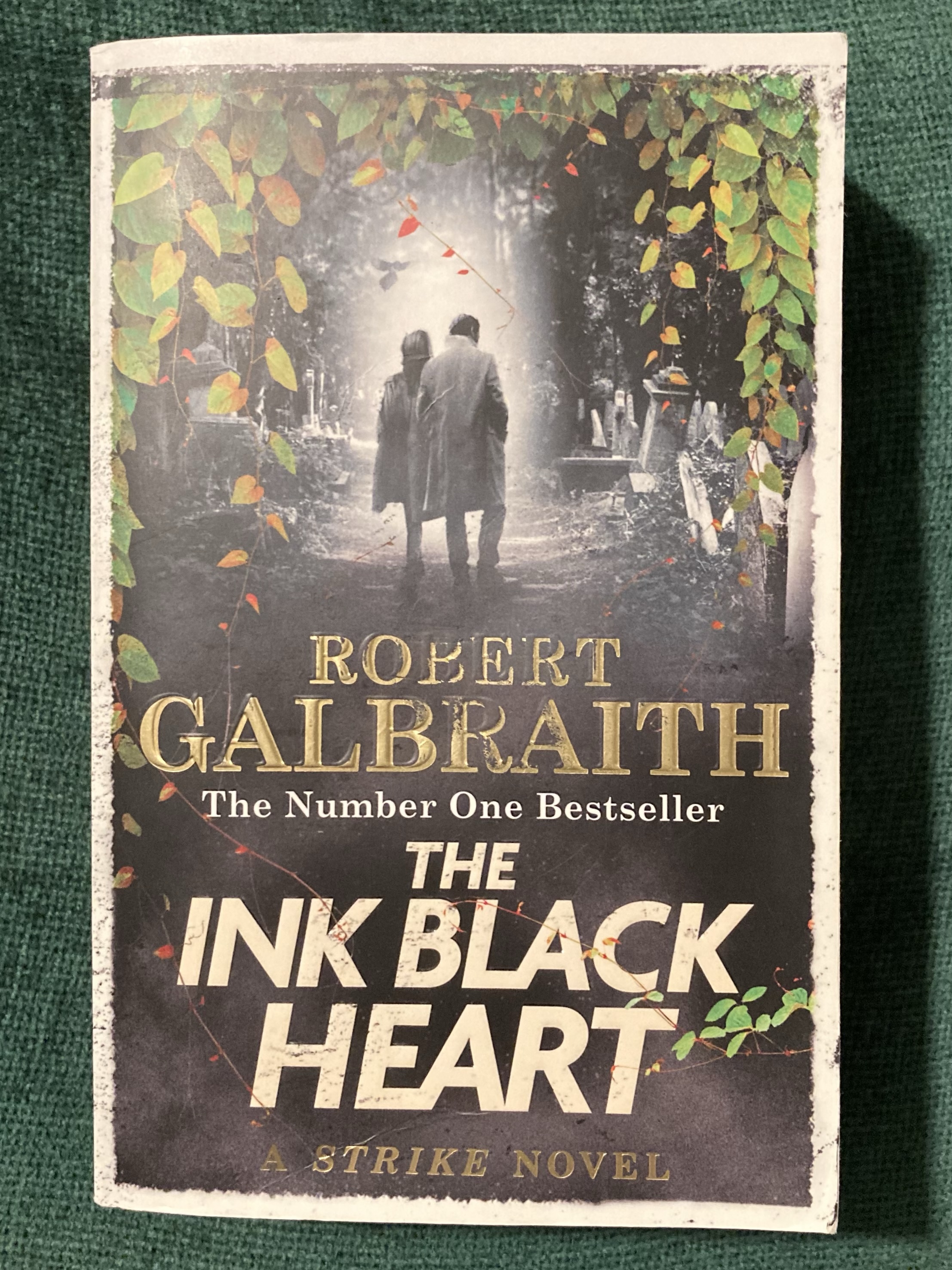
The Ink Black Heart – Robert Galbraith #reading

Oh J.K. Rowling (a.k.a. Robert Galbraith)… Why oh why do you seem to be obsessed with writing ever longer lengthier novels?

The Ink Black Heart is the sixth novel in the Cormoran Strike series, written by J.K. Rowling under the pseudonym Robert Galbraith. The plot follows Strike and his former assistant, now professional partner, Robin Ellacott, as they try to get to the bottom of a complex and grisly crime – the murder of the co-creator of a highly successful online cartoon series (The Ink Black Heart of the book’s title) in the very graveyard in which the cartoon is set. The story plot is typically convoluted, throwing in lots of characters, many of whom are suspects at some point, with all of the action happening alongside the ongoing will-they-won’t-they saga of Strike and Robin’s frustrated relationship.

Compounding this complexity, the plot is made even more complicated to follow by the fact that large chunks of the dialogue between some of the characters takes place via online messaging threads. This throws up two issues for the reader. First, because the characters involved in the online messaging conversations hide their identity behind anonymous usernames it is some way into the book before you know who is talking to who (obviously, this is deliberate). Secondly, it is an (impossible?) challenge to work out how to read up to three parallel conversations between different pairs or groups of, sometimes overlapping, individuals. I can understand why the Rowling/Galbraith chose to write these sections in this way – the chat threads take place within an online game that is based on The Ink Black Heart cartoon – but I felt it made reading the book unnecessarily hard, and at times rather frustrating, work.

I should come clean… In general, I’m not a fan of long books. I like to feel that I am making reasonably rapid progress through a novel and that I won’t get stuck on the same book for more than a few weeks. So with The Ink Black Heart extending to around 1200 pages it took me a while to summon up the courage to make a start on it. However, it wasn’t simply the length of The Ink Black Heart that set me off on the wrong foot, because I’ve also had a long-standing gripe about the way that Rowling’s books seem to get longer and longer with each new one that comes out. This happened with the Harry Potter series, in which the first three titles were quite short, easily-tackled, but still satisfying stories, as the later volumes became progressively more ‘doorstop-like’ each time one appeared. I still enjoyed all of these books, but when I read them I really felt that Rowling’s writing could perhaps do with a good dose of editing… [hark at me, calling out one of the most successful, if not the most successful, writers of modern times.]

Rowling’s tendency for bloated writing is something that I think is particularly apparent in the Strike novels. I do enjoy reading them, but I can’t help but wonder whether it is really necessary to drape Strike and Robin’s relationship across quite so many pages. I think it’a all a bit tedious, and find myself almost screaming at the pair of them to just get on with it. [For balance here, I should say that both my wife and my elder daughter completely disagree with me on this point!] There is also a lot of description of minute details of events that have no bearing on the plot, which is fine if you like that sort of thing (i.e. not being allowed to get to the heart of the matter as quickly as you would like), but stretches my patience close to breaking point. I suspect that The Ink Black Heart could probably be half its present length and still be a great read (and obviously a better read in my opinion).

Perhaps, in the future, Rowling/Galbraith could write two separate books that can be read in parallel – one housing all of the crime/sleuthing-related action and then for those that can be bothered to read it, a second volume that takes a microscopic look at the trials and torments of the relationship between Strike and Robin. At the end of each chapter of the first volume the text could read something like this:

Reader:
If you want to get straight on with the exciting action to discover just how the shocking realization that Strike and Robin have just made takes them one step closer to uncovering the identity of the killer that lives in their midst, then turn the page and read on.
But if, instead, you’d like to lose the thread of the story and forget exactly who said what to whom as you read another account of Robin’s misapprehension of Strike’s words to her in their last conversation and Strike’s desperate attempts to convince himself that getting closer to Robin can’t possibly be the obvious conclusion of them spending almost every waking hour together, then switch over to the companion volume where things might eventually get ever-so-slightly slushy.

Sizzling sleuthing or risky romance? You decide…

Now It All Makes Sense – Alex Partridge #reading

A few weeks ago, I completed my seventh book of the year: ‘Now It All Makes Sense’ by Alex Partridge. This was one that I consumed in audiobook format, narrated by the author.

I decided to listen to this book after my wife drew my attention to it. I’m not sure where she came across it being mentioned, but it’s clear that Partridge currently has a pretty massive media presence with social media channels (with millions of followers), a podcast called ADHD Chatter (with 500,000 listeners) and now this book (an ‘instant Sunday Times bestseller’ apparently). From a bit of searching online, it seems that, in the world of new media he is viewed as one of the experts on adult ADHD (Attention Deficit Hyperactivity Disorder). His background is in social media content creation – he founded UNILAD and LADBible at the age of just 21, two social news and entertainment companies that, according to his biography, were followed by 300 million people. I guess it is not surprising then that after being diagnosed with ADHD at the age of 34, he has come to be a dominant figure in the online adult ADHD media space but I’d never heard of him.

You might think that as a fellow late-diagnosed ADHDer (albeit more than 20 years later in life than Partridge), I would have found plenty in ‘Now It All Makes Sense’ that resonated with me, but that wasn’t the case at all.

I’ll come straight to it… I didn’t much like this book. Partridge clearly writes from his own experience, which is, obviously, a sensible thing for him to do… except that throughout the book he refers to ADHD only in terms of his own particular expression of it. He writes/says things like “Those of us with ADHD will be familiar with…” and “As anyone with ADHD will know…”, and then he describes how he is forgetful, how he loses things, how he is completely disorganized, how he is entrepreneurial etc. Well, I have ADHD and I am not (generally) forgetful, I don’t (generally) lose things, I am probably one of the most organized people around and would hardly describe myself as entrepreneurialanything…, so no, actually, I am not “familiar with” and don’t really “know” the ADHD that is described by Partridge, not in myself at least. And if I am not familiar with it then I am sure that there are plenty of others in the same boat. ‘It’ might now all make sense to Alex Partridge, and I am sure that ‘it’ will now also make more sense to some readers of his book, but if I had read or listened to the book a few years ago it would simply have reinforced the inaccurate understanding of ADHD that I then held… and who knows, that might have prevented or delayed me from being able to make sense of my own ‘it’ in the way that I have been able to since my diagnosis.

There’s nothing wrong with Partridge’s account of his ADHD, the impacts it has had, and is having, on his life, and the advice and tips that he provides in the book… provided, that is, that you have an ADHD presentation that is similar to his (or are seeking to understand ADHD in relation to someone you know who is like him). But many people don’t have that ADHD presentation like his and so are not that much like him… that’s one of the peculiarly frustrating but also, dare I say it, interesting, things about ADHD – the challenges it creates can be very different for different individuals. What is wrong… no, perhaps ‘wrong’ is too strong a word here, let’s say ‘potentially unhelpful’ is that Partridge doesn’t really seem to recognize this variation in the diverse challenges that ADHD presents for different people enough. In this way, I think that Partridge misses the opportunity to really broaden out his readers’ understandings of the challenges of living with ADHD, and given his huge online audience and social media status, I think that’s rather disappointing, Maybe instead of ‘Now It All Makes Sense’ the title of the book ought to have been ‘Now I All Make Sense’ (forgive the mangled grammar) to reflect the rather personal nature of Partridge’s narrative.

The Wisdom of Groundhog Day – Paul Hannam #reading

I first read Paul Hannam’s ‘The Wisdom of Groundhog Day’ (TWoGD) back in October 2022. It was one of a number of occasions when I have listened to an episode of a podcast on my walk home from work and been so taken with the content being discussed that I placed an order for the book as I walked along and before I had even arrived home. In this case, the podcast episode was an interview with the author about his book from the ever excellent ‘Art of Manliness’ podcast (Episode 828: The Groundhog Day Roadmap for Changing Your Life).

In the 2.5 years that have passed since that reading, I have held a really positive memory of TWoGD. I was drawn to the way in which Hannam teases his message out of the story of the ‘Groundhog Day’ film – ostensibly just a routine comedy about a grouchy weatherman who gets stuck in a small town having to live the same day of his life again and again and again. The heart of the message is that to find happiness and fulfilment in life it is necessary to change yourself on the inside and this happiness can only arise when you are fully present and focused at all times on being true to yourself, open to experience, and appreciative of the world and the people around you. Based on this memory, I breifly mentioned TWoGD at the end of a meeting of the Book Club associated with Mike Vardy‘s Timecrafting Trust Community and with others intrigued by the idea of the book, it was chosen to be our February read.

So, I came back to TWoGD for a second reading with high hopes and also a little trepidation… What if everyone else hated the book? As I worked my way through it for a second time I found myself with very mixed feelings. I could still see, and appreciate, the cleverness that lay behind it, but I also couldn’t help feeling that it was all a bit forced – a neat idea stretched out to a length many times greater than necessary. I found that there were certain stylistic aspects about the writing that I really disliked – the way that it was written in what seemed to be a series of ‘sound bite’ paragraphs one after the other with not much flow when read together, and the fact that at every turn the example given for how such and such a principle idea had made an impact on someone was taken from Hannam’s personal experience.

As it turned out, most other members of the book club community had fairly similar issues with TWoGD as I did, but the message of the book was well received and we had a lively and interesting discussion nevertheless.

If I was going to sum up the message in TWoGD in one phrase then I think I would struggle to do better than to use the same quote that Hannam uses in the book’s conclusion, taken from the second volume of Marcel Proust’s epic ‘Remembrance of Things Past’ (1924):

We are not provided with wisdom, we must discover it for ourselves, after a journey through the wilderness which no one else can take for us, an effort which no one can spare us.’

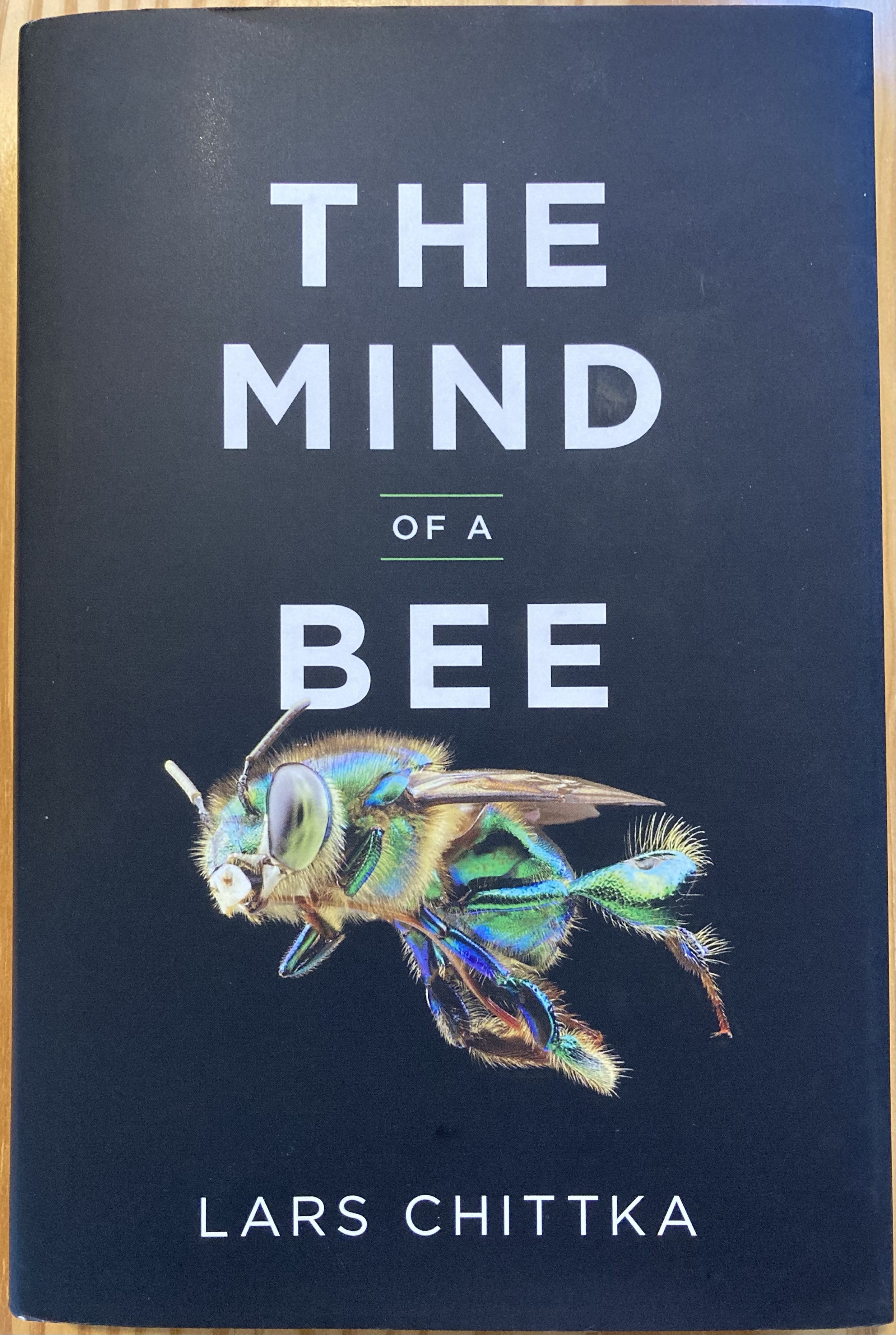
The Mind of a Bee – Lars Chittka #reading

At work, I am part of the supervisory team for a part-time PhD student who is trying to explain the relatively recent (2001) appearance of a tree bumblebee Bombus hypnorum in the U.K. My involvement in the project arose because one possibility for explaining how these bees made the hop across the English Channel from mainland Europe is that they might have been carried over be easterly or southeasterly winds. As the only person who teaches some meteorology in my department I was drawn into discussions at the outset of the project about 5 years ago, and my involvement has continued ever since.

What do I know about bees? Almost nothing… I completed an ‘O’ Level in Biology back in 1981 but I don’t recall bees ever being a topic that we learned about. Since then, although I have a general interest in natural history, I can’t say that I have thought about bees very much. But sometime around 2017 or 2018, the bird box in our garden was taken over by bees, I mentioned this to my the Head of School (who does know about bees), learned that most bumblebees nest in holes in the ground but that some, like my ones, were tree bumblebees, and from there I gradually became enmeshed in the ongoing attempt to explain why one type of these tree bumblebees had suddenly appeared in the U.K. Eventually, I decided I really should get to know a bit about more about bumblebees and that led me first to read Dave Goulson’s book ‘A Sting In The Tale’ (in June 2022) and then at the start of this year, Lars Chittka’s book ‘The Mind of a Bee’.

‘The Mind of A Bee’ was a fascinating book, covering bees’ sensory capabilities, instinctual behaviours, intelligence, communication systems, spatial memory and navigational capabilities, learning, brain structure, personality and consciousness. Packed with easily understandable summaries of a huge of scientific experiments and interesting background information about the scientists that conducted them, ‘The Mind of a Bee’ leaves no room for doubt that despite their small size, bees brains are capable of many astounding feats and that the bees themselves are highly complex animals with many sophisticated behaviours and skills.

The part of the book that interested and intrigued me most was the section early on about sensory capability and, in particular, bee vision. Bee vision is shifted to shorter wavelengths than human vision which means that bees can ‘see’ in the ultra-violet part of the electromagnetic spectrum and are effectively red-blind (which explains why red flowers are relatively rare in European fauna [research has also shown that flower colours have adapted to match insect vision and not the other way around as would perhaps seem more intuitive]). Bee vision is also trichromatic (UV, blue, green) and bee brains mix these three colours in the same way that human brains mix red, green and blue, ending up with a mixed colour that is indistinguishable from pure light at the relevant frequency. Apparently, this is unusual… and it is also very different from the way that we perceive sound, where we can perceive many frequencies at the same time so that we hear chords, harmony and dissonance. This difference arises because we have thousands of auditory receptors responding to different frequencies. I found it fascinating to think about what sound would be like if we could only sense three frequencies and mixed them to make a single note and what vision would be like if we saw objects as chords of different coloured lights. To be honest, my mind was a bit blown by thinking about all of this!

Reading ‘The Mind of a Bee’ certainly gave me a lot of insight into the brains, behaviours and learning capabilities of bees. It’s certainly a book that opens up the mind of the human that reads it and makes that mind think about just how different the game of life can be for different animals.

xGenius – James Tippett #reading

The fourth book I completed in 2025 was xGenius by James Tippett. This is Tippett’s second book about the application of data analytics to football – I read his first, The Expected Goals Philosophy, back in May 2022. xGenius follows up TEGP by digging deeper into the mathematical basis of a range of football statistics such as Expected Goals (xG), and the history of how these measures were developed by professional gamblers looking to get a edge over traditional bookmakers. It turns out that those gamblers were so successful that they pocketed large enough fortunes to become owners of football clubs (e.g. Brentford, Brighton and Hove Albion) and then proceeded to transform those clubs by basing all decisions about things such as player transfers and on-field tactics on those same statistical measures.

I found it interesting to read some more detail about the individual statistics and the various ways that they can be applied, but the most interesting parts of the book were when Tippett highlighted how the way that football is now being played has been transformed by coaches adjusting their tactics to reflect what the data/statistics reveal to be the most effective strategies, despite these often being counter-intuitive. For example, data analysis shows that the chances of scoring a goal from a shot taken from outside the penalty area is very low (around 2%), and so even when an opportunity to shoot from distance presents itself it is arguably better not to shoot but to try to work the ball into the golden zone within the central part of the penalty area – i.e. to take less shots but ones with a higher probability of being goal-scoring ones. Shoot less to score more! Similarly, goals from aerial crosses are rare, as are headed goals and goals scored direct from corners. So, the modern trend of the top teams to focus on retaining possession with lots of ‘tippy-tappy’ passes, whilst trying to get the ball into the perfect spot for a high-probability shot, is rooted in the message that comes out of data analytics, as is the preference for taking short corners rather than launching the ball straight into the box in the hope that a big striker will get his head onto the cross.

A lot of what I don’t particularly like about the way that many of the very ‘best’ teams now play, which I think can make a game really quite boring, can be blamed on the attention now paid to data analytics. This makes sense I think. If data analytics show that a certain approach to games is the most efficient way to win games, then the teams that adopt that approach best become ruthlessly efficient winning machines, and much of the drama in the game, aka the uncertainty, falls away. But I think there is some hope, because surely as more and more teams adopt the same, supposedly most effective tactics, there is increased scope for a team playing differently to surprise their opponents and gain an advantage in the process. It wouldn’t surprise me at all if, after a decade or so in which possession-based football, leading to opportunities to create near-perfect, almost unmissable, chances to score, more teams start to return to a more direct, and potentially more exciting, approach to the game.

One other thing that was very much on my mind while reading xGenius was that the whole field of sports data analytics has emerged in the last 10-15 years. At the time when I was thinking about what I would do with my life back in the early/mid-1980s, the idea that it would be possible to be a professional data analyst for a football team would have seemed laughable. I can’t help thinking that as a scientifically-minded and mathematically-capable teenager who was somewhat obsessed with football scores, facts and figures, if such a career avenue had been possible I would have been all over it. Patterns, trends, maths, numbers, tactics, strategy and football? What’s not to like!

Free To Focus – Michael Hyatt #reading

The third book I read (or in this case, listened to as an audiobook) was Michael Hyatt’s ‘Free to Focus’. I had listened to a podcast interview with the author one morning (an episode of A Productive Conversation with Mike Vardy) and, although much of Hyatt’s advice on productivity and getting things done was common fare, I liked one or two of the descriptions he gave to some of the ideas that were spoken about and thought I would follow up by listening to his book to see whether there was a bit more meat to put on the bones.

I found the book rather dry, with little content that was at all original, and little further depth on the elements that had piqued my interest in the podcast episode. I did like his way of thinking about areas of activity through an analogy with acting – that we do some of our work on the front-stage (the parts we do for public consumption, the locations of our performances and outputs), some on the back-stage (behind the scenes work preparing, rehearsing, grafting away in private) and some on the off-stage (the other activities in our life not directly linked to our main, professional work). Sadly, that’s nowhere near enough for me to suggest that this is a book that anyone else might benefit from reading/listening to.

Atomic Habits – James Clear #reading

The second book that I finished reading in 2025 was ‘Atomic Habits’ by James Clear. I had previously listened to the audiobook version almost immediately after it was released in 2018 but I picked it up again because it was selected as the January title for an online book club that I am a member of within The Timecrafting Trust (Mike Vardy). I will admit that, as much as anything, this time round my interest in Atomic Habits was focused on why it has occupied the bestseller lists for pretty much the entire period of its existence, selling an astonishing 15 million copies in the process (the irony of the fact that I have contributed two of those sales over the years was not lost on me!).

As the subtitle suggests, Atomic Habits positions itself as a guide to building good habits and breaking bad ones. It certainly does start off with a strong focus on (daily) habits, but as I worked my way through the text I soon found myself thinking that it wasn’t really about habits, rather it was simply about how to get things done.

Early in the book I found myself railing against Clear’s argument that habits are such powerful things because they act like compound interest – if you adopt a daily habit to become 1% better in some respect then the power of that habit compounds each day. Clear suggests that if you get 1 percent better each day for one year then you will end up 37 times better by the time you are done and implies that such improvements in personal performance or skill can be achieved by repeatedly performing a 1% better habit each day (note: 37 times better, not 37% better – I checked the maths!). But this is surely not true. A habit that makes you 1% better on the first day continues to make you 1% better than you originally were on the second and subsequent days, but to get better and better (i.e. to grow or compound the percentage improvement) I think you would have to change your activity on each successive day. I accept that there might well be some additional gain to be had by repeating the same habit each day, but not to the extent suggested by the comparison with compound interest. For example, if you adopt a habit of running a mile each day then you will certainly get fitter over an extended period of time than if you just go for the run once, but after a while you will find that your fitness has reached a plateau and to gain further improvement you will have to start running two miles each day etc. In my opinion, if you have to constantly change what you are doing then you are not developing a habit, you are just carrying out an ongoing programme of self-improvement! [I suppose it could be argued that the habit is then repeatedly showing up to complete that ever-changing activity.]

Setting aside my reservations about whether the book is really about habits or, as I think, about setting up your life so that you are more likely to get things done in general, where Atomic Habits succeeds is in distilling the ideas covered into a very simple set of four principles or laws. Each of these laws is matched to one of the stages associated with taking action: cue, craving, response and reward. Clear states these laws as follows:

  • make it obvious
  • make it attractive
  • make it easy
  • make it satisfying

I think it is hard to argue with this framework. Clear considers each of these laws in some detail offering various suggestions to help in each case, but I think that much of this material is not that necessary because the four laws do most of the heavy-lifting on their own.

Put simply: if you want to increase the chances that you will perform a task or activity then you need to make it more obvious and/or more attractive and/or easier and/or more satisfying. Similarly, to combat a bad or unwanted habit, you need to make the cue that triggers it less visible and make the habit itself less attractive and/or more difficult to do and/or less satisfying. I think it is this simplicity of the core message in Atomic Habits that is the secret of its success and its astonishing sales figures. It’s a message that is obviously right (or at least feels obviously right), easy to remember and also easy to make use of.
Job done.

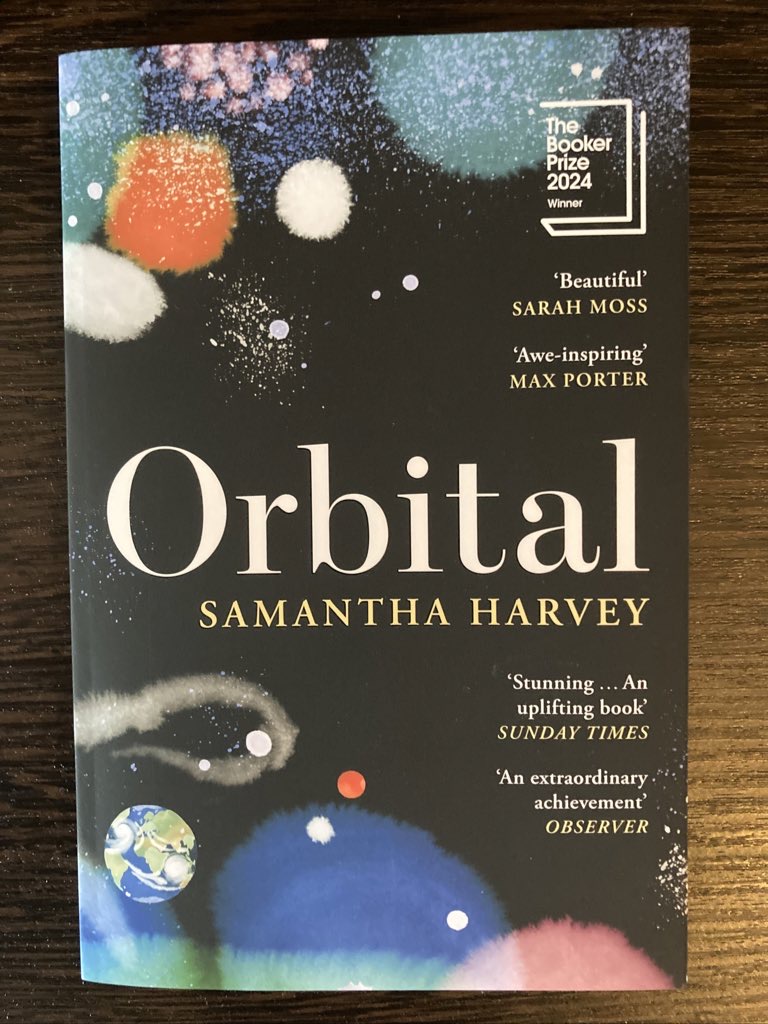
Orbital – Samantha Harvey #reading

‘Orbital’, the 2024 Booker Prize-winning novel by Samantha Harvey was the first book that I finished reading this year. I will admit that I am not usually a reader of what might be called ‘literary’ fiction but as this book was fairly short and has a science-based theme (the book recounts the thoughts of a group of astronauts on board the International Space Station (ISS) as it orbits the Earth over the period of one day), my wife thought it would probably interest me and gave it to me as a Christmas present.

I find books like this, that don’t really have a story as such, quite intriguing. It is interesting to ask the question: What it is that makes spending time with one set of fictional characters doing nothing in particular, apart from existing and thinking, interesting? (especially as it is easy to imagine many instances when it certainly wouldn’t be).

As it turned out, I did enjoy the day I spent with Harvey’s collections of imagined astronauts as they repeatedly observed their home planet (the ISS completes 16 orbits of Earth per day) and mused on their connections with the people, places and events down below. The writing challenges the reader to consider their own place in the world and the perspective from which they view both ordinary and extraordinary events. For me, the core themes that emerged from my reading of Orbital were the extent to which so much of human endeavour is bound up in the pursuit of progress, both the grand-scale technological progress shared only by a few such as the astronauts on the ISS, and the small-scale, day-to-day progress, shared by everyone of us, and the fragility of the world that all of this progress has created.

While gazing down onto the planet’s surface, one of the astronauts muses on this theme of progress in connection with his relationship with his daughter and the passage in the text that captures the stream of his thoughts as he does so was one that resonated deeply for me:

But what he meant to say to his daughter – and what he will say when he returns – is that progress is not a thing but a feeling, it’s a feeling of adventure and expansion that starts in the belly and works up to the chest (and so often ends in the head where it tends to go wrong). It’s a feeling he has almost perpetually when here, in both the biggest and smallest of moments – this belly-chest knowing of the deep beauty of things, and of some improbable grace that has shot him up here in the thick of the stars. A beauty he feels while he vacuums the control panels and air vents, as they eat their lunch separately and then dinner together as they pile their waste into a cargo module to be launched towards earth where it’ll burn up in the atmosphere and be gone, as the spectrometer surveys the planet, as the day becomes night which quickly becomes day as the stars appear and disappear, as the continents pass beneath in infinite colour as he catches a glob of toothpaste mid-air on his brush, as he combs his hair and climbs tired at the end of each day into his untethered sleeping bag and hangs neither upside down nor the right way up, because there is no right way up, a fact the brain comes to accept without argument, as he prepares to sleep two hundred and fifty miles above any ground for their falsely imposed night while outside the sun rises and sets fitfully.