Poetry #poem

I do not know if my poems are any good,
but it seems they help my essence to be understood,
whether by others or simply by myself,
this last, of course, itself essential for my health.

I do not know if my poems are enjoyable to read,
but it seems that crafting them fulfils some vital need,
and that allowing thoughts and feelings to gush forth
provides a compass I can use to find my north.

It seems as if through searching for each rhyme
I’ve stumbled on a way to slow down time,
and that now, through sculpting syllable-istic rhythm,
I see the world in multitudinous ways –
split infinite like sunlight passing through a prism.

And so, once more, I drop into the mine,
to chip away and work the line,
to trace the seam right to its core,
and scrape out all the mineral ore.
I hammer hard to split a rock,
in hope it is a nugget-bearing block,
in hope it might just be the one to hold
a precious, piece of sparkling gold.

I do not know if my poems hit the mark,
but certainly they’ve lit a spark.
So now the flames inside me roar,
and I can ask for nothing more.

Here goes…
First, time slows,
an idea flows,
like water spurting from a hose.
The seedling grows.
The petals unfurl upon the rose.

I take my chance…
Falling deep into the trance,
where visions glance,
words prance,
and rhythms dance.
And then I emerge, life enhanced.

In those moments, my whole world collapses onto a single spot.
So much energy compressed into a tiny dot-
freezing cold yet furnace hot.
I do not know if my poems are any good.
I do not know if my poems are enjoyable to read.
I do not know if my poems hit the mark.
It matters not.

(c) Tim O’Hare, July 2023


POETRY: I had some nice feedback on the first few poems that I wrote, but as this all came from people that knew me well it was impossible not to feel that it must be biased, even if only subconsciously. I began to think about whether my poems really were any good. This is the kind of thinking that usually drains my motivation and stops me in my tracks. But I have changed a bit in recent months, and pondering this a little more, I was able to acknowledge that whether or not anyone else liked my poems, I enjoyed the process of creating them, and was learning about myself as I did so.

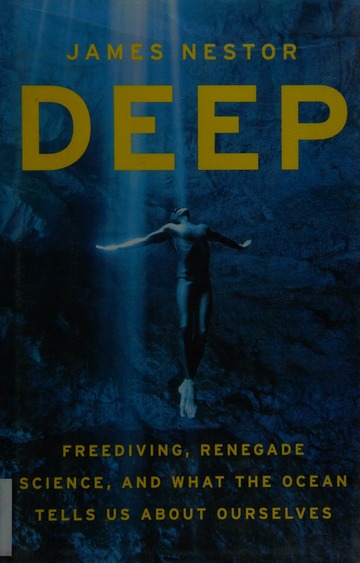
Deep – James Nestor #reading

I read James Nestor’s book Deep back in February/March, but I am a bit behind with my efforts to write blog entries and so I am only just getting round to writing something about it now. You could say that I have been submerged to such an extent that I have not been able to see even a glimmer of light to guide me in the right direction to get back on track…

Deep was not a book that I had ever noticed and thought I wanted to read, but one morning, at the back-end of last year, one of the students I teach in my first-year introductory oceanography module (there are almost 300 of them, although they are rarely [never?] all to be seen in the same place) came to see me during the break in one of my lectures and passed their copy of the book to me suggesting that I might like to read it. I think that my students generally assume that I am fascinated by the subjects that I teach and will love finding out more about any topic relating to them. This is actually not the case – it was a fairly random and somewhat inexplicable sequence of events that ended with me studying for an MSc and then a PhD relating to oceanography, and from there it was just a case of me continuing to follow what seemed to be the simplest path (i.e. the one that involved me making the minimum number of decisions) into my career as a Marine Science lecturer. Inexplicable it may have been (to me at least), but it’s a path that stuck, such that here I am, some 33 years later, still following it (maybe some would call it a rut!). So, in fact, I am not that interested in the undersea world, marine life and topics such as diving, I just somehow create the impression that I am fascinated by the oceans when I am teaching students about the various processes that occur within and on them.

Nevertheless, I thanked the student for passing the book to me and set it aside to read at some point. I had previously read his later book ‘Breath: The New Science of a Lost Art’, I knew that Nestor wrote well and would almost certainly have some interesting points to make, so it wasn’t really a difficult decision.

Deep is mostly about the pursuits of the very strange (to me at least) group of humans who strive to head as far as possible downwards into the ocean depths. It is nearly structured as a series of chapters titled by a depth in feet (e.g. -650, -2500, -35,850) and containing stories of human exploration towards that depth. Initially, at shallower depths, Nestor describes the pursuits of free divers, including the absolutely insane group of people that risk death competing to dive deeper and longer than their rivals. Some of the events that Nestor recounts, in which competitors emerge from the water with blood streaming from their faces, or in a semi or fully unconscious state were pretty horrific and I find it surprising that i) the ‘sport’ is allowed to continue, ii) anyone wants to participate in it and iii) Nestor still went ahead and learned to free dive so that he could join in with various activities.

In the latter part of the book, much of the content focuses on scientists and researchers who combine diving with attempts to better understand the behaviour of marine life such as various types of sharks and whales. All of this content was quite interesting, even for someone who is not at all obsessed with sharks and whales like me! It was particularly interesting to get a glimpse of the kinds of private organisations and collections of individuals that operate in this area of scientific exploration and research – often rather cavalier and unorthodox in their approach, because, I suspect, anyone trying to do the kind of ‘animal-encounters-at-close-quarters’ research that the book describes in a traditional, more highly regulated, academic setting would probably find that their efforts were thwarted by the requirements of such niggly things as risk assessments and ethical considerations.

In the end, I enjoyed reading Deep, and found it interesting to get a glimpse of the world of underwater activity it describes. However, it did nothing to make me wish that I was able to descend below the waves myself, quite the reverse in fact. I’ve always been quite happy existing on the solid substance of the land surface, and it’s pretty obvious to me that nothing is going to change that now!

The Tower #writing

I wrote most of this short story a year or two back, but returned to finish it earlier this year. I had been reading a lot of short stories and always found myself drawn most to those that included some kind of mystery twist as you approach their end. I’m not so bold as to compare my story with the best that are out there, but I am quite pleased with how it turned out, and the way that the three sections work to give the story its three distinct scenes. There are a few elements from my childhood in Somerset thrown into the mix – the shop in the first section was based on one that we used to visit sometimes on the way home from school on the Durleigh Estate in Bridgwater, the boys names match those of some of my class mates, I used to count Fig Rolls as my favourite biscuits and enjoyed many long bike rides out on the lanes that criss-cross the Somerset Levels. The tower itself is very loosely modelled on the Burton Pynsent monument near Curry Rivel, although in my minds eye I relocated this to the northern end of the ridge that runs north-northeast from Aller where the road from Othery to Langport makes a right-angle turn.

This is a fairly long read (it’s ~4000 words in total) but hopeful someone out there will make it all the way through and enjoy reading it!


They had agreed to meet outside the mini-mart at nine thirty but it was already pushing ten and Andrew still hadn’t arrived. The other two had waited patiently at first, assuming that Andrew was delayed at home by some last minute chore, but with every minute that passed this seemed less likely. Perhaps he wasn’t coming after all.

Throughout their wait, James had remained seated on the wall next to the steps down to the shop. He selected pieces of gravel from a handful he had taken from the driveway of a nearby house, lobbing each one towards a bin that stood a few yards away. Most of his throws missed, but he heard the satisfying clang of stone on metal just frequently enough to keep him at it. In contrast, Steve was on his bike, pedaling loops around the small car park in front of the store. It was Sunday, and with the shop not opening for another ten minutes, there were no cars to obstruct him. That would soon change as people started to pull in for a newspaper, some bread or a pint of milk for their breakfast, or supplies for a family trip.

Mr Sousa had arrived in his battered Austin Allegro not long after the boys, and they had grunted a hello to him as he had unlocked the shop door and disappeared inside. They could see him moving around at the counter, and he would soon be flipping over the sign that hung in the doorway to announce that he was open for business.

As Steve freewheeled towards the shop he squeezed the brake lever to lock his back wheel, allowing it to slide out from beneath him to spray a satisfying shower of dust and grit towards where James sat. He brought his bike to a halt.

“Hey, Humpty, let’s get going. If he was coming he’d be here by now. We can’t wait all morning.”

“I guess,” James replied, before directing his next piece of gravel in Steve’s direction, “but it’s odd, it was his idea to go to the tower in the first place.”

“That’s true,” Steve responded, “but he’s always a bit flakey. He probably had second thoughts when he realised the state he’d be in after dragging himself there on that crappy old rust heap he calls a bike. What sort of person rides a bike with only five gears?”

“It’s not his fault,” James said defensively, mindful that Andrew’s family were always struggling to make ends meet, “but it’s annoying. We’ve already wasted half an hour… and he was the one bringing the biscuits. We can’t go out on a bike ride without biscuits. At least Sousa will be opening up soon.”

“You’ll have to go in,” said Steve, “I’m not getting off my bike just for your precious biscuits. Here you go, he’s unlocking the door now. Get your fat arse off that wall and get in there.”

James sighed, he liked Steve, but sometimes the constant jibes got on his nerves and he thought he might bite back. He never did though. It wasn’t worth the bother. They had been mates for as long as he could remember and shared some great adventures together. The last thing James wanted to do was sour their friendship with the whole of the summer holiday still ahead. It did annoy him that Steve’s insistence that he should be the one to go into the shop meant that he would be the one to spend money but that, of course, was the point. Steve might be a lot of things, not all of them nice, but he certainly wasn’t stupid.

James watched as Steve pressed down on his pedals to start another loop and smiled as his friend swerved to avoid a car that had just turned into the car park. He slipped down from the wall and entered the shop.

“Morning Mr Sousa,” he called, heading to the second aisle.

Hmmm… what was it to be? His own favourites were fig rolls, especially the ones you could gradually dismantle, biting away the sides then detaching the base and top to leave only the sweet chewy slab of fig. But Steve hated fig rolls so there was no point in getting those unless he wanted their smashed fragments stuffed down his shirt. No, he supposed that it would have to be ginger nuts again. He reached out to grab a packet but his eyes flicked to the shelf below, and before he could stop himself he was uttering the words “Oh yay, oh yay – excellente, perfectissimo” as his fingers wrapped around a packet of custard creams.

“What’s that James? Did you say something?”

It was Mr Sousa.

“Have you found what you came in for?”

“Yes, it’s fine,” James responded, with a hint of embarrassment, “I’m just getting some biscuits. We’re heading out on our bikes. Andrew was supposed to be coming too but he’s not shown up.”

James slid an assortment of coins across the counter to Mr Sousa, who dragged them over the edge into his cupped hand before pushing the lever to spring the cash-tray towards him and depositing them safely in the appropriate compartments.

“Custard creams eh? Not a bad choice, although I’d have gone for fig rolls myself,” Mr Sousa said cheerfully as James made his way out of the shop.


James was struggling to convince himself that they had drawn any closer to the tower since they’d left the mini-mart car park just after ten. They’d been pedaling for an hour and a half, but despite their efforts it was still only a small bump on the horizon. The ride had been easy at the start, straight down the hill, and then left along the main road, before turning into the hedgerow-lined lane that snaked its way through the fields towards the council estate. They’d put their heads down and pedaled past the stained concrete houses as quickly as they could, and then they were free, out on the flat expanse of the moor. Their target, the ridge with the old tower at its far end, rose like an island to block out the world beyond.

James had only visited the tower once before. It had been a family trip towards the end of the previous summer, the four of them in the little car with the wicker picnic basket, tartan rug and his brother’s kite. It had not been a great trip. Despite their elevation the kite flying had not been successful, and his brother, mood sullied, had decided to entertain himself by trying to trip James over as often as he could. To make matters worse, they had found the gate to the tower held firmly shut, a fat chain doubled around the metal bars and gripped tightly by a heavy-duty padlock. It was a discovery that had done nothing to improve the mood of the day, and the journey home, back through the winding lanes that followed the rhines around the edges of the fields, had been made in silence, each of them knowing that words would only serve as a spark to set the air in the car alight with anger and blame. So much for a happy family day out. But amidst all of the recriminations about why no-one had thought to check whether the tower was open, James had noticed a small gap in the wall, just along from the metal gate, and he had tucked a memory of it safely away for future reference.

It was Andrew who had suggested that they cycle to the tower. James would never have thought of making such a long journey. He was quite happy wheeling around the lanes closer to home but heading out through the network of lanes that criss-crossed the marshy moor was not the sort of idea that came into his head. He’d protested that they didn’t know which of these lanes they should take but Andrew had said that it didn’t matter, all they had to do was keep the tower in sight and work their way towards it. There was no argument against that really because the tower’s prominent position meant that it could never be out of sight for long and so the plan to make this their first adventure of the summer holiday had been hatched, although it had really been Andrew who had made the plan. James’s only contribution had been to inspire the destination when he had told the others about the gap in the wall. And Steve? Well Steve didn’t really care what he was doing or where he was going as long as it gave him something to do. So here they were, Steve pushing on ahead, setting the pace and making the decision about which way to go whenever they came to a junction, James straining to keep up and Andrew nowhere to be seen of course.

They hadn’t bothered to pack any other food and James was starting to think that this was a mistake. One packet of biscuits was hardly going to be enough to sustain them through the day, although with Andrew not there at least there would be more for him. But the biscuits had to wait until they had arrived at the tower. It was one of the rules that the boys imposed on themselves – no biscuits until the destination is reached. They were lucky that they had any biscuits at all today, James thought to himself, as he tried to contain his hunger with a swig of water from the plastic bottle that was cradled on the frame beneath him.

It was hot, approaching the middle of the day, and although they were definitely closer to the tower now, it was clear to James that they still had as much as an hour of pedaling to go. The view from the top of the tower had better be worth it after all of this exertion. It was a great surprise then, that as he rounded another of the right-angle turns at one of the field corners, James saw Steve’s bike propped against a gate and Steve himself sitting on the grassy verge, his back against the gate post.

“Hurry up slow coach,” Steve called out as James came to a halt, “I’m hungry. It’s time to crack open the biscuits.”

“But we’re not at the tower. We can’t open them yet. You know the rules,” James protested.

“Oh sod the rules,” Steve responded, “Who thought them up anyway? It certainly wasn’t me. It’s not like a flash of lightning is going crash down to punish us is it? To be honest if I don’t get something inside me I’m not sure I can be bothered to go all the way to that stupid tower anyway.”

James knew that it was pointless to argue, but it did annoy him that Steve was so quick to discard one of their rules in such a cavalier fashion. Yes, obviously, their rules were not important in the grand scheme of things, but they were their rules and they had all agreed to them. It was just how they did things, part of the special bond that held the three of them together. Now here was Steve, always quick to castigate James or Andrew whenever they suggested a breech, throwing this rule away without any discussion whatsoever.

With some reluctance, James slipped his pack from his back and pulled out the packet that he had purchased earlier.

“You’d better not have squashed them,” Steve exclaimed, and before James had time to reply he reached up to snatch hold of the packet.

“What are these?” Steve moaned with a hint of disgust in his voice, “Custard Creams?”

He ripped open the packet and grabbed a handful of the pale-coloured biscuits.

“At least you weren’t stupid enough to get those disgusting fig things you’re so fond of”, he continued, but his last few words were not really decipherable due to the presence of several biscuits that were already crammed into his mouth.

The two boys sat for a few more minutes. James was dismayed to see the packet emptying steadily.

With just one biscuit left James knew better than to think it could be his, so it was a shock when he heard Steve tell him that he could take it if he wanted. It was too good to be true of course. As James reached down, Steve’s hand shot out to grab the last biscuit, before hurling it across the lane in front of them with a shout of “fetch”. James watched as the last custard cream traced a smooth arc through the air before it dropped with a loud plop into the drainage ditch that ran alongside the field on the opposite side of the road.

James sighed. Not only had they broken their no biscuits rule but Steve had wantonly wasted valuable resources. It was not good, not good at all… But there was no time to consider things further. Steve was already on his bike and accelerating rapidly away.


“Here we are then Mr Webster,” Jake announced somewhat breathlessly as he brought the wheelchair to a halt next to the wooden bench that looked out across the moor, “We’ll just get you settled onto the bench and then I’ll leave you in peace for an hour or so.”

“Thank you Jake, it’s very kind of you to bring me you know. It can’t be easy pushing me all that way,” the old man replied.

“Oh, it’s not too bad,” Jake responded, “at least I was able to park up here. I certainly wouldn’t have fancied pushing you from the bottom of the hill.”

“There you go.”

He planted Mr Webster’s body onto the bench.

“Here’s your paper – you can read all about last night’s match – and here are your biscuits. Don’t eat them all at once!”

Jake folded the wheelchair and propped it securely against the bench.

“I’ll leave you now, but I won’t go far. I’m going to follow the footpath along the ridge towards Ilton. I’ll be back in an hour. Don’t go getting thoughts of racing off down the hill will you,” Jake said cheerily as he began to walk away from the bench.

Jake had started working at the home a few years previously and this was the third time he had brought Mr Webster to this spot. He liked Mr Webster – he was sharper than a lot of the other residents and always liked to talk about the latest football scores or news stories. It always amazed him how much Mr Webster knew about things. It was a couple of years now that he had needed the wheelchair to get around but his mind certainly wasn’t failing. There had been some discussion about whether it was sensible for him to be taken out like this, but Jake had been happy to sort things, and Mr Webster was such a long-standing member of the community at the home that the management had not taken much persuasion to allow the trips to continue. It was not as if Mr Webster demanded to be taken to all kinds of different places at all times of the year. No, Mr Webster only ever wanted to spend a little time in one place, up at the viewpoint towards the end of the ridge close to where the old tower had stood, and always on the same date, July 27th. It was an odd choice – the tower had been demolished many years ago, and the viewpoint and the small parking area nearby had become rather overgrown – but Mr Webster had never given any reason. It was just where he wanted to go, and Jake was happy to take him there and have a few hours away from the slightly stale smell and hushed atmosphere inside the home.

Mr Webster sat on the bench staring out across the patchwork of ditch-lined fields on the moor below. In places the field boundaries were marked by hedgerows and occasionally there were stands of bright-leafed willow trees nestled alongside the larger drainage ditches. A few small roads crossed the moor, zig-zagging their way around the fields to link together the farms and small-holdings dotted within the landscape. It was a long time since Mr Webster had been down any of those roads, not since his childhood in fact, and each year it occurred to him that his trip here might be his last.

He was tempted to close his eyes to nap, but the whole point of coming up to this bench was to feel the air, to sense the sounds and the smells, and most of all to try to absorb the spirit of the place. He couldn’t do that if he dozed off. He wouldn’t be here long, so it was important to remain alert. He didn’t want to miss anything. Not that anything had ever happened up here during any of his other visits. He’d been coming here for almost ten years now, ever since he had moved back down to the area, and just being here sent his mind tumbling back to memories of schooldays, old friends and summer adventures. But this was the first time he’d been back on a Sunday.

It had been quite a wrench when they moved away. He could still remember that other Sunday morning all those years ago when his parents had announced that they had to rush to be with his Mum’s family. There had only been time for him to pack a few things before being bundled into the car for the long drive north. After a few weeks it dawned on him that they would not be heading back, and his suspicions were confirmed when his father hired a van and made the return journey to pick up the rest of their belongings. His parents had asked whether he wanted to go back to help on that trip, but were not surprised when he had said no. After all, he was only young, and it was to be expected that he wouldn’t want to be reminded of what had happened down there. He’d known the two boys well and should have been with them that day, so their disappearance would obviously be difficult for him. So, he had remained in the north, distance keeping him detached from the tragedy.

But he had not forgotten about the others.

When his wife had passed and with his daughter living in Canada, he had decided to return south. The retirement home was ideally located, close enough to his old haunts to provide a feeling of connection, but far enough away for him not to be constantly chased by memories of the time he had spent in and around the area in his childhood.

He caught sight of the boys as they pedaled along a lane beside one of the fields at the edge of the moor, close to where the road climbed steeply towards the ridge. They had emerged into view from behind one of the stands of willow trees – the red-haired boy out in front setting a stiff pace and the other boy trailing a little way behind. He glanced down at his watch and made a mental note that they should arrive at the bench in about twenty minutes. Jake would be on his way back by then. When he looked down at the road again the boys had slipped from view. They would soon be pushing their bikes up the hill.

James was first to emerge followed a little way behind by Steve. They were instantly recognizable. As they pushed their bikes towards him the boys moved closer together, and Mr Webster could see James pointing past the bench towards the wooded area where the tower had stood. They drew level with the bench, and Mr Webster called out to them.

“Well done boys, that must have been quite a climb.”

They did not really respond, just nodding and making a few grunting noises.

“Here, sit yourselves down for a bit of a rest. You’ve earned it. I’ve got some biscuits here – Ginger Nuts. I’m not that keen on them myself but they were the favourites of one of my old schoolfriends.”

The two boys weren’t really interested in sitting and talking to some old codger with false teeth and hair growing out of his ears, they had more exciting things to be doing, but at the mention of biscuits they had pricked up their ears. Steve was the one to reply.

“Yeah, thanks, that’s funny, they’re my favourites too.”

He nodded towards James.

“That idiot went and bought Custard Creams earlier, but we’ve eaten all of those already.”

“That’s a shame,” Mr Webster replied, “Custard Creams are my favourites.”

He passed the unopened packet of Ginger Nuts to the boys.

“If Custard Creams are your favourites why did you bring Ginger Nuts with you?” James asked the old man, “I’d always choose my favourites if it was just me eating them.”

Mr Webster let out a soft sigh.

“Well, I guess I didn’t bring the biscuits to eat myself,” he said, “I usually do bring Custard Creams when I come up here but for some reason I asked Jake to get Ginger Nuts today.”

“Who’s Jake?” James asked, but Mr Webster seemed lost in his thoughts and gave no answer.

Steve glanced towards James, and with eyebrows raised and his finger pointed towards his head, made a whirling motion with his hand as he rolled his eyes. He placed the open packet of biscuits down on the bench and grabbed the handlebars of his bike.

“Come on then,” he spoke to James, “we might as well go and explore that damned tower now that we’ve made it here,” and as the two boys walked away from the bench he continued in a whisper that only James could hear, “There’s something funny about those biscuits. They’re different from the ones we usually get. The packet was different and all. Let’s get going and leave him to his newspaper.”

The two boys walked up the track and disappeared into the line of trees that circled the summit of the hilltop at the end of the ridge behind which the tower was to be found.

Jake sensed that something was not right as soon as the bench came into view. Mr Webster was sitting exactly where Jake had left him, but his head was slumped back against the bench. On the ground nearby lay the packet of biscuits that Jake had bought in the garage on the way over in the morning – not Mr Webster’s usual Custard Creams but the Ginger Nuts that he had expressly asked for – and a group of three sparrows were darting to and fro, sweeping up any crumbs that they could find. As he approached the bench, a gust of wind caught hold of the newspaper on Mr Webster’s lap and flicked it open. The movement distracted Jake for a moment and he glanced down to see a headline that read ‘The Lost Boys – 60 Years Ago Today’, but as intriguing as that sounded, this was no time to start looking at articles in the local newspaper.

Jake took one more look at Mr Webster and was pleased to see that he had a smile on his face. He reached into his jacket pocket and pulled out his phone.

When his call was picked up he responded to the questions calmly.

“Ambulance please.”

“The bench at the end of the ridge that runs southwest from Ilton, next to where the old tower used to be.”

Then Jake turned away, first looking out across the moor below and then turning to follow a gentle breeze that brushed past his face as it sped towards the small wood that smothered the space where the old tower had once stood.


(c) Tim O’Hare, March 2025
Liminal Thinking – Dave Gray #reading

Liminal Thinking: Create the change you want by changing the way you think by Dave Gray is a book that I have toyed with reading for some time. I remember the occasion, quite a few years ago now, when, sat in a presentation at a Teaching and Learning Conference at work, I first encountered the concept of liminal spaces – transitional spaces or places that sit, rather fuzzily, between two different states, spaces or places. Since then, I have become rather fascinated by the concept of limnality, especially where this exists between one state or space that is very familiar and another that is largely, or even wholly, unknown. It’s a concept that I leaned on when writing my poem It Is Time (which should appear on this site in the not-too-distant future, as long as I am able to navigate the liminal space that is wedged between now and then…). So it was not that surprising that when I was looking for a new audiobook to listen to on my way to and from work, Liminal Thinking pushed its way to the head of the queue.

Unfortunately, my ‘reading’ of Liminal Thinking was something of a disappointment.

First, I don’t think Gray’s book is really about limnality at all. Instead, I think it’s a book about how bias creeps into the development of a personal world-view, and how being aware of this can help us to challenge our instinctive thoughts to develop a more robust and accurate set of beliefs. I’m inclined to think that the introduction of the word ‘liminal’ into the title of the book was primarily a case of the author trying to find a distinctive ‘buzzword’ in the hope that it might catch on and become associated with him in similar fashion to ‘atomic’ (Atomic Habits by James Clear) and ‘tiny’ (Tiny Habits by B.J.Fogg). But perhaps that my natural tendency towards cynicism coming into play…

Secondly, my experience listening to this audiobook reinforced a feeling that has been growing inside me for a while now, namely that it doesn’t really work to listen to certain kinds of non-fiction and hope to get much out of the experience. I am thinking here of books that are in any way a bit how to-ish in character. This is because unless you are prepared to be constantly stopping to bookmark segments or to rewind to listen again so as to catch details fully, it’s just not possible to come away from the listening experience with anything tangible (such as some kind of notes), and with no physical, print version available either, there is then nothing to refer back to later on. Still, if nothing else, this does mean that Liminal Thinking taught me one good lesson: that I’m not going to waste my time listening to this kind of book any more.

My experience with Liminal Thinking wasn’t entirely negative. Gray does a nice job of succinctly capturing six ‘principles of beliefs’, namely that:

  • beliefs are models
  • beliefs are created
  • beliefs create a shared world
  • beliefs create blindspots
  • beliefs defend themselves
  • beliefs are tied to identity

These principles are designed to highlight how the things we believe are not necessarily true reflections of reality but are, instead, built on thoughts that we have, mostly automatically, as we process our interactions with the world around us through our unique, personal, and mostly unconscious, set of biases and filters (things like ‘confirmation bias’ or ‘spotlighting’). Gray argues that with the right practice, it is possible to develop the ability to challenge one’s beliefs, and modify the way that we respond to inputs, so that what we come to believe about the world is a more accurate, or at least more reliable, model of our reality. He does this by introducing a number of so-called ‘liminal thinking practices’. These are:

  • assume that you are not objective
  • empty your cup
  • create safe space
  • triangulate and validate
  • ask questions, make connections
  • disrupt routines
  • act as if in the here and now
  • make sense with stories
  • evolve yourself

Most of these practices are pretty much self-explanatory, but if you asked me to explain what it means to ’empty your cup’ (in this context) I’m afraid that I would fail the task… You see, I have developed a belief that when it comes to trying to retain the knowledge and ideas conveyed in non-fiction writing, listening to an audiobook doesn’t work, and that means that whatever ’empty you cup’ is referring to went in one ear and out of the other. What’s more, I am pretty much convinced that no amount of questioning, safe space, routine disruption, story-telling or personal evolution is going to change my mind…

The Killing Field #poem

This is the killing field –
but the danger does not come to you or me
from the piercing horn of a bull’s rush,
the digoxin punch of a fox’s glove,
or a saliva-damp kiss from a cow’s lip.

This is the killing field –
but the danger does not come to you or me
from the aconitine grip of the wolf’s bane,
the spicular burn from a nettle’s leaf,
or a sudden unexpected stroke of a pony’s tail.

This is the killing field –
and just for once, the danger does not even come
from those who strip the land to build and burn,
who work the soil to plant and grow,
who take whatever they wish to take,
who go wherever they wish to go.

This is the killing field –
but the danger does not come to you or me.
It comes to the little creatures
that scuttle and slither over ground,
or paddle at the water’s edge,
or take flight into the humid air,
or hide away within the sedge.
For they refused to yield
to kiss the ground before the wise birds’ shrieks,
and so were baited by the raptors’ curse.

This is the killing field –
but the danger does not come to you or me.
It comes to the mouse, the rabbit and the vole,
not fast enough to find a hole,
the beetle, grub and dragonfly,
left with no escape to try,
the snake, the newt, the toad, the frog,
too slow to get beneath a log,
the pigeon, finch and moorhen chick,
this time, alas, insufficiently quick.

This is the killing field –
and for all the little creatures that you love,
death comes unheralded from far above.

First comes
Buteo buteo (Buzzard):
Mightiest of all,
soaring high in thermal plumes,
before swooping down
to grasp in taloned feet
the unfortunate prey it must consume.

Then comes
Circus aeruginosus (Marsh Harrier):
Not far behind in stature and power,
ranging low with undulating flight,
before entering the reed bed
to pluck out
the tiny creatures hiding there in fright.

But not all threats require wings of such size, for now come
Falco tinnunculus (Kestrel):
Fast wings, steady hover,
sharp eyes,
before falling like a stone
to pounce
with great surprise
and
Falco subbuteo (Hobby):
Wings swept, swift flier,
thrilling chase,
before making the snatch,
to prove
that it has won the race.

An optimist might think
that the setting of the sun
and the falling of the dark
could bring respite.
But this is the killing field –
and the danger comes both day and night.

For now, in fading light, comes
Tyro alba (Barn Owl):
Heavy flaps, ghostly glide,
a pause upon a post,
before the sudden drop
to make the surprise visit
to its host.

Then, as darkness gathers like a cloak, comes
Athene noctua (Little Owl):
Sitting, watching from a lofty perch,
shattering the silence with its screech,
before flying down,
to snaffle up
whatever it can reach.

And finally, with all light gone, comes
Strix aluco (Tawny Owl):
Master of the dark,
Night vision goggled, waiting patiently with hunting ears,
Before pouncing,
silently,
on each and every morsel of a meal it hears.

This is the killing field –
but the danger does not come to you or me.
The danger comes from far above
from birds named with gladiatorial sounding words:
Buteo buteo and Circus aeruginosus
majestic Buzzard and Marsh Harrier.
Falcos tinnunculus and Subbuteo
agile Kestrel and Hobby.
Tyro alba, Athene noctua and Strix aluco:
Barn, Little, Tawny – three wise owls. 

This is the killing field –
and the danger comes with such beauty and grace,
that seeing Death
has never before
put such a smile upon my face.

(c) Tim O’Hare, July 2023


THE KILLING FIELD: While staying in Suffolk during the second week of our summer holiday we walked around Redgrave and Lopham Fen one afternoon. Having seen various birds, but not being entirely sure that I had been able to identify them all correctly, I made sure that we went back for a second look, and I was really thrilled to confirm my first ever sightings of a Marsh Harrier and a Hobby along with the oft-seen Buzzard and Kestrel. These are all beautiful birds, and it was fascinating to watch their different flight patterns and to look up information about their diets and hunting styles. But it struck me quite forcibly that with that beauty and guile came death, and the idea that the area around the fen was a ‘Killing Field’ took root in my head. During our stay we also heard or were told of the whereabouts of several different species of owls – the evening and night hunters – and so I threw those into the deadly mix too.

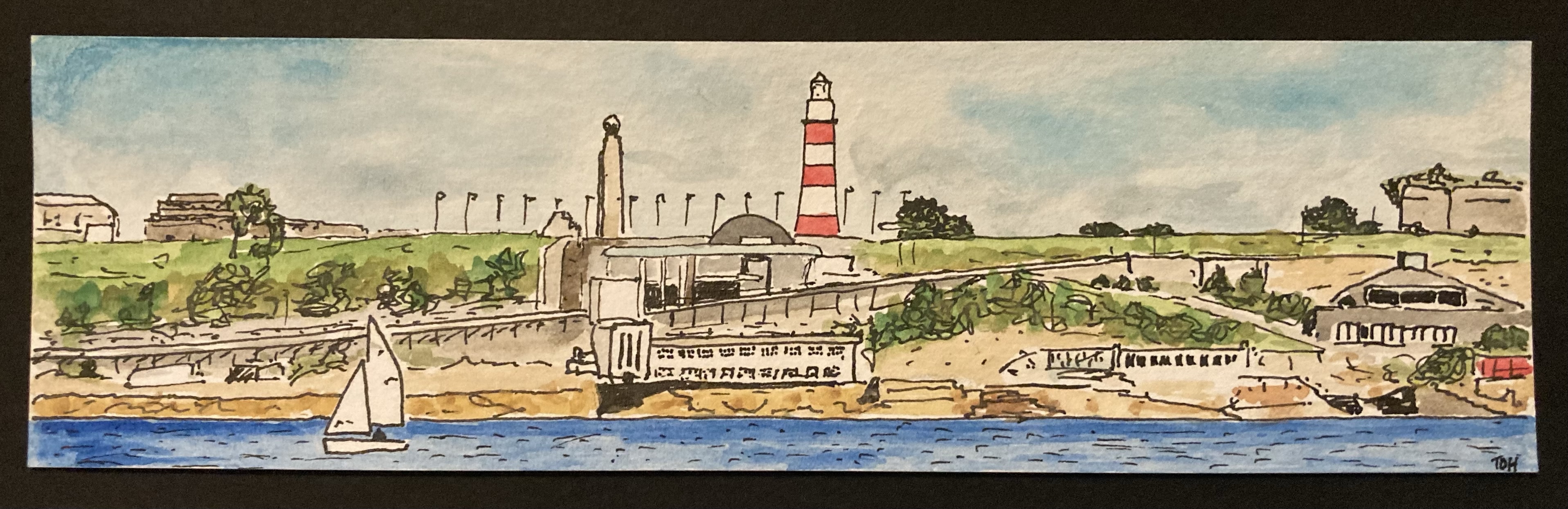
Plymouth Waterfront from Plymouth Sound #art

I painted this small panoramic picture of Plymouth Waterfront as viewed from Plymouth Sound as a bookmark to accompany the birthday present (books!) that my wife gave to one or her friends back in March. They enjoy a weekly walk down to the Plymouth Waterfront on most Friday mornings and so this scene was the obvious subject matter to choose.

It was interesting to paint in this wide format, and it’s an approach that I have been using more recently for some Dartmoor pictures. I think that when we view a landscape in real life our brain naturally provides a somewhat wide-screen view, and that this might be why, at least to some extent, it is often somewhat disappointing when you take a photograph of a view and much of what you see in real life seems to be condensed into a very small part of the picture.

One advantage of adopting this kind of panoramic composition, at least for a novice and completely untrained painter like me, is that it reduces the amount of sky, as this is often tricky to paint. And in this particular picture it also reduced the amount of water that I had to paint, something else that I’m not especially confident with.

All in all, I really liked this picture with its pops of colour [did I really just write ‘pops of colour’ – this seems to be such a trendy turn of words these days on TV programmes relating to art, interior design, home improvement etc. I must have caught it from there…]. I am sure that this is a format and also, with its obvious local interest, a view that I will return to in the future.

Mistakes Are Not Always Bad #wisdom

A couple of weeks ago we paid a visit to Make Southwest, an exhibition space for contemporary craft and design and a leading charity for craft education located in the small town of Bovey Tracey on the southern edge of Dartmoor, about 25 miles from our home in Plymouth. It’s a venue that we have visited a few times before – there is always some kind of special exhibition (this time it was a exhibition of contemporary bells called Sound and Silence) and an interesting array of local artwork, books and assorted items to look at in the shop. On this occasion, the reason for our trip was to see a smaller exhibition of wood engraved prints and, in particular, the printmaker Molly Lemon, who had travelled down from her base in Gloucestershire to demonstrate her work. We have encountered Molly at several Craft/Art Events in the last couple of years and always enjoyed viewing, and chatting to her, about her work. We also enjoyed seeing her compete in, and reach the semi-finals of, the Sky Arts TV Series Landscape Artist of the Year a few weeks ago.

Since I started painting about a year ago, whenever I go to any kind of art gallery or art/craft event I particularly enjoy scavenging the work that is on display or sale for ideas that I can try out for myself. Looking at the various pieces of artwork for sale in the shop at Make Southwest, I was particularly enamoured by some tiny pieces of work created by the printmaker Mike Tingle (also here). These were very small (just a few centimetre) square prints on slightly larger squares of rough-edged paper, with a title and the artist’s name written in pencil around the picture (there is an example of a similar kind of picture just below the centre in this piece of work: Dartmoor Box No 1). I really liked the miniature size and somewhat ‘rough’ nature of the pieces and I immediately thought that it would be fun to try to produce something similar using one of my own small Dartmoor Scenes watercolour paintings.

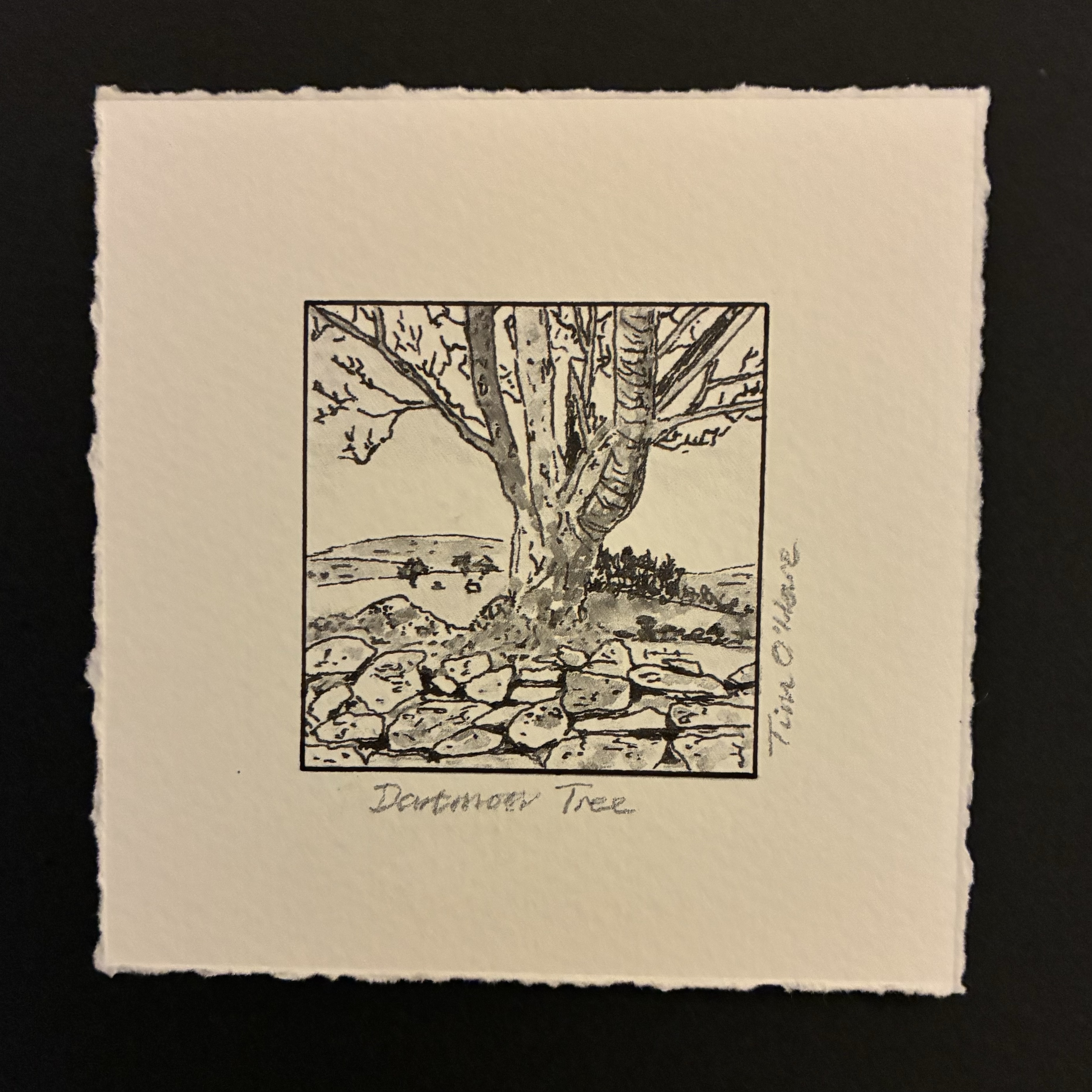
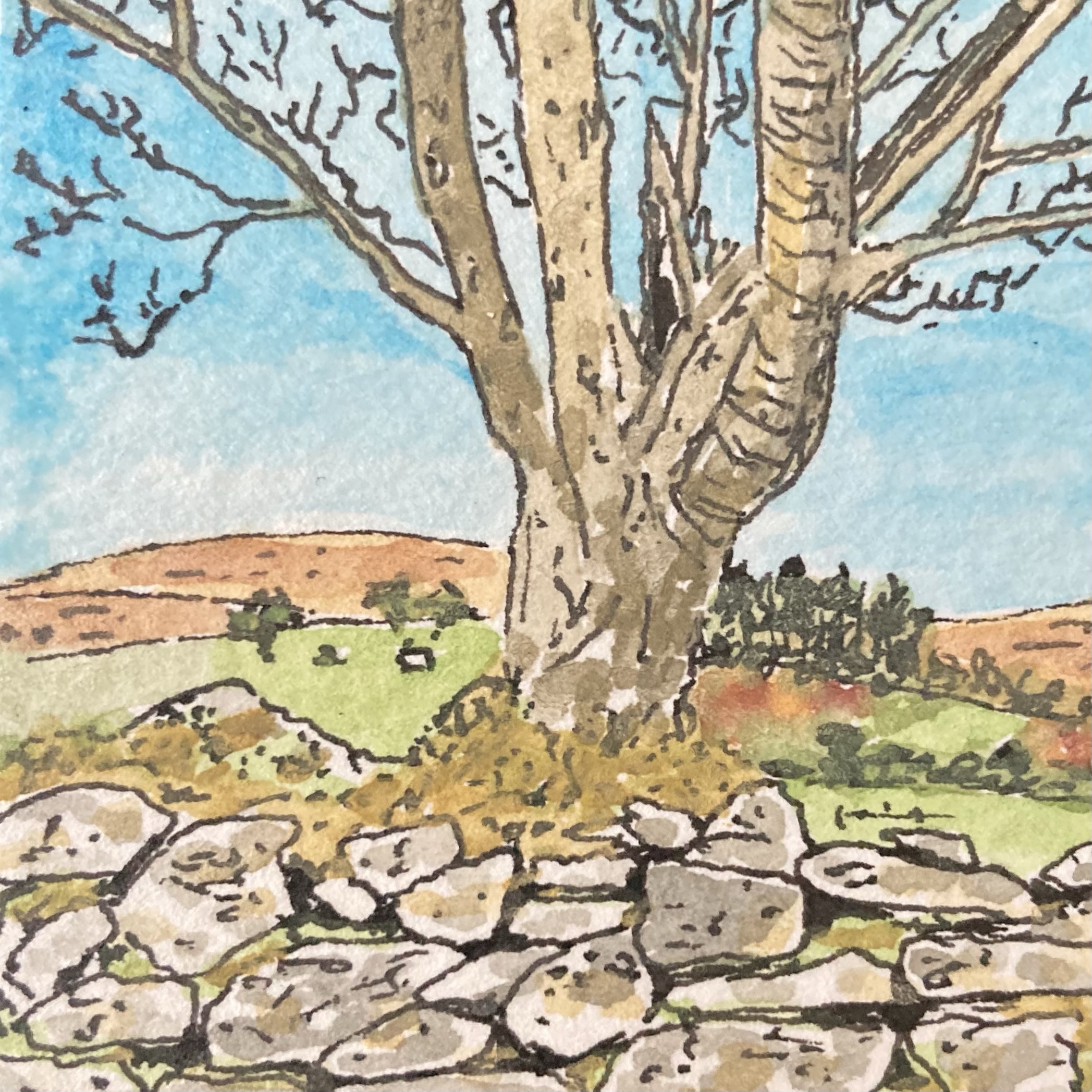
After returning home, I set about seeing what I could produce. First, I selected one of my pictures, opting for this one of a tree growing out of a typical Dartmoor dry-stone wall:

The original picture is a 4.5 cm square ink and watercolour sketch, and my intention was to use our home inkjet printer to make the best quality colour photocopy of it that I could, printing onto a sheet of watercolour paper so that the texture of the original was preserved. I’d already played around with making copies of some of my paintings in this way and so I knew that although the copied versions weren’t quite the same as the originals, with the paler colours tending to wash-out a bit, the process worked pretty well. So far so good.

This is the point at which I made my mistake. In the process of making the copy I somehow selected black-and-white printing, and so when I saw what the printer had spat out into the print tray I was instantly annoyed and frustrated. To make matters worse, because the original picture was on a small square of fairly thick paper, as the scanning light moved below the copier glass a dark shadow line was cast on one side of the copied picture. Not only did I only have a black-and-white copy, but I had a black-and-white copy that had a dark line along one of its edges. What a waste of a sheet of paper and ink…

However, once I had overcome my initial disappointment and self-censure, I decided to press on with the rest of my production process and see what the end result looked like. I had intended that there would be no border between the picture and the surrounding area of paper, but now there was that dark line along one side spoiling that design idea. What could I do? Well, go with the mistake of course. I took my drawing pen and with the aid of a straight edge and a lot of care, I inked in a similar line on the other three sides. Hmmm… it didn’t look as I had planned but I liked the result. Then I measured out a wider border, and again aided by a straight edge, I tore the paper down to size. This part of the process is something that I have found takes a lot of care… if the tear is too sharp you don’t get the nice rough edge I was after, but if you are at all rushed and loose you end up with something that looks clumsy and careless. Fortunately, I managed to do a good job. Finally, I grabbed a soft pencil and quickly wrote a title below the bottom edge and my name on the right-hand side…

The result of this endeavour was the small picture shown at the top of this post and, despite my black-and-white and shadow mistakes in the copying process, I’m really pleased with the end result, so much so, in fact, that I intend to take the rest of my Dartmoor Scenes pictures and treat them in the same fashion. Even better, not only did I end up with a new picture that I really liked and the discovery of a new way to transform existing pictures into a different, somewhat distinctive, form, but I also gave myself a great reminder that making mistakes in life is not always a bad thing. In fact, sometimes, as in this case, a mistake can open up a different path from the one that was intended that leads you towards an unexpected but interesting, exciting or enjoyable destination!

The Lies of the Land #poem

There’s a hill marked on the map,
and so we will have to climb up.
We need to follow the river along the valley,
so then we’ll be quite far down.
Let me see, there should be a church tower…
yes, on the horizon, over there
which means that our path will go right then left twice,
and then another turn right.
Next to the fen marsh it will probably be a bit wet,
but the stretch along the beach should be sandy and dry.
That’s the car park, just in front,
so where’s the windpump?
Behind us, out of sight.

It is helpful to be able to orientate yourself in time and space,
and a comfort to know that everything stands in order,
in its rightful place.
Believe me, there is a problem
if you don’t know which way you should face.
I think I’m pretty good at this, so let me help you understand:
Left, right, up, down, in front, behind, parched or drowned,
the truth is that you must get to know
the lie of the land.

No, sorry, wait… It’s not quite that simple…
That hill I mentioned is only five metres above sea level.
It’s so low down that it can hardly be called a hill,
in fact it’s little more than a pimple.
The water in the river flows further down towards the shore,
which means that the valley is actually up above the sea.
When we reach the church tower, it won’t be over there,
it will be our here, obviously.
And when we follow the path back, we will take a left,
a right and after that we’ll go right then left again.
But it shouldn’t be too confusing,
because we’ll be on familiar ground by then.

This isn’t what I was expecting
from the map on the visitor centre wall.
I guess there’s been so little rain recently
that the marsh is bone dry,
and there’s hardly any water in the drainage channels at all.
The tide must be on its way out,
because there are shells and seaweed all along the shore,
and so the sand is salty wet.
Anyway, it’s been nice since we got away from the car park;
I was pleased to leave that behind
all those cars and people made me fret.
So, where is the windpump?
Have patience, don’t get stressed.
Wait for it. Ready?
There, right in front.
Are you are impressed?

It would be helpful if I could orientate myself in time and space,
and comforting if everything would actually get in order,
into its rightful place.
I definitely have problem
when I don’t know which way I should face.
I thought I was pretty good at this,
but now things are getting out of hand.
Left, right, up, down, in front, behind, parched or drowned,
I’ve really been made a fool of here
by the lies of the land.

(c) Tim O’Hare, July 2023


About this poem: While staying in the Norfolk Broads during our summer holiday we drove out to the coast for a walk at Horsey Gap, parking the car near Horsey Windpump (a National Trust site). On the way there I had been amused to notice that features that were named on the map as hills were, in fact, only a few meters above sea level and the idea that such naming was a ‘lie of the land’ was born. The poem picks up on various elements of the walk which took in fen-land marsh, a beach (with seals swimming in the surf) and, of course, the windpump.

Voluntary Simplicity – Duane Elgin #reading

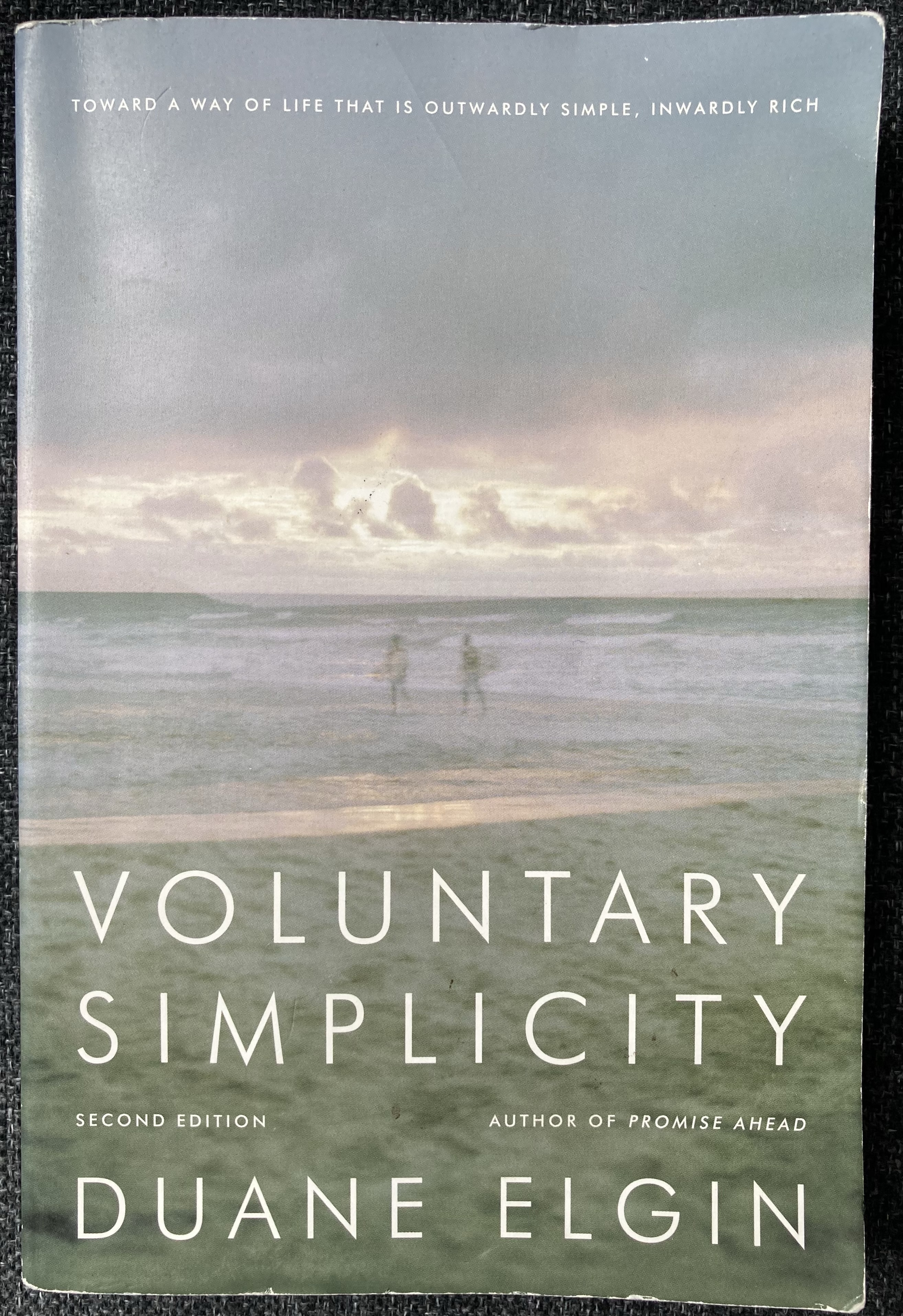
Voluntary Simplicity by Duane Elgin was the March 2025 choice for the TimeCrafting Trust Book Club that I am a member of. I think it’s fair to say that it is unlikely that I would have read it otherwise, although the ideas that it covers – Simplicity and to a lesser extent Minimalism – are certainly ones that I am interested in.

Elgin bases large chunks of the text on a survey he was involved with several decades ago (the first edition of Voluntary Simplicity was published in 1981) which probed the motivations and thinking of many individuals, from many different countries and walks of life, who had opted to simplify their lives. He is at pains to point out the most common perceptions of those who choose to live a ‘simpler life’ – that they tend to be anti-technology, anti-innovation and backward looking – are not generally correct, and that living simply does not have to mean living in poverty, in a rural and/or plain environment, nor does it necessarily result in economic stagnation. In fact, Elgin makes the case that the ever increasing number of people who are choosing to live with simplicity are doing so because it provides a path to greater satisfaction with life, with a deeper connection to the entire world around us.

As the book proceeds, it becomes more and more focused on the necessity that we live more simply in order to survive on the planet as population growth continues, climate changes ever more significantly and obviously, and natural resources are depleted. And, of course, the need for solutions and responses to the challenges that Elgin describes has become significantly more pressing in the years since the book was first released. But Elgin does not get all of his future-visioning right. He places great emphasis on the potential for television to be the vehicle through which positive messages about simplicity can be delivered and is rather dismissive of the potential for new technologies to invade this space. Nevertheless, Elgin’s arguments do mostly stand up to scrutiny.

I felt that Voluntary Simplicity was an ‘okay’ read, although I am sure that there are better, and more up-to-date, books on this topic. I don’t think that it is surprising that prior to reading the announcement that Voluntary Simplicity had been picked as a Book Club book I had ever heard of it or, indeed, of Duane Elgin himself. However, I did my reading did lead me to four quotes that I really liked. The first, comes from one of my favourite sources, the “quote-factory” commonly referred to as Henry David Thoreau. It has perhaps a rather depressing tone – ‘life is frittered away’ – but I think this is what lends it the power to motivate change:

Our life is frittered away by detail… Simplify, simplify.

I also really liked Elgin’s own take on the power of simplicity, namely that:

Simplicity is the razor’s edge that cuts through the trivial and finds the essential.

and I enjoyed his statement that:

Our bodies are biodegradable vehicles for acquiring soul-growing experiences.

‘Biodegradable vehicles for acquiring soul-growing experiences’ – I mean that really is life in a nutshell isn’t it?

Best of all, I think as a result of its own simplicity and the rhythm of the language used, is an adage that Elgin attributes to the New England Puritans:

Use it up, wear it out, make do, or do without.

That’s not a bad maxim to try to live by, at least to some extent.

I Am Not Lost #poem

I’m just back in from my morning run.
Before I left, she asked me how far I was planning to go,
and I replied, “Only about 3 miles – maybe thirty minutes or so”.
I showed her my intended route on the map,
so that in an emergency she could find me in a hurry.

As soon as I was outside, my mind was transported.
There were poppies and other wildflowers in the hay fields,
faces turned to greet the morning sun.
I ran through swathes of wheat and barley waving in the breeze,
reed beds down by the fen, and woods with birds singing merrily in the trees.

But I had been far too optimistic, and so made several false turns,
finding my way blocked, not wanting to squeeze
my way through tick-infested ferns.
At one point I had to whisper my way past a group of young cattle
that barred my path, even nibbling at my shorts.
Fortunately, that encounter did not end up as a battle.

Some people might laugh at my incompetence,
but I have to disagree because
I was not lost.
And though I will reluctantly admit that I did not know exactly where I was,
I don’t think it really mattered
that I wasn’t quite where I’d expected myself to be.

Anyway, I’m back now,
and as soon as I came through the door I said “sorry
because I didn’t want the atmosphere to sour.
You see, I had run five-point-four miles, and been out for almost an hour.
And though she didn’t say anything, if past form is anything to go by,
I expect that she had started to worry.

My run gave me a chance to think, and realise that
even though things didn’t go entirely to plan,
I am not lost.
In fact, I happily accept that I do not know exactly where I am,
because it really doesn’t matter
that I am not where I expect myself to be.

(c) Tim O’Hare, July 2023


About this poem: We moved base for the second week of our summer holiday, and after a few less than successful days in Horning in the Norfolk Broads we moved to the village of Redgrave in Suffolk. I instantly relaxed, and was happy, with walks and runs from the doorstep. For my first morning run there I decided to do a loop of Redgrave and Lopham Fen, memorized a route, or at least thought I had memorized a route, and set out. It was a very enjoyable run but, predictably, not knowing the terrain, I dropped off my planned route and had to use my instinct to find my way back to our accommodation, running further, and taking a fair bit longer, than I had planned. I was not exactly lost, but I did not know exactly where I was and as I was running the words ‘I am not lost but I do not now exactly where I am‘ began to play repeatedly in my mind and the seeds of the poem were sown. I think it’s fair to say that the poem isn’t really about being physically lost while out on a run at all…