Quantock Paintings – Part 1 #art

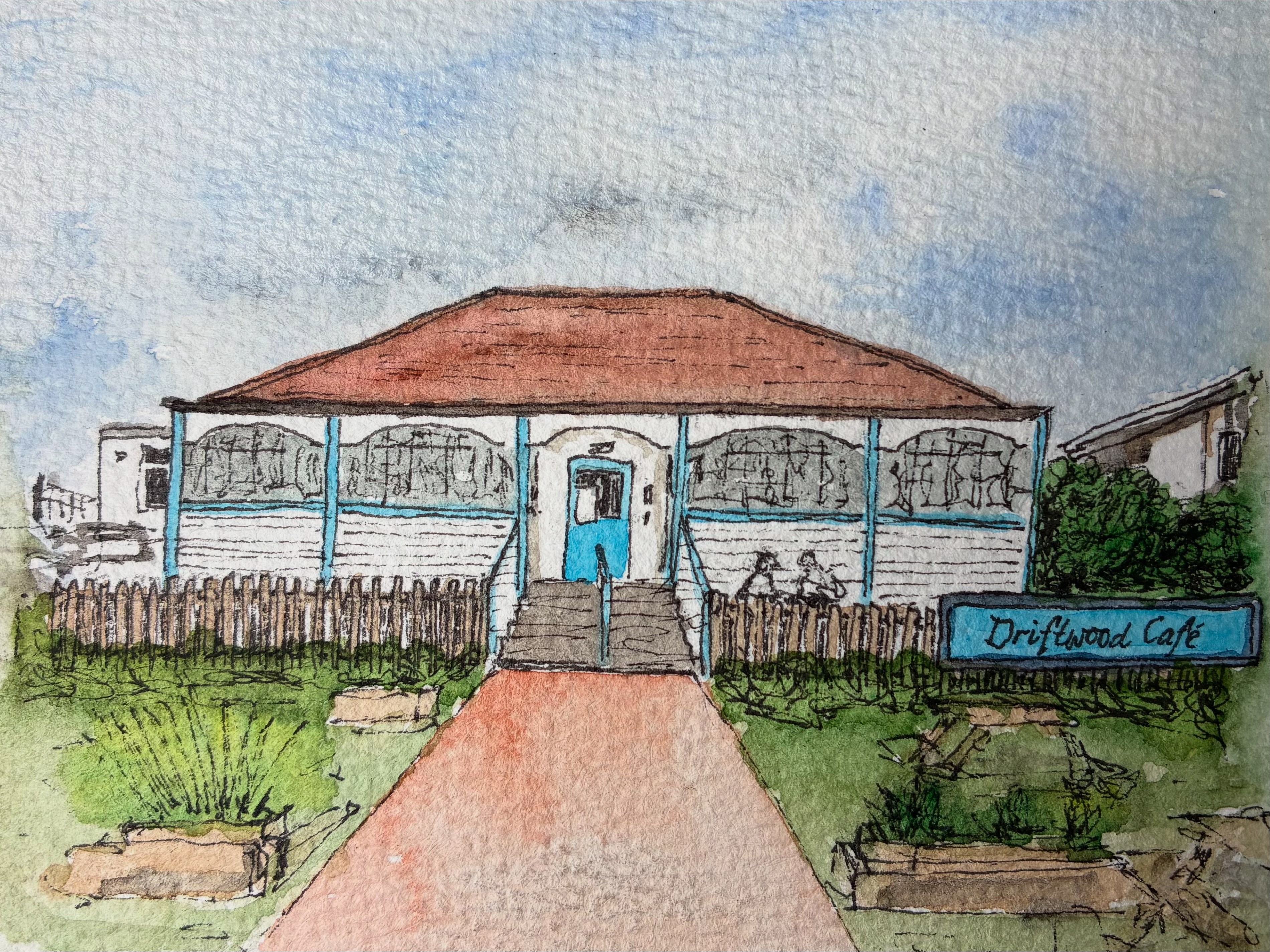
Driftwood Cafe, Blue Anchor, Somerset

In recent summers we have take a series of summer holidays walking in the Yorkshire Dales – first in Swaledale (staying at Low Row near Reeth), then in Wharfedale (based in Ilkley) and last year in ‘Bronte Country’ near Haworth. In each case we combined our week in Yorkshire with a day or two staying somewhere en route to and from our home in Plymouth, or in one case a second week away in Norfolk and Suffolk. For a change, this year, we decided that we’d like to spread our holiday time out over the summer months, and so we picked a couple of fairly local destinations for ‘long weekend’ walking holidays and also booked five days over in Suffolk, combining this with a visit to elderly relatives and an old university friend on mine.

The first of our summer 2025 mini-break locations, in June, took us back to the very familiar territory (for me at least) of the Quantock Hills and the Somerset coast. I grew up a short distance from there in Bridgwater, and we would frequently go on family outings to the area. I also spent quite a lot of time at an activity centre in Kilve on short courses of various kinds (mostly musical).

Although I do like discovering new places, I also very much enjoy returning to familiar haunts, especially for a short trip when you want to be able to slot straight into holiday mode without having to spend time orienting yourself and getting the lie of the land. Our Somerset trip – staying in an AirBnB Shepherd’s Hut near the village of Crowcombe, tucked at the bottom of the western side of the Quantock Hills ridge, very much fell into this ‘familiar territory’ category.

While we were away we enjoyed completing a couple of lengthy walks direct from our accommodation (I particular enjoy a stay away that doesn’t involve having to get in the car), and I was able to spend quite a bit of time painting. In this post I’ll feature four of the pictures that I produced during the break, and I’ll pick up the thread with another post soon that will feature a further group of five pictures.

We started our holiday with lunch at a favourite cafe, the Driftwood Cafe at Blue Anchor – the subject of my first picture (shown at the top of this post). It’s not a fancy cafe at all – I’d describe it as a ham, egg and chips or baked potato cafe – it’s just a nice, simple, easy-going place for a quick bite to eat.

Suitably refueled we then drove the short distance to Kilve and did a short walk (~3 miles) along the coast to East Quantoxhead, before turning inland and returning to the car, with a stop at the Chantry Tea Garden at Kilve where we were the only customers and had an interesting conversation with the owner, who used to be a frequent visitor to Plymouth. The two pictures below show a view of a field that we passed on the return leg (I’ve got a thing for trees silhouetted on the horizon) and the view that we had from our table in the cafe garden of The Chantry itself and the white cottage from which the cafe was run.
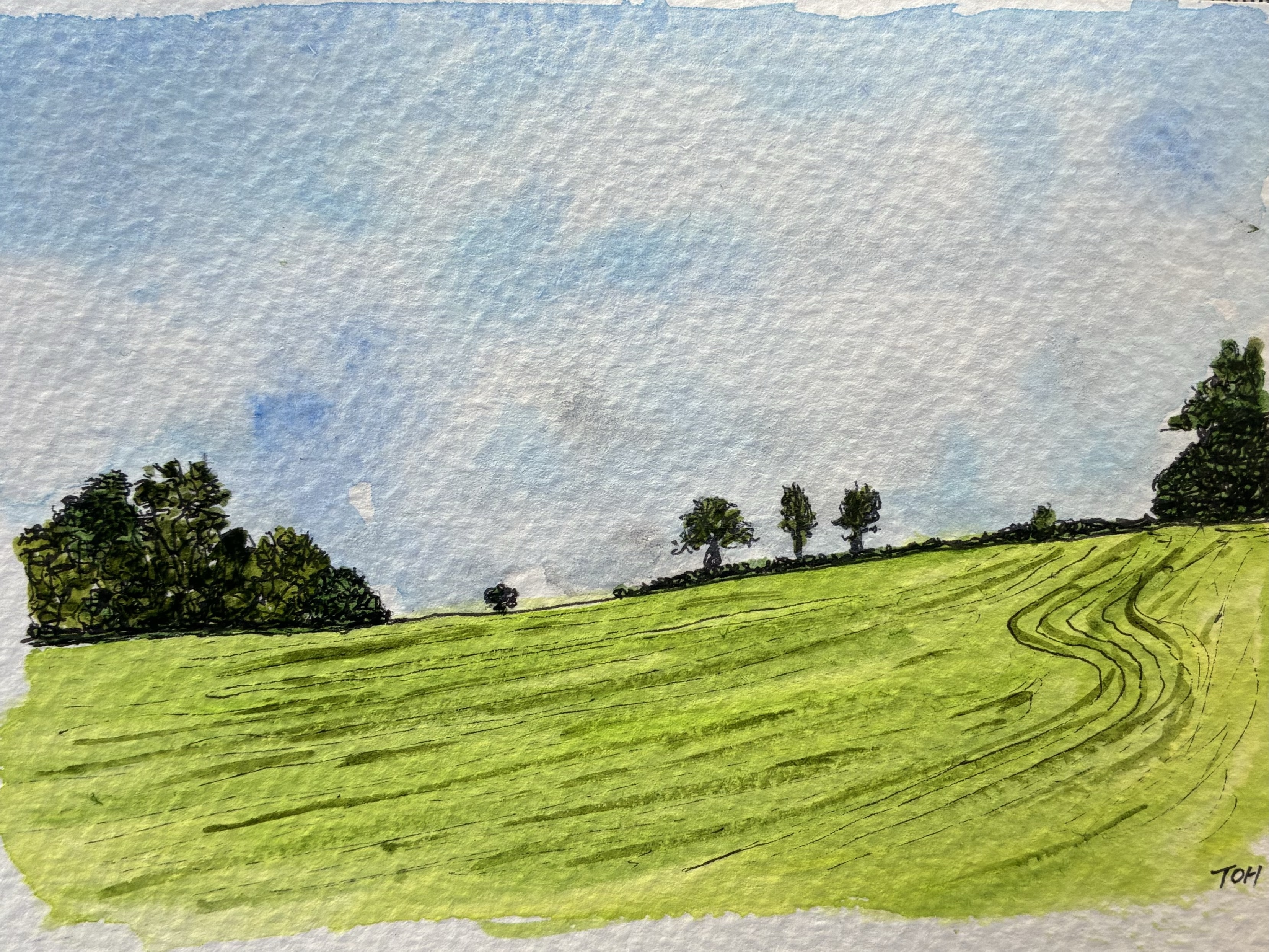
Grass Cut Field Near Kilve, Somerset
The Chantry Tea Garden, Kilve, Somerset

Finally, for now, here’s a scene I painted of the view looking west in the direction of Exmoor from the base of the Quantock Hills. I’ve tried to capture the way that there are successive ‘layers’ of rolling hills as the eye moves towards the horizon, each becoming progressively just a little higher than the previous one. Although wild landscapes can be exhilarating, I do like a farmed landscape – a patchwork of fields, hedges, copses and the odd farm building.
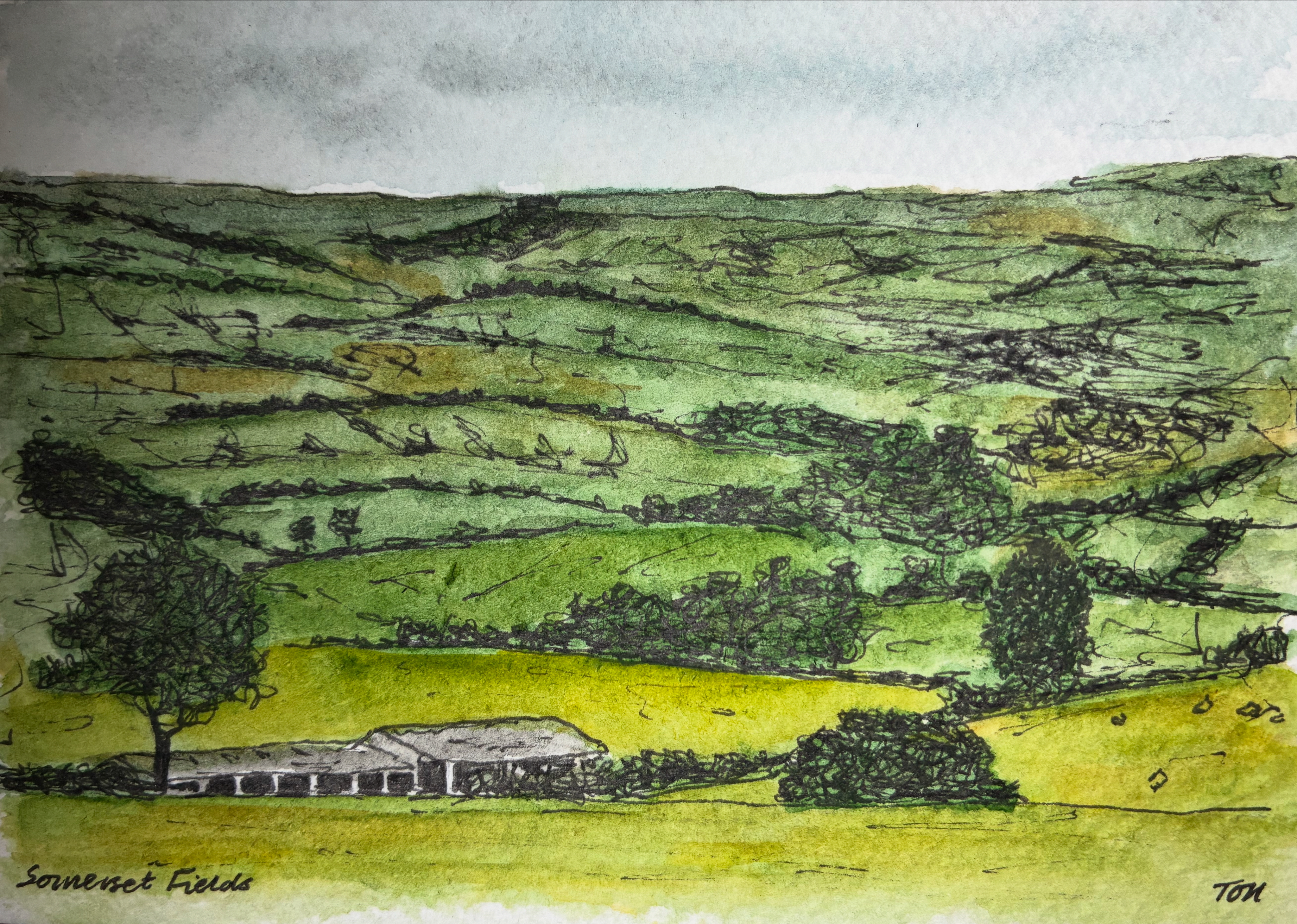
Somerset Fields Looking West From Near Crowcombe

All of these pictures were really just quick ‘practice’ pieces, but I like them all in different ways – Driftwood Cafe for its small details, the grass-cut field for its slightly abstract form, Chantry Tea Garden for its looseness, and Somerset Fields for the way it captures something of the wide expansiveness of the view.

If you have a favourite of these four pictures write a quick comment to let me know!

Walkham Woods (charcoal/watercolour) #art

Since I started drawing and painting back in April 2024 I have primarily worked with ink and watercolour paints, with my ‘go-to’ format being small, usually ~5cm square, pictures on some particular theme that I have chosen to explore for a few days. Producing pictures of that type has become my staple art activity, to the extent that I describe this as my ‘art practice’. However, I am constantly thinking about how I would like to explore different formats and work with different media. This especially happens when I visit an art exhibition, see works by other artists,and wonder what I could produce if I branched out a bit. The funny thing is that prior to my big shift into art in April 2024 I had actually begun to dabble with creating pictures with pastels (e.g. see my post Rediscovering The Artist Within) but I have not returned to pastels once since then.

Sometime back in May I must have been somewhere that brought me into contact with some charcoal drawings. I had a set of charcoal pencils sitting unopened in my art supplies box, and so I thought I would branch out a little and see what happened when I completed the drawing phase of a picture with charcoal, rather than adopting my usual approach of starting off with some faint pencil lines and then going all in with my black ink pen. I think I hoped that the different drawing texture might lead to me producing a more abstract picture. Then, after scribbling away with the charcoal pencil for a bit, I returned to the familiar territory of my watercolour paints to give my drawing some colour.

The result of my efforts is shown in the picture above – a charcoal -cribbles-with-watercolour painting of a row of what I refer to a ‘wall trees’, somewhere in the valley of the River Walkham, from a photo that I had taken on a walk there.

I’m not sure exactly what I think of this picture. It seems quite basic and simple – the trees sitting very much on top of the leafy backdrop and lacking much detail in their trunks and branches – and that simplicity pushes me towards thinking that the picture doesn’t quite work. But I also quite like the more impressionistic look – the rough lines suggesting the texture and structure of the stone wall, and the bright greens and particularly the yellows of the leaf canopy shouting out for attention. The picture has a naivety which I think gives it a certain charm. As I look at the picture, my eyes seem to be drawn in to explore what little detail there is, perhaps more so than happens when viewing one of my more detailed ink and watercolour pictures. Overall, I think that perhaps the switch in drawing medium was successful in helping me to present the view in a more abstract, suggestive manner than my normal ink-and-watercolour approach.

I’ve not had another go with charcoal pencils since I created this picture just over two months ago, but revisiting it now and writing this post has fired me up to spend some more time over the coming period to play around with different approaches and media a bit more. I wonder what will emerge!

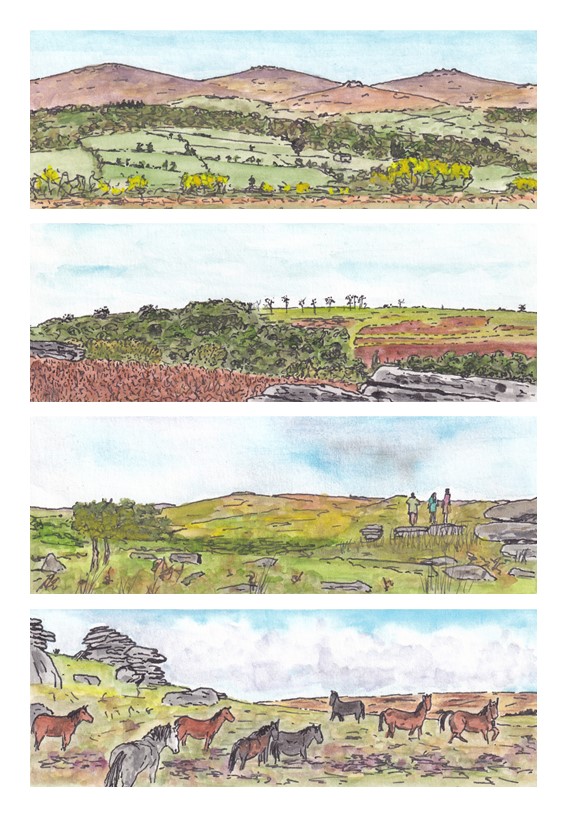
Dartmoor Panoramas #art

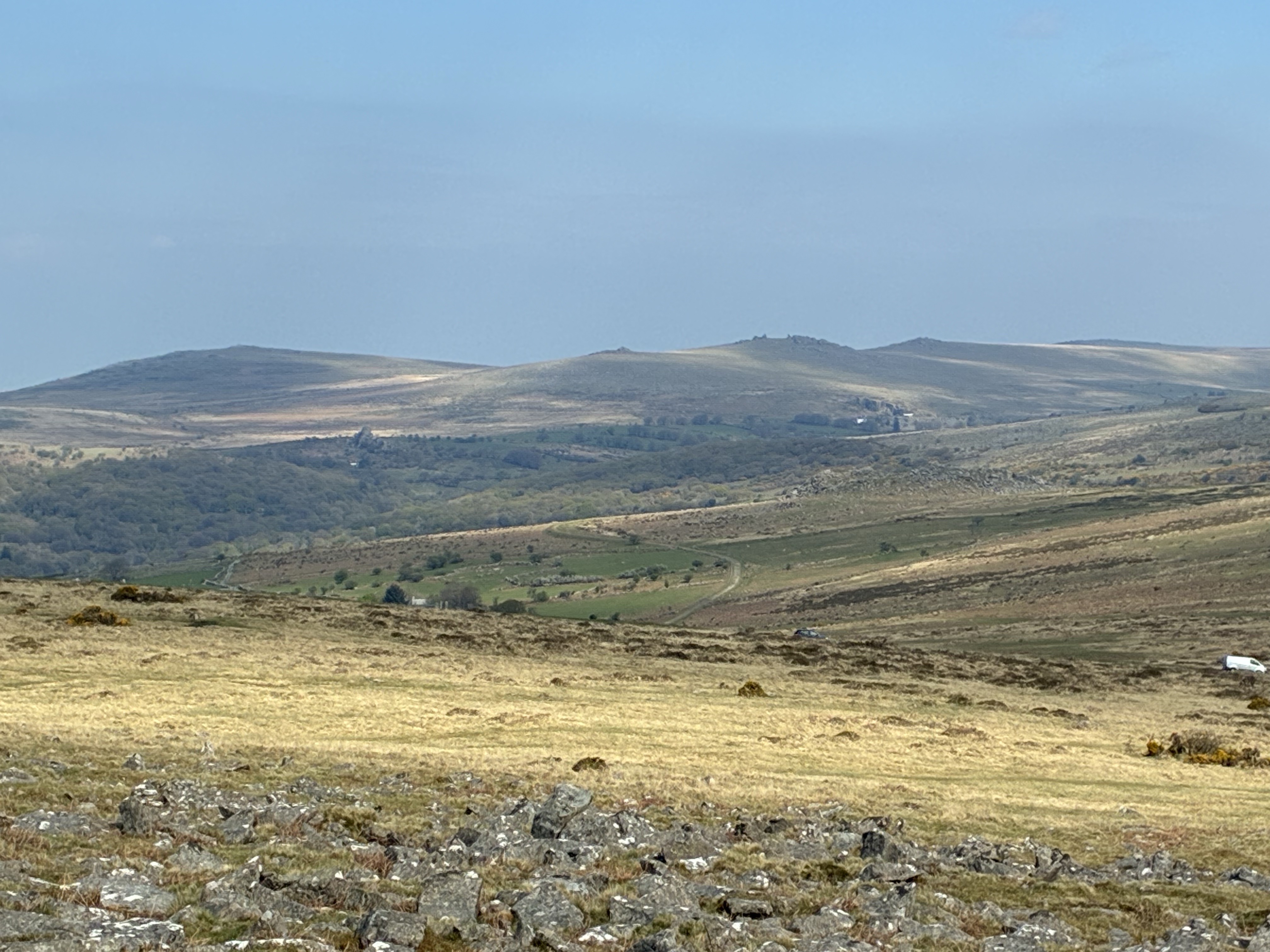
The proximity of Dartmoor to our home in Plymouth generally means that it is our go-to place for weekend walks, so it is hardly surprising that my phone is full of photographs of Dartmoor landscapes. I’m a particular sucker for ‘big views’, but my attempts to capture these in photographs are always something of a let down. Looking with the naked eye, big views fill my visual space with rich detail, but on camera everything seems to shrink, recede and flatten, resulting in a rather distant picture that is dominated by sky, and especially foreground, that the brain somehow filters out of the live view. I expect that this phenomenon is well understood by photographers, and it probably even has a special name, but to me it is just known as ‘disappointment’. This is compounded by the difficulty that I face when I subsequently try to capture this same kind of open, expansive view in one of my paintings. The part of a photograph that I want to paint seems to be only a small component of the whole, and no amount of zooming in seems to really help.

On one recent trip to Dartmoor I was pondering this issue when it occurred to me that what I was seeing with my eyes was a little like the view I got when I used my thumbs and index fingers to create a rectangular, letterbox-like, frame and then looked through that frame as if looking through a window. Despite there being so much more that could be seen, my brain seemed simply to ignore that part of the view that would have outside this frame, whereas my phone camera played no such trick. I began to wonder whether the key to painting this kind of view was to change the size and shape of the picture, adopting a similar letterbox, or panoramic, format. So, for a few days I played with this approach. The results are a series of four small painting that I refer to as my Dartmoor Panorama series.

I’m pleased with these pictures, at least to the extent that they better capture something approximating to the kinds of spacious views that I like best. Using a panoramic format does seem to work. In the third picture I was brave enough to include some people standing on one of the tors and gazing out at the view> I think this little piece of detail adds a lot to the picture, including a splash of contrasting colour. I was even more brave in the fourth picture, including a group of Dartmoor ponies. I tend to think that I’m not able to paint animals, but perhaps I am improving, because at least some of the ponies in this picture seem to have come out pretty well. I am particularly pleased with the grey pony in the foreground and the somewhat lively pony furthest to the right.

I feel sure that I will use this approach to painting expansive views again, and I suspect that at some point my curiosity will lead me to explore some photography guides to see whether I can find a proper explanation of my observation. It might have something to do with ‘foreshortening’ and/or ‘depth-of-field’ (words that I am vaguely familiar with that at least sound like they could be contributing factors). Who knows, perhaps someone reading this post will be able to point me in the right direction!

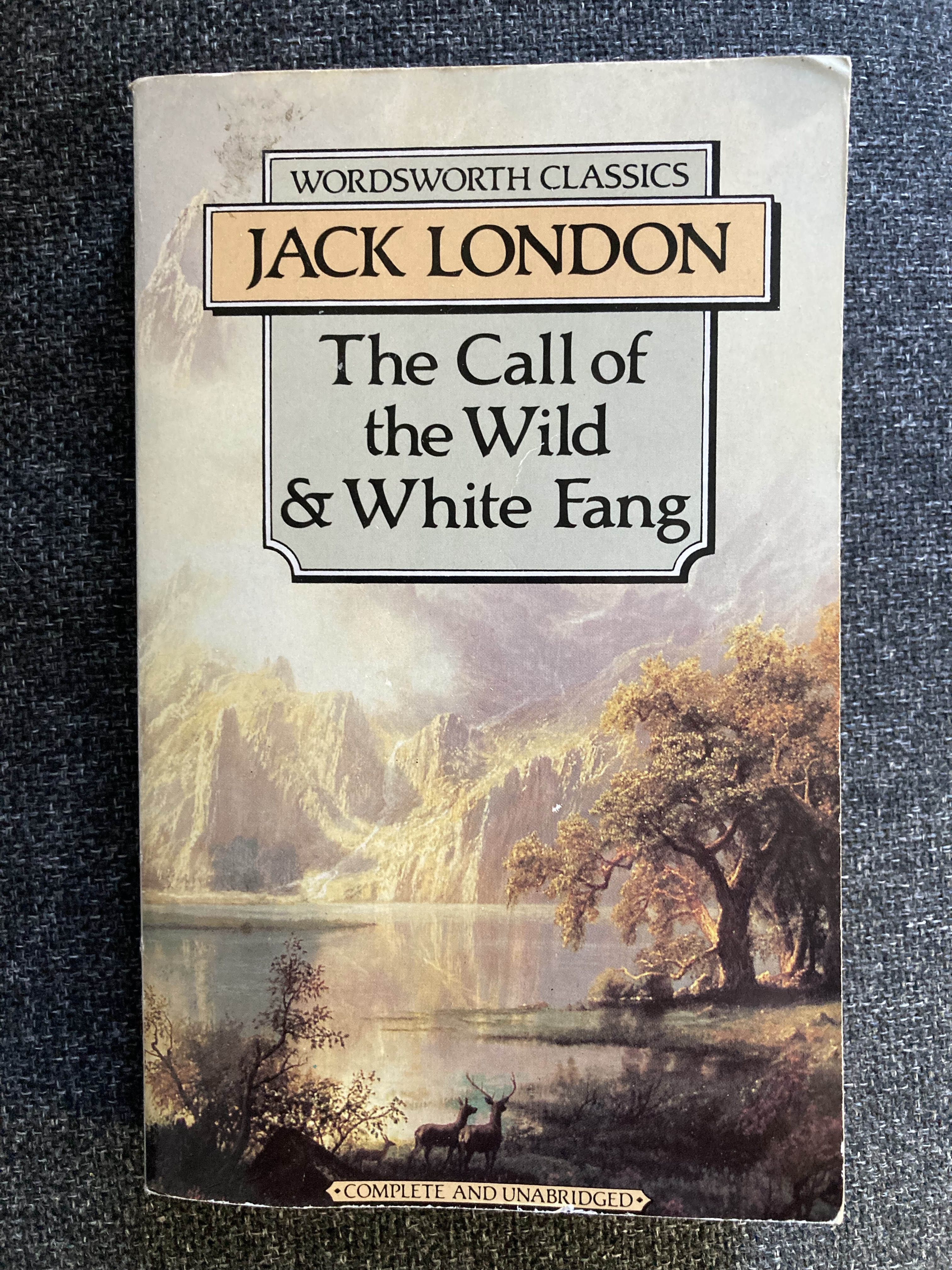
The Call of the Wild – Jack London #reading

A few years ago I discovered the wonderful book 1000 Books To Read Before You Die by James Mustich. Looking through it made me think about the range of books that I read, and in an attempt to make myself explore titles that I might not otherwise look at, I decided that I would work my way through the letters of the alphabet, picking a title written by an author whose surname started with each letter in turn. On my first trip through the alphabet back in 2020 my L title was The Wizard of Earthsea by Ursula Le Guin and then on a second, much slower, alphabetical loop that began in mid-2022 and has only fairly recently reached R, I chose The Spy Who Came In From The Cold by John Le Carre. However, on both of these occasions I came very, very close to selecting one of Jack London’s adventure stories… and so after picking up a combined volume of The Call of the Wild and White Fang in a charity shop, I decided I would finally give one of them a go, plumping for The Call of the Wild, partly because it was the first stories that London wrote, but primarily (I will admit) because it was the shorter of the two!

I enjoyed the story, which is written entirely from the perspective of Buck, a pampered St Bernard-Scotch Shepherd dog who is stolen from a California ranch and sold into service as a sled dog in Alaska. Buck soon has to get wise to the demands of his new environment, being beaten by his first owner and learning to fight with the other dogs to ensure his place in the pecking order. Over time Buck passes between several owners, and makes the long journey into the Klondike region of Canada and across the Yukon Trail. Buck soon establishes himself as the lead dog, having to brutally respond to challenges from rivals. Eventually, Buck is found in a poor state by an experienced traveller John Thornton who nurses him back to health, and the two form a strong bond. Thornton becomes rich after finding gold, and with little work for his dog team to do, Buck, now thoroughly attuned to life in the wild northlands, hears the howling of wolves and wanders off into the wilderness. Buck locates a wolf pack and then makes regular trips to socialise with a lone wolf from it. One day, Buck returns to camp to find that Thornton, his companions, and their dogs, have all been killed by native Americans, and so he sets off in search of his wild brother. Buck encounters a wolf pack and has to fight with them for survival, before discovering that his lone wolf friend is a member of the pack. The story ends with Buck answering the ‘call of the wild’ as he goes off to join with the pack.

It was interesting to read a story in which the human characters are secondary and all of the events are seen through a dog’s eyes. Buck’s journey from domesticated animal to a fearsome creature capable of matching a pack of wild wolves is fascinating to follow, and along the way there are lots of poignant moments as Buck and his human owners come to know and love each other. There are also some sickening scenes in which some of the humans show a complete lack of respect for their animal companions, and for the environment through which they are travelling.

The overarching theme of the book, at least from my perspective, centres on the harshness of the environment and the need to show it, and those traveling through it (human or canine), the utmost respect. Buck instinctively learns first to survive, and then to thrive in the wild, but most of his human owners, underestimating the power of the natural world, do not fare so well.

Call of the Wild was an enjoyable, fairly light read, and it certainly didn’t put me off indulging in another dose of canine adventure, in the form of White Fang, at some point in the future.

A Walk Around Peek Hill #other

We are blessed by the fact that although we live towards the centre of a fairly large and busy city (Plymouth), we are just 10-15 miles drive from the open moorland and wonderful walking landscapes of Dartmoor National Park. I know that some people love the really bleak, wilderness sections of Dartmoor, but my own preference is for what I think of as the ‘edgelands’, where the rougher terrain gives way to wooded valleys and the surrounding farmland. I have always liked landscapes that mix wildness with areas where humans have worked with the land over a long period of time in a relatively unchanging manner. The edgelands of Dartmoor certainly fit this description.

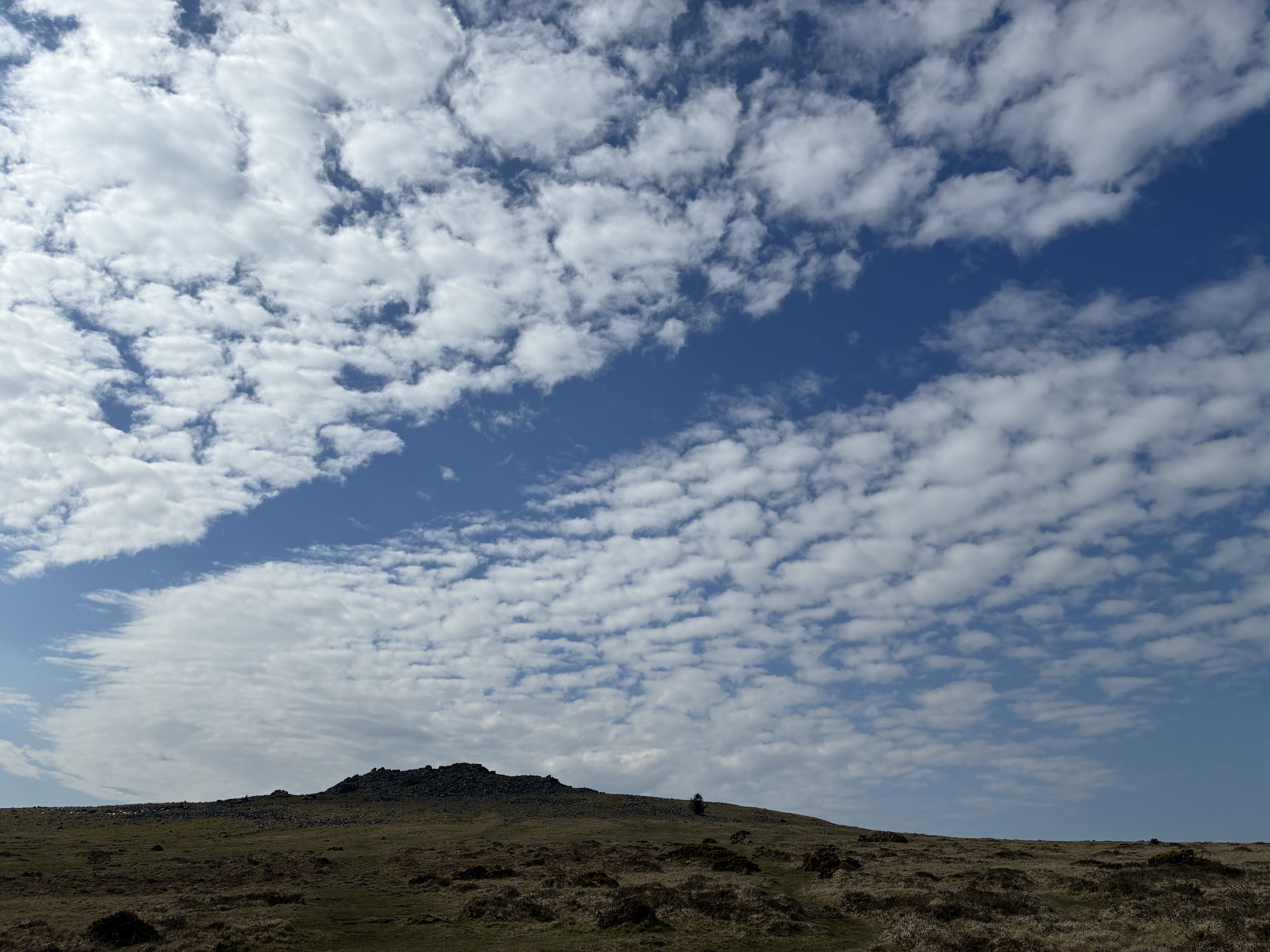
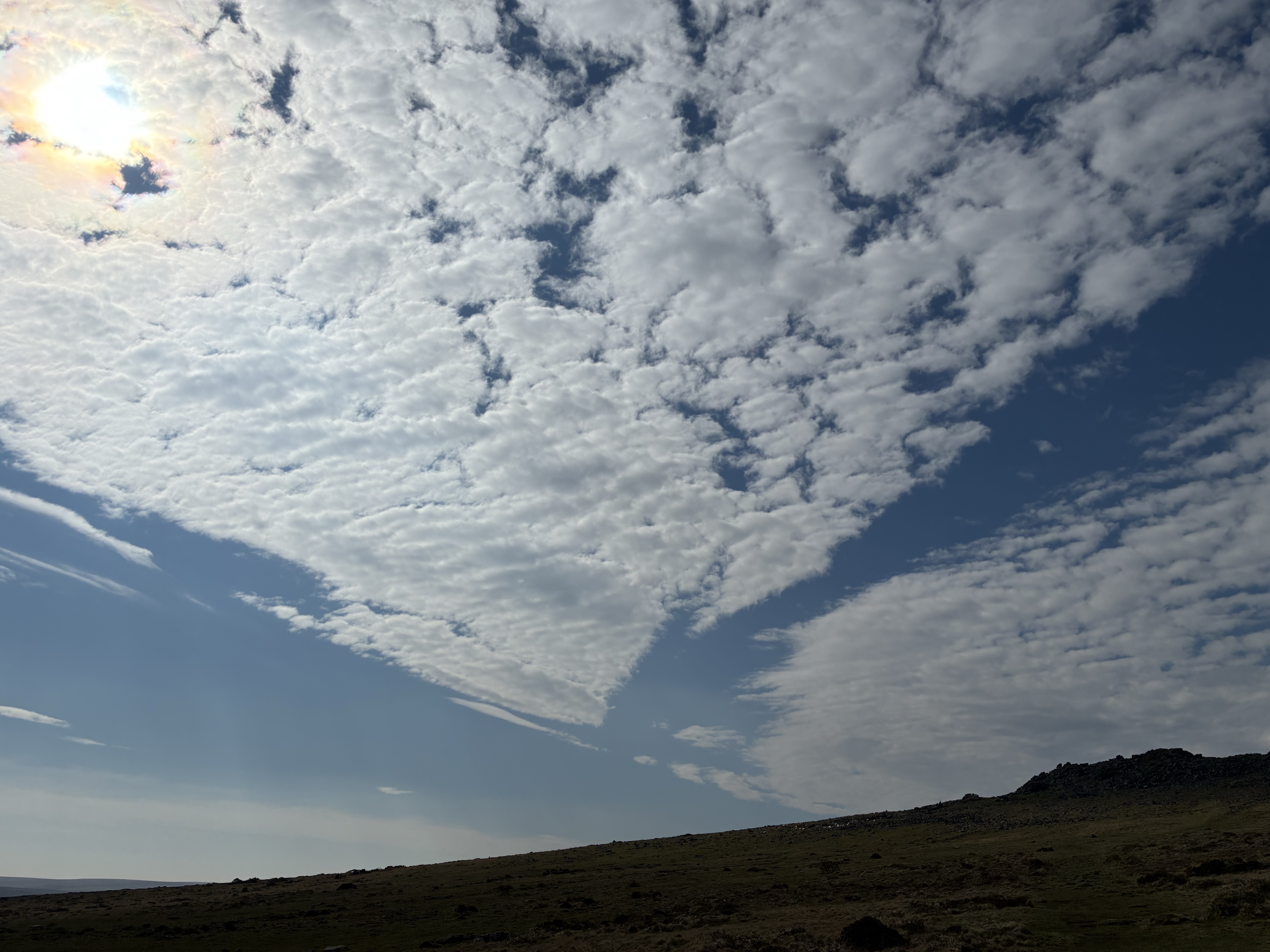
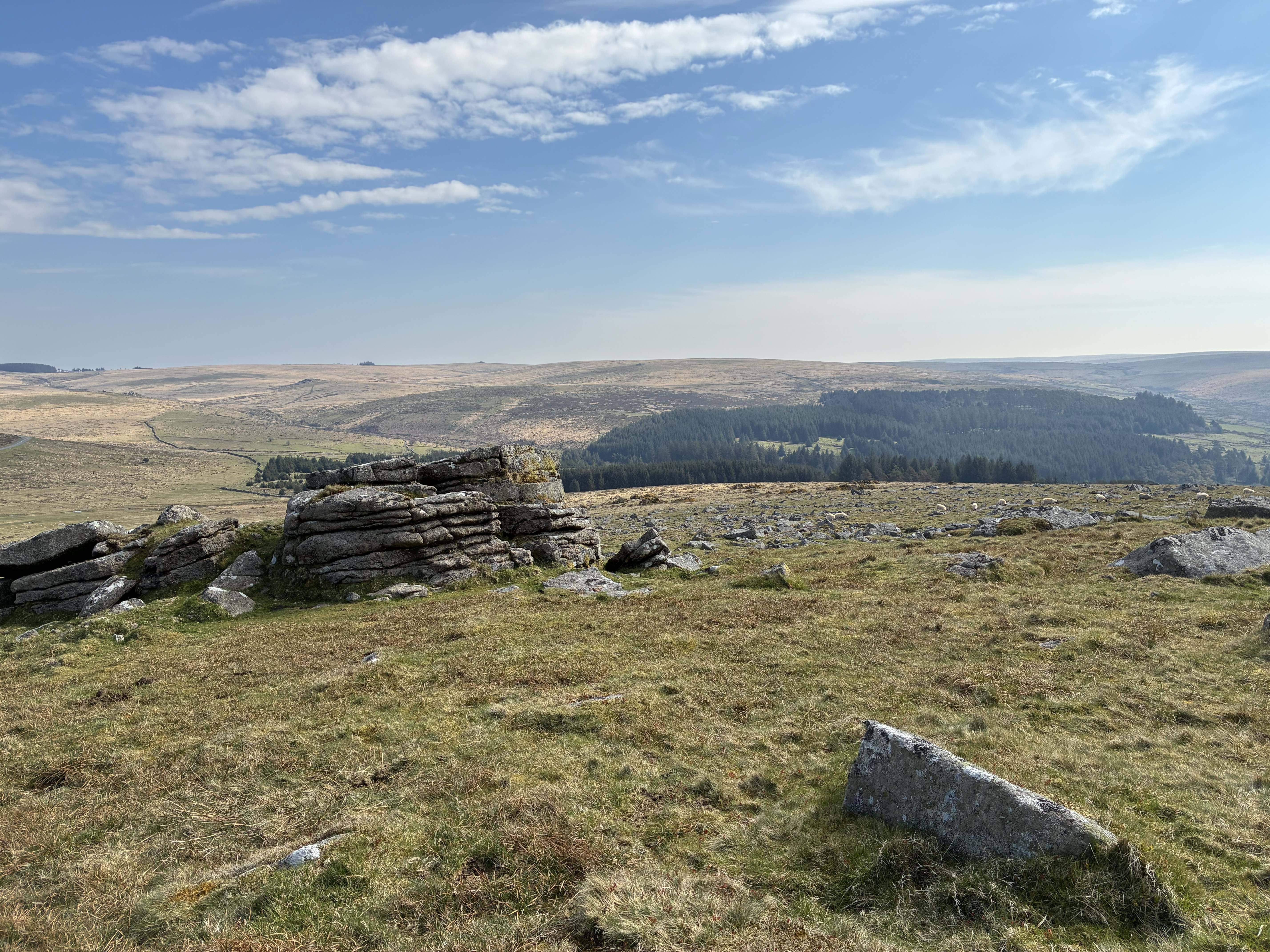
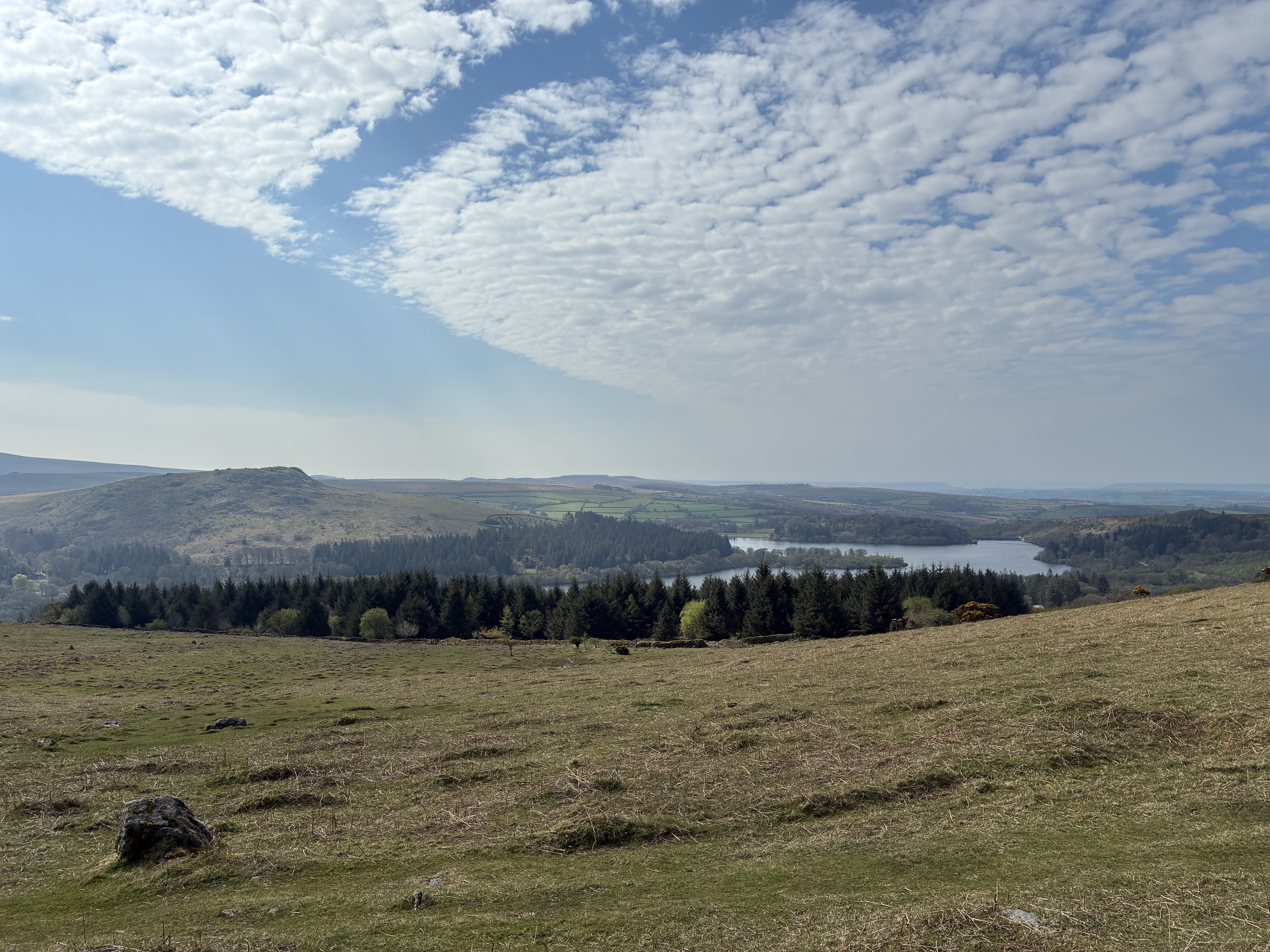
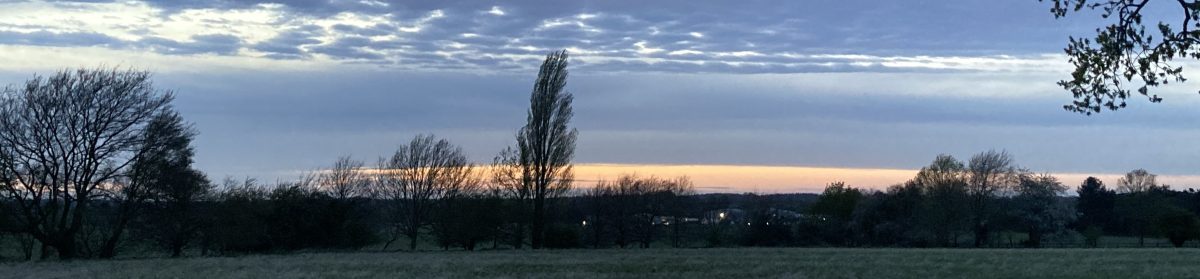
A couple of months ago we drove up towards Princetown and parked a little way from the rocky mass of Sharpitor (above and immediately below). It was a fine day, but one with plenty of interesting cloud formations that arguably made our view of the sky as interesting as the views of the hills and valleys around us…

Our walk took us just north of Sharpitor, from where we were welcomed with expansive views to the northeast of classic Dartmoor moorland:

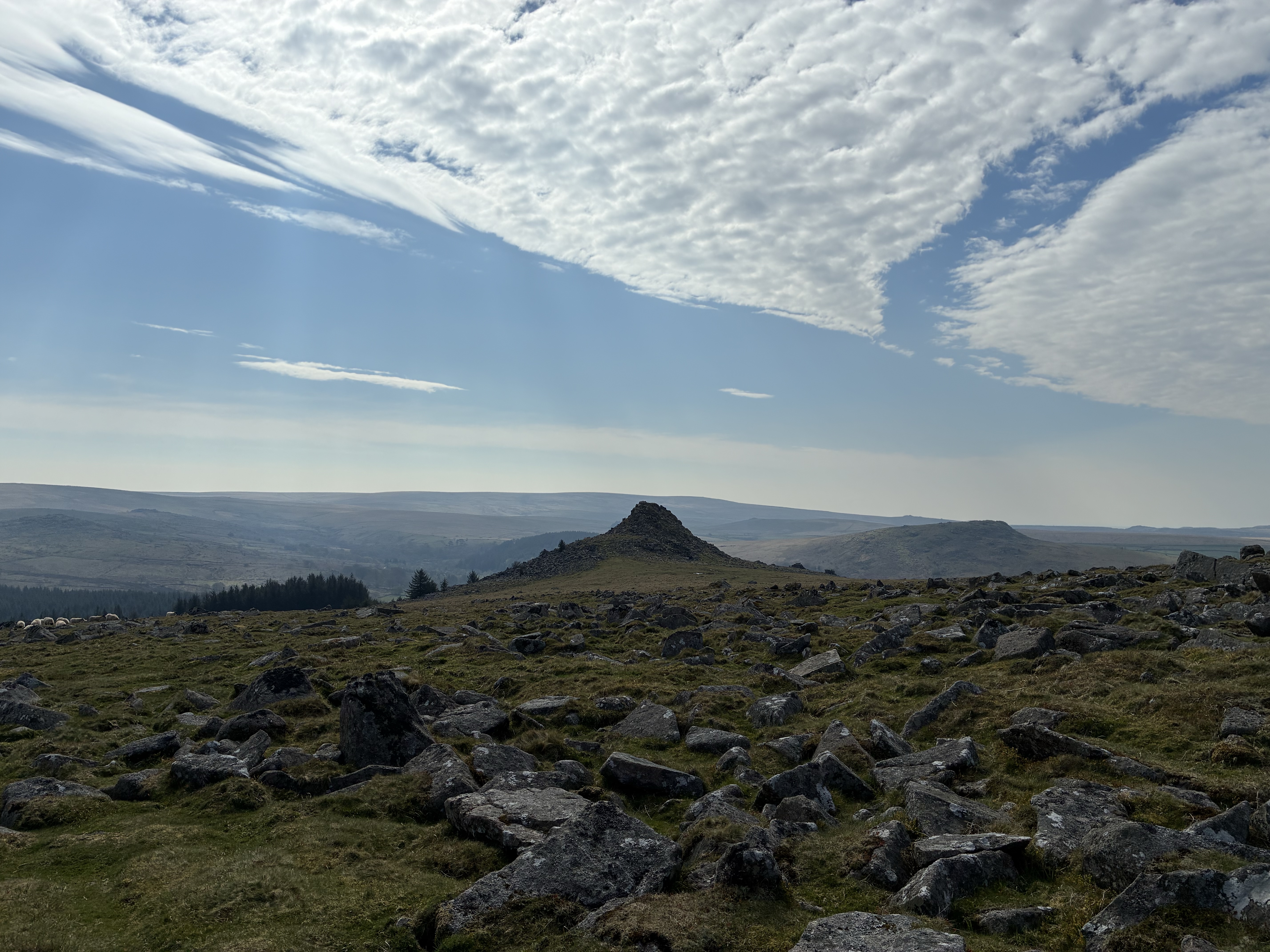
After rounding Sharpitor, the prominent, rather pointed, conical peak of Leather Tor came into view…

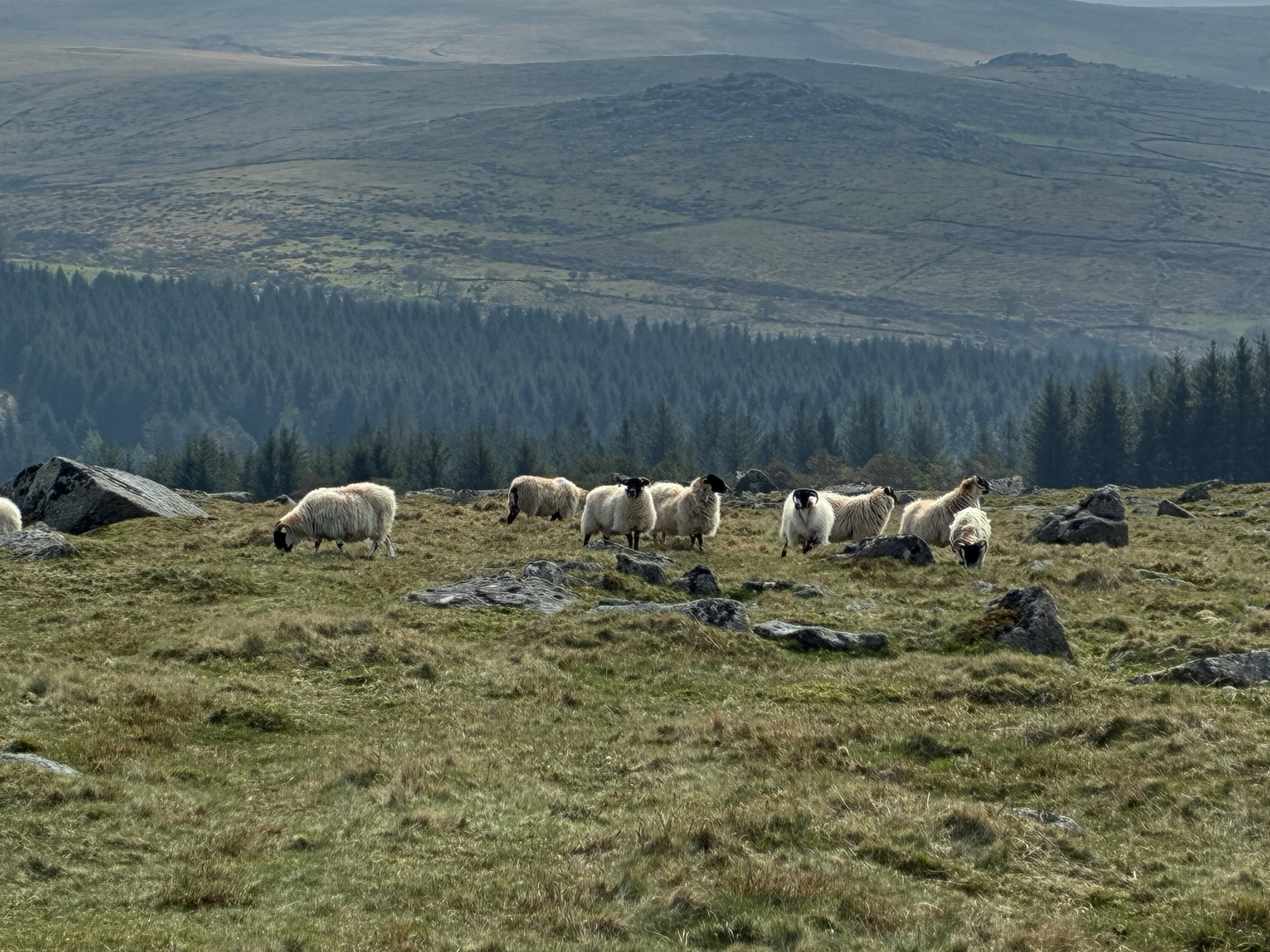
… and we were greeted by a typical group of Dartmoor’s sheep, grazing on the rough hillside…

Having passed midway between Sharpitor and Leather Tor, we turned southwest towards Peek Hill, and from here the view opened out to reveal the waters of Burrator Reservoir, with Plymouth visible towards the horizon…

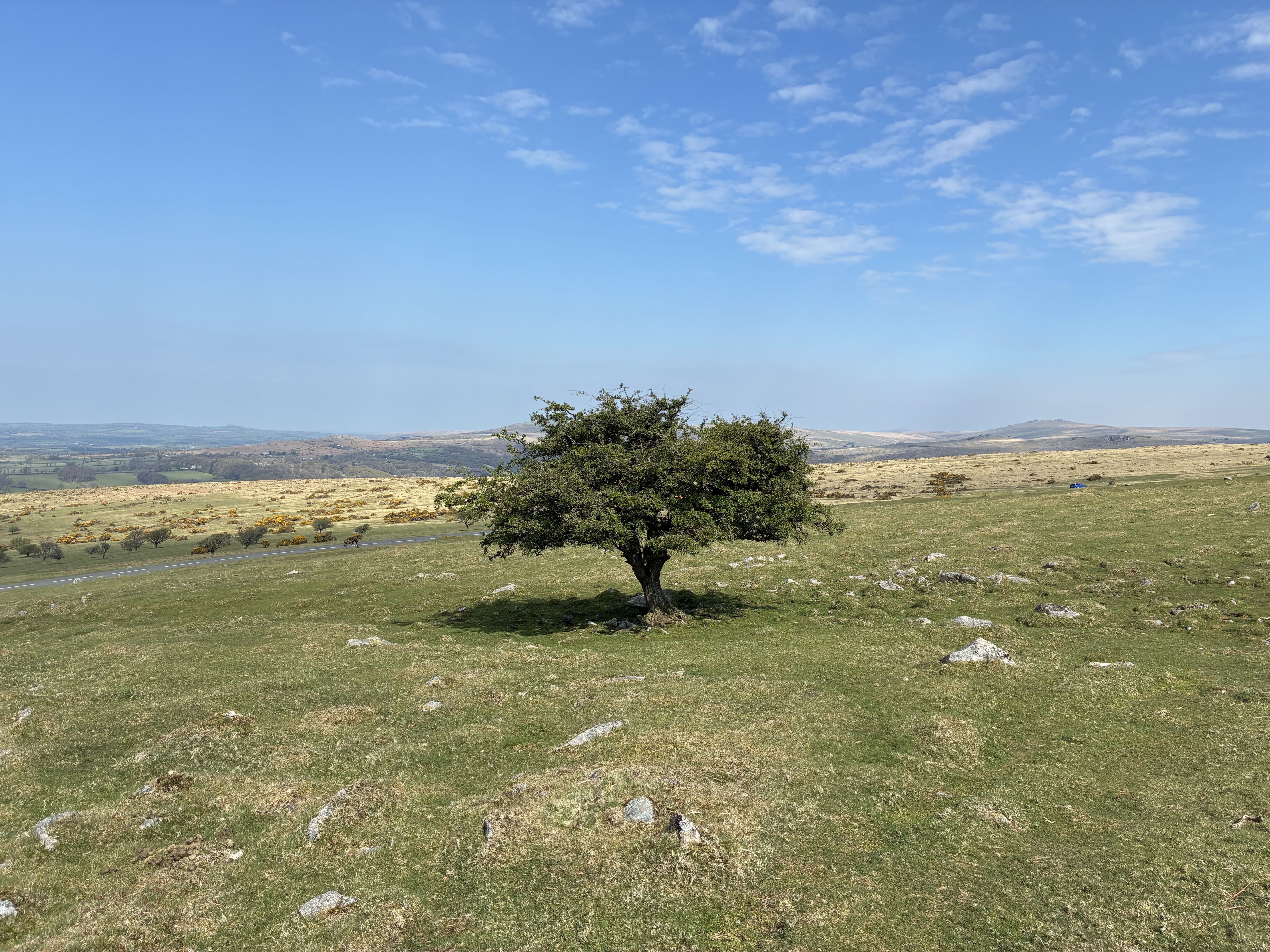
Our route took took us northwest, down the slope from Peek Hill towards the Plymouth-to-Princetown road, and along the way we passed one of my favourite sights, a lone tree of a type that I like to refer to as a symmetree…

Then, just across the road stood this wonderful row of Beech(?) trees, planted into the old stone wall, their dark, essentially leafless, forms making beautiful patterns when viewed against the bright colours of the fields, sky and clouds beyond…

This row of trees – in fact any row of trees like these – are really one of my favourite sights of all, and although there was still a little more walking to do, down towards an ancient stone row that we then followed back towards the car, I think that they are a fitting place for me to end this little photo-tour of our April walk around Peek Hill. I often think that I ought to have a go at painting this row of trees one day… but there are so many branches, so many, many branches… I am not sure that I have the patience for that!

Deep – James Nestor #reading

I read James Nestor’s book Deep back in February/March, but I am a bit behind with my efforts to write blog entries and so I am only just getting round to writing something about it now. You could say that I have been submerged to such an extent that I have not been able to see even a glimmer of light to guide me in the right direction to get back on track…

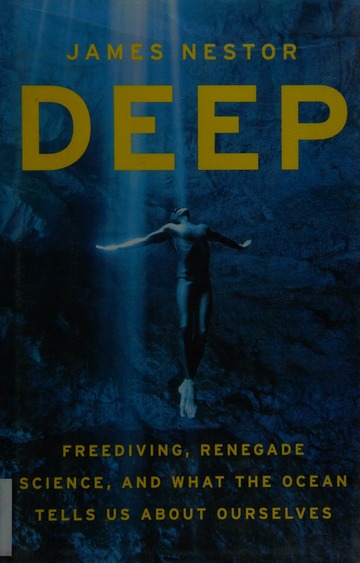
Deep was not a book that I had ever noticed and thought I wanted to read, but one morning, at the back-end of last year, one of the students I teach in my first-year introductory oceanography module (there are almost 300 of them, although they are rarely [never?] all to be seen in the same place) came to see me during the break in one of my lectures and passed their copy of the book to me suggesting that I might like to read it. I think that my students generally assume that I am fascinated by the subjects that I teach and will love finding out more about any topic relating to them. This is actually not the case – it was a fairly random and somewhat inexplicable sequence of events that ended with me studying for an MSc and then a PhD relating to oceanography, and from there it was just a case of me continuing to follow what seemed to be the simplest path (i.e. the one that involved me making the minimum number of decisions) into my career as a Marine Science lecturer. Inexplicable it may have been (to me at least), but it’s a path that stuck, such that here I am, some 33 years later, still following it (maybe some would call it a rut!). So, in fact, I am not that interested in the undersea world, marine life and topics such as diving, I just somehow create the impression that I am fascinated by the oceans when I am teaching students about the various processes that occur within and on them.

Nevertheless, I thanked the student for passing the book to me and set it aside to read at some point. I had previously read his later book ‘Breath: The New Science of a Lost Art’, I knew that Nestor wrote well and would almost certainly have some interesting points to make, so it wasn’t really a difficult decision.

Deep is mostly about the pursuits of the very strange (to me at least) group of humans who strive to head as far as possible downwards into the ocean depths. It is nearly structured as a series of chapters titled by a depth in feet (e.g. -650, -2500, -35,850) and containing stories of human exploration towards that depth. Initially, at shallower depths, Nestor describes the pursuits of free divers, including the absolutely insane group of people that risk death competing to dive deeper and longer than their rivals. Some of the events that Nestor recounts, in which competitors emerge from the water with blood streaming from their faces, or in a semi or fully unconscious state were pretty horrific and I find it surprising that i) the ‘sport’ is allowed to continue, ii) anyone wants to participate in it and iii) Nestor still went ahead and learned to free dive so that he could join in with various activities.

In the latter part of the book, much of the content focuses on scientists and researchers who combine diving with attempts to better understand the behaviour of marine life such as various types of sharks and whales. All of this content was quite interesting, even for someone who is not at all obsessed with sharks and whales like me! It was particularly interesting to get a glimpse of the kinds of private organisations and collections of individuals that operate in this area of scientific exploration and research – often rather cavalier and unorthodox in their approach, because, I suspect, anyone trying to do the kind of ‘animal-encounters-at-close-quarters’ research that the book describes in a traditional, more highly regulated, academic setting would probably find that their efforts were thwarted by the requirements of such niggly things as risk assessments and ethical considerations.

In the end, I enjoyed reading Deep, and found it interesting to get a glimpse of the world of underwater activity it describes. However, it did nothing to make me wish that I was able to descend below the waves myself, quite the reverse in fact. I’ve always been quite happy existing on the solid substance of the land surface, and it’s pretty obvious to me that nothing is going to change that now!

The Killing Field #poem

This is the killing field –
but the danger does not come to you or me
from the piercing horn of a bull’s rush,
the digoxin punch of a fox’s glove,
or a saliva-damp kiss from a cow’s lip.

This is the killing field –
but the danger does not come to you or me
from the aconitine grip of the wolf’s bane,
the spicular burn from a nettle’s leaf,
or a sudden unexpected stroke of a pony’s tail.

This is the killing field –
and just for once, the danger does not even come
from those who strip the land to build and burn,
who work the soil to plant and grow,
who take whatever they wish to take,
who go wherever they wish to go.

This is the killing field –
but the danger does not come to you or me.
It comes to the little creatures
that scuttle and slither over ground,
or paddle at the water’s edge,
or take flight into the humid air,
or hide away within the sedge.
For they refused to yield
to kiss the ground before the wise birds’ shrieks,
and so were baited by the raptors’ curse.

This is the killing field –
but the danger does not come to you or me.
It comes to the mouse, the rabbit and the vole,
not fast enough to find a hole,
the beetle, grub and dragonfly,
left with no escape to try,
the snake, the newt, the toad, the frog,
too slow to get beneath a log,
the pigeon, finch and moorhen chick,
this time, alas, insufficiently quick.

This is the killing field –
and for all the little creatures that you love,
death comes unheralded from far above.

First comes
Buteo buteo (Buzzard):
Mightiest of all,
soaring high in thermal plumes,
before swooping down
to grasp in taloned feet
the unfortunate prey it must consume.

Then comes
Circus aeruginosus (Marsh Harrier):
Not far behind in stature and power,
ranging low with undulating flight,
before entering the reed bed
to pluck out
the tiny creatures hiding there in fright.

But not all threats require wings of such size, for now come
Falco tinnunculus (Kestrel):
Fast wings, steady hover,
sharp eyes,
before falling like a stone
to pounce
with great surprise
and
Falco subbuteo (Hobby):
Wings swept, swift flier,
thrilling chase,
before making the snatch,
to prove
that it has won the race.

An optimist might think
that the setting of the sun
and the falling of the dark
could bring respite.
But this is the killing field –
and the danger comes both day and night.

For now, in fading light, comes
Tyro alba (Barn Owl):
Heavy flaps, ghostly glide,
a pause upon a post,
before the sudden drop
to make the surprise visit
to its host.

Then, as darkness gathers like a cloak, comes
Athene noctua (Little Owl):
Sitting, watching from a lofty perch,
shattering the silence with its screech,
before flying down,
to snaffle up
whatever it can reach.

And finally, with all light gone, comes
Strix aluco (Tawny Owl):
Master of the dark,
Night vision goggled, waiting patiently with hunting ears,
Before pouncing,
silently,
on each and every morsel of a meal it hears.

This is the killing field –
but the danger does not come to you or me.
The danger comes from far above
from birds named with gladiatorial sounding words:
Buteo buteo and Circus aeruginosus
majestic Buzzard and Marsh Harrier.
Falcos tinnunculus and Subbuteo
agile Kestrel and Hobby.
Tyro alba, Athene noctua and Strix aluco:
Barn, Little, Tawny – three wise owls. 

This is the killing field –
and the danger comes with such beauty and grace,
that seeing Death
has never before
put such a smile upon my face.

(c) Tim O’Hare, July 2023


THE KILLING FIELD: While staying in Suffolk during the second week of our summer holiday we walked around Redgrave and Lopham Fen one afternoon. Having seen various birds, but not being entirely sure that I had been able to identify them all correctly, I made sure that we went back for a second look, and I was really thrilled to confirm my first ever sightings of a Marsh Harrier and a Hobby along with the oft-seen Buzzard and Kestrel. These are all beautiful birds, and it was fascinating to watch their different flight patterns and to look up information about their diets and hunting styles. But it struck me quite forcibly that with that beauty and guile came death, and the idea that the area around the fen was a ‘Killing Field’ took root in my head. During our stay we also heard or were told of the whereabouts of several different species of owls – the evening and night hunters – and so I threw those into the deadly mix too.

Mistakes Are Not Always Bad #wisdom

A couple of weeks ago we paid a visit to Make Southwest, an exhibition space for contemporary craft and design and a leading charity for craft education located in the small town of Bovey Tracey on the southern edge of Dartmoor, about 25 miles from our home in Plymouth. It’s a venue that we have visited a few times before – there is always some kind of special exhibition (this time it was a exhibition of contemporary bells called Sound and Silence) and an interesting array of local artwork, books and assorted items to look at in the shop. On this occasion, the reason for our trip was to see a smaller exhibition of wood engraved prints and, in particular, the printmaker Molly Lemon, who had travelled down from her base in Gloucestershire to demonstrate her work. We have encountered Molly at several Craft/Art Events in the last couple of years and always enjoyed viewing, and chatting to her, about her work. We also enjoyed seeing her compete in, and reach the semi-finals of, the Sky Arts TV Series Landscape Artist of the Year a few weeks ago.

Since I started painting about a year ago, whenever I go to any kind of art gallery or art/craft event I particularly enjoy scavenging the work that is on display or sale for ideas that I can try out for myself. Looking at the various pieces of artwork for sale in the shop at Make Southwest, I was particularly enamoured by some tiny pieces of work created by the printmaker Mike Tingle (also here). These were very small (just a few centimetre) square prints on slightly larger squares of rough-edged paper, with a title and the artist’s name written in pencil around the picture (there is an example of a similar kind of picture just below the centre in this piece of work: Dartmoor Box No 1). I really liked the miniature size and somewhat ‘rough’ nature of the pieces and I immediately thought that it would be fun to try to produce something similar using one of my own small Dartmoor Scenes watercolour paintings.

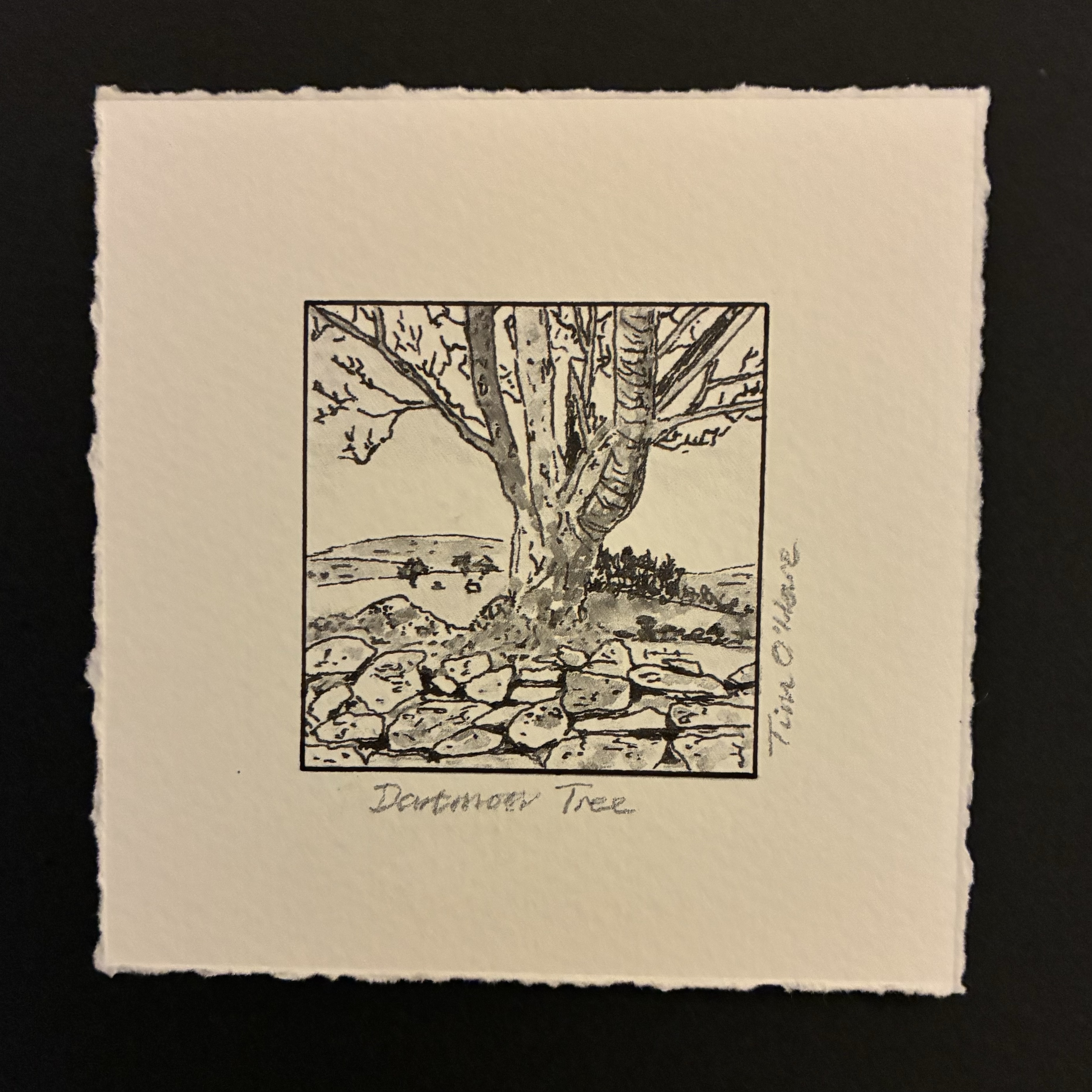
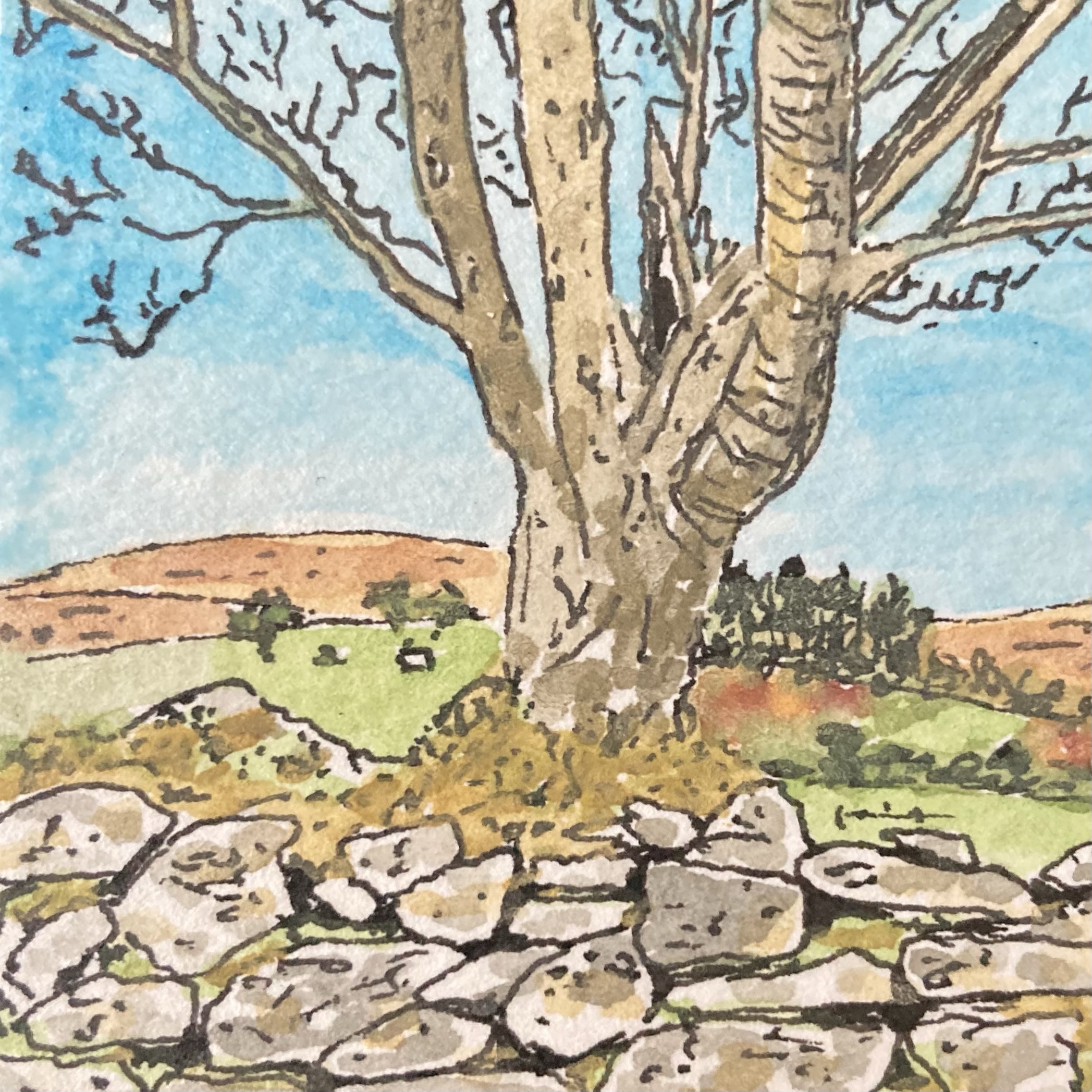
After returning home, I set about seeing what I could produce. First, I selected one of my pictures, opting for this one of a tree growing out of a typical Dartmoor dry-stone wall:

The original picture is a 4.5 cm square ink and watercolour sketch, and my intention was to use our home inkjet printer to make the best quality colour photocopy of it that I could, printing onto a sheet of watercolour paper so that the texture of the original was preserved. I’d already played around with making copies of some of my paintings in this way and so I knew that although the copied versions weren’t quite the same as the originals, with the paler colours tending to wash-out a bit, the process worked pretty well. So far so good.

This is the point at which I made my mistake. In the process of making the copy I somehow selected black-and-white printing, and so when I saw what the printer had spat out into the print tray I was instantly annoyed and frustrated. To make matters worse, because the original picture was on a small square of fairly thick paper, as the scanning light moved below the copier glass a dark shadow line was cast on one side of the copied picture. Not only did I only have a black-and-white copy, but I had a black-and-white copy that had a dark line along one of its edges. What a waste of a sheet of paper and ink…

However, once I had overcome my initial disappointment and self-censure, I decided to press on with the rest of my production process and see what the end result looked like. I had intended that there would be no border between the picture and the surrounding area of paper, but now there was that dark line along one side spoiling that design idea. What could I do? Well, go with the mistake of course. I took my drawing pen and with the aid of a straight edge and a lot of care, I inked in a similar line on the other three sides. Hmmm… it didn’t look as I had planned but I liked the result. Then I measured out a wider border, and again aided by a straight edge, I tore the paper down to size. This part of the process is something that I have found takes a lot of care… if the tear is too sharp you don’t get the nice rough edge I was after, but if you are at all rushed and loose you end up with something that looks clumsy and careless. Fortunately, I managed to do a good job. Finally, I grabbed a soft pencil and quickly wrote a title below the bottom edge and my name on the right-hand side…

The result of this endeavour was the small picture shown at the top of this post and, despite my black-and-white and shadow mistakes in the copying process, I’m really pleased with the end result, so much so, in fact, that I intend to take the rest of my Dartmoor Scenes pictures and treat them in the same fashion. Even better, not only did I end up with a new picture that I really liked and the discovery of a new way to transform existing pictures into a different, somewhat distinctive, form, but I also gave myself a great reminder that making mistakes in life is not always a bad thing. In fact, sometimes, as in this case, a mistake can open up a different path from the one that was intended that leads you towards an unexpected but interesting, exciting or enjoyable destination!

The Lies of the Land #poem

There’s a hill marked on the map,
and so we will have to climb up.
We need to follow the river along the valley,
so then we’ll be quite far down.
Let me see, there should be a church tower…
yes, on the horizon, over there
which means that our path will go right then left twice,
and then another turn right.
Next to the fen marsh it will probably be a bit wet,
but the stretch along the beach should be sandy and dry.
That’s the car park, just in front,
so where’s the windpump?
Behind us, out of sight.

It is helpful to be able to orientate yourself in time and space,
and a comfort to know that everything stands in order,
in its rightful place.
Believe me, there is a problem
if you don’t know which way you should face.
I think I’m pretty good at this, so let me help you understand:
Left, right, up, down, in front, behind, parched or drowned,
the truth is that you must get to know
the lie of the land.

No, sorry, wait… It’s not quite that simple…
That hill I mentioned is only five metres above sea level.
It’s so low down that it can hardly be called a hill,
in fact it’s little more than a pimple.
The water in the river flows further down towards the shore,
which means that the valley is actually up above the sea.
When we reach the church tower, it won’t be over there,
it will be our here, obviously.
And when we follow the path back, we will take a left,
a right and after that we’ll go right then left again.
But it shouldn’t be too confusing,
because we’ll be on familiar ground by then.

This isn’t what I was expecting
from the map on the visitor centre wall.
I guess there’s been so little rain recently
that the marsh is bone dry,
and there’s hardly any water in the drainage channels at all.
The tide must be on its way out,
because there are shells and seaweed all along the shore,
and so the sand is salty wet.
Anyway, it’s been nice since we got away from the car park;
I was pleased to leave that behind
all those cars and people made me fret.
So, where is the windpump?
Have patience, don’t get stressed.
Wait for it. Ready?
There, right in front.
Are you are impressed?

It would be helpful if I could orientate myself in time and space,
and comforting if everything would actually get in order,
into its rightful place.
I definitely have problem
when I don’t know which way I should face.
I thought I was pretty good at this,
but now things are getting out of hand.
Left, right, up, down, in front, behind, parched or drowned,
I’ve really been made a fool of here
by the lies of the land.

(c) Tim O’Hare, July 2023


About this poem: While staying in the Norfolk Broads during our summer holiday we drove out to the coast for a walk at Horsey Gap, parking the car near Horsey Windpump (a National Trust site). On the way there I had been amused to notice that features that were named on the map as hills were, in fact, only a few meters above sea level and the idea that such naming was a ‘lie of the land’ was born. The poem picks up on various elements of the walk which took in fen-land marsh, a beach (with seals swimming in the surf) and, of course, the windpump.

I Am Not Lost #poem

I’m just back in from my morning run.
Before I left, she asked me how far I was planning to go,
and I replied, “Only about 3 miles – maybe thirty minutes or so”.
I showed her my intended route on the map,
so that in an emergency she could find me in a hurry.

As soon as I was outside, my mind was transported.
There were poppies and other wildflowers in the hay fields,
faces turned to greet the morning sun.
I ran through swathes of wheat and barley waving in the breeze,
reed beds down by the fen, and woods with birds singing merrily in the trees.

But I had been far too optimistic, and so made several false turns,
finding my way blocked, not wanting to squeeze
my way through tick-infested ferns.
At one point I had to whisper my way past a group of young cattle
that barred my path, even nibbling at my shorts.
Fortunately, that encounter did not end up as a battle.

Some people might laugh at my incompetence,
but I have to disagree because
I was not lost.
And though I will reluctantly admit that I did not know exactly where I was,
I don’t think it really mattered
that I wasn’t quite where I’d expected myself to be.

Anyway, I’m back now,
and as soon as I came through the door I said “sorry
because I didn’t want the atmosphere to sour.
You see, I had run five-point-four miles, and been out for almost an hour.
And though she didn’t say anything, if past form is anything to go by,
I expect that she had started to worry.

My run gave me a chance to think, and realise that
even though things didn’t go entirely to plan,
I am not lost.
In fact, I happily accept that I do not know exactly where I am,
because it really doesn’t matter
that I am not where I expect myself to be.

(c) Tim O’Hare, July 2023


About this poem: We moved base for the second week of our summer holiday, and after a few less than successful days in Horning in the Norfolk Broads we moved to the village of Redgrave in Suffolk. I instantly relaxed, and was happy, with walks and runs from the doorstep. For my first morning run there I decided to do a loop of Redgrave and Lopham Fen, memorized a route, or at least thought I had memorized a route, and set out. It was a very enjoyable run but, predictably, not knowing the terrain, I dropped off my planned route and had to use my instinct to find my way back to our accommodation, running further, and taking a fair bit longer, than I had planned. I was not exactly lost, but I did not know exactly where I was and as I was running the words ‘I am not lost but I do not now exactly where I am‘ began to play repeatedly in my mind and the seeds of the poem were sown. I think it’s fair to say that the poem isn’t really about being physically lost while out on a run at all…