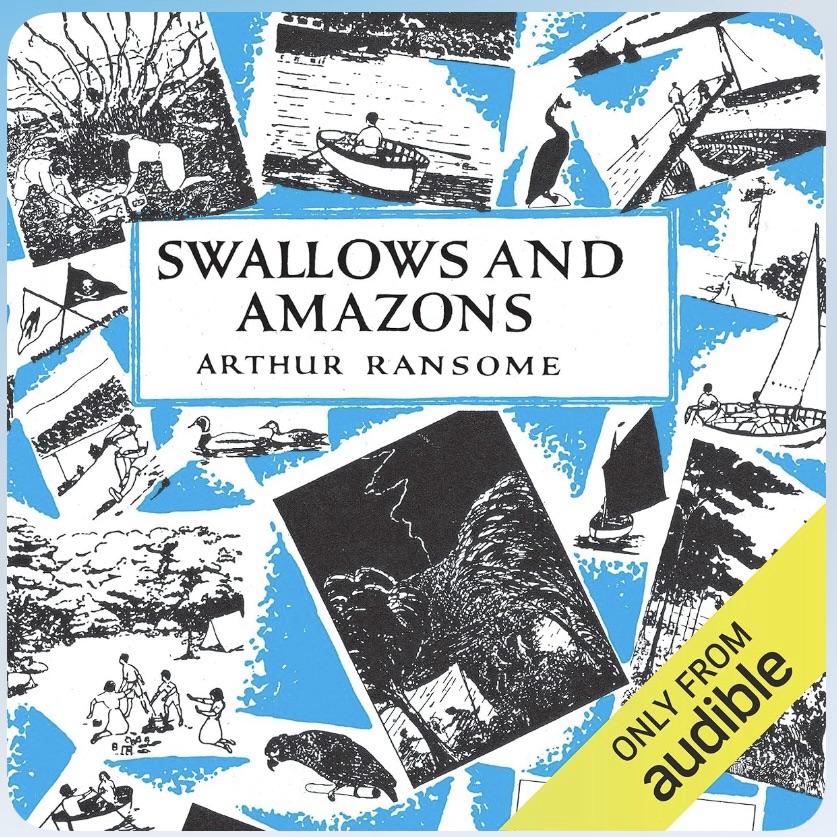
Swallows and Amazons – Arthur Ransome #reading

I listened to the audiobook of Swallows and Amazons, Arthur Ransome’s classic novel for children during the period from late March through to early June this year. It was a fairly long process, almost 9 hours of listening, accomplished mostly on my walks to and from work. There were two reasons for my choice of listening, the first linking to my desire to read explore more novels for children as I tried to find stories that were in any way comparable to my own attempt at a children’s adventure story (something that I have written about in my post on Cornelia Funke’s book The Thief Lord), and the second being that Swallows and Amazons was a suitable ‘R’ pick as I worked my way, for the second time, through an alphabet of author surnames in James Mustich’s wonderful book ‘1000 Books To Read Before You Die’.

Swallows and Amazons is, of course, a very well known title, and for many people it is a much-loved one. But despite its name being very familiar to me, I had never previously read a single word of it. I had a vague idea of what it was about – a bunch of kids having adventures on a boat – but for some reason I thought it was set in the Norfolk Broads rather than the Lake District.

The story revolves around the adventures of four siblings, conveniently, to give a nice balance, two boys and two girls – John, Susan, Titty and Roger – as they spend a summer holiday camping on an island in the middle of a lake and sailing their boat, Swallow, around and about each day. Published in 1930, the children unsurprisingly fall into neatly gender-stereotyped and age-constrained roles, John is very much the responsible old-head, and, naturally, captain of the Swallow. Susan, next oldest, and mate of the Swallow fulfills the ‘mother’ role, taking great care and pride in keeping their camp tidy, preparing meals and keeping the younger children in order. Titty, the younger sister, is the Able Seaman and, it turns out, a little bit of a rebel (the privilege of youth!). Finally, Roger, the baby of the family and ship’s boy, is very much treated as the youngest – being taught how to swim, sometimes being allowed to stay up late or accompany the others as a special treat, and frequently falling asleep.

The main action in the story involves the Swallows interactions with two local children, Nancy and Peggy Blackett, captain and mate of their own boat Amazon, and very much portrayed as rather unsophisticated and down-to-earth locals, in comparison to the rather ‘smart’ Walker children. Initially, the relationship between the Swallows and the Amazons is somewhat hostile but, as you might expect, they end up joining forces, first against the Blackett’s uncle James, who lives in a houseboat on the lake and seems to be inexplicably grumpy and awkward, and then against some rather unsavoury characters who they become embroiled with. Throughout the story it is very much John and Nancy who are held up as the masters of the craft of sailing their boats and leading the adventures, but in the end it is young Titty who turns out to be the real star.

Listening to the audiobook of the story was quite an odd experience. The attitudes and happenings of the story are very dated, and I will admit that the constant references to Titty took some getting used to. The story is absolutely chock full of nautical references to the extent that practically everything the children do is rendered in nautical-speak – for example, everyone else is a pirate or a landlubber, they are constantly jibing or backing the mainsail or trimming the freeboard, and everything they drink becomes grog. All of these things – the datedness, the setting, the obscure language – left me wondering how it could be that, more than 90 years after its publication, Swallows and Amazons is still often lauded and recommended as a story for modern children. Perhaps there is some innate craving for a return to the semi-wild that a child can connect with, even if they (probably) haven’t got a clue about one end of a boat from another, and almost certainly have no idea whatsoever what ‘pemmican’ is!

So did I enjoy Swallows and Amazons? Would I recommend it?

Well, let’s be honest, Swallows and Amazons wasn’t written to entertain an almost 60 year old man with limited interest and experience in sailing, reading it 95 years after it was set and published. It’s probably not surprising then, that I would have to say that I was left underwhelmed… But maybe if I was 12 years old with my thoughts turning to imagined adventures and challenges, and yearning to escape from the constraining influence of the adults in my world I might have felt differently. Then perhaps, I would have leapt onboard at the chance to join John, Susan, Titty, Roger, Nancy and Peggy as they hoist their flags, cast off and allowed the wind to fill their sails and send them racing across the lake in pursuit of their next adventure!

Wild Courage – Jenny Wood #reading

In the early months of this year I read and heard several references to a soon-to-be published book: Wild Courage by Jenny Wood. My interest was piqued further after I viewed a Livestream of an episode of the podcast ‘A Productive Conversation‘, in which the host, Mike Vardy, chatted with the author about her book (A Productive Conversation: Episode 611 – Jenny Wood talks about wild courage and fearless self-advocacy). I duly ordered the book and began reading it soon after it arrived on my doorstep, optimistic that it was going to be an interesting and enjoyable read.

Wood’s basic idea is that in order to progress we need to have courage – to push through fear of the unknown, fear of discontent, fear of failure and fear of judgement by others. She argues that successful people feel, but put aside, all of this fear, becoming their own strongest advocate, and having the courage to take whatever steps are necessary to advance towards their goal(s).

The distinctive feature, or twist, in Woods espousal of this feel the fear and do it anyway approach to life is that she identifies nine traits that generally hold negative connotations, and then recasts each of them as a type of courage that the reader is encouraged to develop and deploy. The nine traits, and their associate courage, are as follows:

  • WEIRD – the courage to stand out
  • SELFISH – the courage to stand up for what you want
  • SHAMELESS – the courage to stand being your efforts and abilities
  • OBSESSED – the courage to set your own standard
  • NOSY – the courage to dig deeper
  • MANIPULATIVE – the courage to influence others
  • BRUTAL – the courage to protect your time and energy
  • RECKLESS – the courage to take calculated risks
  • BOSSY – the courage to listen and lead

I don’t think there’s anything wrong with this approach, in fact I think it provides an interesting route into thinking about this territory…

(can you tell that there’s a but coming?)

…but what I wasn’t expecting from the book, and what disappointed and annoyed me as I read it, was the way that at every turn Wood focused on deploying all of this courage in one area only – career advancement and promotion – so much so that I was left feeling rather battered by the notion that this is the only thing that really matters in life.

At various points in the book I found my anger rising as Wood gave precisely the kind of advice that I detest. For example, in Brutal she instructs readers to ‘let the tree fall‘, i.e. to skip ‘unimportant’ tasks quietly. She suggests that ‘if they’re actually necessary, they’ll come around again, and you’ll have been busy doing unambiguously important work in the meantime.‘. To this I say ‘no, no, no‘. There is nothing more annoying than colleagues who fail to respond to simple requests for information citing the ‘if it’s important I’ll be asked again’ line of reasoning… It’s selfish, inefficient, and plain and simply rude; it says to the person who has sent the request that their time is not important and that it is yours to waste. No, just respond to the request promptly and don’t force people to keep track of your lack of response and to ask twice, or however many more times it takes to rouse you out of your own little world… [rant over]

I also found Wild Courage to be guilty of over-using the ‘personal story’ approach to illustrating the points that were being made. Perhaps some readers like this kind of thing. The odd personal story is fine, I think, but please sprinkle in a few from different scenarios, different worlds, other people etc., so that not every example is drawn from the world of working for Google.

In the end, I found myself frustrated by my reading of Wild Courage. It’s not that the approach and the ideas contained in the book aren’t valid. In the end, the courage that might stem from embracing each of the ‘negative’ traits can be expressed in a nice, succinct and positive manner that has much wider application that career advancement simply by putting the word courage to one side in each phrase. Then, the lessons that flow from those nine traits become a simple set of instructions:

  • stand out
  • stand up for what you want
  • stand behind you efforts and abilities
  • set your own standard
  • dig deeper
  • influence others
  • protect your time and energy
  • take calculated risks
  • listen and lead

which to my mind is a whole lot easier to absorb and a lot more useful than getting caught up having to justify the adoption of those negatively associated words, spinning the idea of courage out of them and suggesting that there is something a little wild about doing so. And what’s more, it’s a set of instructions that is clearly applicable to almost every aspect of life and not just the narrow, corporate-career-focus that Wood chooses to target.

Revelation – C.J. Sansom #reading

I read Revelation, the fourth title in C.J. Sansom’s Shardlake series during April and May 2025. As with the other books in this series, it is quite a weighty tome and follows the lawyer Matthew Shardlake and his general assistant Jack Barak as they investigate another peculiar set of crimes during the reign of King Henry VIII in early 16th century England. The previous book in the series, Sovereign, had seen Shardlake travelling north to York, but Revelation returns the action to the rapidly expanding, crowded and evidently crime-ridden city of London.

Initially, Shardlake finds himself caught up in the investigation of a single, macabre, murder of a legal colleague friend. However, it soon becomes apparent that the murderer is working through the seven prophesies of the Book of Revelation in the bible as more bodies, brutally killed in ways that match the prophesies, are uncovered. As Shardlake’s investigation unfolds and they second-guess the murderers next moves and race to neutralize them, Shardlake comes to realise that he is also very much at threat, adding an extra dimension of urgency to his searches. This is added to by concerns that the crimes have the potential to impact at the highest level, drawing Henry VIII’s future wife Catherine Parr into peril. Along the way, Shardlake spends a lot of time working to free a young man from Bedlam, rekindles his love for an old flame (the wife of the first victim) and Barak becomes ever more distant from his new wife Tamasin, who he first encountered in York while helping investigate the crimes described in the previous book, Sovereign, after the death of their young child.

I remember really enjoying the first book in this series, Dissolution, and I have enjoyed the rest of the series too, but I feel that, perhaps surprisingly, rather than growing in strength as the characters mature and settle into their fictional world, the stories have become progressively weaker with each title. The introduction of the more personal, relationship-base activities of the main characters seem to be rather forced and somewhat out of character, and after making a significant impact in the first two books, Shardlake’s physician friend Guy, potentially the most interesting character of all, seems to have become rather sidelined.

Despite its weaknesses, I still felt that Revelation provided a fairly gripping historical adventure yarn with plenty of twists and turns, and I will certainly continue with the series in the future.

The Mountain Is You – Brianna Wiest #reading

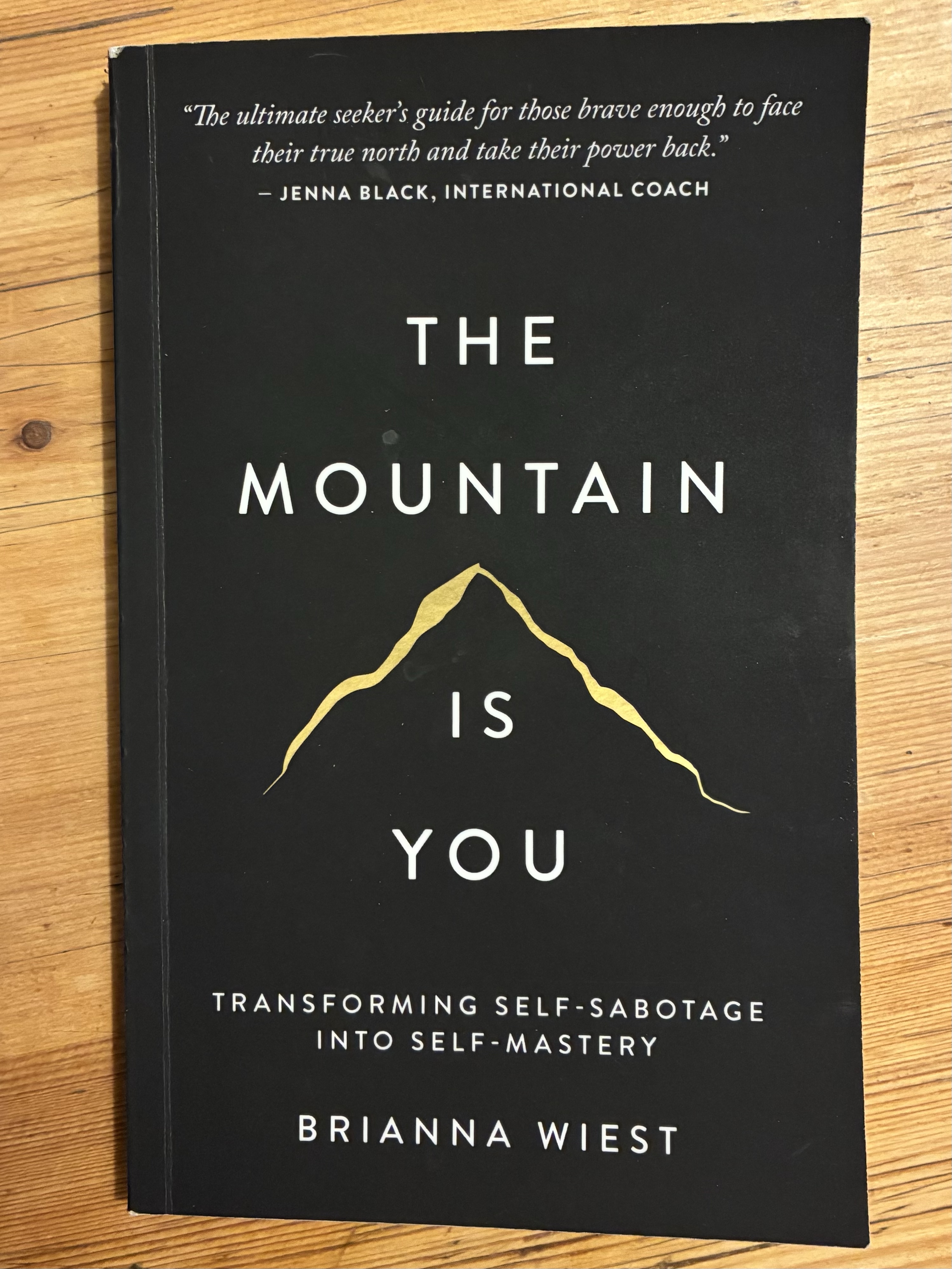
The Mountain Is You: Transforming Self-Sabotage Into Self-Mastery by Brianna West is probably not a book that I would have picked up to read of my own accord, despite that fact that I am pretty much certain that a lot of the struggles I have in pushing myself into action and gaining the sense of achievement and fulfillment that I crave are driven at a fundamental level by self-sabotage in one form or another. There is just something about the whole mountain metaphor, along with the kinds of words used in the book blurb that I read online (‘deep internal work of excavating trauma’, ‘building resilience’, and ‘adjusting how we show up for the climb’) that instinctively put me off. Why then did I work my way through this book for a few weeks in April and May this year? Because it was voted as the reading matter for the May meeting of The Timecrafting Trust Book Club that I participate in, and so, dutifully, I ordered myself a copy and set to work.

Almost from the start, I realized that there might well be a bit more value for me from The Mountain Is You than I had envisaged. I was immediately stuck with some obvious similarity between some of the content being covered and the ideas of psychotherapist Carl Jung that I found enthralling and thoroughly convincing when I read James Hollis’s excellent The Middle Passage a year or so ago.

Wiest begins her book by describing the various forms that self-sabotage can take along with the underlying reasons why each type of self-sabotaging behaviour occurs. There were quite a few lines in this section of the book that resonated with me…

  • sometimes, we sabotage our professional success because what we really want it to create art
  • sometimes, our most sabotaging behaviours are really the result of long-held and unexamined fears we have about the world and ourselves
  • human beings experience a natural resistance to the unknown, because it is essentially the ultimate loss of control

… because yes, I do increasingly seem to be seeing myself as an artist, yes, I definitely have a lot of fears squashed down into my head that hold me back, and yes, I do tend to get overwhelmed and feel very uncomfortable when I perceive that things are spinning out of my control. But why then, knowing all of this, does nothing much really seem to change? Wiest delivers the killer answer:

most people do not actually change their lives until not changing becomes the less comfortable option

Wiest goes on to argue that, in fact, we might be better off re-framing self-sabotage because, ultimately, the habits and behaviours associated with it are actually a result of your very clever subconcious ensuring that some unfilled need, displaced emotion or neglected desire is being met – that those actions are, in fact, deliberately designed to provide a positive outcome that some hidden part of your subconscious seeks.

Aand funnily enough, just this morning, quite coincidentally, I wrote in my journal that perhaps I allowed myself to procrastinate and hold myself back from taking certain actions even though I know this will result in an intense wave of frustration and anger with myself, because at least those negative feelings and emotions are something that I am familiar with and are, in some weird and twisted way, somewhat comforting.

The next section of The Mountain Is You describes a long list of different manifestations of self-sabotage, and whilst many of these did not feel relevant to me, some of them certainly did – hello Perfectionism, Worrying About Least Likely Circumstances, Being Busy, Fear Of Failure, to name a few.

The start of the process of overcoming self-sabotage begins, Wiest suggests, with tuning into, and listening to, the negative emotions associated with it – things like anger, jealousy, regret, chronic fear. She highlights a basic need to be able to ‘allow yourself to feel what you feel without judgement or suppression and notes that understanding your needs, meeting the ones you are responsible for, and then allowing yourself to show up so others can meet the ones you can’t do on your own will help you break the self-sabotage cycle’. For example, feel angry, notice that you are angry, understand why you are angry, remember that it is okay to feel angry… and then get on with life.

There are then a couple of chapters with fairly standard fare on building emotional intelligence and on letting go of baggage from the past, but as these progressed I could feel the book moving steadily into the kind of territory that my initial instincts had led me to expect. Then, aargh, I hit a section titled ‘Releasing your past into the Quantum Field‘ and my brain was instantly screaming at me that I was now thoroughly into pseudo-scientific mumbo-jumbo land… the kind of land where, apparently, ‘You store … emotions, energies and patterns at a cellular level‘. Now, I guess that in some sense everything associated with an individual human is stored at a cellular level, but I am pretty sure that Wiest is suggesting there’s something rather more mysterious and perhaps spiritual going on. I’d be inclined to simply say that statements of that kind are just nonsense!

I guess that from that point onwards, my brain was in a state of high alert, warning me, perhaps unfairly, that much of what I was reading had no real, solid basis. There were lots of nice, almost mantra-like phrases: ‘be willing to be disliked‘, ‘do your inner work‘ and a series of suggestions to ‘create aligned goals, ‘find you inner peace’, ‘detach from worry’, ‘take triggers as signals’, ‘honour your discomfort’, ‘stop trying to be happy’, ‘arrive into the present’ etc., but in the end it was all a bit too much – too many suggestions, too many affirmations, too many challenges to think about overcoming, with the result that I came away confused and somewhat disappointed. After a promising, really very readable first half, everything seemed to have unraveled as the book reached its conclusion. There was just nothing much that was concrete or tangible for me to cling onto.

Late on in the book there was one phrase that I rather liked in a section titled ‘Be aware of what you give your energy’, namely that ‘the wolf that wins is the one that you feed‘ and strangely, on the day that I read those lines some spoke almost the exact same words to me (perhaps that pesky quantum field was doing its thing…). In fact, the whole book is stuffed full of short phrases and sentences that you could lift off the page and incorporate into an inspirational poster or social media post if that is your thing. I may not have warmed to Wiest’s mountain metaphor or felt that the argument in The Mountain Is You hung together in a fully coherent and convincing manner, but she certainly knows how to write what might be called ‘soundbite sentences’. Forget all the gumph about releasing you past into the quantum field and storing emotions at a cellular level, and take this phrase, right at the end of the book… …

One day, the mountain that was in front of you will be so far behind you, it will barely be visible in the distance. But who you become in learning to climb it? That will stay with you forever.

BOOM!

The Thief Lord – Cornelia Funke #reading

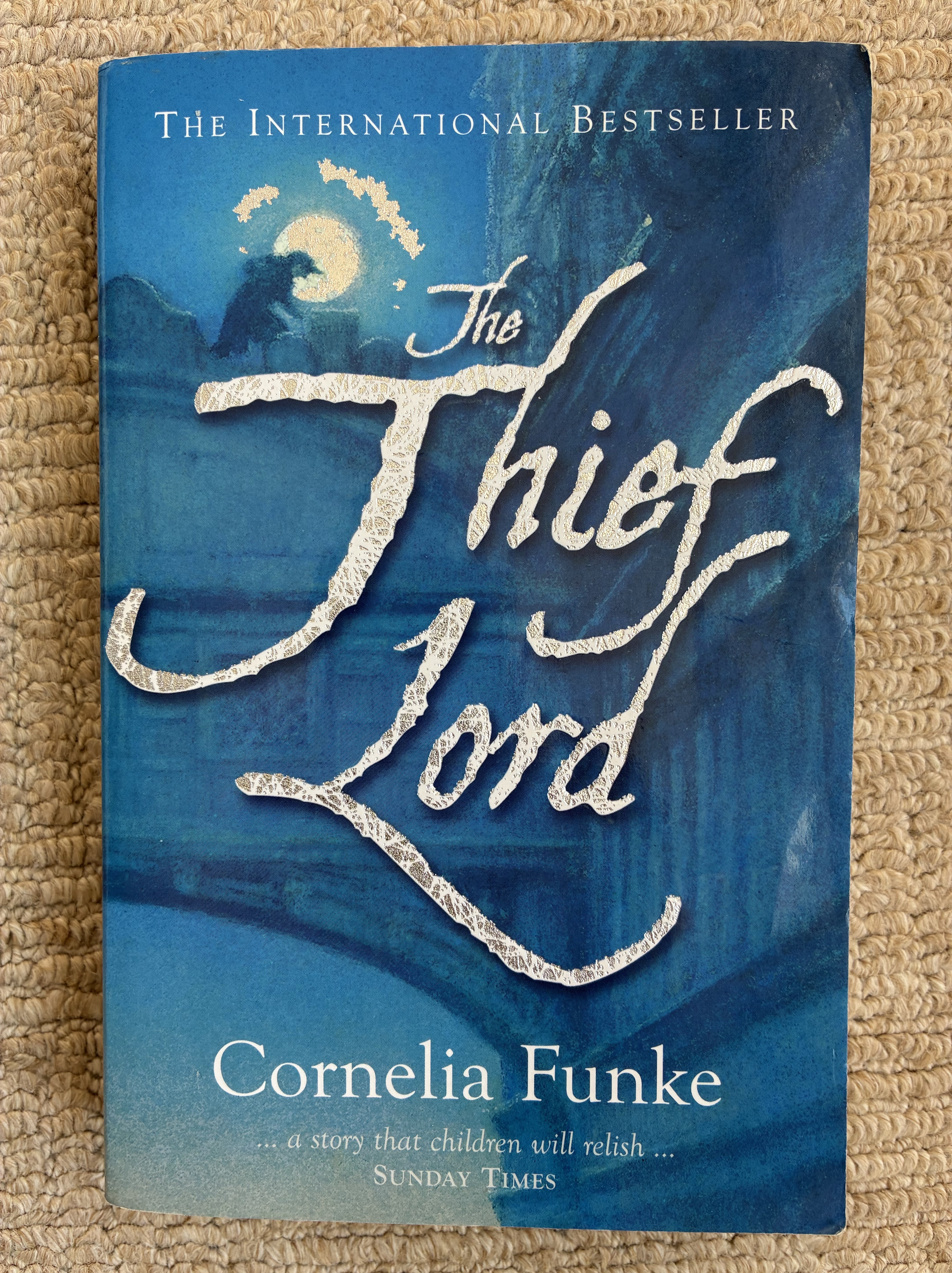
Since I finished writing my children’s adventure story, Empedocles’ Children, earlier this year, I have been exploring the various avenues through which I might eventually get it published. By far the most likely is that I will end up self-publishing Empedocles’ Children as an eBook and print-on-demand paperback, largely because to get a book out into the world via a traditional publishing route you have to first be successful in gaining the interest of a Literary Agent and, by all accounts, the chances of that happening are pretty minimal… As a result, I am adopting the working assumption that the doors to traditional publishers will remain firmly closed to me, but that doesn’t mean that I am not going to give that route to publication a try, in fact I have already started, having worked my way through an online course from Jericho Writers called ‘How To Get A Literary Agent’. About a month ago, following the approach suggested in that course, I sent off ‘query letters’, accompanied by a one-page synopsis and whatever portion of the manuscript the agent requested querying authors to send (usually the first three chapters), to eight Literary Agents. My plan is to send off a further set of query letters to another group of eight agents sometime in September, and then complete a final set of eight submissions in November(ish). The logic of this staged approach to submissions is that it provides the opportunity to modify the submission made to the later groups of agents on the basis of any responses (or lack of responses) received from the earlier one.

But what has any of this got to do with Cornelia Funke’s children’s novel The Thief Lord? The answer is that one of the things Literary Agents generally ask is that authors liken their work to what are termed ‘comparative titles’ (or ‘comps’). This is supposed to be a good way of the author showing where their book fits into the market (and that they know where their book fits into the market), and so help the agent decide whether or not it might be the kind of book that they want to represent and think they can sell to a publisher. With this in mind, before I could finalize my submission package I had to try to come up with a few such comps. Since I don’t routinely read children’s fiction, I spent a long time perusing the shelves of the local bookstore, but this didn’t really help me much because it seems to me that almost all new children’s books now feature magic, witches and wizards, dragons and suchlike. I also decided that I should try to get into the habit of reading some children’s fiction, and so when I stumbled upon a copy of The Thief Lord in a charity shop, I grabbed the opportunity to read a title by one of the most successful writers for children of recent decades.

The story of The Thief Lord is set, rather randomly, in Venice, and follows two orphaned boys, Prosper and his younger brother Boniface who have travelled from Germany after escaping from the clutches of their rather severe aunt who only wants to adopt the younger Boniface. In Venice, the two boys fall in with a group of street children led by the super confident, and extremely talented ‘Thief Lord’, Scipio. The first half of the book sees Prosper and Boniface become steadily more drawn into the group and their schemes to steal items to sell on, often to a corrupt antique dealer Barbarossa. The story hangs together pretty well and I found it a fairly enjoyable read…

…but then in the second half of the story, everything turns a bit weird. The group of children, rather improbably end up being befriended by a woman, Ida Spavento, whose house they were trying to rob, and then the plot suddenly takes Prosper and Scipio to an island where they find a merry-go-round that magically changes the age of those who ride it. I won’t spoil the story by saying who rides it and the extent to which they become younger or older, suffice to say that two of the main characters undergo contrasting permanent transformations after the merry-go-round breaks, trapping them at their new ages. I found the whole of this section of the book to be rather random – as if Funke knew that she wanted (or needed) to put a surprise twist into the book but hadn’t really worked out how to embed it into the story that she was in the process of writing. However, I’m an almost-60-year-old adult and The Thief Lord clearly wasn’t written for someone like me. Perhaps younger readers like (or liked, The Thief Lord was published in 2002) stories that change tack quite radically partway through. Who knows?

Overall, I quite enjoyed reading The Thief Lord, but I didn’t find it particularly satisfying. Interestingly, according to the Wikipedia entry for the book, a review in Publishers Weekly ‘found fault with the pacing’, a comment which matches up well with my own feelings about the story. In the end, I wasn’t left much the wiser in terms of finding a comp for my own book, although there is some similarity in the way that our stories unfold as they go along rather than following some obvious up-front structure or plot. I think there is also some similarity in the way that the stories bring together a group of children with different backgrounds and attributes. But in most respects the two books are very different, not least because Funke’s book has been published, translated into different languages, turned into a film (albeit apparently not a good one) and sold many thousands of copies, whereas my book hasn’t been published, hasn’t been translated, hasn’t been turned into the film and hasn’t sold a single copy…

…yet!

The Productivity Diet – Mike Vardy #reading

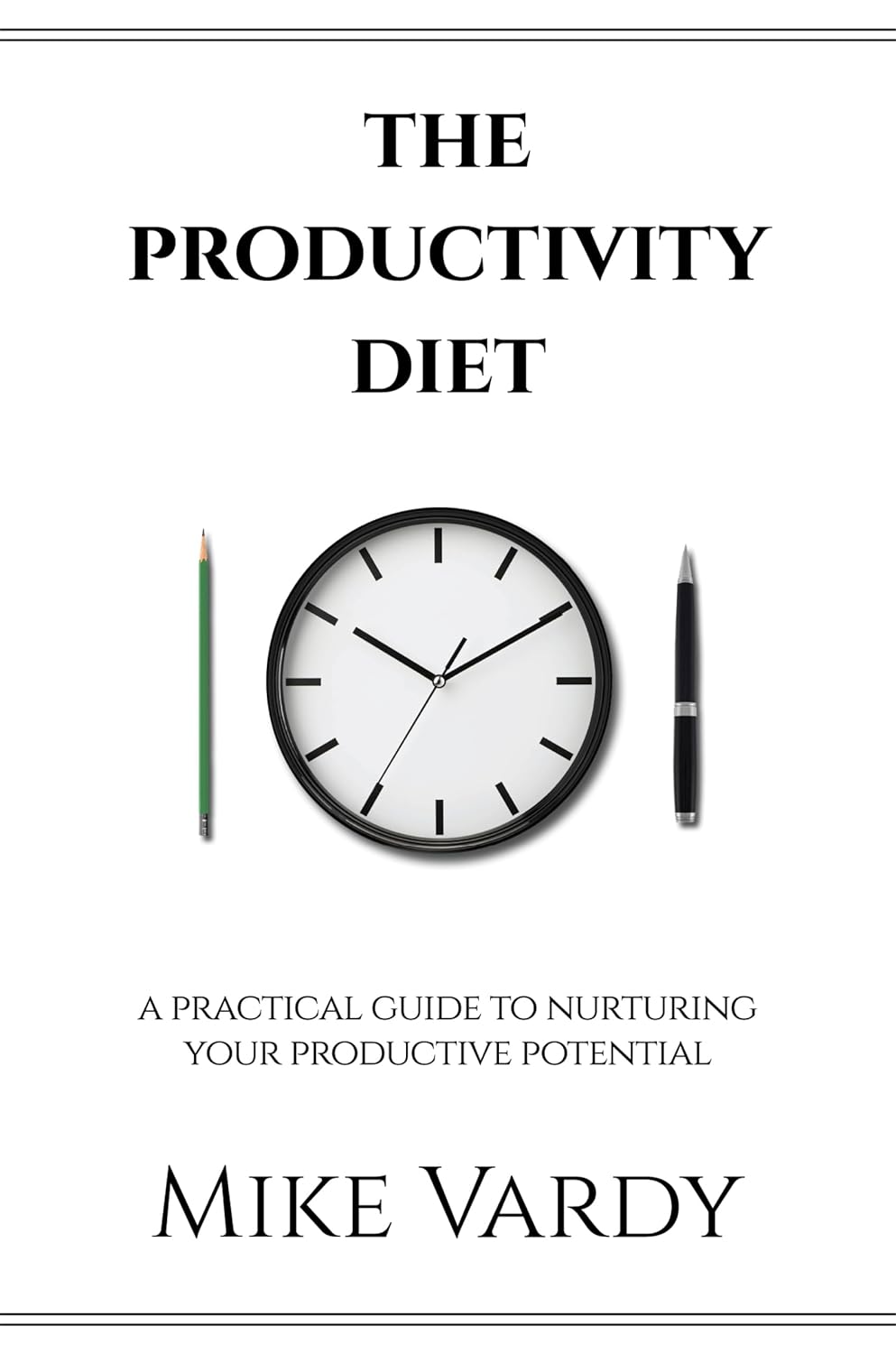
The Productivity Diet is the latest book written by Mike Vardy. Mike, who is based in Victoria, British Columbia, on the western side of Canada, describes himself as a ‘seasoned productivity expert, writer, coach and podcaster’ (quoting from his own website biography), and it was through the latter, his podcast A Productive Conversation, that I first became aware of his work. I don’t know how I initially stumbled on this podcast but for some years I have been a sucker for consuming content related to productivity (or ‘how we operate’ as I prefer to think of it). At some point, listening to episodes of the podcast led me to signing up for Mike’s email newsletter and then, after he sent out a request for people who felt they had a tendency to get started later in the day to contact him, I ended up chatting with him via Zoom about the productivity challenges that I faced and the approaches to overcoming those challenges that I used. At the end of the call, I politely declined the opportunity to join a coaching course with him (£££!!!) but did sign up as a member of his online community The TimeCrafting Trust. That was in March 2024, and over the last 15 months I have got to know quite a few other members of the community, most of whom are based in North America, and participated in a wide range of online events including monthly Book Club meetings, podcast livestreams, workshops and seasonal planning sessions. I think it’s fair to say that whilst Mike and I have never met in person, I could properly describe him as a friend, albeit of the online variety.

But what of The Productivity Diet itself? Mike’s basic view is that we cannot ‘manage time’ and so, instead, we should focus on managing our attention, in particular taking into account how much energy we have at any moment. To paraphrase the book: Productivity isn’t about managing time. It’s about how we use it, how we relate to it, and how we move within it. Mike argues that we should eschew rigid productivity systems in favour of thinking about productivity as a continuous interaction between Intention, Attention, Reflection and Action. Mike’s approach, which he calls TimeCrafting, involves laying out some broad intentions for our areas of focus, but then navigating the reality of our daily experience with a sense of gentleness and responsiveness to our evolving needs.

The Productivity Diet was the subject of a Kickstarter Campaign that Mike started before I got to know him. I think there were a few hiccups along the way, but the book was launched successfully earlier this year. The launch included Mike making appearances on a number of other productivity-related podcasts, and when he announced that he was going to focus an episode of his own podcast on the book I thought it would be fun to offer my services as a stand-in ‘host’ so that rather than it being Mike Vardy having a productive conversation with himself, the episode had a more normal host-author format. A little to my surprise, and despite the fact that I have pretty much no experience of working in broadcast communications, Mike thought this was a good idea and we went ahead and had a lot of fun recording the episode. You can pick it up here if you’re at all interested: A Productive Conversation Episode 603.

There are three major pillars to TimeCrafting as set out in The Productivity Diet: Time Theming, Attention Paths and Reflection.

Mike is big on the first of these pillars, Time Theming, suggesting that it can be beneficial to designate different kinds of themes to act as guide-rails as you decide, in the moment, exactly what to do next. These themes are time-based, for example, daily, weekly, monthly, seasonal or what are termed ‘horizontal’ themes where you select to focus your attention on a particular type of activity at the same time each day. At an even longer timescale, it is suggested that you adopt an ‘Annual Axiom’ – essentially a very short (e.g. three word) description to guide your overall approach to the year ahead. In the world of TimeCrafting, one might decide to group administrative tasks together to tackle on, say, Thursday, or to designate Friday as a day to consider finance-based activities, Tuesday for ‘creating’ etc. One might decide that the focus for the week ahead is, say, ‘rejuvenation’ or ‘correspondence’, or that the next month is for ‘growing contacts’ etc. A key aspect of Time Theming is that the themes are not meant to be a way to rigidly enforce a particular regime of action, but serve more as beacons to guide you back to an intended path if you move away from it. In addition, it is perfectly fine to do tasks and activities that do not match the current intended theme if there is time and space to do so.

The term ‘Attention Path‘ relates to a factor that will influence what you choose to, or can, focus your attention on at any given moment. The Productivity Diet introduces the acronym TREAT as a way to separate out five different types of attention path. TREAT stands for Time-based, Resource-based, Energy-based, Activity-based and Theme-based. The idea is that when selecting tasks to work on next, one considers the options in relation to each of these attention path types, asking questions like: Can this task be accomplished in the time I now have available? Do I have the resources I need to hand? Do I have the energy for this? Does it make sense to do this alongside some other similar task? Does this fit within my intended theme? I know from my interactions with him, that Mike is a firm believer in designating tasks as being low, medium or high energy so that, for example, when you hit a point in a day where you feel fatigued and might otherwise grind to a complete halt (as we all do…) you can glance at your list of possible tasks and pick one or two low energy tasks to accomplish. In this way, time which might otherwise be lost to the void of the internet (for example) can still result in some useful outcome.

The third pillar of TimeCrafting is Reflection. This is the key to continuous evolution and improvement. By reflecting on your actions, for example by writing in a journal, you can identify adjustments that can be made, obstacles to overcome, approaches that can be reinforced or extended. Without meaningful reflection there is no evidence base to use to help inform the decisions you make about what to do when and how etc., and so everything just unfolds somehow in a rather haphazard manner.

I will admit that in my own day-to-day operations, I have not had a great deal of success in using daily, weekly or monthly themes. I think my work days are too variable and I do not have sufficient control over exactly what needs to be done when, for them to work in a very consistent manner. But I think that having the general approach in mind is still helpful, especially at the longer timescales (‘this week/month I will focus on finishing X’). I have had more success with horizontal theming, but the variability of my days (sometimes I have classes to teach, other days I have a meeting etc) means that my attempts to impose order on my day through horizontal themes is generally most successful during the earlier and later (non-work hours) parts of each day. Similarly, I do consider attention paths to some extent, but I find that once my day is underway I tend to forget my plans and just go with the flow. It doesn’t help that I am not very good at checking in with myself to consider whether I would benefit from re-directing my attention (even setting reminders to do this doesn’t work very well – I just ignore them much of the time!). It’s not that I think the ideas underlying TimeCrafting are not valid, quite the reverse really, but I just seem to revolt against any attempt to constrain or direct my attention even though I would very much like to be able to do so!

I like the general approach of TimeCrafting that is set out in The Productivity Diet. I’ve tried to implement what might be called ‘heavier’ systems – things like time-blocking/time-boxing – and whilst they seem to offer an attractive level of control, I always (and quickly) end up revolting against them as my feelings in the moment take over. TimeCrafting offers a more gentle, sensitive, approach to keeping yourself on track, or at least somewhere close to being on track. To use a travel analogy, TimeCrafting is like having a traditional map, understanding what all of the symbols mean and knowing generally where you want to end up, but allowing yourself flexibility to move around the terrain, informed by the map, in the way that feels most appropriate at the time. This seems to me to be a much better way to travel than to switch on the SatNav and following it blindly to the selected destination, even when the road you have just been instructed to turn down is clearly little more than a rough and ever-narrowing track heading to an almost inevitable dead end and a ton of frustration as you try to turn around or back-up, surrounded by a herd of angry cows. Give me the map and my intuition any day!

Tiny Experiments – Anne-Laure Le Cunff #reading

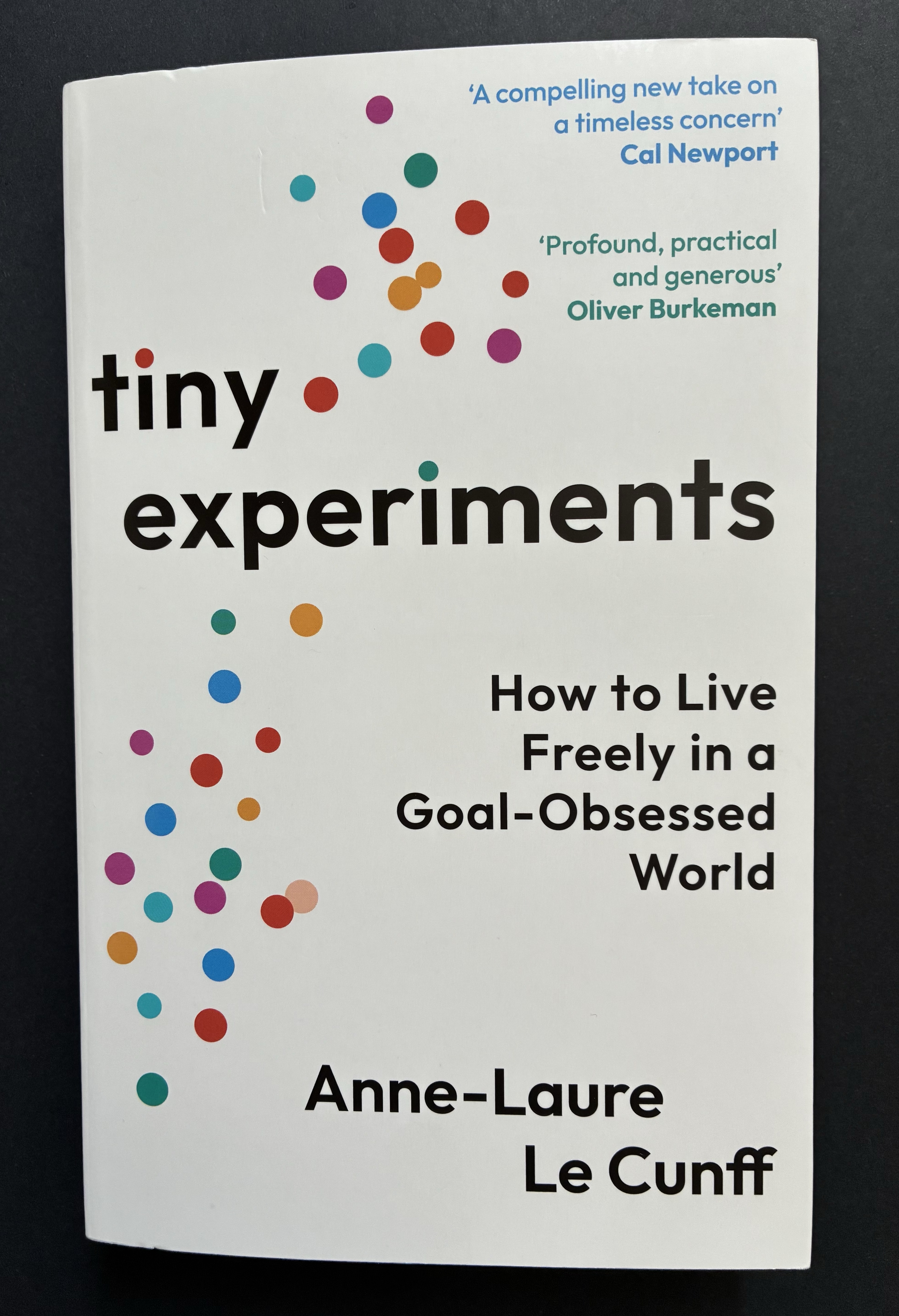
I read Anne-Laure Le Cunff’s debut book, Tiny Experiments, just a month after it was released in March 2025. However, this was not my first sight of the key ideas that the book contains, because I was lucky enough to be chosen as one of 300 people participating in a series of four, weekly online workshops, led by Le Cunff, that took place in February, in the lead up to the book’s publication. These workshops and the online community that accompanied them was called The Curiosity Collective, the name giving prominence to what is perhaps the key theme running Le Cunff’s work – the exhortation to live life in ‘curious mode‘, always willing to explore and experiment with your approach to life, and how you operate in the world. My experience attending those online workshops, showed me that Le Cunff is a highly skilled communicator and excellent teacher, and so I approached reading Tiny Experiments with high expectations. As an added bonus, the book had been chosen as the April pick for The TimeCrafting Trust Book Club.

As noted above, curiosity lies at the heart of Le Cunff’s ideas, and this is most obviously seen in her simple, four-part model for exploring and implementing change in your life. This model is rather neatly captured by the word sequence: PACT > ACT > REACT > IMPACT. At the start of the book, Le Cunff encourages the reader to adopt the mindset of a ‘self-anthropologist’, observing how they act in the world and the outcomes of these results, and then asking questions in relation to these observations. Le Cunff then structures the bulk of the text around her four-step model, stressing the importance of moving away from a Linear Mindset (X leads to Y leads to Z – end of story) towards the adoption of an Experimental Mindset based on the implementation of continuous experimental loops. My own feeling is that the key message here is not really about the distinction between linear v looping but, rather, one of ongoing adaptation and experimentation. The experiments one conducts don’t need to be thought of as loops (in fact they probably won’t bring you back to near your starting point) but they should take you somewhere, and in the process provide valuable evidence to help you work out what you might experiment with and where you might go next.

In the PACT phase of her model, Le Cunff presents a really neat (because it is simple) template for setting up what she refers to as a Tiny Experiment (an exploration of what happens when you make some small, realistic and manageable shift in the way that you operate). This template – a PACT – takes the following form:

“I will [action] for [duration]”

The key here is make sure that the action is purposeful, actionable (something that you can reliably perform), continuous (i.e. repeatable and not changing from day-to-day) and trackable. It is also important to be specific about the duration of the experiment (or else the number of repetitions). This ensures that the experiment is set up so that it provides a large enough dataset for meaningful conclusions to be drawn, but does not continue for so long that the action becomes tedious, or redundant or of little continued value. Essentially, the whole point of the PACT is to provide information that can then be used to adapt future behaviour and experiments, and not as a means to try to establish new habits.

In the ACT phase, you set about completing the activity specified in the PACT. This section of the book has some interesting material exploring the powerful forces of procrastination and, associated with this, perfectionism, that can so easily derail progress towards a goal.

The third phase of the model, REACT, occurs once the action described in the PACT has been completed for the specified duration. At this point, the goal is to look for, and then consider, evidence of the results of the action. Le Cunff highlights that it is important to look for evidence from within/internally (reflection) and externally (feedback from others, evaluation of results). Here, she presents what I suspect will become the most significant legacy of Tiny Experiments, namely her simple PLUS- MINUS-NEXT framework for reflection: what went well, felt good – what challenges or obstacles you faced, what was difficult, what negative feelings emerged – and then how the insights gained can shape future actions. [But whilst this framework is neat and seems to be catching on in the productivity community it might be noted that it is not so very different from the well-established ‘plus-minus-interesting’ framework.]

Because the whole point of Tiny Experiments is to encourage the adoption of an Experimental Mindset towards life, the REACT reflection should lead to a decision being made in relation to the area being investigated by the PACT. Le Cunff suggests that there are three possibilities: PERSIST – prolong the pact, or PAUSE – quit the pact or put it on hold, or PIVOT – modify the pact or shift the focus of a subsequent pact.

The final section of Le Cunff’s framework, IMPACT, focuses on the idea that it is helpful to be open/public about what you are setting out to achieve with your PACT and/or to work with others when pursuing it. This is largely a matter of gaining a useful chunk of external accountability, and also valuable feedback, but having seen many ‘public’ statements of Tiny Experiments PACTs in Le Cunff’s online community Ness Labs and on social media more generally, it is clear that it also serves as a powerful tool to market and promote Le Cunff’s ideas.

I enjoyed reading Tiny Experiments, and I feel pretty sure that it will be the kind of book that continues to have presence in the market for some time. It is well written and nicely structured, and the core ideas are simple (which is a good thing) and neatly presented, such that they have every chance of ‘sticking’. I think the phrase ‘Tiny Experiments‘ will likely become part of the productivity lexicon in similar fashion to James Clear’s ‘Atomic Habits‘. I also think that the “I will [action] for [duration]” statement for a PACT, the ‘PACT-ACT-REACT-IMPACT‘ model (or at least the ‘PACTACTREACT‘ part of it) and, in particular, the ‘PLUS-MINUS-NEXT‘ framework for reflection, will all end up having a healthy existence outside the printed pages of the Tiny Experiments book…

… but in the end, my enthusiasm for Tiny Experiments waned. I had several goes at defining pacts and conducting experiments, but I wasn’t able to make myself see any of them through to a satisfactory conclusion. Life got in the way, and I found myself ignoring my pacts and carrying on with my usual scattergun approach to trying things out. This, of course, probably says more about me than it does about the potential efficacy of Le Cunff’s ideas, but my experience was that despite the simplicity and neatness of the Tiny Experiments model, it did not possess enough power to persuade me to go all in with it. I have also felt that most of the Tiny Experiments that I have seen others setting out to pursue would really be much better described as ‘tiny habits’ (a phrase already coined by the author B.J. Fogg and, of course, rather similar to James Clear’s ‘atomic habits’), rather than tiny experiments, and to put it bluntly, many of them read like tiny morsels of misty-eyed, wishful thinking…

So, in the end I congratulate Anne-Laure Le Cunff for writing a really nice book that captures some neat ideas and makes some good general points, but despite the fact that I am still indulging in some daily ‘plus-minus-next’ reflection, I can’t say that it has turned me into a Tiny Experimentalist.

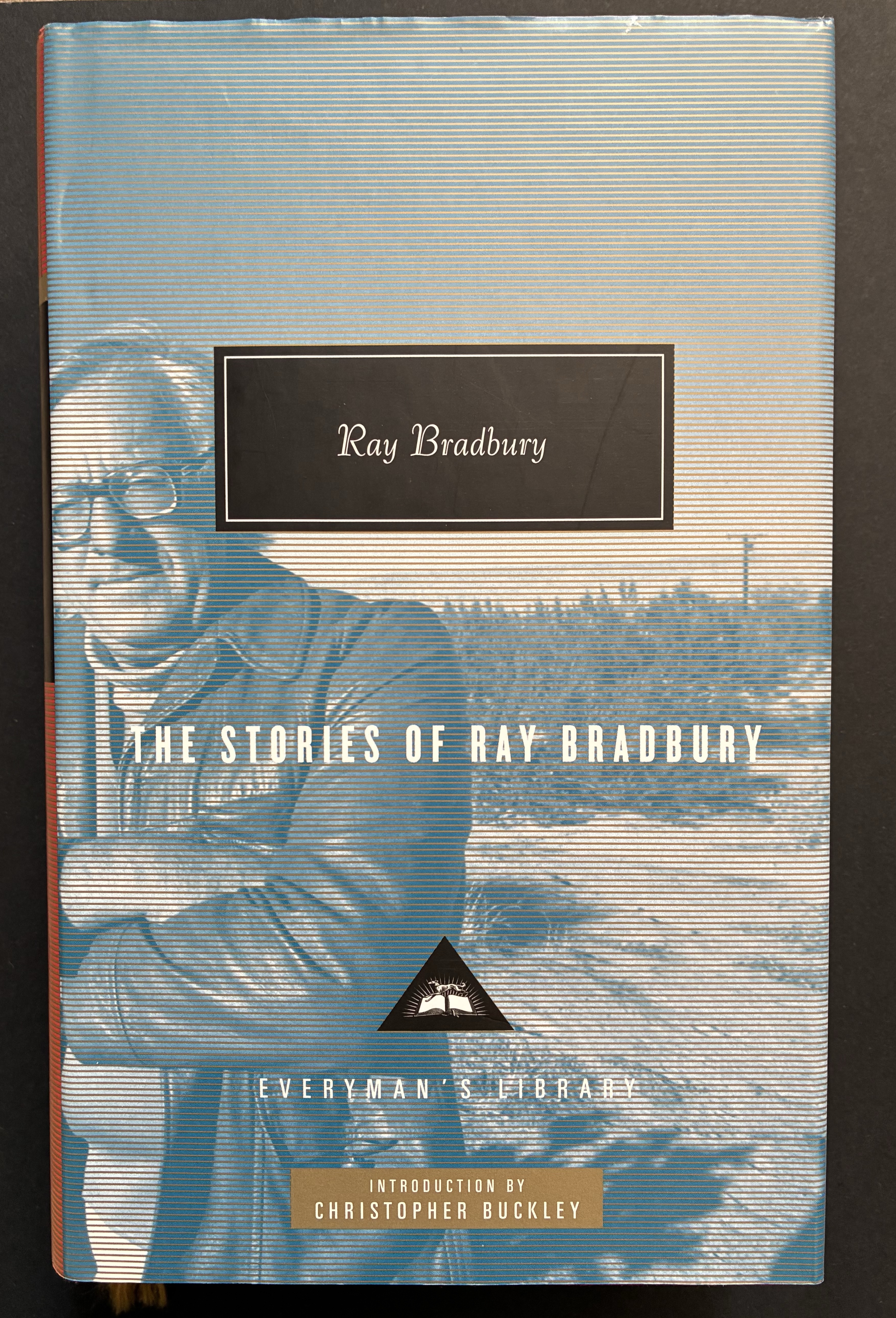
The Stories of Ray Bradbury #reading

Between August 2023 and April 2024 I worked my way through a wonderful anthology of short stories called That Glimpse of Truth, selected by David Miller. I had never really paid much attention to short stories prior to that but I found that I really enjoyed the experience and greatly appreciated the skill of some of the writers who were able to pack so much into such short works. As a follow up, and inspired partly by a childhood memory of watching a television adaptation of The Martian Chronicles, I decided to return to the genre with a big fat volume of The Stories of Ray Bradbury.

I had a bit of a false start with Bradbury’s work, reading just a two or three of his earlier stories and not quite getting the measure of them, but I returned to the task and started afresh towards the end of last November (2024). Whenever my schedule allowed, I read one story as part of my morning reading each day, and so it took me until April complete all 100 of the stories that were included in the compendium.

Reading Bradbury’s short stories turned out to be a really wonderful experience. They fall under several themes – stories centred on an outwardly normal family of vampires, stories that chronicle Bradbury’s imagined colonization of Mars, and probably my favourites, the stories set in small towns in the backwaters of America. All were written in the period 1940-1970ish and often focus on the impact that new or imagined technologies have on fairly ordinary people. Often the stories are very much of their time, reflecting moral positions and biases that we have (mostly) replaced since the words were sent down onto the page. It was notable how often Bradbury’s stories revolved around a somewhat unhappy married couple and, alarmingly, how many times such stories ended with the death of one or other partner, often in quite shocking circumstances. The story in which a husband removes his wife from his life by getting her to turn herself inside out is really quite something…

Unfortunately, I didn’t keep a list of my favourite stories, but I did keep track of some of the passages that particularly caught my attention or resonated with me for some reason and so, in no particular order, I will include these below. I am quite sure that I will re-read this compendium again at some point and I am also quite sure that when I do I will add many more examples to my list!


It was a day to be out of bed, to pull curtains and fling open windows. It was a day to make your heart bigger with warm mountain air.

(Opening lines of The Great Wide World Over There, 1952)


“How do you rest?”
She stopped. It sounded very bad. It sounded so much like an accusation, but it was not, really.

“Why didn’t I ever catch it from you?” she said at last.
He laughed a little bit softly. “Catch what?”
“I caught everything else. You shook me up and down in other ways. I didn’t know anything but what you taught me.”

(from Powerhouse, 1948)


And she decided, as sleep assumed the dreaming for her, that yes, yes indeed, very much so, irrevocably, this was as it had always been and would forever continue to be.

(from The Wilderness, 1952)


There was a long pause, full of stars and time, a waiting pause not unlike the last three years for all of them. And now the moment had arrived, it was Janice’s turn…

(from The Wilderness, 1952)


“So be careful. Stay on the Path. Never step off!”

(from A Sound of Thunder, 1952)


“Do we deserve this?” she said.
“It’s not a matter of deserving; it’s just that things didn’t work out.”


(from The Last Night of the World, 1951)

“Let me finish; not to make money, no. Not to see the sights, no. Those are the lies men tell, the fancy reasons they give themselves. Get rich, get famous, they say. Have fun, jump around, they say. But all the while, inside, something else is ticking along the way it ticks in salmon and whales, the way it ticks, by God, in the smallest microbe you want to name. And that little clock that ticks in everything living, you know what it says? It says get away, spread out, move along, keep swimming.”

(from The Strawberry Window, 1954)


Nor did they ponder the fact that if man dares dip into that stream he grabs a wonder in each hand…

(from The Picasso Summer , 1957)


Ah, those last two. What lines… such vast nuggets of wisdom hidden away in such unassuming stories; little gems, that reward the reader with their sparkling form and serve as beacons to light a path through life. Magic words…

get away, spread out, move along, keep swimming

nor did they ponder the fact that if man dares dip into that stream he grabs a wonder in each hand

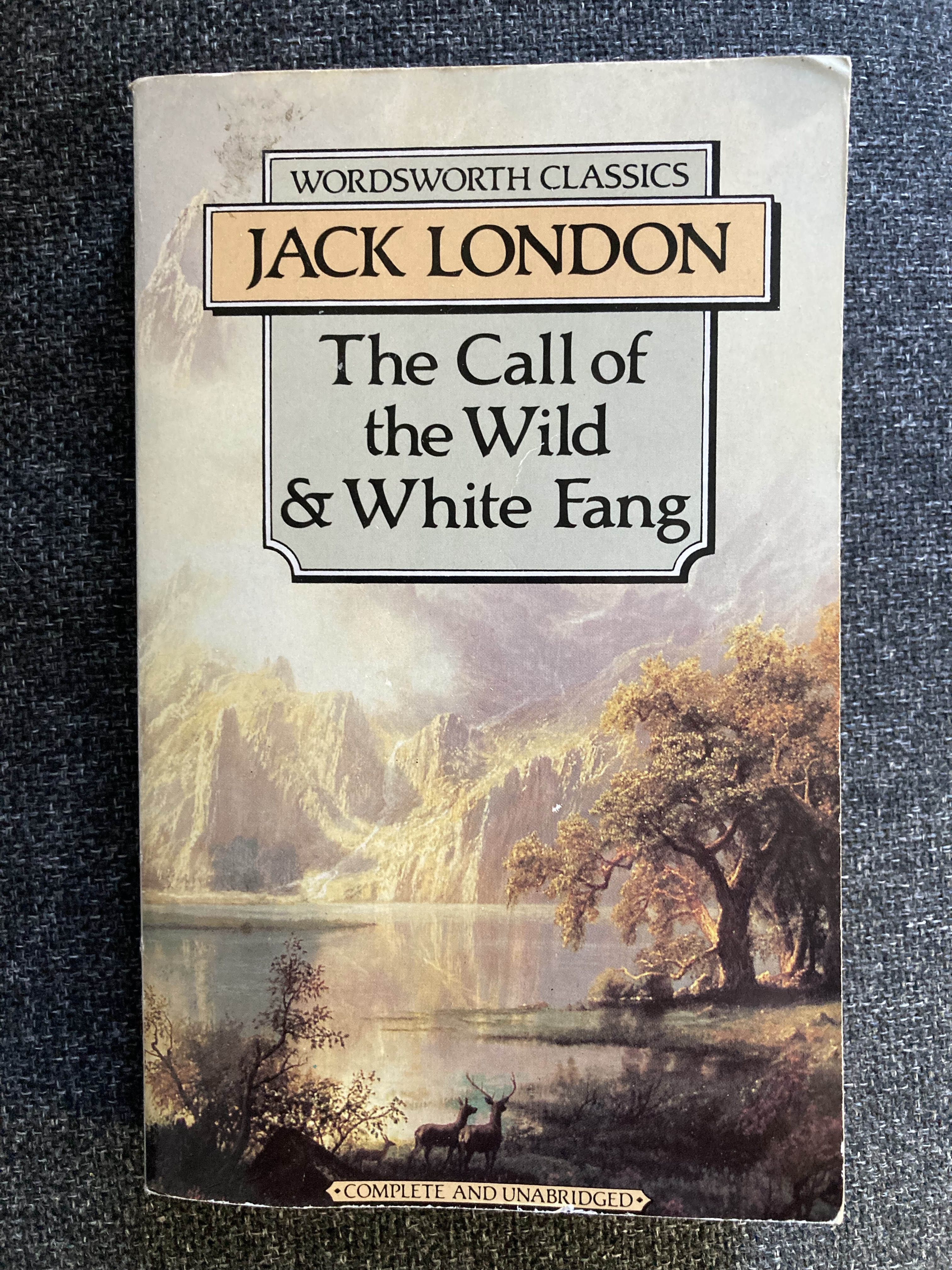
The Call of the Wild – Jack London #reading

A few years ago I discovered the wonderful book 1000 Books To Read Before You Die by James Mustich. Looking through it made me think about the range of books that I read, and in an attempt to make myself explore titles that I might not otherwise look at, I decided that I would work my way through the letters of the alphabet, picking a title written by an author whose surname started with each letter in turn. On my first trip through the alphabet back in 2020 my L title was The Wizard of Earthsea by Ursula Le Guin and then on a second, much slower, alphabetical loop that began in mid-2022 and has only fairly recently reached R, I chose The Spy Who Came In From The Cold by John Le Carre. However, on both of these occasions I came very, very close to selecting one of Jack London’s adventure stories… and so after picking up a combined volume of The Call of the Wild and White Fang in a charity shop, I decided I would finally give one of them a go, plumping for The Call of the Wild, partly because it was the first stories that London wrote, but primarily (I will admit) because it was the shorter of the two!

I enjoyed the story, which is written entirely from the perspective of Buck, a pampered St Bernard-Scotch Shepherd dog who is stolen from a California ranch and sold into service as a sled dog in Alaska. Buck soon has to get wise to the demands of his new environment, being beaten by his first owner and learning to fight with the other dogs to ensure his place in the pecking order. Over time Buck passes between several owners, and makes the long journey into the Klondike region of Canada and across the Yukon Trail. Buck soon establishes himself as the lead dog, having to brutally respond to challenges from rivals. Eventually, Buck is found in a poor state by an experienced traveller John Thornton who nurses him back to health, and the two form a strong bond. Thornton becomes rich after finding gold, and with little work for his dog team to do, Buck, now thoroughly attuned to life in the wild northlands, hears the howling of wolves and wanders off into the wilderness. Buck locates a wolf pack and then makes regular trips to socialise with a lone wolf from it. One day, Buck returns to camp to find that Thornton, his companions, and their dogs, have all been killed by native Americans, and so he sets off in search of his wild brother. Buck encounters a wolf pack and has to fight with them for survival, before discovering that his lone wolf friend is a member of the pack. The story ends with Buck answering the ‘call of the wild’ as he goes off to join with the pack.

It was interesting to read a story in which the human characters are secondary and all of the events are seen through a dog’s eyes. Buck’s journey from domesticated animal to a fearsome creature capable of matching a pack of wild wolves is fascinating to follow, and along the way there are lots of poignant moments as Buck and his human owners come to know and love each other. There are also some sickening scenes in which some of the humans show a complete lack of respect for their animal companions, and for the environment through which they are travelling.

The overarching theme of the book, at least from my perspective, centres on the harshness of the environment and the need to show it, and those traveling through it (human or canine), the utmost respect. Buck instinctively learns first to survive, and then to thrive in the wild, but most of his human owners, underestimating the power of the natural world, do not fare so well.

Call of the Wild was an enjoyable, fairly light read, and it certainly didn’t put me off indulging in another dose of canine adventure, in the form of White Fang, at some point in the future.

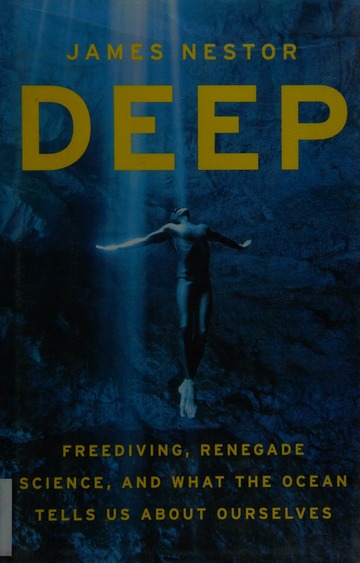
Deep – James Nestor #reading

I read James Nestor’s book Deep back in February/March, but I am a bit behind with my efforts to write blog entries and so I am only just getting round to writing something about it now. You could say that I have been submerged to such an extent that I have not been able to see even a glimmer of light to guide me in the right direction to get back on track…

Deep was not a book that I had ever noticed and thought I wanted to read, but one morning, at the back-end of last year, one of the students I teach in my first-year introductory oceanography module (there are almost 300 of them, although they are rarely [never?] all to be seen in the same place) came to see me during the break in one of my lectures and passed their copy of the book to me suggesting that I might like to read it. I think that my students generally assume that I am fascinated by the subjects that I teach and will love finding out more about any topic relating to them. This is actually not the case – it was a fairly random and somewhat inexplicable sequence of events that ended with me studying for an MSc and then a PhD relating to oceanography, and from there it was just a case of me continuing to follow what seemed to be the simplest path (i.e. the one that involved me making the minimum number of decisions) into my career as a Marine Science lecturer. Inexplicable it may have been (to me at least), but it’s a path that stuck, such that here I am, some 33 years later, still following it (maybe some would call it a rut!). So, in fact, I am not that interested in the undersea world, marine life and topics such as diving, I just somehow create the impression that I am fascinated by the oceans when I am teaching students about the various processes that occur within and on them.

Nevertheless, I thanked the student for passing the book to me and set it aside to read at some point. I had previously read his later book ‘Breath: The New Science of a Lost Art’, I knew that Nestor wrote well and would almost certainly have some interesting points to make, so it wasn’t really a difficult decision.

Deep is mostly about the pursuits of the very strange (to me at least) group of humans who strive to head as far as possible downwards into the ocean depths. It is nearly structured as a series of chapters titled by a depth in feet (e.g. -650, -2500, -35,850) and containing stories of human exploration towards that depth. Initially, at shallower depths, Nestor describes the pursuits of free divers, including the absolutely insane group of people that risk death competing to dive deeper and longer than their rivals. Some of the events that Nestor recounts, in which competitors emerge from the water with blood streaming from their faces, or in a semi or fully unconscious state were pretty horrific and I find it surprising that i) the ‘sport’ is allowed to continue, ii) anyone wants to participate in it and iii) Nestor still went ahead and learned to free dive so that he could join in with various activities.

In the latter part of the book, much of the content focuses on scientists and researchers who combine diving with attempts to better understand the behaviour of marine life such as various types of sharks and whales. All of this content was quite interesting, even for someone who is not at all obsessed with sharks and whales like me! It was particularly interesting to get a glimpse of the kinds of private organisations and collections of individuals that operate in this area of scientific exploration and research – often rather cavalier and unorthodox in their approach, because, I suspect, anyone trying to do the kind of ‘animal-encounters-at-close-quarters’ research that the book describes in a traditional, more highly regulated, academic setting would probably find that their efforts were thwarted by the requirements of such niggly things as risk assessments and ethical considerations.

In the end, I enjoyed reading Deep, and found it interesting to get a glimpse of the world of underwater activity it describes. However, it did nothing to make me wish that I was able to descend below the waves myself, quite the reverse in fact. I’ve always been quite happy existing on the solid substance of the land surface, and it’s pretty obvious to me that nothing is going to change that now!