Things That Help #poem

Things that help include…

A slow start to the day,
with plenty of time for my morning routine…
at least half an hour for reading, lots of different books –
some daily inspiration, a chapter of a long novel,
a short story, some poetry,
and a few pages from a science magazine,
with a cup of black coffee (currently decaf) by my side,
and frequent stops to record an idea
or to note some words of wisdom I have spied.

Then, a dive into my Journal notebook (Moleskine, large, squared),
with my zero-point-nine millimetre Pentel
twist-grip propelling pencil in hand,
scribbling away,
as my thoughts coalesce through the words I write
in a way I simply cannot understand.

At least two or three runs each week…
Preferably, although not as often as I would like, out of the city,
even though I rarely feel that I want to go
and often set out wearing a frown,
ideally working towards some future long-distance event that,
despite crowding in on me horribly as it approaches,
seems to be a necessary challenge,
albeit one reluctantly thrown down.

Having enough money to keep buying books…
titles I come across that interest and intrigue,
for it seems that books are my favourite food
and provide me with much of the sustenance that I need.

Not being hungry…
so, yes, please do bring me that snack
(real food of course, not a book!)

Remembering to drink water…
because going without it is something for which
I really seem to have a knack,
until it is too late, my body dry,
and my brain shrivelled to uselessness by its lack.

Knowing what is coming up…
and having a plan for the hours and days ahead,
even though I know I will not follow my intentions,
will waste much of the day
and become frustrated with myself.
(It’ll be a complete disaster if I set off with no kind of schedule, instead.)

Getting outside into nature, trees, sky, clouds,
and all the rest of it…
especially when there are big views –
it’s so much better for connecting with the world
than a constant processed diet provided by The News.

Talking out my thoughts…
(even if you do not really want to listen,
as long as you nod every so often,
and give a few prompts to keep me going,
it will really help to boost my knowing
and keep my ideas growing.)

Being the master of my own time and space…
so that I can sort and sift my thoughts,
move slowly through the day,
and know where I am and where I am heading.

Working at my own pace…
but also not having to make too many choices.
Although I will always have an opinion –
I admit that’s true –
it is usually far better if you simply tell me what we’re going to do.

Encouragement and praise…
just the right amount and I have to believe that it is sincere.
Just like the ambrosia eaten by Gods it can be sweet and sticky,
so getting this one right is really tricky.

What doesn’t help is…

Losing sight of the things that help,
or forgetting that even though I am certain of their value,
I will often have to force myself to do them,
and that, with insufficient respect for myself,
I will likely lack the courage to make sure that they happen
Enough.

(c) Tim O’Hare, September 2023


THINGS THAT HELP: As I allude to in my note for The Hollow Man (and probably elsewhere) there are certain things I like to do each day or on a regular/routine basis that help me to maintain my level of functioning. I find that I can go for a few days without following my ‘morning routine’ but if I let things slip for any longer or fail to force myself out for a run or a walk in the countryside I start to unravel. Things That Help captures some of these activities and ingredients that keep me in balance and, most importantly, notes the need to keep them in sight and to keep pushing myself to do them. I’ve come to think that everyone should write out their own list of Things That Help and keep it in a prominent place as a reminder
The Stories of Ray Bradbury #reading

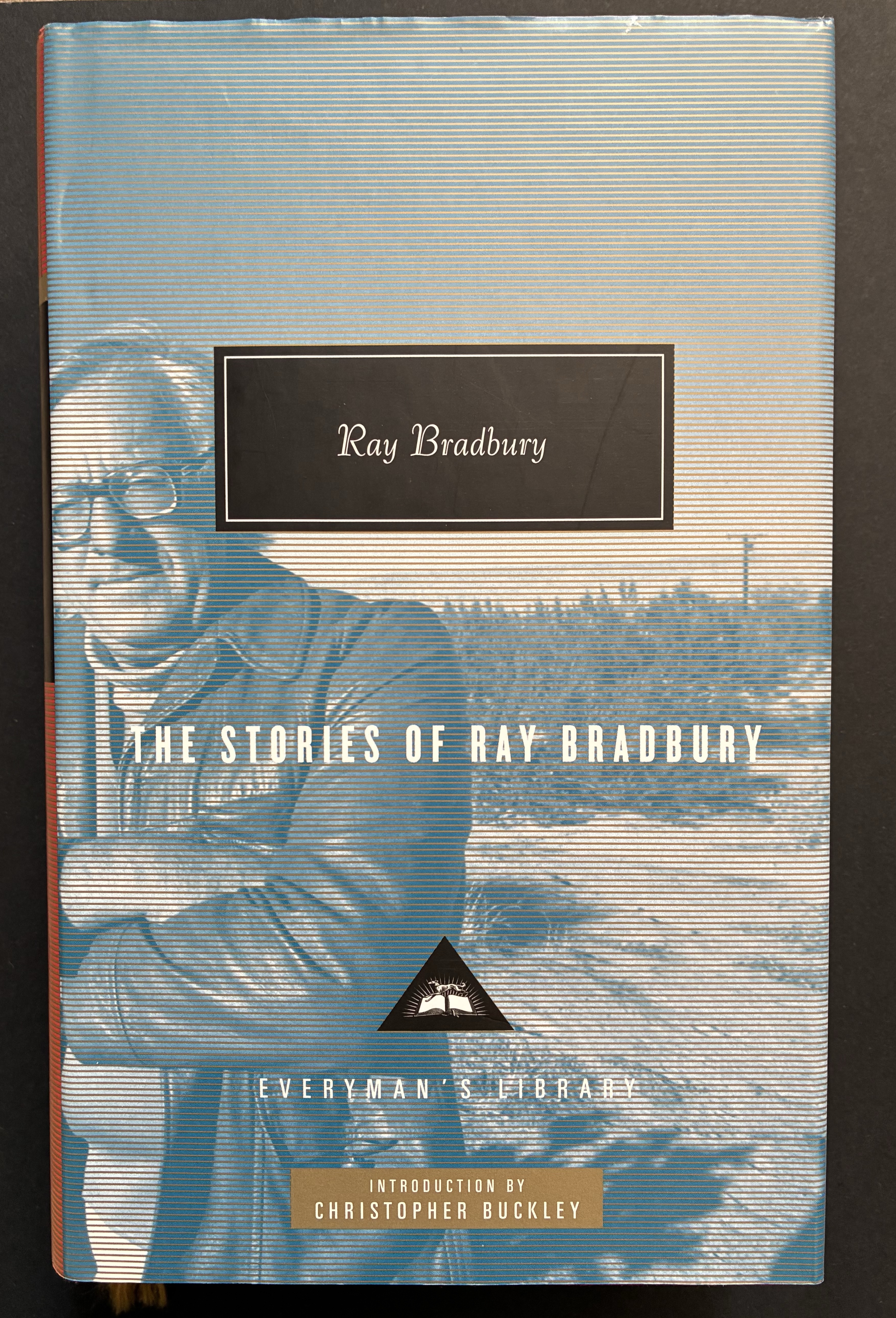
Between August 2023 and April 2024 I worked my way through a wonderful anthology of short stories called That Glimpse of Truth, selected by David Miller. I had never really paid much attention to short stories prior to that but I found that I really enjoyed the experience and greatly appreciated the skill of some of the writers who were able to pack so much into such short works. As a follow up, and inspired partly by a childhood memory of watching a television adaptation of The Martian Chronicles, I decided to return to the genre with a big fat volume of The Stories of Ray Bradbury.

I had a bit of a false start with Bradbury’s work, reading just a two or three of his earlier stories and not quite getting the measure of them, but I returned to the task and started afresh towards the end of last November (2024). Whenever my schedule allowed, I read one story as part of my morning reading each day, and so it took me until April complete all 100 of the stories that were included in the compendium.

Reading Bradbury’s short stories turned out to be a really wonderful experience. They fall under several themes – stories centred on an outwardly normal family of vampires, stories that chronicle Bradbury’s imagined colonization of Mars, and probably my favourites, the stories set in small towns in the backwaters of America. All were written in the period 1940-1970ish and often focus on the impact that new or imagined technologies have on fairly ordinary people. Often the stories are very much of their time, reflecting moral positions and biases that we have (mostly) replaced since the words were sent down onto the page. It was notable how often Bradbury’s stories revolved around a somewhat unhappy married couple and, alarmingly, how many times such stories ended with the death of one or other partner, often in quite shocking circumstances. The story in which a husband removes his wife from his life by getting her to turn herself inside out is really quite something…

Unfortunately, I didn’t keep a list of my favourite stories, but I did keep track of some of the passages that particularly caught my attention or resonated with me for some reason and so, in no particular order, I will include these below. I am quite sure that I will re-read this compendium again at some point and I am also quite sure that when I do I will add many more examples to my list!


It was a day to be out of bed, to pull curtains and fling open windows. It was a day to make your heart bigger with warm mountain air.

(Opening lines of The Great Wide World Over There, 1952)


“How do you rest?”
She stopped. It sounded very bad. It sounded so much like an accusation, but it was not, really.

“Why didn’t I ever catch it from you?” she said at last.
He laughed a little bit softly. “Catch what?”
“I caught everything else. You shook me up and down in other ways. I didn’t know anything but what you taught me.”

(from Powerhouse, 1948)


And she decided, as sleep assumed the dreaming for her, that yes, yes indeed, very much so, irrevocably, this was as it had always been and would forever continue to be.

(from The Wilderness, 1952)


There was a long pause, full of stars and time, a waiting pause not unlike the last three years for all of them. And now the moment had arrived, it was Janice’s turn…

(from The Wilderness, 1952)


“So be careful. Stay on the Path. Never step off!”

(from A Sound of Thunder, 1952)


“Do we deserve this?” she said.
“It’s not a matter of deserving; it’s just that things didn’t work out.”


(from The Last Night of the World, 1951)

“Let me finish; not to make money, no. Not to see the sights, no. Those are the lies men tell, the fancy reasons they give themselves. Get rich, get famous, they say. Have fun, jump around, they say. But all the while, inside, something else is ticking along the way it ticks in salmon and whales, the way it ticks, by God, in the smallest microbe you want to name. And that little clock that ticks in everything living, you know what it says? It says get away, spread out, move along, keep swimming.”

(from The Strawberry Window, 1954)


Nor did they ponder the fact that if man dares dip into that stream he grabs a wonder in each hand…

(from The Picasso Summer , 1957)


Ah, those last two. What lines… such vast nuggets of wisdom hidden away in such unassuming stories; little gems, that reward the reader with their sparkling form and serve as beacons to light a path through life. Magic words…

get away, spread out, move along, keep swimming

nor did they ponder the fact that if man dares dip into that stream he grabs a wonder in each hand

Mistakes Are Not Always Bad #wisdom

A couple of weeks ago we paid a visit to Make Southwest, an exhibition space for contemporary craft and design and a leading charity for craft education located in the small town of Bovey Tracey on the southern edge of Dartmoor, about 25 miles from our home in Plymouth. It’s a venue that we have visited a few times before – there is always some kind of special exhibition (this time it was a exhibition of contemporary bells called Sound and Silence) and an interesting array of local artwork, books and assorted items to look at in the shop. On this occasion, the reason for our trip was to see a smaller exhibition of wood engraved prints and, in particular, the printmaker Molly Lemon, who had travelled down from her base in Gloucestershire to demonstrate her work. We have encountered Molly at several Craft/Art Events in the last couple of years and always enjoyed viewing, and chatting to her, about her work. We also enjoyed seeing her compete in, and reach the semi-finals of, the Sky Arts TV Series Landscape Artist of the Year a few weeks ago.

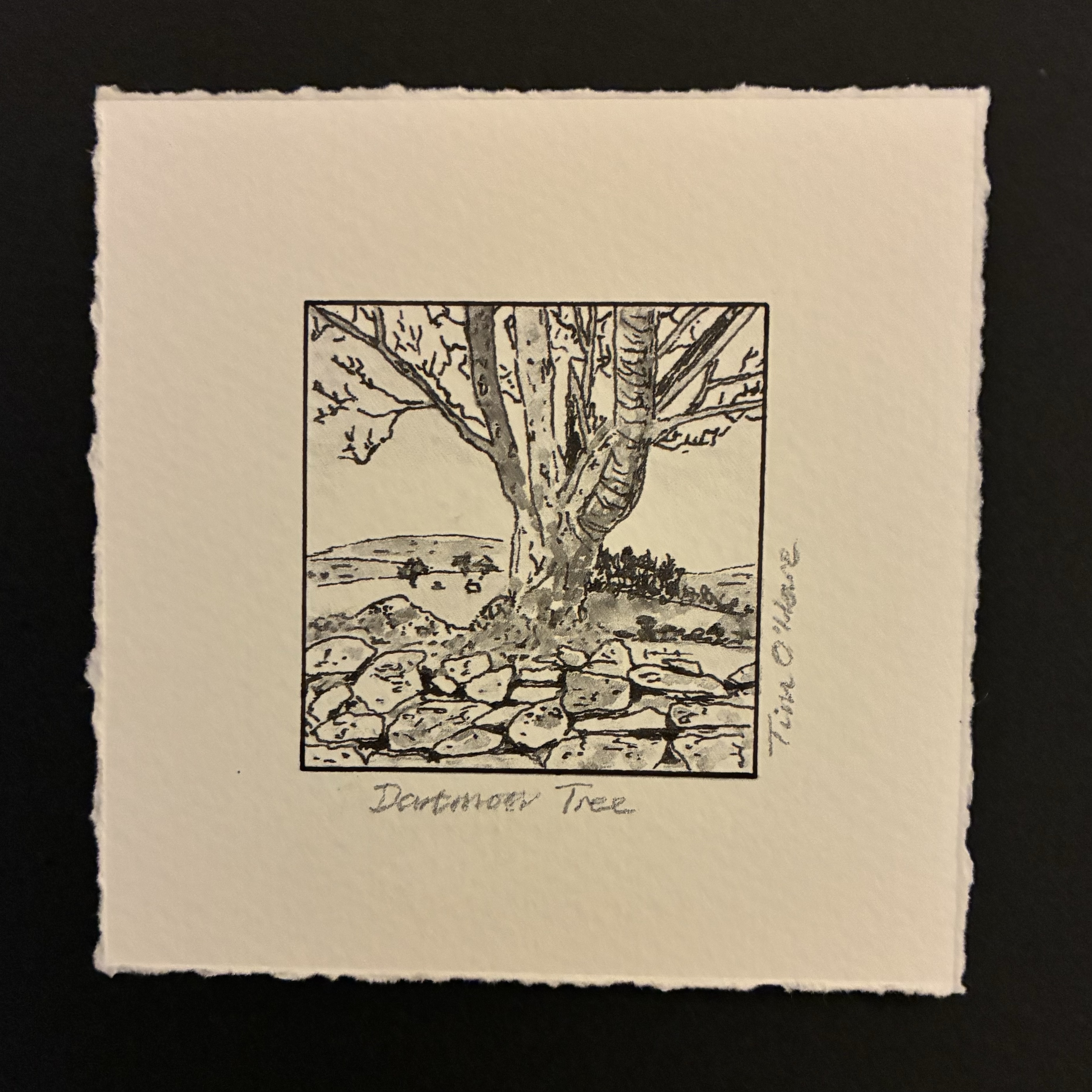
Since I started painting about a year ago, whenever I go to any kind of art gallery or art/craft event I particularly enjoy scavenging the work that is on display or sale for ideas that I can try out for myself. Looking at the various pieces of artwork for sale in the shop at Make Southwest, I was particularly enamoured by some tiny pieces of work created by the printmaker Mike Tingle (also here). These were very small (just a few centimetre) square prints on slightly larger squares of rough-edged paper, with a title and the artist’s name written in pencil around the picture (there is an example of a similar kind of picture just below the centre in this piece of work: Dartmoor Box No 1). I really liked the miniature size and somewhat ‘rough’ nature of the pieces and I immediately thought that it would be fun to try to produce something similar using one of my own small Dartmoor Scenes watercolour paintings.

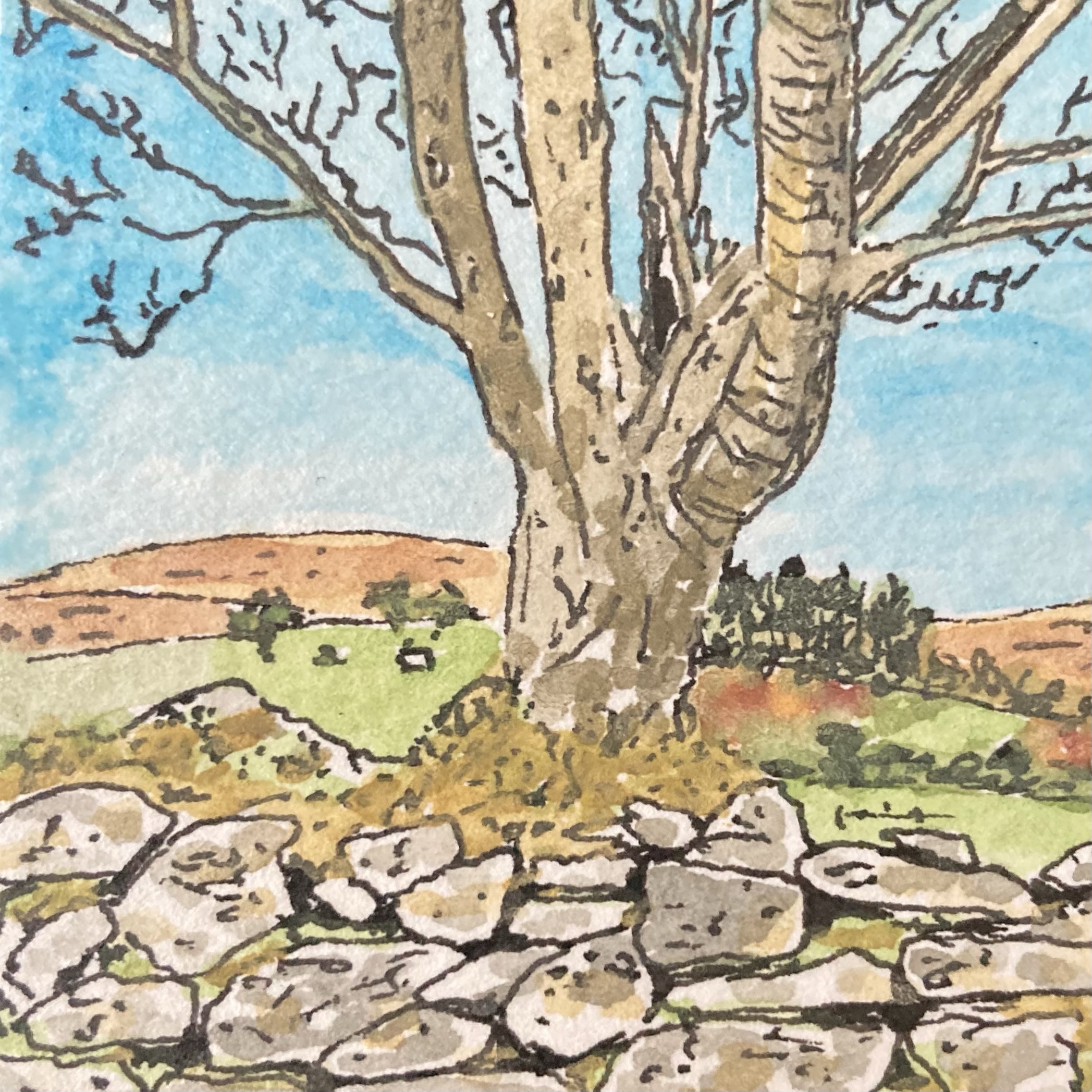
After returning home, I set about seeing what I could produce. First, I selected one of my pictures, opting for this one of a tree growing out of a typical Dartmoor dry-stone wall:

The original picture is a 4.5 cm square ink and watercolour sketch, and my intention was to use our home inkjet printer to make the best quality colour photocopy of it that I could, printing onto a sheet of watercolour paper so that the texture of the original was preserved. I’d already played around with making copies of some of my paintings in this way and so I knew that although the copied versions weren’t quite the same as the originals, with the paler colours tending to wash-out a bit, the process worked pretty well. So far so good.

This is the point at which I made my mistake. In the process of making the copy I somehow selected black-and-white printing, and so when I saw what the printer had spat out into the print tray I was instantly annoyed and frustrated. To make matters worse, because the original picture was on a small square of fairly thick paper, as the scanning light moved below the copier glass a dark shadow line was cast on one side of the copied picture. Not only did I only have a black-and-white copy, but I had a black-and-white copy that had a dark line along one of its edges. What a waste of a sheet of paper and ink…

However, once I had overcome my initial disappointment and self-censure, I decided to press on with the rest of my production process and see what the end result looked like. I had intended that there would be no border between the picture and the surrounding area of paper, but now there was that dark line along one side spoiling that design idea. What could I do? Well, go with the mistake of course. I took my drawing pen and with the aid of a straight edge and a lot of care, I inked in a similar line on the other three sides. Hmmm… it didn’t look as I had planned but I liked the result. Then I measured out a wider border, and again aided by a straight edge, I tore the paper down to size. This part of the process is something that I have found takes a lot of care… if the tear is too sharp you don’t get the nice rough edge I was after, but if you are at all rushed and loose you end up with something that looks clumsy and careless. Fortunately, I managed to do a good job. Finally, I grabbed a soft pencil and quickly wrote a title below the bottom edge and my name on the right-hand side…

The result of this endeavour was the small picture shown at the top of this post and, despite my black-and-white and shadow mistakes in the copying process, I’m really pleased with the end result, so much so, in fact, that I intend to take the rest of my Dartmoor Scenes pictures and treat them in the same fashion. Even better, not only did I end up with a new picture that I really liked and the discovery of a new way to transform existing pictures into a different, somewhat distinctive, form, but I also gave myself a great reminder that making mistakes in life is not always a bad thing. In fact, sometimes, as in this case, a mistake can open up a different path from the one that was intended that leads you towards an unexpected but interesting, exciting or enjoyable destination!

WARNING Stop Look & Listen Before Crossing The Line. #wisdom

Sometimes little pieces of wisdom appear in front of you out of nowhere. You see or hear something that makes you stop and think, and you then find yourself carrying it with you as time passes.

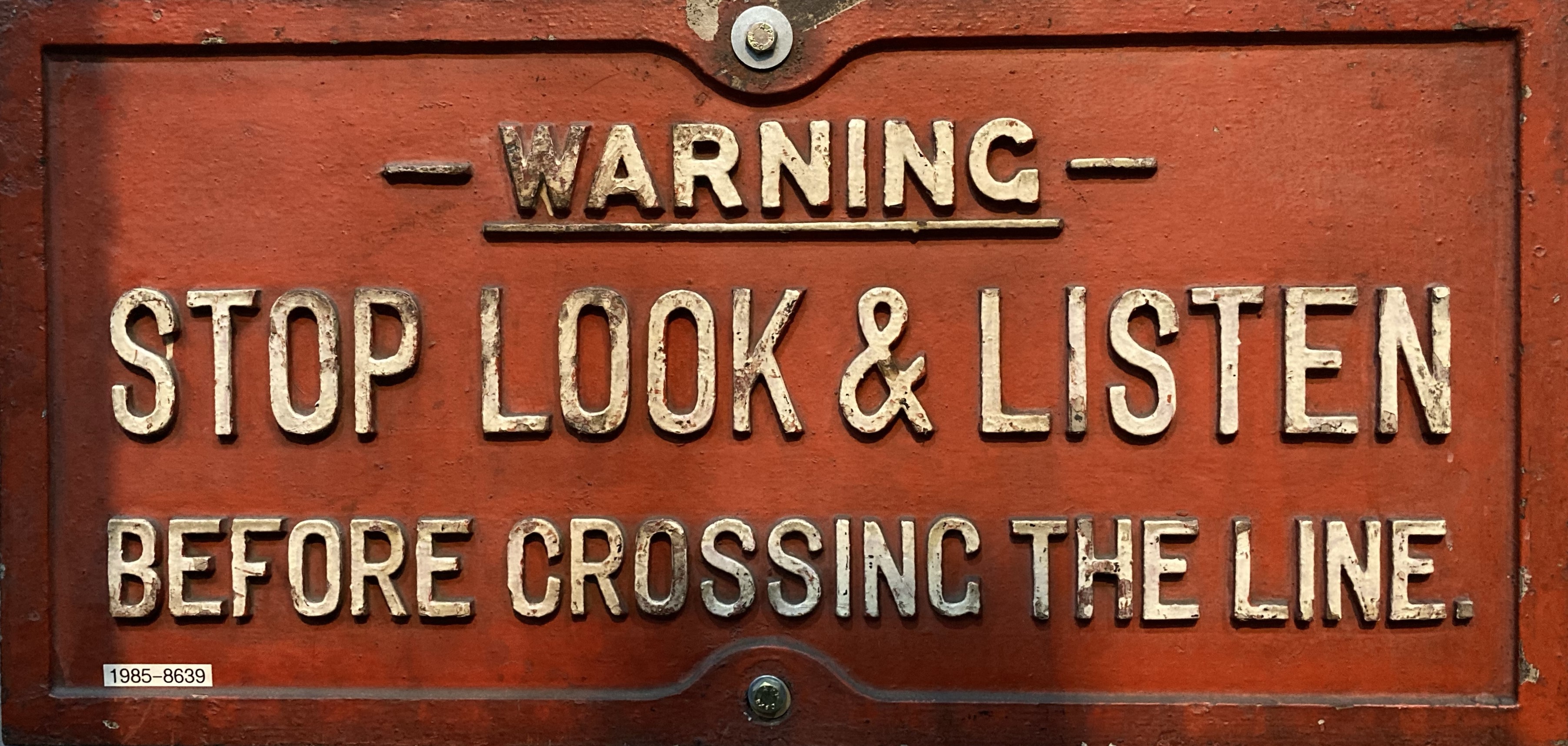
A couple of years ago we paid a visit to the National Railway Museum in York. In addition to some rather impression locomotives and rolling stock of various vintages, the museum is home to a vast range of smaller items associated with rail transport through the ages. Whilst wandering through the exhibits, I was much taken with a simple cast iron sign that was bolted to the wall (shown in the photograph above). Painted a rather satisfying and suitably alert-inducing red, its white embossed letters spell out the message: ‘WARNING – STOP LOOK & LISTEN BEFORE CROSSING THE LINE.’

There are a few things that I particularly like about this sign – its colour, the neat, bold use of capital letters, the way that the words are perfectly balanced and centralized, and the inclusion of the final full stop. Somehow, that last grammatical detail adds to the feeling that this is a sign that was serious about doing its job…

…which was obviously to warn people to take care crossing an unguarded railway line.

I guess that most people visiting the museum walk past that sign without taking much notice of it. In fact, many probably don’t even register that it is there. But as soon as I saw it, I knew that it was a sign and the message that it conveys, were something that I wanted to capture for posterity:

-WARNING-
STOP LOOK & LISTEN
BEFORE CROSSING THE LINE.

Isn’t that great advice, not simply in relation to navigating the obviously dangerous act of crossing a railway line, but for life in general?

Meditations – Marcus Aurelius #reading

Meditations is essentially a collection of journal entries written by Marcus Aurelius, Roman Emperor (161-180) and well-known adherent to the principles of Stoic philosophy. Most of the entries are short notes, written by Marcus as he unpacked his thoughts on the events of a day just passed or noted down some reminder to himself about the way that he wanted to live his life. These entries were never set down with a view to them being read by anyone other than the author, but they now constitute one of the most commonly cited sources of Stoic wisdom, to the extent that Marcus Aurelius is now generally regarded as one of the big three Stoic philosophers (along with Seneca and Epictetus).

I have read and listened to multiple books on Stoic philosophy and the Stoic approach to live that draw heavily on Meditations, most notably the works of Ryan Holiday – in particular The Daily Stoic and the first three books in his series on the four Stoic virtues: Courage is Calling (Courage), Discipline is Destiny (Temperance) and Right Thing, Right Now (Justice) [the fourth and final book in the series: Wisdom Takes Work (Wisdom) is scheduled for publication later in 2025] – and I have dipped into Meditations on and off over the years. But I had not actually read Meditations in its entirety for myself. With that in mind, at the start of this year, I decided to include Meditations as a component of my ‘morning reading’ sequence.

My initial plan was to read one entry of Meditations each morning, but I soon found that the entries are so variable that this approach was frequently not particularly satisfying, and so I switched to reading 5 or 10 entries at a time (depending on how they fell on the page). This meant that it ended up taking me 2.5 months to complete the whole volume.

I had quite high hopes for my reading of Meditations – I was familiar with it as a source of many great quotes – but, in fact, I found it something of a slog to get through. Every now and again a sentence would leap out at me and I would rush to note it down, but around those golden nuggets there was quite a lot of dull rock. I think that most readers would get a lot more out of reading material that draws from Meditations, such as the aforementioned works by Ryan Holiday, than working their way through the original source material. It can obviously be argued that the former approach is lazy and relinquishes control over what wisdom one might gain from the material, but my feeling is that in this case, the ‘tour’ is much enhanced by the commentary provided by a skillful guide.

I guess the real issue with Meditations is that, as already noted, it is not a book that was written by the author to be read. It’s much more suitable for the ‘open at a random page and read an entry whenever the mood takes you’ approach than a cover-to-cover examination (unless your intention is to actually study it). But either way, the little nuggets of wisdom should emerge, and can serve as useful reminders. Here are a few that stood out for me…

Be like the rocky headland on which the waves constantly break. It stands firm, and round it the seething waters are laid to rest.

Just as drifting sands constantly overlay the previous sand, so in our lives what we once did is very quickly covered over by subsequent layers.

Perfection of character is this – to live each day as if it were your last, without frenzy, without apathy, without pretence.

When you have done good and another has benefited, why do you still look, as fools do, for a third thing besides – credit for good works, or a return.

Universal nature delights in change, and all that flows from nature happens for the good.

A genius would make the history of his parish more interesting than another’s history of the world – Henry David Thoreau #wisdom

By Benjamin D. Maxham active 1848 – 1858 – National Portrait Gallery, Public Domain, https://commons.wikimedia.org/w/index.php?curid=24948639

For some years I have been reading my way through the Journal of Henry David Thoreau. Initially, I would just read a few entries at a time, but at some point in 2020 I hit upon the idea of reading entries on the day and month that they were written. At that time I was quite a good way through the book, and so my ‘on-this-date’ reading began with the entries that Thoreau wrote in 1856. Now, 5 years later, in my 2025 it is Thoreau’s 1861, and so the entries I am reading come from the penultimate year of his life (Thoreau died aged 44 in May 1862). When I started this project I was reading a journal entry on most days, but in the last few months, as Thoreau’s health has declined, the frequency of entries has reduced drastically such that I am only sporadically opening my copy of the Journal to discover that there is something there for me to read.

Thoreau’s Journal is packed with detailed observations of the land, wildlife and people around Concord, Massachussetts, and while many of the entries are quite dry and descriptive, with Thoreau you never know when a wonderful nugget of wisdom or a special turn of phrase will crop up. One such occasion happened last May, a couple of weeks before my elder daughter’s wedding, when a perfectly phrased gem popped up that I was able to integrate beautifully well into my ‘father-of-the-bride’ wedding speech!

Earlier this week (on 18th March to be exact) I read a passage of the Journal that I greatly enjoyed and which made me think, and so I thought I would use this post to highlight it to the world (as if… a better wording might be ‘to share it with the one or two people who might randomly stumble upon these words’). In the passage, Thoreau reflects on how the interest one might show in any given piece of history depends on more than just the subject of that history and that… No, I must let Thoreau take up the story…

You can’t read any genuine history – as that of Herodotus or the Venerable Bede – without perceiving that our interest depends not on the subject but on the man*, – on the manner in which he treats the subject and the importance he gives it. A feeble writer and without genius must have what he thinks a great theme, which we are already interested in through the accounts of others, but a genius – a Shakespeare, for instance – would make the history of his parish more interesting than another’s history of the world.’

It’s that last line that is the sparkle within the diamond: ‘a genius would make the history of his parish more interesting than another’s history of the world.’.

In my opinion, Thoreau has it spot on – everything is interesting and anything can be interesting if its story is well told. So, when we think about what to read, what to listen to, what to absorb from the world around us, the secret is to recognize and pay attention to those who are masters of the story-telling craft.**

* or woman obviously, but Thoreau was writing in 1861
** like Thoreau (obviously)

The Wisdom of Groundhog Day – Paul Hannam #reading

I first read Paul Hannam’s ‘The Wisdom of Groundhog Day’ (TWoGD) back in October 2022. It was one of a number of occasions when I have listened to an episode of a podcast on my walk home from work and been so taken with the content being discussed that I placed an order for the book as I walked along and before I had even arrived home. In this case, the podcast episode was an interview with the author about his book from the ever excellent ‘Art of Manliness’ podcast (Episode 828: The Groundhog Day Roadmap for Changing Your Life).

In the 2.5 years that have passed since that reading, I have held a really positive memory of TWoGD. I was drawn to the way in which Hannam teases his message out of the story of the ‘Groundhog Day’ film – ostensibly just a routine comedy about a grouchy weatherman who gets stuck in a small town having to live the same day of his life again and again and again. The heart of the message is that to find happiness and fulfilment in life it is necessary to change yourself on the inside and this happiness can only arise when you are fully present and focused at all times on being true to yourself, open to experience, and appreciative of the world and the people around you. Based on this memory, I breifly mentioned TWoGD at the end of a meeting of the Book Club associated with Mike Vardy‘s Timecrafting Trust Community and with others intrigued by the idea of the book, it was chosen to be our February read.

So, I came back to TWoGD for a second reading with high hopes and also a little trepidation… What if everyone else hated the book? As I worked my way through it for a second time I found myself with very mixed feelings. I could still see, and appreciate, the cleverness that lay behind it, but I also couldn’t help feeling that it was all a bit forced – a neat idea stretched out to a length many times greater than necessary. I found that there were certain stylistic aspects about the writing that I really disliked – the way that it was written in what seemed to be a series of ‘sound bite’ paragraphs one after the other with not much flow when read together, and the fact that at every turn the example given for how such and such a principle idea had made an impact on someone was taken from Hannam’s personal experience.

As it turned out, most other members of the book club community had fairly similar issues with TWoGD as I did, but the message of the book was well received and we had a lively and interesting discussion nevertheless.

If I was going to sum up the message in TWoGD in one phrase then I think I would struggle to do better than to use the same quote that Hannam uses in the book’s conclusion, taken from the second volume of Marcel Proust’s epic ‘Remembrance of Things Past’ (1924):

We are not provided with wisdom, we must discover it for ourselves, after a journey through the wilderness which no one else can take for us, an effort which no one can spare us.’

Home #poem

I don’t know if it is the air:
clean and fresh like an ice-cold beer,
bubbles rising,
condensation on the glass,
enough to quench the fiercest thirst.
Because sometimes…
it’s more like warm flat ale,
the dregs of a barrel,
forced down,
because it cannot possibly go to waste.

Maybe it’s the trees:
aged beings,
firm trunks,
twisting branches,
rustling leaves –
all kinds of greens –
magic matter drawn from thin air.
Although sometimes I am not so keen…
when a dipping twig catches me in the eye,
or a gnarly root sends me sprawling to the ground.

Perhaps it is the quiet:
only the soft, gentle, companion sounds
to the peacefulness of nature’s play –
the babbling of a stream,
the stir of swaying grass,
the lowing of distant beasts.
Although sometimes…
the incessant cawing racket of jackdaws
batters my ears and interrupts my calm
far more acutely than the hum of traffic
or the playground shrieks of children.

It can also be the smells:
sweet fragrances of flowers,
fresh cut hay,
that first exhalation of dry soil
after a much-needed drink of rain.
Although sometimes…
there are certain emanations,
animal and vegetable,
that have me rushing to hold my nose.

I wonder whether it is the sky:
deep blue,
adorned with a constantly changing dance of clouds,
then fading to burning orange
before the deepest black, be-jewelled with silver stars.
But sometimes…
such vastness can be far too much,
for this brain to consume in one sitting.

It’s definitely the route:
words in the book,
lines upon the map,
places to stop for a view,
a little piece of history,
a drink
and a big piece of cake.
Although sometimes…
the wrong words have been used,
those lines have simply not been drawn in the right places,
and the much-anticipated tea shop is closed,
just because it is Wednesday.

It’s tempting to think it is the solitude:
just me and the hills and the trees and the birds
and…
and…
and…
Although, if I am really honest, I will admit that sometimes…
that can also be a state of loneliness.

In any case, it’s certainly also the companionship:
sauntering along,
side-by-side,
ahead,
behind,
talking about the world around us,
solving problems,
making plans.
Although sometimes…
you just will not walk at the right speed,
and yes, I do know that I drive you crazy
every time I stop to listen out for birds
or to take one more arty snap
with the app or the camera on my phone.

I think it could simply be the scale of it:
always as far as the eye can see
(and then beyond into the land of imagination),
stretching back through an infinitude of whens
and forward into yet more thens.
Although sometimes,
as truly awe-inspiring as that can be to consider,
I’m reminded that really there is only here and now.

So, it seems to be the all of it:
air,
trees,
quiet,
smells,
sky,
route,
solitude,
companionship,
scale.,
and more –
a little piece of all of the everything that has ever been,
regardless of whether I,
and all the others just like me,
am here to do my worst,
whilst all the time I try to do my best.
Because…
we can build things,
we can shape things,
we can sell things,
and we can waste things,
but when I take a walk outside,
away from all the stuff,
and when I allow myself to forget what I think I am,
just for a moment,
well then I am home.

(c) Tim O’Hare, June 2023


HOME: Our summer holidays tend to be based around walking in nature and I always find that this activity helps my brain to slow down and provides a great source of nourishment for my thinking. During the process of writing ‘Home’ I reflected on what it is that makes walking in nature such an important and grounding activity for me, and as I ran through various possibilities and found counterarguments for each one I came to realise that there is no single magic ingredient – it was simply that walking in nature was where I felt most at home.

Stillness Is The Key (Ryan Holiday)

Stillness Is The Key was the third of author and modern-day purveyor of Stoic wisdom Ryan Holiday’s original set of books about the application of practicing Stoicism in everyday life. I read (actually listened to) the first two – Ego Is The Enemy and The Obstacle Is The Way – back in late 2017 soon after I started to become interested in Stoicism. Since then I have worked my way through the rest of his more recent output such that I would now probably have to label myself as a committed Ryan Holiday disciple. In 2018 I read The Daily Stoic one day at a time (something I am in the process of repeating this year) and then I listened to the first two volumes of his ongoing Stoic Virtues series – Courage Is Calling and Discipline Is Destiny – in 2021 and 2022 respectively. Last year I completed Lives of the Stoics and I have the third installment of the Stoic Virtues series (Right Thing, Right Now – Justice In An Unjust World) on pre-order for its release later this year. So with all of that in mind it is somewhat odd that it is only now that I have gone back to complete the original trilogy by listening to Stillness Is The Key.

With Ryan Holiday’s work I have always particularly enjoyed listening to the audiobook versions. Not all readers are the right person to narrate their own words but I find that Holiday’s narration brings the words to life and always keeps my attention (usually I am walking to or from work when I listen to audiobooks).

As with all of his other books I enjoyed this dose of Stoic wisdom. Holiday makes the simple wisdom contained in the ancient writings of Epictetus, Seneca and, of course, Marcus Aurelius relevant to life in the present day, treating them like mentors who we can lean upon for advice whenever we feel in need of a slight nudge or some help to become unstuck. The general theme of Stillness Is The Key is, naturally, one of slowing down a little, considering, maintaining a sense of balanced calm and, let’s face it, we could all do with some of that at times (or even often!).

I don’t think Stillness Is The Key is Holiday’s best work. In fact, I think his more recent Stoic Virtues series books are much better crafted than his earlier ones, but then that is surely to be expected as he has lived, practiced and absorbed Stoicism for longer and, I tentatively suggest, become a better writer too as the years have passed. But Stillness Is The Key is still worth reading (or listening to) because above all else it is important to remember that Stoicism is a more than a philosophy – it’s a way of approaching life and something that needs to be practiced, practiced and practiced, day in and day out. Anything that sets out Stoic ideas as clearly as Holiday’s writing and puts them in the front of my mind for a bit is going to help ensure that all of that practice helps to push me a little closer to that impossible to find place where practice makes perfect!

The Secret to Success

A few weeks ago, while reading Theodore Zeldin’s great book ‘The Hidden Pleasures of Life’ I came across a quote which resonated with me at the time and has stuck with me ever since. It comes from a 1967 New York Daily News interview with Bob Dylan in which he was asked about the delay in him producing a new recording and media reports that he had been offered a huge sum of money to switch record labels. His response was:

“What’s money? A man is a success if he gets up in the mornin’ and gets to bed at night and in between he does what he wants to. What I want to do is make music.”

I’ve picked out the middle sentence in bold because that’s the part that I read in Zeldin’s book and the part that is relevant here.

It’s possible to read this sentence as a simple instruction to do whatever you want to do, perhaps being selfish in the process. But that’s not how I read the quote or all that I take from it. For me, there are three elements to the quote, three ‘secrets to success’ – things that could be considered as markers of a successful life. One might also see them as essential ingredients or instructions…

1) Get up in the morning
It sounds simple but there’s quite a lot in this. First, if you get up in the morning then that implies you have made it through another night; you have survived to live another day – that’s Success Number One. Secondly, if you ‘get up’ then you have gone into active mode; you are engaged with life, doing something (anything) – and that’s Success Number Two.

2) Get to bed at night
Similar to ‘Get up in the morning’ there are two parts to this. First, if you ‘get to bed’ then you’ve clearly got a bed of some sort and that implies a least some degree of safety and security which has to be a good thing – Success Number Three. Secondly, the phrase implies that you have made it through another day and, no matter how easy or difficult that has been, I would count that as Success Number 4.

3) Do what you want to do in between
I guess this is obvious – a day spent doing things that you don’t want to do could still be regarded as a success in some ways (see above) but I think it is self-evident that a day spent doing what you want to do, whether that is one thing, a calling such as ‘Dylan’s “make music'”, or a multitude of things big and small, is going to be a better (more successful) day than one where much of your time is given over to activity that is misaligned with your personal values and interests. That’s Success Number 5.

I think it’s obvious that Success Number 5 is THE BIG ONE but I’d also argue that a single day of Success Number 5 would not really make for a successful life – that would only come when it is coupled with Successes Numbers 1-4 over and over again. I would just add here that what is good for one is surely also good for everyone else and so an interpretation of ‘do what you want to do’ that is generous to others and does not work against their own success will most likely lead to the greatest success in life overall. I certainly don’t take this phrase as an excuse for selfishness.

So, that’s the goal: get up in the morning – do what you want to do – go to bed at night; the secret to success in a nutshell.