Walkham Woods (charcoal/watercolour) #art

Since I started drawing and painting back in April 2024 I have primarily worked with ink and watercolour paints, with my ‘go-to’ format being small, usually ~5cm square, pictures on some particular theme that I have chosen to explore for a few days. Producing pictures of that type has become my staple art activity, to the extent that I describe this as my ‘art practice’. However, I am constantly thinking about how I would like to explore different formats and work with different media. This especially happens when I visit an art exhibition, see works by other artists,and wonder what I could produce if I branched out a bit. The funny thing is that prior to my big shift into art in April 2024 I had actually begun to dabble with creating pictures with pastels (e.g. see my post Rediscovering The Artist Within) but I have not returned to pastels once since then.

Sometime back in May I must have been somewhere that brought me into contact with some charcoal drawings. I had a set of charcoal pencils sitting unopened in my art supplies box, and so I thought I would branch out a little and see what happened when I completed the drawing phase of a picture with charcoal, rather than adopting my usual approach of starting off with some faint pencil lines and then going all in with my black ink pen. I think I hoped that the different drawing texture might lead to me producing a more abstract picture. Then, after scribbling away with the charcoal pencil for a bit, I returned to the familiar territory of my watercolour paints to give my drawing some colour.

The result of my efforts is shown in the picture above – a charcoal -cribbles-with-watercolour painting of a row of what I refer to a ‘wall trees’, somewhere in the valley of the River Walkham, from a photo that I had taken on a walk there.

I’m not sure exactly what I think of this picture. It seems quite basic and simple – the trees sitting very much on top of the leafy backdrop and lacking much detail in their trunks and branches – and that simplicity pushes me towards thinking that the picture doesn’t quite work. But I also quite like the more impressionistic look – the rough lines suggesting the texture and structure of the stone wall, and the bright greens and particularly the yellows of the leaf canopy shouting out for attention. The picture has a naivety which I think gives it a certain charm. As I look at the picture, my eyes seem to be drawn in to explore what little detail there is, perhaps more so than happens when viewing one of my more detailed ink and watercolour pictures. Overall, I think that perhaps the switch in drawing medium was successful in helping me to present the view in a more abstract, suggestive manner than my normal ink-and-watercolour approach.

I’ve not had another go with charcoal pencils since I created this picture just over two months ago, but revisiting it now and writing this post has fired me up to spend some more time over the coming period to play around with different approaches and media a bit more. I wonder what will emerge!
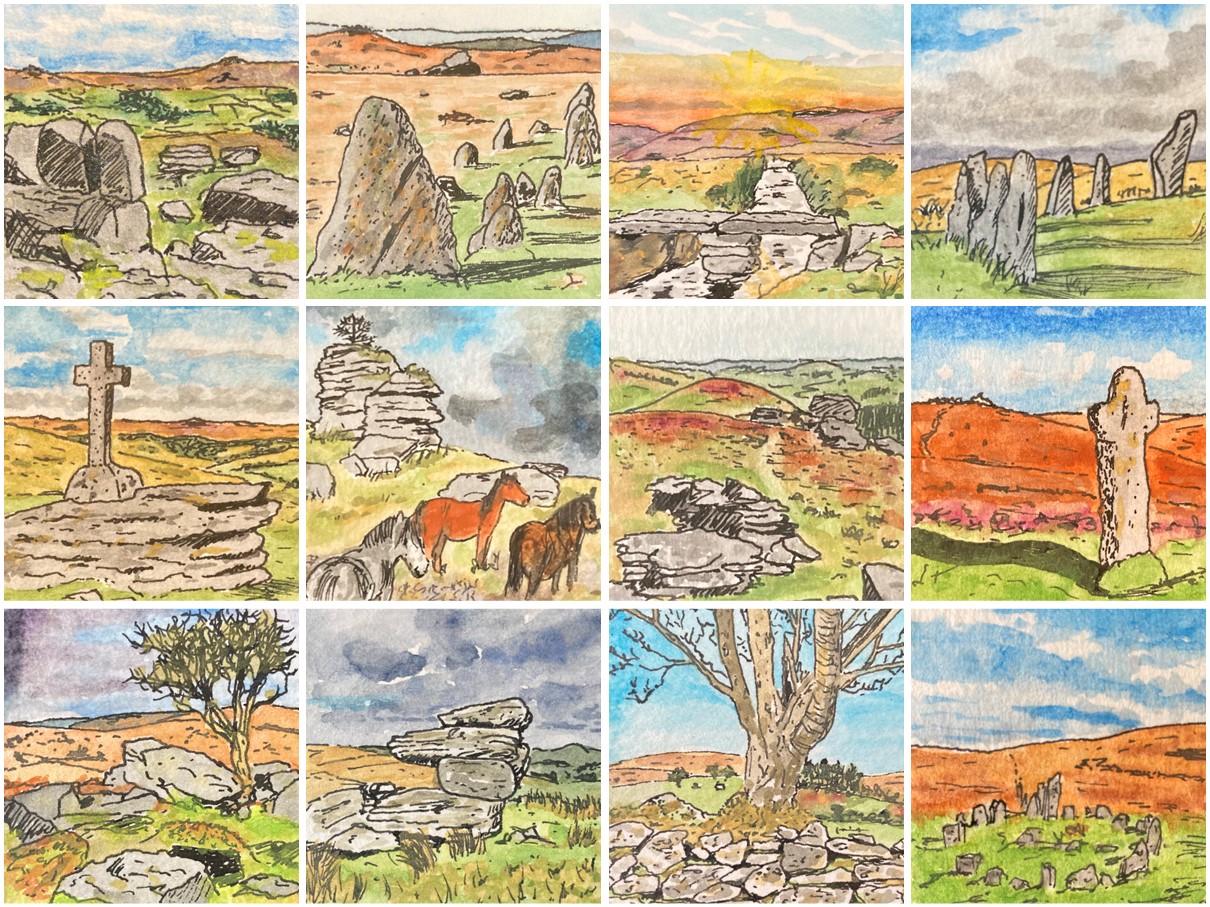
Dartmoor Scenes #art

At the beginning of last month (March 2025) I decided that I wanted to try to embed a more regular art practice into my life. So, one evening, I sliced a piece of watercolour paper into a series of 5 cm squares with the intention of painting some kind of miniature picture each morning. I didn’t know what I would paint, just that I would try to paint something, as often as I could.

It was interesting, then, to wake up the next day and find myself sitting down at my painting table at 7:30 am, before I had even eaten breakfast, painting a little scene of a tor and some scattered rocks, a scene that is typical of Dartmoor, the National Park just north of Plymouth where I live. Because I was working on such a small piece of paper, and because I was trying to work quickly, before I got fully enmeshed in the day’s activities, I found myself adopting a simpler style than usual, with fewer, and bolder, colours and some use of cross-hatching to show shadows and darker areas. I liked what emerged.

After that first painting (the one at the top-left of the composite picture at the top of this post) I still didn’t know what would happen next, but at some point, perhaps after two or three days, I came to realise that I was creating a series of miniature pictures that I labelled Dartmoor Scenes. Initially, it was my intention to paint five pictures, one on each weekday, but having successfully reached that number I decided to push on to nine. This seemed to me to be a good number for a series of little square pictures, neatly forming a 3 x 3 grid.

As I approached what I thought would be the final picture, I received a comment on my Bluesky (social media) account on which where I was posting my new picture each day, suggesting that the pictures would make a nice calendar. It was an idea that I liked, a lot, but of course a calendar needs 12 pictures, one for each month… and so my miniature watercolour Dartmoor Scenes series had to become a collection of 12 pictures in total.

I really enjoyed producing these little pictures (and have since gone on to produce two more sets of 12 similarly-sized pictures on different themes – watch this space for details!). I enjoyed being forced to keep things simple and was really happy with the results (more in some cases than in others). I particularly like the stone row and stone circle pictures on the top row (second-left and top-right), and the tree and wall scene (third-left, bottom row). I also really like the way that they look when placed together.

Although it was already almost the end of March by the time I received it, I got a desk calendar printed up as a kind of test run to see how well it worked… and it worked very well indeed, the pictures coping with being expanded to almost double their original size. Subsequently, I have also had each picture printed as a 10 cm square card and had some copies of a larger card printed with a 3 x 3 composite of the nine pictures that I think are the best of the selection. At some point I hope to get more of these cards printed so that I can have a go at trying to sell some of my artwork. It will be interesting to see what happens if and when I do!

As an experiment in trying to be more regular with my artistic endeavours, this activity has worked really well, and although I have now moved on from Dartmoor Scenes, I suspect that I will return to this theme again at some point and complete another set (at least another four to get to a 4 x 4 grid, but who knows, maybe I have another 13, 24 or even 37 Dartmoor Scenes still in me!)

If you like these pictures, I’d love it if you added a quick comment to this post. It would be fun to know which one(s) you like best.

Out and About Again At Last #other

Four months ago, at the end of August 2024 I managed to do some damage to my left Medial Collateral Ligament while completing long runs. I think I did the injury earlier that month while running the second half of the West Devon Way from Peter Tavy to Okehampton but then I compounded things by attempting to complete my leg of the King Charles III Coastal Challenge, or at least a good chunk of it from Par Beach to Looe, a couple of weeks later. By the end of that run, over typically up-and-down Cornish coastal path terrain I could hardly walk and ever since then I have been trying to nurse it back to strength with the help of some visits to a Sports Therapist and, more recently, a Physiotherapist. But although the area where the MCL itself attaches to the top of my calf muscle has gradually become less sore, I have not been able to get my leg back to normal and pain-free – it now has a tendency to feel somewhat unstable and ‘clicky’ and is very sore most of the time and especially after I have spent any time sitting down. It has been very frustrating, not only preventing me from doing any running (apart from an 0.6 mile test run in mid-December) but it has also meant that I have cut back on walking and certainly not gone for any proper walks our and about on Dartmoor or at the coast.

Consequently, it was with a lot of joy that we took ourselves up onto the edge of Dartmoor yesterday morning for a short loop walk from the village of Meavy over to Burrator Reservoir and then back along the line of the old railway before dropping back to our starting point. The walk, 2.6 miles in total, is one that we have done multiple times before and gives a nice mix of terrain and some good views across the valley and the reservoir.

I particularly like the first section of the walk across some fields into a wooded area…

… after which the path climbs up towards the road at Burrator Reservoir …

After joining the road, we proceeded along it, above the reservoir, until reaching a small waterfall at which point we turned back to join the old railway line back towards Dousland …

The return section is more open with views south across the valley …

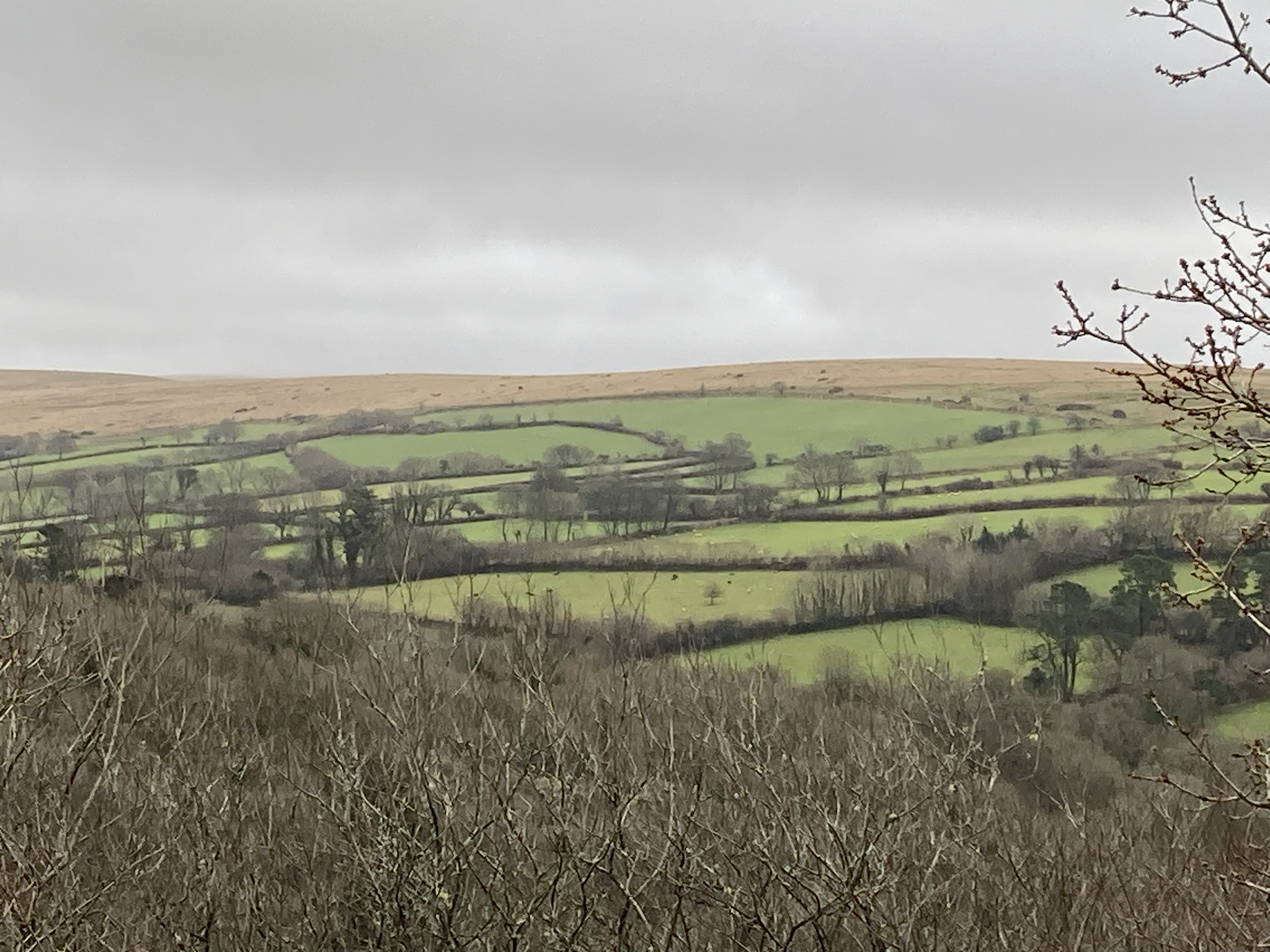
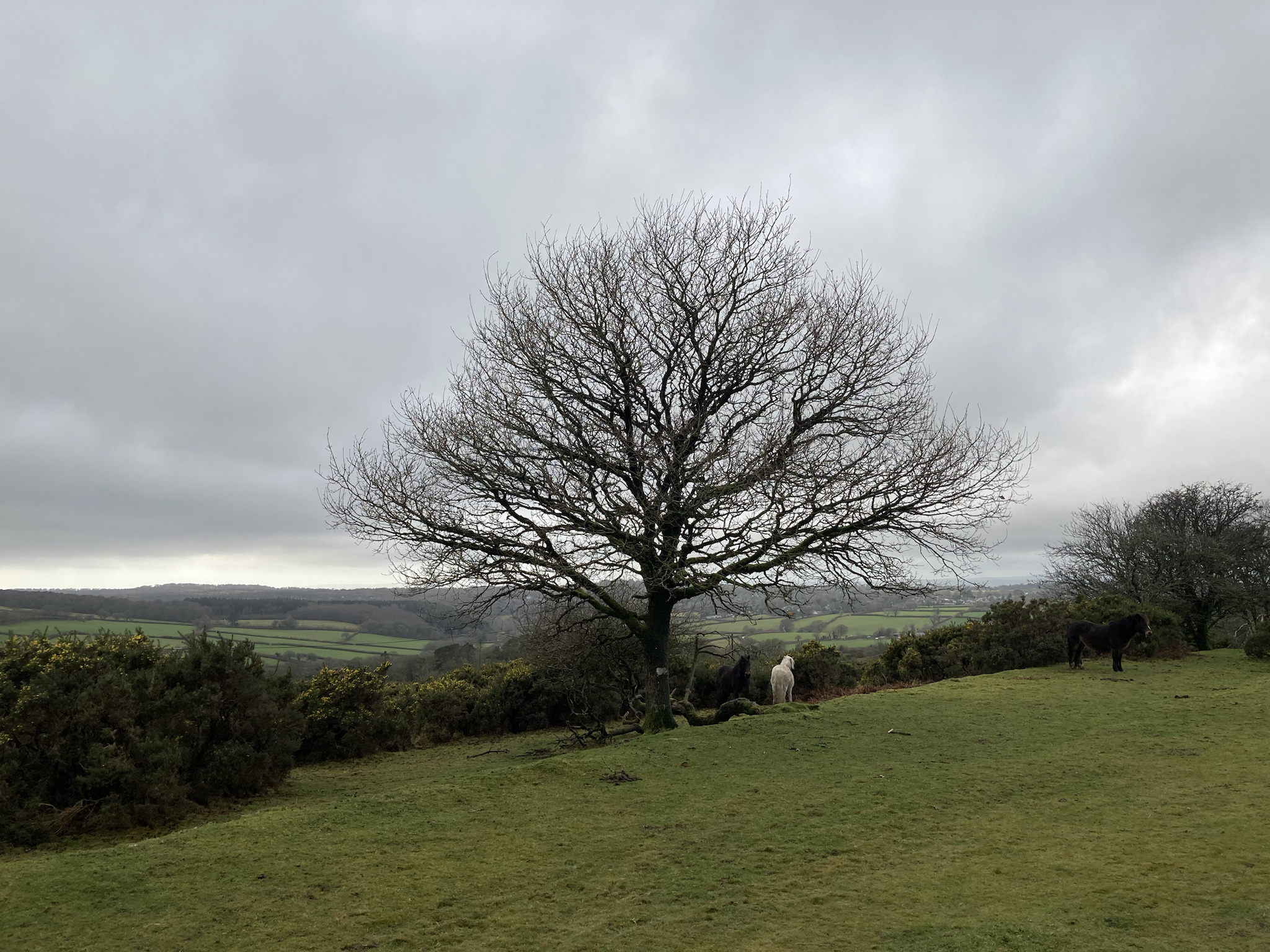
I always like views that have a mix of farmland and wilder moorland. Towards the end of the walk I also got to see another favourite sight, a fairly symmetrically-shaped tree, or what I now refer to as a symmetree!

Although the weather was not great, with cloudy and grey skies, there was no rain and it was just so good to get out and about, to be breathing fresh air, to be unconstrained by walls and to be immersed in nature again.

One day on, I am pleased to report that although my leg does feel somewhat sore, it does not feel any worse than on any other day and so hopefully it will now be possible to start to introduce a bit more proper walking back into life.

Life and Death


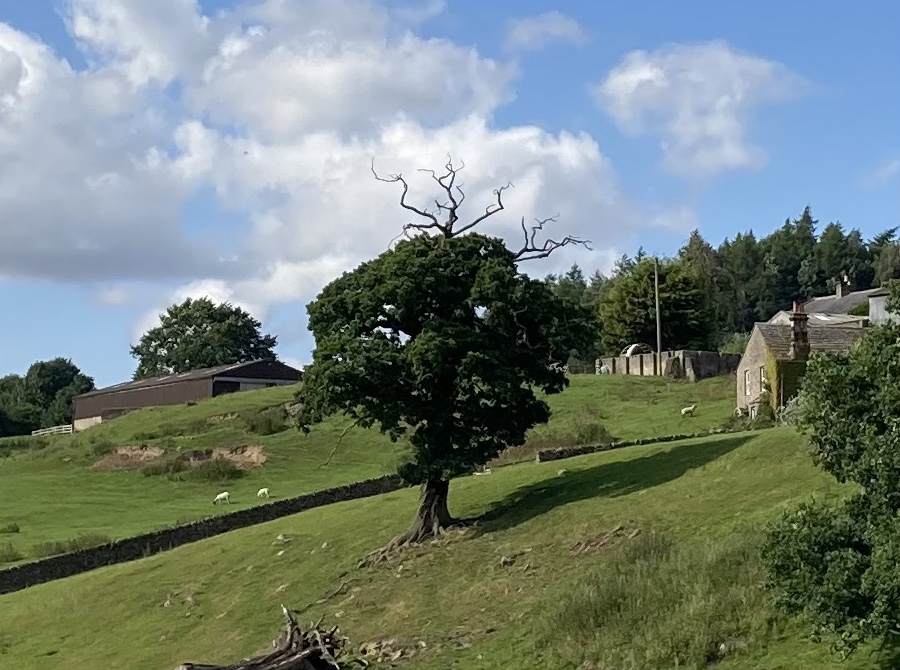
I think it is hard to beat an interesting tree – sometimes it is the shape that speaks to me, sometimes the colours and sometimes it’s the the signs of a hard life lived. So, you can perhaps imagine my excitement when I spotted this particular tree with its strong, thick trunk and its beautifully rounded and perfectly balanced shape all thickly enveloped by deep green leaves, so full of life… and yet, running upwards through its core, emerging to thrust like inverted lightning flashes from its top (and less visible in the photograph, a withered tendril reaching downwards on the left side), the sharp, angular, stripped-bare branches, absolutely dead to the world. This is a tree that is both dead at the core and alive at heart and I have never seen its like before.

Symmetree

I love trees. I love the way that they seem to produce all of their substance out of nothing; the way that they can hang around for ages while the world changes around them; they way that they are all so different whilst still obviously being trees; the way that they change on all kinds of timescales.

I like taking photographs of trees, particularly ones with a high degree of symmetry where the shape of one side of the tree is the same as the shape of the other side and where the trunk is nice a straight and down the middle. I don’t only like symmetrical trees but I do think I like those ones the best.

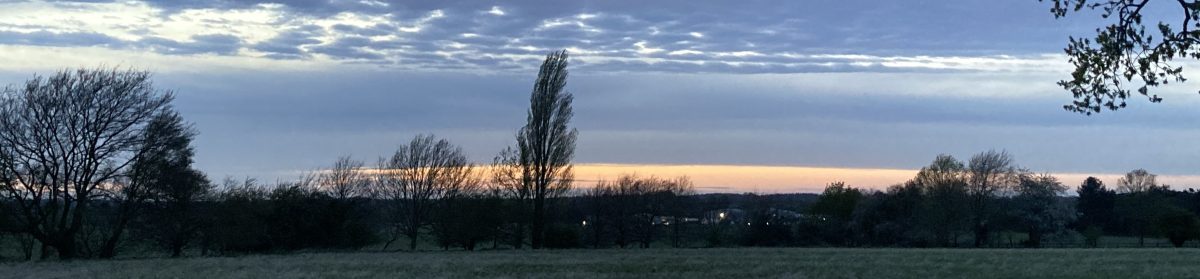
A couple of days ago I was up on Roborough Common (on the south-western edge of Dartmoor). It was my first time properly outside of Plymouth for at least 8 weeks. It was a beautiful sunny and still evening – aren’t they all at the moment? We parked up the car, set out for a stroll and there it was, was one of my favourite symmetrical trees; one that is always hard to walk past without taking a photograph. And so, of course, I did, resulting in a picture that I am particularly proud of.

This isn’t just a symmetrical tree; it’s a Symmetree…