The Mountain Is You – Brianna Wiest #reading

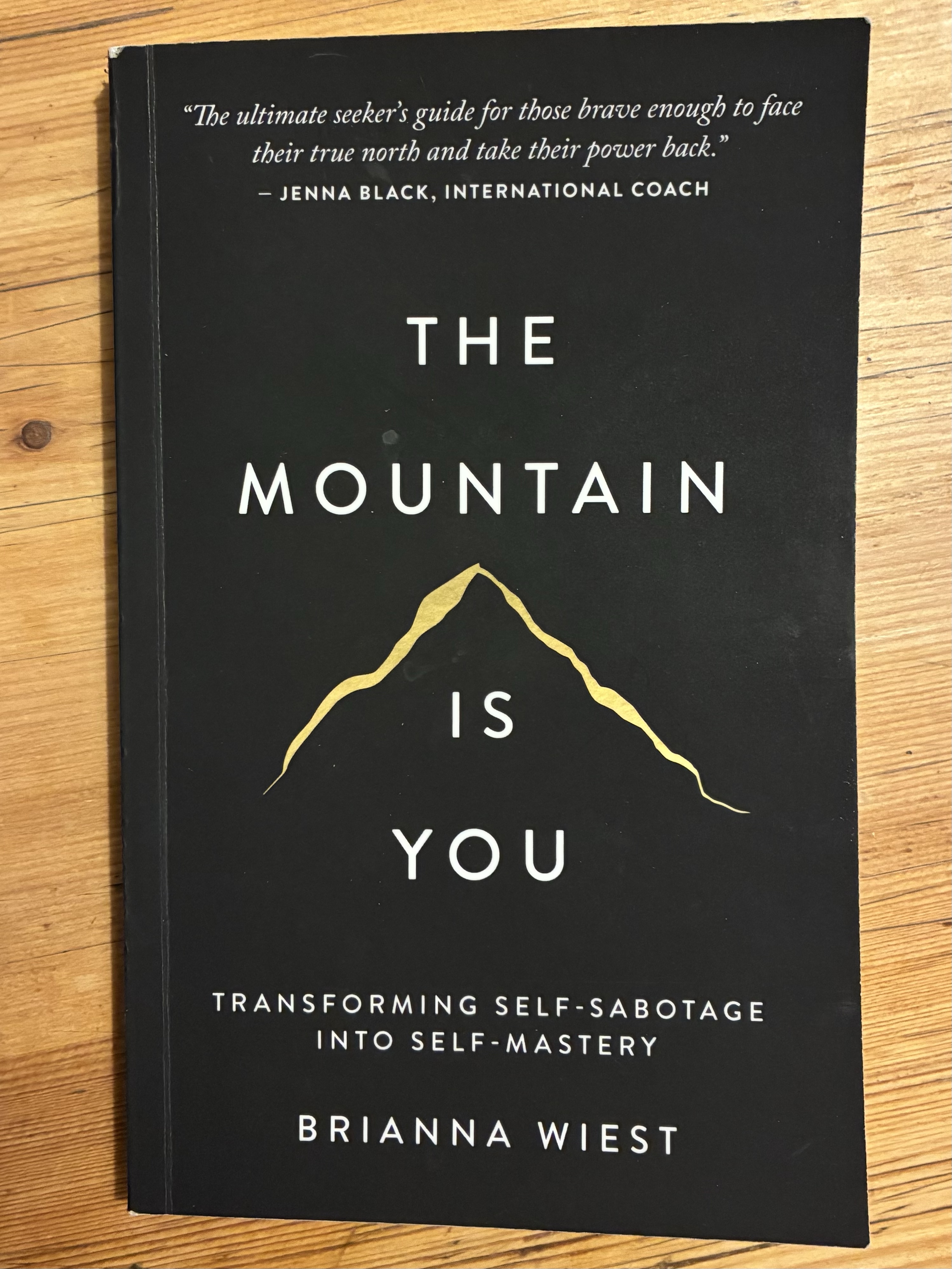
The Mountain Is You: Transforming Self-Sabotage Into Self-Mastery by Brianna West is probably not a book that I would have picked up to read of my own accord, despite that fact that I am pretty much certain that a lot of the struggles I have in pushing myself into action and gaining the sense of achievement and fulfillment that I crave are driven at a fundamental level by self-sabotage in one form or another. There is just something about the whole mountain metaphor, along with the kinds of words used in the book blurb that I read online (‘deep internal work of excavating trauma’, ‘building resilience’, and ‘adjusting how we show up for the climb’) that instinctively put me off. Why then did I work my way through this book for a few weeks in April and May this year? Because it was voted as the reading matter for the May meeting of The Timecrafting Trust Book Club that I participate in, and so, dutifully, I ordered myself a copy and set to work.

Almost from the start, I realized that there might well be a bit more value for me from The Mountain Is You than I had envisaged. I was immediately stuck with some obvious similarity between some of the content being covered and the ideas of psychotherapist Carl Jung that I found enthralling and thoroughly convincing when I read James Hollis’s excellent The Middle Passage a year or so ago.

Wiest begins her book by describing the various forms that self-sabotage can take along with the underlying reasons why each type of self-sabotaging behaviour occurs. There were quite a few lines in this section of the book that resonated with me…

  • sometimes, we sabotage our professional success because what we really want it to create art
  • sometimes, our most sabotaging behaviours are really the result of long-held and unexamined fears we have about the world and ourselves
  • human beings experience a natural resistance to the unknown, because it is essentially the ultimate loss of control

… because yes, I do increasingly seem to be seeing myself as an artist, yes, I definitely have a lot of fears squashed down into my head that hold me back, and yes, I do tend to get overwhelmed and feel very uncomfortable when I perceive that things are spinning out of my control. But why then, knowing all of this, does nothing much really seem to change? Wiest delivers the killer answer:

most people do not actually change their lives until not changing becomes the less comfortable option

Wiest goes on to argue that, in fact, we might be better off re-framing self-sabotage because, ultimately, the habits and behaviours associated with it are actually a result of your very clever subconcious ensuring that some unfilled need, displaced emotion or neglected desire is being met – that those actions are, in fact, deliberately designed to provide a positive outcome that some hidden part of your subconscious seeks.

Aand funnily enough, just this morning, quite coincidentally, I wrote in my journal that perhaps I allowed myself to procrastinate and hold myself back from taking certain actions even though I know this will result in an intense wave of frustration and anger with myself, because at least those negative feelings and emotions are something that I am familiar with and are, in some weird and twisted way, somewhat comforting.

The next section of The Mountain Is You describes a long list of different manifestations of self-sabotage, and whilst many of these did not feel relevant to me, some of them certainly did – hello Perfectionism, Worrying About Least Likely Circumstances, Being Busy, Fear Of Failure, to name a few.

The start of the process of overcoming self-sabotage begins, Wiest suggests, with tuning into, and listening to, the negative emotions associated with it – things like anger, jealousy, regret, chronic fear. She highlights a basic need to be able to ‘allow yourself to feel what you feel without judgement or suppression and notes that understanding your needs, meeting the ones you are responsible for, and then allowing yourself to show up so others can meet the ones you can’t do on your own will help you break the self-sabotage cycle’. For example, feel angry, notice that you are angry, understand why you are angry, remember that it is okay to feel angry… and then get on with life.

There are then a couple of chapters with fairly standard fare on building emotional intelligence and on letting go of baggage from the past, but as these progressed I could feel the book moving steadily into the kind of territory that my initial instincts had led me to expect. Then, aargh, I hit a section titled ‘Releasing your past into the Quantum Field‘ and my brain was instantly screaming at me that I was now thoroughly into pseudo-scientific mumbo-jumbo land… the kind of land where, apparently, ‘You store … emotions, energies and patterns at a cellular level‘. Now, I guess that in some sense everything associated with an individual human is stored at a cellular level, but I am pretty sure that Wiest is suggesting there’s something rather more mysterious and perhaps spiritual going on. I’d be inclined to simply say that statements of that kind are just nonsense!

I guess that from that point onwards, my brain was in a state of high alert, warning me, perhaps unfairly, that much of what I was reading had no real, solid basis. There were lots of nice, almost mantra-like phrases: ‘be willing to be disliked‘, ‘do your inner work‘ and a series of suggestions to ‘create aligned goals, ‘find you inner peace’, ‘detach from worry’, ‘take triggers as signals’, ‘honour your discomfort’, ‘stop trying to be happy’, ‘arrive into the present’ etc., but in the end it was all a bit too much – too many suggestions, too many affirmations, too many challenges to think about overcoming, with the result that I came away confused and somewhat disappointed. After a promising, really very readable first half, everything seemed to have unraveled as the book reached its conclusion. There was just nothing much that was concrete or tangible for me to cling onto.

Late on in the book there was one phrase that I rather liked in a section titled ‘Be aware of what you give your energy’, namely that ‘the wolf that wins is the one that you feed‘ and strangely, on the day that I read those lines some spoke almost the exact same words to me (perhaps that pesky quantum field was doing its thing…). In fact, the whole book is stuffed full of short phrases and sentences that you could lift off the page and incorporate into an inspirational poster or social media post if that is your thing. I may not have warmed to Wiest’s mountain metaphor or felt that the argument in The Mountain Is You hung together in a fully coherent and convincing manner, but she certainly knows how to write what might be called ‘soundbite sentences’. Forget all the gumph about releasing you past into the quantum field and storing emotions at a cellular level, and take this phrase, right at the end of the book… …

One day, the mountain that was in front of you will be so far behind you, it will barely be visible in the distance. But who you become in learning to climb it? That will stay with you forever.

BOOM!

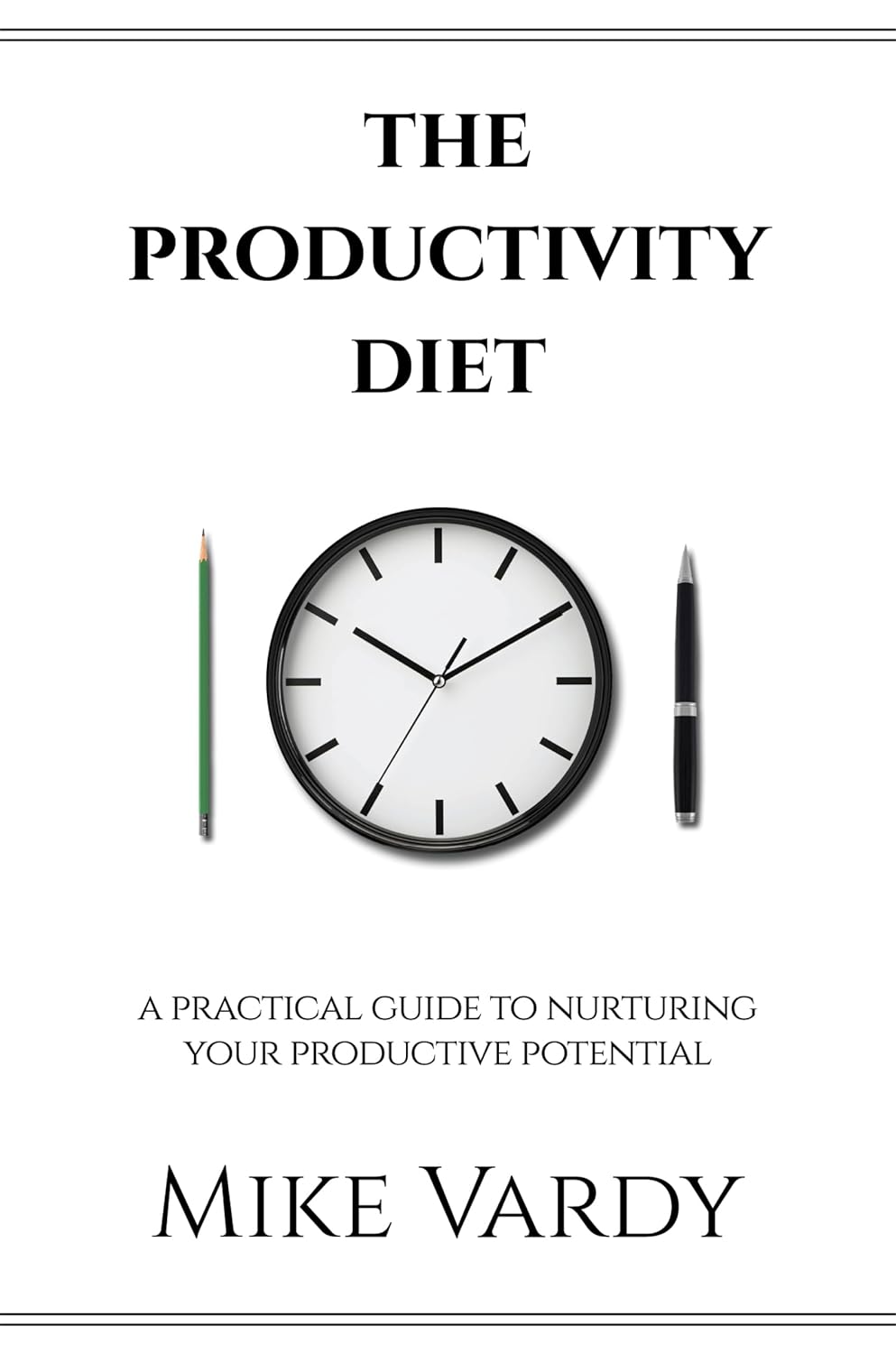
The Productivity Diet – Mike Vardy #reading

The Productivity Diet is the latest book written by Mike Vardy. Mike, who is based in Victoria, British Columbia, on the western side of Canada, describes himself as a ‘seasoned productivity expert, writer, coach and podcaster’ (quoting from his own website biography), and it was through the latter, his podcast A Productive Conversation, that I first became aware of his work. I don’t know how I initially stumbled on this podcast but for some years I have been a sucker for consuming content related to productivity (or ‘how we operate’ as I prefer to think of it). At some point, listening to episodes of the podcast led me to signing up for Mike’s email newsletter and then, after he sent out a request for people who felt they had a tendency to get started later in the day to contact him, I ended up chatting with him via Zoom about the productivity challenges that I faced and the approaches to overcoming those challenges that I used. At the end of the call, I politely declined the opportunity to join a coaching course with him (£££!!!) but did sign up as a member of his online community The TimeCrafting Trust. That was in March 2024, and over the last 15 months I have got to know quite a few other members of the community, most of whom are based in North America, and participated in a wide range of online events including monthly Book Club meetings, podcast livestreams, workshops and seasonal planning sessions. I think it’s fair to say that whilst Mike and I have never met in person, I could properly describe him as a friend, albeit of the online variety.

But what of The Productivity Diet itself? Mike’s basic view is that we cannot ‘manage time’ and so, instead, we should focus on managing our attention, in particular taking into account how much energy we have at any moment. To paraphrase the book: Productivity isn’t about managing time. It’s about how we use it, how we relate to it, and how we move within it. Mike argues that we should eschew rigid productivity systems in favour of thinking about productivity as a continuous interaction between Intention, Attention, Reflection and Action. Mike’s approach, which he calls TimeCrafting, involves laying out some broad intentions for our areas of focus, but then navigating the reality of our daily experience with a sense of gentleness and responsiveness to our evolving needs.

The Productivity Diet was the subject of a Kickstarter Campaign that Mike started before I got to know him. I think there were a few hiccups along the way, but the book was launched successfully earlier this year. The launch included Mike making appearances on a number of other productivity-related podcasts, and when he announced that he was going to focus an episode of his own podcast on the book I thought it would be fun to offer my services as a stand-in ‘host’ so that rather than it being Mike Vardy having a productive conversation with himself, the episode had a more normal host-author format. A little to my surprise, and despite the fact that I have pretty much no experience of working in broadcast communications, Mike thought this was a good idea and we went ahead and had a lot of fun recording the episode. You can pick it up here if you’re at all interested: A Productive Conversation Episode 603.

There are three major pillars to TimeCrafting as set out in The Productivity Diet: Time Theming, Attention Paths and Reflection.

Mike is big on the first of these pillars, Time Theming, suggesting that it can be beneficial to designate different kinds of themes to act as guide-rails as you decide, in the moment, exactly what to do next. These themes are time-based, for example, daily, weekly, monthly, seasonal or what are termed ‘horizontal’ themes where you select to focus your attention on a particular type of activity at the same time each day. At an even longer timescale, it is suggested that you adopt an ‘Annual Axiom’ – essentially a very short (e.g. three word) description to guide your overall approach to the year ahead. In the world of TimeCrafting, one might decide to group administrative tasks together to tackle on, say, Thursday, or to designate Friday as a day to consider finance-based activities, Tuesday for ‘creating’ etc. One might decide that the focus for the week ahead is, say, ‘rejuvenation’ or ‘correspondence’, or that the next month is for ‘growing contacts’ etc. A key aspect of Time Theming is that the themes are not meant to be a way to rigidly enforce a particular regime of action, but serve more as beacons to guide you back to an intended path if you move away from it. In addition, it is perfectly fine to do tasks and activities that do not match the current intended theme if there is time and space to do so.

The term ‘Attention Path‘ relates to a factor that will influence what you choose to, or can, focus your attention on at any given moment. The Productivity Diet introduces the acronym TREAT as a way to separate out five different types of attention path. TREAT stands for Time-based, Resource-based, Energy-based, Activity-based and Theme-based. The idea is that when selecting tasks to work on next, one considers the options in relation to each of these attention path types, asking questions like: Can this task be accomplished in the time I now have available? Do I have the resources I need to hand? Do I have the energy for this? Does it make sense to do this alongside some other similar task? Does this fit within my intended theme? I know from my interactions with him, that Mike is a firm believer in designating tasks as being low, medium or high energy so that, for example, when you hit a point in a day where you feel fatigued and might otherwise grind to a complete halt (as we all do…) you can glance at your list of possible tasks and pick one or two low energy tasks to accomplish. In this way, time which might otherwise be lost to the void of the internet (for example) can still result in some useful outcome.

The third pillar of TimeCrafting is Reflection. This is the key to continuous evolution and improvement. By reflecting on your actions, for example by writing in a journal, you can identify adjustments that can be made, obstacles to overcome, approaches that can be reinforced or extended. Without meaningful reflection there is no evidence base to use to help inform the decisions you make about what to do when and how etc., and so everything just unfolds somehow in a rather haphazard manner.

I will admit that in my own day-to-day operations, I have not had a great deal of success in using daily, weekly or monthly themes. I think my work days are too variable and I do not have sufficient control over exactly what needs to be done when, for them to work in a very consistent manner. But I think that having the general approach in mind is still helpful, especially at the longer timescales (‘this week/month I will focus on finishing X’). I have had more success with horizontal theming, but the variability of my days (sometimes I have classes to teach, other days I have a meeting etc) means that my attempts to impose order on my day through horizontal themes is generally most successful during the earlier and later (non-work hours) parts of each day. Similarly, I do consider attention paths to some extent, but I find that once my day is underway I tend to forget my plans and just go with the flow. It doesn’t help that I am not very good at checking in with myself to consider whether I would benefit from re-directing my attention (even setting reminders to do this doesn’t work very well – I just ignore them much of the time!). It’s not that I think the ideas underlying TimeCrafting are not valid, quite the reverse really, but I just seem to revolt against any attempt to constrain or direct my attention even though I would very much like to be able to do so!

I like the general approach of TimeCrafting that is set out in The Productivity Diet. I’ve tried to implement what might be called ‘heavier’ systems – things like time-blocking/time-boxing – and whilst they seem to offer an attractive level of control, I always (and quickly) end up revolting against them as my feelings in the moment take over. TimeCrafting offers a more gentle, sensitive, approach to keeping yourself on track, or at least somewhere close to being on track. To use a travel analogy, TimeCrafting is like having a traditional map, understanding what all of the symbols mean and knowing generally where you want to end up, but allowing yourself flexibility to move around the terrain, informed by the map, in the way that feels most appropriate at the time. This seems to me to be a much better way to travel than to switch on the SatNav and following it blindly to the selected destination, even when the road you have just been instructed to turn down is clearly little more than a rough and ever-narrowing track heading to an almost inevitable dead end and a ton of frustration as you try to turn around or back-up, surrounded by a herd of angry cows. Give me the map and my intuition any day!