
Wild Courage – Jenny Wood #reading

In the early months of this year I read and heard several references to a soon-to-be published book: Wild Courage by Jenny Wood. My interest was piqued further after I viewed a Livestream of an episode of the podcast ‘A Productive Conversation‘, in which the host, Mike Vardy, chatted with the author about her book (A Productive Conversation: Episode 611 – Jenny Wood talks about wild courage and fearless self-advocacy). I duly ordered the book and began reading it soon after it arrived on my doorstep, optimistic that it was going to be an interesting and enjoyable read.

Wood’s basic idea is that in order to progress we need to have courage – to push through fear of the unknown, fear of discontent, fear of failure and fear of judgement by others. She argues that successful people feel, but put aside, all of this fear, becoming their own strongest advocate, and having the courage to take whatever steps are necessary to advance towards their goal(s).

The distinctive feature, or twist, in Woods espousal of this feel the fear and do it anyway approach to life is that she identifies nine traits that generally hold negative connotations, and then recasts each of them as a type of courage that the reader is encouraged to develop and deploy. The nine traits, and their associate courage, are as follows:

  • WEIRD – the courage to stand out
  • SELFISH – the courage to stand up for what you want
  • SHAMELESS – the courage to stand being your efforts and abilities
  • OBSESSED – the courage to set your own standard
  • NOSY – the courage to dig deeper
  • MANIPULATIVE – the courage to influence others
  • BRUTAL – the courage to protect your time and energy
  • RECKLESS – the courage to take calculated risks
  • BOSSY – the courage to listen and lead

I don’t think there’s anything wrong with this approach, in fact I think it provides an interesting route into thinking about this territory…

(can you tell that there’s a but coming?)

…but what I wasn’t expecting from the book, and what disappointed and annoyed me as I read it, was the way that at every turn Wood focused on deploying all of this courage in one area only – career advancement and promotion – so much so that I was left feeling rather battered by the notion that this is the only thing that really matters in life.

At various points in the book I found my anger rising as Wood gave precisely the kind of advice that I detest. For example, in Brutal she instructs readers to ‘let the tree fall‘, i.e. to skip ‘unimportant’ tasks quietly. She suggests that ‘if they’re actually necessary, they’ll come around again, and you’ll have been busy doing unambiguously important work in the meantime.‘. To this I say ‘no, no, no‘. There is nothing more annoying than colleagues who fail to respond to simple requests for information citing the ‘if it’s important I’ll be asked again’ line of reasoning… It’s selfish, inefficient, and plain and simply rude; it says to the person who has sent the request that their time is not important and that it is yours to waste. No, just respond to the request promptly and don’t force people to keep track of your lack of response and to ask twice, or however many more times it takes to rouse you out of your own little world… [rant over]

I also found Wild Courage to be guilty of over-using the ‘personal story’ approach to illustrating the points that were being made. Perhaps some readers like this kind of thing. The odd personal story is fine, I think, but please sprinkle in a few from different scenarios, different worlds, other people etc., so that not every example is drawn from the world of working for Google.

In the end, I found myself frustrated by my reading of Wild Courage. It’s not that the approach and the ideas contained in the book aren’t valid. In the end, the courage that might stem from embracing each of the ‘negative’ traits can be expressed in a nice, succinct and positive manner that has much wider application that career advancement simply by putting the word courage to one side in each phrase. Then, the lessons that flow from those nine traits become a simple set of instructions:

  • stand out
  • stand up for what you want
  • stand behind you efforts and abilities
  • set your own standard
  • dig deeper
  • influence others
  • protect your time and energy
  • take calculated risks
  • listen and lead

which to my mind is a whole lot easier to absorb and a lot more useful than getting caught up having to justify the adoption of those negatively associated words, spinning the idea of courage out of them and suggesting that there is something a little wild about doing so. And what’s more, it’s a set of instructions that is clearly applicable to almost every aspect of life and not just the narrow, corporate-career-focus that Wood chooses to target.
It Is Time #poem

It is time to banish thoughts of giving up,
to be replaced by the comfort of giving in –
acceptance rather than flight,
to fold back the shutters,
emerging from the dark of night –
allowing in some light.

It is time to cease the role of the bully,
forcing the fearful child within
to be the man he thought he should.
Instead, enfolding in a loving hug
to draw out all he could have been.
If only he had understood.

It is time to give the boy a chance,
to give him space to play his part,
to let him fall and graze his elbow – blood and gravel –
even though tears may flow.
He may be strong enough.
How else will we know?

It is time to take those steps
that cross the threshold of the door,
to find that it was open all along –
never locked – and behind it?
The voice of the song oft heard,
though always sounding slightly wrong.

It is time to push on through the fog,
that cloak of damp that so confuses senses,
seeking clearer skies,
different colours, other forms
to try on for size.
Who knows how those choices may surprise?

It is time to give in,
not to temptation, hopelessness or terror,
but to follow the path
to those imagined lands,
shaping their form with my own hands.
Finally, he understands.

(c) Tim O’Hare, August 2023


IT IS TIME: This poem came completely out of the blue, coalescing onto the page in less than an hour. It reflects a big decision made on the previous day – to signal that I must let go of a big role at work, to stop fighting with the thought that to do so was some kind of failure, and to just accept that I no longer have it within me to push and cajole or fight with myself anymore.

The Productivity Diet – Mike Vardy #reading

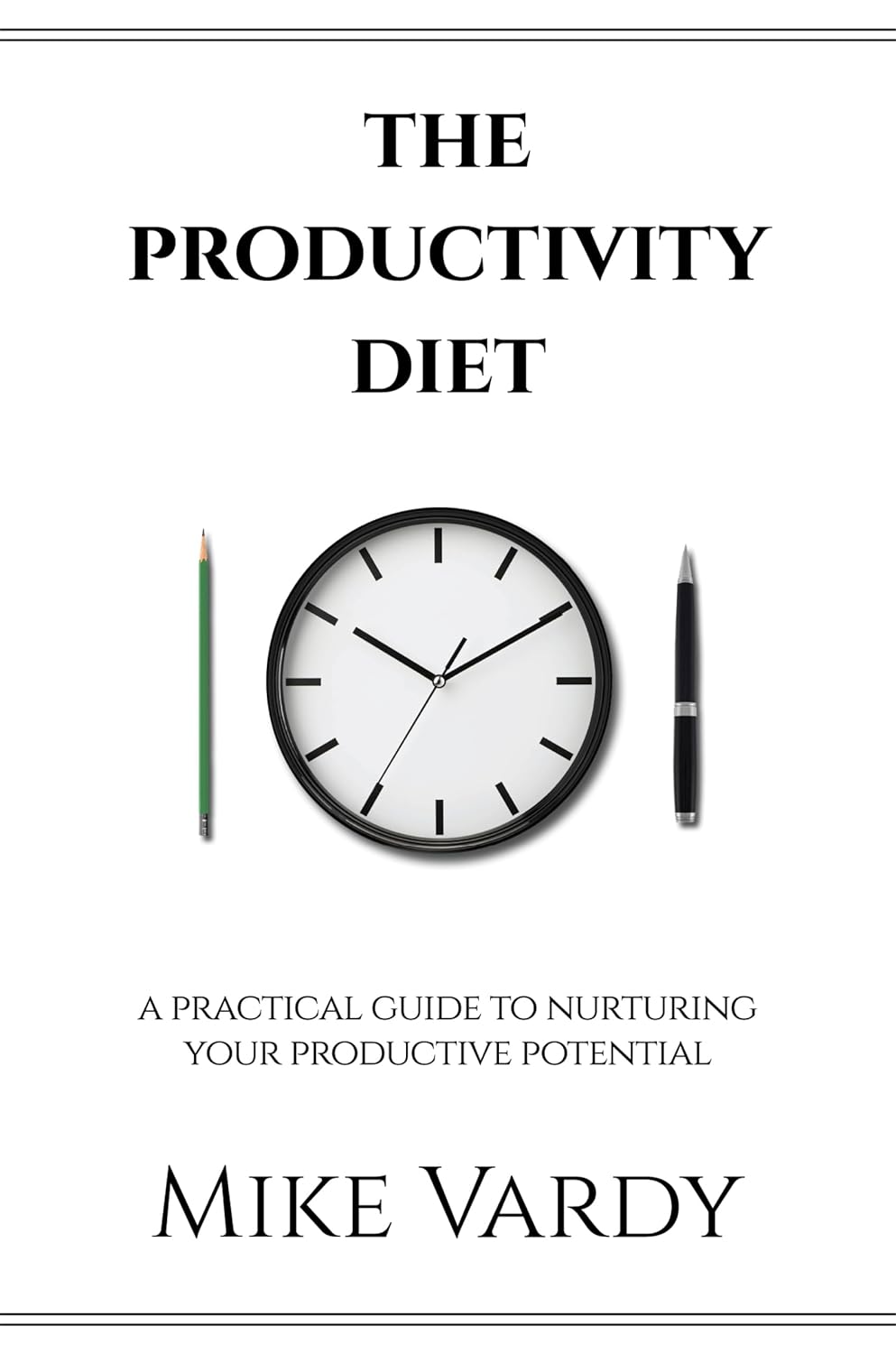
The Productivity Diet is the latest book written by Mike Vardy. Mike, who is based in Victoria, British Columbia, on the western side of Canada, describes himself as a ‘seasoned productivity expert, writer, coach and podcaster’ (quoting from his own website biography), and it was through the latter, his podcast A Productive Conversation, that I first became aware of his work. I don’t know how I initially stumbled on this podcast but for some years I have been a sucker for consuming content related to productivity (or ‘how we operate’ as I prefer to think of it). At some point, listening to episodes of the podcast led me to signing up for Mike’s email newsletter and then, after he sent out a request for people who felt they had a tendency to get started later in the day to contact him, I ended up chatting with him via Zoom about the productivity challenges that I faced and the approaches to overcoming those challenges that I used. At the end of the call, I politely declined the opportunity to join a coaching course with him (£££!!!) but did sign up as a member of his online community The TimeCrafting Trust. That was in March 2024, and over the last 15 months I have got to know quite a few other members of the community, most of whom are based in North America, and participated in a wide range of online events including monthly Book Club meetings, podcast livestreams, workshops and seasonal planning sessions. I think it’s fair to say that whilst Mike and I have never met in person, I could properly describe him as a friend, albeit of the online variety.

But what of The Productivity Diet itself? Mike’s basic view is that we cannot ‘manage time’ and so, instead, we should focus on managing our attention, in particular taking into account how much energy we have at any moment. To paraphrase the book: Productivity isn’t about managing time. It’s about how we use it, how we relate to it, and how we move within it. Mike argues that we should eschew rigid productivity systems in favour of thinking about productivity as a continuous interaction between Intention, Attention, Reflection and Action. Mike’s approach, which he calls TimeCrafting, involves laying out some broad intentions for our areas of focus, but then navigating the reality of our daily experience with a sense of gentleness and responsiveness to our evolving needs.

The Productivity Diet was the subject of a Kickstarter Campaign that Mike started before I got to know him. I think there were a few hiccups along the way, but the book was launched successfully earlier this year. The launch included Mike making appearances on a number of other productivity-related podcasts, and when he announced that he was going to focus an episode of his own podcast on the book I thought it would be fun to offer my services as a stand-in ‘host’ so that rather than it being Mike Vardy having a productive conversation with himself, the episode had a more normal host-author format. A little to my surprise, and despite the fact that I have pretty much no experience of working in broadcast communications, Mike thought this was a good idea and we went ahead and had a lot of fun recording the episode. You can pick it up here if you’re at all interested: A Productive Conversation Episode 603.

There are three major pillars to TimeCrafting as set out in The Productivity Diet: Time Theming, Attention Paths and Reflection.

Mike is big on the first of these pillars, Time Theming, suggesting that it can be beneficial to designate different kinds of themes to act as guide-rails as you decide, in the moment, exactly what to do next. These themes are time-based, for example, daily, weekly, monthly, seasonal or what are termed ‘horizontal’ themes where you select to focus your attention on a particular type of activity at the same time each day. At an even longer timescale, it is suggested that you adopt an ‘Annual Axiom’ – essentially a very short (e.g. three word) description to guide your overall approach to the year ahead. In the world of TimeCrafting, one might decide to group administrative tasks together to tackle on, say, Thursday, or to designate Friday as a day to consider finance-based activities, Tuesday for ‘creating’ etc. One might decide that the focus for the week ahead is, say, ‘rejuvenation’ or ‘correspondence’, or that the next month is for ‘growing contacts’ etc. A key aspect of Time Theming is that the themes are not meant to be a way to rigidly enforce a particular regime of action, but serve more as beacons to guide you back to an intended path if you move away from it. In addition, it is perfectly fine to do tasks and activities that do not match the current intended theme if there is time and space to do so.

The term ‘Attention Path‘ relates to a factor that will influence what you choose to, or can, focus your attention on at any given moment. The Productivity Diet introduces the acronym TREAT as a way to separate out five different types of attention path. TREAT stands for Time-based, Resource-based, Energy-based, Activity-based and Theme-based. The idea is that when selecting tasks to work on next, one considers the options in relation to each of these attention path types, asking questions like: Can this task be accomplished in the time I now have available? Do I have the resources I need to hand? Do I have the energy for this? Does it make sense to do this alongside some other similar task? Does this fit within my intended theme? I know from my interactions with him, that Mike is a firm believer in designating tasks as being low, medium or high energy so that, for example, when you hit a point in a day where you feel fatigued and might otherwise grind to a complete halt (as we all do…) you can glance at your list of possible tasks and pick one or two low energy tasks to accomplish. In this way, time which might otherwise be lost to the void of the internet (for example) can still result in some useful outcome.

The third pillar of TimeCrafting is Reflection. This is the key to continuous evolution and improvement. By reflecting on your actions, for example by writing in a journal, you can identify adjustments that can be made, obstacles to overcome, approaches that can be reinforced or extended. Without meaningful reflection there is no evidence base to use to help inform the decisions you make about what to do when and how etc., and so everything just unfolds somehow in a rather haphazard manner.

I will admit that in my own day-to-day operations, I have not had a great deal of success in using daily, weekly or monthly themes. I think my work days are too variable and I do not have sufficient control over exactly what needs to be done when, for them to work in a very consistent manner. But I think that having the general approach in mind is still helpful, especially at the longer timescales (‘this week/month I will focus on finishing X’). I have had more success with horizontal theming, but the variability of my days (sometimes I have classes to teach, other days I have a meeting etc) means that my attempts to impose order on my day through horizontal themes is generally most successful during the earlier and later (non-work hours) parts of each day. Similarly, I do consider attention paths to some extent, but I find that once my day is underway I tend to forget my plans and just go with the flow. It doesn’t help that I am not very good at checking in with myself to consider whether I would benefit from re-directing my attention (even setting reminders to do this doesn’t work very well – I just ignore them much of the time!). It’s not that I think the ideas underlying TimeCrafting are not valid, quite the reverse really, but I just seem to revolt against any attempt to constrain or direct my attention even though I would very much like to be able to do so!

I like the general approach of TimeCrafting that is set out in The Productivity Diet. I’ve tried to implement what might be called ‘heavier’ systems – things like time-blocking/time-boxing – and whilst they seem to offer an attractive level of control, I always (and quickly) end up revolting against them as my feelings in the moment take over. TimeCrafting offers a more gentle, sensitive, approach to keeping yourself on track, or at least somewhere close to being on track. To use a travel analogy, TimeCrafting is like having a traditional map, understanding what all of the symbols mean and knowing generally where you want to end up, but allowing yourself flexibility to move around the terrain, informed by the map, in the way that feels most appropriate at the time. This seems to me to be a much better way to travel than to switch on the SatNav and following it blindly to the selected destination, even when the road you have just been instructed to turn down is clearly little more than a rough and ever-narrowing track heading to an almost inevitable dead end and a ton of frustration as you try to turn around or back-up, surrounded by a herd of angry cows. Give me the map and my intuition any day!

Tiny Experiments – Anne-Laure Le Cunff #reading

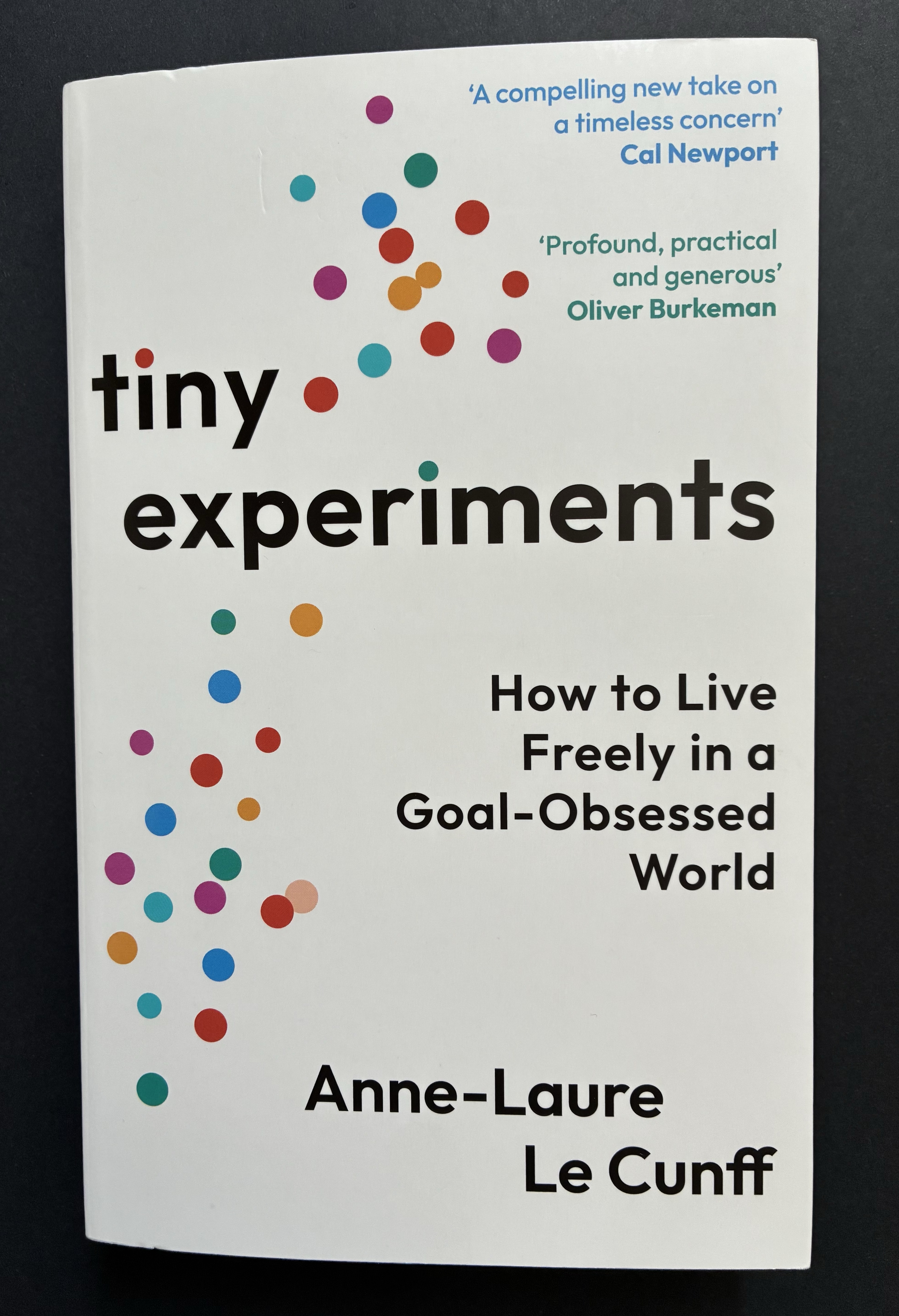
I read Anne-Laure Le Cunff’s debut book, Tiny Experiments, just a month after it was released in March 2025. However, this was not my first sight of the key ideas that the book contains, because I was lucky enough to be chosen as one of 300 people participating in a series of four, weekly online workshops, led by Le Cunff, that took place in February, in the lead up to the book’s publication. These workshops and the online community that accompanied them was called The Curiosity Collective, the name giving prominence to what is perhaps the key theme running Le Cunff’s work – the exhortation to live life in ‘curious mode‘, always willing to explore and experiment with your approach to life, and how you operate in the world. My experience attending those online workshops, showed me that Le Cunff is a highly skilled communicator and excellent teacher, and so I approached reading Tiny Experiments with high expectations. As an added bonus, the book had been chosen as the April pick for The TimeCrafting Trust Book Club.

As noted above, curiosity lies at the heart of Le Cunff’s ideas, and this is most obviously seen in her simple, four-part model for exploring and implementing change in your life. This model is rather neatly captured by the word sequence: PACT > ACT > REACT > IMPACT. At the start of the book, Le Cunff encourages the reader to adopt the mindset of a ‘self-anthropologist’, observing how they act in the world and the outcomes of these results, and then asking questions in relation to these observations. Le Cunff then structures the bulk of the text around her four-step model, stressing the importance of moving away from a Linear Mindset (X leads to Y leads to Z – end of story) towards the adoption of an Experimental Mindset based on the implementation of continuous experimental loops. My own feeling is that the key message here is not really about the distinction between linear v looping but, rather, one of ongoing adaptation and experimentation. The experiments one conducts don’t need to be thought of as loops (in fact they probably won’t bring you back to near your starting point) but they should take you somewhere, and in the process provide valuable evidence to help you work out what you might experiment with and where you might go next.

In the PACT phase of her model, Le Cunff presents a really neat (because it is simple) template for setting up what she refers to as a Tiny Experiment (an exploration of what happens when you make some small, realistic and manageable shift in the way that you operate). This template – a PACT – takes the following form:

“I will [action] for [duration]”

The key here is make sure that the action is purposeful, actionable (something that you can reliably perform), continuous (i.e. repeatable and not changing from day-to-day) and trackable. It is also important to be specific about the duration of the experiment (or else the number of repetitions). This ensures that the experiment is set up so that it provides a large enough dataset for meaningful conclusions to be drawn, but does not continue for so long that the action becomes tedious, or redundant or of little continued value. Essentially, the whole point of the PACT is to provide information that can then be used to adapt future behaviour and experiments, and not as a means to try to establish new habits.

In the ACT phase, you set about completing the activity specified in the PACT. This section of the book has some interesting material exploring the powerful forces of procrastination and, associated with this, perfectionism, that can so easily derail progress towards a goal.

The third phase of the model, REACT, occurs once the action described in the PACT has been completed for the specified duration. At this point, the goal is to look for, and then consider, evidence of the results of the action. Le Cunff highlights that it is important to look for evidence from within/internally (reflection) and externally (feedback from others, evaluation of results). Here, she presents what I suspect will become the most significant legacy of Tiny Experiments, namely her simple PLUS- MINUS-NEXT framework for reflection: what went well, felt good – what challenges or obstacles you faced, what was difficult, what negative feelings emerged – and then how the insights gained can shape future actions. [But whilst this framework is neat and seems to be catching on in the productivity community it might be noted that it is not so very different from the well-established ‘plus-minus-interesting’ framework.]

Because the whole point of Tiny Experiments is to encourage the adoption of an Experimental Mindset towards life, the REACT reflection should lead to a decision being made in relation to the area being investigated by the PACT. Le Cunff suggests that there are three possibilities: PERSIST – prolong the pact, or PAUSE – quit the pact or put it on hold, or PIVOT – modify the pact or shift the focus of a subsequent pact.

The final section of Le Cunff’s framework, IMPACT, focuses on the idea that it is helpful to be open/public about what you are setting out to achieve with your PACT and/or to work with others when pursuing it. This is largely a matter of gaining a useful chunk of external accountability, and also valuable feedback, but having seen many ‘public’ statements of Tiny Experiments PACTs in Le Cunff’s online community Ness Labs and on social media more generally, it is clear that it also serves as a powerful tool to market and promote Le Cunff’s ideas.

I enjoyed reading Tiny Experiments, and I feel pretty sure that it will be the kind of book that continues to have presence in the market for some time. It is well written and nicely structured, and the core ideas are simple (which is a good thing) and neatly presented, such that they have every chance of ‘sticking’. I think the phrase ‘Tiny Experiments‘ will likely become part of the productivity lexicon in similar fashion to James Clear’s ‘Atomic Habits‘. I also think that the “I will [action] for [duration]” statement for a PACT, the ‘PACT-ACT-REACT-IMPACT‘ model (or at least the ‘PACTACTREACT‘ part of it) and, in particular, the ‘PLUS-MINUS-NEXT‘ framework for reflection, will all end up having a healthy existence outside the printed pages of the Tiny Experiments book…

… but in the end, my enthusiasm for Tiny Experiments waned. I had several goes at defining pacts and conducting experiments, but I wasn’t able to make myself see any of them through to a satisfactory conclusion. Life got in the way, and I found myself ignoring my pacts and carrying on with my usual scattergun approach to trying things out. This, of course, probably says more about me than it does about the potential efficacy of Le Cunff’s ideas, but my experience was that despite the simplicity and neatness of the Tiny Experiments model, it did not possess enough power to persuade me to go all in with it. I have also felt that most of the Tiny Experiments that I have seen others setting out to pursue would really be much better described as ‘tiny habits’ (a phrase already coined by the author B.J. Fogg and, of course, rather similar to James Clear’s ‘atomic habits’), rather than tiny experiments, and to put it bluntly, many of them read like tiny morsels of misty-eyed, wishful thinking…

So, in the end I congratulate Anne-Laure Le Cunff for writing a really nice book that captures some neat ideas and makes some good general points, but despite the fact that I am still indulging in some daily ‘plus-minus-next’ reflection, I can’t say that it has turned me into a Tiny Experimentalist.

Poetry #poem

I do not know if my poems are any good,
but it seems they help my essence to be understood,
whether by others or simply by myself,
this last, of course, itself essential for my health.

I do not know if my poems are enjoyable to read,
but it seems that crafting them fulfils some vital need,
and that allowing thoughts and feelings to gush forth
provides a compass I can use to find my north.

It seems as if through searching for each rhyme
I’ve stumbled on a way to slow down time,
and that now, through sculpting syllable-istic rhythm,
I see the world in multitudinous ways –
split infinite like sunlight passing through a prism.

And so, once more, I drop into the mine,
to chip away and work the line,
to trace the seam right to its core,
and scrape out all the mineral ore.
I hammer hard to split a rock,
in hope it is a nugget-bearing block,
in hope it might just be the one to hold
a precious, piece of sparkling gold.

I do not know if my poems hit the mark,
but certainly they’ve lit a spark.
So now the flames inside me roar,
and I can ask for nothing more.

Here goes…
First, time slows,
an idea flows,
like water spurting from a hose.
The seedling grows.
The petals unfurl upon the rose.

I take my chance…
Falling deep into the trance,
where visions glance,
words prance,
and rhythms dance.
And then I emerge, life enhanced.

In those moments, my whole world collapses onto a single spot.
So much energy compressed into a tiny dot-
freezing cold yet furnace hot.
I do not know if my poems are any good.
I do not know if my poems are enjoyable to read.
I do not know if my poems hit the mark.
It matters not.

(c) Tim O’Hare, July 2023


POETRY: I had some nice feedback on the first few poems that I wrote, but as this all came from people that knew me well it was impossible not to feel that it must be biased, even if only subconsciously. I began to think about whether my poems really were any good. This is the kind of thinking that usually drains my motivation and stops me in my tracks. But I have changed a bit in recent months, and pondering this a little more, I was able to acknowledge that whether or not anyone else liked my poems, I enjoyed the process of creating them, and was learning about myself as I did so.

Build A Second Brain #poem

Build a Second Brain they said,
it will help you stay on top of your life.
It will help you manage your personal knowledge,
and keep you from informational overload strife.

Build a Second Brain they said,
it will definitely be something you’ll want to pass on.
It even comes with a fancy name.
It will be what they call a Zettelkasten.

Build a Second Brain they said,
it will be much more useful than note-taking.
It will help you organise all kinds of content,
while developing your skills in note-making.

Build a Second Brain they said,
it will help you make connections.
It will join up all of your different ideas,
rather than keeping them separate in sections.

Build a Second Brain they said,
it’ll stop your mind being like a sieve.
It’ll help you solve problems and find new solutions,
by helping you be more creative.

Build a Second Brain they said,
it will allow you to keep track of all your tasks.
It will help when you’re not quite sure what to do,
and not say ‘yes’ when ‘no’ is the best response if anyone asks.

Build a Second Brain they said,
it will lead to all kinds of digital high-jinks.
It will make you think about graphs and blocks,
and connect up your notes with links.

Build a Second Brain they said,
it does not matter which software you use.
It won’t eat up hours and hours of your time,
as you try out each one and can’t choose.

Build a Second Brain they said,
it really will be loads of fun.
It will give you so much more mental bandwidth,
than you have with just brain number one.

Build a Second Brain they said,
but I am really not sure.
I’ve enough problems working the brain that I’ve got,
that I doubt I could cope with one more!

(c) Tim O’Hare, July 2023


About the poem: I had been reading a lot about an area that is known as ‘Personal Knowledge Management’ (PKM) which is based on an older system of keeping discrete notes on index cards in slip boxes (in German this is called a ‘Zettelkasten’). One recent book on the topic (Building A Second Brain by Tiago Forte) has popularized the idea of a PKM-system as being like a ‘Second Brain’ and all kinds of claims are made by many authors about the usefulness of building a Second Brain for information storage and retrieval, creativity, task management etc. Me being me, I threw myself into building my own digital second brain and then (also me being me) I became a bit obsessed with making it perfect, consistent, all-encompassing etc. It rather took over my life for a bit.

Atomic Habits – James Clear #reading

The second book that I finished reading in 2025 was ‘Atomic Habits’ by James Clear. I had previously listened to the audiobook version almost immediately after it was released in 2018 but I picked it up again because it was selected as the January title for an online book club that I am a member of within The Timecrafting Trust (Mike Vardy). I will admit that, as much as anything, this time round my interest in Atomic Habits was focused on why it has occupied the bestseller lists for pretty much the entire period of its existence, selling an astonishing 15 million copies in the process (the irony of the fact that I have contributed two of those sales over the years was not lost on me!).

As the subtitle suggests, Atomic Habits positions itself as a guide to building good habits and breaking bad ones. It certainly does start off with a strong focus on (daily) habits, but as I worked my way through the text I soon found myself thinking that it wasn’t really about habits, rather it was simply about how to get things done.

Early in the book I found myself railing against Clear’s argument that habits are such powerful things because they act like compound interest – if you adopt a daily habit to become 1% better in some respect then the power of that habit compounds each day. Clear suggests that if you get 1 percent better each day for one year then you will end up 37 times better by the time you are done and implies that such improvements in personal performance or skill can be achieved by repeatedly performing a 1% better habit each day (note: 37 times better, not 37% better – I checked the maths!). But this is surely not true. A habit that makes you 1% better on the first day continues to make you 1% better than you originally were on the second and subsequent days, but to get better and better (i.e. to grow or compound the percentage improvement) I think you would have to change your activity on each successive day. I accept that there might well be some additional gain to be had by repeating the same habit each day, but not to the extent suggested by the comparison with compound interest. For example, if you adopt a habit of running a mile each day then you will certainly get fitter over an extended period of time than if you just go for the run once, but after a while you will find that your fitness has reached a plateau and to gain further improvement you will have to start running two miles each day etc. In my opinion, if you have to constantly change what you are doing then you are not developing a habit, you are just carrying out an ongoing programme of self-improvement! [I suppose it could be argued that the habit is then repeatedly showing up to complete that ever-changing activity.]

Setting aside my reservations about whether the book is really about habits or, as I think, about setting up your life so that you are more likely to get things done in general, where Atomic Habits succeeds is in distilling the ideas covered into a very simple set of four principles or laws. Each of these laws is matched to one of the stages associated with taking action: cue, craving, response and reward. Clear states these laws as follows:

  • make it obvious
  • make it attractive
  • make it easy
  • make it satisfying

I think it is hard to argue with this framework. Clear considers each of these laws in some detail offering various suggestions to help in each case, but I think that much of this material is not that necessary because the four laws do most of the heavy-lifting on their own.

Put simply: if you want to increase the chances that you will perform a task or activity then you need to make it more obvious and/or more attractive and/or easier and/or more satisfying. Similarly, to combat a bad or unwanted habit, you need to make the cue that triggers it less visible and make the habit itself less attractive and/or more difficult to do and/or less satisfying. I think it is this simplicity of the core message in Atomic Habits that is the secret of its success and its astonishing sales figures. It’s a message that is obviously right (or at least feels obviously right), easy to remember and also easy to make use of.
Job done.