Dartmoor Scenes #art

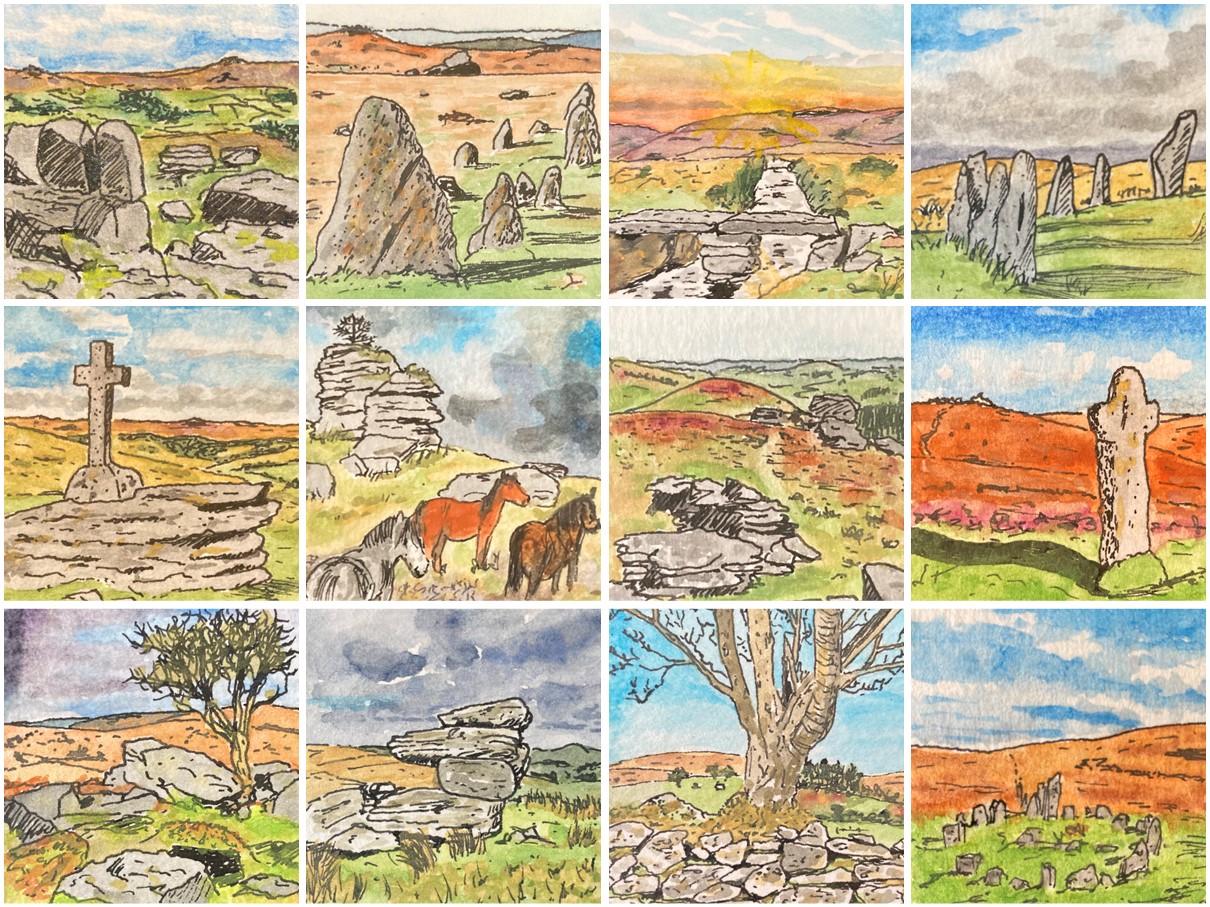
At the beginning of last month (March 2025) I decided that I wanted to try to embed a more regular art practice into my life. So, one evening, I sliced a piece of watercolour paper into a series of 5 cm squares with the intention of painting some kind of miniature picture each morning. I didn’t know what I would paint, just that I would try to paint something, as often as I could.

It was interesting, then, to wake up the next day and find myself sitting down at my painting table at 7:30 am, before I had even eaten breakfast, painting a little scene of a tor and some scattered rocks, a scene that is typical of Dartmoor, the National Park just north of Plymouth where I live. Because I was working on such a small piece of paper, and because I was trying to work quickly, before I got fully enmeshed in the day’s activities, I found myself adopting a simpler style than usual, with fewer, and bolder, colours and some use of cross-hatching to show shadows and darker areas. I liked what emerged.

After that first painting (the one at the top-left of the composite picture at the top of this post) I still didn’t know what would happen next, but at some point, perhaps after two or three days, I came to realise that I was creating a series of miniature pictures that I labelled Dartmoor Scenes. Initially, it was my intention to paint five pictures, one on each weekday, but having successfully reached that number I decided to push on to nine. This seemed to me to be a good number for a series of little square pictures, neatly forming a 3 x 3 grid.

As I approached what I thought would be the final picture, I received a comment on my Bluesky (social media) account on which where I was posting my new picture each day, suggesting that the pictures would make a nice calendar. It was an idea that I liked, a lot, but of course a calendar needs 12 pictures, one for each month… and so my miniature watercolour Dartmoor Scenes series had to become a collection of 12 pictures in total.

I really enjoyed producing these little pictures (and have since gone on to produce two more sets of 12 similarly-sized pictures on different themes – watch this space for details!). I enjoyed being forced to keep things simple and was really happy with the results (more in some cases than in others). I particularly like the stone row and stone circle pictures on the top row (second-left and top-right), and the tree and wall scene (third-left, bottom row). I also really like the way that they look when placed together.

Although it was already almost the end of March by the time I received it, I got a desk calendar printed up as a kind of test run to see how well it worked… and it worked very well indeed, the pictures coping with being expanded to almost double their original size. Subsequently, I have also had each picture printed as a 10 cm square card and had some copies of a larger card printed with a 3 x 3 composite of the nine pictures that I think are the best of the selection. At some point I hope to get more of these cards printed so that I can have a go at trying to sell some of my artwork. It will be interesting to see what happens if and when I do!

As an experiment in trying to be more regular with my artistic endeavours, this activity has worked really well, and although I have now moved on from Dartmoor Scenes, I suspect that I will return to this theme again at some point and complete another set (at least another four to get to a 4 x 4 grid, but who knows, maybe I have another 13, 24 or even 37 Dartmoor Scenes still in me!)

If you like these pictures, I’d love it if you added a quick comment to this post. It would be fun to know which one(s) you like best.
Language of the Spirit – Jan Swafford #reading

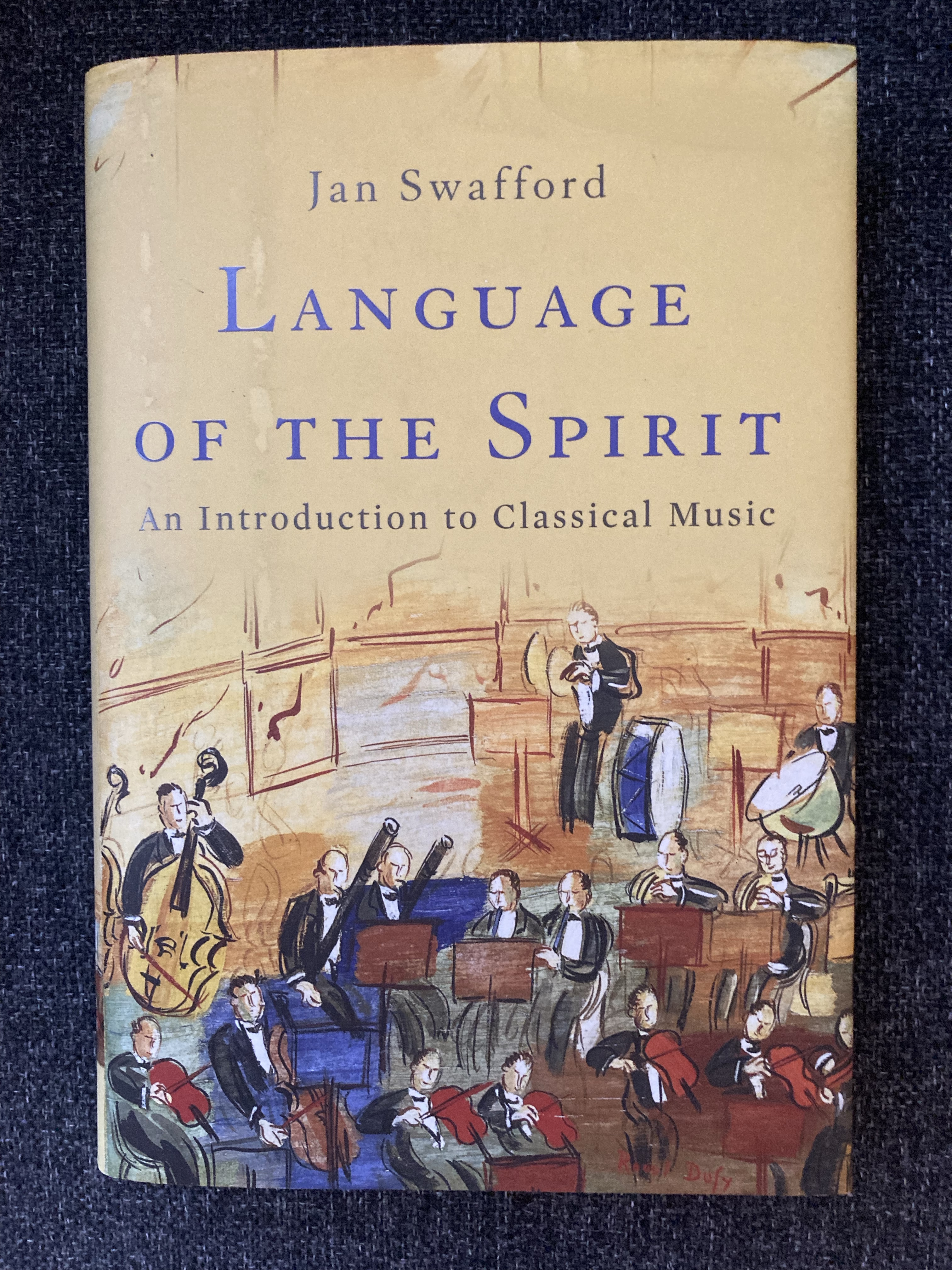
I started reading Jan Swafford’s Language of the Spirit – An Introduction to Classical Music back in June 2023 and finally completed just a fortnight ago. It would be tempting to conclude from this that it was a book that I struggled through but, in fact, nothing could be further from the truth.

I grew up in a household that was full of classical music, from the long, purpose-made shelf unit in the living room that was stuffed full of vinyl records, to the assortment of musical instruments that my father acquired and dabbled with (flute, trumpet, clarinet, mandolin, violin). Apparently, when my brother and sister and I were very young, we would be accompanied on our way to bed by our personal favourite pieces of music, presumably each one being some piece that we had reacted to positively at some point. I don’t recall what my sister’s piece was, but I do know that my (older) brother’s piece was a movement from Schubert’s ‘Trout’ Quintet and mine was the rather stirring ‘March Slav’ by Tchaikovsky (so it is probably no coincidence that Tchaikovsky later became one of my absolute favourites).

I had piano lessons from the age of about six and then at around nine years old I began to learn the ‘cello (because apparently I had shown an interest in learning it, although I can’t say that I remember that and I suspect it was more because it was an instrument that my father wished he had been able to learn). I was never that great at the piano, and stopped after passing my Grade 6 exam, but playing the ‘cello certainly became a big part of my life all the way through my teens and well into my 20s. Over the years, I played in various ensembles and orchestras, in particular leading the ‘cello section in the Somerset Youth Orchestra, the Somerset County Orchestra, Oxford Sinfonietta and Bangor University Orchestra and being on the first desk of the ‘cello section for the annual summer gatherings of the Somerset Chamber Ensemble/Orchestra. It’s fair to say that I was a pretty good ‘cellist – although better known, I think, for my expressive playing than for a robust technique (or any kind of technique at all really – practice and I have never really been comfortable bedfellows in any area of activity…).

I always enjoyed orchestral music the most, especially music composed from around 1850 through to perhaps 1930 – the romantic and late-romantic periods – music full of emotion, passion and angst. My mother used to call the kind of music I liked best ‘troubled music’, which I guess is fair: Brahms, Tchaikovsky (and assorted other Russian composers of that time), Wagner, Sibelius, Richard Strauss, Mahler – that kind of thing. Unlike a lot of musicians, I never went much for some of the classical greats like Bach and Mozart, especially the latter, whose music (am I allowed to write this?) I tend to find rather boring.

In Language of the Spirit, Jan Swafford, a US-composer and music academic, provides a wonderful journey through the classical music canon, from early single-line chants, through all of the great names, and right up to the present day and the post-modernists. The book is mostly written on a one-composer-per-chapter basis, with most chapters being perhaps six to eight pages in length. In each case, Swafford outlines what makes each composer’s work distinctive, and provides a little detail of about their life, their influences and their major works, which brings me to the reason why it has taken me the best part of two years to finish the book…

Just for fun, I decided at the outset that I would listen to every piece of music that Swafford had picked out as being important or a good example of some aspect of a composer’s works. This meant that for each chapter I created a playlist with something like 8-15 pieces requiring multiple (many in some cases) hours of listening – Spotify was my friend! In the end, I managed to listen to every single piece that was highlighted or recommended (including several full operas) except for one piece by Stockhausen that I couldn’t find (but based on the Stockhausen works that I did listen to I can’t say I am too upset about that).

I listened to lots of music that I already knew well, lots of music that I thought that I knew well, and even more music that I didn’t know at all, some of it major works by major composers. I had a few surprises, particularly enjoying the music of Schumann (who I have never paid that much attention to in the past) and Grieg (who I always thought was a bit lightweight), and despite not really enjoying most of the noise that was described as atonal and/or post-modern, there was something about the work of Philip Glass that I enjoyed more than I feel I should have done.

Having now finished reading the book, and having listened to the last piece (John Adams’ Shaker Loops), I was spurred on to re-arrange the furniture in the small bedroom that I use as a kind of home office/personal den so that I could fit in some nice wooden CD shelves that we have struggled to find a good home for recently, and I unboxed all of the CDs (not just classical) that have sat out of sight since we packed them up last summer before having our kitchen re-modeled.

If you don’t know much about classical music but want to know more then I thoroughly recommend Swafford’s book. It is written for a general reader and gives a lot of interesting background and insight into a huge range of music. Alternatively, if you are like me, and know (or think you know) a lot about classical music already, then Language of the Spirit is a great stimulus to rediscovering old favourites and discovering new ones (and also discovering ‘music’ that you will never want to hear again for that matter – but each to their own of course!). Reading Language of the Spirit didn’t convert me into a Mozart-lover – I’m still very much in the ‘troubled music’ camp – but it did broaden my knowledge and has given me a number of composers to explore further. I also discovered that rather than being the somewhat over-sentimental ‘slush-fest’, that I recalled it being from when I played it with the Somerset Youth Orchestra over 40 years ago, Rachmaninoff’s Second Piano Concerto is indeed a rather special piece of music.

Problem Shared #poem

A problem shared is a problem halved,
or so the saying goes.
But whether that is really true
is debatable I suppose.

My problem had been hidden deep inside
until you called it by its name.
And that was like the whistle,
blown to start the game.

The problem that was diagnosed
affected how I lived.
It stopped me getting on with things;
it made my brain a sieve.

This problem that you helped me with
is tricky to unpack,
It means my brain keeps worrying.
I never can relax.

The problem I am grappling with
is not a sickness I contracted.
Rather, it’s part of me,
so always I’m distracted.

The problem you explored with me
in many ways defies convention.
It’s not that I don’t want to,
I just can’t control my attention.

The problem that I shared with you
for years has had me troubled.
And to be honest, since you got involved
its size has more than doubled.

It isn’t that you didn’t help
because certainly you did.
It’s just that now I’m in the game
you’ve helped me lift the lid.

The problem that was inside me
has now come bursting out.
And now I want to dance and sing
and jump and scream and even shout!

My problem shared, it hasn’t halved,
or reduced in size at all.
But now we’ve torn down all the bricks
it’s no longer a wall.

So, although my problem may have multiplied
by three or four or five.
Truly, I give thanks
because you’ve helped me come alive.

(c) Tim O’Hare, July 2023


About this poem: I was given a diagnosis of ADHD at the age of 56 in summer 2022 through a private provider called ‘Problem Shared’, and for about 9 months in late 2022 and the first half of 2023 I had roughly monthly online sessions with a prescribing nurse. These conversations were always very enjoyable (for both of us I think) and helped me to unpack some of the challenges I was experiencing and to express my thoughts and ideas on tackling those challenges, and on ADHD more generally. This poem was not intended to relate only to my interactions with the ‘Problem Shared’ organization, but I used the name as a starting point. It captures the idea that whilst my diagnosis, and subsequent treatment, has certainly generally the flow of my life a lot better, it has also opened up all kinds of additional issues and challenges.

Meditations – Marcus Aurelius #reading

Meditations is essentially a collection of journal entries written by Marcus Aurelius, Roman Emperor (161-180) and well-known adherent to the principles of Stoic philosophy. Most of the entries are short notes, written by Marcus as he unpacked his thoughts on the events of a day just passed or noted down some reminder to himself about the way that he wanted to live his life. These entries were never set down with a view to them being read by anyone other than the author, but they now constitute one of the most commonly cited sources of Stoic wisdom, to the extent that Marcus Aurelius is now generally regarded as one of the big three Stoic philosophers (along with Seneca and Epictetus).

I have read and listened to multiple books on Stoic philosophy and the Stoic approach to live that draw heavily on Meditations, most notably the works of Ryan Holiday – in particular The Daily Stoic and the first three books in his series on the four Stoic virtues: Courage is Calling (Courage), Discipline is Destiny (Temperance) and Right Thing, Right Now (Justice) [the fourth and final book in the series: Wisdom Takes Work (Wisdom) is scheduled for publication later in 2025] – and I have dipped into Meditations on and off over the years. But I had not actually read Meditations in its entirety for myself. With that in mind, at the start of this year, I decided to include Meditations as a component of my ‘morning reading’ sequence.

My initial plan was to read one entry of Meditations each morning, but I soon found that the entries are so variable that this approach was frequently not particularly satisfying, and so I switched to reading 5 or 10 entries at a time (depending on how they fell on the page). This meant that it ended up taking me 2.5 months to complete the whole volume.

I had quite high hopes for my reading of Meditations – I was familiar with it as a source of many great quotes – but, in fact, I found it something of a slog to get through. Every now and again a sentence would leap out at me and I would rush to note it down, but around those golden nuggets there was quite a lot of dull rock. I think that most readers would get a lot more out of reading material that draws from Meditations, such as the aforementioned works by Ryan Holiday, than working their way through the original source material. It can obviously be argued that the former approach is lazy and relinquishes control over what wisdom one might gain from the material, but my feeling is that in this case, the ‘tour’ is much enhanced by the commentary provided by a skillful guide.

I guess the real issue with Meditations is that, as already noted, it is not a book that was written by the author to be read. It’s much more suitable for the ‘open at a random page and read an entry whenever the mood takes you’ approach than a cover-to-cover examination (unless your intention is to actually study it). But either way, the little nuggets of wisdom should emerge, and can serve as useful reminders. Here are a few that stood out for me…

Be like the rocky headland on which the waves constantly break. It stands firm, and round it the seething waters are laid to rest.

Just as drifting sands constantly overlay the previous sand, so in our lives what we once did is very quickly covered over by subsequent layers.

Perfection of character is this – to live each day as if it were your last, without frenzy, without apathy, without pretence.

When you have done good and another has benefited, why do you still look, as fools do, for a third thing besides – credit for good works, or a return.

Universal nature delights in change, and all that flows from nature happens for the good.

Build A Second Brain #poem

Build a Second Brain they said,
it will help you stay on top of your life.
It will help you manage your personal knowledge,
and keep you from informational overload strife.

Build a Second Brain they said,
it will definitely be something you’ll want to pass on.
It even comes with a fancy name.
It will be what they call a Zettelkasten.

Build a Second Brain they said,
it will be much more useful than note-taking.
It will help you organise all kinds of content,
while developing your skills in note-making.

Build a Second Brain they said,
it will help you make connections.
It will join up all of your different ideas,
rather than keeping them separate in sections.

Build a Second Brain they said,
it’ll stop your mind being like a sieve.
It’ll help you solve problems and find new solutions,
by helping you be more creative.

Build a Second Brain they said,
it will allow you to keep track of all your tasks.
It will help when you’re not quite sure what to do,
and not say ‘yes’ when ‘no’ is the best response if anyone asks.

Build a Second Brain they said,
it will lead to all kinds of digital high-jinks.
It will make you think about graphs and blocks,
and connect up your notes with links.

Build a Second Brain they said,
it does not matter which software you use.
It won’t eat up hours and hours of your time,
as you try out each one and can’t choose.

Build a Second Brain they said,
it really will be loads of fun.
It will give you so much more mental bandwidth,
than you have with just brain number one.

Build a Second Brain they said,
but I am really not sure.
I’ve enough problems working the brain that I’ve got,
that I doubt I could cope with one more!

(c) Tim O’Hare, July 2023


About the poem: I had been reading a lot about an area that is known as ‘Personal Knowledge Management’ (PKM) which is based on an older system of keeping discrete notes on index cards in slip boxes (in German this is called a ‘Zettelkasten’). One recent book on the topic (Building A Second Brain by Tiago Forte) has popularized the idea of a PKM-system as being like a ‘Second Brain’ and all kinds of claims are made by many authors about the usefulness of building a Second Brain for information storage and retrieval, creativity, task management etc. Me being me, I threw myself into building my own digital second brain and then (also me being me) I became a bit obsessed with making it perfect, consistent, all-encompassing etc. It rather took over my life for a bit.

Now It All Makes Sense – Alex Partridge #reading

A few weeks ago, I completed my seventh book of the year: ‘Now It All Makes Sense’ by Alex Partridge. This was one that I consumed in audiobook format, narrated by the author.

I decided to listen to this book after my wife drew my attention to it. I’m not sure where she came across it being mentioned, but it’s clear that Partridge currently has a pretty massive media presence with social media channels (with millions of followers), a podcast called ADHD Chatter (with 500,000 listeners) and now this book (an ‘instant Sunday Times bestseller’ apparently). From a bit of searching online, it seems that, in the world of new media he is viewed as one of the experts on adult ADHD (Attention Deficit Hyperactivity Disorder). His background is in social media content creation – he founded UNILAD and LADBible at the age of just 21, two social news and entertainment companies that, according to his biography, were followed by 300 million people. I guess it is not surprising then that after being diagnosed with ADHD at the age of 34, he has come to be a dominant figure in the online adult ADHD media space but I’d never heard of him.

You might think that as a fellow late-diagnosed ADHDer (albeit more than 20 years later in life than Partridge), I would have found plenty in ‘Now It All Makes Sense’ that resonated with me, but that wasn’t the case at all.

I’ll come straight to it… I didn’t much like this book. Partridge clearly writes from his own experience, which is, obviously, a sensible thing for him to do… except that throughout the book he refers to ADHD only in terms of his own particular expression of it. He writes/says things like “Those of us with ADHD will be familiar with…” and “As anyone with ADHD will know…”, and then he describes how he is forgetful, how he loses things, how he is completely disorganized, how he is entrepreneurial etc. Well, I have ADHD and I am not (generally) forgetful, I don’t (generally) lose things, I am probably one of the most organized people around and would hardly describe myself as entrepreneurialanything…, so no, actually, I am not “familiar with” and don’t really “know” the ADHD that is described by Partridge, not in myself at least. And if I am not familiar with it then I am sure that there are plenty of others in the same boat. ‘It’ might now all make sense to Alex Partridge, and I am sure that ‘it’ will now also make more sense to some readers of his book, but if I had read or listened to the book a few years ago it would simply have reinforced the inaccurate understanding of ADHD that I then held… and who knows, that might have prevented or delayed me from being able to make sense of my own ‘it’ in the way that I have been able to since my diagnosis.

There’s nothing wrong with Partridge’s account of his ADHD, the impacts it has had, and is having, on his life, and the advice and tips that he provides in the book… provided, that is, that you have an ADHD presentation that is similar to his (or are seeking to understand ADHD in relation to someone you know who is like him). But many people don’t have that ADHD presentation like his and so are not that much like him… that’s one of the peculiarly frustrating but also, dare I say it, interesting, things about ADHD – the challenges it creates can be very different for different individuals. What is wrong… no, perhaps ‘wrong’ is too strong a word here, let’s say ‘potentially unhelpful’ is that Partridge doesn’t really seem to recognize this variation in the diverse challenges that ADHD presents for different people enough. In this way, I think that Partridge misses the opportunity to really broaden out his readers’ understandings of the challenges of living with ADHD, and given his huge online audience and social media status, I think that’s rather disappointing, Maybe instead of ‘Now It All Makes Sense’ the title of the book ought to have been ‘Now I All Make Sense’ (forgive the mangled grammar) to reflect the rather personal nature of Partridge’s narrative.

Home Park, Plymouth Argyle Football Club #art

I’ve been a regular attender at the home games of Plymouth Argyle Football Club since soon after we moved to Plymouth in summer 1992. The first game I attended was towards the end of the 1992-93 season, and then from 1993-94 onwards I have only missed the odd game each season. In my time as a fan I have seen the team relegated 5 times and promoted 6 times, but sadly, it seems likely that those numbers will have evened out by the time the current season is completed…

In 2003 I started to take my two daughters alternately to games – at that time they were 7 and 5 years old – and then not long after that we would all go together. In the last few years, since my elder daughter moved away to set up her own home in Surrey, I have continued to attend with my younger daughter, and as she has now settled locally, it seems likely that this will continue. Going to Argyle is something that has brought us a lot of great memories, including a few when we travelled to away games for cup matches or key league games. Our trip to Port Vale in May 2023 to see Argyle clinch the League 1 title, achieving over 100 points in the season, was a particular highlight.

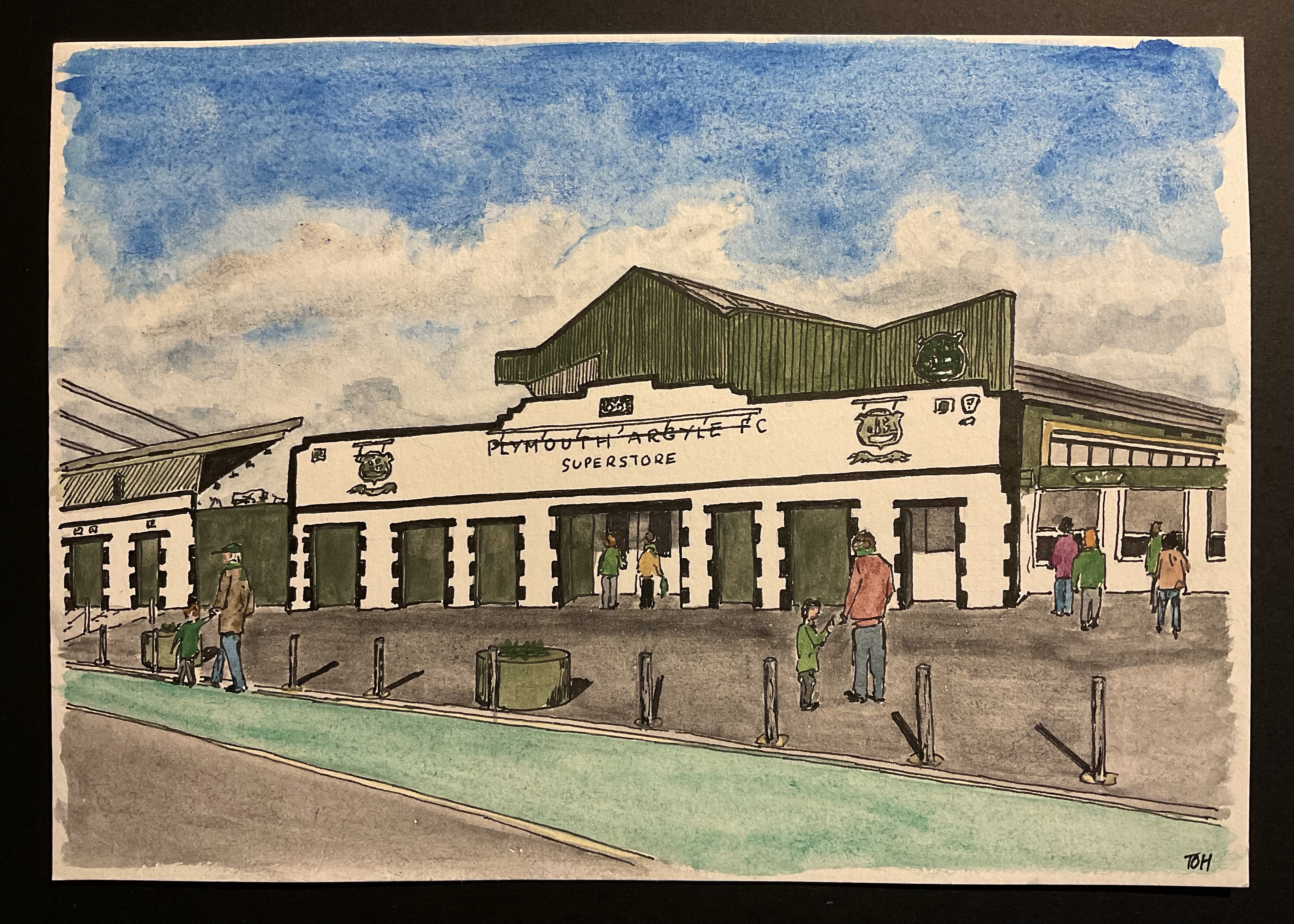
Since I started painting just under a year ago, it seems to have become a bit of a tradition that for birthdays and other special occasions I will paint some kind of artwork to give as a present. Sometimes this is just a small picture for a card or a bookmark, but on a few occasions I have gone for a larger, more ‘significant’ work. So, it was pretty obvious that for my younger daughter’s birthday at the beginning of this month I would produce an Argyle-related picture… The result was the above picture, showing the old entrance to ground, now converted into the club ‘superstore’. I was pleased with how it turned out and also pleased with myself for being brave enough to put a few people into the scene (but notice there are no faces or hands!)

I’m pleased to report that the painting, which I put in a black frame, was very well received… and now it has been given, it’s safe for me to release a picture of it into the world without any risk that I might spoil the surprise. Green Army!

A genius would make the history of his parish more interesting than another’s history of the world – Henry David Thoreau #wisdom

By Benjamin D. Maxham active 1848 – 1858 – National Portrait Gallery, Public Domain, https://commons.wikimedia.org/w/index.php?curid=24948639

For some years I have been reading my way through the Journal of Henry David Thoreau. Initially, I would just read a few entries at a time, but at some point in 2020 I hit upon the idea of reading entries on the day and month that they were written. At that time I was quite a good way through the book, and so my ‘on-this-date’ reading began with the entries that Thoreau wrote in 1856. Now, 5 years later, in my 2025 it is Thoreau’s 1861, and so the entries I am reading come from the penultimate year of his life (Thoreau died aged 44 in May 1862). When I started this project I was reading a journal entry on most days, but in the last few months, as Thoreau’s health has declined, the frequency of entries has reduced drastically such that I am only sporadically opening my copy of the Journal to discover that there is something there for me to read.

Thoreau’s Journal is packed with detailed observations of the land, wildlife and people around Concord, Massachussetts, and while many of the entries are quite dry and descriptive, with Thoreau you never know when a wonderful nugget of wisdom or a special turn of phrase will crop up. One such occasion happened last May, a couple of weeks before my elder daughter’s wedding, when a perfectly phrased gem popped up that I was able to integrate beautifully well into my ‘father-of-the-bride’ wedding speech!

Earlier this week (on 18th March to be exact) I read a passage of the Journal that I greatly enjoyed and which made me think, and so I thought I would use this post to highlight it to the world (as if… a better wording might be ‘to share it with the one or two people who might randomly stumble upon these words’). In the passage, Thoreau reflects on how the interest one might show in any given piece of history depends on more than just the subject of that history and that… No, I must let Thoreau take up the story…

You can’t read any genuine history – as that of Herodotus or the Venerable Bede – without perceiving that our interest depends not on the subject but on the man*, – on the manner in which he treats the subject and the importance he gives it. A feeble writer and without genius must have what he thinks a great theme, which we are already interested in through the accounts of others, but a genius – a Shakespeare, for instance – would make the history of his parish more interesting than another’s history of the world.’

It’s that last line that is the sparkle within the diamond: ‘a genius would make the history of his parish more interesting than another’s history of the world.’.

In my opinion, Thoreau has it spot on – everything is interesting and anything can be interesting if its story is well told. So, when we think about what to read, what to listen to, what to absorb from the world around us, the secret is to recognize and pay attention to those who are masters of the story-telling craft.**

* or woman obviously, but Thoreau was writing in 1861
** like Thoreau (obviously)

The Wisdom of Groundhog Day – Paul Hannam #reading

I first read Paul Hannam’s ‘The Wisdom of Groundhog Day’ (TWoGD) back in October 2022. It was one of a number of occasions when I have listened to an episode of a podcast on my walk home from work and been so taken with the content being discussed that I placed an order for the book as I walked along and before I had even arrived home. In this case, the podcast episode was an interview with the author about his book from the ever excellent ‘Art of Manliness’ podcast (Episode 828: The Groundhog Day Roadmap for Changing Your Life).

In the 2.5 years that have passed since that reading, I have held a really positive memory of TWoGD. I was drawn to the way in which Hannam teases his message out of the story of the ‘Groundhog Day’ film – ostensibly just a routine comedy about a grouchy weatherman who gets stuck in a small town having to live the same day of his life again and again and again. The heart of the message is that to find happiness and fulfilment in life it is necessary to change yourself on the inside and this happiness can only arise when you are fully present and focused at all times on being true to yourself, open to experience, and appreciative of the world and the people around you. Based on this memory, I breifly mentioned TWoGD at the end of a meeting of the Book Club associated with Mike Vardy‘s Timecrafting Trust Community and with others intrigued by the idea of the book, it was chosen to be our February read.

So, I came back to TWoGD for a second reading with high hopes and also a little trepidation… What if everyone else hated the book? As I worked my way through it for a second time I found myself with very mixed feelings. I could still see, and appreciate, the cleverness that lay behind it, but I also couldn’t help feeling that it was all a bit forced – a neat idea stretched out to a length many times greater than necessary. I found that there were certain stylistic aspects about the writing that I really disliked – the way that it was written in what seemed to be a series of ‘sound bite’ paragraphs one after the other with not much flow when read together, and the fact that at every turn the example given for how such and such a principle idea had made an impact on someone was taken from Hannam’s personal experience.

As it turned out, most other members of the book club community had fairly similar issues with TWoGD as I did, but the message of the book was well received and we had a lively and interesting discussion nevertheless.

If I was going to sum up the message in TWoGD in one phrase then I think I would struggle to do better than to use the same quote that Hannam uses in the book’s conclusion, taken from the second volume of Marcel Proust’s epic ‘Remembrance of Things Past’ (1924):

We are not provided with wisdom, we must discover it for ourselves, after a journey through the wilderness which no one else can take for us, an effort which no one can spare us.’

Home #poem

I don’t know if it is the air:
clean and fresh like an ice-cold beer,
bubbles rising,
condensation on the glass,
enough to quench the fiercest thirst.
Because sometimes…
it’s more like warm flat ale,
the dregs of a barrel,
forced down,
because it cannot possibly go to waste.

Maybe it’s the trees:
aged beings,
firm trunks,
twisting branches,
rustling leaves –
all kinds of greens –
magic matter drawn from thin air.
Although sometimes I am not so keen…
when a dipping twig catches me in the eye,
or a gnarly root sends me sprawling to the ground.

Perhaps it is the quiet:
only the soft, gentle, companion sounds
to the peacefulness of nature’s play –
the babbling of a stream,
the stir of swaying grass,
the lowing of distant beasts.
Although sometimes…
the incessant cawing racket of jackdaws
batters my ears and interrupts my calm
far more acutely than the hum of traffic
or the playground shrieks of children.

It can also be the smells:
sweet fragrances of flowers,
fresh cut hay,
that first exhalation of dry soil
after a much-needed drink of rain.
Although sometimes…
there are certain emanations,
animal and vegetable,
that have me rushing to hold my nose.

I wonder whether it is the sky:
deep blue,
adorned with a constantly changing dance of clouds,
then fading to burning orange
before the deepest black, be-jewelled with silver stars.
But sometimes…
such vastness can be far too much,
for this brain to consume in one sitting.

It’s definitely the route:
words in the book,
lines upon the map,
places to stop for a view,
a little piece of history,
a drink
and a big piece of cake.
Although sometimes…
the wrong words have been used,
those lines have simply not been drawn in the right places,
and the much-anticipated tea shop is closed,
just because it is Wednesday.

It’s tempting to think it is the solitude:
just me and the hills and the trees and the birds
and…
and…
and…
Although, if I am really honest, I will admit that sometimes…
that can also be a state of loneliness.

In any case, it’s certainly also the companionship:
sauntering along,
side-by-side,
ahead,
behind,
talking about the world around us,
solving problems,
making plans.
Although sometimes…
you just will not walk at the right speed,
and yes, I do know that I drive you crazy
every time I stop to listen out for birds
or to take one more arty snap
with the app or the camera on my phone.

I think it could simply be the scale of it:
always as far as the eye can see
(and then beyond into the land of imagination),
stretching back through an infinitude of whens
and forward into yet more thens.
Although sometimes,
as truly awe-inspiring as that can be to consider,
I’m reminded that really there is only here and now.

So, it seems to be the all of it:
air,
trees,
quiet,
smells,
sky,
route,
solitude,
companionship,
scale.,
and more –
a little piece of all of the everything that has ever been,
regardless of whether I,
and all the others just like me,
am here to do my worst,
whilst all the time I try to do my best.
Because…
we can build things,
we can shape things,
we can sell things,
and we can waste things,
but when I take a walk outside,
away from all the stuff,
and when I allow myself to forget what I think I am,
just for a moment,
well then I am home.

(c) Tim O’Hare, June 2023


HOME: Our summer holidays tend to be based around walking in nature and I always find that this activity helps my brain to slow down and provides a great source of nourishment for my thinking. During the process of writing ‘Home’ I reflected on what it is that makes walking in nature such an important and grounding activity for me, and as I ran through various possibilities and found counterarguments for each one I came to realise that there is no single magic ingredient – it was simply that walking in nature was where I felt most at home.