King Heron #poem

I spied you threading your way up the narrow ghyll,
just down there where the waters tumble over rocks
on their long route down to the sea.

I watched you picking your way along the stoney path,
stopping to rest awhile under the shade of that old,
wizened tree.

I sensed that with each step of climb, up, up, onto the high moor,
your mind opened like the land,
and all of your thoughts broke free.

I was amused to observe you pause now and then,
looking about to take in the sights,
knowing that you had not yet seen me.

You think this land belongs to you,
your thoughts confirmed by the remnant workings
and heaps of spoil
the miners left behind.

You see evidence all around,
backed up by the words on the pages of your guide,
that this remote corner of the world
is here for humankind.

You sense that there are creatures here
and rue the fact that they hide from view,
wishing they’d show themselves,
so that you can tick them off the list you carry in your mind.

You imagine how it must have been to dig into this land,
with the dust, the noise, and the aching limbs,
to bring out the ore enriched
with the heaviest metal one can find.

And then, at last,
you catch sight of me
as I stand waiting patiently beside the stream.
I thought you’d never notice, so deeply did you dream.
You stop, and,
stretching out one arm,
guide your companion’s sight.
You speak in hushed voices, moving slowly so as not to create fright.

I shift my weight a little,
and turn my head to best present myself to you.
For there have been many others
who have stopped to see this profile view.
And trust me,
I know what to do.

Stick-like legs beneath my plump grey body,
surprisingly large when seen close by.
Arching neck, dagger bill,
the crown of feathers that adorns my head.
All of this can make you sigh.
And, of course,
I know only too well,
that what you really want is to see me fly.

So, I rouse myself fully, unfurl my mighty wings
and with three swift beats I am up and away,
hammering the air as I move along the stream, until,
tantalisingly out of sight,
I find another spot to stay.

Twice more I lead you on our little dance.
I fly upstream
and you advance.

You are thinking that there must be only meagre pickings
in such a small and insignificant stream as this,
and that to sustain so large a body
I must have to spend an age to find a useful meal from tiny fish,
and that to live here as I do, must be so hard and pose a lot of risk.
But there are things that you don’t realise, and sights that you have missed.

This is the miners’ land no more.

And you are only passing through.

And things are not exactly as they seem.

For the land you see around you,
all the hills, the rocks, the fields, the walls,
and each and every one of the countless little streams,
has a mighty ruler who has chosen to be at its helm.

And you, my passing admirer?

You are welcome in my realm.

(c) Tim O’Hare, July 2023


About this poem: This poem was inspired by the sights experienced and thoughts that dropped into my head during a wonderful walk while on our summer holiday in Ilkley, Yorkshire. The route took us along the valley of the River Wharfe and then north for lunch at The Old School Tearoom [highly recommended] in the tiny village of Hebden. From there, we slowly made our way up Hebden Ghyll, a narrow valley that was once the location for extensive lead-mining activities. As the terrain opened up to the expansive higher moorland, I saw a heron standing at the side of the small stream than ran down the ghyll. We stood and watched it for a few moments, and I commented that with the stream being so narrow it must offer slim pickings, and that it must be hard for such a large bird to sustain itself there. And then, of course, the heron did what herons always do…
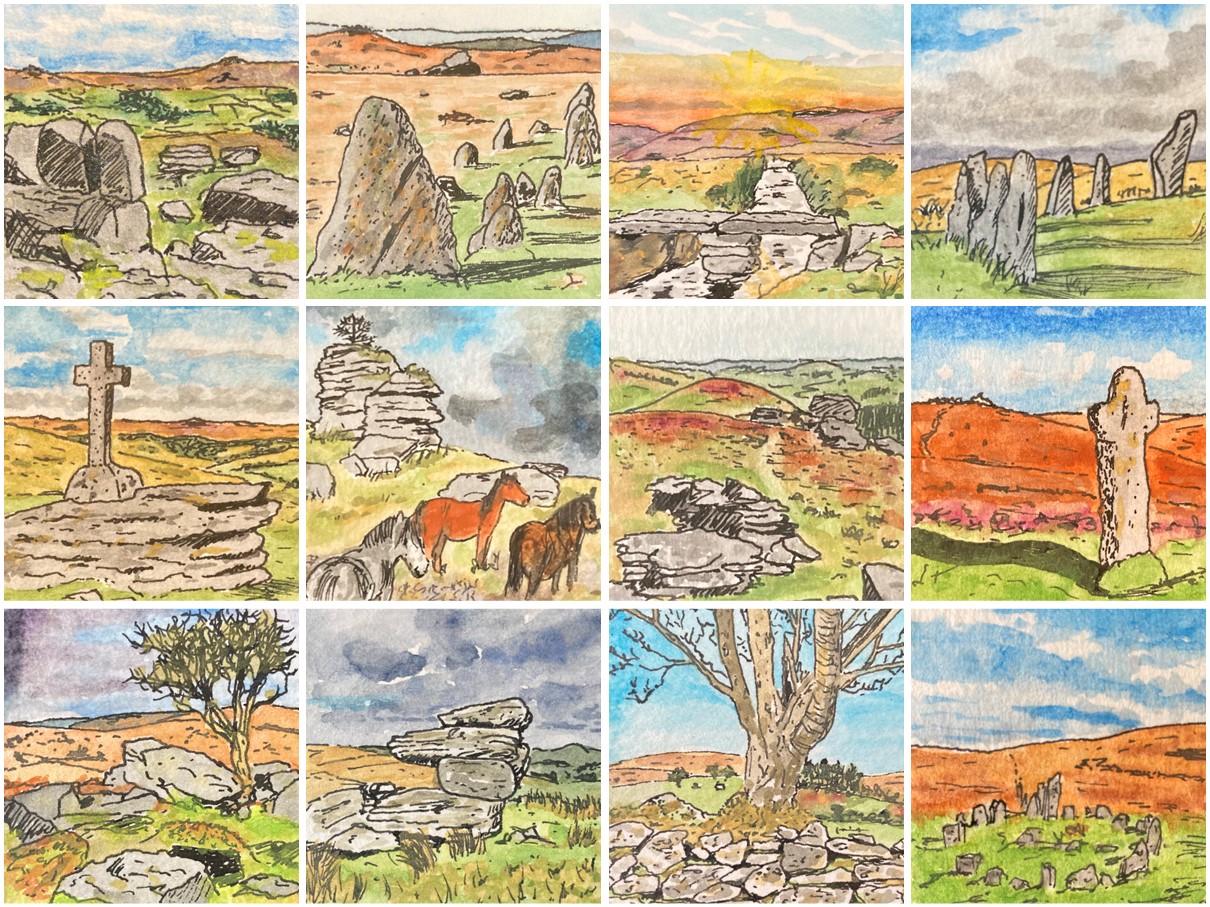
Dartmoor Scenes #art

At the beginning of last month (March 2025) I decided that I wanted to try to embed a more regular art practice into my life. So, one evening, I sliced a piece of watercolour paper into a series of 5 cm squares with the intention of painting some kind of miniature picture each morning. I didn’t know what I would paint, just that I would try to paint something, as often as I could.

It was interesting, then, to wake up the next day and find myself sitting down at my painting table at 7:30 am, before I had even eaten breakfast, painting a little scene of a tor and some scattered rocks, a scene that is typical of Dartmoor, the National Park just north of Plymouth where I live. Because I was working on such a small piece of paper, and because I was trying to work quickly, before I got fully enmeshed in the day’s activities, I found myself adopting a simpler style than usual, with fewer, and bolder, colours and some use of cross-hatching to show shadows and darker areas. I liked what emerged.

After that first painting (the one at the top-left of the composite picture at the top of this post) I still didn’t know what would happen next, but at some point, perhaps after two or three days, I came to realise that I was creating a series of miniature pictures that I labelled Dartmoor Scenes. Initially, it was my intention to paint five pictures, one on each weekday, but having successfully reached that number I decided to push on to nine. This seemed to me to be a good number for a series of little square pictures, neatly forming a 3 x 3 grid.

As I approached what I thought would be the final picture, I received a comment on my Bluesky (social media) account on which where I was posting my new picture each day, suggesting that the pictures would make a nice calendar. It was an idea that I liked, a lot, but of course a calendar needs 12 pictures, one for each month… and so my miniature watercolour Dartmoor Scenes series had to become a collection of 12 pictures in total.

I really enjoyed producing these little pictures (and have since gone on to produce two more sets of 12 similarly-sized pictures on different themes – watch this space for details!). I enjoyed being forced to keep things simple and was really happy with the results (more in some cases than in others). I particularly like the stone row and stone circle pictures on the top row (second-left and top-right), and the tree and wall scene (third-left, bottom row). I also really like the way that they look when placed together.

Although it was already almost the end of March by the time I received it, I got a desk calendar printed up as a kind of test run to see how well it worked… and it worked very well indeed, the pictures coping with being expanded to almost double their original size. Subsequently, I have also had each picture printed as a 10 cm square card and had some copies of a larger card printed with a 3 x 3 composite of the nine pictures that I think are the best of the selection. At some point I hope to get more of these cards printed so that I can have a go at trying to sell some of my artwork. It will be interesting to see what happens if and when I do!

As an experiment in trying to be more regular with my artistic endeavours, this activity has worked really well, and although I have now moved on from Dartmoor Scenes, I suspect that I will return to this theme again at some point and complete another set (at least another four to get to a 4 x 4 grid, but who knows, maybe I have another 13, 24 or even 37 Dartmoor Scenes still in me!)

If you like these pictures, I’d love it if you added a quick comment to this post. It would be fun to know which one(s) you like best.

Home #poem

I don’t know if it is the air:
clean and fresh like an ice-cold beer,
bubbles rising,
condensation on the glass,
enough to quench the fiercest thirst.
Because sometimes…
it’s more like warm flat ale,
the dregs of a barrel,
forced down,
because it cannot possibly go to waste.

Maybe it’s the trees:
aged beings,
firm trunks,
twisting branches,
rustling leaves –
all kinds of greens –
magic matter drawn from thin air.
Although sometimes I am not so keen…
when a dipping twig catches me in the eye,
or a gnarly root sends me sprawling to the ground.

Perhaps it is the quiet:
only the soft, gentle, companion sounds
to the peacefulness of nature’s play –
the babbling of a stream,
the stir of swaying grass,
the lowing of distant beasts.
Although sometimes…
the incessant cawing racket of jackdaws
batters my ears and interrupts my calm
far more acutely than the hum of traffic
or the playground shrieks of children.

It can also be the smells:
sweet fragrances of flowers,
fresh cut hay,
that first exhalation of dry soil
after a much-needed drink of rain.
Although sometimes…
there are certain emanations,
animal and vegetable,
that have me rushing to hold my nose.

I wonder whether it is the sky:
deep blue,
adorned with a constantly changing dance of clouds,
then fading to burning orange
before the deepest black, be-jewelled with silver stars.
But sometimes…
such vastness can be far too much,
for this brain to consume in one sitting.

It’s definitely the route:
words in the book,
lines upon the map,
places to stop for a view,
a little piece of history,
a drink
and a big piece of cake.
Although sometimes…
the wrong words have been used,
those lines have simply not been drawn in the right places,
and the much-anticipated tea shop is closed,
just because it is Wednesday.

It’s tempting to think it is the solitude:
just me and the hills and the trees and the birds
and…
and…
and…
Although, if I am really honest, I will admit that sometimes…
that can also be a state of loneliness.

In any case, it’s certainly also the companionship:
sauntering along,
side-by-side,
ahead,
behind,
talking about the world around us,
solving problems,
making plans.
Although sometimes…
you just will not walk at the right speed,
and yes, I do know that I drive you crazy
every time I stop to listen out for birds
or to take one more arty snap
with the app or the camera on my phone.

I think it could simply be the scale of it:
always as far as the eye can see
(and then beyond into the land of imagination),
stretching back through an infinitude of whens
and forward into yet more thens.
Although sometimes,
as truly awe-inspiring as that can be to consider,
I’m reminded that really there is only here and now.

So, it seems to be the all of it:
air,
trees,
quiet,
smells,
sky,
route,
solitude,
companionship,
scale.,
and more –
a little piece of all of the everything that has ever been,
regardless of whether I,
and all the others just like me,
am here to do my worst,
whilst all the time I try to do my best.
Because…
we can build things,
we can shape things,
we can sell things,
and we can waste things,
but when I take a walk outside,
away from all the stuff,
and when I allow myself to forget what I think I am,
just for a moment,
well then I am home.

(c) Tim O’Hare, June 2023


HOME: Our summer holidays tend to be based around walking in nature and I always find that this activity helps my brain to slow down and provides a great source of nourishment for my thinking. During the process of writing ‘Home’ I reflected on what it is that makes walking in nature such an important and grounding activity for me, and as I ran through various possibilities and found counterarguments for each one I came to realise that there is no single magic ingredient – it was simply that walking in nature was where I felt most at home.

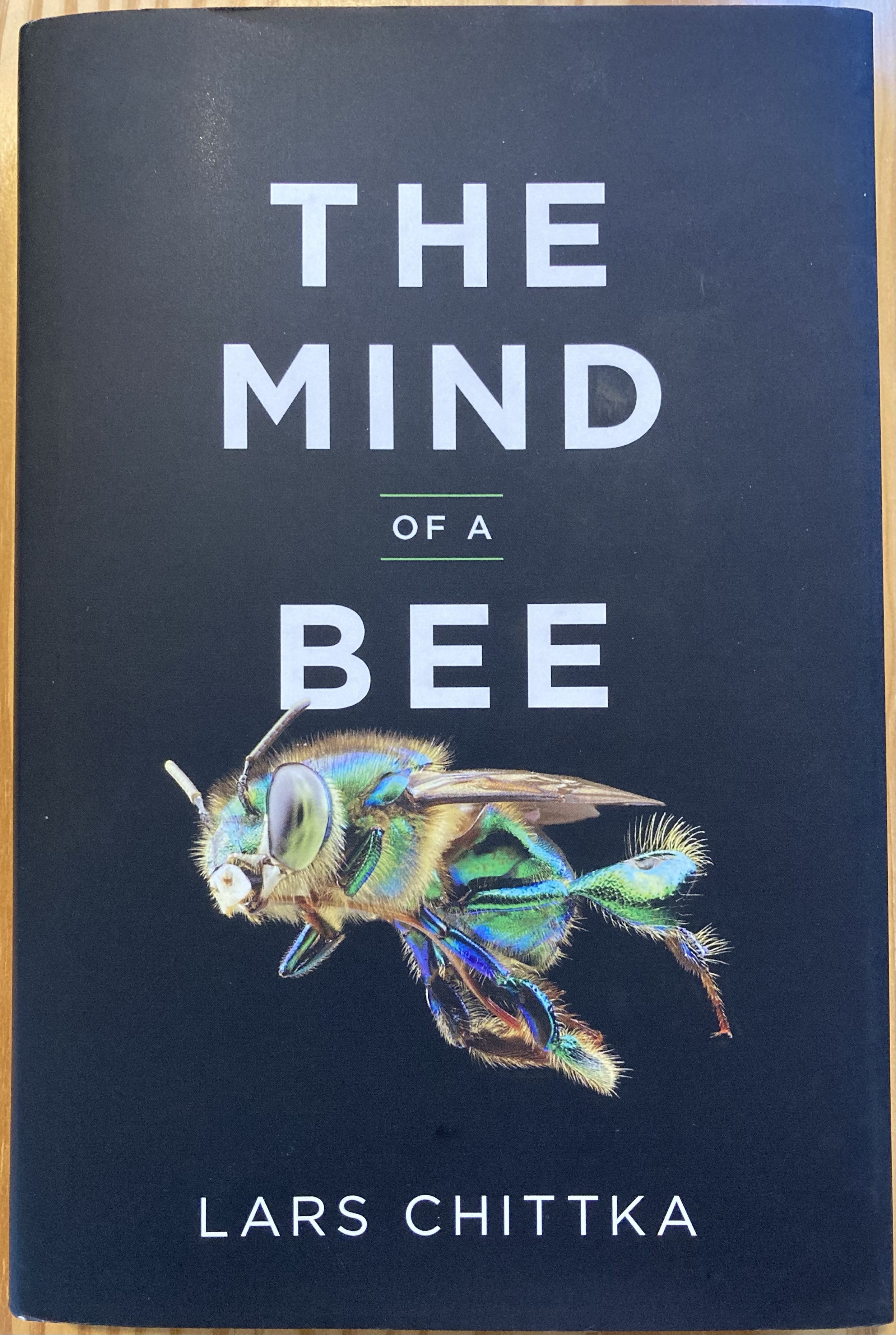
The Mind of a Bee – Lars Chittka #reading

At work, I am part of the supervisory team for a part-time PhD student who is trying to explain the relatively recent (2001) appearance of a tree bumblebee Bombus hypnorum in the U.K. My involvement in the project arose because one possibility for explaining how these bees made the hop across the English Channel from mainland Europe is that they might have been carried over be easterly or southeasterly winds. As the only person who teaches some meteorology in my department I was drawn into discussions at the outset of the project about 5 years ago, and my involvement has continued ever since.

What do I know about bees? Almost nothing… I completed an ‘O’ Level in Biology back in 1981 but I don’t recall bees ever being a topic that we learned about. Since then, although I have a general interest in natural history, I can’t say that I have thought about bees very much. But sometime around 2017 or 2018, the bird box in our garden was taken over by bees, I mentioned this to my the Head of School (who does know about bees), learned that most bumblebees nest in holes in the ground but that some, like my ones, were tree bumblebees, and from there I gradually became enmeshed in the ongoing attempt to explain why one type of these tree bumblebees had suddenly appeared in the U.K. Eventually, I decided I really should get to know a bit about more about bumblebees and that led me first to read Dave Goulson’s book ‘A Sting In The Tale’ (in June 2022) and then at the start of this year, Lars Chittka’s book ‘The Mind of a Bee’.

‘The Mind of A Bee’ was a fascinating book, covering bees’ sensory capabilities, instinctual behaviours, intelligence, communication systems, spatial memory and navigational capabilities, learning, brain structure, personality and consciousness. Packed with easily understandable summaries of a huge of scientific experiments and interesting background information about the scientists that conducted them, ‘The Mind of a Bee’ leaves no room for doubt that despite their small size, bees brains are capable of many astounding feats and that the bees themselves are highly complex animals with many sophisticated behaviours and skills.

The part of the book that interested and intrigued me most was the section early on about sensory capability and, in particular, bee vision. Bee vision is shifted to shorter wavelengths than human vision which means that bees can ‘see’ in the ultra-violet part of the electromagnetic spectrum and are effectively red-blind (which explains why red flowers are relatively rare in European fauna [research has also shown that flower colours have adapted to match insect vision and not the other way around as would perhaps seem more intuitive]). Bee vision is also trichromatic (UV, blue, green) and bee brains mix these three colours in the same way that human brains mix red, green and blue, ending up with a mixed colour that is indistinguishable from pure light at the relevant frequency. Apparently, this is unusual… and it is also very different from the way that we perceive sound, where we can perceive many frequencies at the same time so that we hear chords, harmony and dissonance. This difference arises because we have thousands of auditory receptors responding to different frequencies. I found it fascinating to think about what sound would be like if we could only sense three frequencies and mixed them to make a single note and what vision would be like if we saw objects as chords of different coloured lights. To be honest, my mind was a bit blown by thinking about all of this!

Reading ‘The Mind of a Bee’ certainly gave me a lot of insight into the brains, behaviours and learning capabilities of bees. It’s certainly a book that opens up the mind of the human that reads it and makes that mind think about just how different the game of life can be for different animals.

A Watercolour Sketch for Valentine’s Day #art

Yesterday was 14th February, commonly known as Valentine’s Day – a day for celebrating the romance in your life and letting your ‘special person’ know that you love them. I have to admit though that I am not known for my romantic gestures, or for expressing my emotions (fortunately for me, neither is my wife!), so in our household, Valentine’s Day is not a day filled with red roses, soft music and a candlelit dinner. Nevertheless, we do acknowledge Valentine’s Day in our own way, and this year I spent an enjoyable hour painting a watercolour sketch to turn into a special card. I based the painting on a photograph that I found online of a couple sitting on a bench looking out towards a magnificent view. It’s the kind of bench and the kind of view that my wife and I enjoy sitting on (the picture also had the advantage that I didn’t need to try to paint the faces of the happy couple…). I personalized the couple’s clothing and the colours of their hair and the caps that they are waving just enough so that the couple in the painting could certainly be us.

I’m glad to report that the card and the picture were very well received – evidence, I think, that it means far more to have taken the time to produce something personal and meaningful for the love of your life than to fork out a few quid for a generic heart or flower themed card and a bunch of flowers from the supermarket!

Out and About Again At Last #other

Four months ago, at the end of August 2024 I managed to do some damage to my left Medial Collateral Ligament while completing long runs. I think I did the injury earlier that month while running the second half of the West Devon Way from Peter Tavy to Okehampton but then I compounded things by attempting to complete my leg of the King Charles III Coastal Challenge, or at least a good chunk of it from Par Beach to Looe, a couple of weeks later. By the end of that run, over typically up-and-down Cornish coastal path terrain I could hardly walk and ever since then I have been trying to nurse it back to strength with the help of some visits to a Sports Therapist and, more recently, a Physiotherapist. But although the area where the MCL itself attaches to the top of my calf muscle has gradually become less sore, I have not been able to get my leg back to normal and pain-free – it now has a tendency to feel somewhat unstable and ‘clicky’ and is very sore most of the time and especially after I have spent any time sitting down. It has been very frustrating, not only preventing me from doing any running (apart from an 0.6 mile test run in mid-December) but it has also meant that I have cut back on walking and certainly not gone for any proper walks our and about on Dartmoor or at the coast.

Consequently, it was with a lot of joy that we took ourselves up onto the edge of Dartmoor yesterday morning for a short loop walk from the village of Meavy over to Burrator Reservoir and then back along the line of the old railway before dropping back to our starting point. The walk, 2.6 miles in total, is one that we have done multiple times before and gives a nice mix of terrain and some good views across the valley and the reservoir.

I particularly like the first section of the walk across some fields into a wooded area…

… after which the path climbs up towards the road at Burrator Reservoir …

After joining the road, we proceeded along it, above the reservoir, until reaching a small waterfall at which point we turned back to join the old railway line back towards Dousland …

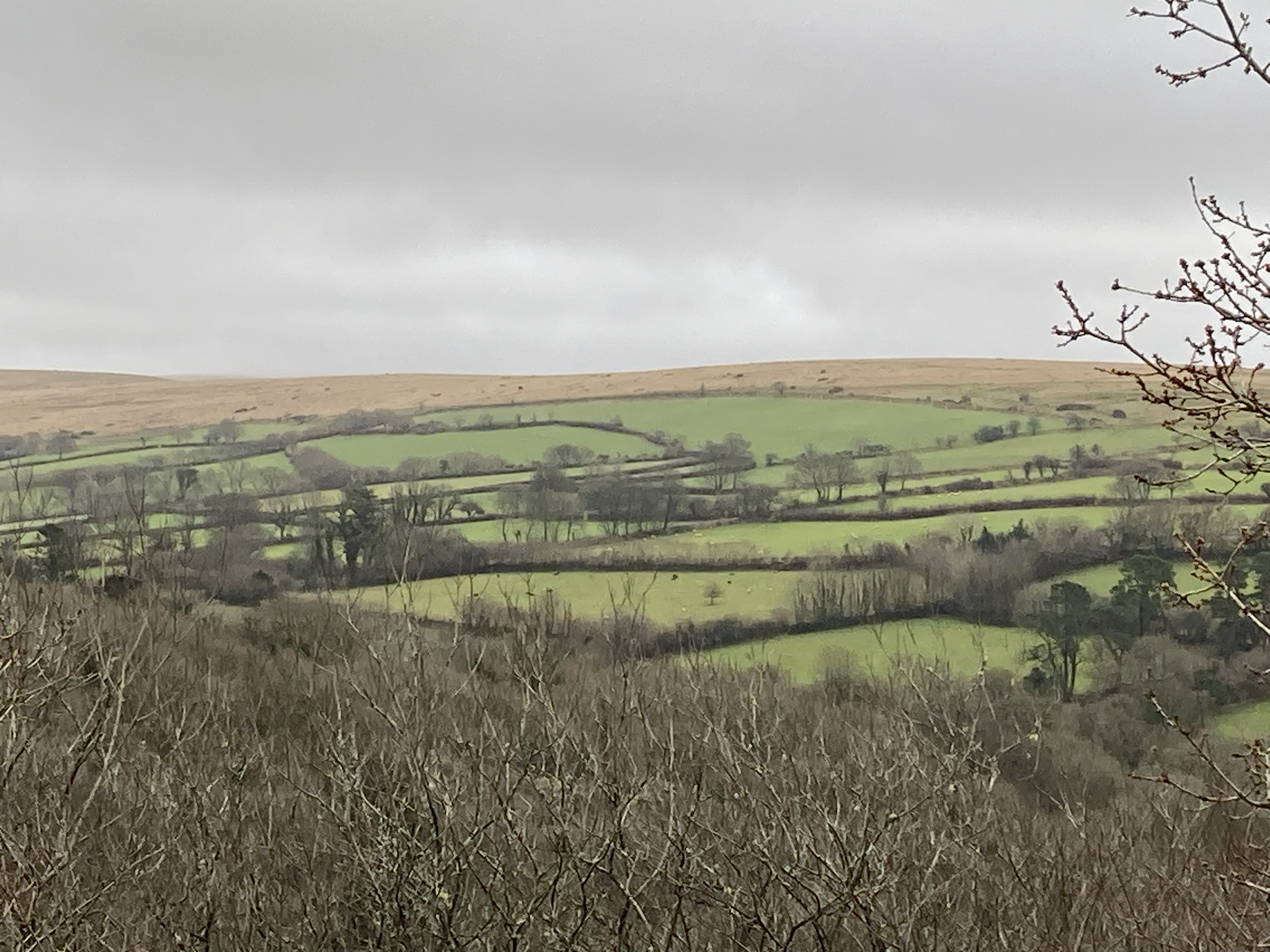
The return section is more open with views south across the valley …

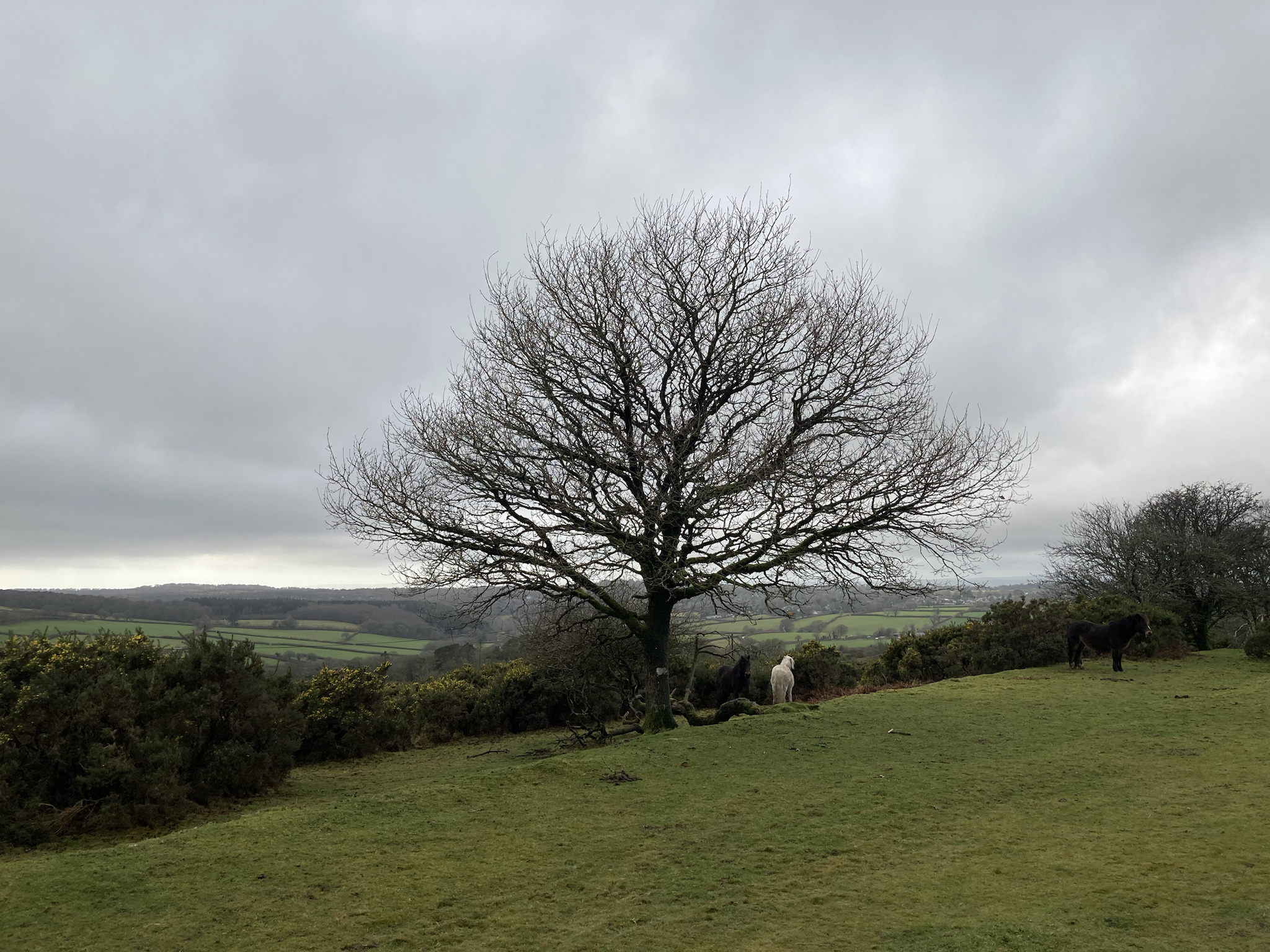
I always like views that have a mix of farmland and wilder moorland. Towards the end of the walk I also got to see another favourite sight, a fairly symmetrically-shaped tree, or what I now refer to as a symmetree!

Although the weather was not great, with cloudy and grey skies, there was no rain and it was just so good to get out and about, to be breathing fresh air, to be unconstrained by walls and to be immersed in nature again.

One day on, I am pleased to report that although my leg does feel somewhat sore, it does not feel any worse than on any other day and so hopefully it will now be possible to start to introduce a bit more proper walking back into life.

Life and Death


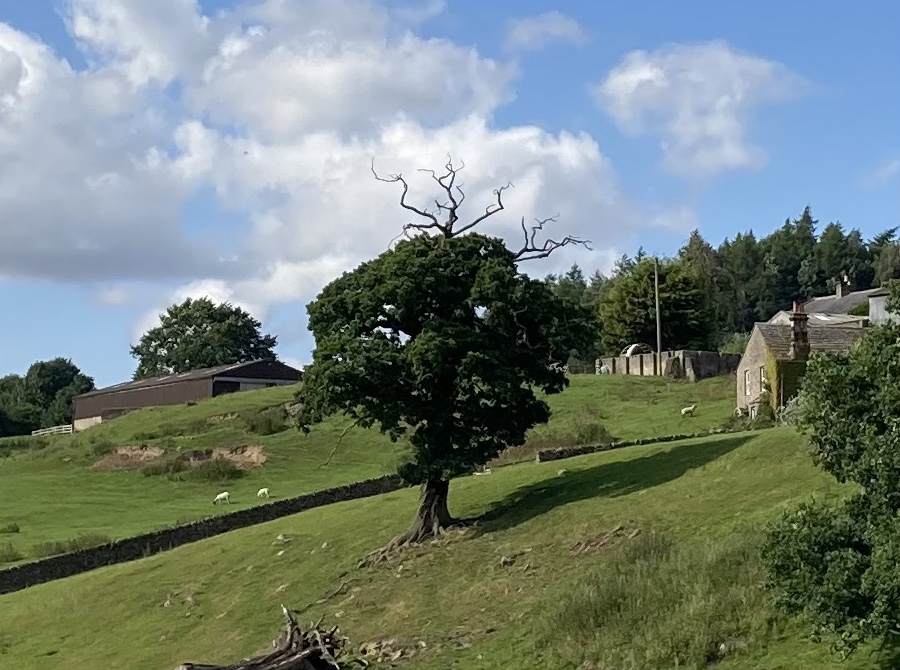
I think it is hard to beat an interesting tree – sometimes it is the shape that speaks to me, sometimes the colours and sometimes it’s the the signs of a hard life lived. So, you can perhaps imagine my excitement when I spotted this particular tree with its strong, thick trunk and its beautifully rounded and perfectly balanced shape all thickly enveloped by deep green leaves, so full of life… and yet, running upwards through its core, emerging to thrust like inverted lightning flashes from its top (and less visible in the photograph, a withered tendril reaching downwards on the left side), the sharp, angular, stripped-bare branches, absolutely dead to the world. This is a tree that is both dead at the core and alive at heart and I have never seen its like before.

Symmetree

I love trees. I love the way that they seem to produce all of their substance out of nothing; the way that they can hang around for ages while the world changes around them; they way that they are all so different whilst still obviously being trees; the way that they change on all kinds of timescales.

I like taking photographs of trees, particularly ones with a high degree of symmetry where the shape of one side of the tree is the same as the shape of the other side and where the trunk is nice a straight and down the middle. I don’t only like symmetrical trees but I do think I like those ones the best.

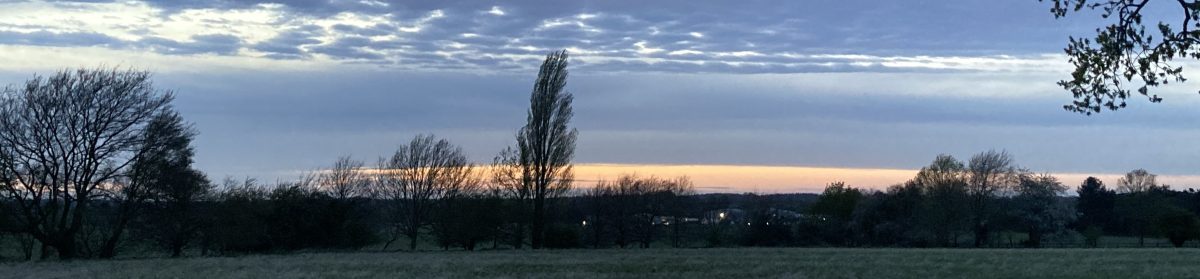
A couple of days ago I was up on Roborough Common (on the south-western edge of Dartmoor). It was my first time properly outside of Plymouth for at least 8 weeks. It was a beautiful sunny and still evening – aren’t they all at the moment? We parked up the car, set out for a stroll and there it was, was one of my favourite symmetrical trees; one that is always hard to walk past without taking a photograph. And so, of course, I did, resulting in a picture that I am particularly proud of.

This isn’t just a symmetrical tree; it’s a Symmetree…