Things That Help #poem

Things that help include…

A slow start to the day,
with plenty of time for my morning routine…
at least half an hour for reading, lots of different books –
some daily inspiration, a chapter of a long novel,
a short story, some poetry,
and a few pages from a science magazine,
with a cup of black coffee (currently decaf) by my side,
and frequent stops to record an idea
or to note some words of wisdom I have spied.

Then, a dive into my Journal notebook (Moleskine, large, squared),
with my zero-point-nine millimetre Pentel
twist-grip propelling pencil in hand,
scribbling away,
as my thoughts coalesce through the words I write
in a way I simply cannot understand.

At least two or three runs each week…
Preferably, although not as often as I would like, out of the city,
even though I rarely feel that I want to go
and often set out wearing a frown,
ideally working towards some future long-distance event that,
despite crowding in on me horribly as it approaches,
seems to be a necessary challenge,
albeit one reluctantly thrown down.

Having enough money to keep buying books…
titles I come across that interest and intrigue,
for it seems that books are my favourite food
and provide me with much of the sustenance that I need.

Not being hungry…
so, yes, please do bring me that snack
(real food of course, not a book!)

Remembering to drink water…
because going without it is something for which
I really seem to have a knack,
until it is too late, my body dry,
and my brain shrivelled to uselessness by its lack.

Knowing what is coming up…
and having a plan for the hours and days ahead,
even though I know I will not follow my intentions,
will waste much of the day
and become frustrated with myself.
(It’ll be a complete disaster if I set off with no kind of schedule, instead.)

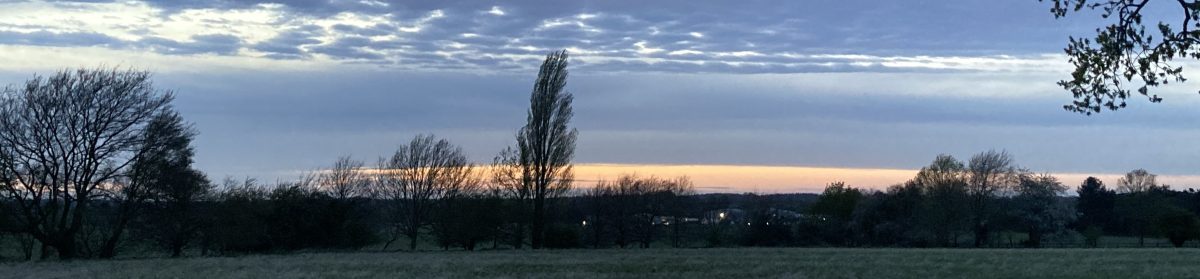
Getting outside into nature, trees, sky, clouds,
and all the rest of it…
especially when there are big views –
it’s so much better for connecting with the world
than a constant processed diet provided by The News.

Talking out my thoughts…
(even if you do not really want to listen,
as long as you nod every so often,
and give a few prompts to keep me going,
it will really help to boost my knowing
and keep my ideas growing.)

Being the master of my own time and space…
so that I can sort and sift my thoughts,
move slowly through the day,
and know where I am and where I am heading.

Working at my own pace…
but also not having to make too many choices.
Although I will always have an opinion –
I admit that’s true –
it is usually far better if you simply tell me what we’re going to do.

Encouragement and praise…
just the right amount and I have to believe that it is sincere.
Just like the ambrosia eaten by Gods it can be sweet and sticky,
so getting this one right is really tricky.

What doesn’t help is…

Losing sight of the things that help,
or forgetting that even though I am certain of their value,
I will often have to force myself to do them,
and that, with insufficient respect for myself,
I will likely lack the courage to make sure that they happen
Enough.

(c) Tim O’Hare, September 2023


THINGS THAT HELP: As I allude to in my note for The Hollow Man (and probably elsewhere) there are certain things I like to do each day or on a regular/routine basis that help me to maintain my level of functioning. I find that I can go for a few days without following my ‘morning routine’ but if I let things slip for any longer or fail to force myself out for a run or a walk in the countryside I start to unravel. Things That Help captures some of these activities and ingredients that keep me in balance and, most importantly, notes the need to keep them in sight and to keep pushing myself to do them. I’ve come to think that everyone should write out their own list of Things That Help and keep it in a prominent place as a reminder

Introducing… Dudley Disrupter

This morning I went for a five and a half mile run before work. This meant I got into work a little later than usual but this was all part of my original plan for the week. In truth, by the time I got into work (after a two mile walk) I was 14 minutes behind schedule, but I had already sneaked a look at my email Inbox and knew that there was nothing much in there that was going to take my time. So, I was confident that I would be able to get back on track pretty much straightaway. My plan for the day followed the same structure that I had (successfully) deployed in the last couple of days, namely a short spell devoted to email first thing, a short buffer of spare time, a longer timeslot of concentrated work on a substantive project (lecture planning in this case), a break for lunch, a planned timeslot for some research reading/activity, a second session on email and miscellaneous tasks and then a two hour meeting to end the day. After two days in which I have stuck unbelievably well (for me) to this kind of plan and made real progress on the substantive tasks I had set aside time for, I felt cautiously optimistic about the day ahead.

Anyway, back to the run. As I ran, I found myself remembering some cartoons I used to watch as a little kid. What I vaguely recalled was a cartoon in which the main character (possibly Mickey Mouse) had two little imaginary characters sitting on his shoulders, on one side a little angel who tried to get Mickey (let’s assume it WAS Mickey) to make good choices and behave well and on the other side a little devil who had the singular ambition to get Mickey into trouble. I have no idea why this particular cartoon idea popped into my head when it did but as I ran along I found myself thinking that my frequent struggles to stick to plans that I have made bore a lot of resemblance to the cartoon. Instead of Mickey generally going about his business there is me, trying to keep focussed and remain productive at work, and perched on my shoulders are the two imaginary characters, the ‘good’ one telling me to stick to my plans and the ‘bad’ one doing absolutely everything in his power to disrupt them, whispering things like: ‘It won’t matter if you just take a break here, you’re tired and you will work better later on if you do’ or ‘There’s no harm in not replying to that email immediately, it won’t do any damage if you just leave it there and then notice it and think about dealing with it another twenty or thirty times…’. I could see that this bad character was just hell-bent on disrupting my best-laid plans, and for that reason I decided that he would need a name with Disrupt or Disrupter in it. First off, the name Disrupter Dave came to mind, but I have a friend called Dave at my running club and he is friendly, helpful and just a generally really nice guy so I couldn’t bring myself to adopt that name. After a bit more thought I settled on Dudley Disrupter – the character Dudley Dursley in J.K. Rowling’s Harry Potter novel series isn’t the nicest (although he is far from the worst of course) and I liked the idea that Dudley could be shortened to Dud which is exactly what I become when Dudley Disrupter gets his way.

I suppose there must also be a ‘good’ character on my other shoulder who also ought to have a name but I don’t really find that he gets in my way very much and so I hardly notice him. Consequently, at present, I am content simply to assume his presence but leave him un-named.

I decided on my run that one of main challenges in life is to watch out for Dudley whispering in my ear and trying to pull me away from my planned path, and I wondered to what extent Dudley might show his face today…

Now, at the end of the working day (I arrived home not long ago) I am glad to report that Dudley didn’t come out to play today. For the third day in a row I stuck to my plan and for the third day in a row I got some really USEFUL work done, as opposed to just getting some work done. I don’t doubt that Dudley Disrupter will appear on my shoulder again soon, tap me on the head and try his best to steer me off course, but it feels as if, by flushing out his existence and giving him a name, I might just have stumbled on a strategy for keeping him out of harm’s way.

Battling the Cracks in Time

Over the last couple of weeks I have been working my way through a huge (virtual) pile of marking – 161 pieces of first year coursework about the circulation of water into and out of the Mediterranean Sea, each one taking me approximately 15 minutes to mark (which equates to a little over 40 hours over a two week period during which all of the rest of my work also had to happen). It was a mammoth task and not one I want to repeat again next year so I will have to make sure that I re-design the work into a more manageable form. To make matters worse, I absolutely hate marking (I suspect everyone does) – it is repetitive, physically and mentally tiring, boring and often quite disheartening. It is a job where it is absolutely essential to be efficient and to stick on task.

As I was working through the pieces of work and struggling to keep on track and avoid being pulled off to do something else more interesting and enjoyable (i.e. anything else) I got a really strong sense that the secret to being successful against this challenge was to not allow tiny cracks in time to open up. The critical time was always just at the moment when I had completed marking one piece of work but just before I had started on the next one. I came to think of these moments as cracks in time.

At the end of each piece of work I had a strong physical sensation of a tiny crack in time appearing and even the slightest hesitation at that point would result in it opening ever so slightly wider, then wider, then wider still until I had tumbled in (to have got up to make a drink or check something on the internet or anything really). I had to be ready for these cracks; ready to outwit them by stepping over into the next piece of work before the crack could take hold and rip open. As soon as I had completed the final action of processing the piece I had just marked I had to be into the next one, opening up the file ready to start work on it. I found that it mattered much less if I paused a few seconds if I had already opened, and therefore ‘started’, the next piece of work than if I paused before doing so. To do the latter allowed the tiny crack to begin its expansion and immediately that had happened a huge amount of additional willpower was needed to get back on track. Although battling these cracks was obviously really a mental challenge, I cannot really put into words how physical the sensation felt, and I think for that reason the idea of cracks in time and my having to battle against their development has taken hold in my head in a wider context than just marking. I have come to realise that much of my battle to maintain the high level of productivity that I desire is the battle against allowing the cracks in time to open. Knowing this I am starting to train myself to be ready for them, to recognise their appearance at the earliest possible stage and to have in place strategies for leaping over them to leave them behind me before they become too wide.
Marking with a positive head on

Today I have been working at home (mostly) marking student coursework. I need to say at the outset that I hate marking. It is a task that never leaves me with a feeling of satisfaction at a job well done. Generally, I find that most of the work I mark is of a fairly mediocre standard, seemingly thrown together with nothing like the care and attention to detail that I think is appropriate. It is like the students simply see pieces of coursework as tasks that have to be got out of the way as quickly as possible, or with the least pain possible, rather than as opportunities to showcase their knowledge, creativity, insight etc. I have told students this on countless occasions, both before and after completing work for me, but the message never seems to get through. I suppose this means that I need to re-examine HOW I am transmitting this message to the students. ‘Something’ always seems to be ‘good enough’.

I suspect that I have a reputation as a hard marker. I suspect that students submitting work for my assignments THINK they deserve better marks. I am pretty sure that I do tend to mark with a somewhat negative mindset, at least in the sense that I notice everything that is wrong or unclear or lacking ahead of noticing things that are right. So I probably could adopt a more positive approach and look much more for the good in pieces of work and/or for the comments I can make to help a student improve rather than pointing out or correcting shortcomings. But this is difficult when so much of the work that is submitted is, to use a ‘word’ that seems to have come into fashion these days, just ‘meh’. This kind of work is not wrong (mostly), it’s just lacking in spark and displaying such a paucity of pride or self-respect. Faced with a sequence of ‘meh’ scripts I find it very difficult not to descend into a negative mindset.

Anyway, today I marked 18 questions, the first of two that students had completed for an assignment on my Year 2 Meteorology module. There was quite a lot of ‘meh’ work in the batch but I THINK I managed to hold on to the line of thought that my role was to offer positive suggestions for improvement whilst still indicating the areas of weakness. Pleasingly, there were a couple of really good pieces of work in the pile, one especially that really showed that the student had taken time to 1) understand everything that they were doing and 2) [importantly in my view] THINK about how to get this across to me. This piece of work was embued with a real sense of the student wanting to display  their best self to me. Fortunately, it came towards the end of the [virtual] pile so it left me with a somewhat positive feeling about the whole day’s work – a fortunate piece of happenstance if ever there was one.

Days Lost versus Days Gained

The days seem to be rushing past at a rate that far exceeds anything I can remember. Each morning the alarm goes off at 6:55, I wake up thinking ‘here we go again’ and it seems like only moments ago that I last did the same. I’m quite familiar with the feeling that time seems to pass more quickly as I get older, something which I always put down to any given time period, such as one hour, being an ever-reducing proportion of my whole life. I am pretty sure that we perceive the passing of time, at least in large part, as being relative to our lifespan to date. But this new sensation of the days tumbling one after the other with such apparently rapid rapidity feels new, or at least more severe.

I expect that time seems to be passing particularly quickly at the moment because I am busy at work. This is my busiest time of year as far as teaching sessions are concerned and most days have multiple fixed appointments such that there is rather limited freedom to shape the progress of each day. Add to this the fact that I have begun to pack some of my early mornings with exercise and it is easy to see how each day has really become a procession of scheduled activities through which I am passing, one after the other with somewhat monotonous regularity. When I think about all of this I am torn between thinking that the solution is to do less and open up more free space in my schedule or to do even more in an attempt to shift myself into a mindset of constant activity. My instinct is that whilst it always seems tempting to do less and to try to relax, it is probably better to stick with things and/or do more. Like many machines, we seem to be able to keep going better and be more effective if we are constantly in use (accepting that sleep is an essential activity that helps to maintain the machinery).

As I write this another thought comes to mind. I think I have a tendency to wake up and think ‘here we go again’ in a somewhat negative, or regretful, manner. Perhaps I am viewing each rapidly passing day as something that has been lost whereas I could view the arrival of each new day as a cause for celebration. Each day that passes is one less day that I have to live but each morning that I awaken is one more day in which to live. Is the glass becoming increasingly empty or is the glass being refilled on a daily basis? It is all a matter of perspective and I think the trick I need to try to employ is to switch my morning mindset to one of excitement at having successfully awoken to a new day and the opportunities it brings. This post started out being titled as ‘Time is rushing past’ but I think the new title ‘Days Lost versus Days Gained’ is a far better way of capturing what has been in my mind as I have written it. The author and Stoic Ryan Holiday suggests that we should carry with us a constant reminder of our mortality to help steer us towards a ‘seize the day’ mental attitude. I am not sure that I really want to constantly remind myself that this day might be my last but I can see some sense and value in this idea. In a similar vein, artist and author Austin Kleon recommends reading the obituary column of a newspaper each day to provide this kind of reminder and also to draw inspiration about what it is possible to achieve with a human life.

Carpe Diem.

Gratitude

Over the last two or three years I have read/heard many times that keeping some kind of ‘gratitude journal’ is supposed to deliver a boost to your happiness/contentedness. The basic idea is to spend a few minutes at the end of each day reflecting on the hours just gone and identifying a small number of things (e.g. three) that you are grateful for. It makes sense that by reminding yourself of such things on a regular basis you will end up with a generally more positive attitude – highlighting and acknowledging the good stuff that has happened or reasons to be cheerful.

I already keep a small journal of sorts. Each night before I go to sleep I make a note of the key events of the day by just writing one or two words to describe the event and drawing a little symbol or icon to represent it. For example, I have different icons for work (two gears meshed together), reading (an open book), watching a film (movie camera), watching TV (TV set), drinking coffee (cup), walking (stick man), listening to a podcast or music (head with earphones). I should add photos of a page or two to this post sometime to illiustrate what I mean (more likely I will write a separate entry about my notebook habits).

For the last week, I have been adding an extra section at the bottom of each day of this journal headed “Grateful for” with a three item list below populated by things I am grateful for from that day. I thought this would be easy. It hasn’t been. When I reflect back on my day each evening I find it surprisingly difficult to come up with items for my ‘grateful for’ list. It is NOT because everything is bad or because I am ungrateful wretch, at least I hope it is not. Rather, I am just finding it hard to identify anything significant or different each day. For example, if I look back on today’s activity so far (I am writing this at work before I leave for home) I can only come up with things like the fact that my schedule hasn’t been too hectic today or that I had egg sandwiches at lunchtime. Things like this just seem too trivial to acknowledge, but try as I might, I can’t pull out anything more significant. I am not sure what to make of this. Perhaps the whole point of keeping a gratitude journal is to focus the mind on small things that would otherwise go unnoticed; to remind yourself that even on a mundane, ordinary day, small and unspectacular things happen that provide a boost to life. I hope so.

New Forest Marathon

Yesterday I ran the New Forest Marathon, my 7th marathon and 10th race of at least marathon distance. We had driven across to the New Forest on Saturday evening, not arriving until after 9:30pm, and stayed in an AirBnB room at Lymington. The final part of the journey was interesting because at night the New Forest area is really, really dark which made navigation quite tricky on the minor roads (the directions for the place we were staying were to look for the telegraph pole with two white lines painted on it – quite tricky with just the car headlamps to see by!). Anyway, after a typically restless pre-marathon night, it was up at 6am for pre-race preparation and the drive to the event. Everything went smoothly enough.

Going into this run I had no idea how I was going to do. The last proper long run I had done was the Mendip Marauder 30 miler in early August, 5 weeks ago, and in between I think I had managed one run of 14 miles and one of 11 miles plus some shorter outings. I knew that I was relying on the residual fitness I had from the spring/early summer period and that it was pretty likely that it would be more of a struggle than I hoped. I think I was hoping that I would get into race zone and be inspired by the scenery.

My marathon PB is just under 3:56 which is almost exactly 9 minute mile pace. Consequently, I decided I would aim to start off, for the first 8 miles, trying to average 9:10m/m pace. The plan was that if that went okay I would try to lift myself to 9:00 minute mile pace for the next 8 or so miles then lift it again to 8:50m/m for the next 8 and then see what was left in the tank for the last couple of miles. The first part of the plan went okay. I made it to 8 miles in decent shape and on course despite some very wet conditions underfoot and started to wind the pace up a bit. My average pace came down to 9:08 by about 10/11 miles but I was finding it hard to find the energy to push on. At around mile 12/13 we hit a longish uphill slog. It was not at all steep but it seemed like it was incessantly up and it was also quite windy. My pace dropped first into the 9:40s and then below 10m/m pace. I was grumbling. My brain decided that the course wasn’t fun, the scenery was boring and there was no support to tap into. Around mile 14 I decided that it simply wasn’t going to happen (whatever ‘it’ was) and I grumbled to myself quite a bit more. I decided that I’d be happy to do 10 minute mile pace for the last 10 miles and that would see me to the finish in around 4:15. But it still wasn’t going well and somewhere around mile 17 I even walked a bit on a hill (for a ‘flat’ course there seemed to be a remarkable amount of uphill but that might just have been my head playing tricks on me). As I walked up the hill a younger guy came up alongside me, also walking, and we started talking. He was tackling his first marathon and it soon became apparent to me that he was finding it a bit of a struggle, largely because he was getting a lot of cramps. I gave him a salt tablet, we chatted some more, he stopped to stretch, I waited for him, and soon my race became one of seeing him home.

I don’t doubt that he, Greg, would have finished anyway (perhaps not though), but helping him through that last 9 miles gave me something to focus on and a purpose for the race. We had a great time chatting away, sharing snippets and stories. He was an fund-raising event coordinator for a hospice in Sheffield so it was certainly all in a good cause. A few times he told me to go on ahead if I wanted to but when I checked, he said he was more than happy for me to stick with him and thankful for the support. I don’t think he realised at the time that helping him get to the finish was also helping me do the same! We encountered his parents en route a couple of times and then, finally, in the finish straight his excited girlfriend before we crossed the line together in 4:29:57. My reaction was to shake his hands and say well done. He looked at me and said ‘Can we have a hug?’. It was very sweaty… but also a great moment. We walked through the finish area, said a few last words to each other and parted on our separate ways.

And that was the New Forest Marathon. At one point it was looking like a bit of a disaster really – an ever-slowing, boring and pointless trudge to the finish for a time I would be somewhat disappointed with. But then my little ball of consciousness did its random dance with his little ball of consciousness, like two eddies temporarily swirling together in a stream, and the world came alive. Yes, this was a relatively slow run, yes it was a bit boring from a scenery point of view and yes it was a trudge, but it certainly wasn’t pointless and, I suspect, that shared experience with a random stranger is one that I will look back on with fondness forever.

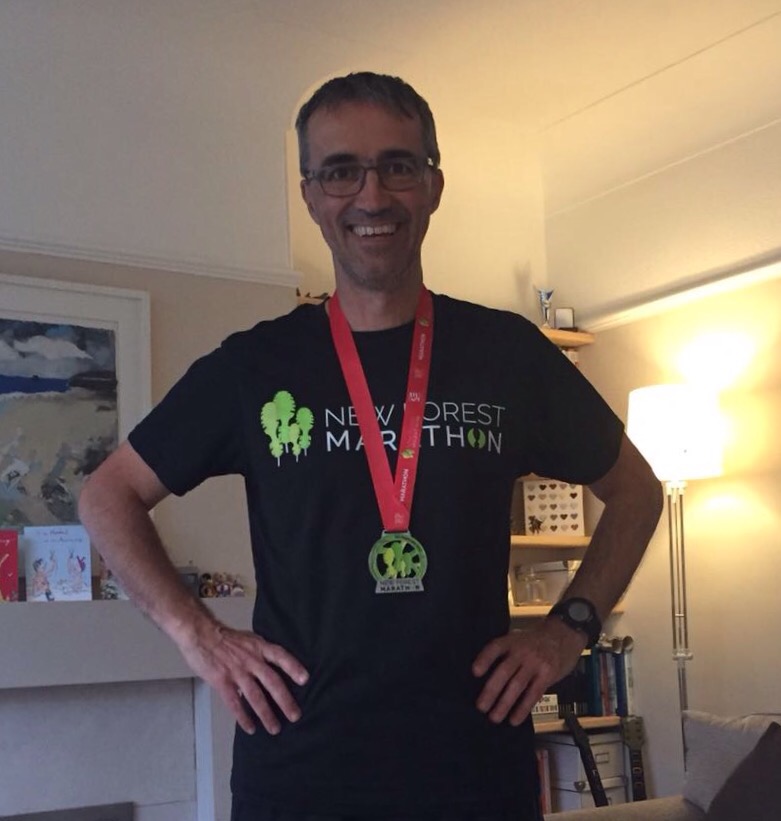
The only picture I took from the event was when I got home later in the evening. For some reason I seem to have adopted some kind of crazy ‘power pose’, but I’ll share it here anyway:

My Intentions Manifesto

Over the last few years I have been absorbing content from various books and podcasts which has gradually been re-shaping the way that I try to live my life. Amongst this reading and listening has been quite a lot on aspects of productivity, Stoic and eastern philosophy, mindfulness and creativity (to list just the broad topics that come to mind immediately). Recently, I took the step of trying to boil this down to a series of short, simple principles that provide a kind of manifesto for my life. I can’t say that I necessarily always manage to live by these principles, but I have them written down and have them easily accessible so that I can glance through them and remind myself how I want to be. Initially, they changed quite a bit as I iterated them towards a state that I was happy with but the list seemed to settle down at 9 items which I think capture everything I want captured for now. I thought I would share them here. They are expressed not as instructions to myself but as intentions and so I am calling this list my Intentions Manifesto. It goes like this:

I intend to…

… be PRESENT

… be DELIBERATE [1]

… be PLAYFUL [2]

… focus on SINGLE STEPS

… take ACTION

… take the STAIRS [3]

… act with KINDNESS

… keep moving FORWARDS [4]

… leave things BETTER [5]

Notes:
[1] I often come back to the idea that whatever you do you should do it deliberately rather than accidentally.
[2] I loved Mark Rowlands exposition of the importance of play and being playful in his book ‘Running with the Pack’. He (sort of) defined play as being when you deliberately choose to do a task in a manner that makes it harder than it needs to be for no reason other than because you can. I liked that idea.
[3] This comes from Rory Vaden’s book ‘Take the Stairs’ and captures the/his idea that if you tackle the hard stuff now, what follows becomes easier but if you take the easy route now what follows is harder (‘Short-term easy = long-term difficult, short-term difficult = long-term easy’)
[4] I mean keep things/stuff moving forwards at all times not keep physically moving forwards although the latter is also good advice when running a long way!
[5] This comes from a podcast (it might have been The Unmistakable Creative interview with Jim Bunch but I can’t be sure without going back and listening again). Anyway, expressed in a slightly fuller form I mean that it is a good idea to always leave environments in a better state than you find them in. An environment could be the world around me generally but it might also be something small like the bathroom, my office or even my bag.

The Action Grid

On Monday I shared my thoughts about a a new system I had stumbled up (invented?) to become unstuck and get more things done. Now, at the end of a full week at work using it, I thought I would look back on how things have panned out and make an initial judgement on whether the system has actually helped at all.
The first thing I should note is that I don’t recall working so hard (just in case anyone important is reading this I should point out that, obviously, I always work hard). I feel tired and I am looking forward to some downtime this weekend. But I also feel satisfied that I have got a lot done, more than I would have done if I had just come to work and tried to do some stuff. I have also taken less breaks, partly because I want to save money by not buying coffee so much, partly because a lot of colleagues are not in work at the moment so I have eaten lunch on the go, but also because I have had a singular focus on wanting to make progress.

I have named my system the Action Grid. This week it has had 10 columns (projects) which I think is perhaps one or two too many. For each project I planned a next action for each day (either in advance or from one day to the next). I have made progress on all of these projects, just missing a couple of actions on a couple of projects on Monday and finding myself running out of time for three actions today, although I could probably achieve these if I hadn’t also decided to spend the last couple of hours of the week reviewing everything, catching up on email and setting things up for next week instead. Here is a picture of my Action Grid as at the middle of Friday afternoon:

Through the week I have completed quite a lot of tasks that I KNOW I would not have completed if I hadn’t been trialing my Action Grid system. I have written to two old friends, something I have been meaning to do since Christmas in one case and since last summer(!) in the other. I have finished sorting out my research-paper archive in my filing cabinets (which I started doing last summer). I have phoned the media company to cancel my Sky Movies subscription, thereby saving ~£12 per month (so if I had done this a year ago like I could have done I would be almost £150 richer…). I have made substantial progress in completing my database of Marine Science degree alumni (adding 2017, 2008, 2007 and 2006 – just 2005 and 2004 to go now). I have spent at least an hour each day working through some Matlab workshops to brush up my Matlab programming skills. I have moved forward a worthwhile amount on a couple of work (School management) projects.

I think that it was particularly useful to decide on the projects that were going to get my focus this week and to adopt a strategy of trying to nudge each of these forwards a little bit every day. Some days I made a fairly substantial step, other days I just printed a document or sent an email, but every day I moved forwards on each project. One week is not enough to judge the usefulness of this system for me, especially as this is a summer week when there are few distractions in terms of teaching sessions, meetings etc. and when the university is generally pretty quiet. But I know that in previous years I have struggled to be very productive during such weeks so this one has been quite a revelation. Suffice it to say that I will certainly be giving my Action Grid system another go next week.

Watching the waters go by

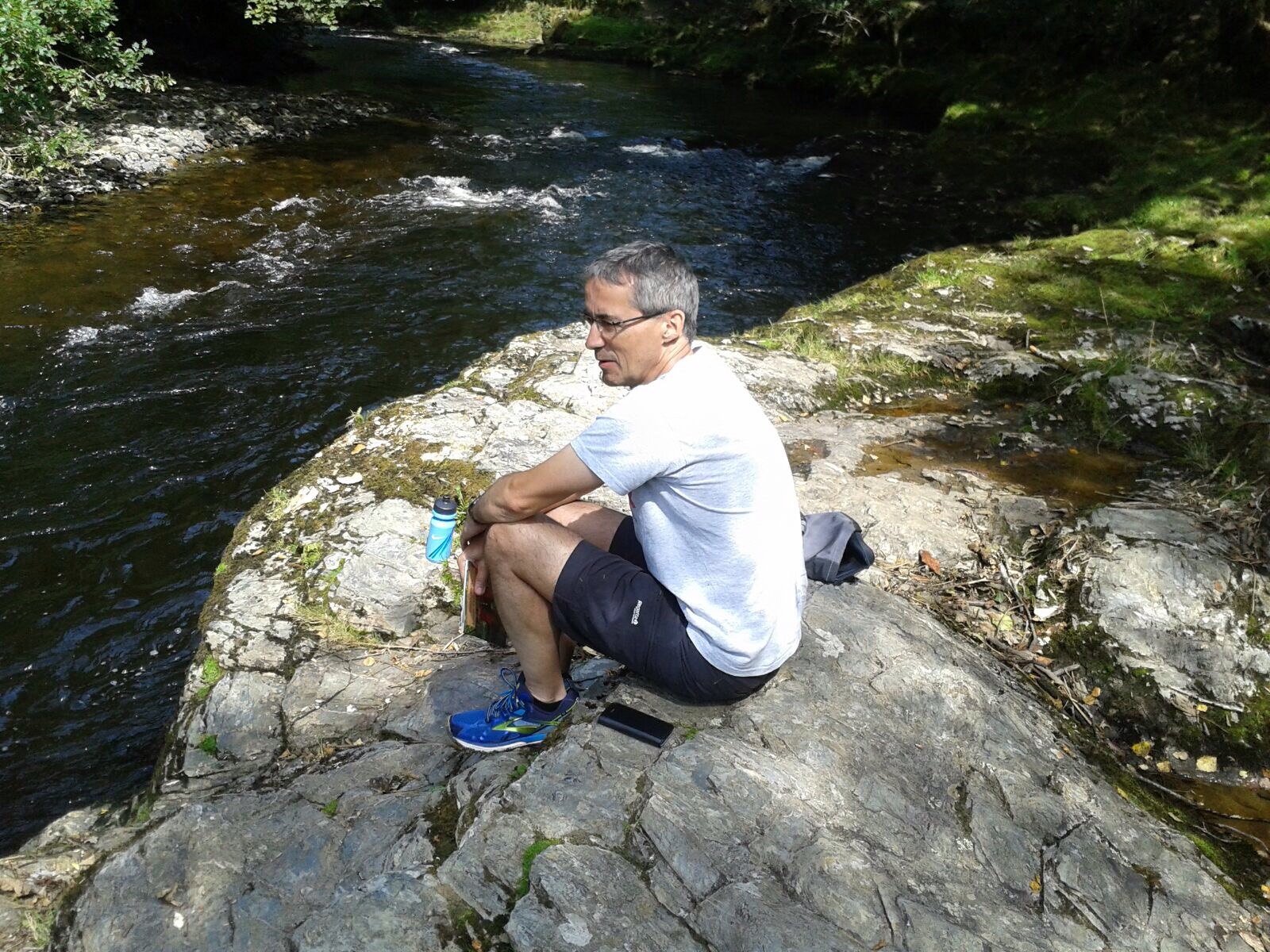
On Sunday we took a walk from Long Ash near Horrabridge down to Double Waters – the aptly named confluence of the Rivers Walkham and Tavy and then back via Grenofen Bridge. At Double Waters we stopped for a while and ate a picnic lunch sitting on a rock next to the river Walkham. It was a marvelous place to watch the waters go by and to contemplate. The waters flowed rapidly past shedding eddies, creating waves in the surface and carrying a constant stream of leaves, sometimes floating sometimes submerged, but always flashing past in an instant never to be seen again – a perfect reminder of the transient nature of existence.

IMG_2990