
Stumblings #1

This is the first of what may, or may not, become a series of posts in which I write about five things I stumbled upon in the last week or so. These ‘things’ might be anything: a book I read, a film I watched, something I created, a piece of insight gained. I have no idea whether I will be able to sustain this, what it will become in the future or whether anyone will find it interesting, but if nothing else, I intend to enjoy recognising the five things I stumble upon each week and recording them in this way. Here goes:

1) Accidental Creative Podcasts
I came across the Accidental Creative website a while back and read the first book by it’s author, Todd Henry, towards the back end of last year. Accidental Creative is aimed at ‘creatives’, taking a wide definition of this word along the lines of ‘someone whose work entails them creating value on a regular basis’. I really enjoyed the book and found a lot within it that resonated with my struggles to remain productive and creative. More recently, I started listening to the Accidental Creative Podcast and my decision to include this entry in my Stumblings is specifically inspired by a podcast on ‘Procrastinating on Purpose’ that I listened to on the way home from work one day last week. The basic idea of PoPing is that you should decide what to do at any point based not simply on whether tasks are urgent or important (classic time management approach) but also whether they are significant. Like most ideas of this type, it’s all just common sense really, in this case that it is a really good idea to deliberately spend time doing things that enable you to be more productive in the future (such as developing skills, laying foundations, scoping a project) and that to do this you have to deliberately put off until later other tasks that you could do now but don’t have to. The danger is that you simply do the tasks you can do now, create an illusion that you have been productive but then not enable yourself to work ‘better’ in the future. Anyway, I include the AC Podcasts here not for that specific episode but just as something that I think is generally seeming to have some value for me.

2) Tchaikovsky Symphonies
I grew up to classical music and always had a particular liking for Tchaikovsky. But in recent years (actually more like the last 30 years) I haven’t found time for myself to listen to classical music so much. A couple of weeks ago I went to see the film Birdman with my younger daughter and Tchaikovsky’s music features quite heavily in the soundtrack (a great choice for the film because, for me at least, T’s music is laced with strain, yearning and a feeling of desperation). Subsequently, I decided to listen to T’s later symphonies (surely his best works) and this reminded me how much I liked them and how great they are. As a child I was always most taken by the 5th Symphony, but I have to say that from this recent re-listening, the 4th Symphony is the one that did it for me this time. The music in the first movement seemed to reach right inside me, rip out my heart and then wink mockingly at me. Not everyone’s cup of tea I suppose!

3) Regular Running
This year (well since 2nd January actually) I have been running every day, if only for a mile sometimes. I suspect I will write more about this in the future but, for now, I just wanted to record that there seems to be something different that happens to both your body and your mind when you run daily rather than just running a few times each week. Physically, I can start to see my body re-shaping itself which is interesting. Mentally, I find I am far more ‘level’, quicker to focus on tasks at hand and generally more positive. It’s well known that running induces chemical changes in your body but I hadn’t expected to notice such a difference in my response between running often and running daily. Of course, it might just be me feeling something because I want to feel it. We’ll see.

4) Action v Inaction
This is a simple one. I was musing about diving in and doing something versus thinking about doing something later and the following words popped into my head: “The brief moment for action is inevitably followed by a lifetime of opportunities for inaction”.

5) Whiplash
I went to see this film with my wife and younger daughter. All I want to say is that it is brilliant. I like films that are about something rather than simply a story. Whiplash is about what is and isn’t acceptable when trying to foster genius. It almost forces you to agree with some really unacceptable behaviour on the part of a teacher/mentor. Brilliant acting, brilliant filming, brilliantly playful, brilliantly thought-provoking. Watch it.
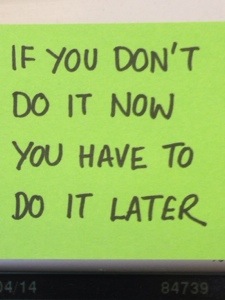
If you don’t do it now you have to do it later

I got stuck at work today. I was supposed to have a meeting lasting the whole morning but, unprecedentedly, it was all done and dusted in about an hour. Now usually a meeting finishing early would be a cause for celebration, providing a whole chunk of unexpected bonus time in which to do something useful. But alas, today I just couldn’t get started on any of the multitude of tasks that were waiting for my attention – marking projects, filling out my Performance Development Review form, revising some degree course web-pages to name the three most urgent.

I do tend to suffer from difficulty getting started at times, experiencing a complete lack of motivation despite having limited time and unlimited tasks, and it can be a real problem. I have tried to analyse why my motivation gets stuck sometimes but there is no real pattern to when things go wrong – it just appears out of nowhere. But a significant part of the problem is that the tasks awaiting me are just somewhat boring and have little direct value for me personally. They are just tedious tasks that need to be done that I don’t really want to do and so sometimes, I simply don’t.

In the end, after a period of frustration, I did get going, and partly this was because I told myself that I would have to do the tasks sometime so it might as well be now. The answers to problems of this type are invariably obvious and simple but it helps to remind yourself of them sometimes, which us why I grabbed a post-it-note, scribbled a few words on it and stuck it on my phone as a constant visible reminder for future times I feel myself getting stuck.

20140428-195900.jpg

My Running Week 2014 #17

This was a big week for my running as on Sunday I did my first ever Half Marathon (Plymouth), something that would only have been a vague dream a year ago.

Prior to the HM I had an easy week and just did a couple of slowish short runs of 3.4 miles on Monday and Friday down into Hartley Vale, through Linketty Lane up to Widey and back through Crownhill and the Manadon roundabout to home. I spent the whole week expecting to succumb to a bad cold that was doing the rounds at home and so the only thing on my mind was to keep healthy and make sure that my legs didn’t seize up.

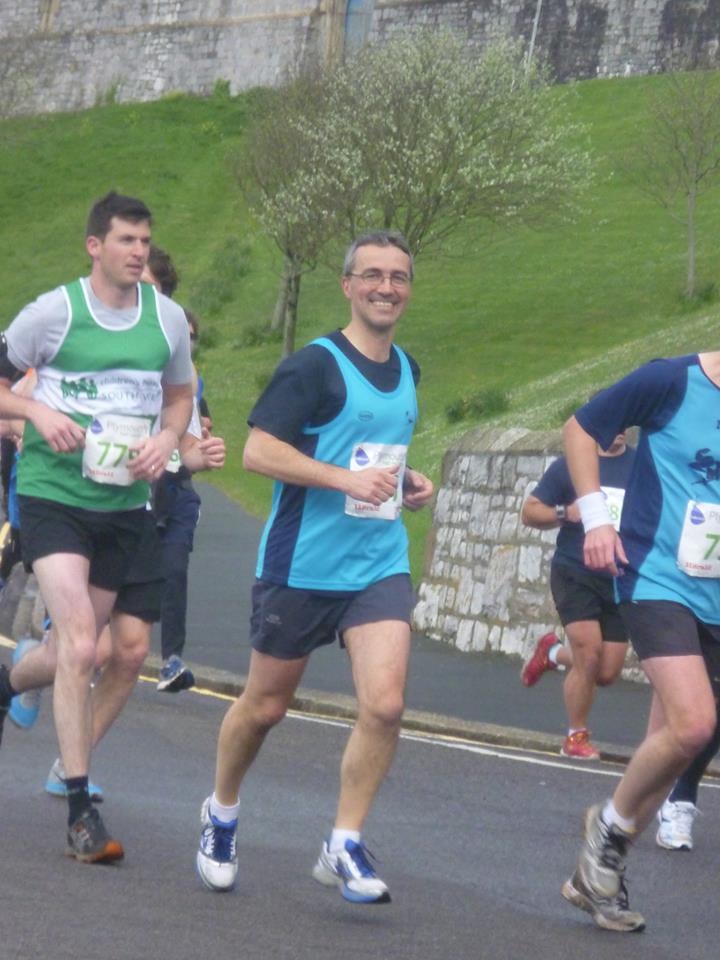
So, on Sunday morning I did the Plymouth Half Marathon. I had a target time of 1 hour 50 minutes and despite a somewhat congested start I was running along nicely in the opening 4 miles or so at ~8 minute mile pace, well within the pace I needed for a 1:50 time. The route then started the slow climb up Billacombe Road and it surprised me here to find myself overtaking people who were already walking – bad race planning/pacing on their part. I maintained a good pace through the next few miles and then entered the Saltram House estate and deliberately made full use of the downhill stretch it presented. At around 8-9 miles I found myself passing the 1:45 pacers and at that stage I thought maybe that time was possible but they went past me again at about 9-10 miles and I didn’t see them again on the remainder of the route. I did slow somewhat in the last 3 miles or so and the final mile of the route was tough with a nasty little hill to finish. I completed the run in 1:45:51 which surpassed my expectations and will be good enough to earn me a bronze certificate from the Plymouth Musketeers (to match my bronze for 10k earned a few weeks ago). It was a great experience, with over 4200 runners (I placed between 800th and 900th) with quite a few people I knew cheering me on along the route which was nice.

Here is a nice picture of me near the start of the race:

Plymouth Half

If University departments were football teams

At about this time of year, with issues of promotion and relegation beginning to be settled, professional football teams start to make their plans for the next season. As part of this process the manager decides which players with expiring contracts he wants to offer new contracts to, which he will release and which players with ongoing contracts he wants to push out of the door and make available for transfer or loan to other clubs. The result is a rush of ‘retained lists’ and ‘released lists’ signalling to other clubs that Player X is wanted, Player Y can leave, Player Z is available to other teams for a price. At the same time, work begins to recruit fresh talent to plug gaps in the squad, bring in fresh young talent or an experienced old head.

The thought struck me earlier that it would be interesting if a University department operated in the same manner. At the end of the year the Head of Department, or Subject Group Head, would look at the performance of the academics in the subject area, review student feedback, look at research output, look at teaching requirements for the next year etc. and make decisions on who would stay and who had to go. They might decide that the subject area needed to bring in an experienced, already productive research professor, or perhaps several energetic and eager new faces. They might take the chance to cut away the dead wood or offer reduced or improved terms to existing group members.

In such an environment, it would be incredibly different to work in a university. Gone would be any notion of stability. Faces would have to fit, measured productivity would be paramount. Academics would become itinerant mercenaries, loyalty would fly out of the window and priorities might shift at the whim of the management team (actually that bit happens). In my opinion, in such a regime, Higher Education would be completely unattractive place to work for most people. But it would be very, very interesting to see who would end up on the retained list and who would be released and whether, in the end, quality could be improved by a much more ruthless approach to hiring and firing personnel.

A Puppy is for Life…

Today at work, completely out of the blue, I received an email from a former student requesting some help on a small piece of oceanography work he is completing for an Open University course. It was something I hadn’t given any thought to for at least 20 years and so I wasn’t immediately able to help. However, being the kind of person that I am, I dug out some textbooks, looked at my old MSc Physical Oceanography notes and, when these avenues failed to provide any quick insights, I had a root around online. All of this searching led me to conclude that the question being asked didn’t have a particularly straightforward (aka ‘one-line’) answer, but I was able to respond with some general guidance and a link to a comprehensive set of US university course notes that were relevant.

This particular former student was (how can I best put this?) one who I had to give a lot of support and guidance to while he was on the course so I found it a little amusing that I was still his ‘go-to’ person for help some three or so years after he had left. I happened to mention today’s contact to a colleague and his response was ‘A puppy is for life…’. I think some people might find such contacts a little on the irritating side but I generally go about life helping people as much as I can when they ask me for help and so I suppose it is no surprise that for some students this ‘service’ continues long after they have left. On reflection, I don’t think I would want it any other way really.

My Running Week 2014 #16

I managed three runs this week – one longer slower run and two short fast ones.

The first run was on Monday morning when I set out to do 10-11 miles at a steady pace as my last long run before tackling the Plymouth Half Marathon. I tried a new route from home, down through Hartley Vale, under the A38 via Linketty Lane then up to Plymouth Garden Centre, along Transit Way, across to Kings Tamerton, through Ham, over Central Park, around the park and home. It turned out to be a pretty tough run with some decent hills (much hillier than the Half Marathon route) and I completed the 10.7 miles in just under 1 hour 35 minutes or 8:51 minute/mile pace. Given the route I was happy enough.

Then, on Thursday, I did the 5k ‘Timed Run’ with the Plymouth Musketeers. This is a regular run in which everyone runs the same 5k loop down into Ernesettle and then back up Biggin Hill to the start. It was my second time on this run and I achieved a time of 24:47 which was about 2 minutes quicker than my last attempt several months ago. Coincidentally, on both occasions I finished 13th overall!

On Saturday morning I did the Plym Valley Parkrun for the 18th time and set out to achieve a Personal Best on the back of my new 5k PB achieved at the Worcester Woods Parkrun the previous week. I did achieve a PB for the route (23:12) but missed out on a 5k PB by just 4 seconds. I have a couple of 5k targets within close reach now – an overall 5k PB and a sub-23 minute time, both of which I hope to achieve in the near future.

A bits and pieces day

Today I had what I would describe as a ‘bits and pieces day’. Looking back on the last 8 hours or so there is not one particular task that I have done that I would identify as a highlight but there are a lot of smaller tasks that have quite neatly rounded a few things off and left me with an overall feeling of useful achievement to take home ahead of the long Easter weekend.

In short, I have had a discussion with a senior colleague about actions we can take to connect better with potential students, photocopied a sample of marked coursework for two modules, advised a student who wants to repeat a year of his course, made a list of the Final Stage projects for next year, collated materials for an in-class test I am running next week and caught up with my entries on this blog.

It would be nice to be able to point to one significant more creative triumph from today but actually I am quite content, because sometimes a bits and pieces day is exactly what you need.

Just when you think marking is finished, it isn’t

There is always an immensely satisfying moment that occurs on completion of a big pile of marking because, make no mistake about it, marking student work is pretty much always a hard, somewhat depressing, slog. It is a repetitive task and, sadly, often serves to highlight what students don’t know, don’t understand and what they don’t know howt to do rather than being a celebration of creativity, insight and high level performance. It also lays bare any slight ambiguities or uncertainties in the assessment brief and potentially exposes areas of content that perhaps were not taught as well as you hoped or thought they were.

So it was when I recently finished marking my Year 2 Meteorology coursework. There were not too many scripts (18), but each piece of work comprised three quite significant separate elements, and going through each piece of work, writing feedback and grading the work took me the best part of two full days. But then it was done – cue the ‘immensely satisfying moment’. Only that moment of completion was a false dawn… because completing marking of a piece of work is not the same thing as completing the whole process of assessment for a piece of work, as there is a second component of the process – independent internal scrutiny – that has to be done before the marks can be finalised.

Independent Internal Scrutiny can take a number of different forms but in many cases (including this one) it involves finding a colleague who was not associated with the assessment and getting them to look through the set of marked scripts to check that the marks awarded are appropriate and the quality of feedback given is sufficiently high. This has to be done before the work can be returned to students and so almost always it is a process that has to be completed quickly in the brief gap between finishing the marking and returning the work within the University’s agreed timescale. There is a significant challenge here, namely to find a colleague who, although already extremely busy, is willing to give up some of their time at short notice to scrutinise your work. For me, today, during the Easter vacation and with almost all of my colleagues on leave and the work due to be returned to students in two working days time, this challenge could have been impossible, so it was with great relief that my tentative request to my colleague Jill Schwarz produced a rapid ‘yes’ and, better still, a pile of scrutinised marking within the space of a couple of hours.

It is tempting now to breathe the big sigh of relief and savour the ‘immensely satisfying moment’ – the marking is done, the independent internal scrutiny is done, the assessment process is done… but wait, there is still more to do; one final piece of assessment-related torture to carry out. Before I can hand the work back to students I have the joyous task of standing over a hot photocopier, producing copies of a sample of the work to put in a cardboard box so that the External Examiner can (if they choose) scrutinise the assessment and be satisfied that academic standards are being upheld and that the assessment process was carried out in a fair and appropriate manner. And this photocopying process is in itself a major task – removing staples/plastic wallets, selecting the appropriate choice of single or double-sided copying (often both within the same document), unfolding any oversized pages, feeding everything through the copier using every special technique known to humankind to avoid paper jams and then, inevitably, cursing very, very loudly when the photocopier does jam, the paper supply is used up or the toner runs out…

… but that’s a job for tomorrow.

My Running Week 2014 #15

We were away from home (mostly near Newcastle) so my running was a little different from usual this week, although as has been the pattern for quite a few recent weeks, my running consisted of just two runs again.

On Thursday morning I did a slow (10:18 pace) 7 mile run along the Tyne Valley from Newburn to Wylam and back along a section of the Hadrian Cycleway. This was all very flat and on a good surface. I had spent quite a bit of the previous three days either sitting in a car or pounding around shopping centres so it was great to get a lot of tiredness out of my legs and get moving again.

On the way back home from Newcastle we split the journey, stopping on Friday night at Droitwich so that on Saturday morning I did the Worcester Woods Parkrun (5k). This was my first piece of Parkrun tourism. The course was certainly flatter than the Plym Valley Parkrun but it was tricky at times. First, with over 350 runners the start was very congested and I had to work hard to move myself through the pack so that I could run freely. The route then did two loops skirting around and through a patch of woodland on a path that was very windy, rather narrow for the number of runners and not without the occasional hazard underfoot (e.g. tree-roots). The first half of each loop was more downhill such that the second half was quite a stiff climb. On emerging from the woods for the last time the finish was a downhill sprint across a field for a couple of hundred metres. I ran hard all the way round, looking for a new 5k PB, and so I was pleased to come in at 23m08s (7:29 pace), 46 seconds under my best time for the Plym Valley Parkrun. One interesting statistic was that I completed the two loops of the woods in almost identical times – 10:08m and 10:09m – so I was obviously running very consistently throughout the race which is pleasing.

My Running Week 2014 #14

I completed just two runs again this week, the Plymouth Musketeers group run on Thursday evening (Central Park route with the 9 minute/mile group covering a whopping 6.6 miles in total) and a second longer run on Saturday afternoon after returning from work at an Applicant Day.

The Saturday run was a 10 mile up and back run along the Plym Valley trail. I set off thinking I would do a mile or two at a slow pace and then try to do 10 miles at 8 minute 30 second pace but quickly decided that I would do 10 miles in total and, having done a slow first mile (9:17 pace), try to get my average pace for the run down to 8:30. As the route took me higher I rapidly found myself running in low cloud which added a nice ethereal quality to the run. I turned around just before the Leighbeer tunnel. It was a good run and I easily managed to get my average pace down to the target level. It was not as quick as I hope to go in the upcoming Plymouth Half Marathon (my first run at that distance) but it was a good average pace on a route that is definitely uphill to the turn.