The Great Wave Off Kanagawa… in Mutley

Yesterday morning, at the end of a lecture I gave on Waves and Tides, I showed a picture of Hokusai’s famous work of art The Great Wave Off Kanagawa. My lecture was being observed by one of my colleagues (every year we have to observe and be observed) and she remarked afterwards that there was a Plymouth version of The Great Wave painted onto a wall in the Mutley area of Plymouth. After a short discussion we established roughly where this mural was and I was surprised to find that it is on a road that I have driven along many times. My colleague said they thought they had a photograph of it and just now they have tagged me into a tweet that they have posted with their picture. It’s absolutely tremendous – a graffiti style rendition of the great work in bold colors, somewhat simpler than the original but capturing the same scene and sufficiently similar to be immediately recognizable but not so similar that it is simply a copy.

Here is the picture – I am absolutely going to have to make a special trip there soon to find the building a take a picture or two of my own…

Board Games… It’s Work, But Not As We Know It

I spent this afternoon at work in what is perhaps the most unusual manner of any afternoon that I have spent at work, in a room overlooking Plymouth Sound with 60-70 first year students all playing board games. These students are one week into their four week ‘Our Ocean Planet’ module in which they design and present an artifact to communicate a marine science-related issue. Artifacts can include posters, videos, TED-style talks, campaigns, blogs and …. board games. So, the idea of the session today was for the students to spend 2-3 hours playing one or more games in their groups, evaluating their experiences and having a think about what works well and what doesn’t. Alongside this of course, they were working together as a team and getting to know each other.

It was a really interesting experience to watch them at work. Groups of (mostly) four students (mostly aged 19-20) clustered on individual tables (per group) chatting away, reading rules, setting up, playing games through – thoroughly social, thoroughly engaged in their activity, clearly treating the session seriously and getting something out of it. This, on a Friday afternoon when the sun was shining outside and when no-one would actually have picked them up on not being there.

My role, along with that of the other tutors present was to help them along, to encourage, to join in, to pose questions about what they were doing.

Perhaps the most intriguing thing of all was the fact that for most of the session, certainly for the first hour or so and for some groups as much as three hours, there was almost none of the continual interaction with smartphones that is so prevalent everywhere these days. For a few tens of minutes, these students put down their tech and became immersed in cardboard pieces, counters, rule booklets etc. and, critically, each other. They became truly social animals and it was blindingly obvious that they enjoyed it.

I expect that on leaving the session most slipped almost immediately back into their internet-connected, social network-driven existences, but I do I hope that the little glimpse of real reality that I saw in action this afternoon continues to blossom in their lives.


Lucky Les – The Best Book Ever? – Reader, You Decide…

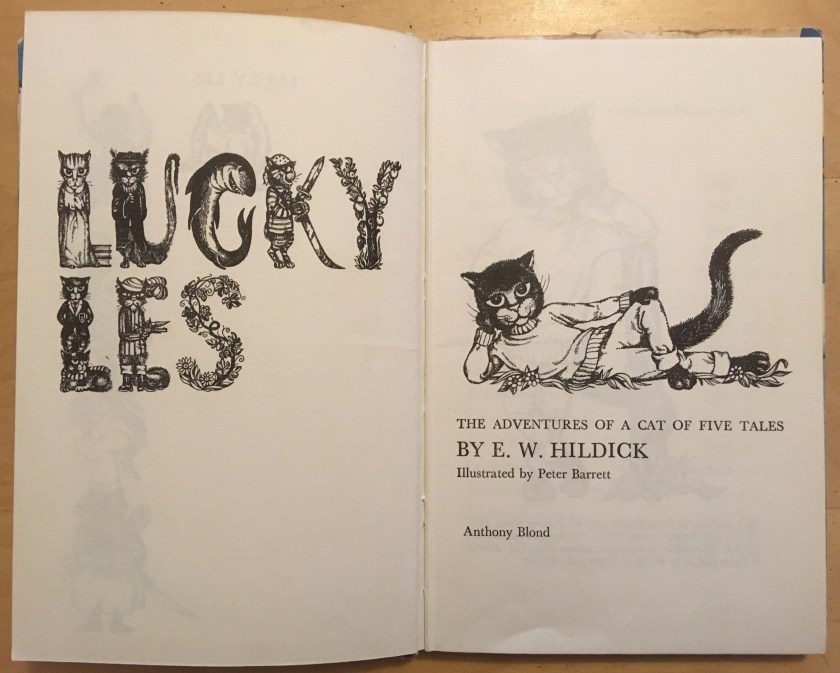
By far the best, most inspirational, book I had as a kid was ‘Lucky Les’ by E.W. Hildick:

The hero of this book is Les, the youngest member of a family of anthropomorphised cats who, being black, is naturally the luckiest of all his brothers and sisters. In fact, Les is so lucky that he is probably the luckiest cat alive. He always gets the cream on the top of the milk and ALWAYS got the black one in a packet of fruit pastilles (a part of the story that has always lived with me). He was that lucky.

The book is beautifully illustrated with pen drawings like these on the title page:

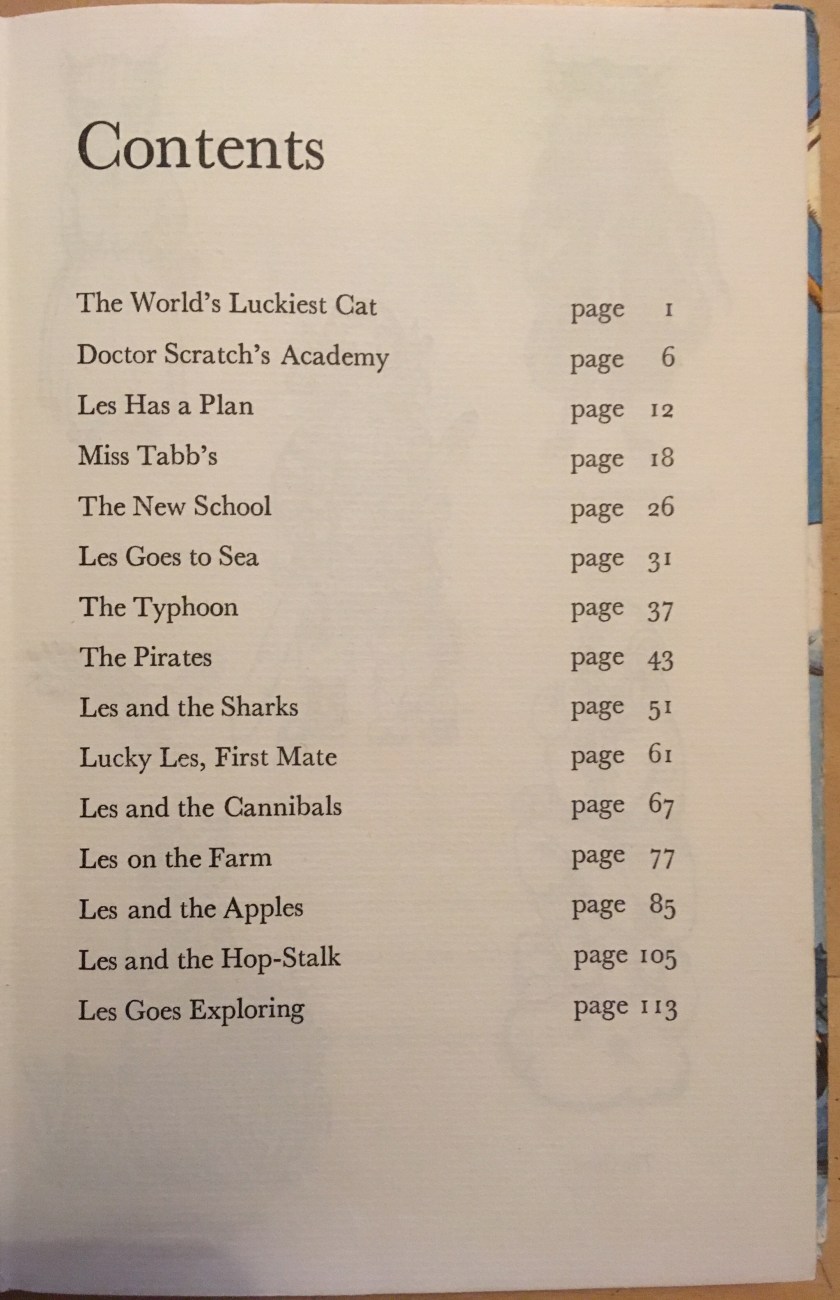
But the main reason that Lucky Les is such a great book is that it is cleverly arranged to provide multiple possible stories. At the end of most chapters the reader can decide what will happen next to Les (one of two choices each time pointing to specific later chapters) such that he can go to one of two schools (Dr Scratch’s Academy or Miss Tabb’s [Dr Scratch is essentially a pirate masquerading as a headteacher whereas Miss Tabb is so soft and caring as to be completely ineffectual at running a school – and guess what, if you put the two of them together you get the perfect school]) and then follow one of two primary career paths (going to sea or becoming a farmer) each of which then leads to various other branches (as a farmer he can grow apples or hops, a choice which ultimately leads him in two different directions). As such, Lucky Les perhaps represents the first piece of career guidance literature that I ever read (and at that time I certainly wanted to be a farmer so it is ironic that I ended up not going to sea but studying it!). There are five possible endings to the book but a couple of parallel branches along the way so in total I think there are about nine permutations – which seems to me like a great way of keeping a young reader interested in a book for an extended period.

I really loved reading Lucky Les as a child (in the early/mid 1970s I guess) and am so pleased that I still have my original hardback copy. I must read one or two of the permutations again soon.

I have often thought that it is surprising that there are not more branching books of this kind and wondered whether I might one day have a go at writing one. Perhaps there is scope for a follow up, something along the lines of ‘What Lucky Les Did Next’ or, if I allow myself to be really cynical for a moment: ‘Unlucky Les: What Happened When The Luckiest Cat In The World Grew Up’.

Meet Spike

This morning I gave a once-per-year lecture session on ‘Creating a Website’ as part of the ongoing Marine Science Communications module ‘Our Ocean Planet’. In this session I talk about how easy it is to produce a website these days using platforms such as WordPress and I use a few of the websites that I have produced over the years as examples. Amongst those example websites was, of course, this one.

I have written before about how I don’t write the entries on this blog for anyone in particular. I know that there is almost no audience looking at this blog on a regular basis. I am simply using writing these blog posts as a way to maintain a discipline of writing something everyday. Of course, I would be lying if I didn’t admit that I’d like to think there could be an audience, at least for the occasional post that I write that actually says something interesting or useful (if these even exist), but that is different from writing in the expectation that anyone out there is at all interested in what I have to say.

Today though, suddenly, this site has attracted a few readers, as evidenced by the spike in visits and views shown below:

These numbers are still small, but against the background of the visits and views for a ‘normal’ day the spike in activity is huge. It is also, of course, artificial. These visits and views have only occurred because I was using this site as an example in my lecture this morning. They simply show that there were a few students in the audience who were either interested enough, inquisitive enough or perhaps just plain nosey enough to visit and dig a little deeper. They very probably took a quick look and left rapidly never to be seen again which is, of course, absolutely fine because that just returns me back to normality. But who knows, it’s possible one or two might come back again in the future in some random moment when they are at a loss for something to do and wonder what I might be writing about, whether anyone is still sat in a chair, whether beetroot is still on the menu or whether I have finally managed to come to enjoy marking.

It has been nice to see Spike today, but he’s only passing through and will be gone tomorrow.

Marking and Running

I spent today at home marking student courseworks from my second year Meteorology module. Regular readers of this blog (yes, I know, there’s no such thing really) might recall at least one previous post that I have written moaning about how much I hate marking and mostly I just want to say it again – I hate marking. In fact, I really, really, really detest marking. Of course the completely ironic thing about this feeling is that most of the students who produced the work that I am marking hated having to produce that work. Some of them probably really, really, really detested having to produce it. Which makes us kind of even I suppose, although it seems a bit unfair that they each only have to suffer once whereas I have to suffer as many times as there are students. Sometimes I think we should enter into a pact. I’ll not set them any work to do, they won’t have to do it, I won’t have to mark it and we’d all be happy. Sadly, of course, such a beautifully simple and elegant solution is not allowed. Marks there must be and, in truth, it is through having to do assessed pieces of work that most of the learning happens which is, after all, the whole point of studying a subject at University.

As I get older I try to see the positive side of things and so I have to ask myself what the positive side of a day spent at home marking might be. The answer is actually rather simple. On a day when I go to work I spend approximately 40 minutes getting to work in the morning and another 40 minutes getting home again at the end of the day. I have a two mile walk (usually – tomorrow it is three because I am starting at the Marine Station) which takes me between 30 and 35 minutes but there is always some time lost at either end going through doors, taking off my coat etc. All of which means that by staying at home to mark I get back 80 minutes of my time, and what can I do with 80 minutes? I can run 8 miles. Which is exactly what I did at the end of this afternoon – 8 miles down and around Mannamead (Thorn Park, Mutley Park) across Mannamead Road along Seymour Road and up and down a few hills, back across to Mutley Plain, down into Hyde Park and Central Park, past Argyle’s ground and home after a few twists and turns along the way – a route that seems to have become my go-to route over the last few weeks – 8 joyous miles in the misty, drizzly half-dark which more or less cleansed my mind of the horror that it had been through for most of the rest of the day (I exaggerate a little).

Marking and running. Without one I wouldn’t quite have had the opportunity for the other and probably wouldn’t have enjoyed it as much either. In the end then, it was not such a bad way to spend a day after all.

‘Our Ocean Planet’ gets underway

Today is the first day of a module that I help to teach called ‘Our Ocean Planet’. It is completely different from other modules I work on because 1) it only lasts 4 weeks and is the only thing that the students who are taking it do for those weeks and 2) it has very little technical content. The idea of the module is for small groups of students to pick an issue relating to the oceans and develop some kind of ‘product’ designed to communicate the issue to a wide audience. In the past we have had groups produce talks, books (for various age groups), websites and quite a few games. It’s quite a fun and interesting module to be involved with because no two groups are the same and at the outset there is no knowing what direction any particular group will take both in terms of the topic/issue that they cover and the vehicle through which they choose to communicate it.

This year I am involved in two ways. First I will be ‘looking after’ four of the working groups (each with four students), although this going to be a somewhat lighter touch than in the last couple of years as there is only one formal meeting with each group each week. Secondly, I volunteered to give a few lectures to provide some background information on the oceans, aimed mostly at the students on the module who are not covering any marine science in the rest of their course. On the module we have students from various marine science and marine biology degrees but also some from geography, geology and environmental science and also some from English and creative writing. I gave the first of my lectures this morning, titled ‘Geography of the Oceans’, and covered the general distribution of the oceans on the planet, the shape and form of the seabed in different domains (continental margins, deep ocean floor, ocean trenches and mid-ocean ridges) and talked a little about the dynamic nature of the seabed and the Earth’s crust more generally (plate tectonics, seafloor spreading). The session seemed to go okay and I was pleased that I got the timing about right (this is always tricky when giving a session for the first time despite years of experience – partly because the more teaching you do the more comfortable you become just talking around a topic and this can mean that you take more time on topics than planned).

This afternoon the students have been out on and around Plymouth Sound taking photographs of the water and, in particular, litter and pollution in the water, and tweeting their pictures and thoughts about what they see. Later on they will be analysing this data to get a look at the bigger picture.

The real fun starts in a couple of days time when the groups start to properly form and, panicked by the short timescale available to them (3 weeks), start to decide on their topics and how they are going to communicate them. It would be nice to see some novel topics this year and some creative approaches to the communication side of things. We shall see.

Okay I Am Sat In A Chair

I received a text today from my younger daughter which reads ‘Okay I am sat in a chair’. For some reason I keep turning this phrase around in my head as if it has some kind of deep and profound meaning which I cannot quite grasp. It doesn’t of course, it was simply a reply to a text I sent telling her that we would meet her in the cafe in the IKEA store in Southampton (she was already in the store and we were putting some purchases in the boot of the car). But it is going around and around my brain and I can feel myself peering into the cracks between the words trying to draw out the hidden meaning that my intuition tells me is there if I only look hard enough. Perhaps it needs some punctuation. A comma after ‘Okay’ obviously does the trick but it could be a little bit Yoda like if there was a comma after the word ‘am’ to split it into two phrases – ‘okay I am’, ‘sat in a chair’ – but not quite. Now I come to think about it, I think it is this Yoda-like quality of the first three words that is making me ponder the whole phrase, and realizing that might just give me a means to escape the mental torture that I am putting myself through thinking about it so much. I should try to move on. In fact, I should not TRY to move on, I should just move on. After all, as Yoda himself once said ‘Do, or do not. There is no try.’

Awayday to St Mary’s

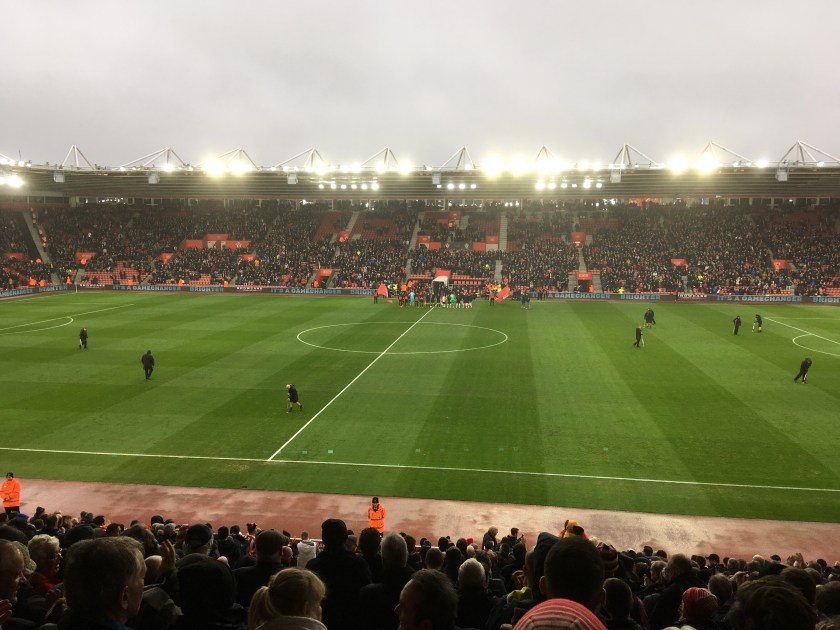
Today I had the slightly weird experience of watching a live football match between two teams that meant nothing to me. The occasion was the 4th round FA Cup tie between Southampton and Watford at St Mary’s which happened to coincide with there being no Plymouth Argyle home game to watch and a younger daughter who needed to be taken back to university in Southampton after a quick trip home for my elder daughter’s birthday.

The game ought to have been significantly better quality than the usual League 1 fare I get to see, what with both teams being Premiership outfits but, in truth, it was a scrappy game and remarkably like watching an Argyle match. Southampton took the lead in the first couple of minutes, through an ex-Argyle player no less, and then despite being the better team, managed to sit back and allow Watford time to gradually build pressure, helped by somewhat bizarre, defensively minded, substitutions. I felt an equaliser was inevitable but Southampton held on. The home fans grumbled just like Argyle fans, well perhaps not quite that much, so I felt pretty much at home!

Hedgehog Cake

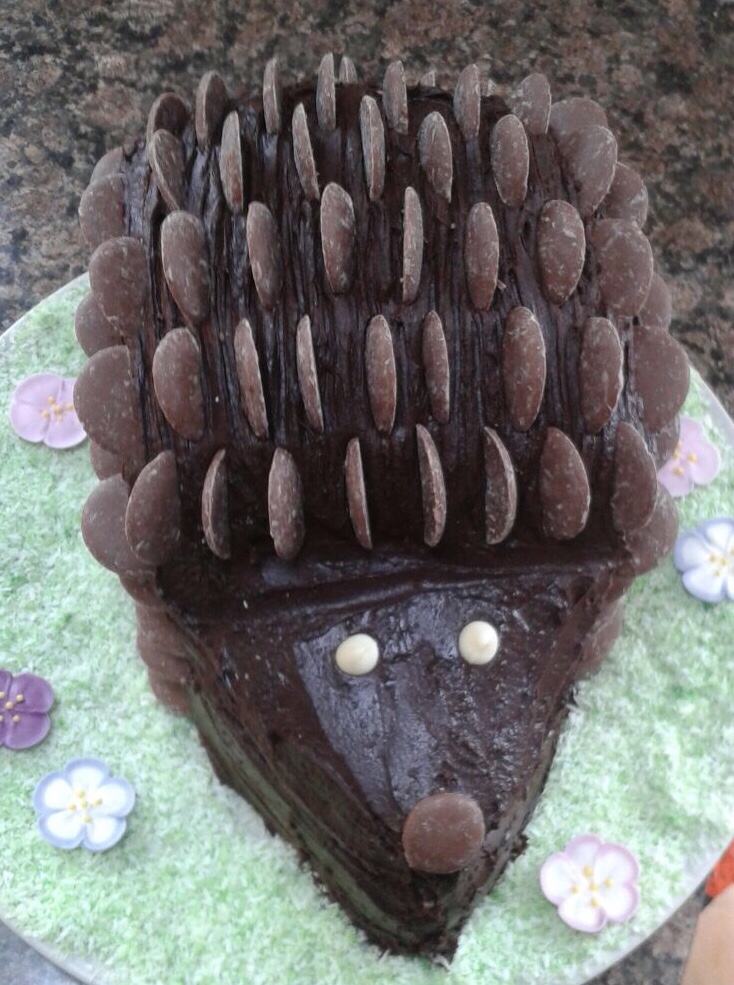
Today is my elder daughter’s birthday. At 22 years old it might be felt that she is too old for presents and birthday cake but in my book you are never truly too old for such things. In recent months she has become rather fond of hedgehogs and so my wife decided that this was the time to take on the challenge that is the ‘hedgehog cake’. Regular viewers of the Great British Bake Off spin-off programme GBBO: Extra Slice will know that making a complete hash of making a hedgehog cake is a pretty common occurrence, with viewers sending in their pitiful but frankly absolutely hilarious offerings. Thus it is with some pride that I am able to report that my wife’s attempt wasn’t at all bad – as I put it to her in a WhatsApp message earlier today: ‘it’s imperfection adds to its loveliness’ (which I thought was a tactful way of providing honest feedback…). The cake itself was absolutely delicious, even though I do try to tell myself that SUGAR IS EVIL POISON but, of course, taste is somewhat secondary when it comes to hedgehog cakes and so I can only finish this post with a photo to show the cake in all of its glory…

Putting Miles Into My Legs

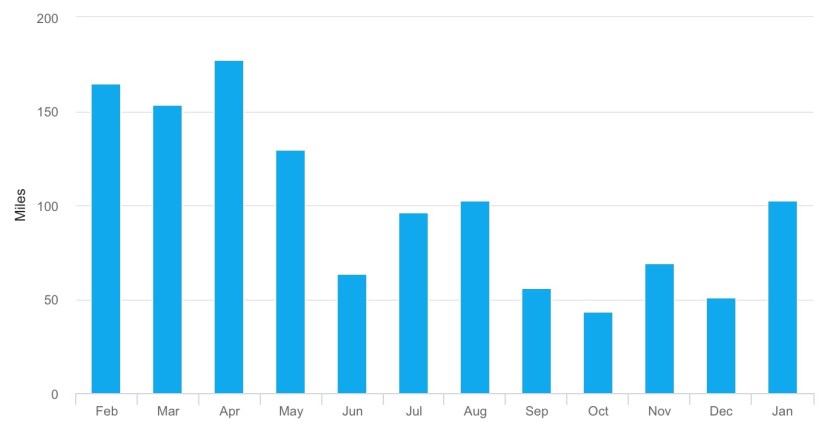
I ran just over 1200 miles last year which obviously averages out at 100 miles per month. In fact, my miles were heavily biased towards the first five months of the year as I prepared for and completed my first 50 mile event. At the turn of the year I decided that I’d like to try to spread my effort more evenly across the year and so I started this year with the target of completing at least 100 miles each calendar month.

25 days into the year things are going well and I seem to have acquired an additional mileage target along the way. Having run 25 miles in the first two weeks of the year it occurred to me that as well as evening my miles out across the months I could also even them out across the weeks and aim for 25 miles EVERY week. Now I am sure that at some point I will fail with this challenge; I am bound to succumb to a cold or have to miss runs if I am away or something. But for as long as I can the target now is 25 miles each week and I have already achieved this for four consecutive weeks bringing up the 100 miles for January also.

My legs have felt tired this week, which surprised me a bit as 25 miles is not an exceptional mileage but when I thought about it I realised that, although my current mileage is a lot less than my peak weekly mileage last year, it is a LOT more than I managed through the autumn months of 2017. This is nicely highlighted by the plot below which shows my monthly totals for the last 12 months (so February 2017 – January 2018). January 2018’s total is not at all remarkable when compared with February, March, April and May 2017 but it is SIGNIFICANTLY up on the preceding four months and is, in fact, my highest monthly total since last May (when I ran the 50 miler).

Putting all of these miles into my legs feels really great. It is like putting petrol in the tank. To run a long way there is no substitute for putting miles in the legs (although it is obviously important to put them in in a sustainable manner and not to build up too quickly). I will probably ramp things up a bit over the next few months as I build towards the Southampton marathon in mid-April and then after that my aim will be to maintain at least my current effort. This plan might get blown out of the water by illness or injury or if I do some crazy long event again and need more rest afterwards, but for now it’s just a case of keeping things ticking along.