New Music… The Low Anthem and Glen Hansard

I listened to a couple of new musicians/bands today with somewhat mixed outcomes.

First, this morning in the I newspaper I read a review of a new album ‘The Salt Doll Went to Measure the Depths of the Sea’ by a band called The Low Anthem. It is a ‘concept album’ that follows an old folk tale about a salt doll who gradually explores the sea. Each time the doll enters the water a little more of its body melts away (the third track is called ‘Give My Body Back’ and is when the doll dips her toe in the water only to find she loses it). It got four stars in the review and sounded intriguing (I really liked the idea of the story which, basically, says that the more you explore and try to discover yourself the more you slip away – I’ve not done it justice here and ought to re-read the review and follow-up on the story itself) so I thought I should listen to it not really having any idea what sort of music it was. It was okay – soft tones, percussion, piano – not especially memorable, not unpleasant at all but not something I think I will rush back to for another listen.

Secondly, I discovered that I had previously saved an album called ‘Didn’t He Ramble’ by Glen Hansard on Spotify, presumably as something I thought I might want to listen to at some point sometime and probably on the basis of another review in the newspaper. With no idea what I was about to let myself in for I hit play and rather liked the soft, folky, lilting tones – voice and guitar – with some tracks that made me stop and take notice from a lyrical perspective (‘Winning Streak’). This album is definitely one that I will return to and I think I will also explore anything else Glen Hansard has produced.
The Run That Ran Itself

Thursday night is club night at my running club (Plymouth Musketeers) and so tonight I took myself along and joined the 10 minute/mile group on a new route (Honicknowle). At the outset the group leaders were rather concerned that they wouldn’t remember the directions but in the end everything went smoothly and we discovered that the route was a relatively un-hilly and quick one compared to most of the club routes.

Before starting the run and for the first half mile or so I felt tired and wasn’t expecting to particularly enjoy myself, but as the run unfolded I fell in with a few of the regulars and we just ticked along, chatting (mostly) about Plymouth Argyle’s recent upturn in form and football more generally. The combination of a relatively easy route, a whole bunch of runners who were completely comfortable with the pace and the good company and chit-chat on the way round meant that the run went incredibly smoothly, seemed fairly effort free and was just generally thoroughly enjoyable. When we got back to the club base I had clocked 5.4 miles at 9:41 pace so we’d got along at a decent lick and not really noticed it. It was a nice surprise.

The best way that I can describe the run, as I have titled this post, is that it was a run that ran itself. It doesn’t really get a lot better than that (well perhaps it would if it had been light so that we could actually see where we were going and then been running somewhere with good views… but that’s just being picky). I’d be quite content if all runs were a bit like this evening’s.

Free Coffee

This is quite a funny situation to be in but perhaps also a bit worrying…

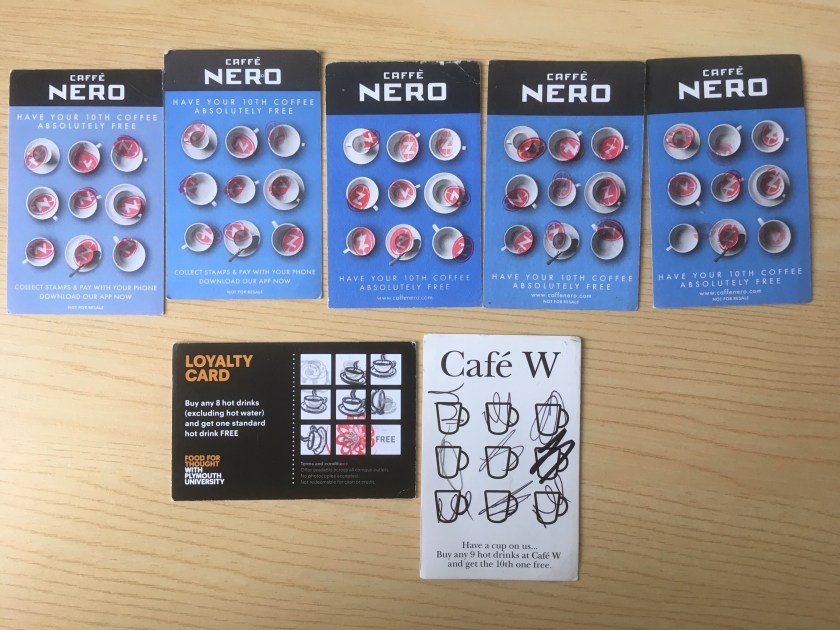
At £2.30-£2.40 a pop in Caffè Nero, £1.90 in Cafe W and £1.80 in the University, this represents almost £140 worth of coffee consumption (albeit over several months and partly funded by gift cards given to me for my birthday in October and at Christmas), not to mention a fair amount of time…

…but still…

Reading and Walking

Today, on my way down to the Marine Station from my office for an afternoon session on a first year module ‘Our Ocean Planet’ I found myself with a decision to make. I had not read anything scientific yet, had nothing scientific to read on me and knew I would have little time for scientific reading later on. Why was that a problem? It was a problem because my ‘scientific reading’ streak was sitting at 50 consecutive days and counting and so I was faced with a decision about whether and how to keep it going.

Without any real pre-meditation, as I walked down through the Drake Circus shopping centre I made a sudden left turn and dived into Waterstones bookshop. I had 5 minutes to spare and thought I would just have a quick look to see if there was any popular science book that leapt off the shelf at me. I thought that at least if I had something suitable to read I MIGHT be able to carve out some time to read a chapter but without a book my streak was certainly lost. After a quick perusal of the shelf I settled on ‘Seven Brief Lessons on Physics’ by Carlo Rovelli, a neat little book with seven short chapters each covering some aspect of 20th century physics (relativity, quantum mechanics, black holes etc.). The book had two great virtues that made it suitable for my purpose: 1) the chapters were really short, under 10 pages and 2) it was cheap (£6.99).

With book in pocket I continued on my way, but as I got down to the waterfront and started to skirt around the eastern side of Sutton Harbour I found myself reaching into my pocket, bringing the slim volume out and starting to read the preface. I don’t think I have ever read a book as I walked and this was a particularly risky place to start with the quayside and a drop into water on my right hand side in places and cobbles and uneven surfaces under my feet for much of the way. But having read the preface I found myself piling into Lesson 1 on Einstein’s theory of General Relativity and in a piece of sublime timing I completed the chapter just as I approached the Marine Station. The writing was absolutely perfect for my purpose – beautifully crafted for a non-scientific audience but with a scientific depth that made it a worthwhile read. I had made a good choice.

The sun was shining and the weather calm, crisp and clear so conditions were more or less perfect for my first foray into reading while walking. I did enjoy the experience and I can imagine repeating it again in similar circumstances.

Best of all, my streak remains unbroken, now up to 51 days and, what’s more, I have six more lessons to read so no excuses for not pushing on towards 60!

Getting Going Too Late

Today I have encountered a frustrating issue that seems to crop up fairly often in my working days. To begin with, I struggled to settle into work well and found myself somewhat distracted and not working very efficiently for a good chunk of the morning. Then, this afternoon I found I was fully into the task I was doing and so I now find myself, at about the time that I am wanting to go home, properly immersed in the task and not really wanting to stop working on it. Actually, no, that’s wrong, I really DON’T want to carry on working on it and I definitely DO want to stop working and go home. What I mean is that I am now working efficiently and am tuned into the work task at precisely the time that I am going to (have to) stop working on it, when this morning, when I had more work time stretching ahead of me, I couldn’t settle. This happens quite a lot. I find I just get going towards the end of the afternoon but then have very little time to make good use of my burst of focus and energy.

I have wondered about this before and whether there is any way that I can make better use of what appears to be a natural rhythm to my working day or whether there is something I can do to shift the focus/energy peak earlier in the day so that it has a longer period through which to be useful. How can I create the ‘end of the afternoon’ feel in the morning? Is it a matter of doing things differently earlier in the day or eating differently? Might it simply be that as the available work day starts to shrink I am better able to push myself into a state of focussed activity in an attempt to finish tasks before I go home? I suppose that if it was just me that I had to take into consideration I MIGHT allow myself to carry on working into the evening. I seem to really switch on about 2-3 hours after I have eaten lunch or about 5-6 hours after I arrive at work so it might be that I need to spend a long time ‘warming up’ – that would suggest an earlier start to the day. I don’t know. I’m confused. I’d love to solve this one.

Back to Back Runs

This weekend, for the first time in ages (months) I have run on both Saturday and Sunday – so-called ‘back to back’ runs. This was partly because going into the weekend I was still quite well short of my 25 mile weekly target, but also because having now decided on my race events for the first half of the year I have finally settled on a training plan.

First, the race events. I have The Grizzly coming up in March, 19-20 miles of very varied off-road terrain including two lengthy stretches on shingle beaches, coastal footpaths, woody tracks with roots and stones to trip you up, lots of up (including one section on the coast path where the local mountain rescue team stand on guard in case anyone gets vertigo), lots of down, lots and lots of mud (potentially thigh deep in places) etc. Then, for April I have now finally gotten round to entering the Southampton Marathon, a race that I got my best ever marathon time in last year involving two laps including a back-and-forth run across the Itchen Bridge, a section through Southampton FC’s ground at St Mary’s and some other nice sections (although they have changed and reversed the route this year which has annoyed me a little). And then for June I have entered the 30 mile version of the Conquest of Avalon, an off-road ultramarathon in Somerset. All of which means that some proper training is needed…

Last year, when I ran a 50 mile route in May I followed a training plan from a website called ‘Ultraladies’. The plan seemed to me to be realistic and doable and, given that I got myself around a 52 mile route in under 12 hours, obviously worked. So, I am now following their 50km training plan. The key aspects of this plan are that I need to push the number of runs I do each week up to 5 (rest on Monday and Friday) and, most importantly, I need to start doing back-to-back runs on Saturday and Sunday. Everything I have read about distance training emphasises the importance of back-to-backs and so, this morning, I found myself constantly reminding myself that yes, of course I was tired, but that was the whole point and that this (the second run of the weekend) was where most of the training value comes from.

I ran 16 miles yesterday (Saturday) as per the training plan and was supposed to do 8 today but my other target of 25 miles minimum per week left me actually only needing to complete 3.4 miles. This meant that when I set out I had two numbers, 3.4 and 8, in mind and, for obvious reasons, quite a psychological pull towards the smaller one. And so I was absolutely delighted with myself when I steamed through the 3.4 mile point and just kept going. Training for long events is ALL about putting in the miles and now I am sitting here finally thinking that I am properly on my way, not just running quite a lot but running quite a lot with a purpose.

Atmosphere of Hope (Tim Flannery)

I have just finished reading ‘Atmosphere of Hope’ by Tim Flannery, a 2015 follow-up to his well-known book about climate change ‘The Weather Makers’. Flannery is an acknowledged global expert on climate change and, in particular, how nations and individuals are, or are not, responding to and trying to mitigate it.

Atmosphere of Hope is an interesting, albeit slightly odd, book. It is written in short chapters of 6-7 pages (which I like – I hate books with long chapters) that, at times, seem to be a bit thrown together. It is a little like he decided to rattle off a book but couldn’t quite be bothered to craft a really good one. However, he writes well and knows his stuff so despite this weakness, the book still works and is highly informative.

There is a lot of bad news in Atmosphere of Hope. Flannery spells out how, despite some progress, we are simply not doing enough to ensure that we have a better than 50% chance of 2 degrees Celsius warming. But, as the title of the book suggests, he also offers some hope, in particular highlighting advances in third-way technologies – ones designed to actively remove carbon from the atmosphere – and the huge potential for renewable energy sources (primarily solar and wind) coupled with electric vehicles to form a major part of a climate change mitigation solution. Overall, I was left reasonably optimistic – the advances in technology are massive and the rate at which use of renewables is advancing whilst economies are still growing offers considerable hope. I was most interested, and surprised, to read about how electric vehicles could act as the battery storage mechanism to even out the unsteady supply of energy associated with most renewable sources. I had never really thought about this idea before and how excess energy generated at times of high supply could be stored in millions of small vehicle batteries which could then feed energy back into the grid at other times.

One issue with the book, which is not the fault of the book itself but rather with the time that I read it, is that it was written before the Paris climate conference in 2017 and, perhaps even more importantly, in the pre-Trump era. It would be interesting to read Flannery’s thoughts taking into account these developments – I ought to have a look online sometime to see what I can find. Or I could just wait a few years for his next book!

Gavin and Stacey

We started watching the BBC Comedy series Gavin and Stacey tonight, getting through the first two episodes of Series 1 via Amazon Prime. My younger daughter was watching some of the later episodes while she was home over the Christmas break and my wife had seen one of these and thought it looked like a programme we would both enjoy. Hence us watching it tonight. And on the basis of the two episodes we have seen so far it certainly is. All of the characters have their own uniquely funny attributes and seem very well observed and it is a programme that doesn’t try too hard to be funny all the time, instead mixing various flavors of humour with wry observation and even pathos.

When I messaged my daughter to tell her we had started watching the series she asked me to let her know if I start to have a favourite character, a comment which made me ponder 1) who her favourite character is and 2) whether there was a character that she thought I would find particularly amusing. I have to say that although he has only played a small role in each of the first two episodes I have a sneaking suspicion that Rob Brydon’s character ‘Uncle Bryn’ will turn out to be the one. I also have a feeling that we’ll be watching more episodes over the weekend and probably hitting Series 2 before we know it…

Coffee Ripples

My teaching at the Marine Station for the ‘Our Ocean Planet’ module finished early this morning and so on my way back through town I took a few minutes to stop for a coffee and to work through and write down some thoughts I have been having about the need for me to find more time for creative projects (aka research) at work. Amongst these projects is a piece of work I would like to do looking at the development of bedforms (sand ripples) in time-varying flows – these might be sand ripples formed by the wind or sand ripples on the seabed formed by currents, including reversing currents such as tides and, perhaps, waves (although the spatial scales are quite different and so the details of the sediment transport processes might be very different and require a different model). This is an area of work that I was into yonks* ago. I have a pretty clear idea of the approach I want to take, I just need to knuckle down and try things out.

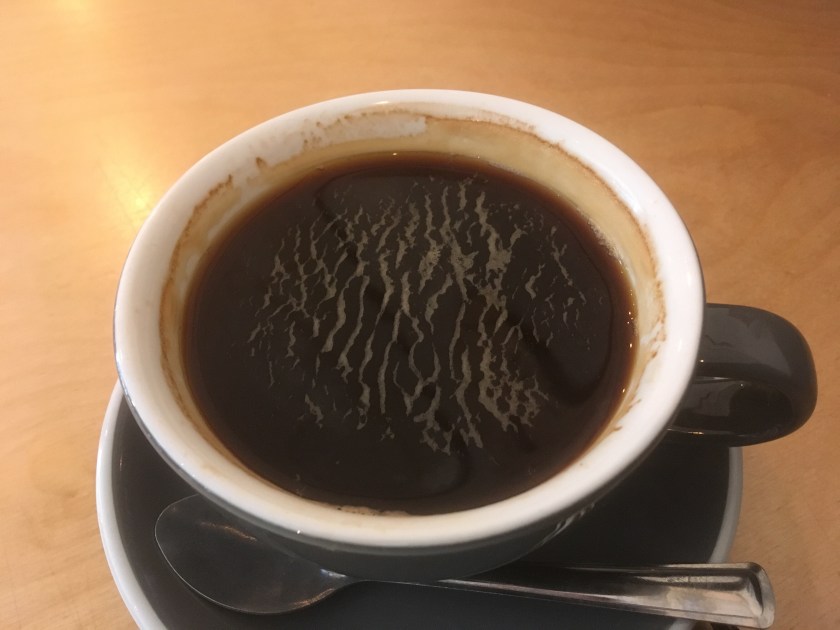
Anyway, I was sitting there writing in my notebook about creative projects and ripples with my cup of coffee (Americano) in front of me on a small table. This table had a bit of a wobble and I guess I was moving my body in some manner that caused the table to rock gently from side-to-side. I only realised this because when I looked up and looked at my coffee I was confronted with a pattern of lines (like ripples) in the surface…

These lines were aligned with the direction that the table was rocking (i.e. the table was rocking left-right as I looked at it and the pattern in the coffee was aligned front-back). It was a lovely, and fortuitous, example of pattern formation in nature of exactly the kind that I was thinking about. To try to extend things further I turned the coffee cup through 90 degrees and then deliberately set about rocking the table. I was hoping to make a new set of lines appear but at 90 degrees to the previous ones. The experiment was only partially successful. I broke up the existing pattern and saw some signs of new lines appearing…

…but I think my deliberate rocking was more forceful than my accidental rocking and I didn’t quite have the patience to make things work really nicely. Apart from anything else the coffee was getting cold and so I started to drink it. I think in my second picture you can see signs of a new pattern of lines aligned with the cup handle this time, but they haven’t completely redistributed or replaced the previous pattern.

This post nicely demonstrates both the pleasure and peril of being an inquisitive, scientifically-minded person. On the one hand, there is a rich world to discover in every single thing you do. On the other hand, it becomes impossible to simply sit and enjoy a cup of coffee without asking questions about what is going on!

*yonks = many years in case you have not come across this term before