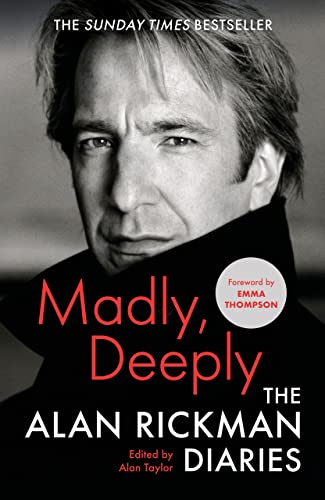
Madly, Deeply – The Alan Rickman Diaries

This morning I finally finished the weighty tome that is Madly Deeply – The Alan Rickman Diaries. I started it back in June 2023 and have been reading a section, usually 3-6 months of entries, most weekday mornings since then. So, it has been a long read and, to some extent, a bit of a slog.

I was attracted to reading Madly Deeply after reading a review article in a newspaper soon after it was released. The article made quite a big play of how wonderful Rickman’s actual diaries were to look at, often illustrated with really nice sketches and drawings relating to the themes he was writing about, so it was something of a let-down to find that the published book contained only five pages (of over 450 in total) that showed any of these illustrations (and two of those five pages were the inside front cover). But never mind, there would always be interesting insights to read about the Harry Potter films since he surely must have loved his involvement in those in his role as Severus Snape…

Alas, it turns out that Rickman clearly didn’t much like being such a major part of the HP film series to the extent that he almost bailed out part way through (imagine if that had happened…).

The first thing that hit me smack bang in the face when I started reading the diaries (they begin in 1993 and run through to his death at the age of 69 in 2015) was that his life was absolutely, completely, inexpicably busy. Hardly a day seemed to pass when he wasn’t flying somewhere, seeing a film or play, dining out with friends, rehearsing, discussing things with directors and producers and agents, fending off critics etc. In fact, it felt like he did most of these things on most days – one day in New York, then on to Paris, Prague, South Africa, Italy, California, London in an utter whirlwind of activity. Just reading about his life left me exhausted and I still cannot comprehend how anyone can cope with such a life and, apparently, have so much energy. [I wasn’t surprised when, quite far on in the diaries, he casually dropped in a reference to his ADHD… although his flavour ADHD was certainly not much like my flavour of ADHD!]

I can’t say that I particularly warmed to Alan Rickman as a person through his diary entries which surprised me a little, although on reflection there is really no reason why I might have expected to. His entries often paint a picture of a slightly bitter man, somewhat intolerant about the ‘failings’ of others (of which there seemed to be many), who seemed to feel a little under-valued and, perhaps, frustrated that he was not always understood as he felt he should be. But then there are also clear indications of loyalty, a desire for fairness and a love of his art and a quirky sense of humour.

Overall, it was interesting to get a little glimpse of a world that I was almost completely oblivious to prior to reading the book – an insane world of rushing about and pouring oneself into project after project – a world that truly must have been madly and deeply exhausting but, I guess, full of experience and excitement. I don’t want to rush about quite to the extent that Alan Rickman seemed able to but it’s perhaps useful to have received this glimpse of just how much a life fully lived can contain.
Stillness Is The Key (Ryan Holiday)

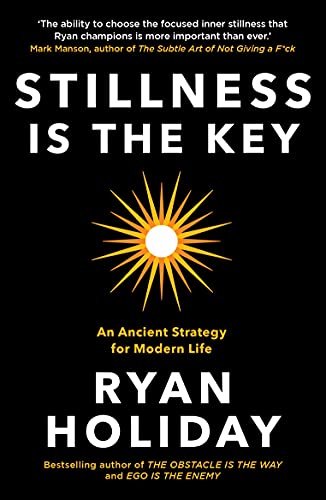
Stillness Is The Key was the third of author and modern-day purveyor of Stoic wisdom Ryan Holiday’s original set of books about the application of practicing Stoicism in everyday life. I read (actually listened to) the first two – Ego Is The Enemy and The Obstacle Is The Way – back in late 2017 soon after I started to become interested in Stoicism. Since then I have worked my way through the rest of his more recent output such that I would now probably have to label myself as a committed Ryan Holiday disciple. In 2018 I read The Daily Stoic one day at a time (something I am in the process of repeating this year) and then I listened to the first two volumes of his ongoing Stoic Virtues series – Courage Is Calling and Discipline Is Destiny – in 2021 and 2022 respectively. Last year I completed Lives of the Stoics and I have the third installment of the Stoic Virtues series (Right Thing, Right Now – Justice In An Unjust World) on pre-order for its release later this year. So with all of that in mind it is somewhat odd that it is only now that I have gone back to complete the original trilogy by listening to Stillness Is The Key.

With Ryan Holiday’s work I have always particularly enjoyed listening to the audiobook versions. Not all readers are the right person to narrate their own words but I find that Holiday’s narration brings the words to life and always keeps my attention (usually I am walking to or from work when I listen to audiobooks).

As with all of his other books I enjoyed this dose of Stoic wisdom. Holiday makes the simple wisdom contained in the ancient writings of Epictetus, Seneca and, of course, Marcus Aurelius relevant to life in the present day, treating them like mentors who we can lean upon for advice whenever we feel in need of a slight nudge or some help to become unstuck. The general theme of Stillness Is The Key is, naturally, one of slowing down a little, considering, maintaining a sense of balanced calm and, let’s face it, we could all do with some of that at times (or even often!).

I don’t think Stillness Is The Key is Holiday’s best work. In fact, I think his more recent Stoic Virtues series books are much better crafted than his earlier ones, but then that is surely to be expected as he has lived, practiced and absorbed Stoicism for longer and, I tentatively suggest, become a better writer too as the years have passed. But Stillness Is The Key is still worth reading (or listening to) because above all else it is important to remember that Stoicism is a more than a philosophy – it’s a way of approaching life and something that needs to be practiced, practiced and practiced, day in and day out. Anything that sets out Stoic ideas as clearly as Holiday’s writing and puts them in the front of my mind for a bit is going to help ensure that all of that practice helps to push me a little closer to that impossible to find place where practice makes perfect!

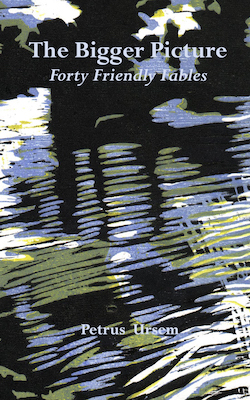
The Bigger Picture (Petrus Ursem)

Last November we popped up to Yelverton to visit a local event for artists and makers from the Tamar Valley. There were quite a few stalls with different types of artwork that I really liked, one such being the work of artist and writer Peter Ursem. As well as his wonderful lithograph prints of various locations in and around Dartmoor and the Tamar Valley he also had a few prints and cards of some poetry and copies of his books – a children’s adventure story trilogy that I really must read sometime and a small volume called ‘The Bigger Picture’ written under his pen-name Petrus Ursem. I got chatting with Peter about is work and immediately felt a strong mental connection – we talked about the process of writing and where ideas come from and he told me about how TBP was a collection of short fables written in similar form to those of the Master of Fables, Aesop, with a group of animals interacting to discuss and explore different pieces of wisdom and thought. I was immediately hooked by his description and purchased a copy of TBP which I have been reading on and off since then – one fable (of forty in total) each morning.

Many of the fables in The Bigger Picture take a word or short phrase and then have the different animals (a rather odd mix including a crocodile, an owl a peacock, a worm, a bull, a bee and others along with a few non-animal characters like Cloud) riffing on it as they meet up and go about their daily business, always uncovering some little nugget of wisdom along the way. To give an idea there are fables called ‘Between a Rock and a Hard Place’, ‘Point of View’ and ‘No Half Measures’. Talking with Peter I was interested to hear that partly this construction stemmed from him originally being from The Netherlands and so being intrigued by certain turns of phrase in English.

I finished the last fable ‘Being You’ last week and as I did so I found myself wishing that during my first readings I had made some notes to capture a few quotes and some of the glimpses of wisdom the fables contained. At first, I was a little disappointed to reflect that most of what I had read had slipped straight out of my head but then I realised that this was actually a bonus… because I have now promised myself that at some point in the not too distant future I will read The Bigger Picture through again, with pencil and notebook in hand, and be inspired and enchanted once more.

The Maltese Falcon (Dashiell Hammett)

Way back in 2020 I started a ‘project’ of reading my way through an alphabet of author surnames using the wonderful book ‘1000 Books To Read Before You Die’ by James Mustich as my inspiration. The idea was to deliberately pick books and authors that I wouldn’t otherwise or normally read, selecting titles from those for which Mustich’s entries piqued my interest in some way. These weren’t the only books I read at the time but I made a point of moving quite swiftly through the alphabet and it took me just under 15 months to make it through from A as far as W but missing out Q because the only option suggested by Mustich was The Q’uran and whilst I would actually like to read that book I just didn’t want to have to devote so much of my reading time to that kind of challenge. The options for X, Y and Z were also really limited and so I decided not to force myself to complete those last three letters. It was a really interesting experience and one that introduced me to some really excellent books including one of my now all-time favourites, Jeanette Haien’s ‘The All Of It’.

In summer 2022 I decided I would repeat the challenge and started again on A, but this time I only got as far as C in the space of two months before my reading went off in other directions. I picked things up again last summer and made my way through D to G during the rest of 2023. Having gained a little momentum again I decided to keep going with my second author alphabet this year…

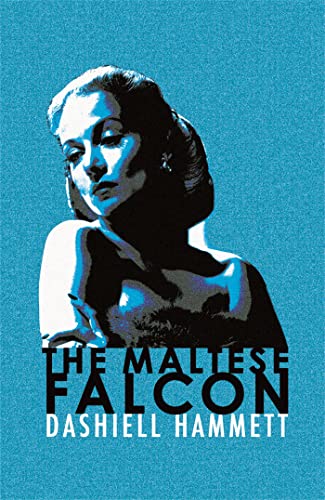
My first completed book of the year was ‘The Maltese Falcon’ by Dashiell Hammett – a 1930s thriller involving various rather odd and somewhat incompetent criminals and somewhat too invincible private eye who are all caught up in pursuit of a valuable old, bejeweled statuette of a bird. The action moved on quickly, rather too quickly for any significant plot or character development in my opinion which in the end left me having quite enjoyed the read but certainly not drawn to explore any of Hammett’s other work.

The Secret to Success

A few weeks ago, while reading Theodore Zeldin’s great book ‘The Hidden Pleasures of Life’ I came across a quote which resonated with me at the time and has stuck with me ever since. It comes from a 1967 New York Daily News interview with Bob Dylan in which he was asked about the delay in him producing a new recording and media reports that he had been offered a huge sum of money to switch record labels. His response was:

“What’s money? A man is a success if he gets up in the mornin’ and gets to bed at night and in between he does what he wants to. What I want to do is make music.”

I’ve picked out the middle sentence in bold because that’s the part that I read in Zeldin’s book and the part that is relevant here.

It’s possible to read this sentence as a simple instruction to do whatever you want to do, perhaps being selfish in the process. But that’s not how I read the quote or all that I take from it. For me, there are three elements to the quote, three ‘secrets to success’ – things that could be considered as markers of a successful life. One might also see them as essential ingredients or instructions…

1) Get up in the morning
It sounds simple but there’s quite a lot in this. First, if you get up in the morning then that implies you have made it through another night; you have survived to live another day – that’s Success Number One. Secondly, if you ‘get up’ then you have gone into active mode; you are engaged with life, doing something (anything) – and that’s Success Number Two.

2) Get to bed at night
Similar to ‘Get up in the morning’ there are two parts to this. First, if you ‘get to bed’ then you’ve clearly got a bed of some sort and that implies a least some degree of safety and security which has to be a good thing – Success Number Three. Secondly, the phrase implies that you have made it through another day and, no matter how easy or difficult that has been, I would count that as Success Number 4.

3) Do what you want to do in between
I guess this is obvious – a day spent doing things that you don’t want to do could still be regarded as a success in some ways (see above) but I think it is self-evident that a day spent doing what you want to do, whether that is one thing, a calling such as ‘Dylan’s “make music'”, or a multitude of things big and small, is going to be a better (more successful) day than one where much of your time is given over to activity that is misaligned with your personal values and interests. That’s Success Number 5.

I think it’s obvious that Success Number 5 is THE BIG ONE but I’d also argue that a single day of Success Number 5 would not really make for a successful life – that would only come when it is coupled with Successes Numbers 1-4 over and over again. I would just add here that what is good for one is surely also good for everyone else and so an interpretation of ‘do what you want to do’ that is generous to others and does not work against their own success will most likely lead to the greatest success in life overall. I certainly don’t take this phrase as an excuse for selfishness.

So, that’s the goal: get up in the morning – do what you want to do – go to bed at night; the secret to success in a nutshell.

The All Of It (Jeannette Haien)

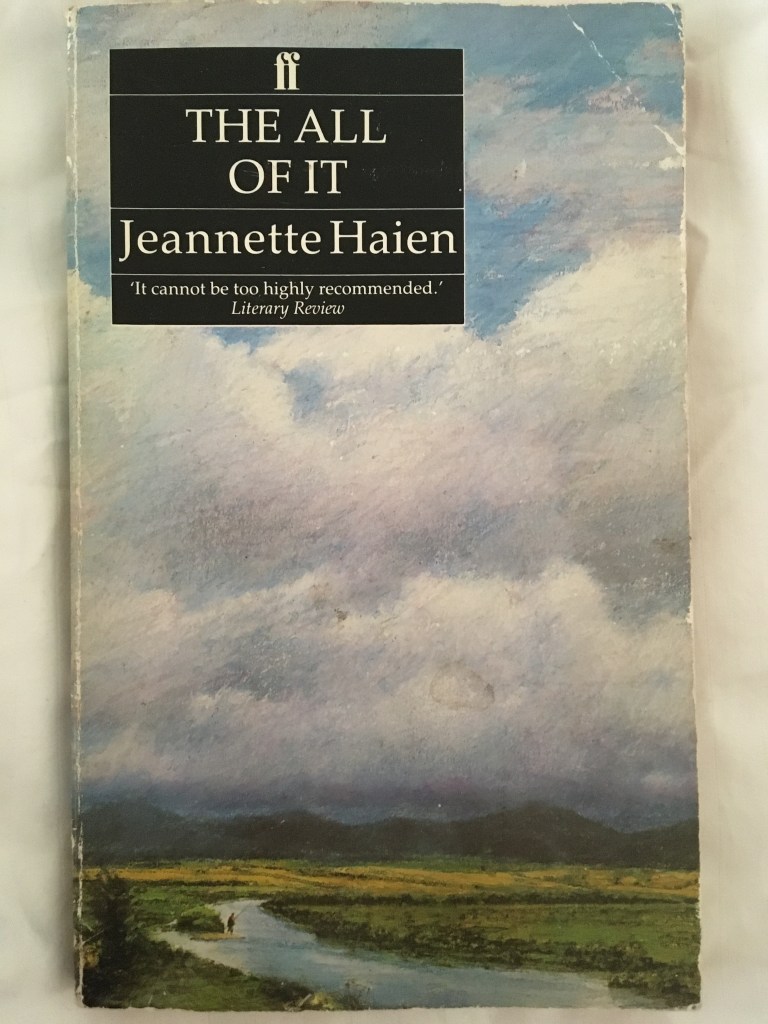
At the start of the year I decided that interspersed within other books, I would aim to read one book by an author from each letter of the alphabet in sequence chosen from James Mustich’s wonderful volume 1001 Books To Read Before You Die. In particular, I wanted as much as possible to try to use this mini-project as a spur to read (or listen to in audiobook form) works that I wouldn’t otherwise consider. So far this year I have already worked my way through Edward Abbey’s ‘Desert Solitaire’, Natalie Babbitt’s ‘Tuck Everlasting’, J.L. Carr’s ‘A Month in the Country’, Alain De Botton’s ‘How Proust Can Change Your Life’, Loren Eiseley’s ‘The Immense Journey’, F.Scott Fitzgerald’s ‘The Great Gatsby’ and William Golding’s ‘Lord of the Flies’ amongst 22 other books mostly not in Mustich’s big list. Last night, I finished my ‘H’ book, Jeanette Haien’s ‘The All Of It’.

‘The All Of It’ is a short novel (just over 140 pages) and was Haien’s first, written in her 60s after she had had a successful career as a concert pianist. The novel is set in the wild part of northwestern Ireland and revolves around the ‘confession’ by a 60ish year old woman Enda to the local Catholic Priest Father Declan after the passing of 63 year old Kevin. I won’t say any more about Kevin in case you read the book. Interspersed with Enda’s ‘confession’, when she tells Father Declan the ‘all of it’, is description of his attempt to catch a salmon on the final day of the fishing season, a day or two after their conversation. I can’t really say any more about the plot because that would give everything away. It’s a simple story, nicely told and really it is a story about being fearless and taking the plunge, of which there are at least four taken in the story – Enda and Kevin’s plunge in their childhood, Enda’s plunge in telling Father Declan the story, Father Declan’s plunge in having one last cast with a fly (a trout fly even!) and then Father Declan’s final plunge, arguably the most significant plunge of all.

I bought my copy of ‘The All Of It’ secondhand from an eBay seller. It absolutely stank of what I can only describe as musty, old lady, perfume – not exactly the best thing at a time when you have heightened awareness of the contents of the air that you put near your face and you have a habit of flicking quickly through the pages of a book to look for chapter breaks and to gauge how far you have to go. Several times I blasted my face with old, I mean REALLY old, perfume and who knows what else. But I am still alive so far and, oddly, the musty old perfume smell made me feel just a little more connected to Enda than I might otherwise have been.

I’m an absolute sucker for a story that holds wisdom within it and, although simple, ‘The All Of It’ certainly does hold wisdom, oodles of it. Sometimes in life you just have to step over the threshold, or start to talk, or cast your line,…

… or listen to your heart.