Over the last couple of months I have been gradually gearing up to start trying to sell some of my artwork. Obviously, I am not thinking that there will be crowds flocking to part with their hard-earned money to the extent that I might become rich through my artist endeavours. Rather, people who see my pictures often pass comment that they think I could sell them, and the inquisitive part of me thinks that it will be interesting to find out whether that is true, and if it is, which pieces of my output people like enough to pay for. [Okay, okay – I admit it – I’d also love to have the implicit praise and external validation that would come my way if my artwork attracted interest in this way… but I know that it’s far better for me not to get hung up on this aspect of things and, instead, to focus on simply enjoying the process of creating art and then allowing it to leak out into the world.]
So far, my art selling has only gone as far as listing prints of my Dartmoor Stone Circle painting on eBay (two copies sold, albeit to the same buyer, in almost four months…) and, more recently, to set up an online shop on Etsy. In this shop I have listed my Dartmoor Stone Circle print (one copy sold) and lots of different Greetings Cards based on some of my miniature watercolour series: Dartmoor Scenes, House Plants, Capital City Landmarks, Cornwall Landmarks and Exmoor Views (of which I have sold the grand total of two: one of ‘The Forbidden City, Beijing’ from my Capital City Landmarks series and one of ‘The Roundhouse Gallery, Sennen Cove’ from my Cornwall Landmarks series). Clearly, it is slow going, partly because I need to master the art of marketing and try to drive some traffic to the shop, but also, because I doubt that there are many people shopping online for greetings cards of random places or plants! Nevertheless, it was a bit of a thrill when my phone pinged to tell me that these sales had been made..
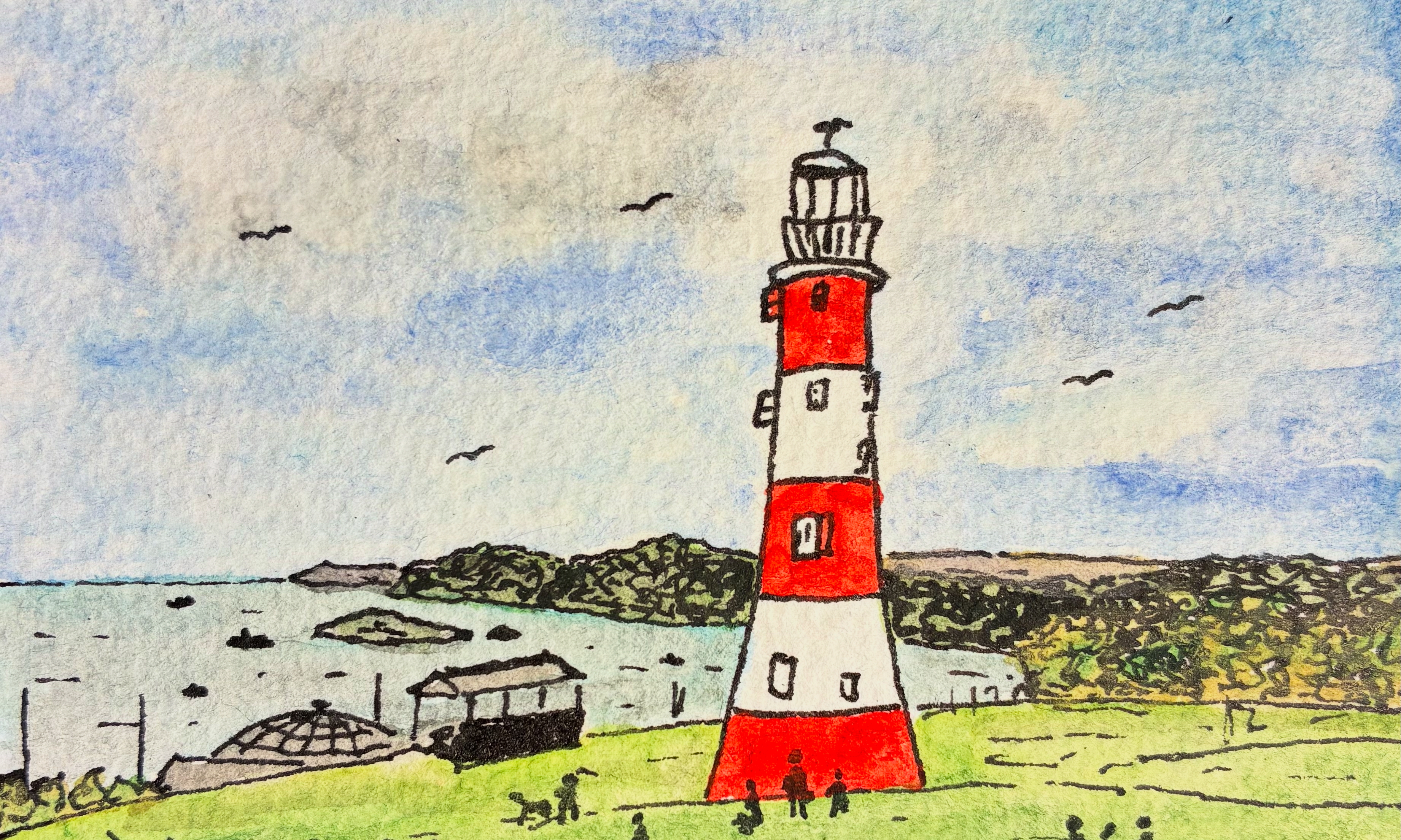
One of the things that I wanted to make sure of before I launched my online shop was that I had all of my art-related points of contact joined up nicely. To that end, I managed to get hold of an email address and accounts on all of the major social media sites (Instagram, X, Bluesky, Facebook, Meta) that matched the name of my etsy shop (@timohareart). To help with future networking and promotion activities, I designed some business cards to convey all of this information to anyone interested. For these, I decided that I would paint a picture of Plymouth’s most iconic landmark, Smeaton’s Tower, with Plymouth Sound and Cornwall in the background to use on the front of the card. It took me several attempts to set up the picture so that I could add the name of my art ‘business’ without the text crossing the darker parts of the picture and that could be cropped nicely into a circle for use on the back of the card and on my social media accounts. The picture at the top of this post is final version.
The final form of the business card is shown below (front and back)…


… and just in case you’re reading this and are tempted to explore a little more, here are some direct links:
shop: timohareart.etsy.com
web: timohare.blog/art
instagram: @timohareart
(Instagram is probably the best social media site to see all of my artwork as I produce it, but you can find my art via the same social media handle on the other sites, although these are not all updated to the same extent.)
 Tim O'Hare