Tim O’Hare Art is open for business! #art

Over the last couple of months I have been gradually gearing up to start trying to sell some of my artwork. Obviously, I am not thinking that there will be crowds flocking to part with their hard-earned money to the extent that I might become rich through my artist endeavours. Rather, people who see my pictures often pass comment that they think I could sell them, and the inquisitive part of me thinks that it will be interesting to find out whether that is true, and if it is, which pieces of my output people like enough to pay for. [Okay, okay – I admit it – I’d also love to have the implicit praise and external validation that would come my way if my artwork attracted interest in this way… but I know that it’s far better for me not to get hung up on this aspect of things and, instead, to focus on simply enjoying the process of creating art and then allowing it to leak out into the world.]

So far, my art selling has only gone as far as listing prints of my Dartmoor Stone Circle painting on eBay (two copies sold, albeit to the same buyer, in almost four months…) and, more recently, to set up an online shop on Etsy. In this shop I have listed my Dartmoor Stone Circle print (one copy sold) and lots of different Greetings Cards based on some of my miniature watercolour series: Dartmoor Scenes, House Plants, Capital City Landmarks, Cornwall Landmarks and Exmoor Views (of which I have sold the grand total of two: one of ‘The Forbidden City, Beijing’ from my Capital City Landmarks series and one of ‘The Roundhouse Gallery, Sennen Cove’ from my Cornwall Landmarks series). Clearly, it is slow going, partly because I need to master the art of marketing and try to drive some traffic to the shop, but also, because I doubt that there are many people shopping online for greetings cards of random places or plants! Nevertheless, it was a bit of a thrill when my phone pinged to tell me that these sales had been made..

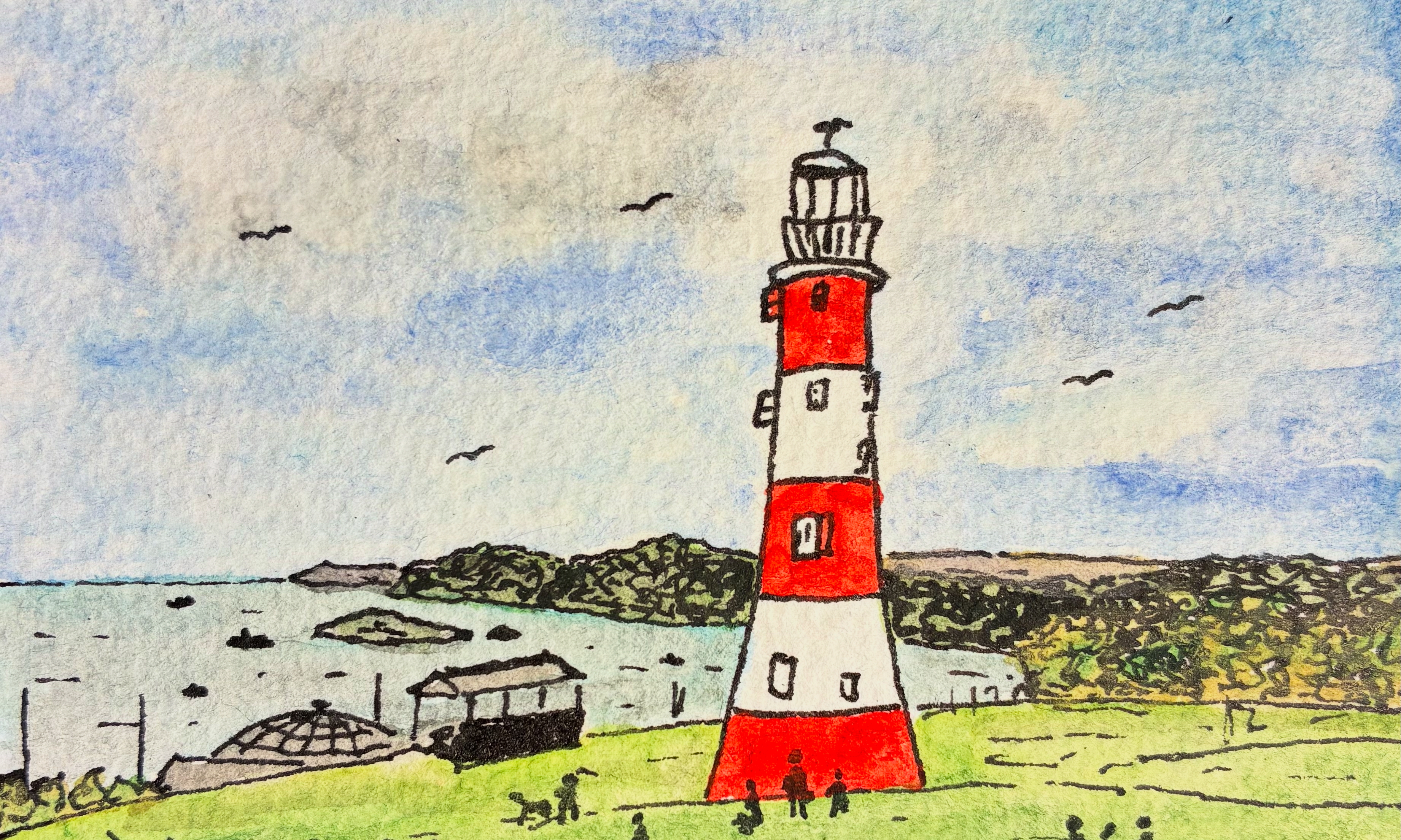
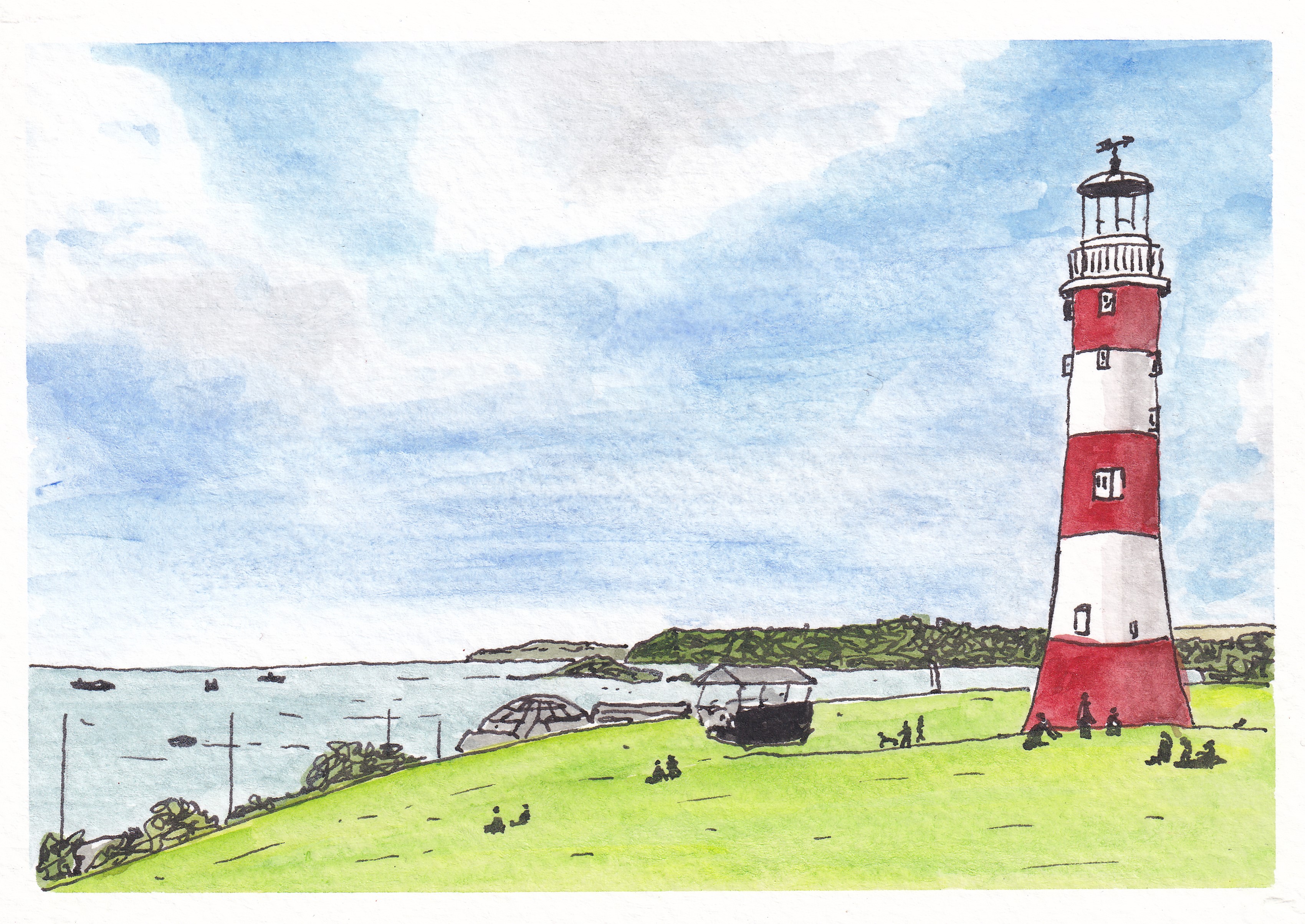
One of the things that I wanted to make sure of before I launched my online shop was that I had all of my art-related points of contact joined up nicely. To that end, I managed to get hold of an email address and accounts on all of the major social media sites (Instagram, X, Bluesky, Facebook, Meta) that matched the name of my etsy shop (@timohareart). To help with future networking and promotion activities, I designed some business cards to convey all of this information to anyone interested. For these, I decided that I would paint a picture of Plymouth’s most iconic landmark, Smeaton’s Tower, with Plymouth Sound and Cornwall in the background to use on the front of the card. It took me several attempts to set up the picture so that I could add the name of my art ‘business’ without the text crossing the darker parts of the picture and that could be cropped nicely into a circle for use on the back of the card and on my social media accounts. The picture at the top of this post is final version.

The final form of the business card is shown below (front and back)…

… and just in case you’re reading this and are tempted to explore a little more, here are some direct links:

shop: timohareart.etsy.com
web: timohare.blog/art
instagram: @timohareart

(Instagram is probably the best social media site to see all of my artwork as I produce it, but you can find my art via the same social media handle on the other sites, although these are not all updated to the same extent.)
Plymouth Postcards #art

Smeaton’s Tower Lighthouse, Plymouth Hoe

Back in April, after completing four series on miniature watercolour pictures (Dartmoor Scenes, House Plants, Capital City Landmarks and Mysterious Britain), I decided that I would give myself a new challenge by scaling up my paintings a bit and keep my subject matter close to home with a set of pictures that I described with the working title ‘Plymouth Postcards’. I wanted to try to keep the same kind of fairly loose style but I thought it would be good to be able to capture a bit more detail of each scene. My miniature watercolours had been just 5cm square (or 5cm x 7cm in the case of the Mysterious Britain series) but this new series was, naturally, postcard sized (roughly 10cm x 15cm). That’s an increase in area of up to six times, and so it gave me quite lot more sketching, drawing and painting to complete!

My first picture (above) focused on what is probably the most iconic view associated with Plymouth, the red-and-white striped form of Smeaton’s Tower – one-time lighthouse on the Eddystone Rock which was moved to Plymouth Hoe when it was replaced in the 1880s.

Next up, I remained close to the waterfront with a view across the inner basin of Sutton Harbour towards the old customs house and the Three Crowns pub. I am not sure that the colour of the water there is ever quite as blue as my picture suggests, but I like the bright and cheery feel of this painting…

Sutton Harbour, Plymouth

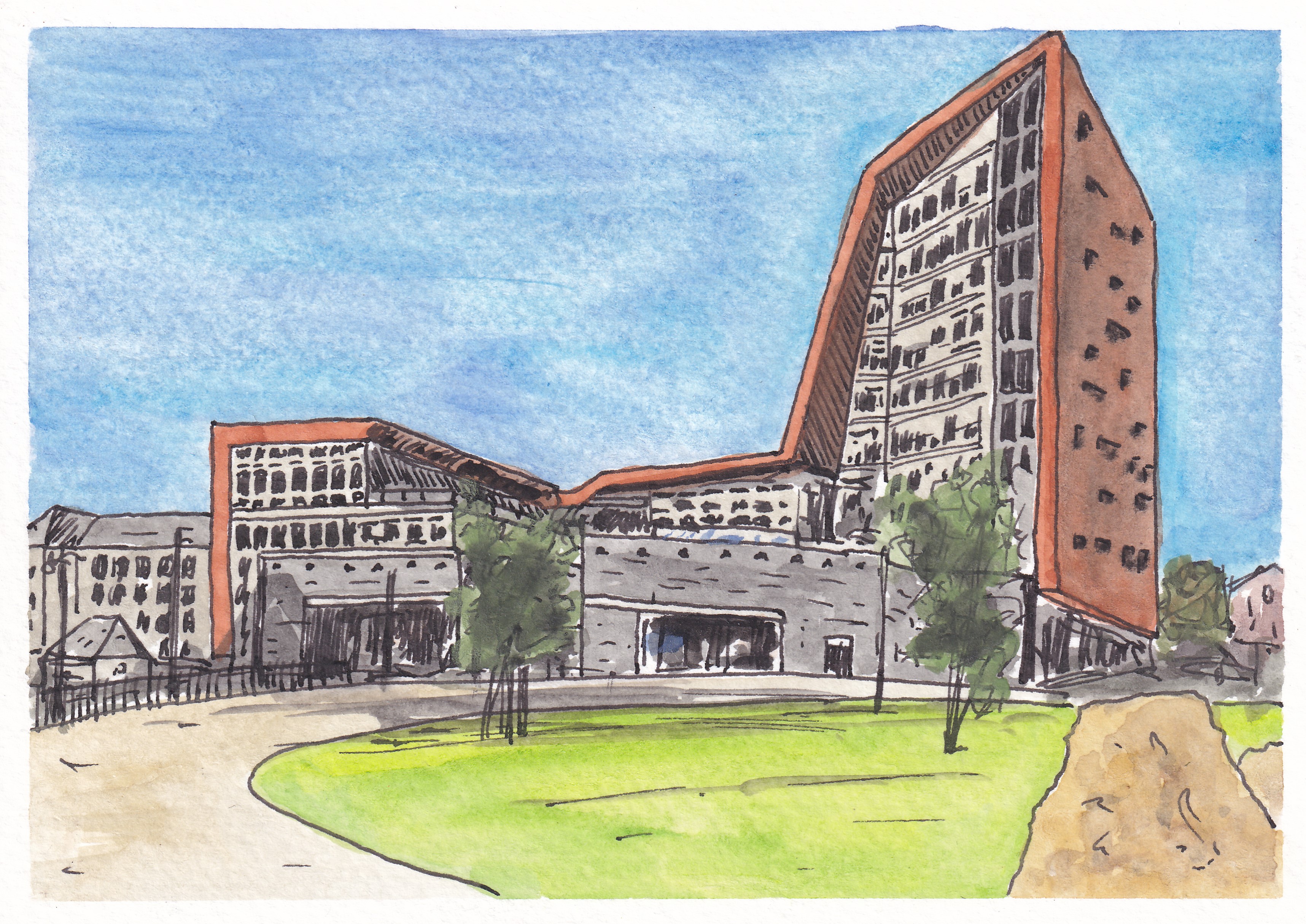
Third came a view of one of Plymouth’s most distinctive new buildings, the Roland Levinsky Building, home of the Arts Faculty at my workplace, the University of Plymouth. Again, the sky is perhaps a little too bright, but I like the three-way competition between the blue sky, the green of the grassy area in the foreground, and the coppery-orange cladding of the building itself…

The Roland Levinsky Building, University of Plymouth

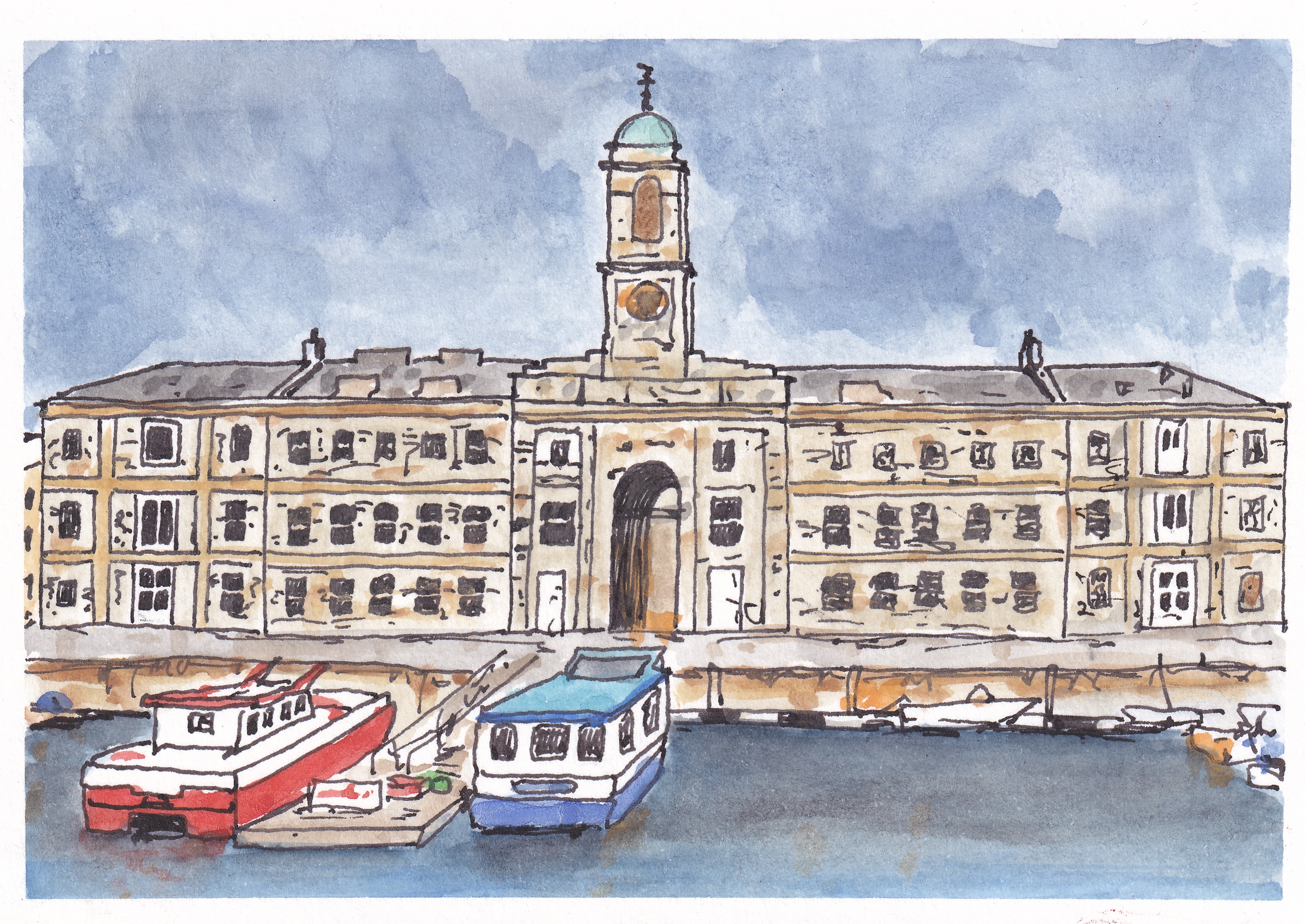
After painting a fairly new building, it was time to visit a much older one with a ffront-on view of one of the main buildings at the Royal William Yard, formerly the victualling yard for the Royal Navy but now a home for swanky apartments, restaurants, various studios and art spaces, and a cinema. I think this is one of my favourites from the series…

Royal William Yard, Plymouth

Then, it was back to the city centre for a picture showing the Charles Church, bombed in the Second World War and left in its broken state as a memorial to lives lost. Behind it, the angular exterior of the eastern end of the Drake Circus Shopping Centre forms an interesting backdrop which was surprisingly challenging to paint…

Charles Church and Drake Circus Shopping Centre, Plymouth

For my sixth Plymouth Postcard, I took a trip down to the Barbican area of the city for a view of the Plymouth Gin Distillery on Southside Street. It was difficult to get the perspective of the curved road right but I think I have just about managed it…

Plymouth Gin Distillery, Southside Street

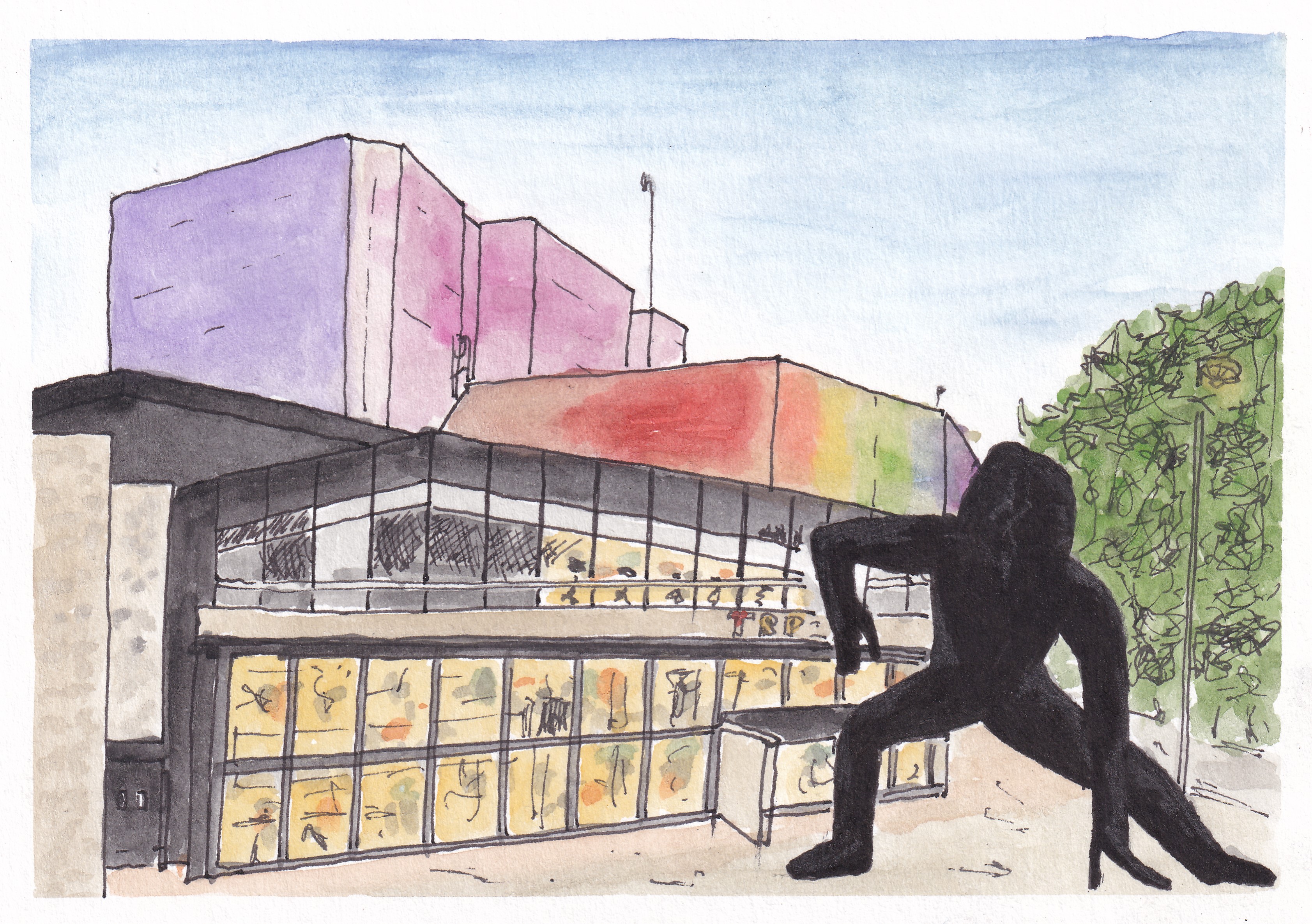
It was time to get a bit ‘arty’, so my next picture was of the interestingly illuminated Theatre Royal, with the imposing form of the statue ‘Messenger’ in front of it. I think that I did pretty well with the theatre itself, and the shape of the statue isn’t too bad, but my initial attempts to shade its dark form resulted in it looking like a hairy gorilla, and so I coloured it black with a permanent marker to try to salvage the picture. Unfortunately, this was only partially successful and I think I would have to describe this one as something of a ‘fail’…

Theatre Royal and ‘Messenger’, Plymouth

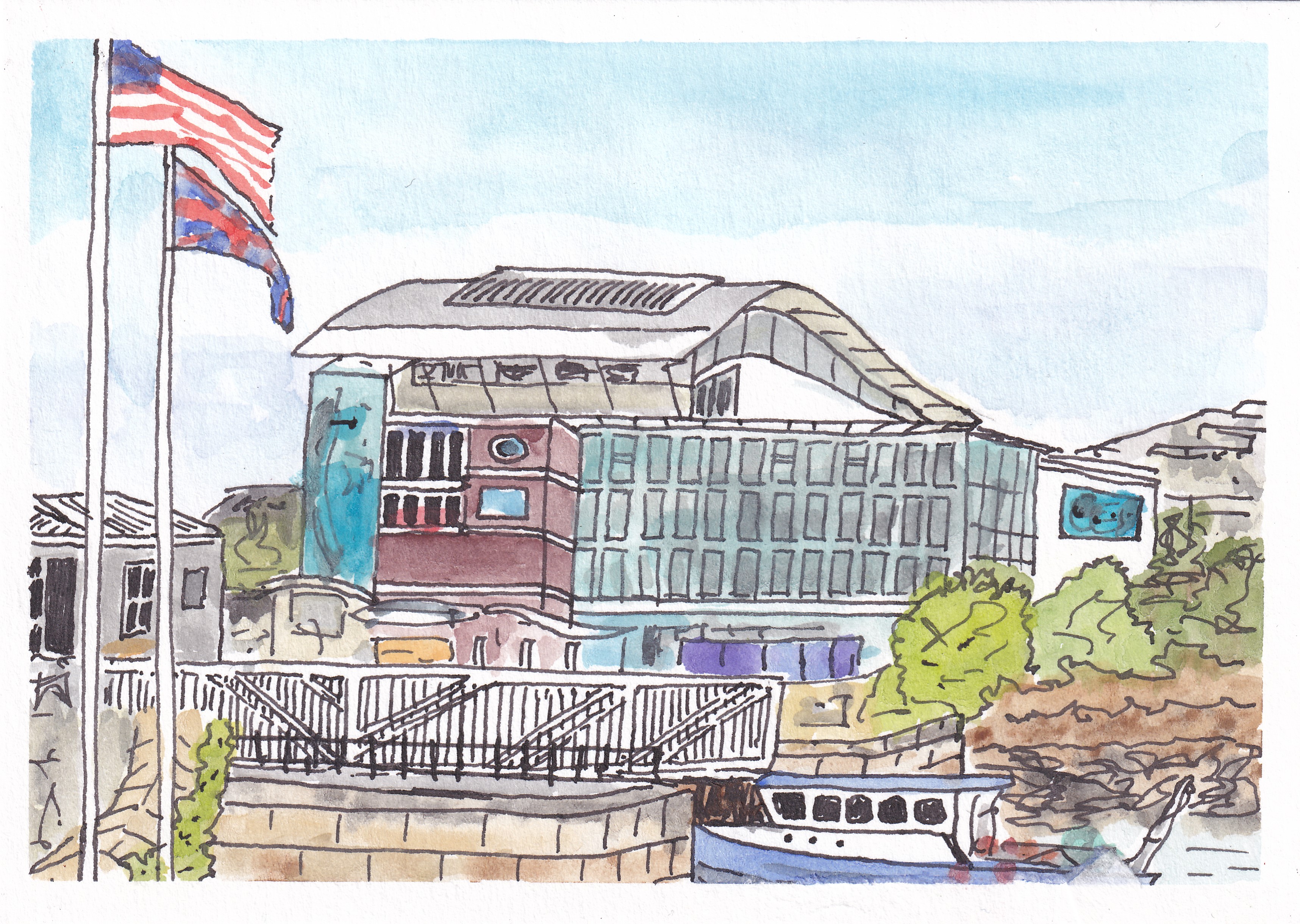
Painting number eight took me back to Sutton Harbour, this time looking across the swing bridge towards the Fish Market on the far left and the National Marine Aquarium, with its wavy roof in the centre. I’m please with the way I captured the blue colour of the windows and the advertising poster on the left of the building, and I like the foreground detail of the boat and bridge. Sadly, my attempt at a Union Jack flag was not quite so successful and the flag of the USA seems to have lost its stars…

The National Marine Aquarium, Plymouth

My ninth picture took me to very familiar territory, with a view of the old turnstiles at Home Park, home of Plymouth Argyle Football Club…

Home Park, Plymouth Argyle Football Club

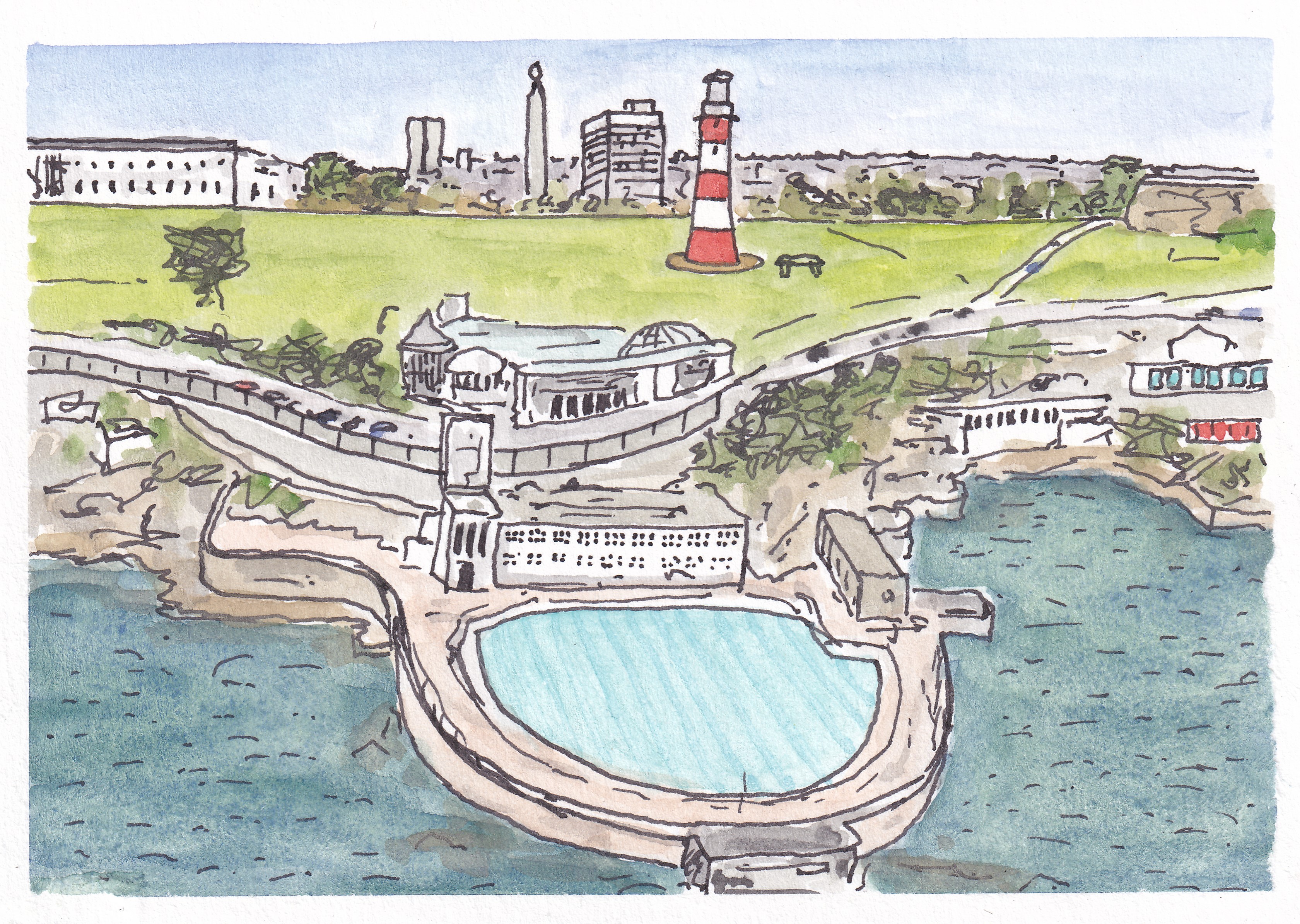
… and then it was back to the waterfront with a view of the art deco Tinside Lido with part of Plymouth Hoe, Smeaton’s Tower and the war memorial in the background…

Tinside Lido and Plymouth Hoe

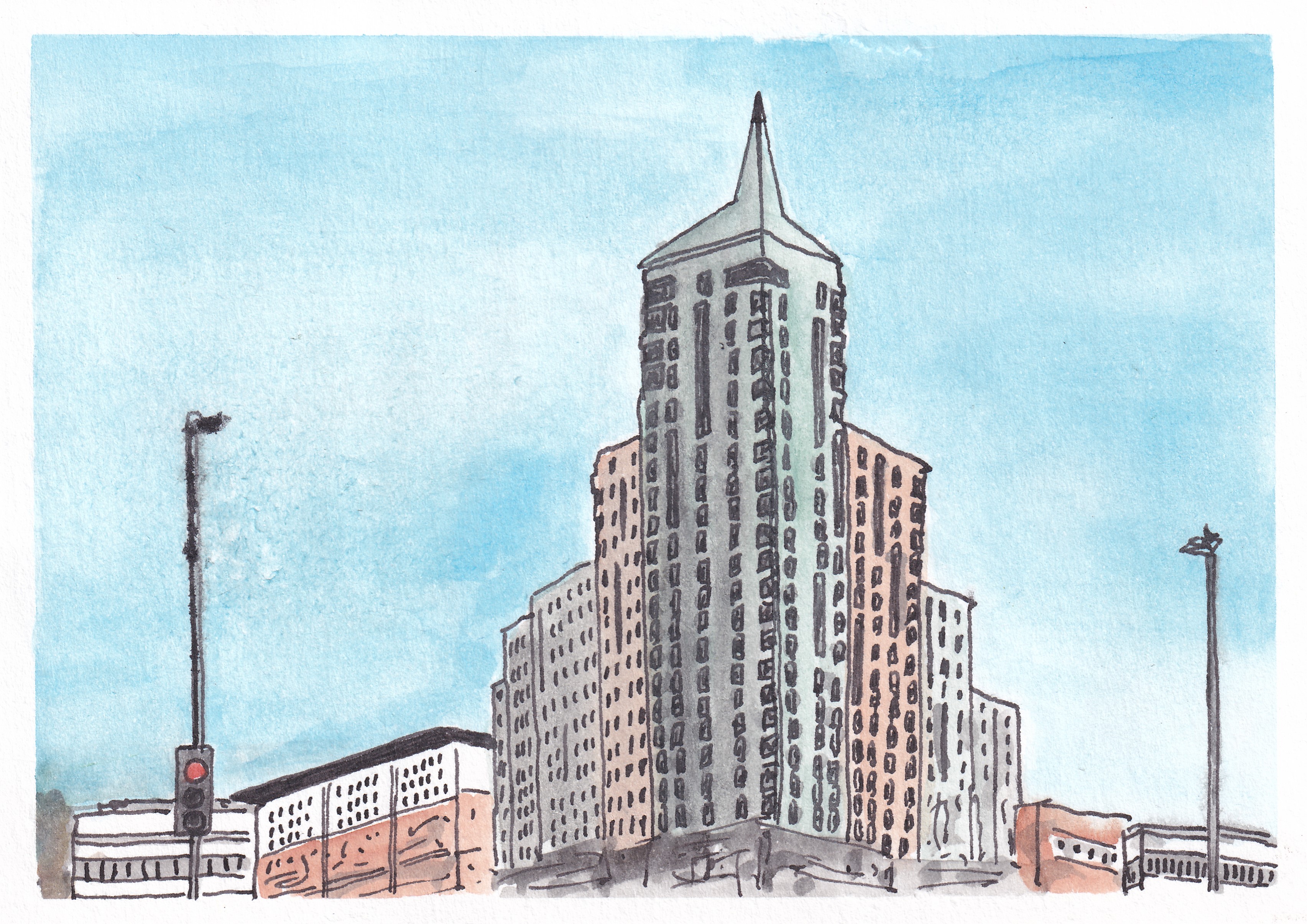
I finished my series with two pictures of contrasting buildings. First up was the Devonport Town Hall and Column, with the oddly coloured and spectacularly fronted (and named) Odd Fellows Hall on the right. Finally, my subject was the sharply-topped, and so highly appropriately named, Beckley Point (a Hall of Residence for students in the city). This is, apparently, the tallest building in the southwest of England (although I don’t know what is being counted as the southwest in this case)…

Devonport Town Hall and Column and the Odd Fellows Hall
Beckley Point Hall of Residence, Plymouth

This was a fun series to do, taking 17 days to complete, and overall I was pleased with the results of my efforts. It was interesting to try to capture some of the more striking buildings and views that Plymouth has to offer, particularly as it is generally regarded as an architecturally bland and unexciting place (largely as a result of the fact that much of the city centre was flattened by bombing raids in the Second World War).

I am sure that I will do plenty more paintings of Plymouth views in the future, but I think this set forms a good initial collection, showcasing some of the different areas and places of interest in the city nicely.