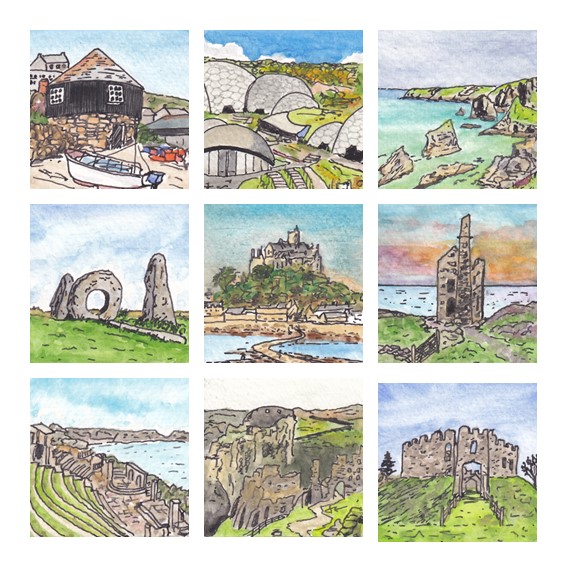
I like to try to spend a little time painting on as many days as I can, and for obvious reasons, the key to this is to keep my pictures small. One of my favourite formats seems to be 5cm square pictures painted in a fairly loose style, with not too much detail and a fairly limited colour palette. Each picture starts with a few pencil marks that serve as guide lines for the pen work, mostly outlining key features and providing various forms of shading. Once the ink has dried, which only takes a few seconds, I start to apply the watercolour paint, usually colouring the sky and any large blocks of vegetation first, before moving on to fill in any details. The whole process generally takes less than 30 minutes and my preference is to spend time of this as pretty much the first thing I do in the morning. When I completed my first small picture, I didn’t have any particular plans for further pictures on the same theme, but one picture led to another, and it seems that I end up producing these miniature watercolours as part of a series, first Dartmoor Scenes and then House Plants, Capital City Landmarks, and a series of slightly larger Mysterious Britain pictures. Most recently, returning closer to home, I completed this set of pictures showing various landmarks in our neighbouring county, Cornwall.
The pictures weren’t painted in this order, but the subjects of my Cornwall Landmarks series are (from top-left working across the rows and down the columns in the composite picture above) The Roundhouse Gallery, Sennen Cove, The Eden Project near St Austell, Bedruthan Steps, Men-An-Tol stone ring, St Michael’s Mount near Penzance, a classic coastal tin mine pumping station, the Minac Theatre, Tintagel Castle and Restormel Castle near Lostwithiel. If I had to choose favourites then I think I would go for the pictures of The Roundhouse Gallery, Bedruthan Steps and Restormel Castle, although I might well make different selections the next time I look at them!
As with each of my other miniature watercolour series, I plan to get some copies of the 3 x 3 composite picture printed as greetings cards to sell at some point, and I will probably try out some of them as individual framed versions too.
I guess the obvious question for me now is where I will go next with this kind of miniature watercolour picture. This morning I painted a view from a photograph I took last week while staying in Exmoor, and so I guess that it is likely that I will end up doing some more from that beautiful part of the world. But whether I will end up with enough for a full series, so that I can make another 3 x 3 composite, only time will tell!
Back in April, after completing four series on miniature watercolour pictures (Dartmoor Scenes, House Plants, Capital City Landmarks and Mysterious Britain), I decided that I would give myself a new challenge by scaling up my paintings a bit and keep my subject matter close to home with a set of pictures that I described with the working title ‘Plymouth Postcards’. I wanted to try to keep the same kind of fairly loose style but I thought it would be good to be able to capture a bit more detail of each scene. My miniature watercolours had been just 5cm square (or 5cm x 7cm in the case of the Mysterious Britain series) but this new series was, naturally, postcard sized (roughly 10cm x 15cm). That’s an increase in area of up to six times, and so it gave me quite lot more sketching, drawing and painting to complete!
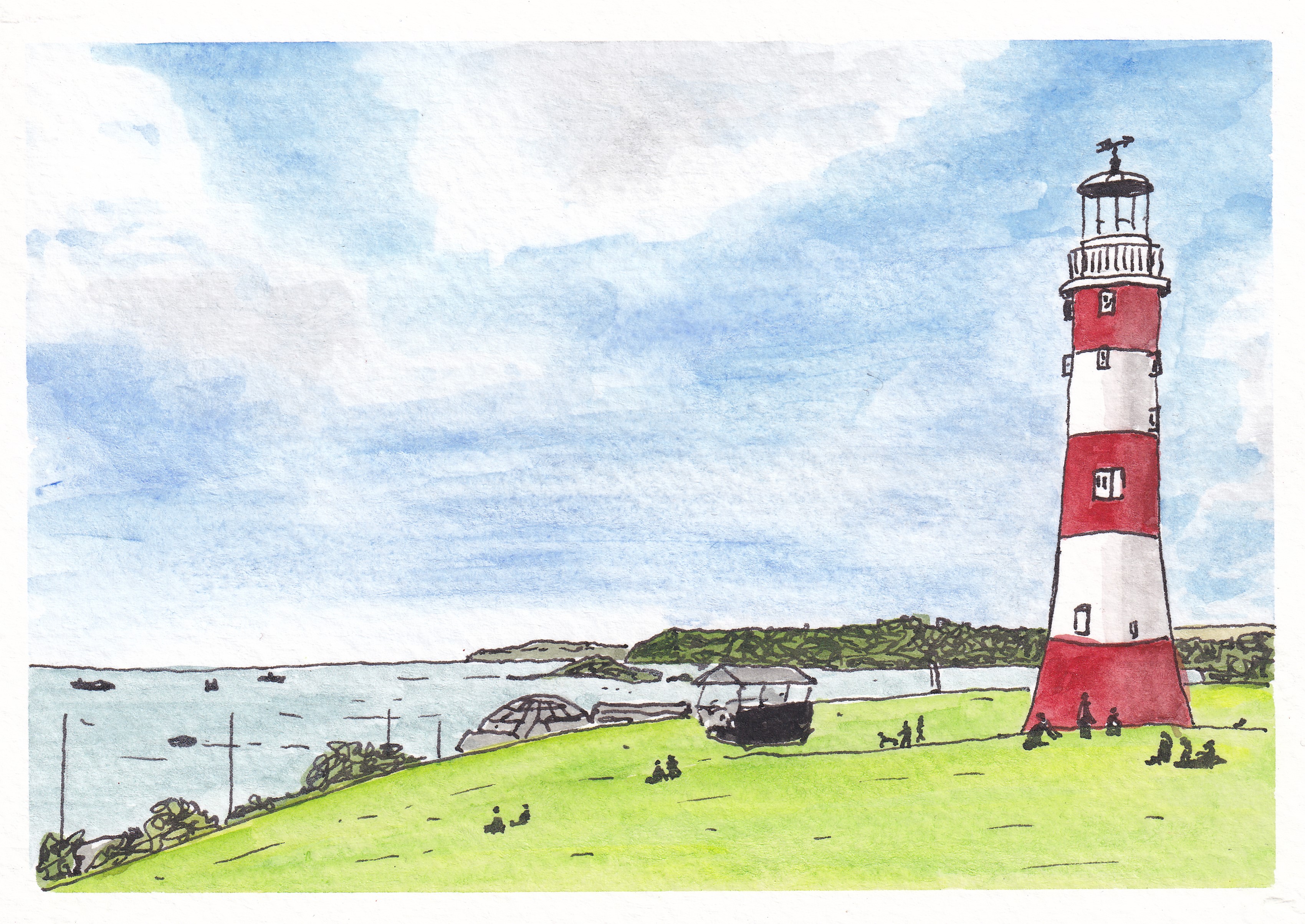
My first picture (above) focused on what is probably the most iconic view associated with Plymouth, the red-and-white striped form of Smeaton’s Tower – one-time lighthouse on the Eddystone Rock which was moved to Plymouth Hoe when it was replaced in the 1880s.
Next up, I remained close to the waterfront with a view across the inner basin of Sutton Harbour towards the old customs house and the Three Crowns pub. I am not sure that the colour of the water there is ever quite as blue as my picture suggests, but I like the bright and cheery feel of this painting…
Sutton Harbour, Plymouth
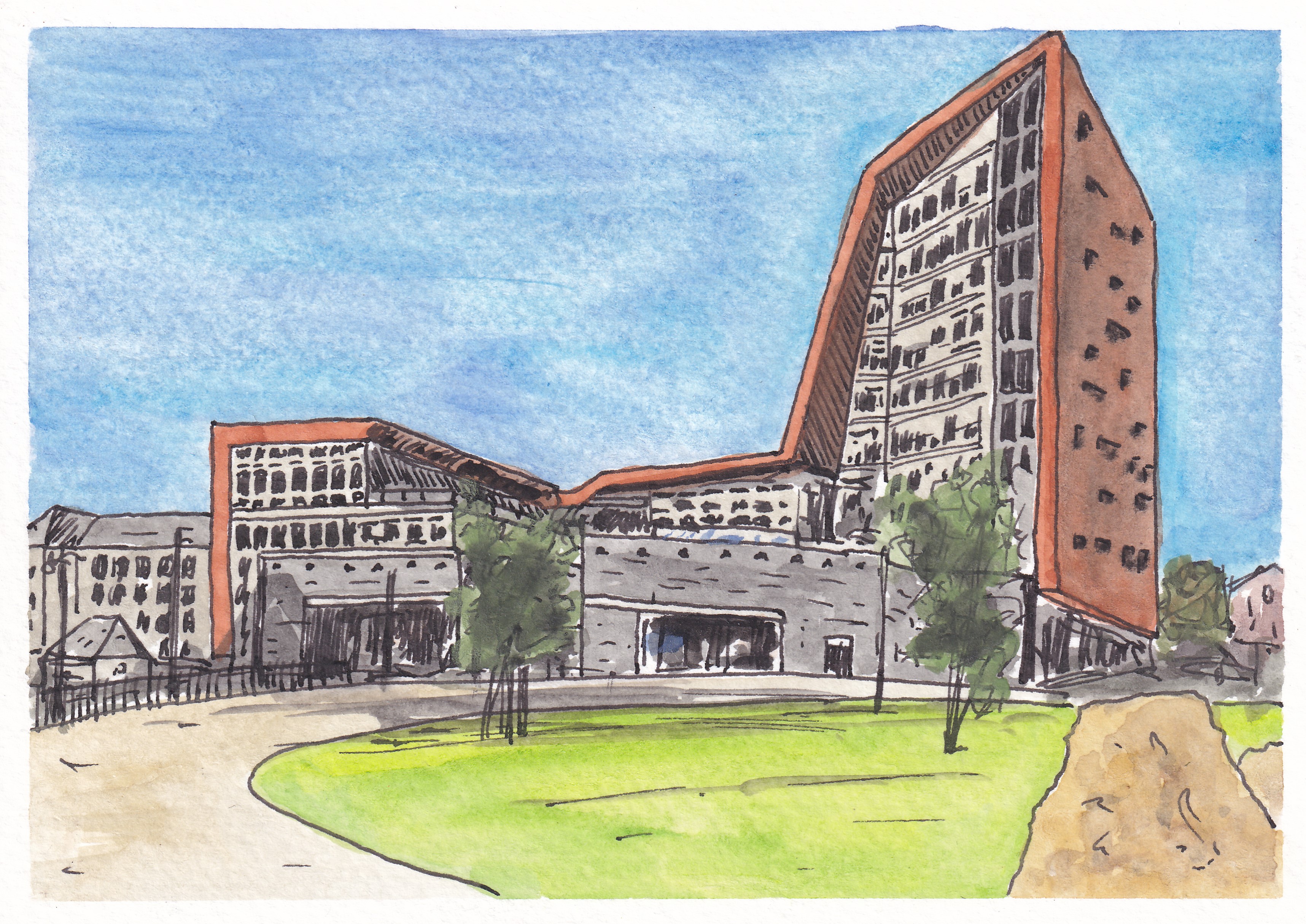
Third came a view of one of Plymouth’s most distinctive new buildings, the Roland Levinsky Building, home of the Arts Faculty at my workplace, the University of Plymouth. Again, the sky is perhaps a little too bright, but I like the three-way competition between the blue sky, the green of the grassy area in the foreground, and the coppery-orange cladding of the building itself…
The Roland Levinsky Building, University of Plymouth
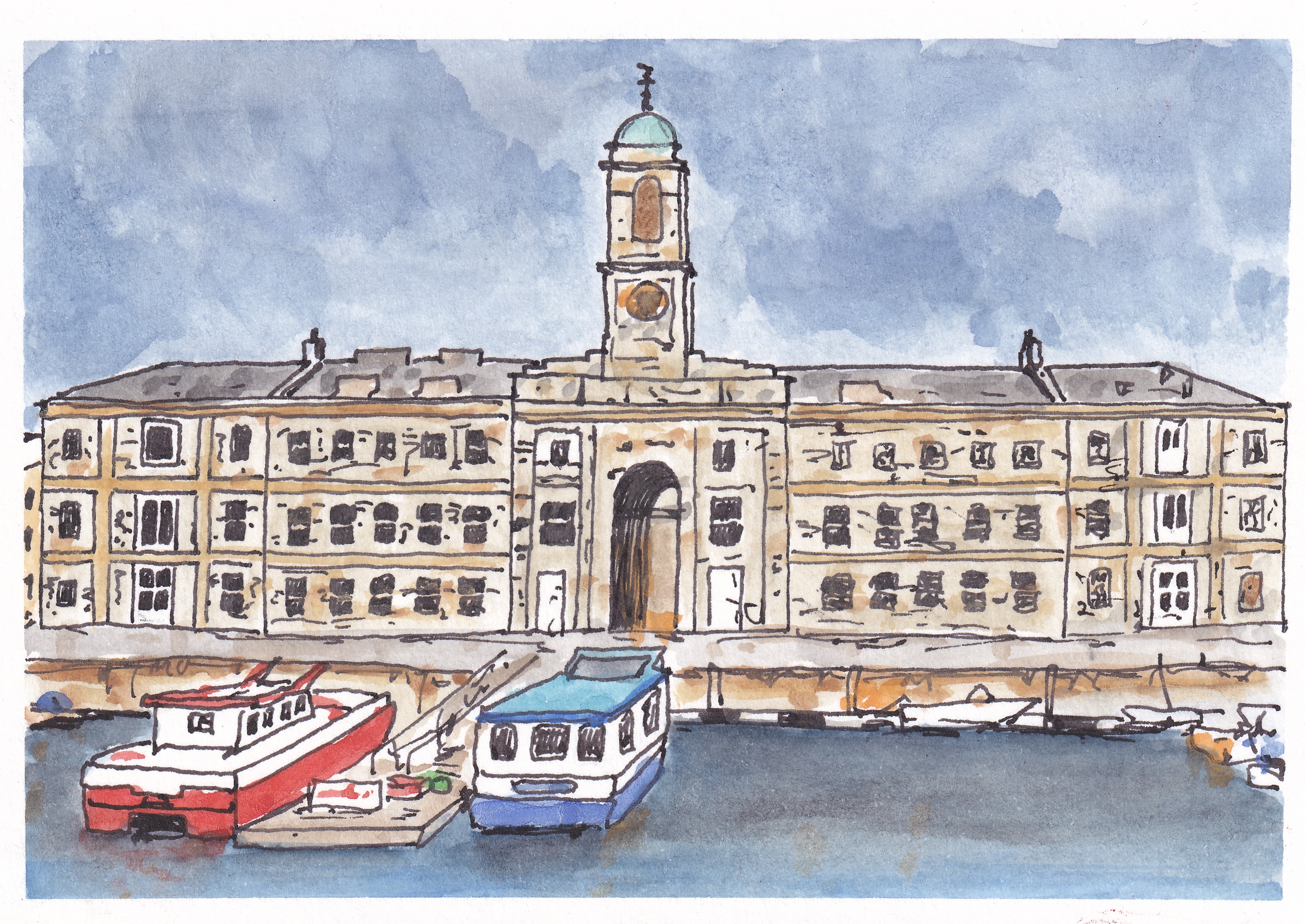
After painting a fairly new building, it was time to visit a much older one with a ffront-on view of one of the main buildings at the Royal William Yard, formerly the victualling yard for the Royal Navy but now a home for swanky apartments, restaurants, various studios and art spaces, and a cinema. I think this is one of my favourites from the series…
Royal William Yard, Plymouth
Then, it was back to the city centre for a picture showing the Charles Church, bombed in the Second World War and left in its broken state as a memorial to lives lost. Behind it, the angular exterior of the eastern end of the Drake Circus Shopping Centre forms an interesting backdrop which was surprisingly challenging to paint…
Charles Church and Drake Circus Shopping Centre, Plymouth
For my sixth Plymouth Postcard, I took a trip down to the Barbican area of the city for a view of the Plymouth Gin Distillery on Southside Street. It was difficult to get the perspective of the curved road right but I think I have just about managed it…
Plymouth Gin Distillery, Southside Street
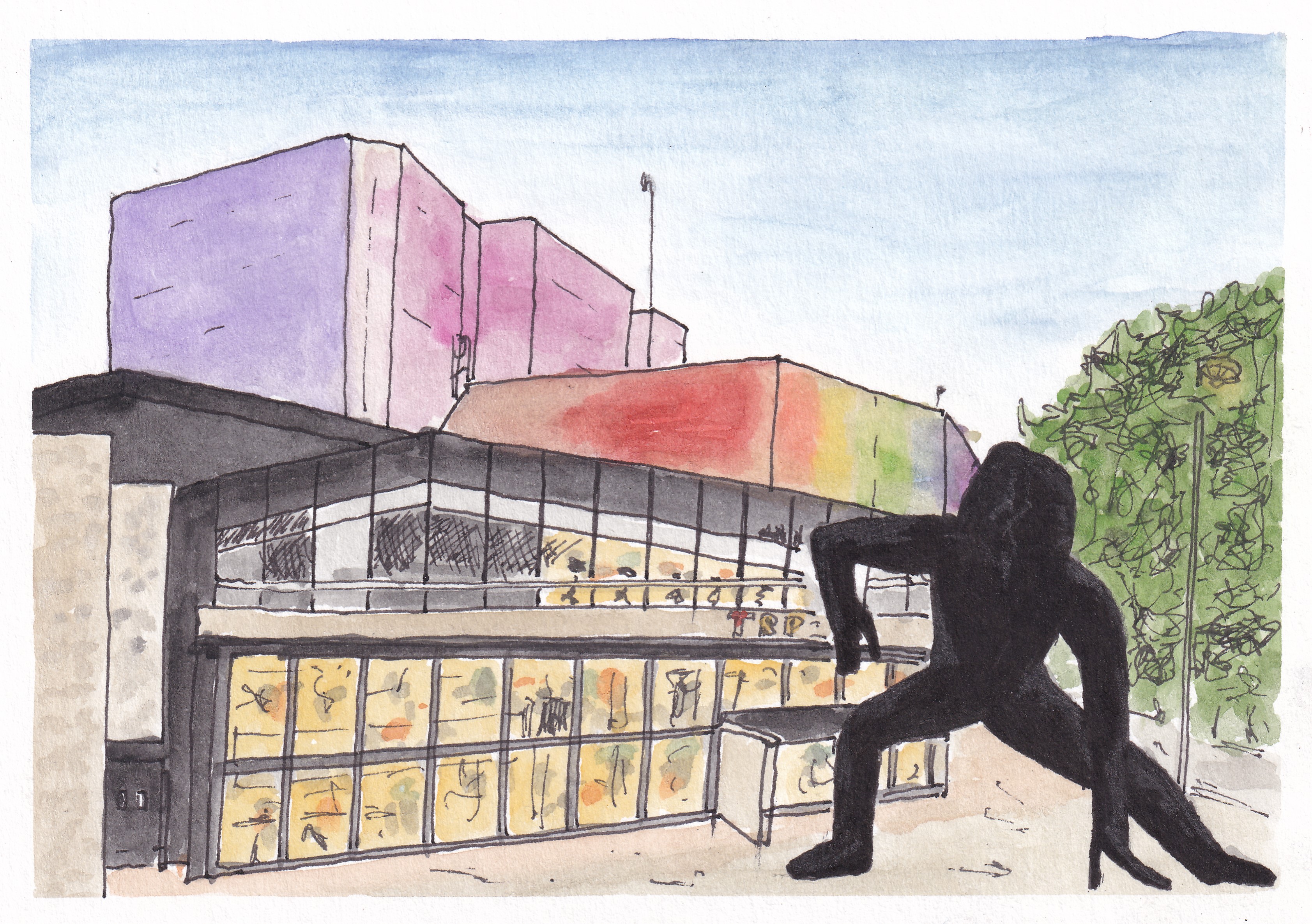
It was time to get a bit ‘arty’, so my next picture was of the interestingly illuminated Theatre Royal, with the imposing form of the statue ‘Messenger’ in front of it. I think that I did pretty well with the theatre itself, and the shape of the statue isn’t too bad, but my initial attempts to shade its dark form resulted in it looking like a hairy gorilla, and so I coloured it black with a permanent marker to try to salvage the picture. Unfortunately, this was only partially successful and I think I would have to describe this one as something of a ‘fail’…
Theatre Royal and ‘Messenger’, Plymouth
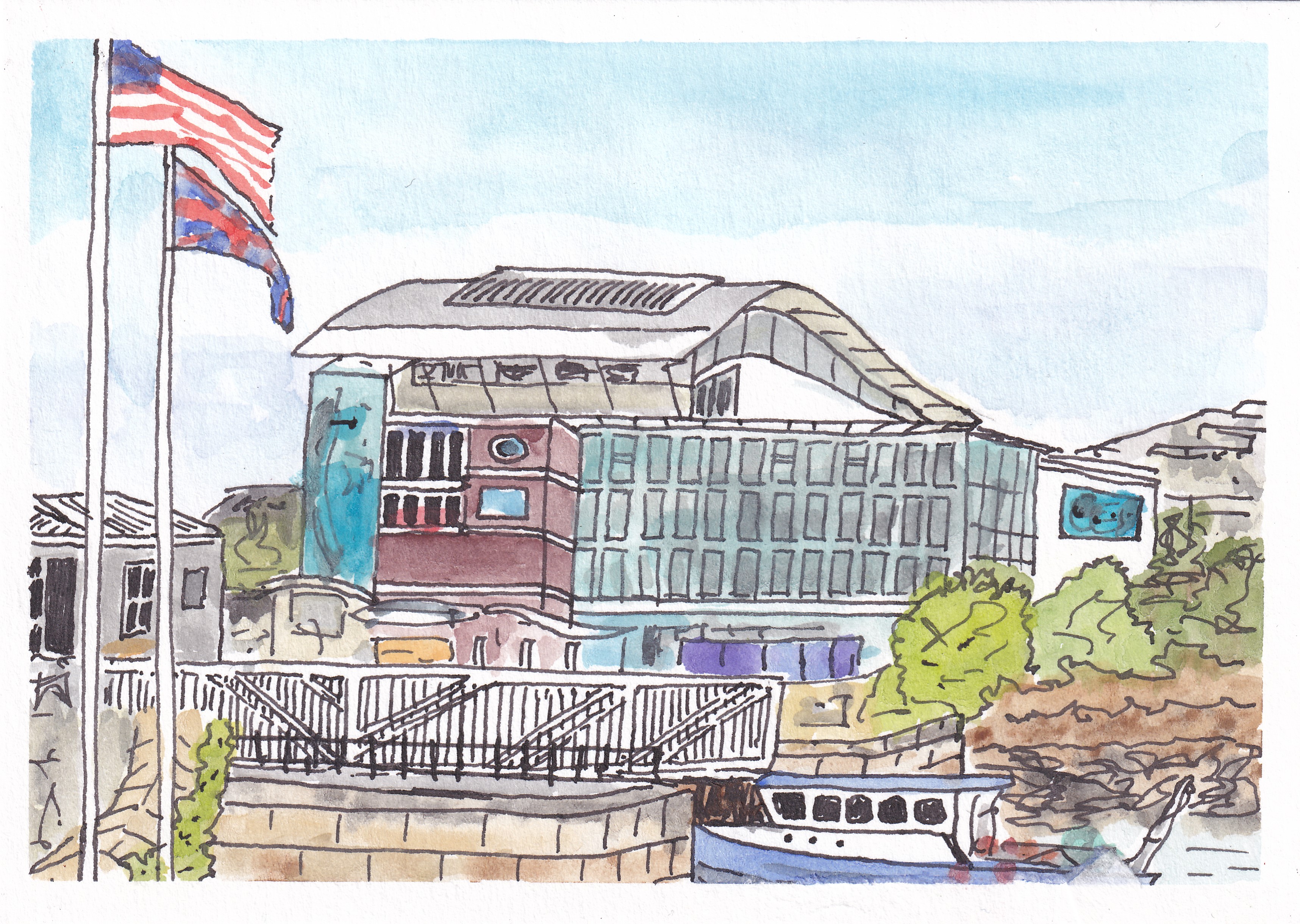
Painting number eight took me back to Sutton Harbour, this time looking across the swing bridge towards the Fish Market on the far left and the National Marine Aquarium, with its wavy roof in the centre. I’m please with the way I captured the blue colour of the windows and the advertising poster on the left of the building, and I like the foreground detail of the boat and bridge. Sadly, my attempt at a Union Jack flag was not quite so successful and the flag of the USA seems to have lost its stars…
The National Marine Aquarium, Plymouth
My ninth picture took me to very familiar territory, with a view of the old turnstiles at Home Park, home of Plymouth Argyle Football Club…
Home Park, Plymouth Argyle Football Club
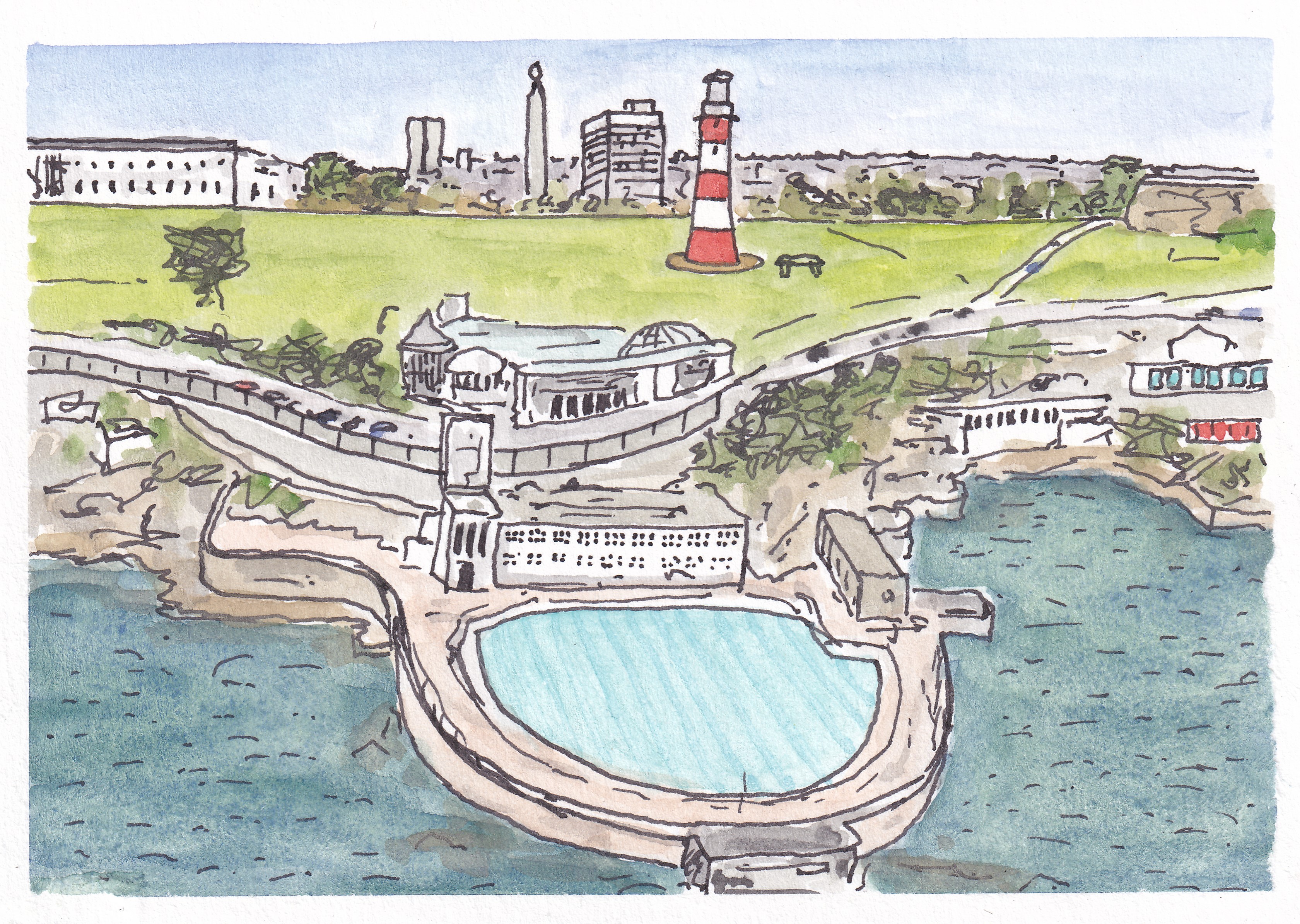
… and then it was back to the waterfront with a view of the art deco Tinside Lido with part of Plymouth Hoe, Smeaton’s Tower and the war memorial in the background…
Tinside Lido and Plymouth Hoe
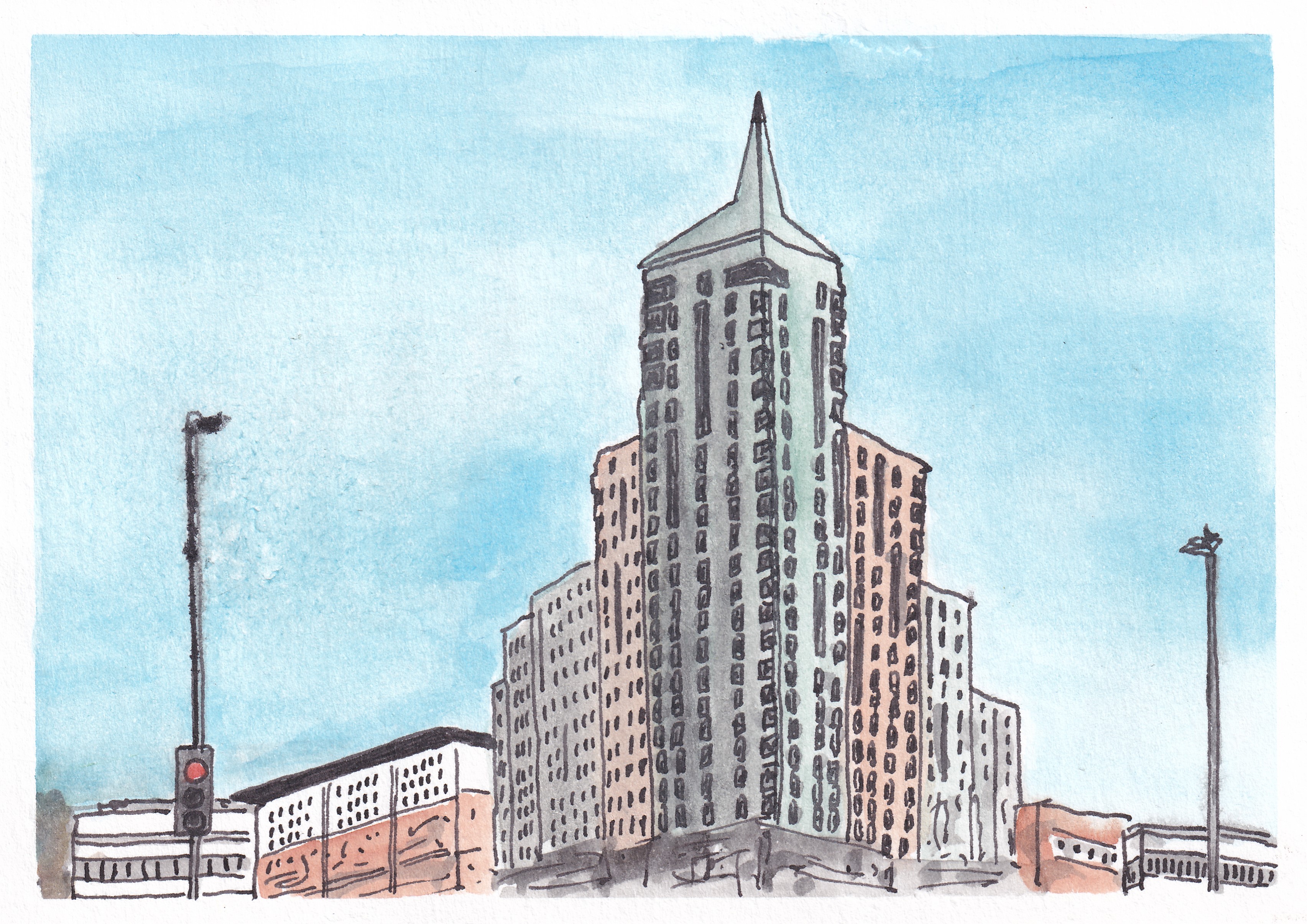
I finished my series with two pictures of contrasting buildings. First up was the Devonport Town Hall and Column, with the oddly coloured and spectacularly fronted (and named) Odd Fellows Hall on the right. Finally, my subject was the sharply-topped, and so highly appropriately named, Beckley Point (a Hall of Residence for students in the city). This is, apparently, the tallest building in the southwest of England (although I don’t know what is being counted as the southwest in this case)…
Devonport Town Hall and Column and the Odd Fellows HallBeckley Point Hall of Residence, Plymouth
This was a fun series to do, taking 17 days to complete, and overall I was pleased with the results of my efforts. It was interesting to try to capture some of the more striking buildings and views that Plymouth has to offer, particularly as it is generally regarded as an architecturally bland and unexciting place (largely as a result of the fact that much of the city centre was flattened by bombing raids in the Second World War).
I am sure that I will do plenty more paintings of Plymouth views in the future, but I think this set forms a good initial collection, showcasing some of the different areas and places of interest in the city nicely.
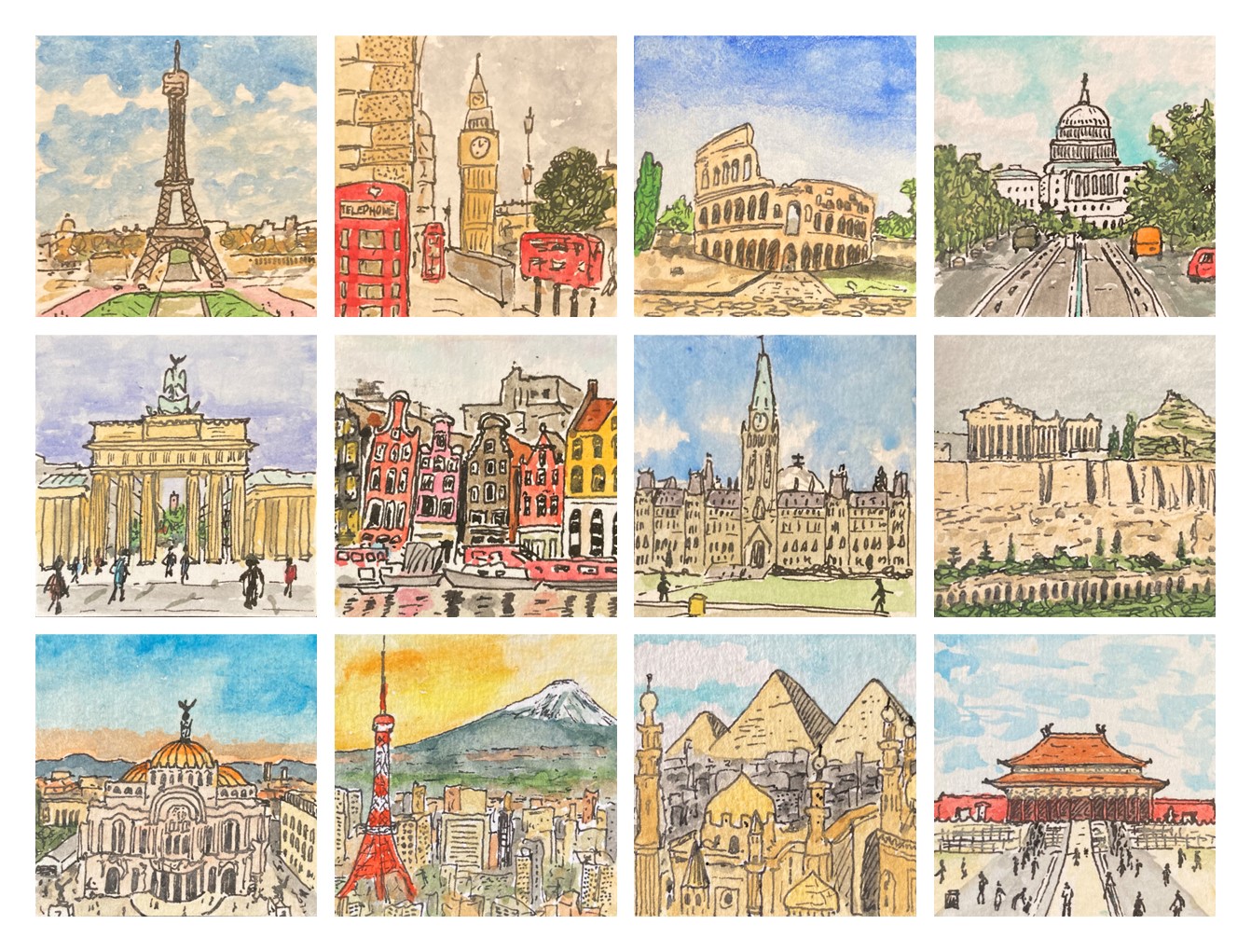
Back in March, I was in a great rhythm with my art, painting a miniature watercolour picture first thing in the morning on most days. Without really thinking about it I found that I slipped into a routine of painting a small (5cm x 5cm) picture on some chosen theme. Each one took me about 30 minutes to do – it was a kind of morning meditation! My first theme was of Dartmoor Scenes and this was followed by a series of House Plant pictures, but for my third set of these pictures I decided to go further afield, and chose Capital City Landmarks.
The first couple of pictures I produced were easy choices – Big Ben in London and The Eiffel Tower in Paris, but then I found myself having to scratch around a bit, wondering where to head next, as I realised that many of the most recognisable landmarks that popped into my head were not located in capital cities. Any sane person would surely have just accepted that fact and switched the theme to City Landmarks, but if you think that’s the kind of thing that I would allow myself to do then you would be sorely mistaken…
In the end, I did manage to find enough subjects to complete a series of twelve pictures and the results are shown in the composite image at the top of this post. It ended up that half of my landmarks were in Europe (London, Paris, Rome, Berlin, Amsterdam and Athens) and the other half where further afield (Washington D.C., Toronto, Mexico City, Tokyo, Cairo and Beijing).
I’m really please with this set of pictures and plan to produce some greetings cards with them.
Do you have a favourite? Are there any other (not necessarily capital) city landmarks that you’d like to see me turn my hand to?





 Tim O'Hare