Back in early June it was the first anniversary of the wedding of my elder daughter (K) and wanting to find a unique and personal gift to mark this occasion I set about thinking of some kind of art-related present for the pair of them. I thought about painting a scene from one of their wedding photographs, but my attempts at including recognizable people in my pictures so far have not proved to be very successful, and so I quickly ruled that possibility out. I thought about painting a ‘standard’ picture of some kind, but it wasn’t that obvious how to select a scene that carried some relevant meaning – a view of the Park Bar on the Reading University campus (where they first met) didn’t really appeal and, in any case, that would have taken me back into ‘people problem’ territory again.
Instead, I decided to try out an idea I had a few months ago when I came across some small wooden boxes for sale at bargain price in the shop The Works. These little square boxes, about 6cm across, were almost exactly the same size as the miniature watercolour pictures that I often paint, and it had occurred to me that it would be neat to pop two such pictures into a box so that when it is opened the two pictures are revealed. Putting this idea together with the upcoming wedding anniversary it seemed like a natural fit – to celebrate the matrimonial joining together of two young people with a little box bringing together two pictures – one related to each person.
After a little more deliberatrion, I decided that the two pictures would show the places of origin of the two halves of the happy couple. In my daughter’s case this was the city of Plymouth, a familiar theme for my paintings, and for her now husband (H) I chose a view of Horsley Towers, a rather grand, gothic building that is the dominant landmark in the village of East Horsley in Surrey where he grew up.
Having painted the two miniature pictures and fixed them carefully to the base and lid inside the box, all that remained was to personalize the front of the box with their initials, package it up and drop it in the post to them.
I’m glad to report that they loved their little box of pictures. It’s obviously nothing grand or expensive, but I think the best gifts are those that have a personal touch and are the product of some dedicated labour.
The proximity of Dartmoor to our home in Plymouth generally means that it is our go-to place for weekend walks, so it is hardly surprising that my phone is full of photographs of Dartmoor landscapes. I’m a particular sucker for ‘big views’, but my attempts to capture these in photographs are always something of a let down. Looking with the naked eye, big views fill my visual space with rich detail, but on camera everything seems to shrink, recede and flatten, resulting in a rather distant picture that is dominated by sky, and especially foreground, that the brain somehow filters out of the live view. I expect that this phenomenon is well understood by photographers, and it probably even has a special name, but to me it is just known as ‘disappointment’. This is compounded by the difficulty that I face when I subsequently try to capture this same kind of open, expansive view in one of my paintings. The part of a photograph that I want to paint seems to be only a small component of the whole, and no amount of zooming in seems to really help.
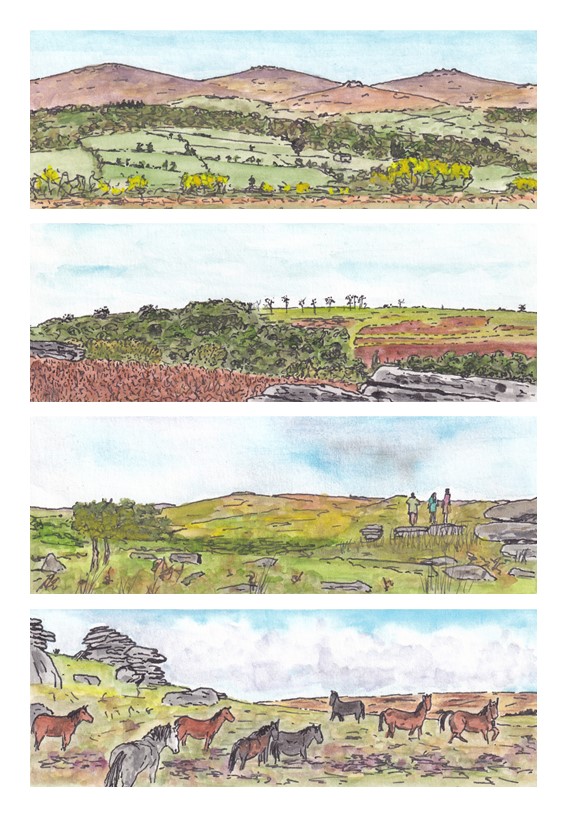
On one recent trip to Dartmoor I was pondering this issue when it occurred to me that what I was seeing with my eyes was a little like the view I got when I used my thumbs and index fingers to create a rectangular, letterbox-like, frame and then looked through that frame as if looking through a window. Despite there being so much more that could be seen, my brain seemed simply to ignore that part of the view that would have outside this frame, whereas my phone camera played no such trick. I began to wonder whether the key to painting this kind of view was to change the size and shape of the picture, adopting a similar letterbox, or panoramic, format. So, for a few days I played with this approach. The results are a series of four small painting that I refer to as my Dartmoor Panorama series.
I’m pleased with these pictures, at least to the extent that they better capture something approximating to the kinds of spacious views that I like best. Using a panoramic format does seem to work. In the third picture I was brave enough to include some people standing on one of the tors and gazing out at the view> I think this little piece of detail adds a lot to the picture, including a splash of contrasting colour. I was even more brave in the fourth picture, including a group of Dartmoor ponies. I tend to think that I’m not able to paint animals, but perhaps I am improving, because at least some of the ponies in this picture seem to have come out pretty well. I am particularly pleased with the grey pony in the foreground and the somewhat lively pony furthest to the right.
I feel sure that I will use this approach to painting expansive views again, and I suspect that at some point my curiosity will lead me to explore some photography guides to see whether I can find a proper explanation of my observation. It might have something to do with ‘foreshortening’ and/or ‘depth-of-field’ (words that I am vaguely familiar with that at least sound like they could be contributing factors). Who knows, perhaps someone reading this post will be able to point me in the right direction!
Back in April, after completing four series on miniature watercolour pictures (Dartmoor Scenes, House Plants, Capital City Landmarks and Mysterious Britain), I decided that I would give myself a new challenge by scaling up my paintings a bit and keep my subject matter close to home with a set of pictures that I described with the working title ‘Plymouth Postcards’. I wanted to try to keep the same kind of fairly loose style but I thought it would be good to be able to capture a bit more detail of each scene. My miniature watercolours had been just 5cm square (or 5cm x 7cm in the case of the Mysterious Britain series) but this new series was, naturally, postcard sized (roughly 10cm x 15cm). That’s an increase in area of up to six times, and so it gave me quite lot more sketching, drawing and painting to complete!
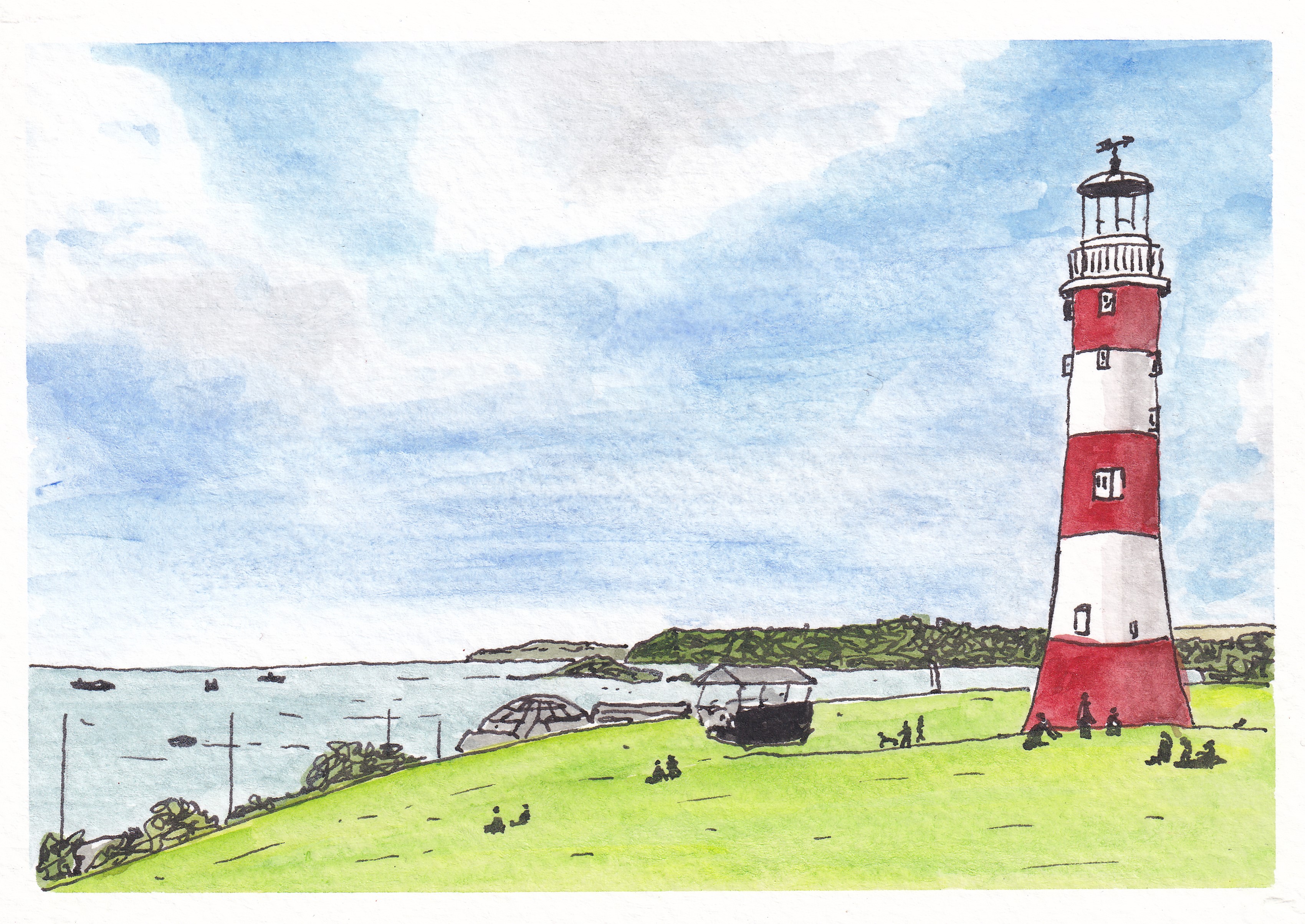
My first picture (above) focused on what is probably the most iconic view associated with Plymouth, the red-and-white striped form of Smeaton’s Tower – one-time lighthouse on the Eddystone Rock which was moved to Plymouth Hoe when it was replaced in the 1880s.
Next up, I remained close to the waterfront with a view across the inner basin of Sutton Harbour towards the old customs house and the Three Crowns pub. I am not sure that the colour of the water there is ever quite as blue as my picture suggests, but I like the bright and cheery feel of this painting…
Sutton Harbour, Plymouth
Third came a view of one of Plymouth’s most distinctive new buildings, the Roland Levinsky Building, home of the Arts Faculty at my workplace, the University of Plymouth. Again, the sky is perhaps a little too bright, but I like the three-way competition between the blue sky, the green of the grassy area in the foreground, and the coppery-orange cladding of the building itself…
The Roland Levinsky Building, University of Plymouth
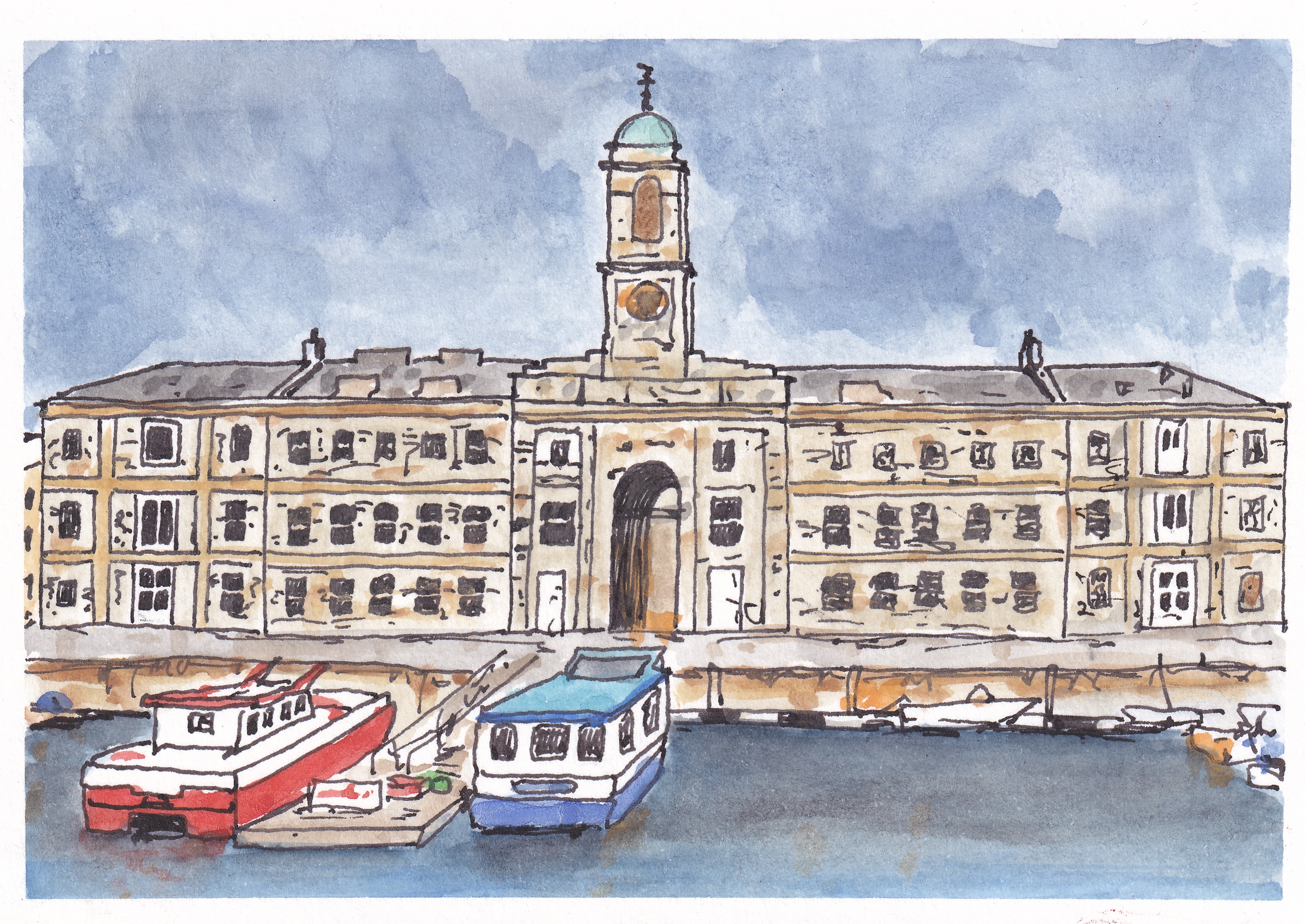
After painting a fairly new building, it was time to visit a much older one with a ffront-on view of one of the main buildings at the Royal William Yard, formerly the victualling yard for the Royal Navy but now a home for swanky apartments, restaurants, various studios and art spaces, and a cinema. I think this is one of my favourites from the series…
Royal William Yard, Plymouth
Then, it was back to the city centre for a picture showing the Charles Church, bombed in the Second World War and left in its broken state as a memorial to lives lost. Behind it, the angular exterior of the eastern end of the Drake Circus Shopping Centre forms an interesting backdrop which was surprisingly challenging to paint…
Charles Church and Drake Circus Shopping Centre, Plymouth
For my sixth Plymouth Postcard, I took a trip down to the Barbican area of the city for a view of the Plymouth Gin Distillery on Southside Street. It was difficult to get the perspective of the curved road right but I think I have just about managed it…
Plymouth Gin Distillery, Southside Street
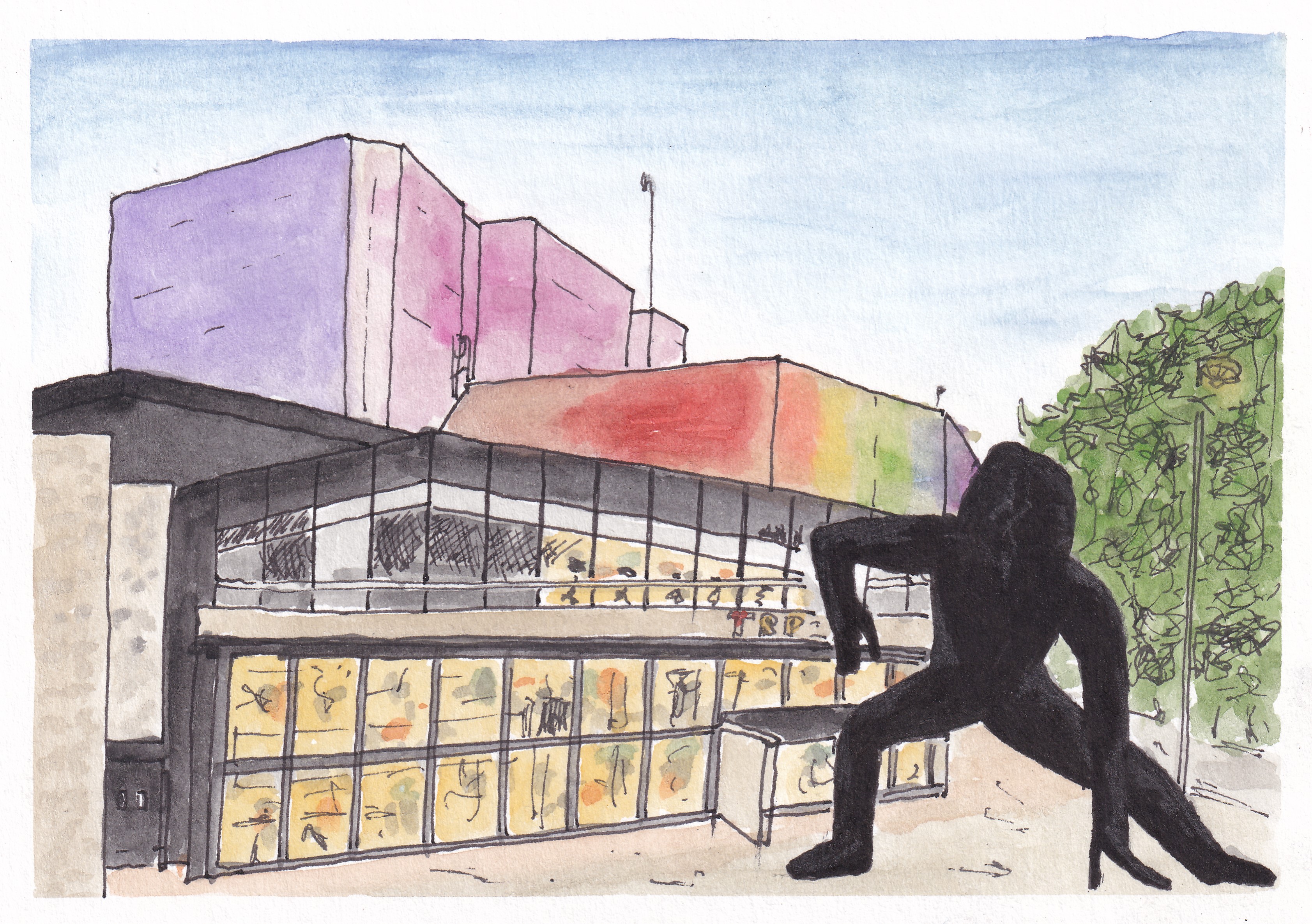
It was time to get a bit ‘arty’, so my next picture was of the interestingly illuminated Theatre Royal, with the imposing form of the statue ‘Messenger’ in front of it. I think that I did pretty well with the theatre itself, and the shape of the statue isn’t too bad, but my initial attempts to shade its dark form resulted in it looking like a hairy gorilla, and so I coloured it black with a permanent marker to try to salvage the picture. Unfortunately, this was only partially successful and I think I would have to describe this one as something of a ‘fail’…
Theatre Royal and ‘Messenger’, Plymouth
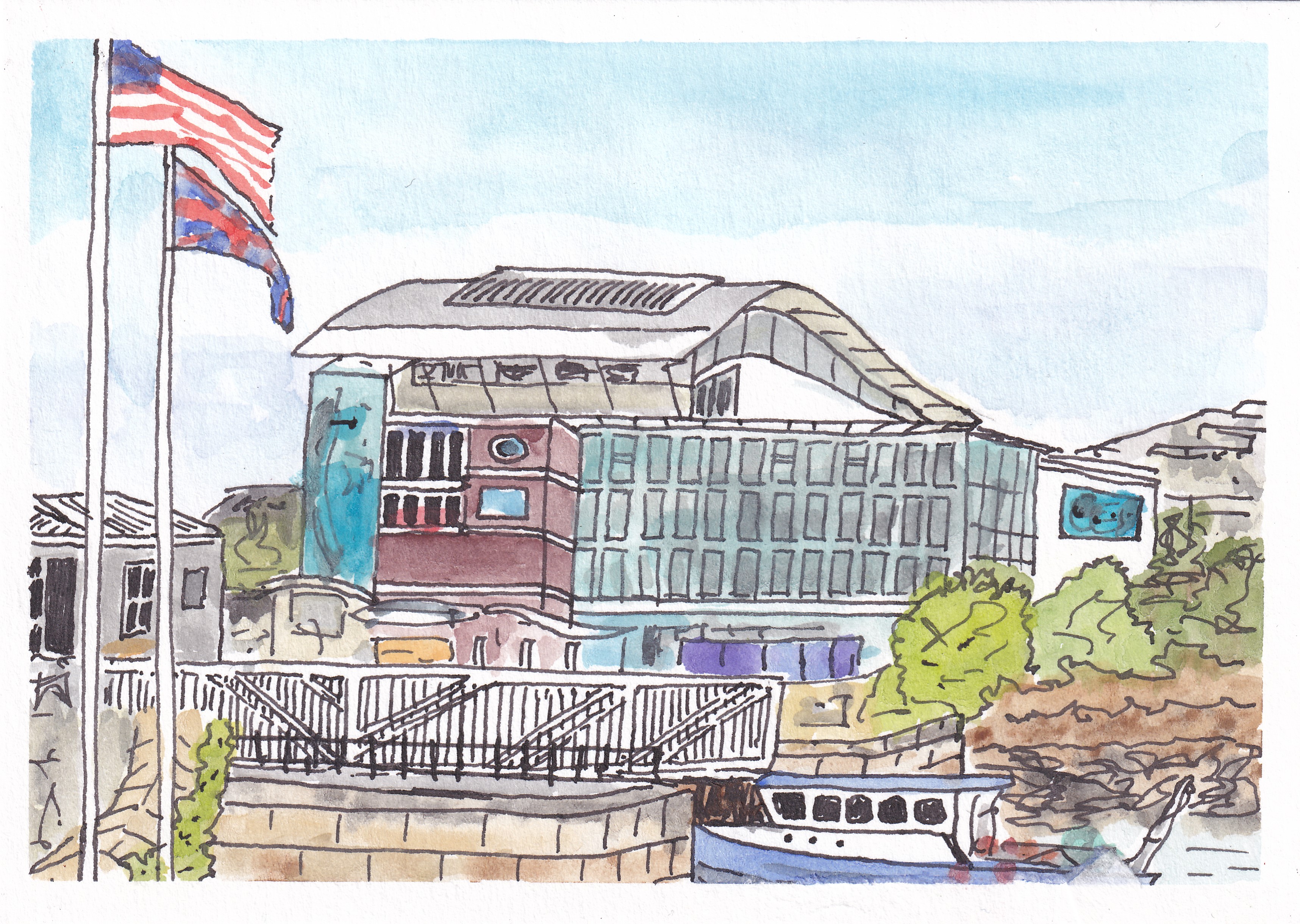
Painting number eight took me back to Sutton Harbour, this time looking across the swing bridge towards the Fish Market on the far left and the National Marine Aquarium, with its wavy roof in the centre. I’m please with the way I captured the blue colour of the windows and the advertising poster on the left of the building, and I like the foreground detail of the boat and bridge. Sadly, my attempt at a Union Jack flag was not quite so successful and the flag of the USA seems to have lost its stars…
The National Marine Aquarium, Plymouth
My ninth picture took me to very familiar territory, with a view of the old turnstiles at Home Park, home of Plymouth Argyle Football Club…
Home Park, Plymouth Argyle Football Club
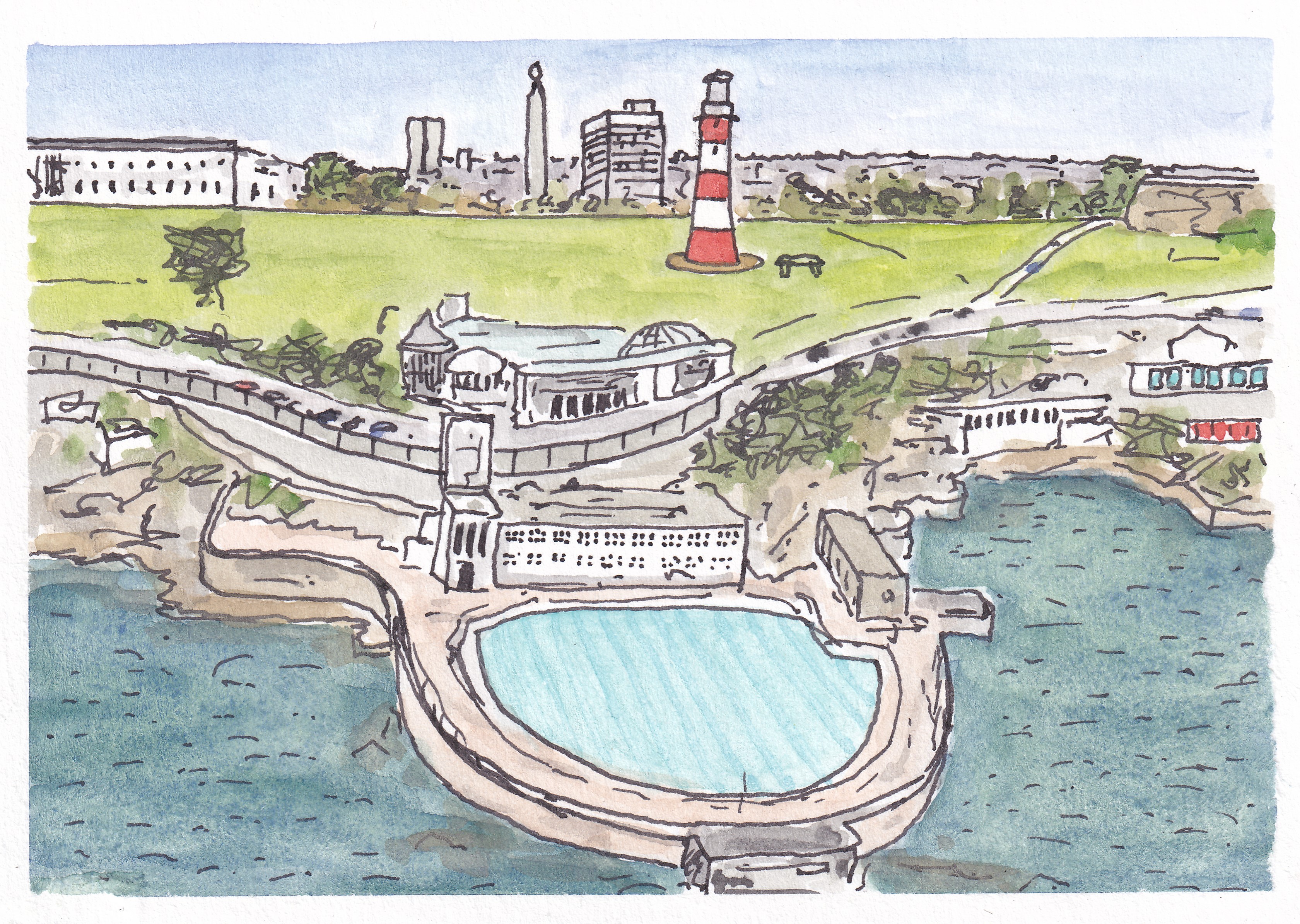
… and then it was back to the waterfront with a view of the art deco Tinside Lido with part of Plymouth Hoe, Smeaton’s Tower and the war memorial in the background…
Tinside Lido and Plymouth Hoe
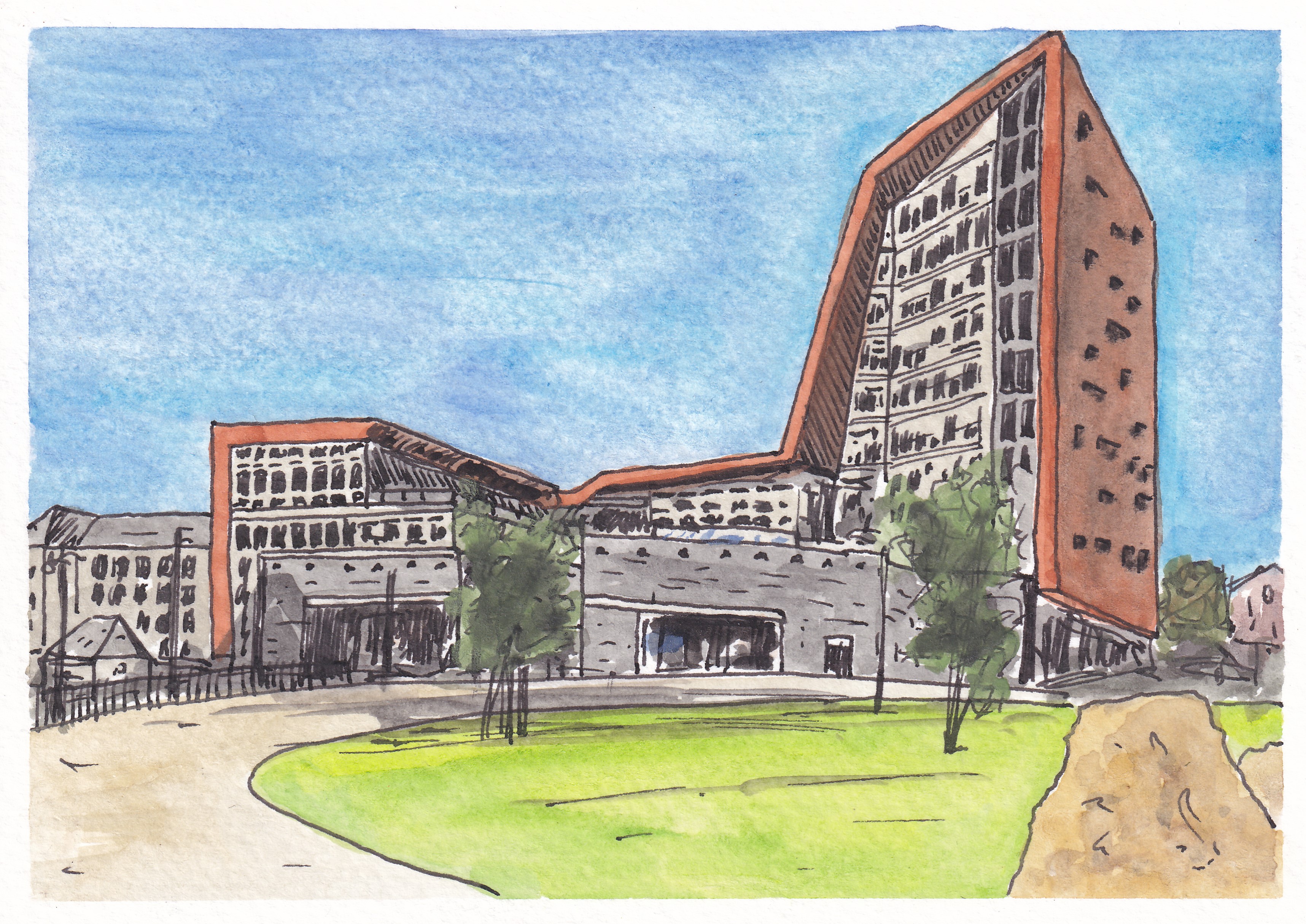
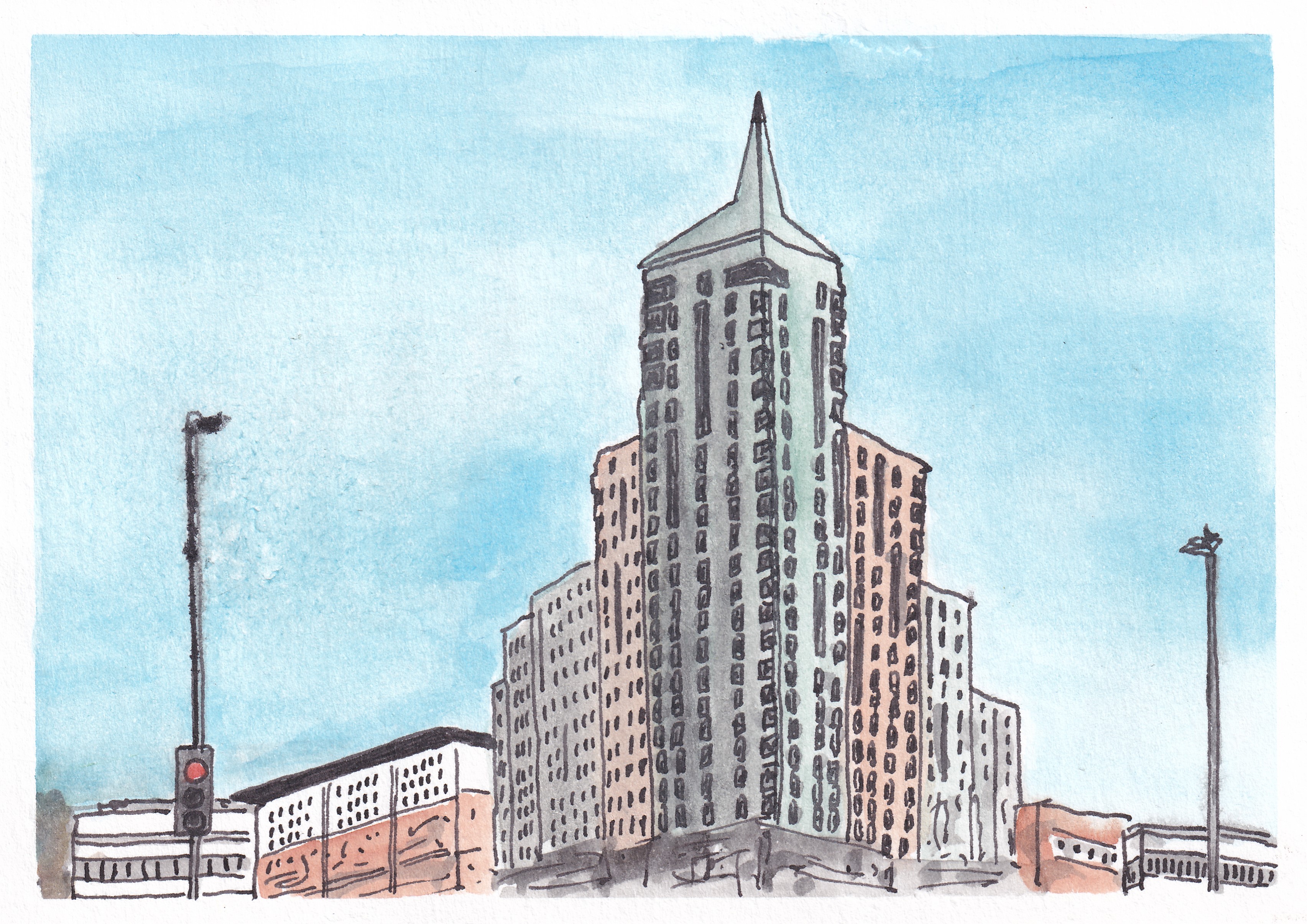
I finished my series with two pictures of contrasting buildings. First up was the Devonport Town Hall and Column, with the oddly coloured and spectacularly fronted (and named) Odd Fellows Hall on the right. Finally, my subject was the sharply-topped, and so highly appropriately named, Beckley Point (a Hall of Residence for students in the city). This is, apparently, the tallest building in the southwest of England (although I don’t know what is being counted as the southwest in this case)…
Devonport Town Hall and Column and the Odd Fellows HallBeckley Point Hall of Residence, Plymouth
This was a fun series to do, taking 17 days to complete, and overall I was pleased with the results of my efforts. It was interesting to try to capture some of the more striking buildings and views that Plymouth has to offer, particularly as it is generally regarded as an architecturally bland and unexciting place (largely as a result of the fact that much of the city centre was flattened by bombing raids in the Second World War).
I am sure that I will do plenty more paintings of Plymouth views in the future, but I think this set forms a good initial collection, showcasing some of the different areas and places of interest in the city nicely.
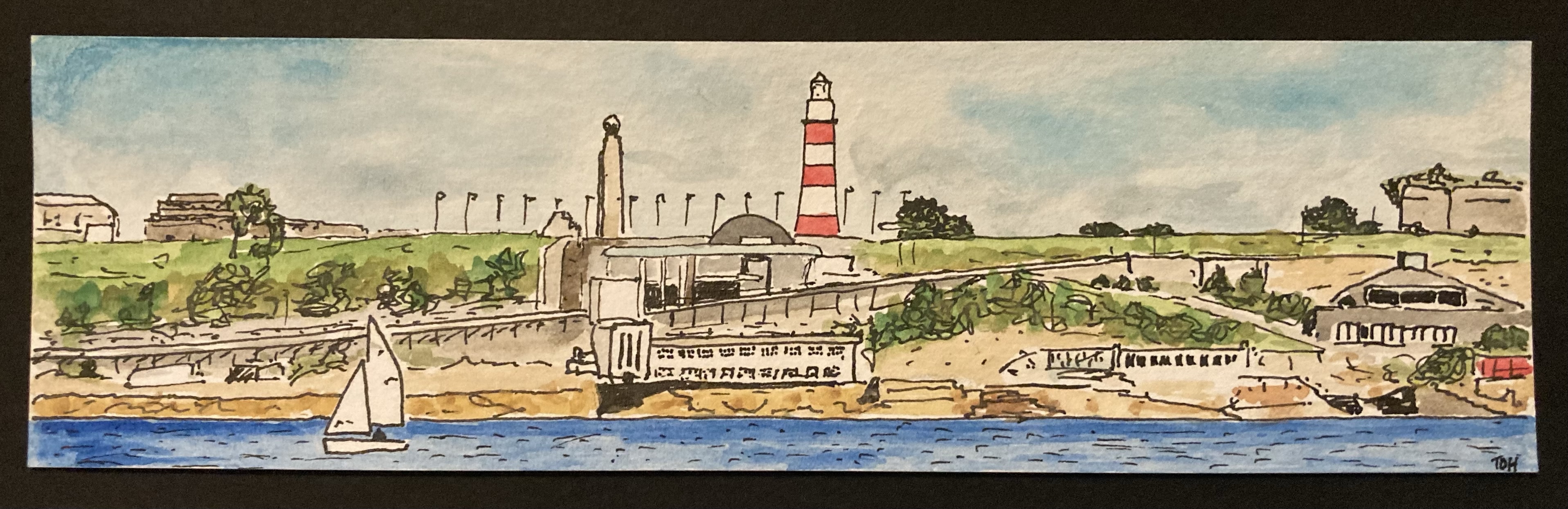
I painted this small panoramic picture of Plymouth Waterfront as viewed from Plymouth Sound as a bookmark to accompany the birthday present (books!) that my wife gave to one or her friends back in March. They enjoy a weekly walk down to the Plymouth Waterfront on most Friday mornings and so this scene was the obvious subject matter to choose.
It was interesting to paint in this wide format, and it’s an approach that I have been using more recently for some Dartmoor pictures. I think that when we view a landscape in real life our brain naturally provides a somewhat wide-screen view, and that this might be why, at least to some extent, it is often somewhat disappointing when you take a photograph of a view and much of what you see in real life seems to be condensed into a very small part of the picture.
One advantage of adopting this kind of panoramic composition, at least for a novice and completely untrained painter like me, is that it reduces the amount of sky, as this is often tricky to paint. And in this particular picture it also reduced the amount of water that I had to paint, something else that I’m not especially confident with.
All in all, I really liked this picture with its pops of colour [did I really just write ‘pops of colour’ – this seems to be such a trendy turn of words these days on TV programmes relating to art, interior design, home improvement etc. I must have caught it from there…]. I am sure that this is a format and also, with its obvious local interest, a view that I will return to in the future.
A couple of weeks ago we paid a visit to Make Southwest, an exhibition space for contemporary craft and design and a leading charity for craft education located in the small town of Bovey Tracey on the southern edge of Dartmoor, about 25 miles from our home in Plymouth. It’s a venue that we have visited a few times before – there is always some kind of special exhibition (this time it was a exhibition of contemporary bells called Sound and Silence) and an interesting array of local artwork, books and assorted items to look at in the shop. On this occasion, the reason for our trip was to see a smaller exhibition of wood engraved prints and, in particular, the printmaker Molly Lemon, who had travelled down from her base in Gloucestershire to demonstrate her work. We have encountered Molly at several Craft/Art Events in the last couple of years and always enjoyed viewing, and chatting to her, about her work. We also enjoyed seeing her compete in, and reach the semi-finals of, the Sky Arts TV Series Landscape Artist of the Year a few weeks ago.
Since I started painting about a year ago, whenever I go to any kind of art gallery or art/craft event I particularly enjoy scavenging the work that is on display or sale for ideas that I can try out for myself. Looking at the various pieces of artwork for sale in the shop at Make Southwest, I was particularly enamoured by some tiny pieces of work created by the printmaker Mike Tingle (also here). These were very small (just a few centimetre) square prints on slightly larger squares of rough-edged paper, with a title and the artist’s name written in pencil around the picture (there is an example of a similar kind of picture just below the centre in this piece of work: Dartmoor Box No 1). I really liked the miniature size and somewhat ‘rough’ nature of the pieces and I immediately thought that it would be fun to try to produce something similar using one of my own small Dartmoor Scenes watercolour paintings.
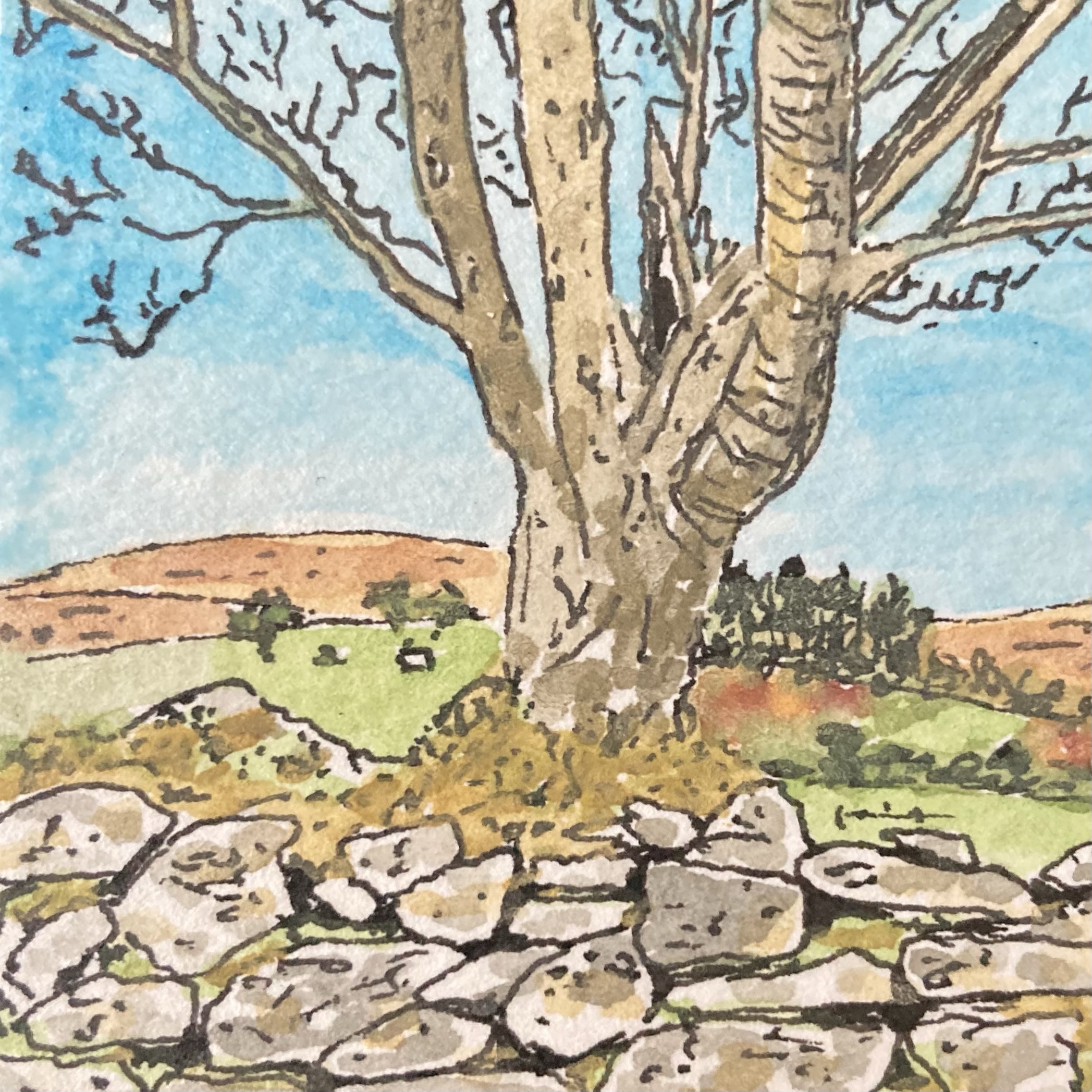
After returning home, I set about seeing what I could produce. First, I selected one of my pictures, opting for this one of a tree growing out of a typical Dartmoor dry-stone wall:
The original picture is a 4.5 cm square ink and watercolour sketch, and my intention was to use our home inkjet printer to make the best quality colour photocopy of it that I could, printing onto a sheet of watercolour paper so that the texture of the original was preserved. I’d already played around with making copies of some of my paintings in this way and so I knew that although the copied versions weren’t quite the same as the originals, with the paler colours tending to wash-out a bit, the process worked pretty well. So far so good.
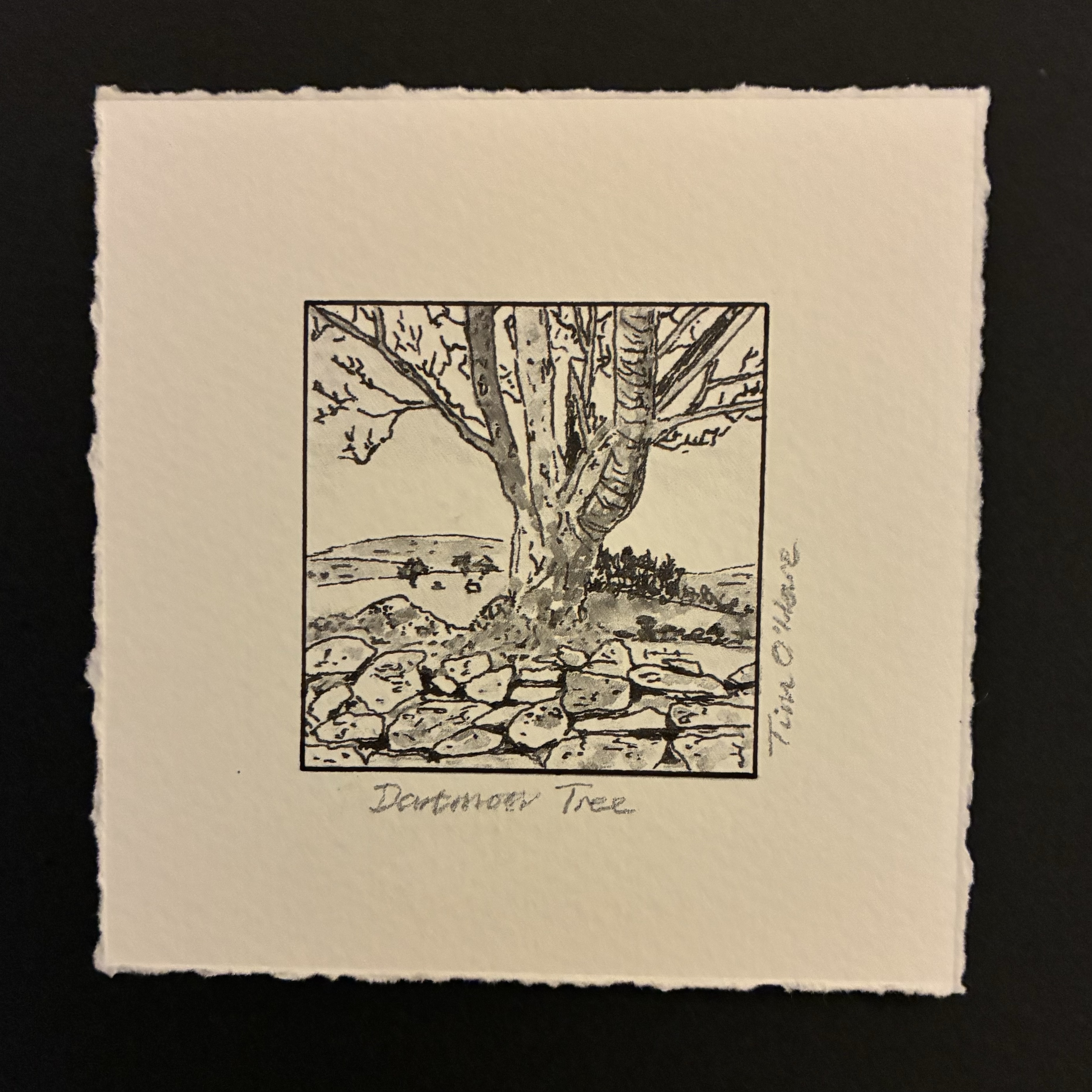
This is the point at which I made my mistake. In the process of making the copy I somehow selected black-and-white printing, and so when I saw what the printer had spat out into the print tray I was instantly annoyed and frustrated. To make matters worse, because the original picture was on a small square of fairly thick paper, as the scanning light moved below the copier glass a dark shadow line was cast on one side of the copied picture. Not only did I only have a black-and-white copy, but I had a black-and-white copy that had a dark line along one of its edges. What a waste of a sheet of paper and ink…
However, once I had overcome my initial disappointment and self-censure, I decided to press on with the rest of my production process and see what the end result looked like. I had intended that there would be no border between the picture and the surrounding area of paper, but now there was that dark line along one side spoiling that design idea. What could I do? Well, go with the mistake of course. I took my drawing pen and with the aid of a straight edge and a lot of care, I inked in a similar line on the other three sides. Hmmm… it didn’t look as I had planned but I liked the result. Then I measured out a wider border, and again aided by a straight edge, I tore the paper down to size. This part of the process is something that I have found takes a lot of care… if the tear is too sharp you don’t get the nice rough edge I was after, but if you are at all rushed and loose you end up with something that looks clumsy and careless. Fortunately, I managed to do a good job. Finally, I grabbed a soft pencil and quickly wrote a title below the bottom edge and my name on the right-hand side…
The result of this endeavour was the small picture shown at the top of this post and, despite my black-and-white and shadow mistakes in the copying process, I’m really pleased with the end result, so much so, in fact, that I intend to take the rest of my Dartmoor Scenes pictures and treat them in the same fashion. Even better, not only did I end up with a new picture that I really liked and the discovery of a new way to transform existing pictures into a different, somewhat distinctive, form, but I also gave myself a great reminder that making mistakes in life is not always a bad thing. In fact, sometimes, as in this case, a mistake can open up a different path from the one that was intended that leads you towards an unexpected but interesting, exciting or enjoyable destination!
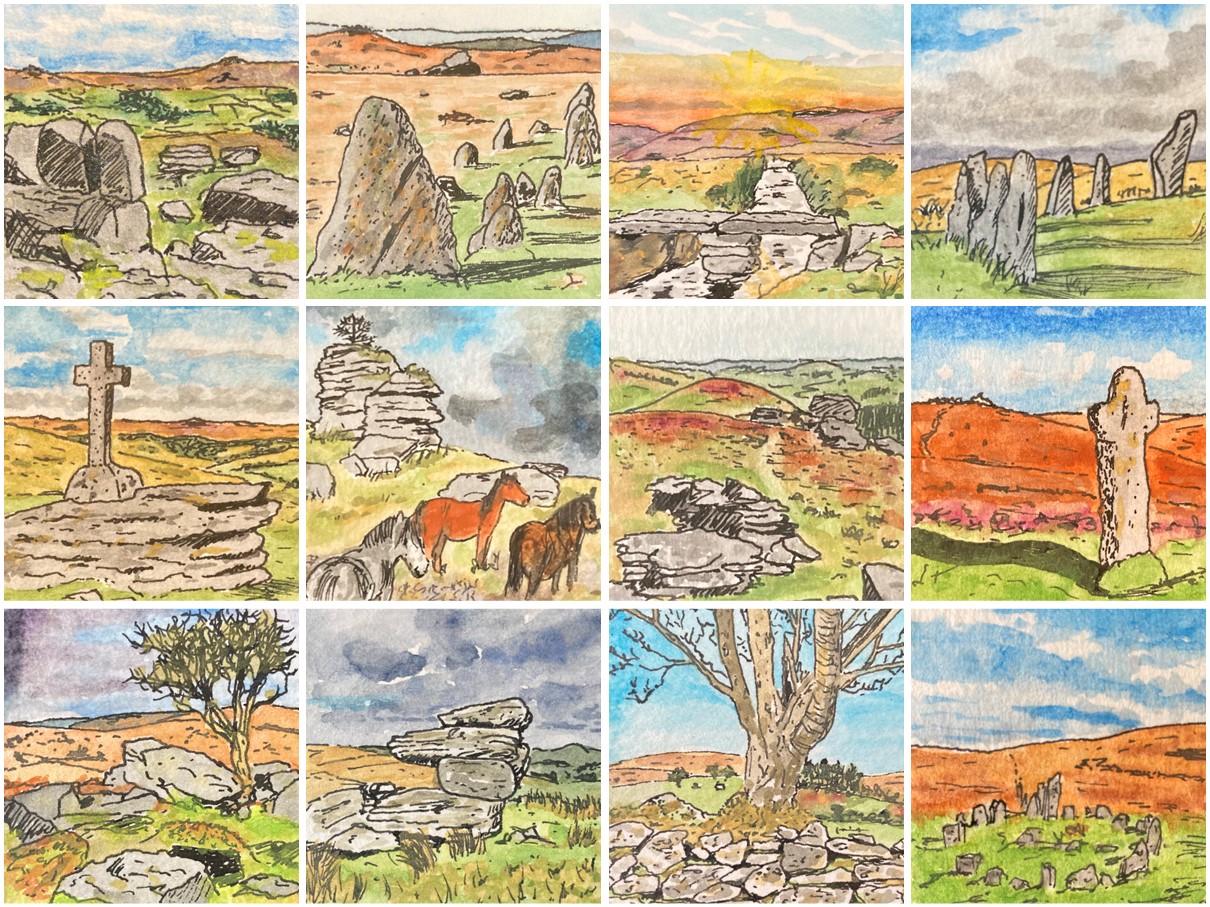
At the beginning of last month (March 2025) I decided that I wanted to try to embed a more regular art practice into my life. So, one evening, I sliced a piece of watercolour paper into a series of 5 cm squares with the intention of painting some kind of miniature picture each morning. I didn’t know what I would paint, just that I would try to paint something, as often as I could.
It was interesting, then, to wake up the next day and find myself sitting down at my painting table at 7:30 am, before I had even eaten breakfast, painting a little scene of a tor and some scattered rocks, a scene that is typical of Dartmoor, the National Park just north of Plymouth where I live. Because I was working on such a small piece of paper, and because I was trying to work quickly, before I got fully enmeshed in the day’s activities, I found myself adopting a simpler style than usual, with fewer, and bolder, colours and some use of cross-hatching to show shadows and darker areas. I liked what emerged.
After that first painting (the one at the top-left of the composite picture at the top of this post) I still didn’t know what would happen next, but at some point, perhaps after two or three days, I came to realise that I was creating a series of miniature pictures that I labelled Dartmoor Scenes. Initially, it was my intention to paint five pictures, one on each weekday, but having successfully reached that number I decided to push on to nine. This seemed to me to be a good number for a series of little square pictures, neatly forming a 3 x 3 grid.
As I approached what I thought would be the final picture, I received a comment on my Bluesky (social media) account on which where I was posting my new picture each day, suggesting that the pictures would make a nice calendar. It was an idea that I liked, a lot, but of course a calendar needs 12 pictures, one for each month… and so my miniature watercolour Dartmoor Scenes series had to become a collection of 12 pictures in total.
I really enjoyed producing these little pictures (and have since gone on to produce two more sets of 12 similarly-sized pictures on different themes – watch this space for details!). I enjoyed being forced to keep things simple and was really happy with the results (more in some cases than in others). I particularly like the stone row and stone circle pictures on the top row (second-left and top-right), and the tree and wall scene (third-left, bottom row). I also really like the way that they look when placed together.
Although it was already almost the end of March by the time I received it, I got a desk calendar printed up as a kind of test run to see how well it worked… and it worked very well indeed, the pictures coping with being expanded to almost double their original size. Subsequently, I have also had each picture printed as a 10 cm square card and had some copies of a larger card printed with a 3 x 3 composite of the nine pictures that I think are the best of the selection. At some point I hope to get more of these cards printed so that I can have a go at trying to sell some of my artwork. It will be interesting to see what happens if and when I do!
As an experiment in trying to be more regular with my artistic endeavours, this activity has worked really well, and although I have now moved on from Dartmoor Scenes, I suspect that I will return to this theme again at some point and complete another set (at least another four to get to a 4 x 4 grid, but who knows, maybe I have another 13, 24 or even 37 Dartmoor Scenes still in me!)
If you like these pictures, I’d love it if you added a quick comment to this post. It would be fun to know which one(s) you like best.







 Tim O'Hare