The Time Crackers – progress update #writing

Some time ago (by which I mean years, not weeks or even months), well before I had finished writing the final draft of my children’s adventure story Empedocles’ Children, I had the idea for another children’s book – The Time Crackers. Empedocles’ Children ended up as a fairly weighty tome, coming in at around 110,000 words and (probably) best suiting readers towards the upper end of what is termed ‘middle grade’ (ages 8-12). I hadn’t particularly aimed it at that reading level, it just turned out that way, but for The Time Crackers, I felt that the story would connect best with slightly younger children, and decided that I would make a conscious effort to keep the chapters short and ensure that the story was snappy and moved along at a good pace.

Without giving too much away, the basic premise of The Time Crackers centres around two children who discover a portal through which they shift to the same location but at a specific time at which an important (real) historical event takes place there. They are able to move back and forth between the historic and modern time periods (as long as they keep hold of the ‘key’ of course, which is tricky when they don’t even know that one exists…). Then, while they are in the historical setting, they get caught up in an adventure that requires them to solve a coded puzzle which then leads them to take action to ensure that the history unfolds as it should do.

At the outset I had the basic premise of the story, the location and its associated historical setting and event, and an idea for the initial incident that brings the two children to discover the time-crossing portal (the setting is Plymouth and the historical setting is the late 16th century so you can probably guess the historical event!). I also had the idea for a second location, and an association with a completely different historical period, and so I can quite imagine that by the time I have finished it, The Time Crackers will have become The Time Crackers 1:….., the first story in The Time Crackers series.

I started writing the first chapter of The Time Crackers (‘Flashback’) at least a year ago (probably more) and managed to add two more chapters (‘The New Girl’ and ‘Target Practice’), reaching the point in the story where the two children, Jim and Mols, have been introduced (to the reader and to each other), we have got to know a little bit about Jim, his character and his home set-up, and things were nicely set up ready for the trigger incident that leads Jim and Mols to discover the time portal. But then, as is often the way with me, things ground to a halt as I got busy, diverted my attention towards other creative projects (such as my discovery of painting 14 months ago), or just succumbed to the chronic procrastination that is the bane of my life. Whatever the reason, the ability to sit down and write new words eluded me…

… until yesterday, when, without too much effort, I finally opened and re-read Chapter 3, decided that it was essentially complete and then found that sentences were emerging in my brain and flowing smoothly to my fingers and then onwards onto the screen as I launched myself into Chapter 4 (‘Noises In The Dark’). The result was that after about 30-40 minutes I had harvested the next 800 or so words of the story, and in the process, advanced the story almost to its pivotal moment, the accidental discovery of the time portal. That moment deserves to be the focus of Chapter 5, but before I can find out exactly how events unfold, I need to go back into Chapter 4 and flesh it out with another an additional few hundred words so that it balances the length of the previous chapters a bit better. I had been hoping to do that today, but alas, I managed to divert my attention into other projects instead. I am not sure whether this was a piece of deliberate self-sabotage, my brain opting not to even try to write just in case the well had run dry, or whether it was just the way of things. What I do know is that I really would like to press on with writing this story, because I am excited to see how it unfolds and to discover what thrills and scrapes Jim and Mols get themselves into as they try to solve The Mystery of Drake’s Drum.
The Hollow Man #poem

He does not signal his arrival with a knock upon the door.
I am not warned of his entry by footsteps sounding on the floor.
He is not accompanied by wraith-like wisps of mist.
Nor does he lean in close to give my cheeks a loving kiss.
There is no movement as he slides into the room.
I only realise he is present when overcome by gloom.

For he is a master of disguise,
sidling up to me, out of sight of prying eyes
until he has taken up his place,
occupying every single atom of my space,
matching every feature, to cast a shadow on my face.
He reshapes my breath to turn each exhalation into a sigh,
and cries tears upon my heart to dowse the flames
and cause the fire to die.

If I am sitting reading in a chair,
he squeezes in to look upon the words,
and twists their meanings
so that they transform, grotesquely and absurd.
If I am gazing from the window to catch sight of nature’s green,
he draws a veil across my eyes to wipe away life’s vibrant sheen.
If I am setting out upon a chosen path,
he conjures fog so thick and heavy that I cannot find the start.
If I have hopes to pursue a long-awaited plan,
he shows me every obstacle and challenge that he can.
He breaks the bridges of my imagination
so that they have insufficient span.
He was with me yesterday.
He is The Hollow Man.

He does not ask if it is convenient for him to share my time.
I have no say in this, the choice is his, not mine.
He does not consider for one moment
whether I would like him near,
for if he needs my space he takes it with no fear.
He gives no thought to any impact that he makes.
It’s up to him to choose the one he takes.

For he is a master of deceit,
and if he needs to feed then he will eat
until he has taken all he grips,
draining arteries with a thousand sips,
sucking out the marrow through his lips.
He gnaws away until my bones are stripped of meat,
and leaves the empty carcass in a heap.

When he is with me all I feel is rank despair.
I try to look ahead but only find a vacant stare.
When he is with me I can see no hope,
I cannot move as I would like, my walk becomes a slope.
When he is with me there is only cloud,
and I would even welcome then a deathly shroud.
When he is with me there is nothing you can say,
for I am empty till he moves away.
There is no weapon you can use to end his stay.
He is The Hollow Man,
and he will have his day.

Yet, he will tire, and then as softly as he came,
I find that he has slipped away to leave me with my fragile frame,
and if I search with care for what lies buried in the depths,
I find that he has not quite stripped me as I slept.
For there are embers that still burn though feebly bright,
that, tended gently, provide new warmth that brings a light.

For he is a master who will make his mark,
and from those tiny flames out jumps a spark,
until it catches on the dried-out skin,
taking hold to make new flames begin,
exploding with the hidden energy within,
then bursting outwards as a firework on its arc,
until the world no longer seems so dark.

There is no fanfare as he leaves his host,
he simply slips into the ether to become another haunting ghost.
There is no note to say farewell,
no threat that he’ll return to cast his spell.
But I expect that he’ll be back,
that he will claw his way inside once more
to turn my soul to black.
And strangely, though his visits cause much strain,
the gift he brings is worth the pain,
and even though I shudder at his name,
I know with certainty that he will come again.

He is the slaughterer –
the one who feeds upon the lamb.
He is the emptier –
the one who draws out all the poison
that has spread across the land.
He is The Hollow Man,
and I must welcome his arrival,
for he is part of who I am.

(c) Tim O’Hare, August 2023


THE HOLLOW MAN: I would say that I am usually in a fairly positive frame of mind, but every so often, and always without any real warning, I find that I have slipped into a deep state in which I have absolutely zero motivation and can see no point whatsoever in doing anything at all. I become uncommunicative, I mutter, I trudge. I know that I am in this state, but I am powerless to change things; in fact, in the moment, I don’t want to. The best way that I can describe how I feel is empty, or hollow. Over time, I have learned that this down phase passes, and usually I wake the next morning feeling back to normal, better even, than I did before the dip. My energy levels shoot back up, and I feel more inspired. ‘The Hollow Man’ was written on such a morning. After a terrible dip the previous day I had spent an hour or so reading, gone for a short run, and emerged from the shower with the first two lines of the poem in my head. As soon as I could I stood at my whiteboard, wrote out those two lines and then followed the seam to chip out the whole of the first verse. At that point I was thinking that I should stop, but I soon found myself at the computer typing in the first verse and then, over the next couple of hours, all of the rest of the poem tumbled out. At the outset, I had no idea that the poem would ultimately become uplifting (well I think it is uplifting!) and perhaps even a little profound.

Poetry #poem

I do not know if my poems are any good,
but it seems they help my essence to be understood,
whether by others or simply by myself,
this last, of course, itself essential for my health.

I do not know if my poems are enjoyable to read,
but it seems that crafting them fulfils some vital need,
and that allowing thoughts and feelings to gush forth
provides a compass I can use to find my north.

It seems as if through searching for each rhyme
I’ve stumbled on a way to slow down time,
and that now, through sculpting syllable-istic rhythm,
I see the world in multitudinous ways –
split infinite like sunlight passing through a prism.

And so, once more, I drop into the mine,
to chip away and work the line,
to trace the seam right to its core,
and scrape out all the mineral ore.
I hammer hard to split a rock,
in hope it is a nugget-bearing block,
in hope it might just be the one to hold
a precious, piece of sparkling gold.

I do not know if my poems hit the mark,
but certainly they’ve lit a spark.
So now the flames inside me roar,
and I can ask for nothing more.

Here goes…
First, time slows,
an idea flows,
like water spurting from a hose.
The seedling grows.
The petals unfurl upon the rose.

I take my chance…
Falling deep into the trance,
where visions glance,
words prance,
and rhythms dance.
And then I emerge, life enhanced.

In those moments, my whole world collapses onto a single spot.
So much energy compressed into a tiny dot-
freezing cold yet furnace hot.
I do not know if my poems are any good.
I do not know if my poems are enjoyable to read.
I do not know if my poems hit the mark.
It matters not.

(c) Tim O’Hare, July 2023


POETRY: I had some nice feedback on the first few poems that I wrote, but as this all came from people that knew me well it was impossible not to feel that it must be biased, even if only subconsciously. I began to think about whether my poems really were any good. This is the kind of thinking that usually drains my motivation and stops me in my tracks. But I have changed a bit in recent months, and pondering this a little more, I was able to acknowledge that whether or not anyone else liked my poems, I enjoyed the process of creating them, and was learning about myself as I did so.

Mistakes Are Not Always Bad #wisdom

A couple of weeks ago we paid a visit to Make Southwest, an exhibition space for contemporary craft and design and a leading charity for craft education located in the small town of Bovey Tracey on the southern edge of Dartmoor, about 25 miles from our home in Plymouth. It’s a venue that we have visited a few times before – there is always some kind of special exhibition (this time it was a exhibition of contemporary bells called Sound and Silence) and an interesting array of local artwork, books and assorted items to look at in the shop. On this occasion, the reason for our trip was to see a smaller exhibition of wood engraved prints and, in particular, the printmaker Molly Lemon, who had travelled down from her base in Gloucestershire to demonstrate her work. We have encountered Molly at several Craft/Art Events in the last couple of years and always enjoyed viewing, and chatting to her, about her work. We also enjoyed seeing her compete in, and reach the semi-finals of, the Sky Arts TV Series Landscape Artist of the Year a few weeks ago.

Since I started painting about a year ago, whenever I go to any kind of art gallery or art/craft event I particularly enjoy scavenging the work that is on display or sale for ideas that I can try out for myself. Looking at the various pieces of artwork for sale in the shop at Make Southwest, I was particularly enamoured by some tiny pieces of work created by the printmaker Mike Tingle (also here). These were very small (just a few centimetre) square prints on slightly larger squares of rough-edged paper, with a title and the artist’s name written in pencil around the picture (there is an example of a similar kind of picture just below the centre in this piece of work: Dartmoor Box No 1). I really liked the miniature size and somewhat ‘rough’ nature of the pieces and I immediately thought that it would be fun to try to produce something similar using one of my own small Dartmoor Scenes watercolour paintings.

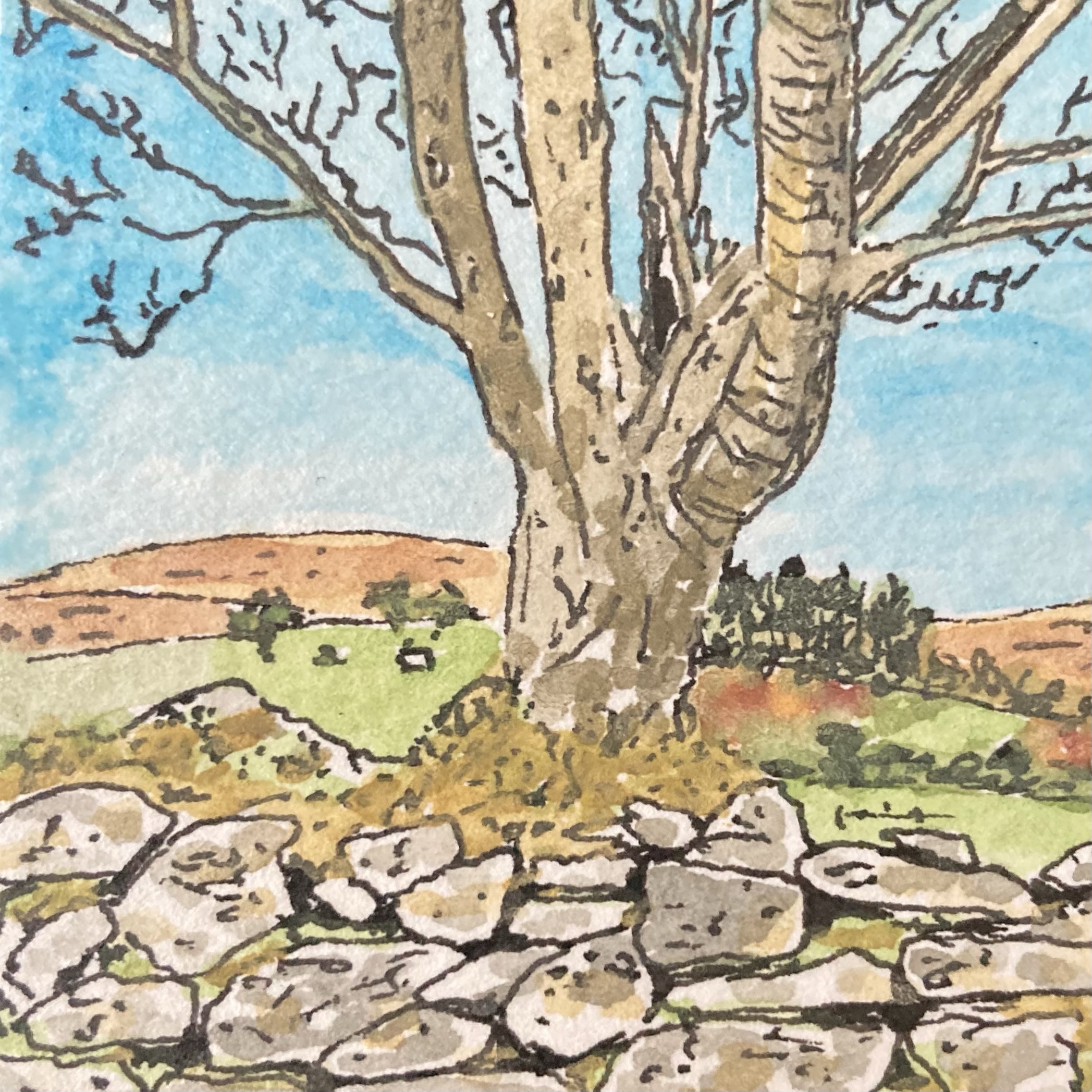
After returning home, I set about seeing what I could produce. First, I selected one of my pictures, opting for this one of a tree growing out of a typical Dartmoor dry-stone wall:

The original picture is a 4.5 cm square ink and watercolour sketch, and my intention was to use our home inkjet printer to make the best quality colour photocopy of it that I could, printing onto a sheet of watercolour paper so that the texture of the original was preserved. I’d already played around with making copies of some of my paintings in this way and so I knew that although the copied versions weren’t quite the same as the originals, with the paler colours tending to wash-out a bit, the process worked pretty well. So far so good.

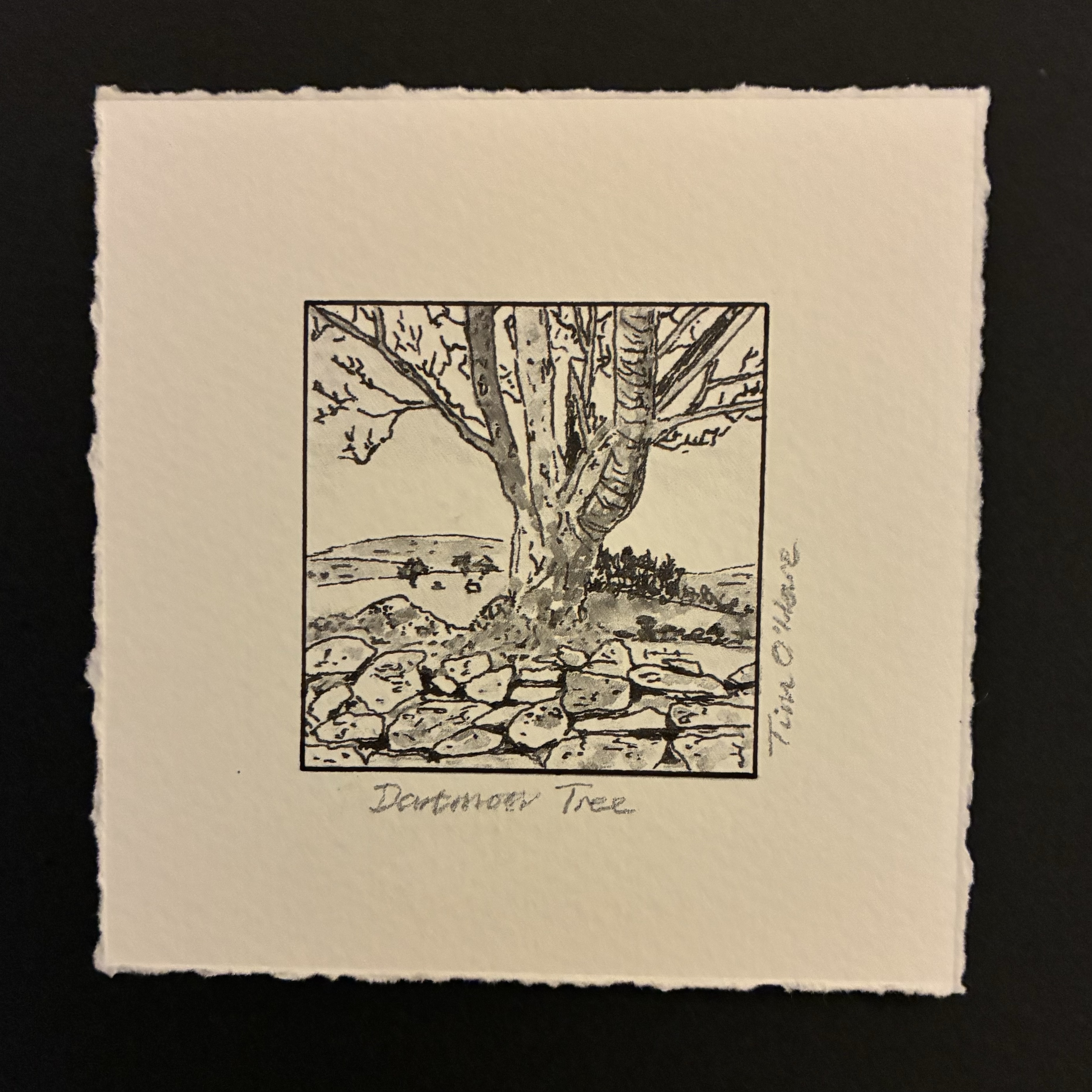
This is the point at which I made my mistake. In the process of making the copy I somehow selected black-and-white printing, and so when I saw what the printer had spat out into the print tray I was instantly annoyed and frustrated. To make matters worse, because the original picture was on a small square of fairly thick paper, as the scanning light moved below the copier glass a dark shadow line was cast on one side of the copied picture. Not only did I only have a black-and-white copy, but I had a black-and-white copy that had a dark line along one of its edges. What a waste of a sheet of paper and ink…

However, once I had overcome my initial disappointment and self-censure, I decided to press on with the rest of my production process and see what the end result looked like. I had intended that there would be no border between the picture and the surrounding area of paper, but now there was that dark line along one side spoiling that design idea. What could I do? Well, go with the mistake of course. I took my drawing pen and with the aid of a straight edge and a lot of care, I inked in a similar line on the other three sides. Hmmm… it didn’t look as I had planned but I liked the result. Then I measured out a wider border, and again aided by a straight edge, I tore the paper down to size. This part of the process is something that I have found takes a lot of care… if the tear is too sharp you don’t get the nice rough edge I was after, but if you are at all rushed and loose you end up with something that looks clumsy and careless. Fortunately, I managed to do a good job. Finally, I grabbed a soft pencil and quickly wrote a title below the bottom edge and my name on the right-hand side…

The result of this endeavour was the small picture shown at the top of this post and, despite my black-and-white and shadow mistakes in the copying process, I’m really pleased with the end result, so much so, in fact, that I intend to take the rest of my Dartmoor Scenes pictures and treat them in the same fashion. Even better, not only did I end up with a new picture that I really liked and the discovery of a new way to transform existing pictures into a different, somewhat distinctive, form, but I also gave myself a great reminder that making mistakes in life is not always a bad thing. In fact, sometimes, as in this case, a mistake can open up a different path from the one that was intended that leads you towards an unexpected but interesting, exciting or enjoyable destination!

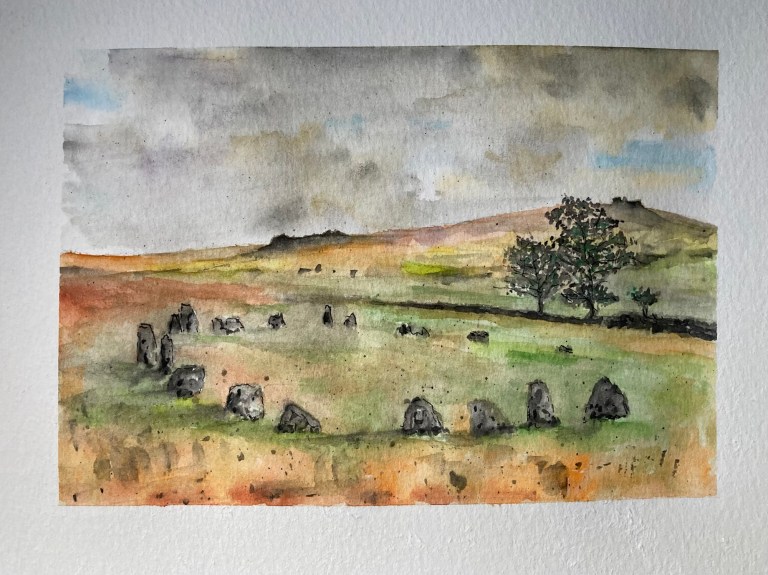
Stone Circle, Dartmoor #art

Back in April I decided I would like to have a go at sketching and painting. I have often thought about trying to do watercolour painting but my natural tendency towards perfectionism and my inability to carve out time for such activities has always put paid to those ideas. Back in Primary School – 50 or so years ago – I was quite into drawing and painting (without any particular flair) but in the intervening years I have hardly picked up a sketching pen or paint set. So, it was a bit of an impulse decision when I decided to work my way through a free video course on drawing and painting with ‘loose lines’ earlier this year. The course consisted of ten short videos that gave prompts to follow and, importantly, encouraged imperfection and embracing of mistakes (one of the practice tasks included instructions to deliberately make mistakes which I will admit I found hard to follow).

After just a few days of working through the course I was branching out to do more ambitious pieces and soon found myself starting to develop my own style. Since then I have been producing pictures on a fairly regular basis – mostly quick (15-30 minute), small watercolour landscapes and usually with quite a lot of detail put in with black ink. Producing these little works of art has been something I have greatly enjoyed and even though I say it myself the final pieces have been pretty good and certainly much better than I expected them to be given that I have a complete lack of technical training and zero experience to guide me. I just try things out, play and see what happens.

Over the weekend just gone I sat down for half an hour or so and decided I would have a go at producing a watercolour painting without doing what I usually do which is to first draw out the subject in a fair amount of detail in ink and then subsequently add more detail in ink on top of the paint. I have called this a ‘minimal ink’ watercolour (I did put a few small details in after I had completed the painting). I chose a photo of a stone circle on Dartmoor as my subject matter. The result is the picture at the top of this post and it is one that I am really pleased with. I am pleased with the sky as I have captured the colours and cloud shapes better than any sky I have painted previously and I am pleased with the oranges and pinks in the colour of the moorland. Most of all I am pleased that I have extended the range of my art a little more by limiting my use of ink and creating something that is a little less detailed and a little more impressionistic. It is certainly a style that I will have a go at again sometime.

Rediscovering the Artist Within

When I was in Primary School I was pretty good at drawing. I remember winning a prize for an art-based project to capture a week-long residential trip we made to Tenby in South Wales and my teacher being thrilled at being able to keep a detailed pen and ink drawing I made of a monastery building in Pembrokeshire which was where she was from (Pembrokeshire that is, not the monastery). I never really got on with art at Secondary School. I think perhaps I didn’t have the patience to stick to a task long enough to turn out something worthwhile and there were 101 other things that I could be doing that grabbed my attention instead. But I have always wanted to learn to draw properly, to take up water-colour painting (perhaps not the best choice as I think it is actually one of the more difficult types of paint to use) or to have some kind of (graphic) artistic endeavour that I could lose myself in. I think I like the idea of being a wanderer, stopping here and there to whip out my art materials and conjure up a piece of magic. It’s never happened of course – life has got in the way.

My most recent attempt to get a brush-hold in the artistic world was towards the end of 2022. At a Maker Fair in South Devon in November I saw some pieces of artwork that I really liked – big abstract pastel drawings of wind-swept Dartmoor landscapes – and that led me to suggest that Father Christmas might like to give me some pastel crayons and drawing paper so that I could have a go at producing something similar. FC duly obliged and I was all geared up and ready to go…

…but time passed and, of course, it didn’t happen – life got in the way…

A couple of days ago, more than a year after I was gifted the materials, I settled myself down and had a play. I have to confess that the reason I finally got to make art that afternoon was that whilst out on a walk with my wife the day before I had been musing about how bad I am at getting myself to do the things that I say that I want to do (my self-analysis tells me that this is a combined result of three things: i) a continuous feeling of guilt that I hold inside me that there is something more important that I should be doing for someone else, ii) a ridiculously crippling tendency towards perfectionism that stops me starting things so that I don’t have to run the risk of the outcomes not being good enough and iii) the fact that my brain is always distracting itself to think about other things leaving me completely unable to decide what I will settle down to do in any given moment). My wife’s response was to suggest that we set aside the following afternoon for us both to make some art and because she had fixed that as a plan it was then possible for me to follow it through (I have no problem doing things when other people ask or tell me to do them!).

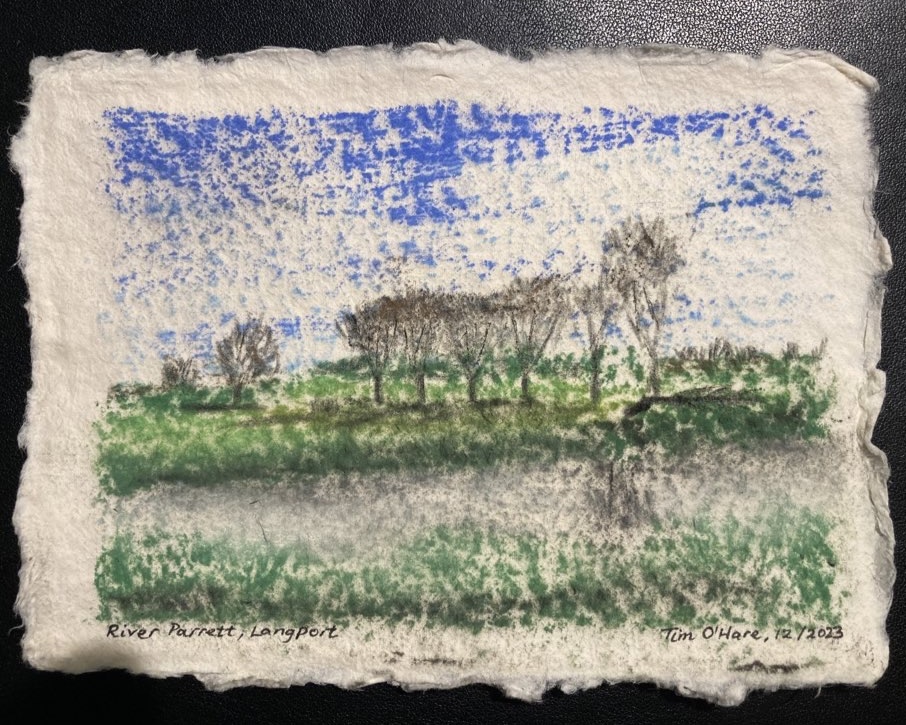
The result was that I spent a couple of hours with my little pack of pastel crayons and drawing paper and without any real idea about how to use them to best effect I just picked a photograph to base the picture on and dived in… What I discovered is that pastel crayons are a perfect medium for me to use because they seem to be very forgiving. I started with just a little colour and gradually built up the picture from the top downwards not thinking to much but just feeling what colour I would place where, how hard I would press, how much I would blend or smudge colours etc. and, amazingly, the results came out far better than I could ever have hoped. One good decision I made was to start small – with some postcard-sized paper – as this meant that I could produce a finished picture in less than an hour.

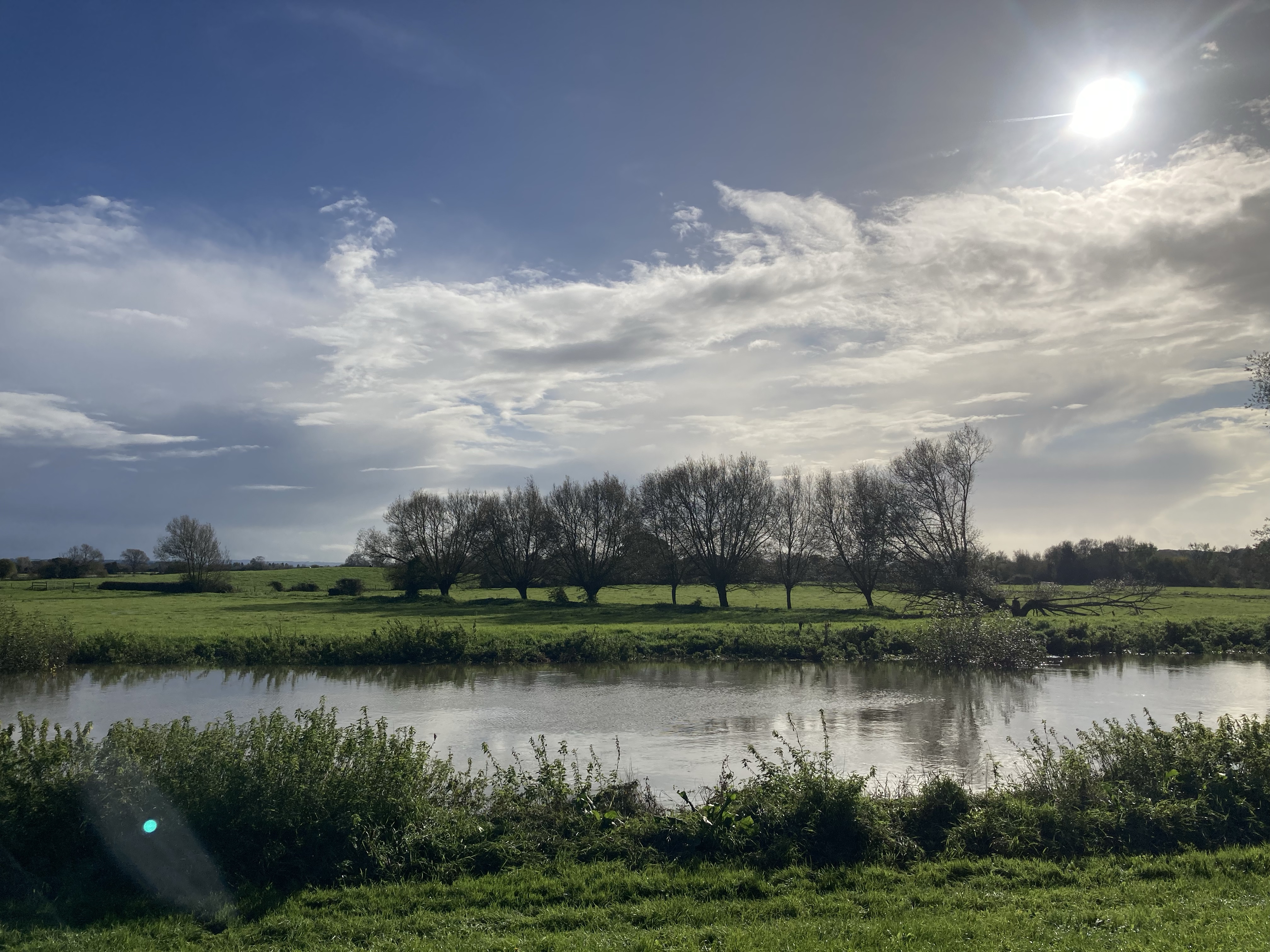
My first picture was from a photograph I took when visiting Langport in Somerset back in October. It’s a view from a bench across the River Parrett. I’ll add the photograph to the end of this post but here’s the picture that I drew:

My initial reflection was that I could have used a little more solid color but, on the other hand, I quite liked the rather sparse and washed-out look.

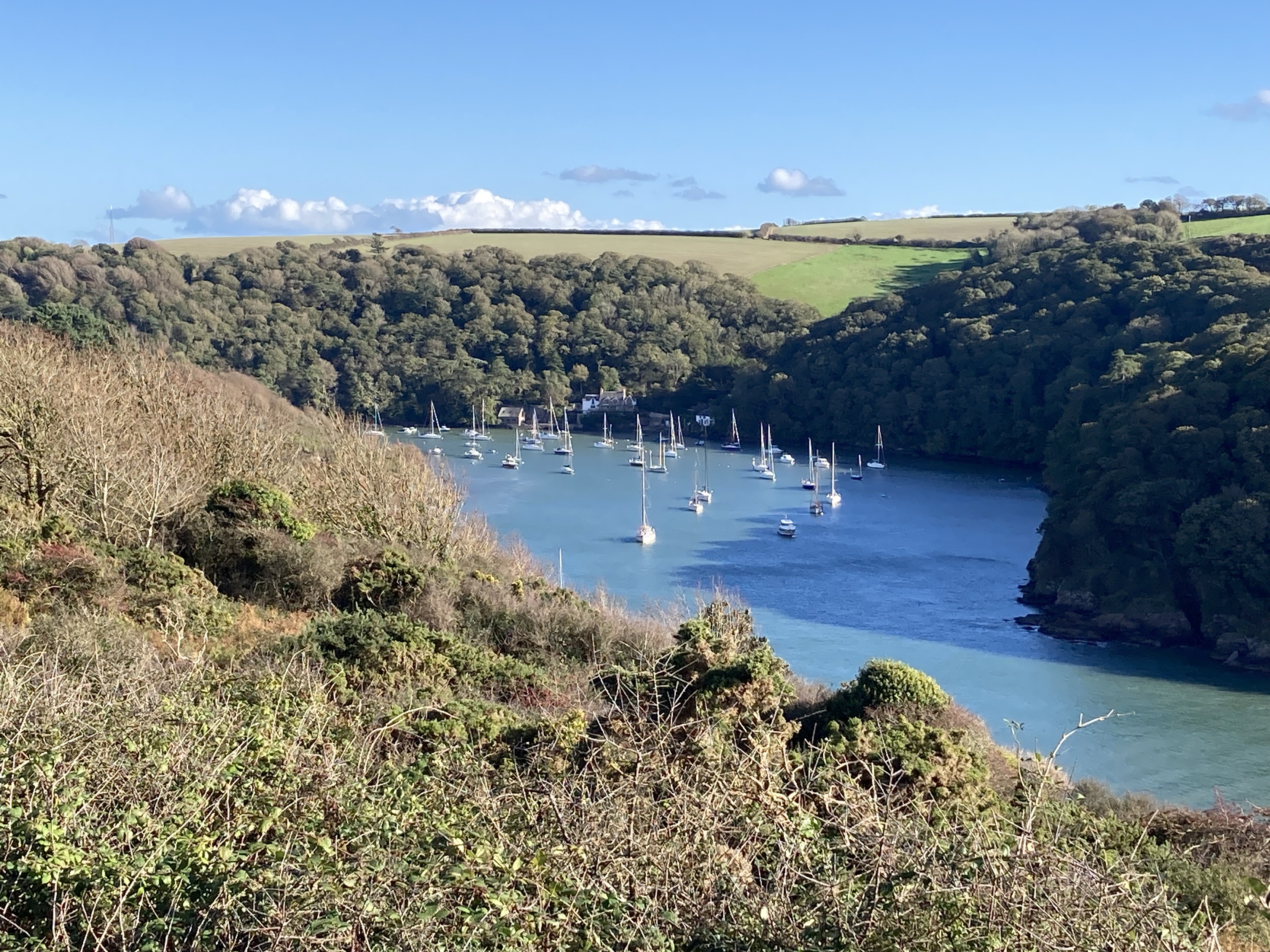
Having made a start with one picture I kept going, immediately setting to work on a second picture, this time a view of the Yealm Estuary near Warren Point (again, see the end of this post for the original photograph). This second picture ended up with much denser colour and if viewed from a distance almost has a photographic quality about it. The paper I used was very rough/bobbly hand-made paper which led to an interesting pointillism-like effect. I also added a few details with a fine ink pen – something that I think was only partly successful. Again, I am rather please with the result:

All of which means that I seem to have magically found myself being an artist and I am absolutely sure that it will not be long before I am having another go because I loved the deep-concentration and freedom of the process. When producing these pictures I was able to completely lose myself in the flow of the work, almost becoming part of it – in fact on reflection I would definitely say that the word art became a verb describing how I chose to spend a little piece of my life (I was ‘arting’) and not simply a noun describing the little pieces of coloured paper that I ended up with. Now I am really looking forward to seeing where this new pursuit takes me!

For completeness, here are the two photographs on which my first two pictures were based: