I read Revelation, the fourth title in C.J. Sansom’s Shardlake series during April and May 2025. As with the other books in this series, it is quite a weighty tome and follows the lawyer Matthew Shardlake and his general assistant Jack Barak as they investigate another peculiar set of crimes during the reign of King Henry VIII in early 16th century England. The previous book in the series, Sovereign, had seen Shardlake travelling north to York, but Revelation returns the action to the rapidly expanding, crowded and evidently crime-ridden city of London.
Initially, Shardlake finds himself caught up in the investigation of a single, macabre, murder of a legal colleague friend. However, it soon becomes apparent that the murderer is working through the seven prophesies of the Book of Revelation in the bible as more bodies, brutally killed in ways that match the prophesies, are uncovered. As Shardlake’s investigation unfolds and they second-guess the murderers next moves and race to neutralize them, Shardlake comes to realise that he is also very much at threat, adding an extra dimension of urgency to his searches. This is added to by concerns that the crimes have the potential to impact at the highest level, drawing Henry VIII’s future wife Catherine Parr into peril. Along the way, Shardlake spends a lot of time working to free a young man from Bedlam, rekindles his love for an old flame (the wife of the first victim) and Barak becomes ever more distant from his new wife Tamasin, who he first encountered in York while helping investigate the crimes described in the previous book, Sovereign, after the death of their young child.
I remember really enjoying the first book in this series, Dissolution, and I have enjoyed the rest of the series too, but I feel that, perhaps surprisingly, rather than growing in strength as the characters mature and settle into their fictional world, the stories have become progressively weaker with each title. The introduction of the more personal, relationship-base activities of the main characters seem to be rather forced and somewhat out of character, and after making a significant impact in the first two books, Shardlake’s physician friend Guy, potentially the most interesting character of all, seems to have become rather sidelined.
Despite its weaknesses, I still felt that Revelation provided a fairly gripping historical adventure yarn with plenty of twists and turns, and I will certainly continue with the series in the future.
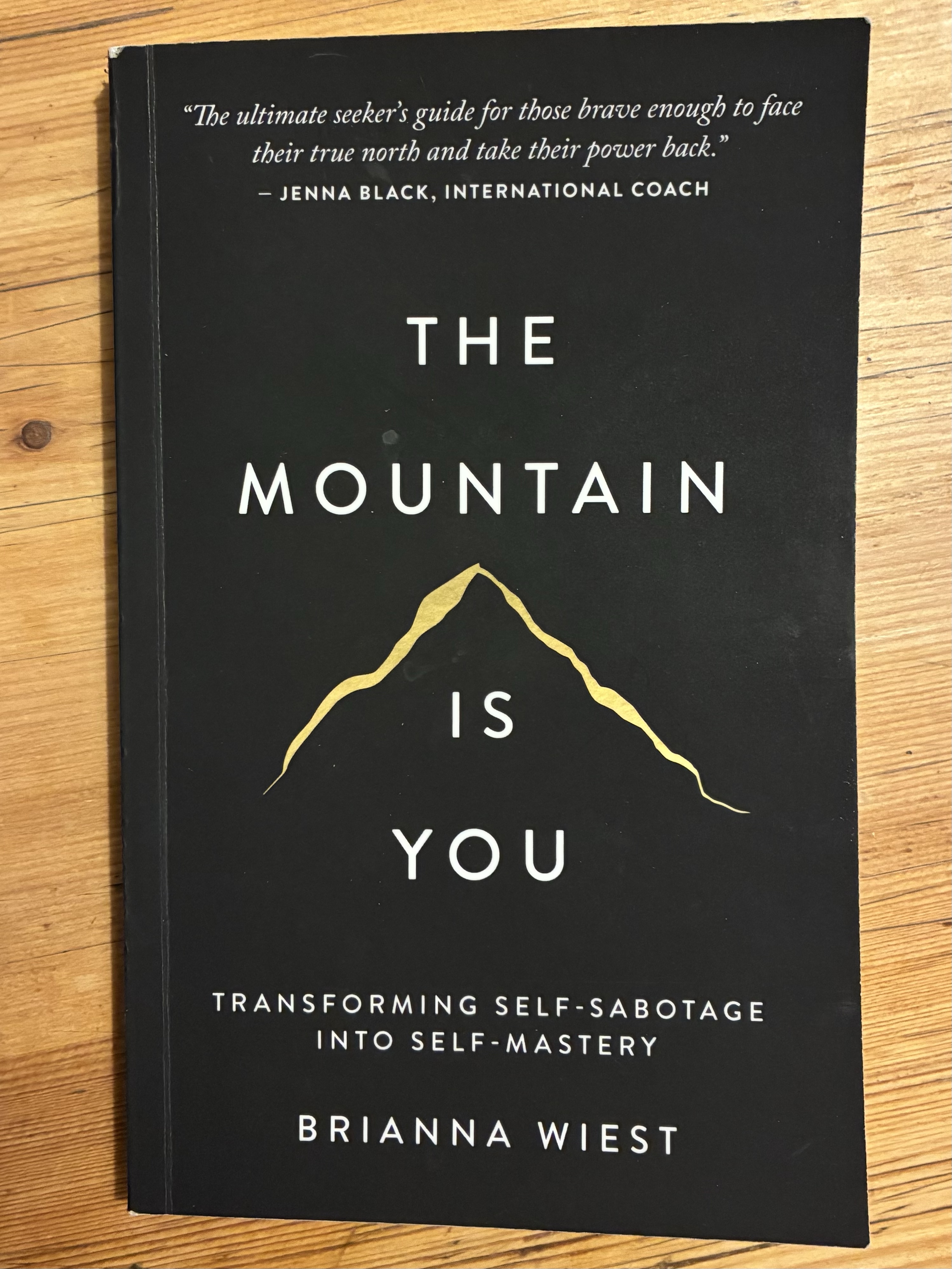
The Mountain Is You: Transforming Self-Sabotage Into Self-Mastery by Brianna West is probably not a book that I would have picked up to read of my own accord, despite that fact that I am pretty much certain that a lot of the struggles I have in pushing myself into action and gaining the sense of achievement and fulfillment that I crave are driven at a fundamental level by self-sabotage in one form or another. There is just something about the whole mountain metaphor, along with the kinds of words used in the book blurb that I read online (‘deep internal work of excavating trauma’, ‘building resilience’, and ‘adjusting how we show up for the climb’) that instinctively put me off. Why then did I work my way through this book for a few weeks in April and May this year? Because it was voted as the reading matter for the May meeting of The Timecrafting Trust Book Club that I participate in, and so, dutifully, I ordered myself a copy and set to work.
Almost from the start, I realized that there might well be a bit more value for me from The Mountain Is You than I had envisaged. I was immediately stuck with some obvious similarity between some of the content being covered and the ideas of psychotherapist Carl Jung that I found enthralling and thoroughly convincing when I read James Hollis’s excellent The Middle Passage a year or so ago.
Wiest begins her book by describing the various forms that self-sabotage can take along with the underlying reasons why each type of self-sabotaging behaviour occurs. There were quite a few lines in this section of the book that resonated with me…
‘sometimes, we sabotage our professional success because what we really want it to create art‘
‘sometimes, our most sabotaging behaviours are really the result of long-held and unexamined fears we have about the world and ourselves‘
‘human beings experience a natural resistance to the unknown, because it is essentially the ultimate loss of control‘
… because yes, I do increasingly seem to be seeing myself as an artist, yes, I definitely have a lot of fears squashed down into my head that hold me back, and yes, I do tend to get overwhelmed and feel very uncomfortable when I perceive that things are spinning out of my control. But why then, knowing all of this, does nothing much really seem to change? Wiest delivers the killer answer:
‘most people do not actually change their lives until not changing becomes the less comfortable option‘
Wiest goes on to argue that, in fact, we might be better off re-framing self-sabotage because, ultimately, the habits and behaviours associated with it are actually a result of your very clever subconcious ensuring that some unfilled need, displaced emotion or neglected desire is being met – that those actions are, in fact, deliberately designed to provide a positive outcome that some hidden part of your subconscious seeks.
Aand funnily enough, just this morning, quite coincidentally, I wrote in my journal that perhaps I allowed myself to procrastinate and hold myself back from taking certain actions even though I know this will result in an intense wave of frustration and anger with myself, because at least those negative feelings and emotions are something that I am familiar with and are, in some weird and twisted way, somewhat comforting.
The next section of The Mountain Is You describes a long list of different manifestations of self-sabotage, and whilst many of these did not feel relevant to me, some of them certainly did – hello Perfectionism, Worrying About Least Likely Circumstances, Being Busy, Fear Of Failure, to name a few.
The start of the process of overcoming self-sabotage begins, Wiest suggests, with tuning into, and listening to, the negative emotions associated with it – things like anger, jealousy, regret, chronic fear. She highlights a basic need to be able to ‘allow yourself to feel what you feel without judgement or suppression and notes that understanding your needs, meeting the ones you are responsible for, and then allowing yourself to show up so others can meet the ones you can’t do on your own will help you break the self-sabotage cycle’. For example, feel angry, notice that you are angry, understand why you are angry, remember that it is okay to feel angry… and then get on with life.
There are then a couple of chapters with fairly standard fare on building emotional intelligence and on letting go of baggage from the past, but as these progressed I could feel the book moving steadily into the kind of territory that my initial instincts had led me to expect. Then, aargh, I hit a section titled ‘Releasing your past into the Quantum Field‘ and my brain was instantly screaming at me that I was now thoroughly into pseudo-scientific mumbo-jumbo land… the kind of land where, apparently, ‘You store … emotions, energies and patterns at a cellular level‘. Now, I guess that in some sense everything associated with an individual human is stored at a cellular level, but I am pretty sure that Wiest is suggesting there’s something rather more mysterious and perhaps spiritual going on. I’d be inclined to simply say that statements of that kind are just nonsense!
I guess that from that point onwards, my brain was in a state of high alert, warning me, perhaps unfairly, that much of what I was reading had no real, solid basis. There were lots of nice, almost mantra-like phrases: ‘be willing to be disliked‘, ‘do your inner work‘ and a series of suggestions to ‘create aligned goals, ‘find you inner peace’, ‘detach from worry’, ‘take triggers as signals’, ‘honour your discomfort’, ‘stop trying to be happy’, ‘arrive into the present’ etc., but in the end it was all a bit too much – too many suggestions, too many affirmations, too many challenges to think about overcoming, with the result that I came away confused and somewhat disappointed. After a promising, really very readable first half, everything seemed to have unraveled as the book reached its conclusion. There was just nothing much that was concrete or tangible for me to cling onto.
Late on in the book there was one phrase that I rather liked in a section titled ‘Be aware of what you give your energy’, namely that ‘the wolf that wins is the one that you feed‘ and strangely, on the day that I read those lines some spoke almost the exact same words to me (perhaps that pesky quantum field was doing its thing…). In fact, the whole book is stuffed full of short phrases and sentences that you could lift off the page and incorporate into an inspirational poster or social media post if that is your thing. I may not have warmed to Wiest’s mountain metaphor or felt that the argument in The Mountain Is You hung together in a fully coherent and convincing manner, but she certainly knows how to write what might be called ‘soundbite sentences’. Forget all the gumph about releasing you past into the quantum field and storing emotions at a cellular level, and take this phrase, right at the end of the book… …
‘One day, the mountain that was in front of you will be so far behind you, it will barely be visible in the distance. But who you become in learning to climb it? That will stay with you forever.‘
Since I finished writing my children’s adventure story, Empedocles’ Children, earlier this year, I have been exploring the various avenues through which I might eventually get it published. By far the most likely is that I will end up self-publishing Empedocles’ Children as an eBook and print-on-demand paperback, largely because to get a book out into the world via a traditional publishing route you have to first be successful in gaining the interest of a Literary Agent and, by all accounts, the chances of that happening are pretty minimal… As a result, I am adopting the working assumption that the doors to traditional publishers will remain firmly closed to me, but that doesn’t mean that I am not going to give that route to publication a try, in fact I have already started, having worked my way through an online course from Jericho Writers called ‘How To Get A Literary Agent’. About a month ago, following the approach suggested in that course, I sent off ‘query letters’, accompanied by a one-page synopsis and whatever portion of the manuscript the agent requested querying authors to send (usually the first three chapters), to eight Literary Agents. My plan is to send off a further set of query letters to another group of eight agents sometime in September, and then complete a final set of eight submissions in November(ish). The logic of this staged approach to submissions is that it provides the opportunity to modify the submission made to the later groups of agents on the basis of any responses (or lack of responses) received from the earlier one.
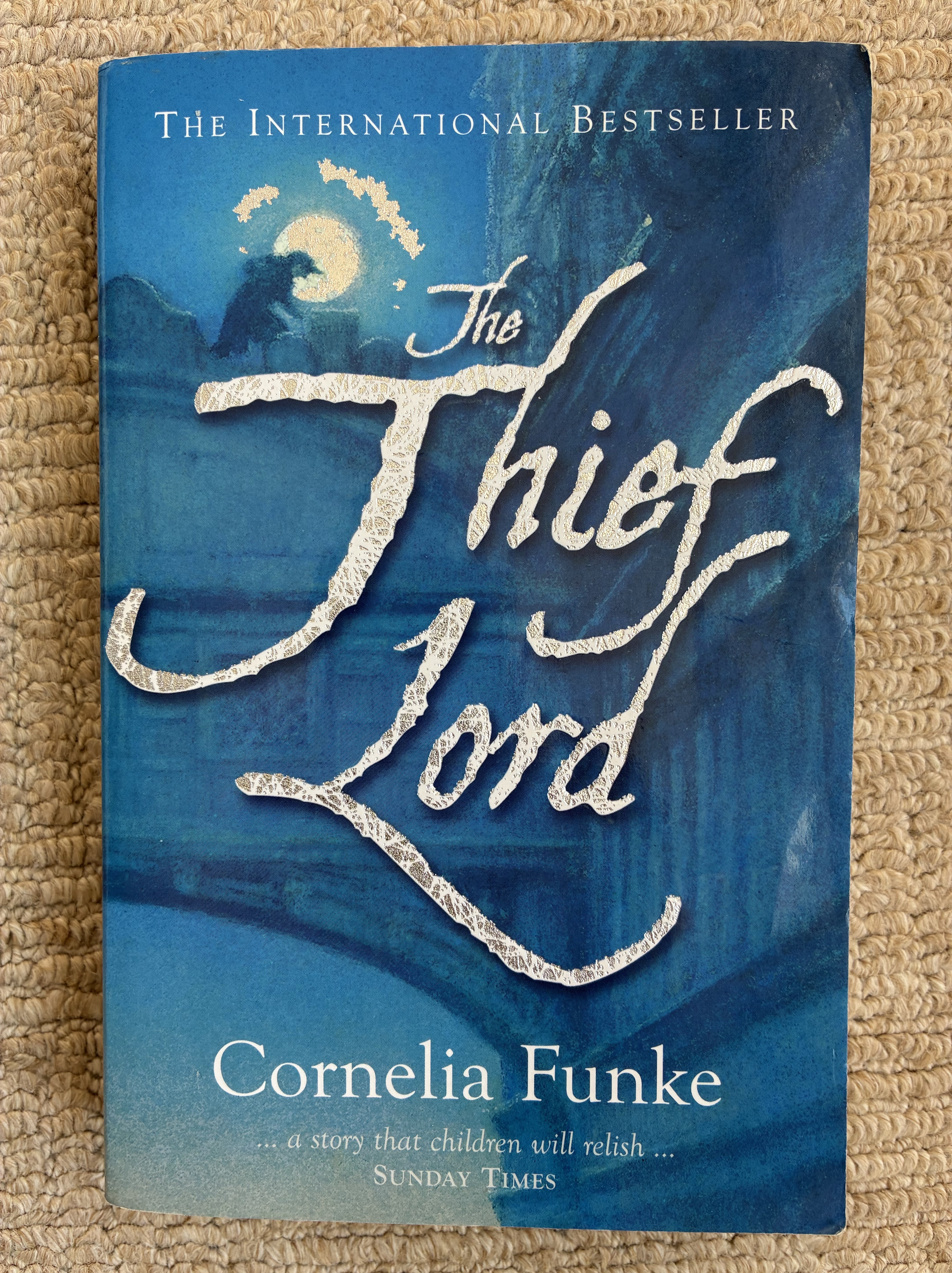
But what has any of this got to do with Cornelia Funke’s children’s novel The Thief Lord? The answer is that one of the things Literary Agents generally ask is that authors liken their work to what are termed ‘comparative titles’ (or ‘comps’). This is supposed to be a good way of the author showing where their book fits into the market (and that they know where their book fits into the market), and so help the agent decide whether or not it might be the kind of book that they want to represent and think they can sell to a publisher. With this in mind, before I could finalize my submission package I had to try to come up with a few such comps. Since I don’t routinely read children’s fiction, I spent a long time perusing the shelves of the local bookstore, but this didn’t really help me much because it seems to me that almost all new children’s books now feature magic, witches and wizards, dragons and suchlike. I also decided that I should try to get into the habit of reading some children’s fiction, and so when I stumbled upon a copy of The Thief Lord in a charity shop, I grabbed the opportunity to read a title by one of the most successful writers for children of recent decades.
The story of The Thief Lord is set, rather randomly, in Venice, and follows two orphaned boys, Prosper and his younger brother Boniface who have travelled from Germany after escaping from the clutches of their rather severe aunt who only wants to adopt the younger Boniface. In Venice, the two boys fall in with a group of street children led by the super confident, and extremely talented ‘Thief Lord’, Scipio. The first half of the book sees Prosper and Boniface become steadily more drawn into the group and their schemes to steal items to sell on, often to a corrupt antique dealer Barbarossa. The story hangs together pretty well and I found it a fairly enjoyable read…
…but then in the second half of the story, everything turns a bit weird. The group of children, rather improbably end up being befriended by a woman, Ida Spavento, whose house they were trying to rob, and then the plot suddenly takes Prosper and Scipio to an island where they find a merry-go-round that magically changes the age of those who ride it. I won’t spoil the story by saying who rides it and the extent to which they become younger or older, suffice to say that two of the main characters undergo contrasting permanent transformations after the merry-go-round breaks, trapping them at their new ages. I found the whole of this section of the book to be rather random – as if Funke knew that she wanted (or needed) to put a surprise twist into the book but hadn’t really worked out how to embed it into the story that she was in the process of writing. However, I’m an almost-60-year-old adult and The Thief Lord clearly wasn’t written for someone like me. Perhaps younger readers like (or liked, The Thief Lord was published in 2002) stories that change tack quite radically partway through. Who knows?
Overall, I quite enjoyed reading The Thief Lord, but I didn’t find it particularly satisfying. Interestingly, according to the Wikipedia entry for the book, a review in Publishers Weekly ‘found fault with the pacing’, a comment which matches up well with my own feelings about the story. In the end, I wasn’t left much the wiser in terms of finding a comp for my own book, although there is some similarity in the way that our stories unfold as they go along rather than following some obvious up-front structure or plot. I think there is also some similarity in the way that the stories bring together a group of children with different backgrounds and attributes. But in most respects the two books are very different, not least because Funke’s book has been published, translated into different languages, turned into a film (albeit apparently not a good one) and sold many thousands of copies, whereas my book hasn’t been published, hasn’t been translated, hasn’t been turned into the film and hasn’t sold a single copy…
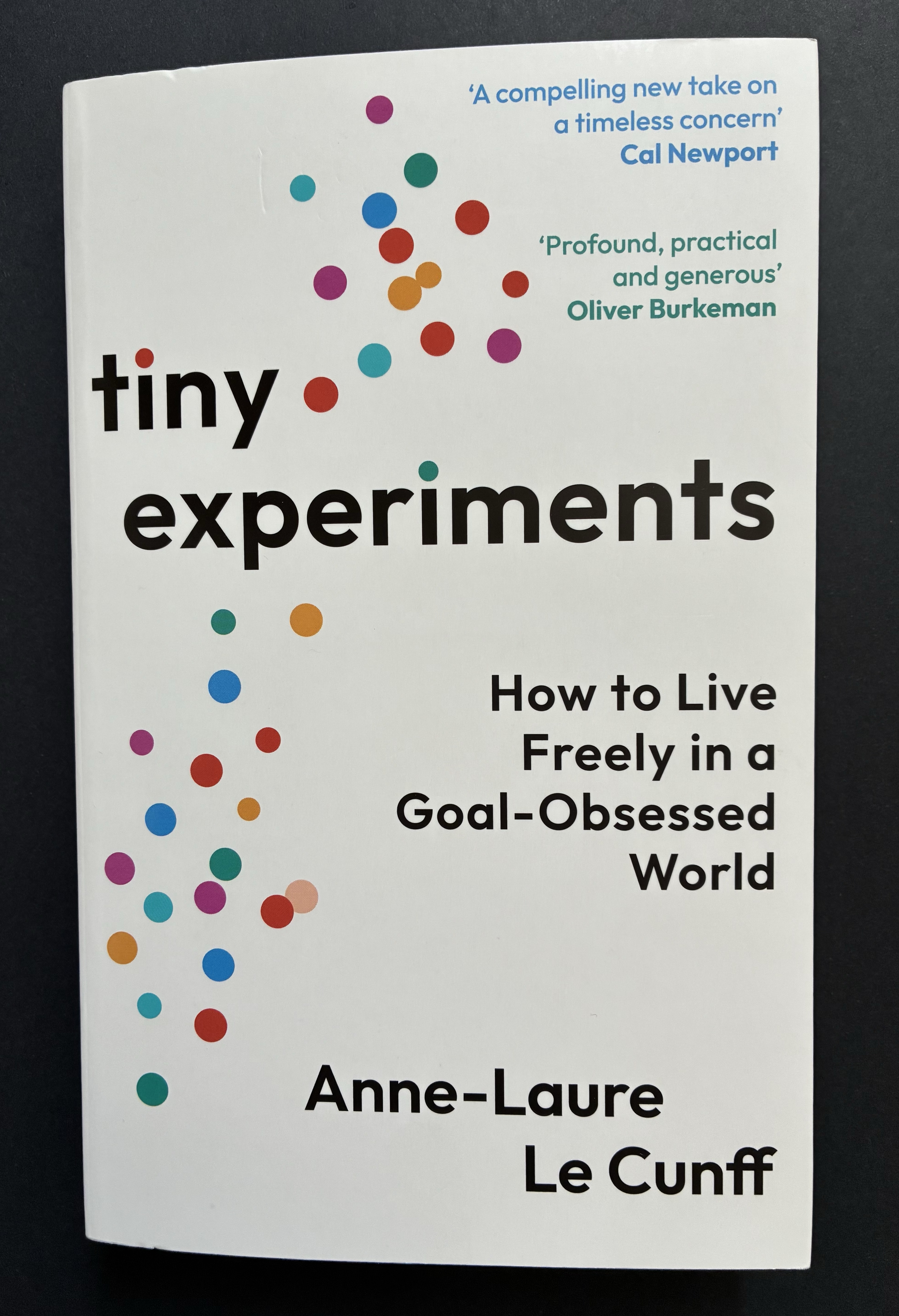
I read Anne-Laure Le Cunff’s debut book, Tiny Experiments, just a month after it was released in March 2025. However, this was not my first sight of the key ideas that the book contains, because I was lucky enough to be chosen as one of 300 people participating in a series of four, weekly online workshops, led by Le Cunff, that took place in February, in the lead up to the book’s publication. These workshops and the online community that accompanied them was called The Curiosity Collective, the name giving prominence to what is perhaps the key theme running Le Cunff’s work – the exhortation to live life in ‘curious mode‘, always willing to explore and experiment with your approach to life, and how you operate in the world. My experience attending those online workshops, showed me that Le Cunff is a highly skilled communicator and excellent teacher, and so I approached reading Tiny Experiments with high expectations. As an added bonus, the book had been chosen as the April pick for The TimeCrafting Trust Book Club.
As noted above, curiosity lies at the heart of Le Cunff’s ideas, and this is most obviously seen in her simple, four-part model for exploring and implementing change in your life. This model is rather neatly captured by the word sequence: PACT > ACT > REACT > IMPACT. At the start of the book, Le Cunff encourages the reader to adopt the mindset of a ‘self-anthropologist’, observing how they act in the world and the outcomes of these results, and then asking questions in relation to these observations. Le Cunff then structures the bulk of the text around her four-step model, stressing the importance of moving away from a Linear Mindset (X leads to Y leads to Z – end of story) towards the adoption of an Experimental Mindset based on the implementation of continuous experimental loops. My own feeling is that the key message here is not really about the distinction between linear v looping but, rather, one of ongoing adaptation and experimentation. The experiments one conducts don’t need to be thought of as loops (in fact they probably won’t bring you back to near your starting point) but they should take you somewhere, and in the process provide valuable evidence to help you work out what you might experiment with and where you might go next.
In the PACT phase of her model, Le Cunff presents a really neat (because it is simple) template for setting up what she refers to as a Tiny Experiment (an exploration of what happens when you make some small, realistic and manageable shift in the way that you operate). This template – a PACT – takes the following form:
“I will [action] for [duration]”
The key here is make sure that the action is purposeful, actionable (something that you can reliably perform), continuous (i.e. repeatable and not changing from day-to-day) and trackable. It is also important to be specific about the duration of the experiment (or else the number of repetitions). This ensures that the experiment is set up so that it provides a large enough dataset for meaningful conclusions to be drawn, but does not continue for so long that the action becomes tedious, or redundant or of little continued value. Essentially, the whole point of the PACT is to provide information that can then be used to adapt future behaviour and experiments, and not as a means to try to establish new habits.
In the ACT phase, you set about completing the activity specified in the PACT. This section of the book has some interesting material exploring the powerful forces of procrastination and, associated with this, perfectionism, that can so easily derail progress towards a goal.
The third phase of the model, REACT, occurs once the action described in the PACT has been completed for the specified duration. At this point, the goal is to look for, and then consider, evidence of the results of the action. Le Cunff highlights that it is important to look for evidence from within/internally (reflection) and externally (feedback from others, evaluation of results). Here, she presents what I suspect will become the most significant legacy of Tiny Experiments, namely her simple PLUS- MINUS-NEXT framework for reflection: what went well, felt good – what challenges or obstacles you faced, what was difficult, what negative feelings emerged – and then how the insights gained can shape future actions. [But whilst this framework is neat and seems to be catching on in the productivity community it might be noted that it is not so very different from the well-established ‘plus-minus-interesting’ framework.]
Because the whole point of Tiny Experiments is to encourage the adoption of an Experimental Mindset towards life, the REACT reflection should lead to a decision being made in relation to the area being investigated by the PACT. Le Cunff suggests that there are three possibilities: PERSIST – prolong the pact, or PAUSE – quit the pact or put it on hold, or PIVOT – modify the pact or shift the focus of a subsequent pact.
The final section of Le Cunff’s framework, IMPACT, focuses on the idea that it is helpful to be open/public about what you are setting out to achieve with your PACT and/or to work with others when pursuing it. This is largely a matter of gaining a useful chunk of external accountability, and also valuable feedback, but having seen many ‘public’ statements of Tiny ExperimentsPACTs in Le Cunff’s online community Ness Labs and on social media more generally, it is clear that it also serves as a powerful tool to market and promote Le Cunff’s ideas.
I enjoyed reading Tiny Experiments, and I feel pretty sure that it will be the kind of book that continues to have presence in the market for some time. It is well written and nicely structured, and the core ideas are simple (which is a good thing) and neatly presented, such that they have every chance of ‘sticking’. I think the phrase ‘Tiny Experiments‘ will likely become part of the productivity lexicon in similar fashion to James Clear’s ‘Atomic Habits‘. I also think that the “I will [action] for [duration]” statement for a PACT, the ‘PACT-ACT-REACT-IMPACT‘ model (or at least the ‘PACT–ACT–REACT‘ part of it) and, in particular, the ‘PLUS-MINUS-NEXT‘ framework for reflection, will all end up having a healthy existence outside the printed pages of the Tiny Experiments book…
… but in the end, my enthusiasm for Tiny Experiments waned. I had several goes at defining pacts and conducting experiments, but I wasn’t able to make myself see any of them through to a satisfactory conclusion. Life got in the way, and I found myself ignoring my pacts and carrying on with my usual scattergun approach to trying things out. This, of course, probably says more about me than it does about the potential efficacy of Le Cunff’s ideas, but my experience was that despite the simplicity and neatness of the Tiny Experiments model, it did not possess enough power to persuade me to go all in with it. I have also felt that most of the Tiny Experiments that I have seen others setting out to pursue would really be much better described as ‘tiny habits’ (a phrase already coined by the author B.J. Fogg and, of course, rather similar to James Clear’s ‘atomic habits’), rather than tiny experiments, and to put it bluntly, many of them read like tiny morsels of misty-eyed, wishful thinking…
So, in the end I congratulate Anne-Laure Le Cunff for writing a really nice book that captures some neat ideas and makes some good general points, but despite the fact that I am still indulging in some daily ‘plus-minus-next’ reflection, I can’t say that it has turned me into a Tiny Experimentalist.
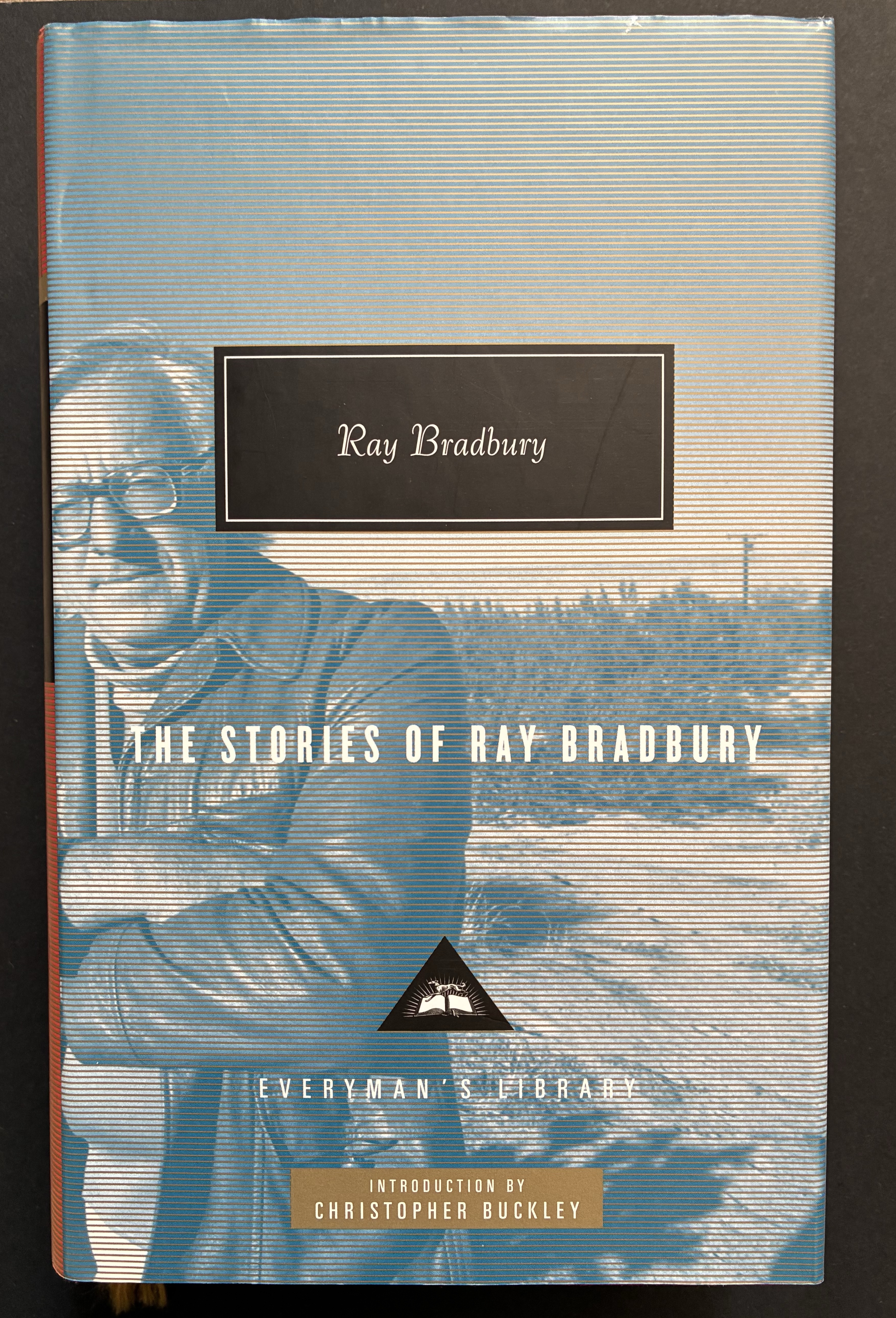
Between August 2023 and April 2024 I worked my way through a wonderful anthology of short stories called That Glimpse of Truth, selected by David Miller. I had never really paid much attention to short stories prior to that but I found that I really enjoyed the experience and greatly appreciated the skill of some of the writers who were able to pack so much into such short works. As a follow up, and inspired partly by a childhood memory of watching a television adaptation of The Martian Chronicles, I decided to return to the genre with a big fat volume of The Stories of Ray Bradbury.
I had a bit of a false start with Bradbury’s work, reading just a two or three of his earlier stories and not quite getting the measure of them, but I returned to the task and started afresh towards the end of last November (2024). Whenever my schedule allowed, I read one story as part of my morning reading each day, and so it took me until April complete all 100 of the stories that were included in the compendium.
Reading Bradbury’s short stories turned out to be a really wonderful experience. They fall under several themes – stories centred on an outwardly normal family of vampires, stories that chronicle Bradbury’s imagined colonization of Mars, and probably my favourites, the stories set in small towns in the backwaters of America. All were written in the period 1940-1970ish and often focus on the impact that new or imagined technologies have on fairly ordinary people. Often the stories are very much of their time, reflecting moral positions and biases that we have (mostly) replaced since the words were sent down onto the page. It was notable how often Bradbury’s stories revolved around a somewhat unhappy married couple and, alarmingly, how many times such stories ended with the death of one or other partner, often in quite shocking circumstances. The story in which a husband removes his wife from his life by getting her to turn herself inside out is really quite something…
Unfortunately, I didn’t keep a list of my favourite stories, but I did keep track of some of the passages that particularly caught my attention or resonated with me for some reason and so, in no particular order, I will include these below. I am quite sure that I will re-read this compendium again at some point and I am also quite sure that when I do I will add many more examples to my list!
‘It was a day to be out of bed, to pull curtains and fling open windows. It was a day to make your heart bigger with warm mountain air.‘
(Opening lines of The Great Wide World Over There, 1952)
‘“How do you rest?” She stopped. It sounded very bad. It sounded so much like an accusation, but it was not, really. … “Why didn’t I ever catch it from you?” she said at last. He laughed a little bit softly. “Catch what?” “I caught everything else. You shook me up and down in other ways. I didn’t know anything but what you taught me.”‘
(from Powerhouse, 1948)
‘And she decided, as sleep assumed the dreaming for her, that yes, yes indeed, very much so, irrevocably, this was as it had always been and would forever continue to be.‘
(from The Wilderness, 1952)
‘There was a long pause, full of stars and time, a waiting pause not unlike the last three years for all of them. And now the moment had arrived, it was Janice’s turn…‘
(from The Wilderness, 1952)
‘“So be careful. Stay on the Path. Never step off!”‘
(from A Sound of Thunder, 1952)
‘“Do we deserve this?” she said. “It’s not a matter of deserving; it’s just that things didn’t work out.”‘
(from The Last Night of the World, 1951)
‘“Let me finish; not to make money, no. Not to see the sights, no. Those are the lies men tell, the fancy reasons they give themselves. Get rich, get famous, they say. Have fun, jump around, they say. But all the while, inside, something else is ticking along the way it ticks in salmon and whales, the way it ticks, by God, in the smallest microbe you want to name. And that little clock that ticks in everything living, you know what it says? It says get away, spread out, move along, keep swimming.”‘
(from The Strawberry Window, 1954)
‘Nor did they ponder the fact that if man dares dip into that stream he grabs a wonder in each hand…‘
(from The Picasso Summer , 1957)
Ah, those last two. What lines… such vast nuggets of wisdom hidden away in such unassuming stories; little gems, that reward the reader with their sparkling form and serve as beacons to light a path through life. Magic words…
…get away, spread out, move along, keep swimming…
…nor did they ponder the fact that if man dares dip into that stream he grabs a wonder in each hand…

 Tim O'Hare