Sun Dogs

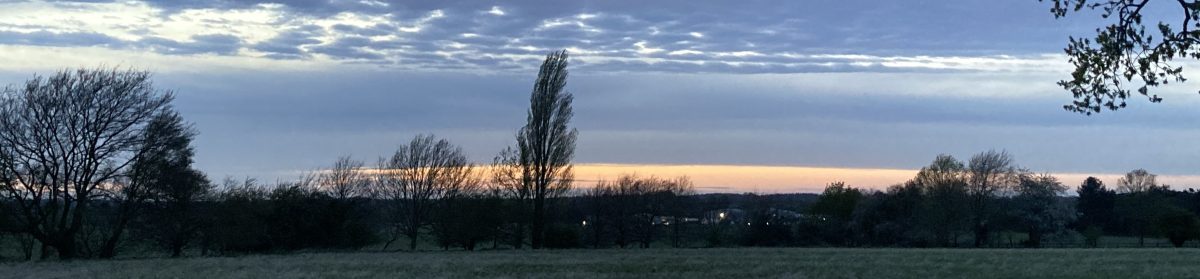
A couple of weeks ago I was driving back from dropping my younger daughter off at her football training. It was about 6.30pm and the route took me almost due west through Plymouth. Ahead of me, in the sky, were (high) Cirrostratus clouds blocking out the Sun as it dropped down towards the western horizon. Either side of the sun were two small patches of “rainbow” – in other words not actually portions of full rainbow arcs but small patches of rainbow coloured light glinting through the clouds, horizontally one on either side of the sun. It was a beautiful site and, of course, when I got home I went scurrying to my books and discovered that what I had just seen was an excellent pair of “sun dogs”, also known as “mock suns” or “parhelia”. They are formed by the refraction of sublight through hexagonal ice crystals (hence the observation of high clouds). According to my copy of “The Cloud Collector’s Handbook” a matching pair of sun dogs earns me 35 points! (TCCH is like an I-Spy book on clouds…).

For more on this kind of atmospheric optical phenomenon this Atmospheric Optics website is really excellent and contains explanations and lots of wonderful images. The entry on sun dogs is here.

A comfortable opening day win

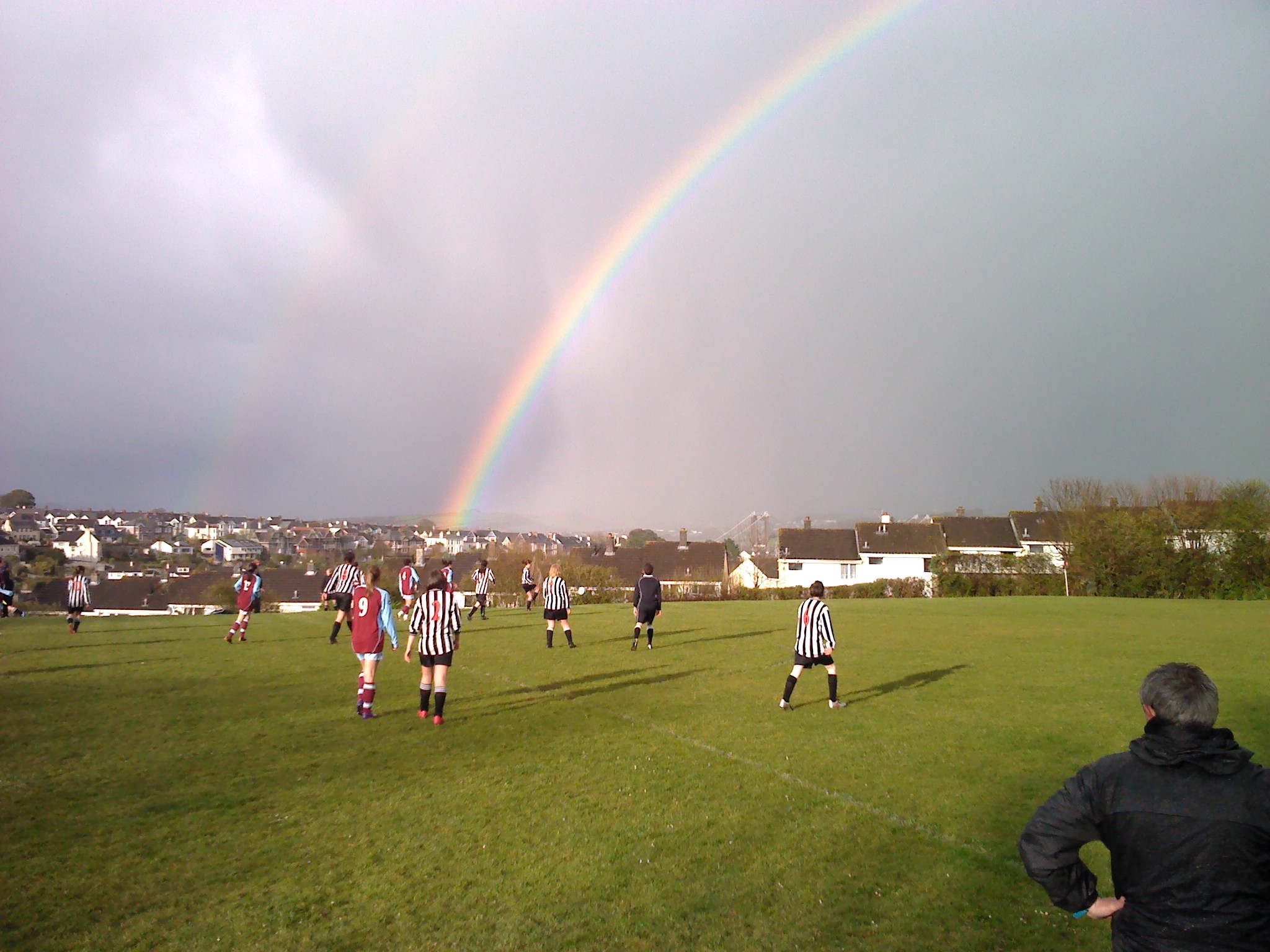
Just got back from watching my youngest daughter’s football team (Phoenix City under-14s) play their first league match of a new season. It was a home game against Activate and, after the upset of going a goal down eraly on (and an own goal too), Phoenix took control of the game scoring 3 in the first half and 1 more in the second half to run out 4-1 winners. She played in centre-midfield, marking Activate’s best player and providing much of the distribution that helped to unlock the Activate defence. They all played really well (tired a bit towards the end as would be expected for a first game) but it was great to get this one out of the way, some points on the board and some positivity into the goal difference column.

The pleasure of finding a new author

I’m always a little sad each time I finished reading a book by one of my favourite authors because it means that there is one less title in that particular series waiting for me at some point in the future. A few days ago I finished off another of the Ian Rankin Rebus novels and I’m steadily working my way through the crime series of Arnaldur Indridason and Andrea Camilleri. On the historical fiction side I’m about halfway through George MacDonald Fraser’s Flashman books, well advanced with Bernard Cornwell’s Sharpe series and also recently finished the latter author’s most recent Uhtred novel. I’ve read all of Patrick O’Brian’s Aubrey/Maturin novels and the first three of Julian Stockwin’s Kydd series but every single one of Forrester’s Hornblower books are still ahead of me so there’s still plenty of naval fiction to go.

So, I was absolutely delighted when, on completion of the latest Rankin book, I picked up the first Wallander novel by Swedish author Henning Mankel. I’ve watched some of the BBC TV Wallander adaptations and read great things about the original Swedish TV ones but this didn’t necessarily mean that I would enjoy reading the books. I should not have worried; Mankel’s novel had me gripped right from the start and I am cracking on through it at a great pace. It’s a story that I have watched the TV adaptation of but it’s really interesting to observe how different the two treatments are and how certain elements of the story were mucked about with for TV. Best of all, it’s a pleasure to know that I now have another great series of books stretching out before me.

Back again, a little different

I’ve had a bit of break from this site – caused by a combination of being really busy and also me wanting to sort out in my own mind my strategy for adding material to the site. In the past I have tried to be completely consistent in what I add – for example ALWAYS adding a post about each book I read or ALWAYS trying to write a note about news stories I see about oceanography and meteorology. The trouble with this approach is it creates a sense of being under pressure and it is very easy for a back-log to build up and feelings of guilt to set in. So, I’ve decided to reinstate the site but not be too concerned about being completely consistent with what I post. I’m also thinking I will probably add some more material that relates to my work, both what I have published and what I am working on. My penchant for recording things will continue as I do plan to keep the “Reading Record” page up to date (just as a simple list of what I read) and I have also put back in the “Run O’Hare Run” page to record my latest efforts in trying to get fitter by running more (I have to do something to stop my body creaking quite so much). Fingers crossed – we’ll see how it goes.

:59 Seconds – Think a little, Change a lot

The premise of psychologist Richard Wiseman‘s book “:59 seconds” is that he sets out to review published (scientific) literature on a range of topics that are normally the fare of self-help books in the hope that he can reveal what has been proven to be correct and then distill this down into a few very quick actions that people can take. I’ve been reading it on and off for a few months now and, finding myself in between books, I’ve just polished off the last few sections (decision making, parenting, personality). I found the book a bit frustrating – it’s like a quick glimpse at topics which might be more interesting if looked at in a bit more detail – but some of the material covered is quite neat and some of the findings a little surprising given conventional wisdom (e.g. group brainstorming does not produce a bigger range of ideas). Wiseman finishes the book by presenting 10 quick pieces of “advice” all of which are pretty obvious but there’s no harm in being reminded of them – time to get a pot plant for my office I think.

Faster

Years ago I read James Gleick‘s first and most famous book “Chaos” which is the classic outcount of the discovery of the concept of Chaos is science. More recently, in his third book “Faster” (which I picked up in the local Oxfam shop), Gleick has turned his hand to an exploration of time and, in particular, how our concepts of time have changed in the modern age with everything becoming faster, more hurried, more vital and more rushed. This book is written in quite short sections, each one an essay on some aspect of our perception or interaction with time. I enjoyed reading this book, especially as many of Gleick’s ideas chime with thoughts I have myself about how complexity, choice and urgency are together disrupting our lives and creating an unnecessarily rushed world. The chapter on waiting (or not waiting) for lifts was particularly challenging to me, partly because it came early in the book and partly because it provided me with an immediate opportuity to challenge my behaviour and slow down (while waiting for lifts at work). So, all in all, I enjoyed this book and got something out of reading it – a desire to slow down and a sense of purpose to do so.

Voices

No, this isnt an entry to report that I have been hearing strange voices in my head… rather it’s an entry to record that I recently completed the third novel by Icelandic author Arnaldur Indridason which is titled “Voices”. Indridason’s novels are what are called “police procedurals” in that they basically follow in a fair amount of detail the police process of investigating a murder from the point of the discovery of the body to the final resolution of the case. In Indridason’s books the main character is a detective called Erlendur who has a failed marriage, two drug addict children and a whole host of personal pyschological difficulties. This particular novel follows a murder commited in a tourist hotel just before the busy Christmas period and I found the whole set-up and the plot to be rather grim and populated by rather sordid characters. Erlendur doesn’t really do that much and he doesn’t have any great flashes of inspiration to unlock a startling twist in the plot but the story gradually unfolds and Erlendur gets the job done. I really liked the first of Indridason’s novels (“Tainted Blood”) but although I enjoyed reading this one I’m not convinced that this series is quite as good as the general acclaim it seems to get.

The Checklist Manifesto

One of the best books I have read in recent year’s was Atul Gawande’s “Better” – a book which I found both useful and inspiring. Consequently, as soon as I saw that Gawande had written a new book “The Checklist Manifesto” I rushed to get hold of a copy and moved it up to the top of pile of books to read – I wasn’t disappointed. In this book Gawande recounts his investigations into how the use of simple checklists can be used to minimise errors in surgery in hospitals all around the world (part of a World Health Organization initiative). Gawande explores the use of checklists by pilots in both routine and emergency situations and within huge construction projects and describes his attempts to design simple checklists for use before and after surgery and the difficulties of persuading surgical teams that their use was worthwhile (it most certainly was). One of the more interesting facets uncovered by Gawande is that the best checklists don’t simply list tasks that have to be done (they can do this) but they also incorporate checkpoints that require people to share certain information or discuss situations and produce agreed decisions.

As a surgeon, Gawande writes openly about surgical procedures and at times you need to have a pretty strong stomach to take in what is being written (at one point he describes accidentally cutting a patient’s vena cava and the resulting blood loss as “terrifying”).

So, another great read from an inspiring author. More please.

Mortal Causes

I’m a very ordered person and a bit of a collector so when I read a particular author’s novels I like to do so in the correct sequence. Consequently, I was mortified (well perhaps that’s a bit of an overstatement) when I discovered recently that my gradual sequential reading of Ian Rankin’s Rebus novels was not quite as sequential as I thought it was. It turned out that four or five Rebus novels ago I missed a chunk of the series out – I don’t know why or how, but now I have to fill in that gap, and that meant going back to Mortal Causes. It was classic Rebus, centred on the sectarian issues that divide Catholics and Protestants in Northern Ireland cropping up in the context of Scottish Nationalism. So there is a gruesome punishment killing at the start and then a series of bomb threats relating to Edinburgh Festival venues, a particularly nasty villain and the usual mix of curious characters. Was it good? Well it’s Ian Rankin and Rebus so, of course, the answer is yes although I wouldn’t class it as one of the more gripping or intriguing stories in the series.

Time to catch up

Well, for some reason that I cannot quite put my finger on I’ve not managed to put any attention into writing for this blog over recent weeks (no, months). I guess I have just been busy, both at work and at home, and although it doesn’t really take much time to write an new entry my busy-ness has knocked me out of the habit of sitting down, logging in and hitting the keys. Now it’s time for this phase of inactivity to stop, it’s time to catch up…