The Procrastination Equation

I’m not an inefficient person; I get a lot done and I’ve never been accused of being lazy, but I’ve known for a long time that I am pretty good at wasting time when I’ve got more important tasks to do. So when I recently popped into the local bookshop and saw a book called The Procrastination Equation on the shelf and when I read the blurb and discovered that it wasn’t a self-help book but rather a serious summary of research on this topic I had to buy it. After all, I needed something to be looking at whilst I should have been doing something more important…

The book is written by Dr Piers Steel who, according to his own words, is an internationally leading expert on the topic having researched it (properly) from all kinds of different angles. And it was a good read with some really interesting findings and a nice simple basic premise – the equation of the title which I am not going to outline here because if you are interested you should read it yourself.

I particularly liked the destruction of modern technologies such as the internet and electronic mail because their time draining properties are well known to me. Apparently, research shows that on average it takes 15 minutes to “recover” from the interruption of an email and this is then equated to 2 hours wasted per normal working day. This is very nicely quantified by expressing this as being like starting work each year on 1st April (i.e. wasting one quarter of the year). Obviously that analogy isn’t exactly right but it makes you think.

The sections on simplifying your working environment, removing extraneous piles of materials and having prominent reminders of why you work (what you work for), also resonated with me and I will be looking to throw out a huge amount of “stuff” ahead of an office move this summer.

The bottom line message, of course, is really just another example of something that has been in my head for a while now, in relation to responding to climate change and keeping fit and healthy, namely: we know what we have to do, so we just have to get on and do it…
The Dogs of Riga

I’ve just finished reading Hanning Mankell’s second Wallander novel, The Dogs of Riga, which takes Wallander away from Sweden into a corrupt underworld of the Latvian capital. Having seen quite a few of the BBC TV Wallander adaptations, I was quite surprised to be reading what seemed to be a very untypical storyline so early on in the series of novels, but as I continued my way through the book I became aware that the story it contained, and the way Wallander’s character is developed through it, helps to explain a lot of the traits he displays in the BBC portrayal (that are presumably based on how he appears in later books). Anyway, in The Dogs of Riga, Wallander is challenged to his very core by ruthless killers, corrupt police and the necessity of operating under-cover and unofficially in a country that he simply doesn’t know or understand, driven largely by a sense of duty and an inexplicable attraction to the widow of a newly-found (and lost) Latvian colleague. In the end, putting it in the simplest possible terms, he gets lucky.

Coming Back To Me

I’ve just finished reading Somerset and ex-England cricketer Marcus Trescothick’s autobiography “Coming Back To Me”. I don’t tend to read many biographies/autobiographies but as a keen follower of Somerset dating back to my teen-age years and an admirer of what Trescothick has achieved as captain and with the bat in recent years this one has always been on my list of books to read. But in truth, the main reason I was interested in reading it was because Trescothick is perhaps now best known because of his dramatic returns from overseas tours with England due to severe bouts of depression and separation anxiety (from his family). This is a topic which fascinates me and I have often thought that it is mad to expect any individual to compete at the highest level with almost no breaks in the schedule and with long spells overseas away from home. So, really, it is amazing that a lot more players haven’t cracked in the way that Trescothick did.

I found his descriptions of how he felt during his darkest moments particularly interesting, having myself experienced a few spells that were not so different to the ones he describes and also his account of the typical person who suffers depression which was somewhat like reading a description of myself. Lucky, was a word that came to my mind, when reading his book and reflecting on a couple of my own past experiences…

I think he can only be admired, not so much for writing the book, but for getting to grips with the idea that his happiness and that of his family are more important than living up to the expectations of the professional game and society’s norm for a top-level sportsman. You can only do so much and the key is to ensure that the things you do are the right ones, based on the right values.

Amazing cloud film

This is an entry I’ve been meaning to write for ages. Sometime a while back I stumbled upon a website for a Science/Art project called “A History of the Sky” by a guy called Ken Murphy. This project sets out to record the history of the sky as viewed from a fixed vantage point using a time-lapse camera. The camera films the sky each day taking a picture every 10 seconds and then the film from each day is displayed side by side on a big screen producing a mosaic-like effect in which each block of the screen is a day’s worth of sky change. The aim is to put screens in public arenas and, ultimately to show the full year in one go. It’s perhaps hard to get a real grasp of what this ends up looking like but you can read more about the project at its website which also include examples of a 42 day preview movies and a 126 day version which is also available to view in better quality directly on youtube (watch in full screen mode). The 126 day version is particularly good because it is a long enough period to be able to see the seasonal change in sunrise and sunset times between the earlier and later days in the sequence. I also really like the way that you can see the pinky/purple tinge of sunset enter each image just before the end of daylight and the image dropping out to black.

Personally, I think there is only one word to describe this piece of work and that (much over-used) word is “awesome”.

Cage football

Anyone who has clicked through to look at my “Run O’Hare Run” page may have noticed that alongside my record of my running exploits I have added the comment “+ cage football on Saturday” in the entries for the last couple of weeks. I thought I would explain what this is.

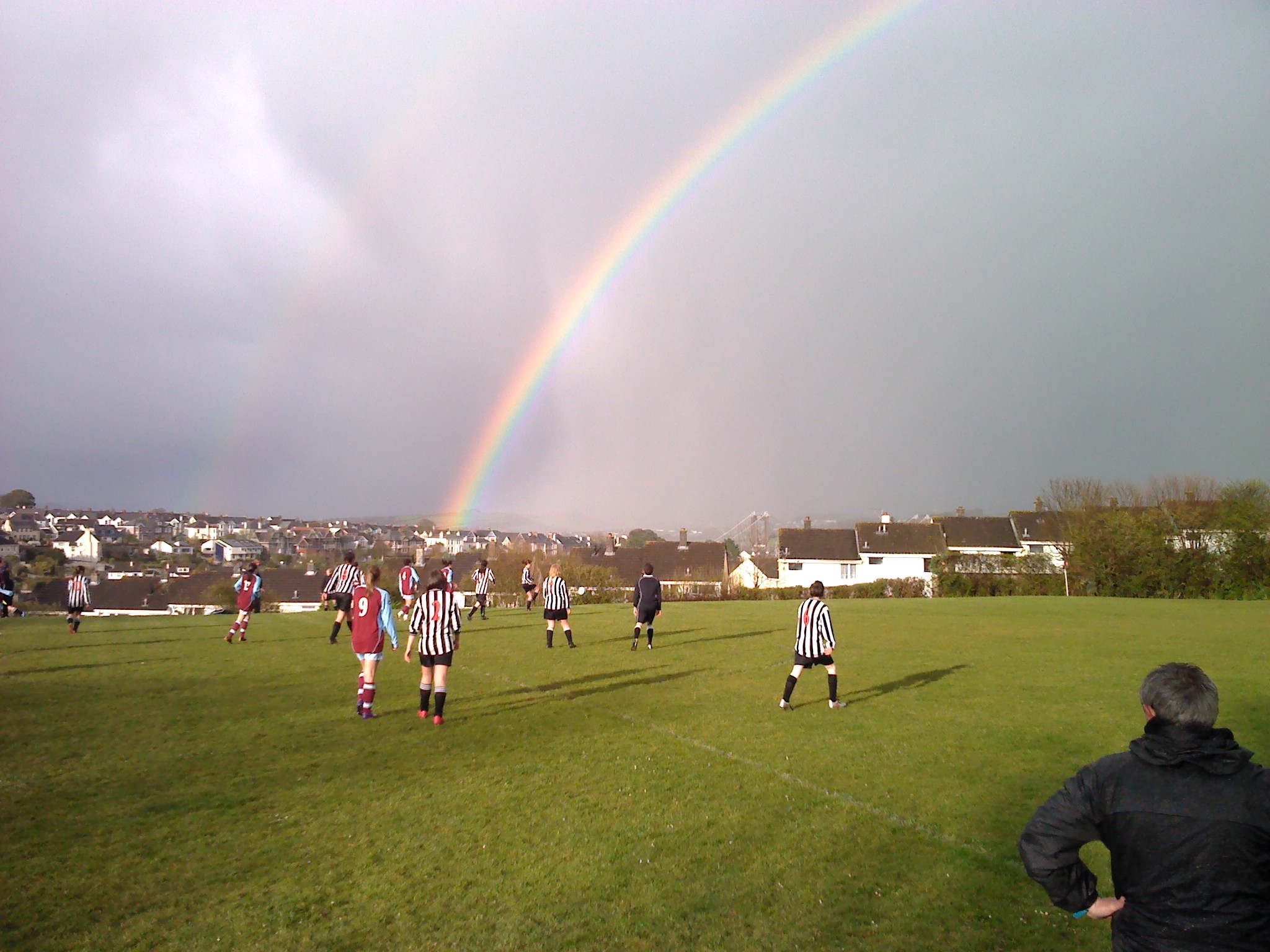
Most Saturday mornings at the moment are taken up ferrying my younger daughter to her football matches for Phoenix City under-14s and then watching these games unfold. However, when there is no match, as has been the case for the last couple of weekends, some of the players in her team together with their manager/coach and a few of us old men (Dads) get together in one of those small cages that house a concrete pitch, a couple of basketball goals and a couple of open areas that serve as football goals. We then spend an hour or so running around like mad things, the girls practising their skills and the Dads trying to regain their lost youth. It’s brilliant fun – if I played football with just a bunch of men I’d be instantly mashed to pieces, but against the girls it’s possible to run around a bit, demonstrate those silky ball skills (though mine do then to occur in slow motion) and even score the odd goal or two (though my shots do have a frustrating tendency to go straight at the ‘keeper). Mind you, it’s not without no physical content – the girls are pretty good at the odd kick in the shins and it’s good to see (and experience) them beginning to get the hang of barging opposition players out of the way and trying out some of the dark arts of holding and shoving. It’s also really, really good exercise (for me). In fact two weeks ago I almost managed to reduce myself to complete physical incapacity within the space of 10 minutes – and quickly learned the lesson to pace myself better last time.

Anyway, that’s cage football.

Induction

Well, that’s four solid days of Induction over and done with for another year. This is the process of welcoming new students onto the courses I run, filling them with rather boring but quite important information and beginning to get to know the new ones a bit. Today I had 2.5 hours of small group tutorials with half of the new first years (~30) and then group meetings with the returning Year 2 and 3 students.

It’s always interesting to meet and properly talk to the new students and find out a bit about them. This year we’ve got eerything from a professional boxer to a road-cyclist from the Sky team to an Olympic Development Squad wind-surfer to someone who is very keen on origami! (which gave me an excuse to tell my story about how, as a child, I put on an exhibition of my origami models in the local public library only for all of my models to be destroyed when the library burned down in a fire…).

This afternoon it was great to welcome back the returning students and I decided to test myself by trying to name every single one of them and only stumbled (okay, forgot) about 5 out of 60 or so in total which can’t be a bad achievement.

The trouble with Induction Week though is that it’s almost impossible to get any other work done for a few days so although I have the luxury tomorrow of a “clear” day in my diary, it’s going to be a day filled with pretty frantic activity to prepare for the start of teaching next week.

Super Freakonomics

A while back I read and thoroughly recommended a book called Freakonomics that presents a whole series of ideas about the analysis of interesting problems and data sets using approaches from economics. I really enjoyed thw wide-ranging ideas in the book and the journeys into topics I hadn’t given much thought to before. So I was looking forward to reading Super Freakonomics – a follow-up book by the same pair of authors.

SF started off quite well. There’s a really interesting and eye-opening chapter on the economics of prostitution. But I felt like I had read quite a lort of the book before, not least because there IS some duplication with Malclom Gladwell’s “The Tipping Point” both in content and style. Towards the end, SF focuses in on actiosn that can be taken to counter-act climate change and here I felt that it rather looses the plot and becomes a bit of a rant about geoengineering and an advert for a few particular ideas. The critical analysis that characterised Freakonomics and the earlier parts of SF seems to get lost which is a pity.