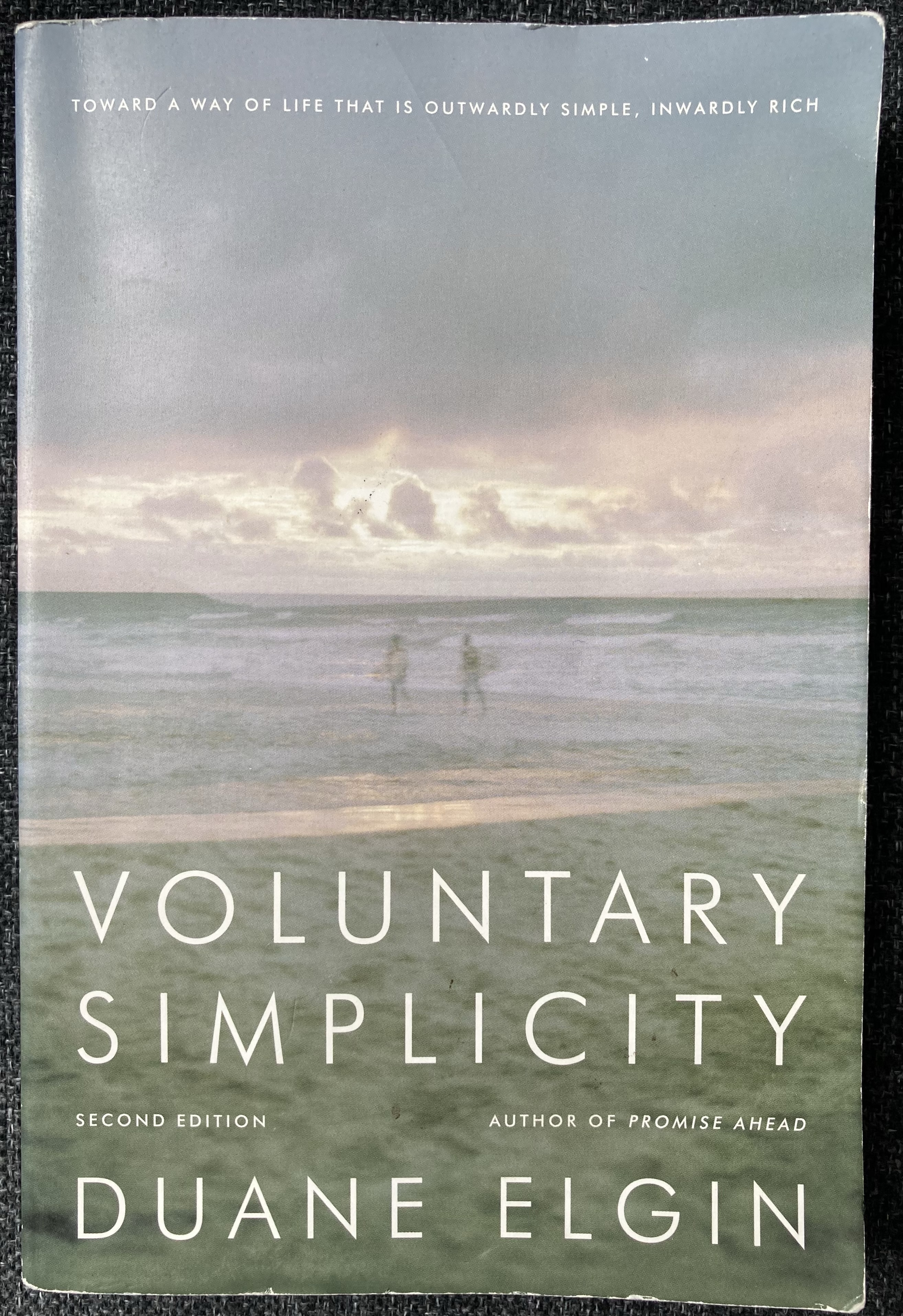
Voluntary Simplicity by Duane Elgin was the March 2025 choice for the TimeCrafting Trust Book Club that I am a member of. I think it’s fair to say that it is unlikely that I would have read it otherwise, although the ideas that it covers – Simplicity and to a lesser extent Minimalism – are certainly ones that I am interested in.
Elgin bases large chunks of the text on a survey he was involved with several decades ago (the first edition of Voluntary Simplicity was published in 1981) which probed the motivations and thinking of many individuals, from many different countries and walks of life, who had opted to simplify their lives. He is at pains to point out the most common perceptions of those who choose to live a ‘simpler life’ – that they tend to be anti-technology, anti-innovation and backward looking – are not generally correct, and that living simply does not have to mean living in poverty, in a rural and/or plain environment, nor does it necessarily result in economic stagnation. In fact, Elgin makes the case that the ever increasing number of people who are choosing to live with simplicity are doing so because it provides a path to greater satisfaction with life, with a deeper connection to the entire world around us.
As the book proceeds, it becomes more and more focused on the necessity that we live more simply in order to survive on the planet as population growth continues, climate changes ever more significantly and obviously, and natural resources are depleted. And, of course, the need for solutions and responses to the challenges that Elgin describes has become significantly more pressing in the years since the book was first released. But Elgin does not get all of his future-visioning right. He places great emphasis on the potential for television to be the vehicle through which positive messages about simplicity can be delivered and is rather dismissive of the potential for new technologies to invade this space. Nevertheless, Elgin’s arguments do mostly stand up to scrutiny.
I felt that Voluntary Simplicity was an ‘okay’ read, although I am sure that there are better, and more up-to-date, books on this topic. I don’t think that it is surprising that prior to reading the announcement that Voluntary Simplicity had been picked as a Book Club book I had ever heard of it or, indeed, of Duane Elgin himself. However, I did my reading did lead me to four quotes that I really liked. The first, comes from one of my favourite sources, the “quote-factory” commonly referred to as Henry David Thoreau. It has perhaps a rather depressing tone – ‘life is frittered away’ – but I think this is what lends it the power to motivate change:
“Our life is frittered away by detail… Simplify, simplify.“
I also really liked Elgin’s own take on the power of simplicity, namely that:
“Simplicity is the razor’s edge that cuts through the trivial and finds the essential.“
and I enjoyed his statement that:
“Our bodies are biodegradable vehicles for acquiring soul-growing experiences.“
‘Biodegradable vehicles for acquiring soul-growing experiences’ – I mean that really is life in a nutshell isn’t it?
Best of all, I think as a result of its own simplicity and the rhythm of the language used, is an adage that Elgin attributes to the New England Puritans:
“Use it up, wear it out, make do, or do without.“
That’s not a bad maxim to try to live by, at least to some extent.
 Tim O'Hare