The Thief Lord – Cornelia Funke #reading

Since I finished writing my children’s adventure story, Empedocles’ Children, earlier this year, I have been exploring the various avenues through which I might eventually get it published. By far the most likely is that I will end up self-publishing Empedocles’ Children as an eBook and print-on-demand paperback, largely because to get a book out into the world via a traditional publishing route you have to first be successful in gaining the interest of a Literary Agent and, by all accounts, the chances of that happening are pretty minimal… As a result, I am adopting the working assumption that the doors to traditional publishers will remain firmly closed to me, but that doesn’t mean that I am not going to give that route to publication a try, in fact I have already started, having worked my way through an online course from Jericho Writers called ‘How To Get A Literary Agent’. About a month ago, following the approach suggested in that course, I sent off ‘query letters’, accompanied by a one-page synopsis and whatever portion of the manuscript the agent requested querying authors to send (usually the first three chapters), to eight Literary Agents. My plan is to send off a further set of query letters to another group of eight agents sometime in September, and then complete a final set of eight submissions in November(ish). The logic of this staged approach to submissions is that it provides the opportunity to modify the submission made to the later groups of agents on the basis of any responses (or lack of responses) received from the earlier one.

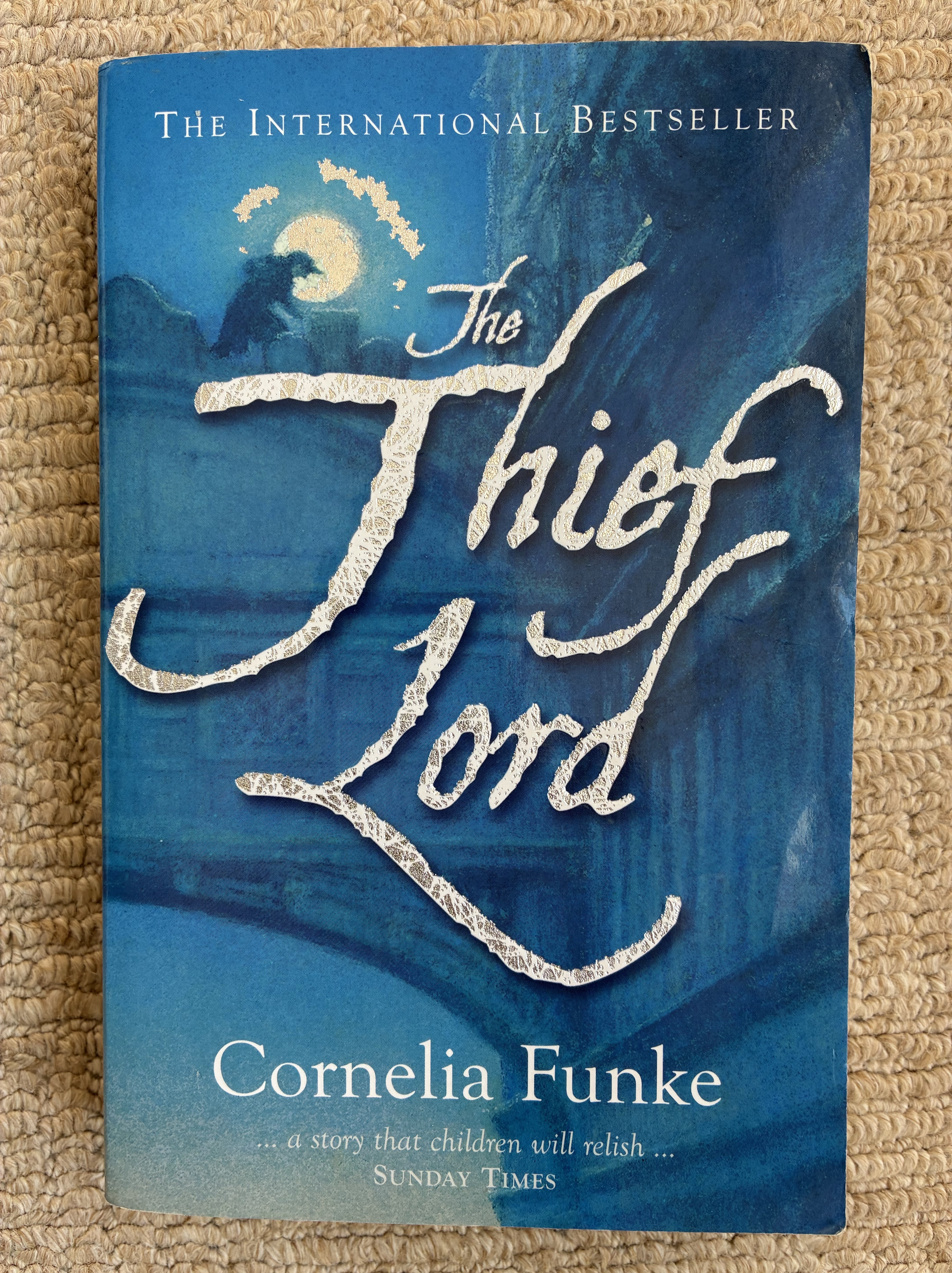
But what has any of this got to do with Cornelia Funke’s children’s novel The Thief Lord? The answer is that one of the things Literary Agents generally ask is that authors liken their work to what are termed ‘comparative titles’ (or ‘comps’). This is supposed to be a good way of the author showing where their book fits into the market (and that they know where their book fits into the market), and so help the agent decide whether or not it might be the kind of book that they want to represent and think they can sell to a publisher. With this in mind, before I could finalize my submission package I had to try to come up with a few such comps. Since I don’t routinely read children’s fiction, I spent a long time perusing the shelves of the local bookstore, but this didn’t really help me much because it seems to me that almost all new children’s books now feature magic, witches and wizards, dragons and suchlike. I also decided that I should try to get into the habit of reading some children’s fiction, and so when I stumbled upon a copy of The Thief Lord in a charity shop, I grabbed the opportunity to read a title by one of the most successful writers for children of recent decades.

The story of The Thief Lord is set, rather randomly, in Venice, and follows two orphaned boys, Prosper and his younger brother Boniface who have travelled from Germany after escaping from the clutches of their rather severe aunt who only wants to adopt the younger Boniface. In Venice, the two boys fall in with a group of street children led by the super confident, and extremely talented ‘Thief Lord’, Scipio. The first half of the book sees Prosper and Boniface become steadily more drawn into the group and their schemes to steal items to sell on, often to a corrupt antique dealer Barbarossa. The story hangs together pretty well and I found it a fairly enjoyable read…

…but then in the second half of the story, everything turns a bit weird. The group of children, rather improbably end up being befriended by a woman, Ida Spavento, whose house they were trying to rob, and then the plot suddenly takes Prosper and Scipio to an island where they find a merry-go-round that magically changes the age of those who ride it. I won’t spoil the story by saying who rides it and the extent to which they become younger or older, suffice to say that two of the main characters undergo contrasting permanent transformations after the merry-go-round breaks, trapping them at their new ages. I found the whole of this section of the book to be rather random – as if Funke knew that she wanted (or needed) to put a surprise twist into the book but hadn’t really worked out how to embed it into the story that she was in the process of writing. However, I’m an almost-60-year-old adult and The Thief Lord clearly wasn’t written for someone like me. Perhaps younger readers like (or liked, The Thief Lord was published in 2002) stories that change tack quite radically partway through. Who knows?

Overall, I quite enjoyed reading The Thief Lord, but I didn’t find it particularly satisfying. Interestingly, according to the Wikipedia entry for the book, a review in Publishers Weekly ‘found fault with the pacing’, a comment which matches up well with my own feelings about the story. In the end, I wasn’t left much the wiser in terms of finding a comp for my own book, although there is some similarity in the way that our stories unfold as they go along rather than following some obvious up-front structure or plot. I think there is also some similarity in the way that the stories bring together a group of children with different backgrounds and attributes. But in most respects the two books are very different, not least because Funke’s book has been published, translated into different languages, turned into a film (albeit apparently not a good one) and sold many thousands of copies, whereas my book hasn’t been published, hasn’t been translated, hasn’t been turned into the film and hasn’t sold a single copy…

…yet!

The Time Crackers – progress update #writing

Some time ago (by which I mean years, not weeks or even months), well before I had finished writing the final draft of my children’s adventure story Empedocles’ Children, I had the idea for another children’s book – The Time Crackers. Empedocles’ Children ended up as a fairly weighty tome, coming in at around 110,000 words and (probably) best suiting readers towards the upper end of what is termed ‘middle grade’ (ages 8-12). I hadn’t particularly aimed it at that reading level, it just turned out that way, but for The Time Crackers, I felt that the story would connect best with slightly younger children, and decided that I would make a conscious effort to keep the chapters short and ensure that the story was snappy and moved along at a good pace.

Without giving too much away, the basic premise of The Time Crackers centres around two children who discover a portal through which they shift to the same location but at a specific time at which an important (real) historical event takes place there. They are able to move back and forth between the historic and modern time periods (as long as they keep hold of the ‘key’ of course, which is tricky when they don’t even know that one exists…). Then, while they are in the historical setting, they get caught up in an adventure that requires them to solve a coded puzzle which then leads them to take action to ensure that the history unfolds as it should do.

At the outset I had the basic premise of the story, the location and its associated historical setting and event, and an idea for the initial incident that brings the two children to discover the time-crossing portal (the setting is Plymouth and the historical setting is the late 16th century so you can probably guess the historical event!). I also had the idea for a second location, and an association with a completely different historical period, and so I can quite imagine that by the time I have finished it, The Time Crackers will have become The Time Crackers 1:….., the first story in The Time Crackers series.

I started writing the first chapter of The Time Crackers (‘Flashback’) at least a year ago (probably more) and managed to add two more chapters (‘The New Girl’ and ‘Target Practice’), reaching the point in the story where the two children, Jim and Mols, have been introduced (to the reader and to each other), we have got to know a little bit about Jim, his character and his home set-up, and things were nicely set up ready for the trigger incident that leads Jim and Mols to discover the time portal. But then, as is often the way with me, things ground to a halt as I got busy, diverted my attention towards other creative projects (such as my discovery of painting 14 months ago), or just succumbed to the chronic procrastination that is the bane of my life. Whatever the reason, the ability to sit down and write new words eluded me…

… until yesterday, when, without too much effort, I finally opened and re-read Chapter 3, decided that it was essentially complete and then found that sentences were emerging in my brain and flowing smoothly to my fingers and then onwards onto the screen as I launched myself into Chapter 4 (‘Noises In The Dark’). The result was that after about 30-40 minutes I had harvested the next 800 or so words of the story, and in the process, advanced the story almost to its pivotal moment, the accidental discovery of the time portal. That moment deserves to be the focus of Chapter 5, but before I can find out exactly how events unfold, I need to go back into Chapter 4 and flesh it out with another an additional few hundred words so that it balances the length of the previous chapters a bit better. I had been hoping to do that today, but alas, I managed to divert my attention into other projects instead. I am not sure whether this was a piece of deliberate self-sabotage, my brain opting not to even try to write just in case the well had run dry, or whether it was just the way of things. What I do know is that I really would like to press on with writing this story, because I am excited to see how it unfolds and to discover what thrills and scrapes Jim and Mols get themselves into as they try to solve The Mystery of Drake’s Drum.

Empedocles’ Children – progress update #writing

Some time ago, something like 10 years ago to be more precise, the basic idea for a children’s adventure story popped into my head. It was really just the bare bones of a story – a title (Empedocles’ Children), an underlying basis for the story, a vague idea of the way that it would conclude, and a fairly detailed visual image of the event that would launch the reader into the action. At some point, fairly early on, I wrote out a version of the first chapter, but once those words were out of me, I didn’t do much to make further progress. In the meantime, fragments and ideas for the story would pop into my head at random moments, often resulting in me excitedly exclaiming to whoever was in the vicinity that: “I have just had a great idea for my book when I write it”. I think this must have happened quite a lot and over an extended period (years) because eventually, after one such utterance, my younger daughter (who would have been in her late teens at the time) responded with the rather cutting, but entirely fair, response: “Well that will never happen.”

But, eventually, I did begin to make progress, producing several more chapters in 2021 and then, in a series of bursts of creativity that became gradually longer, more frequent and more reliable, I found myself approaching the end of the story. Along the way I found the process of writing the story an absolutely fascinating one. Whether it is the ‘right’ or ‘best’ way to approach things or not (and it is probably not), I wrote the story without any kind of outline or plan, other than knowing a little about where the main characters in the story (four children called Conlaed, Yara, Tal and Karin) had to end up, and a final climax to the story that became gradually sharper in my mind as it approached. Instead, I simply sat myself down and let the story emerge. When I talk to people about this process I usually use one of two analogies – that story writing is like find a seam of precious ore and then chipping away to follow it through the surrounding rock, or that it is like gently pulling on a thread to tease it from a knotty bundle. I also tended towards thinking that even though I didn’t know how the story would unfold, I could trust my characters to show me. In that sense, I was simply following them on their journey, and describing the events that befell them as I did so. At times, it was hard to escape the feeling that the story (stories in general) are already ‘out there’ and that the task of a writer is to find (not create) one and then reveal it to others.

A couple of months ago I reached the point where I had a full draft of the story, and I then spent some time reading it through to check for errors, omissions and inconsistencies and to make any corrections and revisions that were necessary. I spent quite a lot of time going and back and forth with the dialogue, struggling a bit to work out the best way to format this (which I found difficult because there does not seem to be a standard method for presenting dialogue, something that surprised me a lot). Then, with a final draft version completed I was left wondering what, exactly, I should do next with all of those words. And there were a lot of them, a whopping 110,000 or so in fact, because the final version came at with 48 chapters (plus a prologue, interlude and epilogue).

I’m still not quite sure what I will do next with my manuscript. I know that I can go down a self-publishing route fairly quickly and easily – I have already got the text in a ‘flowable’ format suitable for e-readers. I also know that to try to get a book published by a traditional publisher first requires gaining the interest of a Literary Agent, something that seems to be incredibly difficult – so I know that that route is both difficult and unlikely to be successful. My instinct is that I want to at least try to go down the traditional publishing route and see what happens, and so at the moment I am working my way through various materials that should help me engage with that process. At some point, I might actually get to the stage of having written a synopsis, a query letter, identified comparative titles (‘comps’), drawn-up a long-list of suitable agents to query, and a short list for a first batch of submissions. Then all it will take is a bit of bravery and a willingness to suffer rejection…

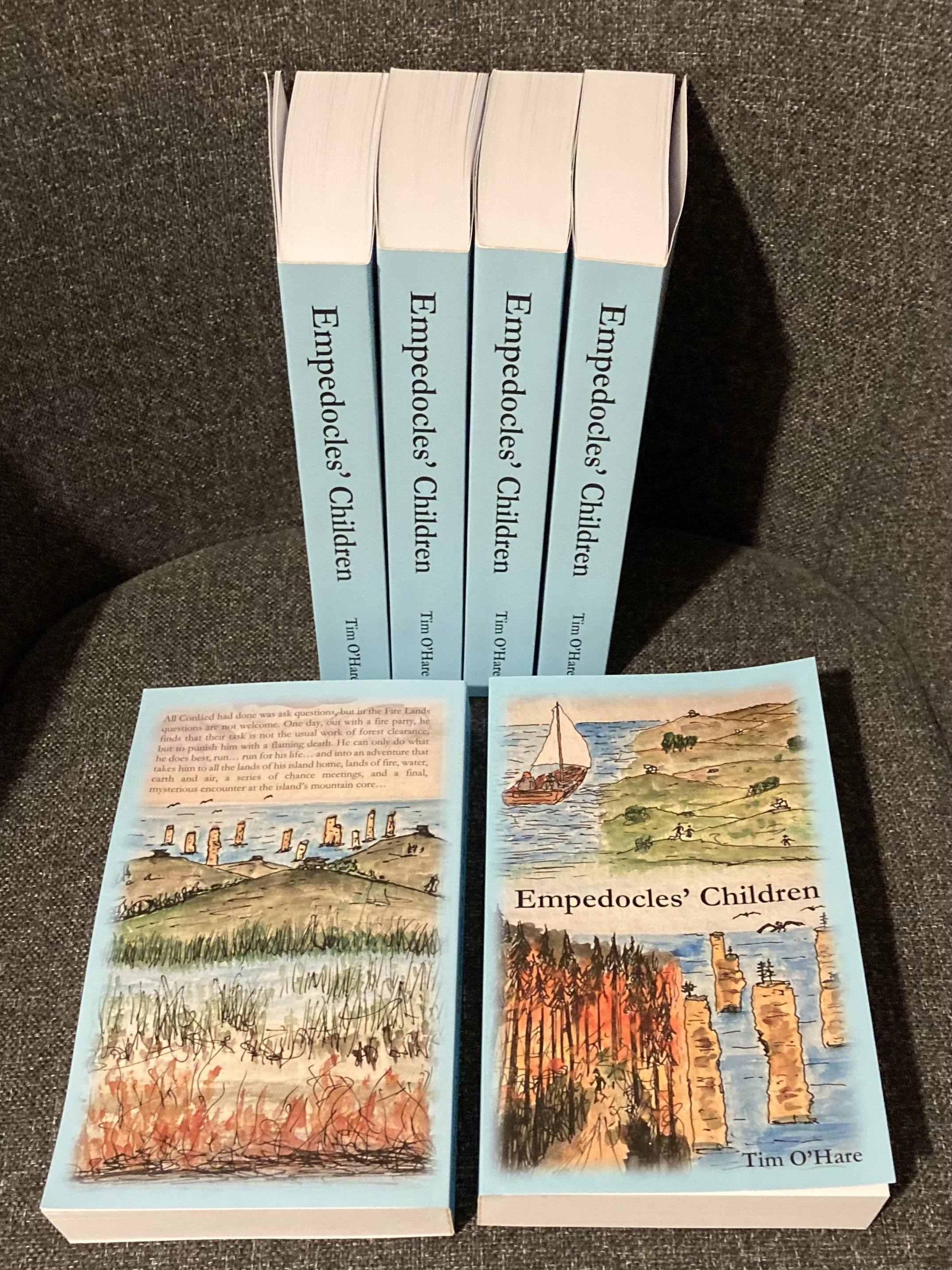
In the meantime, I decided that one of the issues with writing (certainly these days when writing on a computer) is that once you have finished your story you have nothing physical to show for your efforts. With this in mind, I spent a week or two putting my text into an attractive, ‘proper’ book format, painted some pictures to use as cover art, and then I sent it off to a printing company to get a few copies of it as a properly printed paperback book. Now, even if I make no further progress towards publishing it at all, I can, at least, glance at my bookshelf and see a nice fat paperback sitting there that I produced. Just that thought is rather satisfying and it allows me to inwardly respond to my daughter’s statement, “that will never happen”, with the words “but look, it did!”

If anyone reading this thinks that they’d like to be a test reader then please do get in touch. The story follows a group of children who are brought together as they travel through a disintegrating island realm, facing all kinds of natural challenges – fire, floods, earthquakes, volcanic eruptions and landslides – as they are gradually drawn towards the mountain that sits at the island’s core and, unknowingly to a meeting with a strange philosopher-hermit who must share the wisdom that will allow the fractured peoples of the island to come together to re-build their world. I think that the book would probably be put into the ‘middle grade’ of perhaps ‘9-12 age group’ categories but honestly, it’s a fun adventure with lots of twists and turns that adults should enjoy too – I certainly did!

Bilbo Comes to the Huts of the Raft-Elves #writing

I wrote this piece back in 2021 – one of three that I wrote under the working title: ‘Glances and Glimpses’. Each of the pieces captures some thoughts on an activity or incident that connects different periods of my life and/or opens a window on some aspect of my character, thereby providing a glance or a glimpse inside my head and into my life. I used to think, rather grandly I suppose, that I might write enough of these to produce a full-blown autobiography/memoir of sorts, and who knows, that may still be the case. For now I will be content to post this one here, with the others to follow. Perhaps doing this will spur me on to have go at writing some more ‘Glances and Glimpses’ to join them in the not too distant future.

+++++

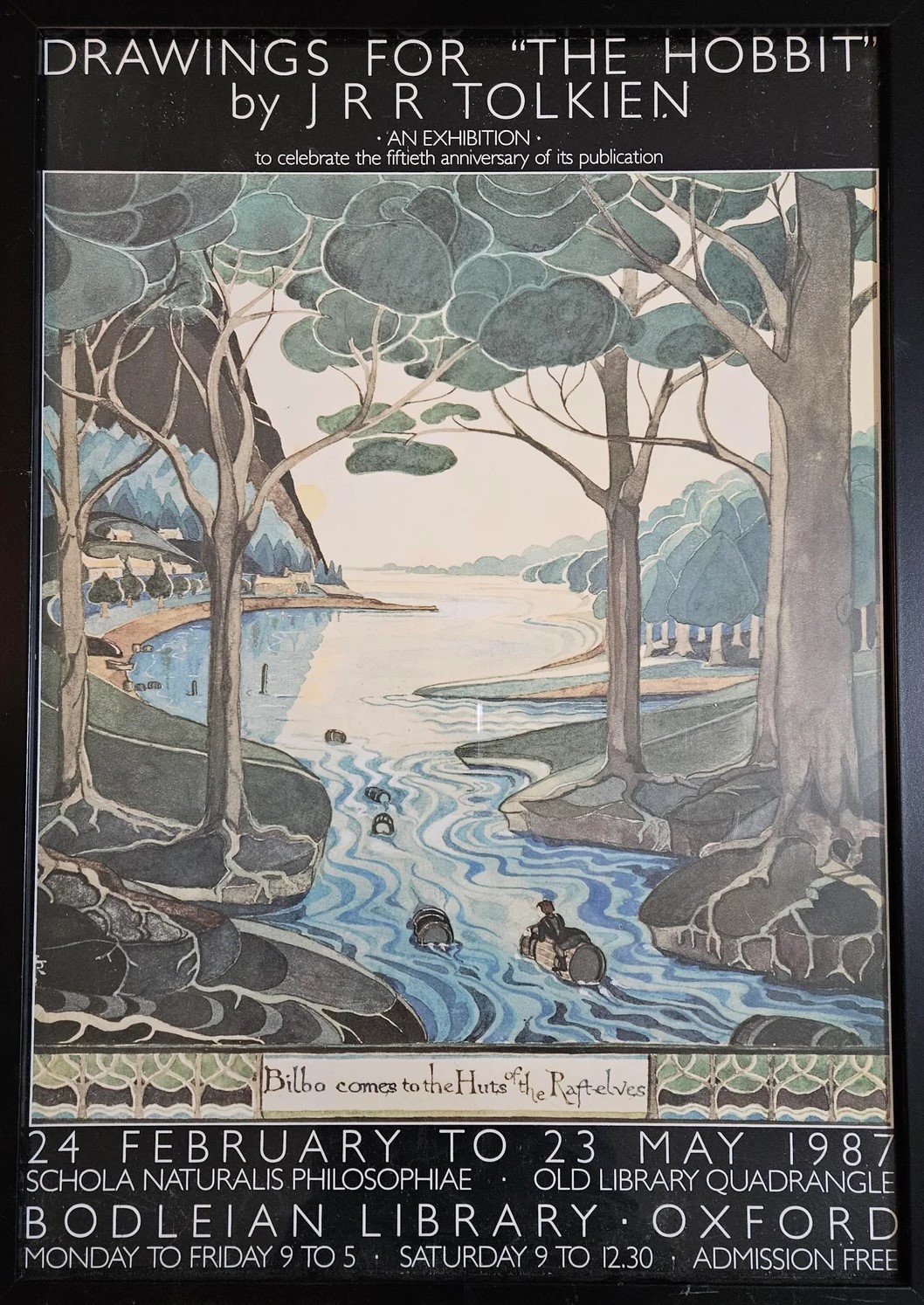
In the downstairs toilet of our house, which is just a small room off the hallway tucked underneath the stairs, hangs a poster. It’s mounted in a simple clip-frame. Every time I go into that space I look at that poster. Every time I see that poster I smile inwardly, and rapidly tell myself the story of when I first saw it, how I first obtained it, how I lost it, and how I got it back again. Ultimately, it’s a story of a thoughtful act of kindness, a simple act of love, a gift-giving from someone who deeply cares about me. It’s also a story that serves as a bridge to my past, and to many moments of happiness some years before the gift-giver even came into my life. There’s more. The theme of the poster is one of adventure and bravery, fear and danger, and leaping (plunging might be better) into the unknown. Those words – adventure, bravery – are not really me. Plunging into the unknown is NOT what I do. Fear stalks me constantly. So the poster is a reminder that it is okay to be brave, to be adventurous, to take risks and to plunge into the unknown, regardless of your fears, and without clear sight of the dangers. In fact, it’s more than okay, it’s a positively good idea!

The poster at the heart of this story advertised an exhibition of drawings that the author J.R.R. Tolkien made to accompany his book ‘The Hobbit’. The exhibition took place at the Bodleian Library, Oxford, between 24th February and 23rd May 1987 and was a celebration of the fiftieth anniversary of the publication of the book in 1937. It is a beautiful poster, mostly because apart from a title and the vital information about the exhibition in white letters on a black background at the top and bottom, it is almost entirely made up of one of Tolkien’s best works of art. The picture is titled ‘Bilbo comes to the Huts of the Raft-Elves’ and captures the moment in the story when, having strayed into the territory of the Wood-Elves and been imprisoned in their dungeons, the hobbit Bilbo manages to obtain a set of keys, free his band of dwarf companions and escape by floating them all off down the river in empty wine barrels. The picture shows the river after it has leveled out through rapids and waterfalls, meandering onward towards a small settlement through woods that come right down to the water’s edge, all gnarly roots and hummocky promontories. In the distance there are buildings – the huts of the Raft-Elves – alongside a small beach-like area on a broad right-sweeping bend in the river. In the mid-ground, in the centre of the channel, are a number of barrels floating smoothly down towards the beach, and bringing up the rear is one barrel with the small figure of Bilbo clinging tightly to the top of it as it floats along, since, having himself sealed the last dwarf-laden barrel, there was no-one left to seal in Bilbo… The lighting of the picture is beautiful, rays of sunlight stretching down through the canopy of trees, illuminating the middle distance, drawing the eye ever onward. The colours are soft greens, soft blues, greys and browns. It is a delicious palette that perfectly captures the deep woods, the swirling waters and the hope that lies ahead. The poster was designed by Trilokesh Mukherjee and whilst it is the picture that is the real thing of beauty, credit must be given for a design that blends the outer information and the inner artwork to such wonderful effect. Trilokesh Mukherjee will probably never know just how much pleasure his piece of design work has given me over the last 34 years.

As you will gather, I love this poster. I loved it from the moment I first saw it pinned to a noticeboard in the long corridor of Lady Margaret Hall, Oxford, that I wandered down several times each day to get from my room in college to the dining hall and food. I loved it so much that one day, on my way back from dinner, I stopped at the poster, pulled out the drawing pins that held it fast to the wall, and grabbed it. From that moment, that poster was mine. I could place it on my own wall and gaze at it whenever I wanted to, as much as I wanted to. My precious!

Looking back, it is hugely ironic that whilst I gained possession of the poster, I did not set foot in the exhibition. It was open for 8 hours every weekday and 3.5 hours every Saturday during the entire period of the exhibition. It was perhaps a 15 minute walk from my room and in a building that I frequently passed. There was no admission fee. Yet still I did not go to see the actual work of art itself. At that time in my life, going to an art exhibition just wasn’t really the kind of thing I did. Tragic really.

I had, of course, read The Hobbit – just once at that time, perhaps 10 years previously. I remember the circumstances fairly well. I was off school with a cold – the sort of 3 day ‘snuffler’ that was bad enough to lay a child low but not bad enough to prevent all kinds of activity… So, I could read. Over those few days I took the small hardback copy of The Hobbit down from our family bookshelves – I remember there was no dust jacket, just the soft, almost olive green board covers – and I followed Bilbo and his companions as they made their way from The Shire to The Lonely Mountain, defeated the dragon Smaug and gathered up the golden treasure hoard. Along the way of course, Bilbo gains The Ring, that bringer of so much trouble and strife, that metaphor for the weight that we all carry with us through life. But that is another tale. The one abiding memory that I have from my first reading of The Hobbit was from towards the end of the story when one of Bilbo’s dwarf companions, I think I was the effervescent Killi, dies of wounds received in a fight. I think perhaps he was protecting Bilbo at the time. I remember how I cried; oh how I cried.

1987 was the year that I finished my time studying in Oxford, and so that summer the poster was rolled up and carried away from its spiritual home. Bilbo had come to the huts of the Raft-Elves, now he was coming with me… and he stayed with me for some years, probably stuck to a wall on display at times, perhaps not at others. I know that he was still with me some years later – certainly four or five years later – because after I had met my wife Karen we must have had the poster on display at home. During that time I must have spoken fondly of the poster, so strongly in fact, that my words burned an impression in her memory. Dragon fire words!

The problem with posters of course is that they are not made to last. My poster had a job to do for perhaps a few months at most. So, as the years passed and the poster was moved here and moved there, pinned and unpinned, rolled and unrolled, blutacked and unblutacked, its edges died a slow death, its corners fractured, its heart creased. At some point, probably at one of our early house moves, the decision must have been made that my precious poster should end its journey; and so it was lost and essentially forgotten about, by me at least.

We come forward many years – around 30 years from when I first saw the poster on the noticeboard in Oxford and perhaps 20 from when it slipped away from me. My elder daughter was at university in Reading and with my younger daughter in tow I took myself off to Oxford to watch Plymouth Argyle play Oxford United down towards the south-eastern fringe of the city. My wife came along too to share a little time with our elder daughter who had popped up on the train for the afternoon. I can’t be sure of the score of the match, but it might have been 0-0 for there has certainly been one such goalless draw between those two teams at that location that I have seen, the most mind-numbingly dull 0-0 draw that you could possibly imagine, bereft of goals, bereft of excitement, bereft of anything remotely resembling entertainment.

We drove home to Plymouth immediately after the game. I was probably tired and almost certainly not in a good mood. Travelling halfway across the country for that sort of game is not the best way to spend a Saturday. I am sure that doom and gloom would have been the order of things, for me at least. And then:

Guess what I’ve got you?

There it was. My poster. Well, not exactly my poster but a flat, undamaged, shiny copy of the exact same poster – not a reproduction, not a different poster of the same picture… the same poster – ‘designed by Trilokesh Mukerjee’. Perfection.

It turned out that wife and daughter had been browsing in Blackwell’s – the famous Oxford bookshop – and there, nestled hidden in a rack was the ‘Drawings for “The Hobbit” by J.R.R. Tolkien’ exhibition poster – just one copy, presumably sitting there for 30 or so years, costing just a few pounds, waiting for its moment.

That poster, my second copy, did not get pinned, rolled or blutacked, it got loved. As soon as possible it went straight into a frame and onto the wall, the wall where it has remained ever since, and where I now see it several times most days. It reminds me of happy times in Oxford – friends, places, events. It makes me laugh that I didn’t even make it to the exhibition. It causes me to retell its story in my mind. And it reminds me how things that are lost can be found. Most importantly, every day it reminds me that someone listens, someone watches, someone remembers and someone loves.

A couple of years later, I noticed that there was an exhibition of artwork and artefacts of Tolkien in the Bodleian Library, Oxford. It was the only such public exhibition of these items for many years and it included the small number of paintings that Tolkien painted for The Hobbit. Of course we went. The pictures, the maps, the draft chapters were all wonderful. The picture was wonderful. But my poster is better.

Bilbo and the dwarves escape from the dungeons of the Wood-Elves and down the river in the only way that is possible. It is an uncomfortable mode of transport, it is an uncertain path to take – being caught whilst loading the barrels, drowning, suffocating, being dashed against rocks are all possible outcomes – but they take it nonetheless. Quite literally, they throw themselves into life and life carries them forward. That is a lesson that I need to be reminded of every single day. The road goes ever on, but it requires bravery to keep moving forwards.

(c) Tim O’Hare, March 2025 (originally written in 2021)

Plymouth Waterfront and Tinside Lido #art

Last summer, we had stayed in a tiny AirBnB in the garden of a house near Hebden Bridge in Yorkshire and loved the red-clay crockery that was provided for us to use so much that when we found out that it was hand-made by the owner, a highly-skilled potter, we asked tentatively asked if she could some like it for us, thinking that it would be way beyond our price-range if she could, and were pleasantly surprised to learn that she could and that it wasn’t. After a delay of a few months, while we waited for our new kitchen to be finally in place and she worked on other jobs, we received a big box of plates, bowls and mugs. Unfortunately, in that first delivery there were two or three breakages and one or two pieces that we were told were not up to standard (but looked fine to us) and so we had to wait a little longer for everything to be made and be with us. A few weeks ago the final package arrived and we were so pleased with our acquisition (apparently it has only been made before for a couple of fancy tapas restaurants somewhere in London) that we wanted to send a card as a thank you for all of the effort that went into fulfilling our order, including making replacement and a few extra pieces as we decided that we did want mugs after all.

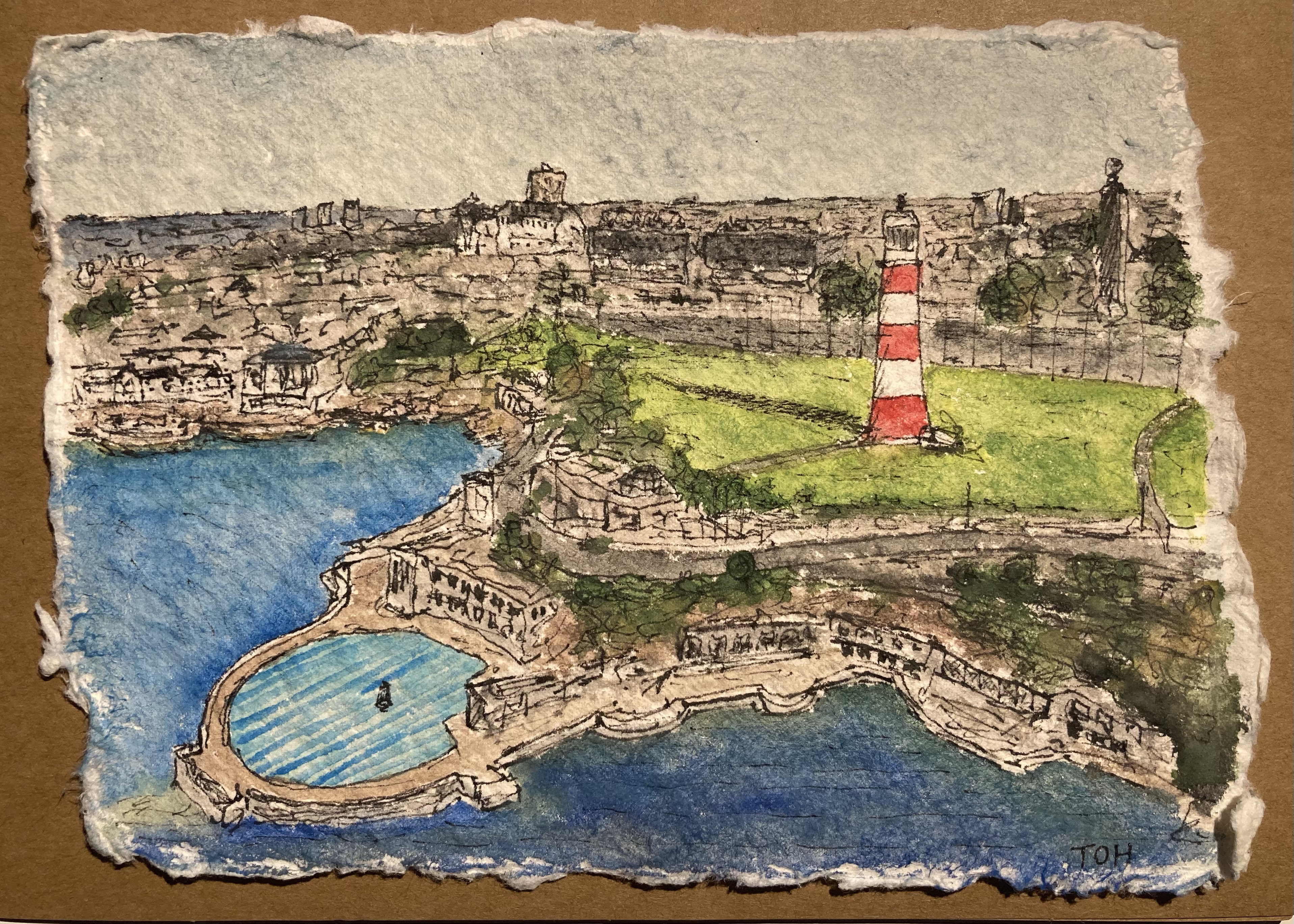
So, I sat down to paint a picture to make the card with and was faced with a decision: what to paint? I thought about painting a countryside scene from somewhere near the holiday let or one local to us (e.g. Dartmoor) but in the end I plumped for a view of Plymouth waterfront and found a suitable photograph online to use as a basis. I was really pleased with how the resulting picture ended up – it is the first time that I have tried to capture such a large built-up area in a painting and whilst the size of the picture (~10 x 15cm) means (deliberately) that there is little scope for lots of detail, I’m happy with the extent to which I have worked in sufficient detail to capture the main features of the buildings in the foreground and enough of their sense in the background.

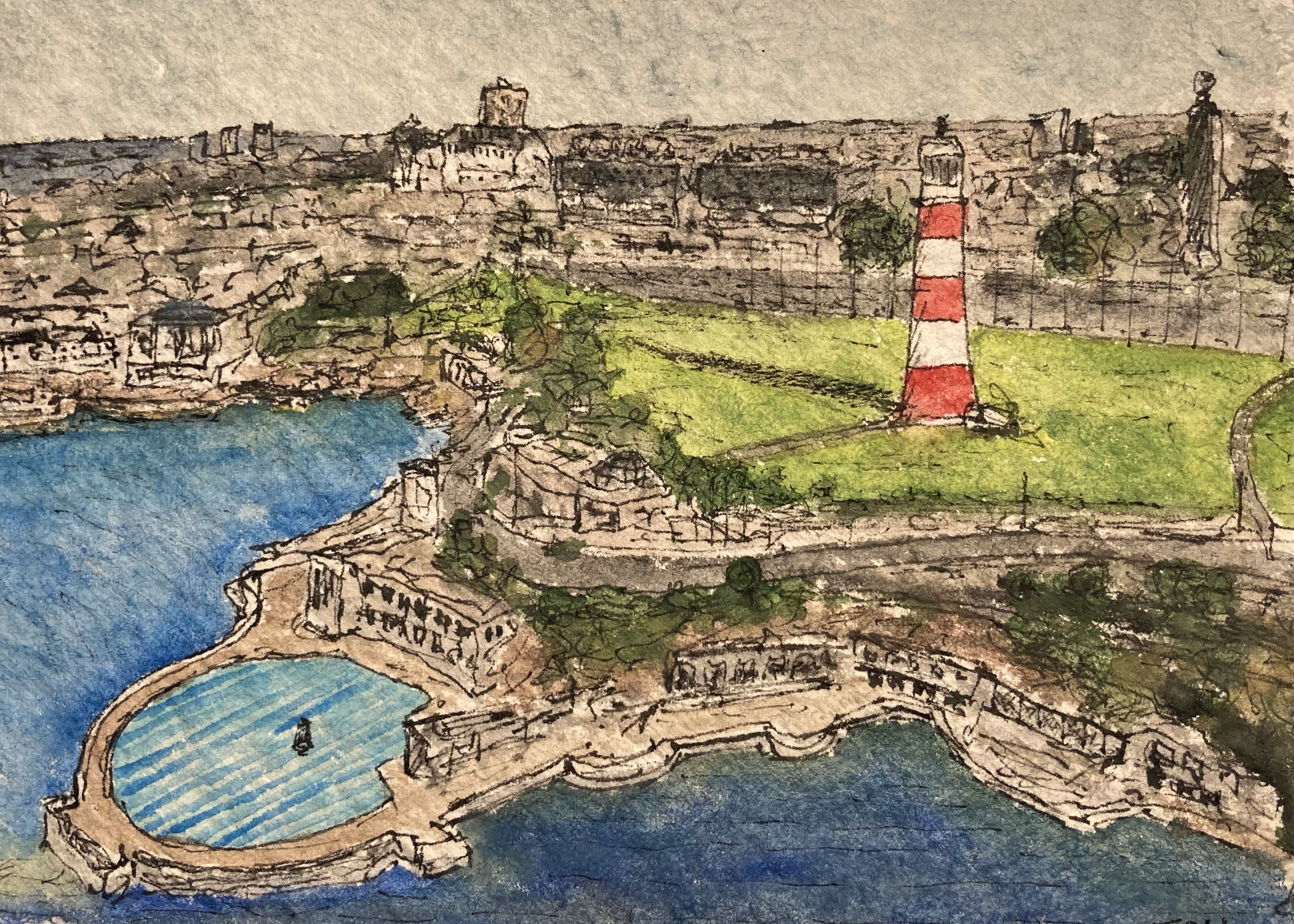
Subsequently, I have been exploring getting some of my artwork printed with a view to seeing whether anyone might part with a little of their hard-earned cash for any of it in the future, and as a test piece I got my Plymouth Waterfront picture printed as an A6 postcard using the cropped version shown below. I’m really please with how the postcards have come out and I now have a staggeringly large number of them that I will, at some point, either sell or give away!

And A Writer

Following on from the poetry website that I set up in September 2023 (And A Poet)* I thought I would create a home for some of my assorted pieces of other writing. After a brief flurry of activity this morning I have finished setting up the site and uploaded three pieces that I wrote back in 2021. These are what I call Glances and Glimpses – reflective pieces on a possession I own or an activity I enjoy(ed) that form a bridge between me now and back at various other points in my life.

The website is called: And A Writer and the three pieces that are currently available are:
Bilbo Comes To The Huts Of The Raft-Elves
Welcome To The World Jigsaw Completion Championships
Flick To Kick

Hopefully there will be more of this kind of writing and anything else more substantial that I get round to producing available at that site as time unfolds.

Tim O’Hare, January 2024


* On publishing this post I have realised that somehow I have managed not to mention my foray into poetry already on this blog despite this being A BIG DEAL (for me at least). I am definitely going to have to remedy in the coming days. Watch this space!