
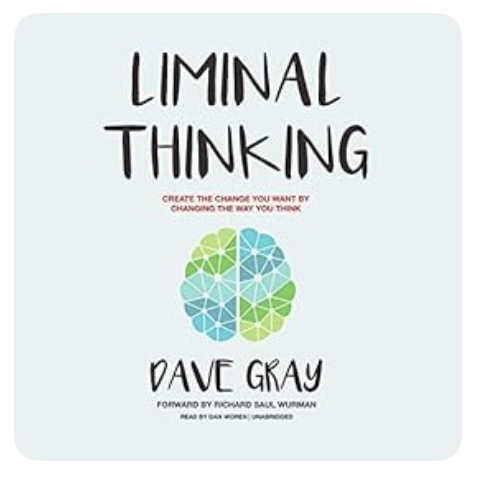
Liminal Thinking: Create the change you want by changing the way you think by Dave Gray is a book that I have toyed with reading for some time. I remember the occasion, quite a few years ago now, when, sat in a presentation at a Teaching and Learning Conference at work, I first encountered the concept of liminal spaces – transitional spaces or places that sit, rather fuzzily, between two different states, spaces or places. Since then, I have become rather fascinated by the concept of limnality, especially where this exists between one state or space that is very familiar and another that is largely, or even wholly, unknown. It’s a concept that I leaned on when writing my poem It Is Time (which should appear on this site in the not-too-distant future, as long as I am able to navigate the liminal space that is wedged between now and then…). So it was not that surprising that when I was looking for a new audiobook to listen to on my way to and from work, Liminal Thinking pushed its way to the head of the queue.
Unfortunately, my ‘reading’ of Liminal Thinking was something of a disappointment.
First, I don’t think Gray’s book is really about limnality at all. Instead, I think it’s a book about how bias creeps into the development of a personal world-view, and how being aware of this can help us to challenge our instinctive thoughts to develop a more robust and accurate set of beliefs. I’m inclined to think that the introduction of the word ‘liminal’ into the title of the book was primarily a case of the author trying to find a distinctive ‘buzzword’ in the hope that it might catch on and become associated with him in similar fashion to ‘atomic’ (Atomic Habits by James Clear) and ‘tiny’ (Tiny Habits by B.J.Fogg). But perhaps that my natural tendency towards cynicism coming into play…
Secondly, my experience listening to this audiobook reinforced a feeling that has been growing inside me for a while now, namely that it doesn’t really work to listen to certain kinds of non-fiction and hope to get much out of the experience. I am thinking here of books that are in any way a bit how to-ish in character. This is because unless you are prepared to be constantly stopping to bookmark segments or to rewind to listen again so as to catch details fully, it’s just not possible to come away from the listening experience with anything tangible (such as some kind of notes), and with no physical, print version available either, there is then nothing to refer back to later on. Still, if nothing else, this does mean that Liminal Thinking taught me one good lesson: that I’m not going to waste my time listening to this kind of book any more.
My experience with Liminal Thinking wasn’t entirely negative. Gray does a nice job of succinctly capturing six ‘principles of beliefs’, namely that:
- beliefs are models
- beliefs are created
- beliefs create a shared world
- beliefs create blindspots
- beliefs defend themselves
- beliefs are tied to identity
These principles are designed to highlight how the things we believe are not necessarily true reflections of reality but are, instead, built on thoughts that we have, mostly automatically, as we process our interactions with the world around us through our unique, personal, and mostly unconscious, set of biases and filters (things like ‘confirmation bias’ or ‘spotlighting’). Gray argues that with the right practice, it is possible to develop the ability to challenge one’s beliefs, and modify the way that we respond to inputs, so that what we come to believe about the world is a more accurate, or at least more reliable, model of our reality. He does this by introducing a number of so-called ‘liminal thinking practices’. These are:
- assume that you are not objective
- empty your cup
- create safe space
- triangulate and validate
- ask questions, make connections
- disrupt routines
- act as if in the here and now
- make sense with stories
- evolve yourself
Most of these practices are pretty much self-explanatory, but if you asked me to explain what it means to ’empty your cup’ (in this context) I’m afraid that I would fail the task… You see, I have developed a belief that when it comes to trying to retain the knowledge and ideas conveyed in non-fiction writing, listening to an audiobook doesn’t work, and that means that whatever ’empty you cup’ is referring to went in one ear and out of the other. What’s more, I am pretty much convinced that no amount of questioning, safe space, routine disruption, story-telling or personal evolution is going to change my mind…

 Tim O'Hare