The Thief Lord – Cornelia Funke #reading

Since I finished writing my children’s adventure story, Empedocles’ Children, earlier this year, I have been exploring the various avenues through which I might eventually get it published. By far the most likely is that I will end up self-publishing Empedocles’ Children as an eBook and print-on-demand paperback, largely because to get a book out into the world via a traditional publishing route you have to first be successful in gaining the interest of a Literary Agent and, by all accounts, the chances of that happening are pretty minimal… As a result, I am adopting the working assumption that the doors to traditional publishers will remain firmly closed to me, but that doesn’t mean that I am not going to give that route to publication a try, in fact I have already started, having worked my way through an online course from Jericho Writers called ‘How To Get A Literary Agent’. About a month ago, following the approach suggested in that course, I sent off ‘query letters’, accompanied by a one-page synopsis and whatever portion of the manuscript the agent requested querying authors to send (usually the first three chapters), to eight Literary Agents. My plan is to send off a further set of query letters to another group of eight agents sometime in September, and then complete a final set of eight submissions in November(ish). The logic of this staged approach to submissions is that it provides the opportunity to modify the submission made to the later groups of agents on the basis of any responses (or lack of responses) received from the earlier one.

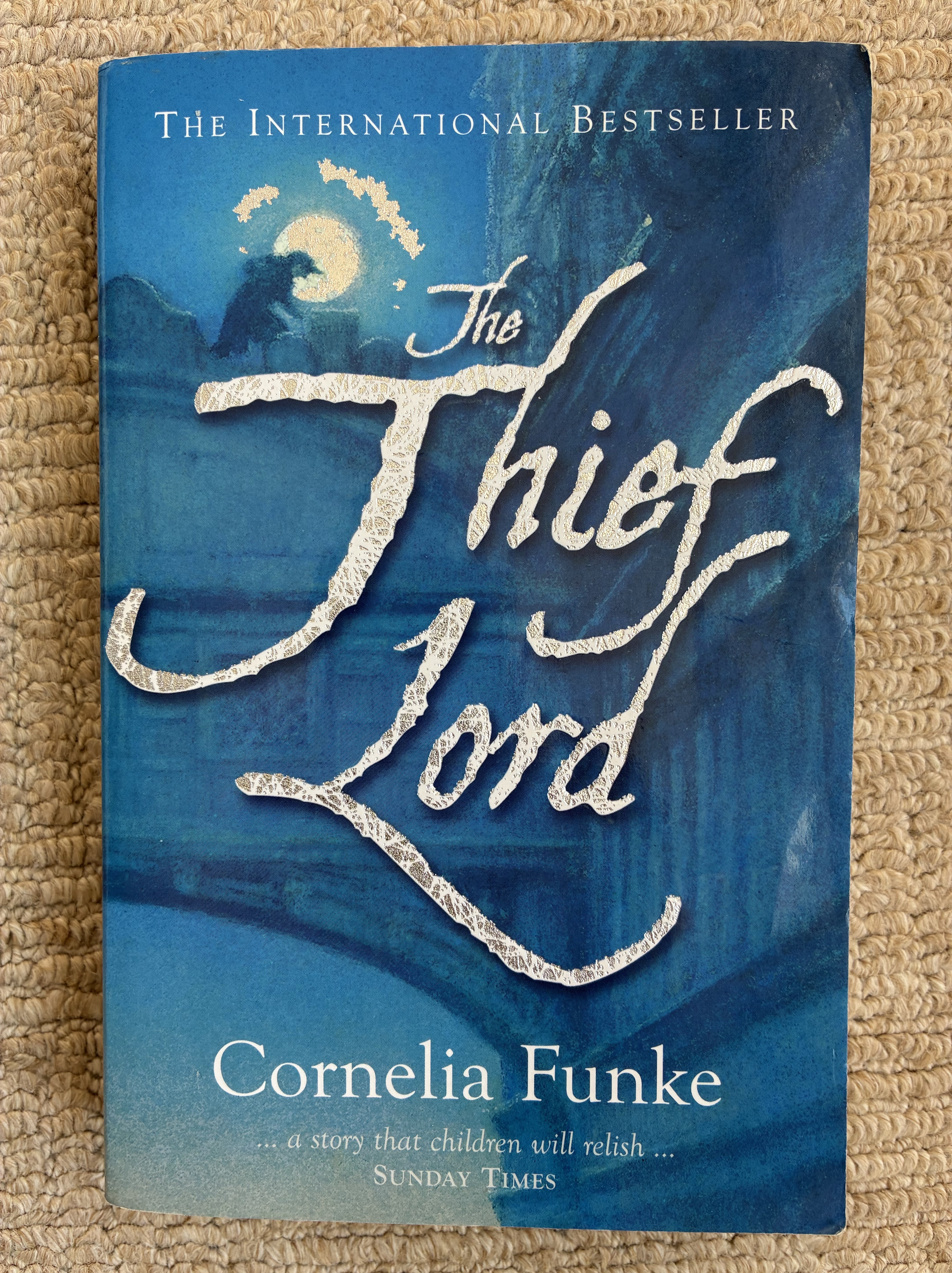
But what has any of this got to do with Cornelia Funke’s children’s novel The Thief Lord? The answer is that one of the things Literary Agents generally ask is that authors liken their work to what are termed ‘comparative titles’ (or ‘comps’). This is supposed to be a good way of the author showing where their book fits into the market (and that they know where their book fits into the market), and so help the agent decide whether or not it might be the kind of book that they want to represent and think they can sell to a publisher. With this in mind, before I could finalize my submission package I had to try to come up with a few such comps. Since I don’t routinely read children’s fiction, I spent a long time perusing the shelves of the local bookstore, but this didn’t really help me much because it seems to me that almost all new children’s books now feature magic, witches and wizards, dragons and suchlike. I also decided that I should try to get into the habit of reading some children’s fiction, and so when I stumbled upon a copy of The Thief Lord in a charity shop, I grabbed the opportunity to read a title by one of the most successful writers for children of recent decades.

The story of The Thief Lord is set, rather randomly, in Venice, and follows two orphaned boys, Prosper and his younger brother Boniface who have travelled from Germany after escaping from the clutches of their rather severe aunt who only wants to adopt the younger Boniface. In Venice, the two boys fall in with a group of street children led by the super confident, and extremely talented ‘Thief Lord’, Scipio. The first half of the book sees Prosper and Boniface become steadily more drawn into the group and their schemes to steal items to sell on, often to a corrupt antique dealer Barbarossa. The story hangs together pretty well and I found it a fairly enjoyable read…

…but then in the second half of the story, everything turns a bit weird. The group of children, rather improbably end up being befriended by a woman, Ida Spavento, whose house they were trying to rob, and then the plot suddenly takes Prosper and Scipio to an island where they find a merry-go-round that magically changes the age of those who ride it. I won’t spoil the story by saying who rides it and the extent to which they become younger or older, suffice to say that two of the main characters undergo contrasting permanent transformations after the merry-go-round breaks, trapping them at their new ages. I found the whole of this section of the book to be rather random – as if Funke knew that she wanted (or needed) to put a surprise twist into the book but hadn’t really worked out how to embed it into the story that she was in the process of writing. However, I’m an almost-60-year-old adult and The Thief Lord clearly wasn’t written for someone like me. Perhaps younger readers like (or liked, The Thief Lord was published in 2002) stories that change tack quite radically partway through. Who knows?

Overall, I quite enjoyed reading The Thief Lord, but I didn’t find it particularly satisfying. Interestingly, according to the Wikipedia entry for the book, a review in Publishers Weekly ‘found fault with the pacing’, a comment which matches up well with my own feelings about the story. In the end, I wasn’t left much the wiser in terms of finding a comp for my own book, although there is some similarity in the way that our stories unfold as they go along rather than following some obvious up-front structure or plot. I think there is also some similarity in the way that the stories bring together a group of children with different backgrounds and attributes. But in most respects the two books are very different, not least because Funke’s book has been published, translated into different languages, turned into a film (albeit apparently not a good one) and sold many thousands of copies, whereas my book hasn’t been published, hasn’t been translated, hasn’t been turned into the film and hasn’t sold a single copy…

…yet!
The Stories of Ray Bradbury #reading

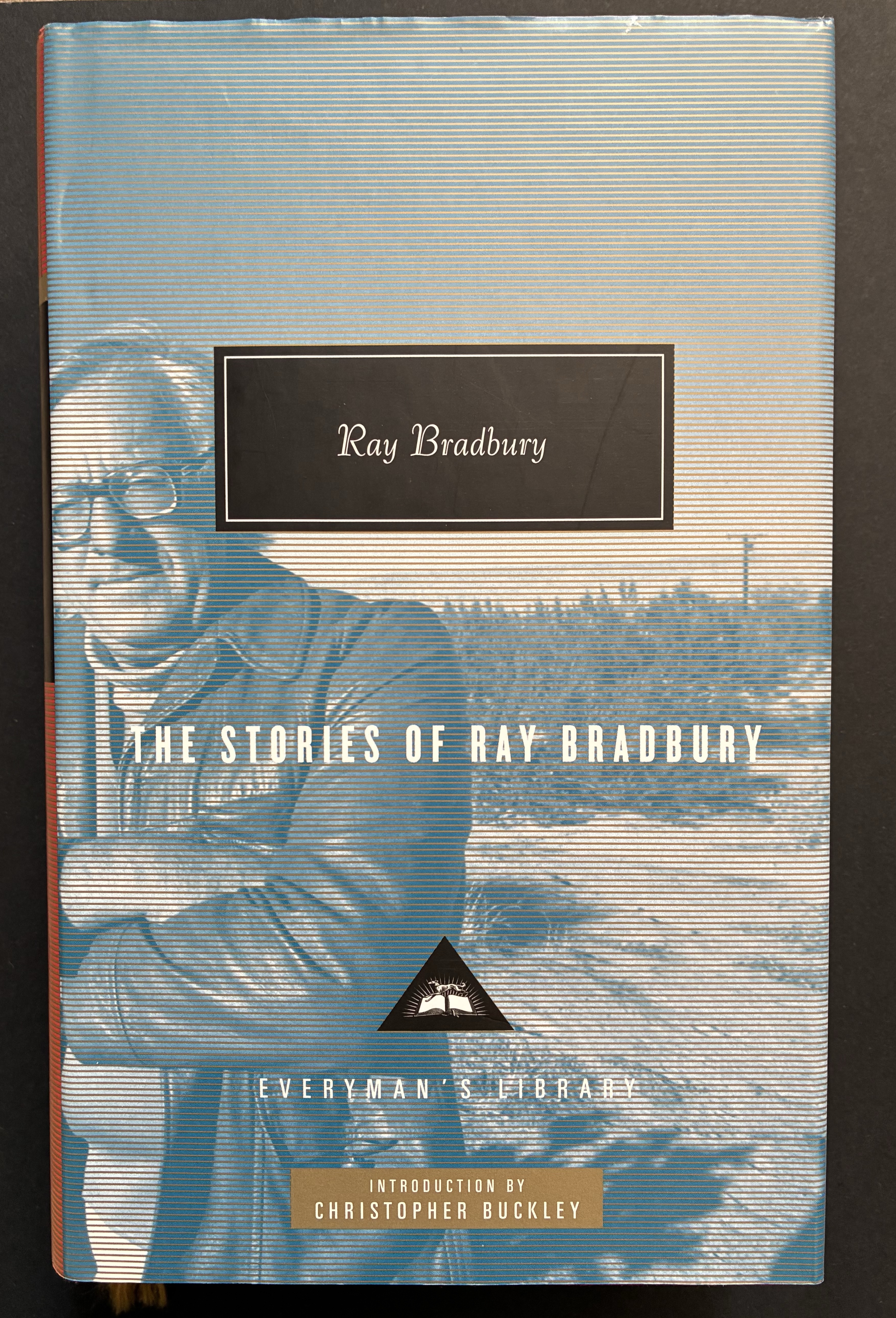
Between August 2023 and April 2024 I worked my way through a wonderful anthology of short stories called That Glimpse of Truth, selected by David Miller. I had never really paid much attention to short stories prior to that but I found that I really enjoyed the experience and greatly appreciated the skill of some of the writers who were able to pack so much into such short works. As a follow up, and inspired partly by a childhood memory of watching a television adaptation of The Martian Chronicles, I decided to return to the genre with a big fat volume of The Stories of Ray Bradbury.

I had a bit of a false start with Bradbury’s work, reading just a two or three of his earlier stories and not quite getting the measure of them, but I returned to the task and started afresh towards the end of last November (2024). Whenever my schedule allowed, I read one story as part of my morning reading each day, and so it took me until April complete all 100 of the stories that were included in the compendium.

Reading Bradbury’s short stories turned out to be a really wonderful experience. They fall under several themes – stories centred on an outwardly normal family of vampires, stories that chronicle Bradbury’s imagined colonization of Mars, and probably my favourites, the stories set in small towns in the backwaters of America. All were written in the period 1940-1970ish and often focus on the impact that new or imagined technologies have on fairly ordinary people. Often the stories are very much of their time, reflecting moral positions and biases that we have (mostly) replaced since the words were sent down onto the page. It was notable how often Bradbury’s stories revolved around a somewhat unhappy married couple and, alarmingly, how many times such stories ended with the death of one or other partner, often in quite shocking circumstances. The story in which a husband removes his wife from his life by getting her to turn herself inside out is really quite something…

Unfortunately, I didn’t keep a list of my favourite stories, but I did keep track of some of the passages that particularly caught my attention or resonated with me for some reason and so, in no particular order, I will include these below. I am quite sure that I will re-read this compendium again at some point and I am also quite sure that when I do I will add many more examples to my list!


It was a day to be out of bed, to pull curtains and fling open windows. It was a day to make your heart bigger with warm mountain air.

(Opening lines of The Great Wide World Over There, 1952)


“How do you rest?”
She stopped. It sounded very bad. It sounded so much like an accusation, but it was not, really.

“Why didn’t I ever catch it from you?” she said at last.
He laughed a little bit softly. “Catch what?”
“I caught everything else. You shook me up and down in other ways. I didn’t know anything but what you taught me.”

(from Powerhouse, 1948)


And she decided, as sleep assumed the dreaming for her, that yes, yes indeed, very much so, irrevocably, this was as it had always been and would forever continue to be.

(from The Wilderness, 1952)


There was a long pause, full of stars and time, a waiting pause not unlike the last three years for all of them. And now the moment had arrived, it was Janice’s turn…

(from The Wilderness, 1952)


“So be careful. Stay on the Path. Never step off!”

(from A Sound of Thunder, 1952)


“Do we deserve this?” she said.
“It’s not a matter of deserving; it’s just that things didn’t work out.”


(from The Last Night of the World, 1951)

“Let me finish; not to make money, no. Not to see the sights, no. Those are the lies men tell, the fancy reasons they give themselves. Get rich, get famous, they say. Have fun, jump around, they say. But all the while, inside, something else is ticking along the way it ticks in salmon and whales, the way it ticks, by God, in the smallest microbe you want to name. And that little clock that ticks in everything living, you know what it says? It says get away, spread out, move along, keep swimming.”

(from The Strawberry Window, 1954)


Nor did they ponder the fact that if man dares dip into that stream he grabs a wonder in each hand…

(from The Picasso Summer , 1957)


Ah, those last two. What lines… such vast nuggets of wisdom hidden away in such unassuming stories; little gems, that reward the reader with their sparkling form and serve as beacons to light a path through life. Magic words…

get away, spread out, move along, keep swimming

nor did they ponder the fact that if man dares dip into that stream he grabs a wonder in each hand

Empedocles’ Children – progress update #writing

Some time ago, something like 10 years ago to be more precise, the basic idea for a children’s adventure story popped into my head. It was really just the bare bones of a story – a title (Empedocles’ Children), an underlying basis for the story, a vague idea of the way that it would conclude, and a fairly detailed visual image of the event that would launch the reader into the action. At some point, fairly early on, I wrote out a version of the first chapter, but once those words were out of me, I didn’t do much to make further progress. In the meantime, fragments and ideas for the story would pop into my head at random moments, often resulting in me excitedly exclaiming to whoever was in the vicinity that: “I have just had a great idea for my book when I write it”. I think this must have happened quite a lot and over an extended period (years) because eventually, after one such utterance, my younger daughter (who would have been in her late teens at the time) responded with the rather cutting, but entirely fair, response: “Well that will never happen.”

But, eventually, I did begin to make progress, producing several more chapters in 2021 and then, in a series of bursts of creativity that became gradually longer, more frequent and more reliable, I found myself approaching the end of the story. Along the way I found the process of writing the story an absolutely fascinating one. Whether it is the ‘right’ or ‘best’ way to approach things or not (and it is probably not), I wrote the story without any kind of outline or plan, other than knowing a little about where the main characters in the story (four children called Conlaed, Yara, Tal and Karin) had to end up, and a final climax to the story that became gradually sharper in my mind as it approached. Instead, I simply sat myself down and let the story emerge. When I talk to people about this process I usually use one of two analogies – that story writing is like find a seam of precious ore and then chipping away to follow it through the surrounding rock, or that it is like gently pulling on a thread to tease it from a knotty bundle. I also tended towards thinking that even though I didn’t know how the story would unfold, I could trust my characters to show me. In that sense, I was simply following them on their journey, and describing the events that befell them as I did so. At times, it was hard to escape the feeling that the story (stories in general) are already ‘out there’ and that the task of a writer is to find (not create) one and then reveal it to others.

A couple of months ago I reached the point where I had a full draft of the story, and I then spent some time reading it through to check for errors, omissions and inconsistencies and to make any corrections and revisions that were necessary. I spent quite a lot of time going and back and forth with the dialogue, struggling a bit to work out the best way to format this (which I found difficult because there does not seem to be a standard method for presenting dialogue, something that surprised me a lot). Then, with a final draft version completed I was left wondering what, exactly, I should do next with all of those words. And there were a lot of them, a whopping 110,000 or so in fact, because the final version came at with 48 chapters (plus a prologue, interlude and epilogue).

I’m still not quite sure what I will do next with my manuscript. I know that I can go down a self-publishing route fairly quickly and easily – I have already got the text in a ‘flowable’ format suitable for e-readers. I also know that to try to get a book published by a traditional publisher first requires gaining the interest of a Literary Agent, something that seems to be incredibly difficult – so I know that that route is both difficult and unlikely to be successful. My instinct is that I want to at least try to go down the traditional publishing route and see what happens, and so at the moment I am working my way through various materials that should help me engage with that process. At some point, I might actually get to the stage of having written a synopsis, a query letter, identified comparative titles (‘comps’), drawn-up a long-list of suitable agents to query, and a short list for a first batch of submissions. Then all it will take is a bit of bravery and a willingness to suffer rejection…

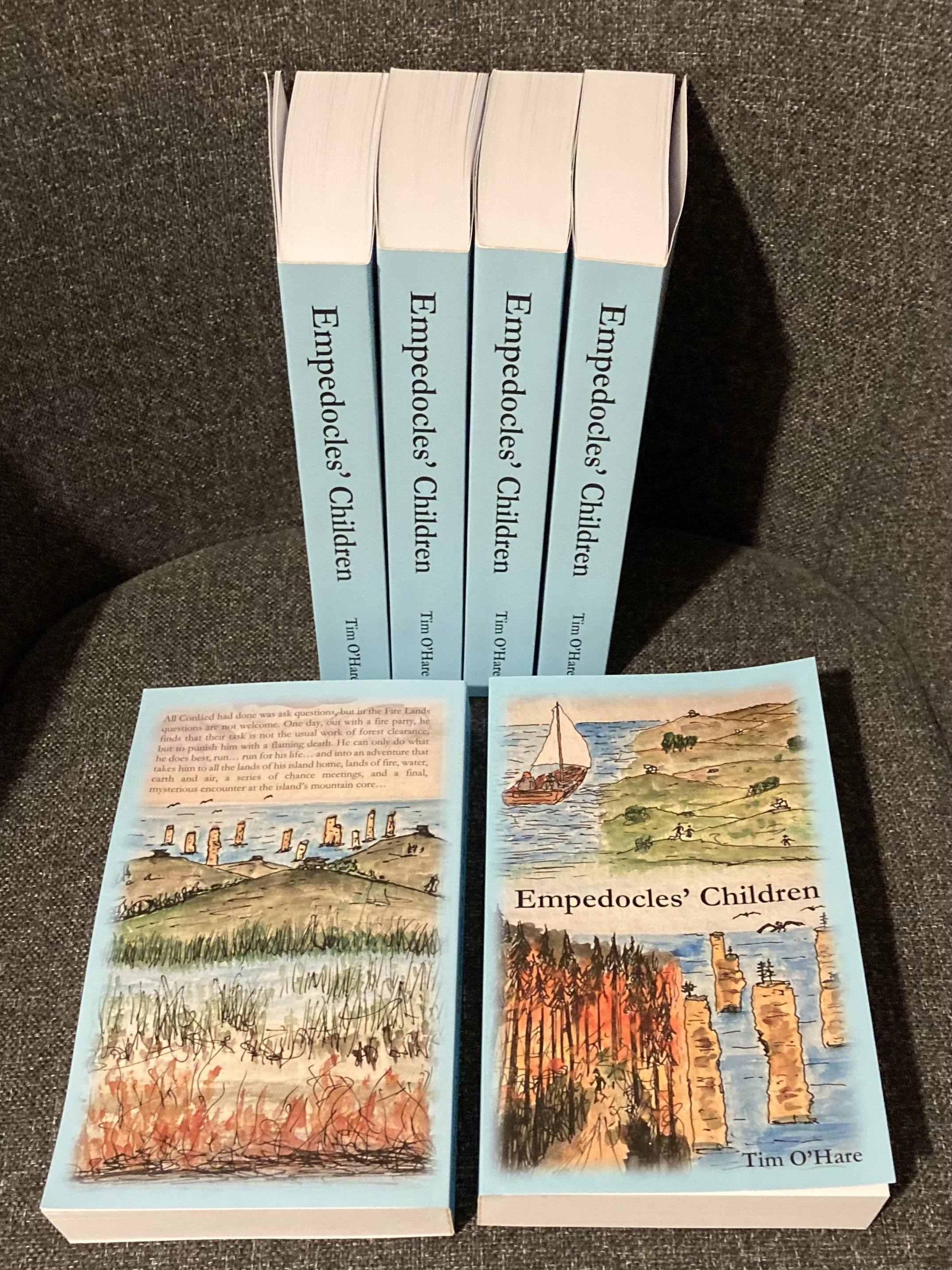
In the meantime, I decided that one of the issues with writing (certainly these days when writing on a computer) is that once you have finished your story you have nothing physical to show for your efforts. With this in mind, I spent a week or two putting my text into an attractive, ‘proper’ book format, painted some pictures to use as cover art, and then I sent it off to a printing company to get a few copies of it as a properly printed paperback book. Now, even if I make no further progress towards publishing it at all, I can, at least, glance at my bookshelf and see a nice fat paperback sitting there that I produced. Just that thought is rather satisfying and it allows me to inwardly respond to my daughter’s statement, “that will never happen”, with the words “but look, it did!”

If anyone reading this thinks that they’d like to be a test reader then please do get in touch. The story follows a group of children who are brought together as they travel through a disintegrating island realm, facing all kinds of natural challenges – fire, floods, earthquakes, volcanic eruptions and landslides – as they are gradually drawn towards the mountain that sits at the island’s core and, unknowingly to a meeting with a strange philosopher-hermit who must share the wisdom that will allow the fractured peoples of the island to come together to re-build their world. I think that the book would probably be put into the ‘middle grade’ of perhaps ‘9-12 age group’ categories but honestly, it’s a fun adventure with lots of twists and turns that adults should enjoy too – I certainly did!

A genius would make the history of his parish more interesting than another’s history of the world – Henry David Thoreau #wisdom

By Benjamin D. Maxham active 1848 – 1858 – National Portrait Gallery, Public Domain, https://commons.wikimedia.org/w/index.php?curid=24948639

For some years I have been reading my way through the Journal of Henry David Thoreau. Initially, I would just read a few entries at a time, but at some point in 2020 I hit upon the idea of reading entries on the day and month that they were written. At that time I was quite a good way through the book, and so my ‘on-this-date’ reading began with the entries that Thoreau wrote in 1856. Now, 5 years later, in my 2025 it is Thoreau’s 1861, and so the entries I am reading come from the penultimate year of his life (Thoreau died aged 44 in May 1862). When I started this project I was reading a journal entry on most days, but in the last few months, as Thoreau’s health has declined, the frequency of entries has reduced drastically such that I am only sporadically opening my copy of the Journal to discover that there is something there for me to read.

Thoreau’s Journal is packed with detailed observations of the land, wildlife and people around Concord, Massachussetts, and while many of the entries are quite dry and descriptive, with Thoreau you never know when a wonderful nugget of wisdom or a special turn of phrase will crop up. One such occasion happened last May, a couple of weeks before my elder daughter’s wedding, when a perfectly phrased gem popped up that I was able to integrate beautifully well into my ‘father-of-the-bride’ wedding speech!

Earlier this week (on 18th March to be exact) I read a passage of the Journal that I greatly enjoyed and which made me think, and so I thought I would use this post to highlight it to the world (as if… a better wording might be ‘to share it with the one or two people who might randomly stumble upon these words’). In the passage, Thoreau reflects on how the interest one might show in any given piece of history depends on more than just the subject of that history and that… No, I must let Thoreau take up the story…

You can’t read any genuine history – as that of Herodotus or the Venerable Bede – without perceiving that our interest depends not on the subject but on the man*, – on the manner in which he treats the subject and the importance he gives it. A feeble writer and without genius must have what he thinks a great theme, which we are already interested in through the accounts of others, but a genius – a Shakespeare, for instance – would make the history of his parish more interesting than another’s history of the world.’

It’s that last line that is the sparkle within the diamond: ‘a genius would make the history of his parish more interesting than another’s history of the world.’.

In my opinion, Thoreau has it spot on – everything is interesting and anything can be interesting if its story is well told. So, when we think about what to read, what to listen to, what to absorb from the world around us, the secret is to recognize and pay attention to those who are masters of the story-telling craft.**

* or woman obviously, but Thoreau was writing in 1861
** like Thoreau (obviously)