
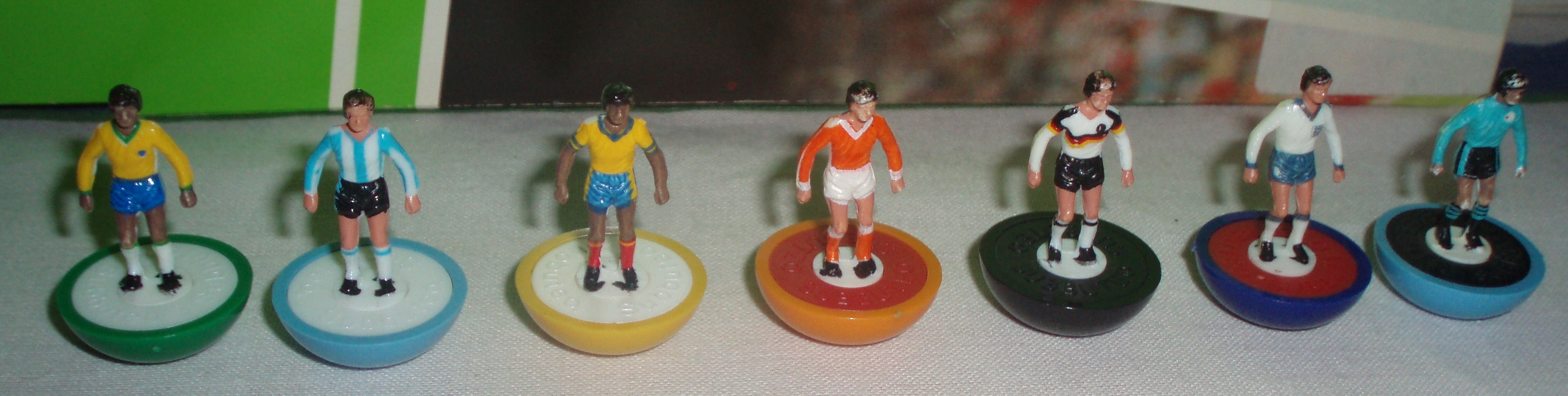
I am kneeling on the floor, left arm supporting my weight as my body leans forward. My right arm reaches out with elbow pointing away and fingers spread to rest gently on the soft green cloth. My index finger draws back and swings down to send the small plastic figure skittering forwards. It arcs right before nudging the over-sized plastic sphere so that it rolls perfectly into place. They’re in with a chance here…
I lift my knee to shift my body sideways and disaster strikes. A momentary loss of stability brings my knee rapidly downwards. Instantly, there are two sources of suffering. There is the sharp pain as a small plastic shape drills its way into my knee and as I cry out masking its sound, the crack of the double leg fracture occurs. Another star will be entering the treatment room…
If you were a football-crazy child in the 1970s you may well have experienced something like the event described above. Before football became a constantly-available televisual anaesthetic, we had to make do with the once-a-year spectacle of the FA Cup Final, the stay-up-late drama of Match of the Day, the post-Sunday-lunch-treat of The Big Match or the intoxicating excitement of European games on BBC Radio 2 (2000 metres Long Wave), with their mysterious interference of howls and whistles. To experience the ebbs-and-flows and thrills-and-spills of Liverpool versus Manchester United we had to create them ourselves, on a piece of green cloth with 22 plastic figures, a small ball and a set of goals. This was Subbuteo Table Football.
With the passing of time, my recollection of how Subbuteo entered my life is somewhat hazy. I have always told myself that what I remember is being given a Subbuteo set by my parents as a birthday present. If that is true it would have been the Club Edition, the standard set with cloth pitch, two goals, two teams, three small balls and a set of corner and halfway flags. In this set, the teams sport blue or red shirts and socks and plain white shorts, and so an imaginative youngster can play games between, for example, Everton, Portsmouth or Rochdale and Manchester United, Charlton Athletic or Barnsley. But my memory also tells me that my parents were not impressed with the value for money this set provided, it was taken back to the shop, and an alternative plan put in place to enable their disappointingly football-mad child to indulge what could only be a passing phase. But surely I am misremembering… returning an already gifted child’s present back to the store? That can’t be right. Over fifty years on, I have no way of finding out the truth.
What is certain, is that I never owned the Subbuteo Club Edition as a child, and so I never possessed the thin, green, slightly shiny cloth pitch with its white printed markings, the regulation, square-‘timbered’ goals with red and blue nets, and the two standard teams with their basic blue-white-blue and red-white-red kit combinations. Instead, my games were played out on a pitch lovingly made by my needlework-teacher mother, with line markings zig-zag stitched in white cotton into a piece of heavyweight, deep green cloth, cut, measured and marked to exactly the same size as the official one. That I never owned that standard pitch stung me at the time. Every child knows that there is no substitute for the specific branded item that they want as a Christmas or birthday present, and any parent who has tried to buck that rule will probably know it too. But now it is time for me to confess that my home-made pitch was in many ways better than the proper one. The heaviness of the cloth meant that the playing surface smoothed out better, and the darker colour was so much nicer. True, the stitched lines did sit ever so slightly proud of the playing surface, especially where corners turned or joins were made and the weight of stitches increased, but this was just something to take into account during play. (I wonder now whether this is why I so hate to see defenders trying to guide the ball out for a goal kick as I sit in my seat at Home Park and cheer on the team I adopted some thirty plus years ago!) To accompany my home-made pitch I needed goals and because these were bought as a separate item I had a set of ‘World Cup’ goals, modelled, I think, on those used in the 1974 World Cup in Germany (with round posts and crossbars, and realistic white nets and green plastic bases). Again, somewhat sheepishly, I confess that these were better, more solid, more exotic than the basic goals of the Club Edition.
It was my original teams that were the real source of disappointment, or more precisely it was one of them. My guess is that they were whatever the local stockist had going at a rock-bottom price. I think that one team was the simple red-white-red kit found in the Club Edition, which was fair enough. But the other? Well, that was Bangor. Who in 1974, apart from an actual fan of ‘The Seasiders’, had even heard of Bangor? And what sort of team plays in yellow shirts with blue sleeves and black shorts anyway? I suggest the answers to those two questions are: ‘pretty much no-one’, ‘none of any significance’ and to the first question again: ‘certainly not me’.
Subbuteo proved to be more than a passing phase in my life and over the next few years I built my supplies. There were more teams – Liverpool miraculously appeared one Christmas morning (well done parents!) and a successful raid on a local jumble sale bizarrely gave me imaginary trips from my home in Somerset to the Edinburgh derby, with the deep maroon shirts of the Hearts of Midlothian and, always one of my favourites, the white-sleeved, green shirts of Hibernian. At ‘peak-Subbuteo’ I had maybe ten teams, but which ten they were was always changing as I set to work with Humbrol model paints and fine tipped brushes. Over time, my players put on weight as layers of colour were added, flesh and hair were re-tinted and black boots were polished (always black of course).
There were accessories – corner and line flags (who didn’t snap these?), a referee and linesman set (pointless), self-adhesive shirt numbers (an aid for the internal commentary that filled my head), the TV camera tower, the green, picket-fence-style pitch surround, a set of six ball boys resplendent in yellow tracksuits with red stripes down their arms (useless for retrieving the ball when it rolled under the piano) and, best of all, the scoreboard, with its rotating number dials and two slots to insert whichever of the multitude of small printed card slips displayed the names of the teams currently in play. There were many others, and as a child who could happily spend hours poring over catalogues I certainly knew about and wanted them all – the FA Cup, throw-in taking figures, corner taking figures, working floodlights and eventually, in a move that presaged the stadium building phase of modern football, the grandstand.
By the time of my early teens, my pitch was pinned to a low, perfectly-sized table that had once housed my older brother’s model railway. I fixed a cardboard edge to form a pitch surround complete with painted advertising hoardings and at one end there was room for a stand, lovingly crafted from an old cardboard box. The table sat in the corner of my bedroom and was the venue for countless games, with me playing both teams, one predominantly right-handed, the other left-handed in what must have given games some approximation to home advantage. Subbuteo is clearly a game designed for two players, pitting their wits and their skills against each other in friendly rivalry, but almost all of my matches were played out as me versus me. It was a realm for individual, personal immersion and a chance to escape to victory, and defeat, away from prying eyes.
My knock-out tournaments were huge affairs, and for these the card tabs of the match scoreboard came into their own. I would draw them out one-by-one to build a complete set of fixtures, the cards laid out on the floor in pairs, winners of fixture one playing winners of fixture two etc., each round progressing with ever-decreasing numbers until I arrived at the final pairing. I don’t remember any strong favouritism coming in to play, but I suspect that the referee’s decisions on matters such as penalties or offside were not always without bias and that stoppage time at the end of matches was probably ‘fluid’. These tournaments, with 64 teams at the outset, comprised 63 matches and lasted several days – just me in my own little world of imaginary football, right hand, left hand, back and forth, shoulders aching, knees numb.
At some point, all of my Subbuteo teams and accessories went the same way as my Action Man, Matchbox cars and sundry other items, sold to fund my burgeoning interest in home computers. But my attachment to the game remained strong, such that in the late 1990s, presumably after I had made much mention of it, my wife bought me a set as a wedding anniversary present. Finally, at the age of 30-something, I owned the proper Club Edition complete with its basic goals, its oh-so-breakable corner flags, its boring team kits and its horrible, thin, shiny pitch… That set now resides in our loft along with a Plymouth Argyle team that was also gifted to me (1993/94: green and white striped shirts with black shorts) and I must confess that it has been little played. As an adult I could not escape the obvious bias in my play, and I no longer possessed the patience to let a game unfold or the ability to put up with the strain of reaching, leaning and shuffling around on the floor. But despite this lack of match action, I confess that many, many times I have caught myself scrolling through online listings, just a finger’s flick away from re-uniting myself with the pitch surround, TV tower or scoreboard, and once I gazed with horror at a particular ‘completed item’: Bangor team, in box – sold for £165.
… The big hand in the sky reaches down to lift the star winger from the field. He must await the final whistle before taking his turn on the operating board. Despite horrific injuries he will return to play again, nicknamed ‘Stumpy’, with bulges of glue where shin bones have been fixed and a slight sideways lean that will enable him to turn in ways that none of his teammates can.
Back on the pitch, the ball lies just inside the penalty area. My right hand reaches across and lines up behind the number 10 as my left arm extends, twisting round to grasp the small green plastic handle that emerges behind the goal. This is the moment… Flick. Jerk. The handle swings across, clattering the goalkeeper, arms stretched ever-hopefully upwards, against the frame of the goal. That would most certainly have hurt. But the ball has gone the other way and now lies nestled neatly in the far corner of the goal. The painted fans behind the goal are stunned as they wonder just where the referee found eight minutes of stoppage time, and then the final, silent, whistle sounds. The rotating dial on the scoreboard turns, the next number appears, and the FA Cup has produced its greatest ever shock… Manchester United 0, Southport 1. ‘The Sandgrounders’ have had their day.
I wrote this piece a few years ago, one of three that I produced under the collective working title: ‘Glances and Glimpses’, each capturing my thoughts on, or memories of, an activity or incident that connected different periods of my life and/or opened a window onto some aspect of my character. Earlier this year, I spent some time revising and editing it in the hope that it might be deemed suitable for publication in the magazine When Saturday Comes – it wasn’t, in fact the rejection email came back to me so quickly that was hard not to think that it did not even pass beneath the eyes of the ‘reader’. But it would be a pity if it remained hidden out of sight and didn’t even have the opportunity to find a reader or two, and perhaps spark a few memories of other injured players, self-made competitions, or great cup upsets.
If this piece resonates at all with you then please drop a comment below. It’d be great to read about other similar memories.

 Tim O'Hare