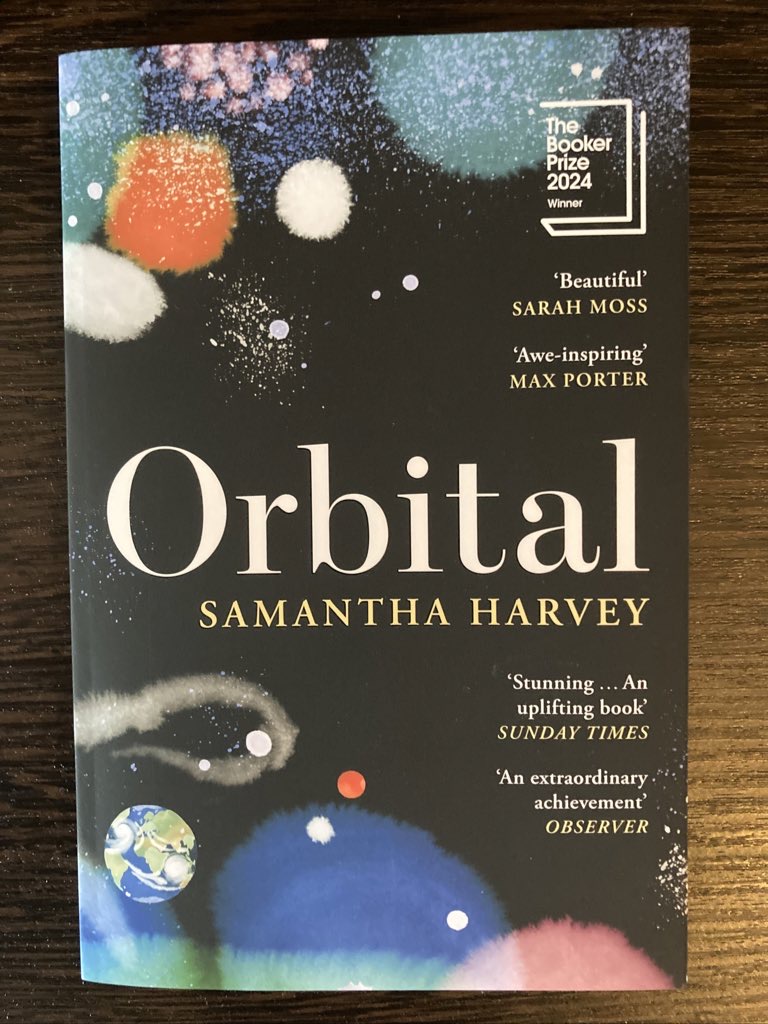
‘Orbital’, the 2024 Booker Prize-winning novel by Samantha Harvey was the first book that I finished reading this year. I will admit that I am not usually a reader of what might be called ‘literary’ fiction but as this book was fairly short and has a science-based theme (the book recounts the thoughts of a group of astronauts on board the International Space Station (ISS) as it orbits the Earth over the period of one day), my wife thought it would probably interest me and gave it to me as a Christmas present.
I find books like this, that don’t really have a story as such, quite intriguing. It is interesting to ask the question: What it is that makes spending time with one set of fictional characters doing nothing in particular, apart from existing and thinking, interesting? (especially as it is easy to imagine many instances when it certainly wouldn’t be).
As it turned out, I did enjoy the day I spent with Harvey’s collections of imagined astronauts as they repeatedly observed their home planet (the ISS completes 16 orbits of Earth per day) and mused on their connections with the people, places and events down below. The writing challenges the reader to consider their own place in the world and the perspective from which they view both ordinary and extraordinary events. For me, the core themes that emerged from my reading of Orbital were the extent to which so much of human endeavour is bound up in the pursuit of progress, both the grand-scale technological progress shared only by a few such as the astronauts on the ISS, and the small-scale, day-to-day progress, shared by everyone of us, and the fragility of the world that all of this progress has created.
While gazing down onto the planet’s surface, one of the astronauts muses on this theme of progress in connection with his relationship with his daughter and the passage in the text that captures the stream of his thoughts as he does so was one that resonated deeply for me:
‘But what he meant to say to his daughter – and what he will say when he returns – is that progress is not a thing but a feeling, it’s a feeling of adventure and expansion that starts in the belly and works up to the chest (and so often ends in the head where it tends to go wrong). It’s a feeling he has almost perpetually when here, in both the biggest and smallest of moments – this belly-chest knowing of the deep beauty of things, and of some improbable grace that has shot him up here in the thick of the stars. A beauty he feels while he vacuums the control panels and air vents, as they eat their lunch separately and then dinner together as they pile their waste into a cargo module to be launched towards earth where it’ll burn up in the atmosphere and be gone, as the spectrometer surveys the planet, as the day becomes night which quickly becomes day as the stars appear and disappear, as the continents pass beneath in infinite colour as he catches a glob of toothpaste mid-air on his brush, as he combs his hair and climbs tired at the end of each day into his untethered sleeping bag and hangs neither upside down nor the right way up, because there is no right way up, a fact the brain comes to accept without argument, as he prepares to sleep two hundred and fifty miles above any ground for their falsely imposed night while outside the sun rises and sets fitfully.‘
 Tim O'Hare